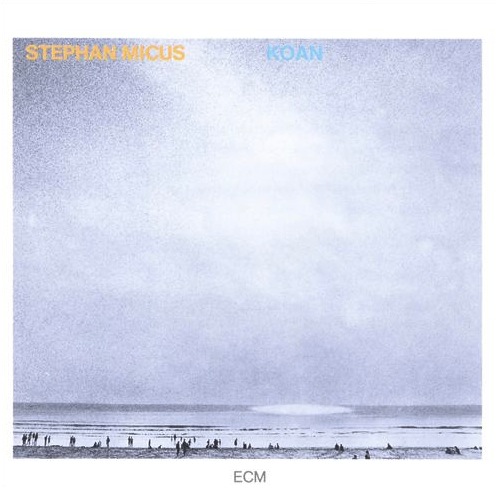
Stephan Micus shakuhachi, zither, gender, sarangi, rabab, bodhran, angklung, kyeezee, Burmese bells, guitar, voice
Recorded 1977 in Cologne
An ECM Production
Wayfaring multi-instrumentalist Stephan Micus began his ECM journey with this five-part album of characteristic rituals, now digitally restored for posterity. The Zen Buddhist kōan, often misunderstood as a riddle without answer, is more rightly experienced as a path to openness, and it is this path that Micus has walked since he first committed his sounds to disc. In denying an effect for every cause, the kōan opens both the questioner and the questioned to the possibility of possibility—which is to say, beyond the duality of things. Like the music contained on this eponymous recording, it is not meant to be solved but discovered for what it is. Micus’s music is thus an ongoing kōan, for despite the fascination of his array and technical adjustments thereto, an awareness of infinity prevails.
If we discover anything from the shakuhachi solo that is Part I, it’s that Micus’s unaccompanied sojourns are as multitudinous as his multi-tracked assemblages are singular. For while that hollowed stalk of bamboo, itself a voice without breath, finds accompaniment in the form of zither, gender (Balinese xylophone), and guitar in Parts II and V, in those group settings it feels more like the reflection than the reflected. Each instrument embodies one element in an organic picture, leaving the unsung song to trace its slow-motion arc across the sky, a comet on its way toward slumber. In the final wave, the zither offers itself percussively: the string as skin. Micus’s breath, simple and serene, meanwhile blots the torch of every star until the darkness becomes an expression of light.
Parts IIIa and IIIb feature the rabab—an Afghan lute, which sounds like a resonant shamisen and has both rhythmic and melodic functions—and the deeper sarangi. A translucent shakuhachi marks the first half, but gives way to a Mongolian-influenced sound, scraped like barnacles from the earth’s crust. This leaves only Part IV, in which Micus sings over a congregation of Burmese bells.
In this sound-world, instruments never compete. Nothing “solos,” per se, but coheres by means of an undying spirit, to which only the master musician may attend through a lifetime of rare creation. As one of Micus’s most meditative sustains, Koan enables a microscopically visceral experience that is forever new because it is the very picture of regeneration.
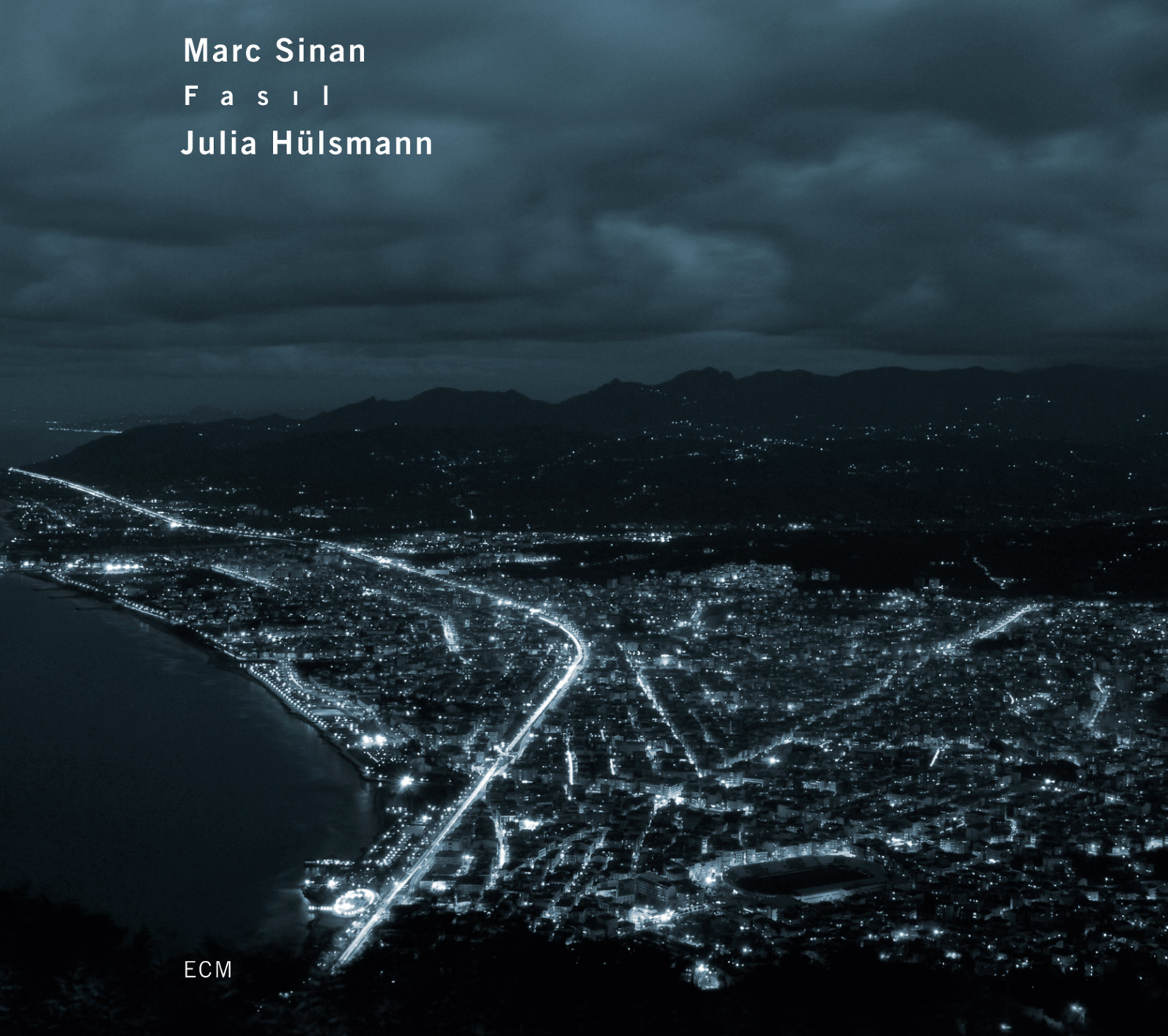
Marc Sinan guitar Yelena Kuljic vocals Lena Thies viola Julia Hülsmann piano Marc Muellbauer double-bass Heinrich Köbberling drums, percussion Recorded March 2008 at Rainbow Studio, Oslo Engineer: Jan Erik Kongshaug Produced by Manfred Eicher
Guitarist and composer Marc Sinan, recently of the (sadly) European-only release Hasretim, made his ECM debut with Fasıl, an album of enduring originality and refinement. The title refers to a suite form used in both classical and modern Ottoman ensemble music, and which here would seem to nod in both directions. It’s almost unfortunate that the Turkish word should so closely resemble the English “facile,” for the music here is anything but superficial. By way of comparison, one might pair it with Jon Balke’s SIWAN, as Balke illuminates and draws out likeminded ethnomusical connections with care.
Siwan’s own fasıl tells the story of ‘Ā’ishah bint Abī Bakr (613/14-678), youngest and favorite wife of the Prophet Muhammad. In this fresh musical context, her sentiments twirl and float by turns along a river’s current of rhythmic libations. Librettist Marc Schiffer weaves into those sentiments influences ranging from the Qur’an to ancient Persian poetry in search of common ground. Pianist Julia Hülsmann’s trio with bassist Marc Muellbauer and drummer Heinrich Köbberling—the subject of such later albums as The End of a Summer and Imprint—flexes the project’s instrumental spine. They are joined by violist Lena Thies, Sinan on guitar, and the Serbian-born, Berlin-based singer Yelena Kuljic in the role of ‘Ā’ishah.
The album begins, as does any fasıl performance, with an instrumental “Peshrev,” which lowers us gently into the waters of this emotionally dynamic world. It is a world of comfort and challenge, a quilt of geographical distances made immediate by design. Other traditional movements include iterations of the taksim, an improvisational interlude which unspools purple braids from Hülsmann’s interpretive fingers. Through these run the finer threads of Sinan’s flamenco-esque strumming and Thies’s spirited bowing. Sinan augments these with two movements based on transcriptions of an imam (Islamic cantor) he recorded while conducting research for this project in Turkey. “Sure 6/51” and “Sure 81 Taksimi” revolve around Hülsmann’s rhythm section, guitar and viola taking respective turns in the lead.
Yet it is by virtue of Kuljic’s portrayal of ‘Ā’ishah that the album comes into its own. Beginning with the drawing of desire that is “This Bloody Day” and ending with the affirmative “You Open My Eyes,” her voice sheds light by which to see. She explores themes as wide-ranging as agency and politics (“Taking Leave”), the body as landscape (“The Last Night”), and, couched in the album’s most entrancing melody, the intertwining of lives under Heaven (“The Dream”). Sinan rocks a lovely fulcrum in the latter through a smooth, jazzy core, and lends his flexible architecture to “The Struggle Is Over,” carving a sliver of moon into the sky.
All in all, these are songs of holdings on and lettings go. The instrumental elaborations are thoughtful (and thought-provoking), unraveling richly dyed sacraments in sound. At their heart is a song entitled “The Necklace.” It is a pivotal moment, both in the lives of its characters and of this cycle as a whole. It refers to story recounted in the Qur’an, in which ‘Ā’ishah, during one of Muhammad’s desert raids, is mistakenly left behind when she goes looking for a lost necklace and returns to camp to discover that her caravan has departed without her. She is found by a nomad under Muhammad’s employ named Sufwan and taken to the next campsite, only to be met with gossip of infidelity. Unbelieving of these rumors, Muhammad takes his wife’s word on faith (albeit after a revelation from Allah confirms her innocence), and her accusers are summarily punished. It speaks volumes about a woman whose strength thrived in her resolve, in her resistance to a world of men, and in her refusal to let her integrity fade into the dunes.
Marc Sinan music, guitars, idea, concept and production Traditional musicians from Turkey
Mustafa Boztüy darbuka, framedrum Güç Başar Gülle oud Ömer Can Satır kaval Onur Şentürk kemençe Erdem Şimşek bağlama Traditional musicians from Armenia Araik Bartikian duduk, zurna Vazgen Makaryan duduk, zurna Andrea Molino arrangement, conductor (DVD only) Jonathan Stockhammer conductor Markus Rindt idea, concept and production
CD recorded live July 2011 at Schleswig Holstein Musikfestival by Volker Greve and Holger Schwark
“Prolog” recorded December 2012 at MIAM Istanbul by Can Karadogan
Mastering: Volker Greve
DVD recorded Ocobter 2010 at Festspielhaus Hellerau
An ECM Production
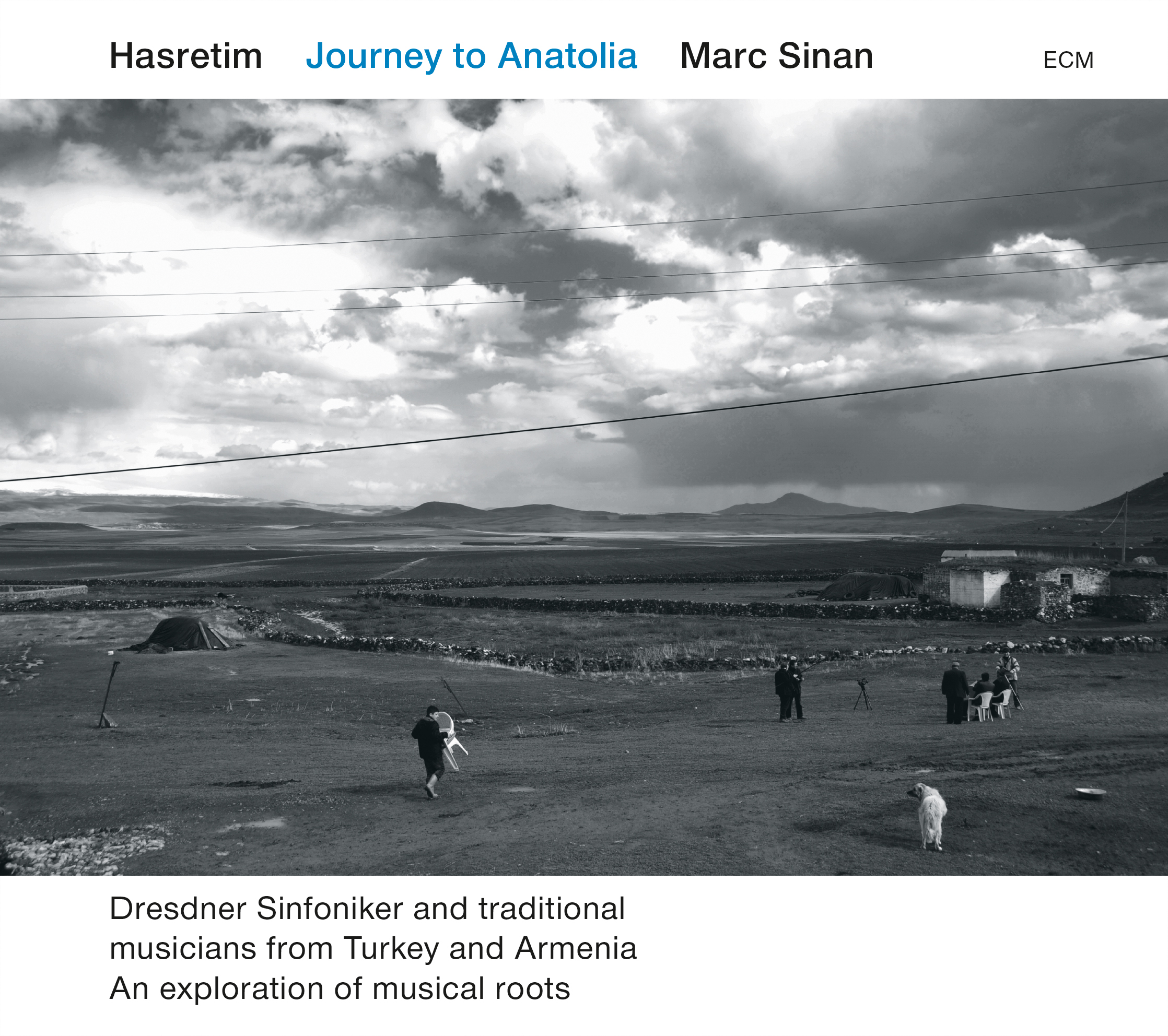
Classical guitarist Marc Sinan, born in 1976 to a Turkish-Armenian mother and a German father, has over the past two decades attracted increasing demand as a soloist and collaborator, and dedicates his output to softening divides between genres, eras, and cultures. Hasretim represents the most significant evolutionary leap in his career as a composer. The result of a commission by Hellerau – European Center for the Arts Dresden and the Dresdner Sinfoniker, this video-musical journey traces Sinan’s heritage along the Black Sea coast to the Armenian border. More than that, it’s an invaluable archive of life and song on the Anatolian plateau, which he explored together with Dresdner Sinfoniker artistic director Markus Rindt in 2010. During the trip, Sinan was saddened to find that the preservation of folk music so prevalent elsewhere (viz: the Baltic states, Hungary, and Greece) was lacking in Turkey. Consequently, he took Hellerau’s commission as an opportunity to address the discrepancy, pooling a storehouse of traditional musicians and incorporating their art into a large-scale, contemporary piece of his own design. “I was quite nervous,” writes Sinan of the recording process. “Unlike musical field research, our project demanded much more than simply documenting the current state of the Turkish musical tradition regardless of its artistic merit. We were on a treasure hunt and would only rest once we stumbled upon something truly special.” As connections grew, so too did the availability of choice musical talent and the opportunity to capture it for posterity. Once satisfied with his bank of original recordings, to them Sinan introduced what he calls “decisive, subjective elaborations” in the form of both through-composed and improvised material.
Hasretim was originally conceived as an installation piece, with videos of these unrecognized Turkish troubadours (many of whom must balance their musical lives with working ones) projected onto five towering vertical screens at stage rear. Before them plays an assembly of European classical musicians augmented by traditional specialists from Turkey and Armenia. The latter bring their expertise to a veritable portrait of Asia Minor in sound as the oud, kaval, kemençe, bağlama, duduk, zurna, and frame drum hold their own alongside strings and winds. It is to ECM’s credit that its release should encompass both the audio on CD and the visual on an accompanying DVD. For while the music stands alone as a welcoming experience, to see the musicians (live and recorded) in their element, along with segues of candid scenes from Istanbul and beyond, brings out the project’s reach in most immediate terms. Both versions feature essentially the same personnel, with the notable exception of conductors: Jonathan Stockhammer directs the CD version, recorded live at the Schleswig Holstein Musikfestival, while Andrea Molino, also the project’s musical arranger, handles the DVD performance, recorded at Festspielhaus Hellerau.
As indicated by the title, which means “I’m yearning” or “My desire,” Hasretim is a search for roots. Yet it’s also a spray of new foliage in the towering branches, nourished by Sinan’s unique ear for montage. The album is bookended by a “Prolog” and “Epilog.” One is a menagerie of harmonics, blips, and whispers that tightens like a spring, while the other pieces together footage of nearly all the recorded musicians in a chain of reprisals, ending as it began: with an attunement that spans multiple geographies.
Within this frame are five distinct “Tableaux,” each named after a Turkish city or, in the case of “Tableau II – Yayla,” for the mountain pastures where an old man (Haci Ömer Elibol) plays the end-blown kaval while his sheep animate the background. His call, for that is what it becomes in Sinan’s contextualization, inspires some upbeat interweaving. In contrast to the dark fiddling of “Tableau I – Ordu,” which details the face of singer Asiye Göl across all five screens, it more fully includes itself in the musical goings on.
Indeed, voices resound clearest throughout the program, even if certain instrumentalists do stand out for their charisma. There is Hüsseyin Altay on the tulum (Turkish bagpipe), joined by droning brass; the unforgettable Ismail Küçük, who sings and bows his kemençe in “Tableau III – Trabzon” from the back seat of a car, thus underscoring the film’s road movie feel; the duet of Ömer Parlak on kaval and Mesut Kurt (along with Göl, the youngest of those featured) on kemençe; and in “Tableau IV – Erzurum” the rhythmically savvy Aşik Eminoglu accompanying himself on the bağlama to invigorating effect. This same Tableau also cradles “In Memory of Vahide,” a 10-minute duduk duet that interpolates shadows into light. All of this buoys “Tableau V – Kars” as the most compositionally unified vision of live elements (especially in the percussion) and descriptive archival work.
In absence of any background information, one might never know that Sinan witnessed firsthand a loss of connection among contemporary Turkish musicians to their rich heritage, or that their art needed recovery in this regard. Neither was the counterpoint lost on him between the boisterous people and their peaceful, sometimes dreary, settings. Such contrast of medium and message informs every frame and staff of this multimedia treasure trove. Although awarded a special prize by the German Commission for UNESCO for its “inspiring and experimental confrontation between different cultures,” Hasretim is less about experiment than experience and anything but a confrontation. Rather, it is a book to which each new witness adds a page.
(See the article as it originally appeared in RootsWorld online magazine, where you may also hear samples.)
Stephan Micus douss’n gouni, duduk, maung, gongs, tibetan cymbals, bavarian zither, sinding, steel-string guitar, hammered dulcimers, charango solo, nay, bass duduk, voices Recorded 2004-2008 at MCM Studios
Produced by Manfred Eicher
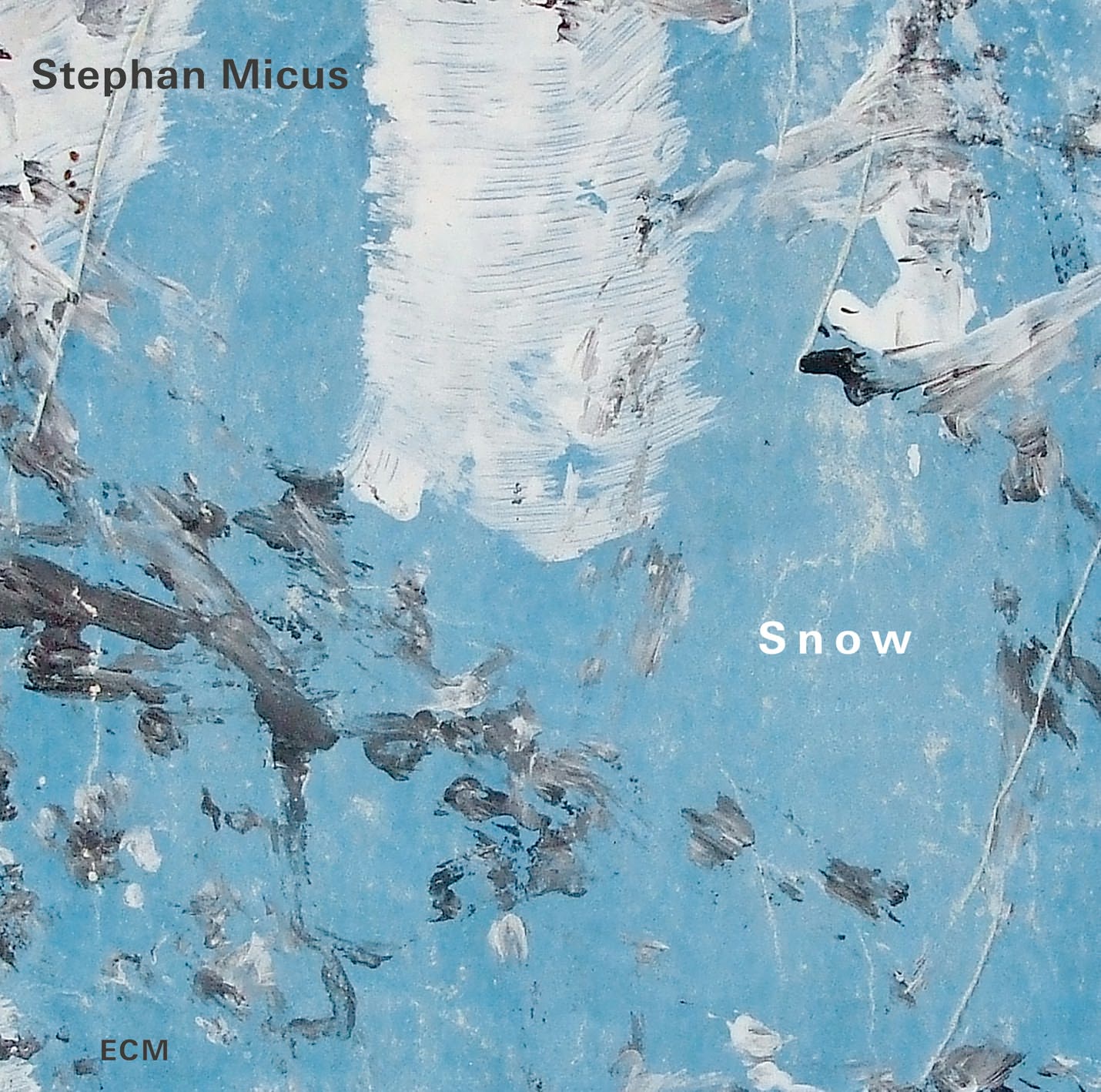
For his 18th ECM meditation, German multi-instrumentalist Stephan Micus goes deeper into his travels, into his technique, and into himself. Among his usual bevy of means, the Armenian double-reed duduk—last heard on Towards the Wind—is now a central energy field, its song a balance to the cold. “I’ve always regarded snow as the essence of magic,” notes Micus in this album’s press release, and his impressionistic view of one of nature’s most enigmatic phenomena shines through with a glow all its own. The title track likewise harbors many warm bodies, despite the wintry theme. Two doussn’gouni (a West African harp that Micus debuted on Desert Poems), along with various gongs and cymbals, give the duduk a gentle berth for travel. Guided by breath, not oar, its intense presence rides toward frosty shores, singing of the ice as gateway and kissing the land with its solemnity. Also retained from Desert Poems is the sinding, another West African harp that blends with steel-string guitar, hammered dulcimers, and an ever-growing chorus of voices in “Sara.”
The duduk continues its tender mission across a “Midnight Sea” (accompanied here only by Bavarian zither) and into the arms of “Madre.” The latter speaks further in the language of strings and mallets, and both mix the reeds spatially, so that notes scale from left to right as they ascend. The album’s final track, “Brother Eagle,” features the bass duduk. Along with two sinding and fifteen voices, its near-ghostly sound feels spun from the very earth of which it chants. This marriage of glitter and darkening cloud, of moonlit sailing and glorious dream journeying, advances its subterranean walkabout lead by shadows toward the promise of sunrise.
Making its debut at Micus’s fingertips is the charango, an Andean double-stringed ukulele popularized by Argentine composer Gustavo Santaolalla. “Nordic Light” is a solo for the instrument, which in this context sounds more like some miniature koto that evokes its aurora with understated flame. Another solo begins “For Ceren and Halil” before being joined by seven more charangos, duduk, nay, sinding, and five hammered dulcimers in an eddying current of leaves and time until they reach the waterfall that makes one of them all. The album’s sole remainder is “Almond Eyes” (11 voices, steel-string guitar, maung), which offers some of Micus’s most impassioned singing yet.
It bears noting that the cover of Snow was painted by father Eduard Micus (1925-2000), a gestural painter who shaped his medium as his son shapes sound. It’s a naked glimpse into the musician’s upbringing, and proof that life is indeed a river that, once frozen, simply awaits the thaw of another realm.
Savina Yannatou voice Kostas Vomvolos qanun, accordion Yannis Alexandris oud, guitar Kyriakos Gouventas violin, viola Harris Lambrakis nay Michalis Siganidis double-bass Kostas Theodorou percussion, double-bass Recorded October 2007 at Sierra Studios, Athens Engineer: Yannis Baxevanis
Edited and mixed by Manfred Eicher, Yannis Baxevanis, Kostas Vomvolos, and Savina Yannatou
Produced by Manfred Eicher
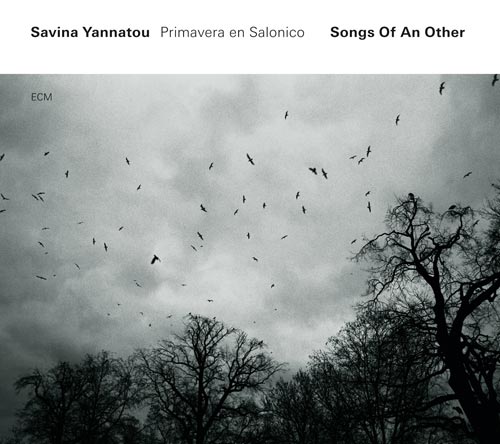
Songs Of An Other marks the third point of contact between Greek singer Savina Yannatou, along with Primavera en Salonico, and ECM. The program is more geographically varied than ever and emphasizes the interpretive prowess of its musicians. Much of that prowess breathes through Primavera’s superb control, for while the album boasts moments of sportive extroversion, it upholds the music first and foremost as a model for emancipation.
Indeed, Songs Of An Other shows this collective at both its most animated and its most delicate, oftentimes within the same song. Both the slack-stringed “Za lioubih maimo tri momi,” which comes by way of Bulgarian Macedonia, and “Radile” (from Greece) run the line of straight-up folk and all-out jam. In the latter vein, two new tunes based on Greek sources add another line to the project’s résumé. “O Yannis kai O Drakos” is a dragon-slaying song replete with fanciful colorations, paroxysmal gasps, and subtly frenetic bassing. “Perperouna,” a call for rain, explores the gravelly pits of Yannatou’s voice, embraced by the windy brine of nay and kalimba, all moving in a Celtic knot of rhythm toward an adlibbed comet’s tail. Even the “Albanian lullabye” becomes a ritual of ululations and incantations, honing a mysterious and strangely accessible edge.
For much of the album, however, the musicians tread a delicate path, adapting to every dip in Yannatou’s tightrope along the way. From the dulcet “Smilj Smiljana” (Serbia) to the Italian olive-harvester’s song “Addio amore,” they emote lucidly. Combinations of flute, violin, and accordion cloud like ink in water in “Sassuni oror” (Armenia); dances take the night by the hand in “Dunie-au” (Kazakhstan); and the 16h-century Yiddish traditional “Omar hashem leyakoyv” is practically translucent in sentiment.
The greatest accomplishment of Songs is the fullness with which it romanticizes, as is clear in “Sareri hovin mermen” (Armenia). Given the “Eastern” feel, one might easily read into it an alluring sway. Likewise, “Ah, Marouli,” a Greek song about sponge-divers on the island of Kalymnos, sashays with seeming invitation. And yet, these arrangements are so emotionally (and physically) complete that they hardly need even these words to convey to the uninitiated listener the magic of their self-assurance. And that’s the thing: every step and element of this audible alchemy is as lucid as the light that illuminates the talents of these fine instrumentalists, Yannatou tracing them all the while as a wave might shape an Aegean breeze.
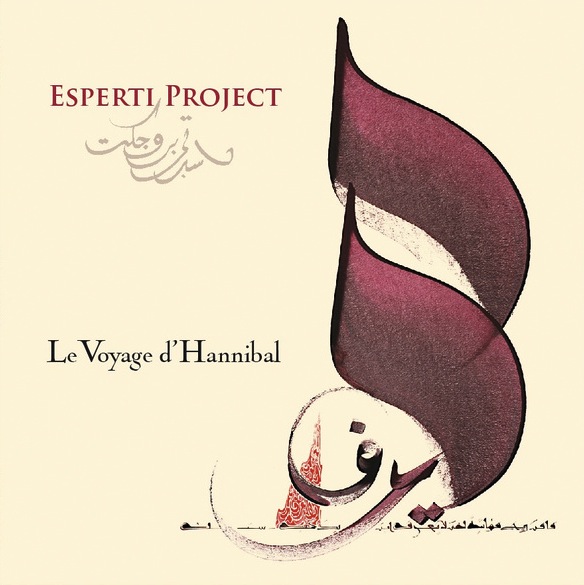
One of a handful of new reviews for RootsWorld online magazine, here I explore the once and future past with Andrea Esperti’s eponymous project debut, Le Voyage d’Hannibal. Click on the cover to discover!
Marilyn Mazur marimba, bowed vibraphone and waterphone, hang, bells, gongs, cymbals, magic drum, log drum, sheep bells, Indian cowbells, udu drum, various drums and metal utensils Jan Garbarek tenor and soprano saxophones, flute Recorded June 2005 at Sun Studio, Copenhagen Engineer: Bjarne Hansen Produced by Manfred Eicher
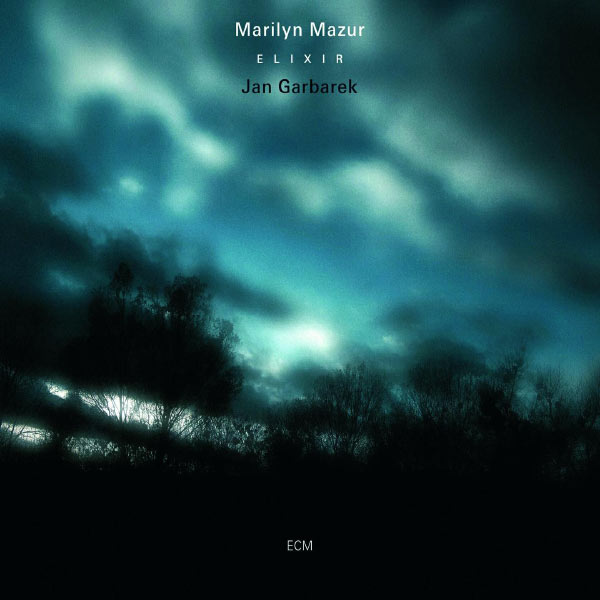
As resident percussionist of the Jan Garbarek Group for 14 years, Marilyn Mazur enlivened every path set before her with dynamism and panache. On Elixir, she delineates her own compass and invites Garbarek on a journey of organic play, thus yielding a composite sketchbook of improvised solos, duos, and multitracked collages.
Each of the album’s 21 tracks is an iceberg’s tip. Only the penultimate “Winter Wish” exceeds four minutes, and with it the waterline. This and other such evocative titles as “The Siren In The Well,” “Mountain Breath” (which sounds like an eagle dreaming of a whale), and “Bell-Painting” afford imaginings for the wayward listener fortunate to wander into these territories. The latter title is especially appropriate, for Mazur is very much a painter whose palette is her instrument. From a kit that spans the globe, she chooses only the most appropriate pigment for each image. Be it the splash of a Chinese gong (cf. “Creature Walk” and “Talking Wind”), the pulse of hand on taut skin (“Mother Drum”), or the resonant metals of “Pathway,” she reverse engineers gold into its base components and treats each as if it were just as precious. Her solos speak to the heart because they speak to the earth: the two are one in the same.
Her duets with Garbarek both open (“Clear”) and close (“Clear Recycle”) the program. The Norwegian saxophonist’s rasp brings out the light of Mazur’s subterranean designs and with it illuminates their innermost dances. Colors reveal themselves accordingly in the sheer variety of instruments. Whether by hang drum or waterphone, cymbals or flute, their groove magnifies the great within: foot to earth as soul to sky. Through them run the ley lines of the plains, singing and free. Like the track from which the album gets its name, they feed an incantation of which verses come and go like clouds, if only to remind us that the sky above never goes away, for that is where we will go when our bodies bend over in silence.
Two more reviews for RootsWorld online magazine, these of two very different albums: Iranian singer Marjan Vahdat’s long-awaited solo debut, Blue Fields, and Scottish fiddler Aidan O’Rourke’s autobiographical Hotline. Click a cover to discover!





 Between Sound and Space: ECM Records and Beyond