

“I can imagine the New Series in the form of a journey: there is a route mapped out, but it is open to contingency; it does not insist on the shortest or most direct road. It allows for detours that might lead into totally different areas from the original plan.”
–Manfred Eicher
There exists a particular sensibility in recorded music that refuses spectacle, distrusts haste, and listens for what emerges only when attention is sustained. It is an ethos built on patience, on the belief that sound is not merely an event but an environment and that listening is as much a moral as an aesthetic act. Within this sensibility, music is not asked to announce itself loudly or justify its presence through novelty or authority. Instead, it is allowed to exist in a state of becoming. The Compendium at hand arises from this worldview. It does not rush to explain or persuade. It invites the reader into a space where time slows, where artistic intent is inseparable from restraint, and where the deepest meanings are often carried by what is nearly imperceptible.
Producer Manfred Eicher understands classical music not as a fixed inheritance but as a living terrain shaped by memory, silence, and risk. It softens the rigid hierarchies that separate genres, eras, and disciplines, favoring instead a continuity that flows between medieval chant and contemporary composition, between written score and spontaneous intuition, between the concert hall and the solitary act of listening. The guiding conviction is that music’s truth lies not in classification but in presence. How a note is played, how a phrase is allowed to decay, how a recording captures air, distance, and stillness matters more than the lineage of the material itself. The book emerges as an artifact of this conviction, shaped by the same attention to space, texture, and inwardness that has long defined the sound world it chronicles. It stands not as a monument but as a threshold, inviting readers into a cinematic way of hearing.
To situate this volume properly requires a widening of perspective, an understanding of how recorded classical music has historically been framed and mediated. For much of the 20th century, the dominant classical record labels functioned as custodians of authority. Houses such as Deutsche Grammophon, Decca, and Philips constructed a sonic canon through monumental interpretations, star conductors, and a reverence for definitive statements. Their achievements were immense and lasting, yet their aesthetic tended toward the architectural. Performances were designed to stand as reference points, recordings as polished monuments to permanence, history rendered stable and self-assured.
Against this backdrop, the New Series emerged not in opposition but in quiet divergence. Under the wider umbrella of ECM Records, it proposed a fundamentally different relationship between music, performer, and listener. Classical music was no longer approached as a preserved inheritance to be polished and displayed but as a living continuum, shaped by fragility, curiosity, and permeability. The New Series allowed sound to be influenced by poetry, film, sacred ritual, folk memory, and contemporary abstraction without anxiety over category or lineage. It invited unfamiliar accents into familiar forms and treated unfamiliar forms with the same care traditionally reserved for the canon.
The Compendium mirrors this orientation with remarkable fidelity. Its structure resists hierarchy, favoring proximity over ranking, conversation over proclamation. Rather than reinforcing the idea of repertoire as a fixed body of works to be mastered, it presents classical music as an ongoing exchange among composers, performers, and listeners across time and geography. Each page represents a frame in a larger, evolving montage. In doing so, the book articulates a philosophy that classical music remains most vital when it is allowed to remain unfinished, receptive, and alive.
At the center of this vision stands Eicher, not as a figure of authority in the conventional sense but as a listener whose curatorial instinct has quietly reshaped the conditions under which music comes into being. His words from a 1986 interview provide more than an epigraph for this review. They function as its axis. When he describes the New Series as a journey with a mapped route that remains open to contingency, he gestures toward an understanding of artistic practice that values deviation as deeply as intention. Progress is not measured by efficiency or arrival but by attentiveness to what reveals itself along the way, detours the very means through which meaning is discovered.
This conception of music as an exploratory act underlies every page of this volume. One senses its affinities with interior monologues, the long take in cinema, the negative space of modern painting, and the instinctive pacing of the stage. Music, in this framework, does not exist in isolation. It absorbs light, text, gesture, and silence, allowing each to subtly alter its contour. The Compendium reflects this sensibility without didacticism. It does not attempt to persuade through argument or analysis. Its structure mirrors the listening experience the New Series has long cultivated, where coherence arises gradually, and conviction emerges not from assertion but from accumulated attention.
The journey begins, with a sense of inevitability rather than chronology, in Arvo Pärt. His music, austere yet luminous, does more than inaugurate the New Series. It establishes a gravity field around which much of what follows seems to orbit. Pärt’s work reintroduced stillness as a radical force in modern music, restoring silence as something charged with ethical and spiritual weight. Thus, the label’s deeper preoccupations with time, devotion, and resonance come into focus.
From there, the book proceeds composer by composer, each chapter opening onto a distinct interior landscape while remaining visibly connected to a larger constellation. Figures such as György Kurtág, Giya Kancheli, Tigran Mansurian, Valentin Silvestrov, Alexander Knaifel, and Veljo Tormis are presented not as representatives of national schools or stylistic movements but as participants in a shared inquiry into memory, loss, and the fragility of form. Many of these composers write music that feels as though it is listening backward, attentive to echoes of vanishing traditions, while remaining unmistakably contemporary. Their work often proceeds by subtraction rather than accumulation, trusting sparse gestures, broken phrases, and restrained dynamics to carry emotional and historical weight.
Taken together, these composers suggest an alternative modernism, one less concerned with rupture or provocation than with remembrance and inwardness. Their music asks how history survives in sound, how trauma, exile, and cultural erosion might be transmuted into quiet persistence. The Compendium allows these affinities to emerge organically, without forcing comparison, inviting the reader to sense the shared temperature of their work over technical minutiae.
The scope widens further with composers whose practices actively dissolve the boundaries between genres and disciplines. Heinz Holliger and Heiner Goebbels bring to the New Series a heightened theatrical and literary awareness, where music becomes inseparable from text, gesture, and spatial experience. Their contributions underscore the label’s openness to works that exist as events rather than objects. In a different but equally expansive way, Meredith Monk articulates an aesthetic grounded in directness, purity, asymmetry, and transparency. Her music, born of the physicality of the voice and the ceremony of performance, seems to distill the label’s approach into human breath and movement, reminding us that experimentation need not sacrifice intimacy.
Alongside these figures stand composers such as Gavin Bryars, Erkki-Sven Tüür, Thomas Larcher, Dobrinka Tabakova, and Eleni Karaindrou, whose work stands slightly askew from prevailing trends. Their music is neither doctrinaire nor opportunistic. It operates according to an inner necessity, attentive to lyricism, atmosphere, and emotional clarity without yielding to sentimentality. The New Series has provided a home for such voices precisely because it values conviction over conformity, allowing composers to develop long arcs of work free from the pressures of fashion or institutional expectations.
The presence of each is deepened by carefully chosen quotations reflecting on the act of composition itself, paired with portrait photographs and images from recording sessions. These reveal the human conditions under which their creations come into being, the solitude, concentration, doubt, and patience required to bring sound into focus. One senses the rehearsal room, the studio, the long hours of listening and adjustment. In this way, the book affirms one of its central truths: that modern music, at its most vital, is not an abstract system but a lived practice, shaped by time, attention, and the enduring vulnerability of those who make it.
Equally vital to this story are the performers, whose interpretations run through the New Series in quiet refrain. They are not presented as virtuoso personalities imposing themselves upon the music but as mediators who allow its inner logic to speak with clarity and force. Their artistry lies in restraint as much as command.
Artists such as Gidon Kremer, András Schiff, and Kim Kashkashian exemplify this ethic through an almost ascetic devotion to sound itself. Their performances are marked by transparency of texture and a shedding of rhetorical excess, allowing even the most fragile or fragmentary music to retain its integrity. In the case of Keith Jarrett, whose presence bridges the worlds of improvisation and composed music, the New Series reveals how attentiveness can dissolve distinctions between genres, bringing the same intensity of listening to both the written score and being in the moment. Conductors such as Dennis Russell Davies further extend this approach, shaping large forms with a sensitivity to balance and pacing that privileges inner coherence over outward drama.
The ensemble performances documented in the Compendium deepen this perspective. Groups like The Hilliard Ensemble and Trio Mediaeval bring centuries-old repertoire into dialogue with contemporary composition, revealing unexpected continuities across time through their vocal blend and disciplined stillness. The Danish String Quartet exemplifies how chamber music, when approached with collective intelligence and trust, can achieve a rare balance of precision and vulnerability. In these performances, risk is not theatrical but structural, emerging from the willingness to expose the music’s quietest tensions.
Together, these musicians embody the New Series ideal, where lucidity replaces polish and attentiveness supplants display. Their work suggests that, at its highest level, performance is morally shaped. The Compendium honors them not as interpreters of a fixed tradition but as active participants in a living one, reminding us that the future of classical music depends as much on how it is experienced in the moment as on the notes preserved on the page.
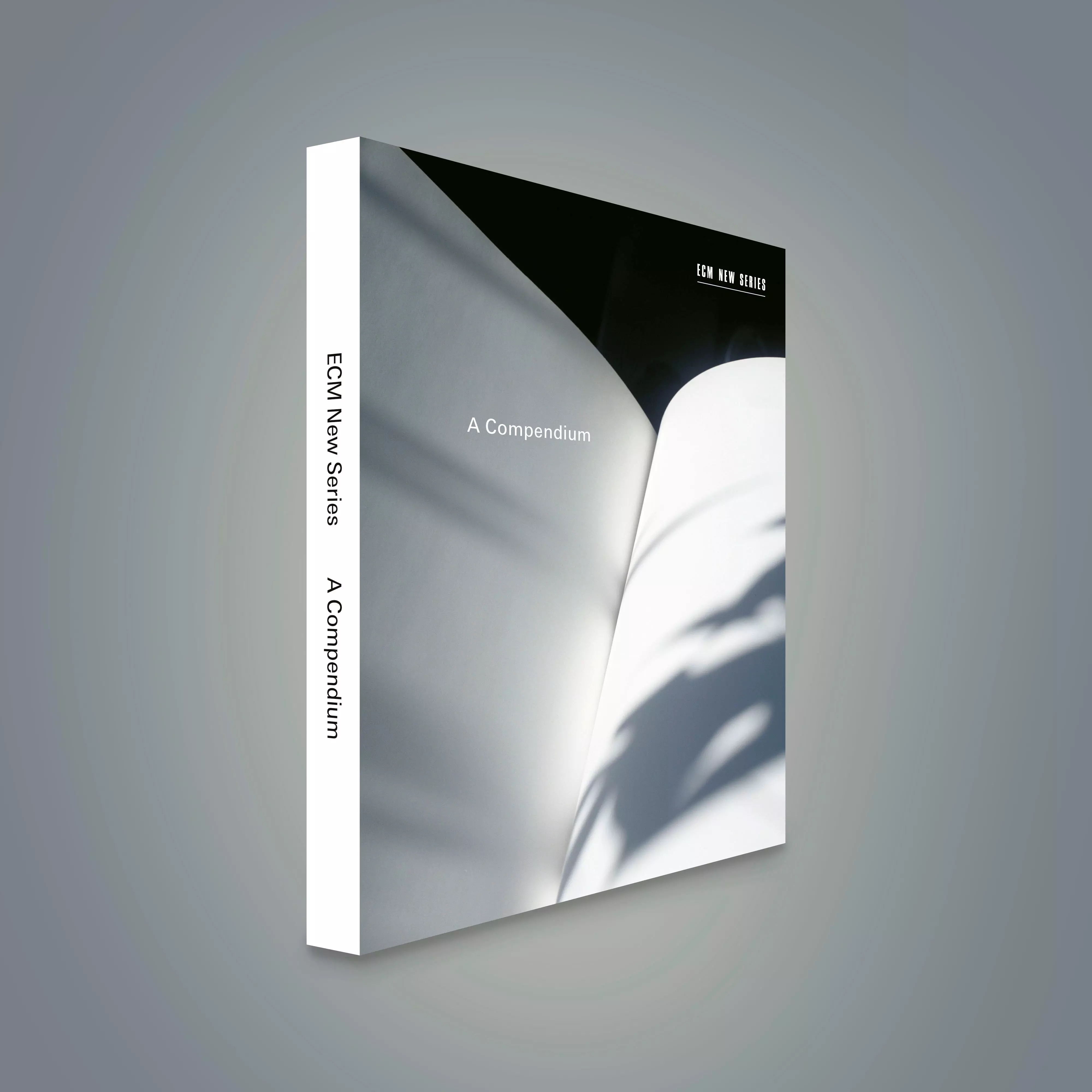
As a physical object, the Compendium embodies the visual and tactile intelligence that has long distinguished ECM’s aesthetic. Its design speaks in a measured voice, austere yet quietly radiant, disciplined without austerity for its own sake. White space is not an absence but a field of attention. Typography, sequencing, and image placement appear calibrated to slow the reader’s pace, encouraging a form of engagement that mirrors the label’s decades-long listening habits. One does not skim this book. One dwells within it, returning to pages as one might return to a recording, attentive to shifts of mood and emphasis that only reveal themselves over time.
In this way, the book becomes an extension of the recordings themselves, another site where listening is shaped by care. It aligns with an idea of art that does not rush to occupy the foreground but waits for the reader or listener to meet it halfway. The reward for this patience is depth, not as density of information but as depth of presence.
In the end, ECM New Series: A Compendium stands as far more than an anniversary publication or institutional summation. It is a sustained meditation on how classical music might remain fully alive in the present without forfeiting its inwardness or historical gravity. By expanding the very conditions under which music is performed, recorded, and heard, the New Series has quietly altered the expectations surrounding classical sound. It has shown that innovation need not announce itself loudly, that progress can unfold through refinement, patience, and a deepening of attention.
This book captures that achievement with a humility that feels inseparable from its subject. It neither proclaims a legacy nor attempts to fix it in place. Instead, it reflects a way of thinking about music as a continuing conversation with time, one that values listening as an act of openness rather than mastery. Like enduring works of literature and art, the New Series does not seek to dominate history or escape it. It listens to it, answers it, and leaves space for what has yet to arrive.
 Between Sound and Space: ECM Records and Beyond