


Constellations in Shadow
Across the canvas of Austrian avant-garde cinema, where names such as Kubelka and Kren have long been rendered in sharp, declarative strokes, the work of Moucle Blackout flickers with a quieter, though no less vibrant radiance. Her work breathes in a mirrored room, only to be released again in altered form. To encounter her oeuvre is to step into a field of delicate resistances, where form unsettles authority and vision unfolds through a patient, almost subterranean insistence.
Born Christiane Engländer in 1935, she embarked on her creative self-examinations through sculpture and design. As Brigitta Burger-Utzer observes, she moved within the orbit of the Vienna Group during its formative years, witnessing a burgeoning experimental culture that, despite its radical aspirations, remained curiously closed to women. While the men gathered, wrote, filmed, and declared, she watched, listened, and absorbed.
That threshold, neither inside nor entirely outside, became fertile ground. Instead of echoing the gestures of her contemporaries, she cultivated another trajectory, one that slips between categories. Her studies at the IDHEC in Paris between 1957 and 1958 opened a corridor of possibility, while her chance encounter with Marc Adrian (whom she later married) introduced her to the tactile processes of making films by placing a camera in her hands, an act that now carries a faint mythic glow. From that moment, experimentation became atmosphere, and together they explored development, color manipulation, and the mutable chemistry of the image. As she later remarked in conversation with Michaela Grill and Isabella Reicher: “I enjoy filmmaking, and this pleasure becomes visible.”
The name Moucle Blackout itself embodies that same playful opacity. “Muckl,” a childhood nickname, was combined with the enigmatic “Blackout” at Adrian’s suggestion into a conceptual eclipse. The moniker suggests a break in the flow of light. It also invites a loss of consciousness, as if meaning might shift under prolonged attention.
Thresholds, Absences, Openings
Her earliest independent films have been lost, a disappearance that feels less accidental than symptomatic. The marginalization of women within international avant-garde histories leaves behind many such absences that echo louder than presence. What remains begins, officially, with Walk in from 1969.
Blackout has long resisted the notion of meaning as a finished object. “I wanted the films to remain open to interpretation, but not too easy to decipher,” she explains. “It is not about serving the audience things ready made.” The viewer dwells at risk of uncertain, entering a building under construction where the floor may shift beneath each step.
Her filmography, though concise, unfolds across a spectrum of forms. Structural rigor dissolves into moments of chromatic delirium. Color pulses with interior life. Elsewhere, fragments of bourgeois ritual appear as rehearsed performances, their naturalness gently undone. Her palette is one of perceptual instruments, recalibrating not only what is seen but the conditions under which seeing becomes possible.
Arindam Sen suggests that Blackout’s work invites a rethinking of history itself, less as a sequence of monumental gestures than as an accumulation of small, deliberate acts. Each project becomes a step, quiet yet exacting, within a trajectory that often remains obscured. Recognition arrived late. Only in 2014, at the age of 79, did she receive a retrospective in Villach, a gathering of decades that had persisted without spectacle.
To place Moucle Blackout alongside figures such as VALIE EXPORT opens a dialogue between distinct strategies. Whereas EXPORT confronts with immediacy, Blackout allows the image to tremble until its surface betrays its instability.
Her work resides in intervals. Between frames. Between disciplines. Between recognition and obscurity. Photography, collage, object-making, dance: all is fair game. Each medium becomes a site where perception is tested.
Filmic Apertures
1. Walk in (1969, 16mm/digital, 5 min)
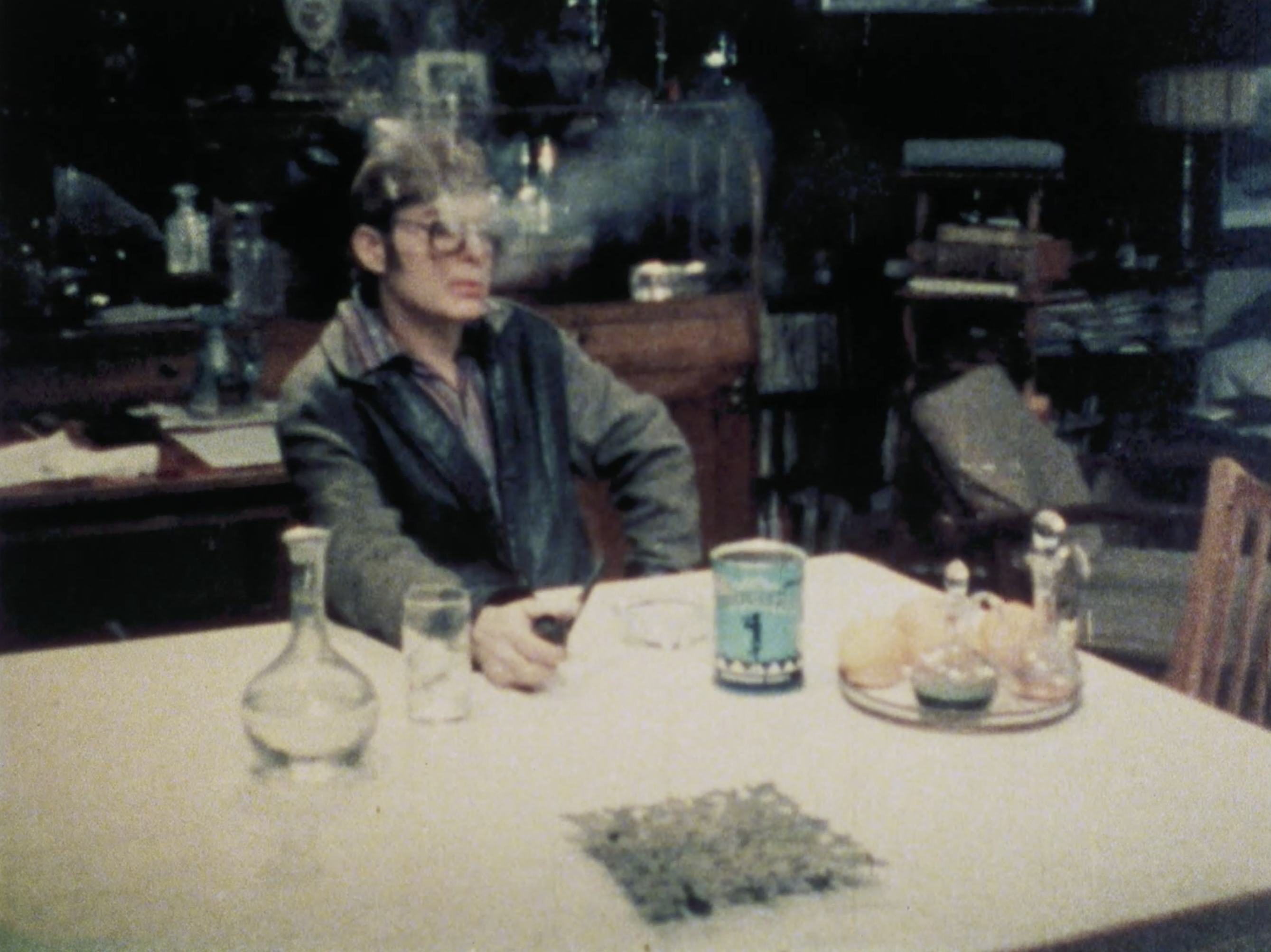
Although this is a structural film, it also functions as Blackout’s critical response to structural film, a gesture that flirts with imitation yet resolves into something more internally corrosive. The canonical language of repetition is taken up only to be bent inward, its apparent neutrality revealed as a mechanism capable of entrapment. From Marc Adrian’s entrance into their shared apartment to his measured sitting, the careful filling of a pipe, and the slow ignition of smoke, each action arrives with the promise of ordinary continuity. That promise dissolves almost immediately. The gesture fractures, breaks apart, and multiplies itself into rhythmic segments that refuse to align into forward motion. Seven hundred twenty frames are shuffled into a temporal labyrinth, where progression loses its footing and begins to circle itself.
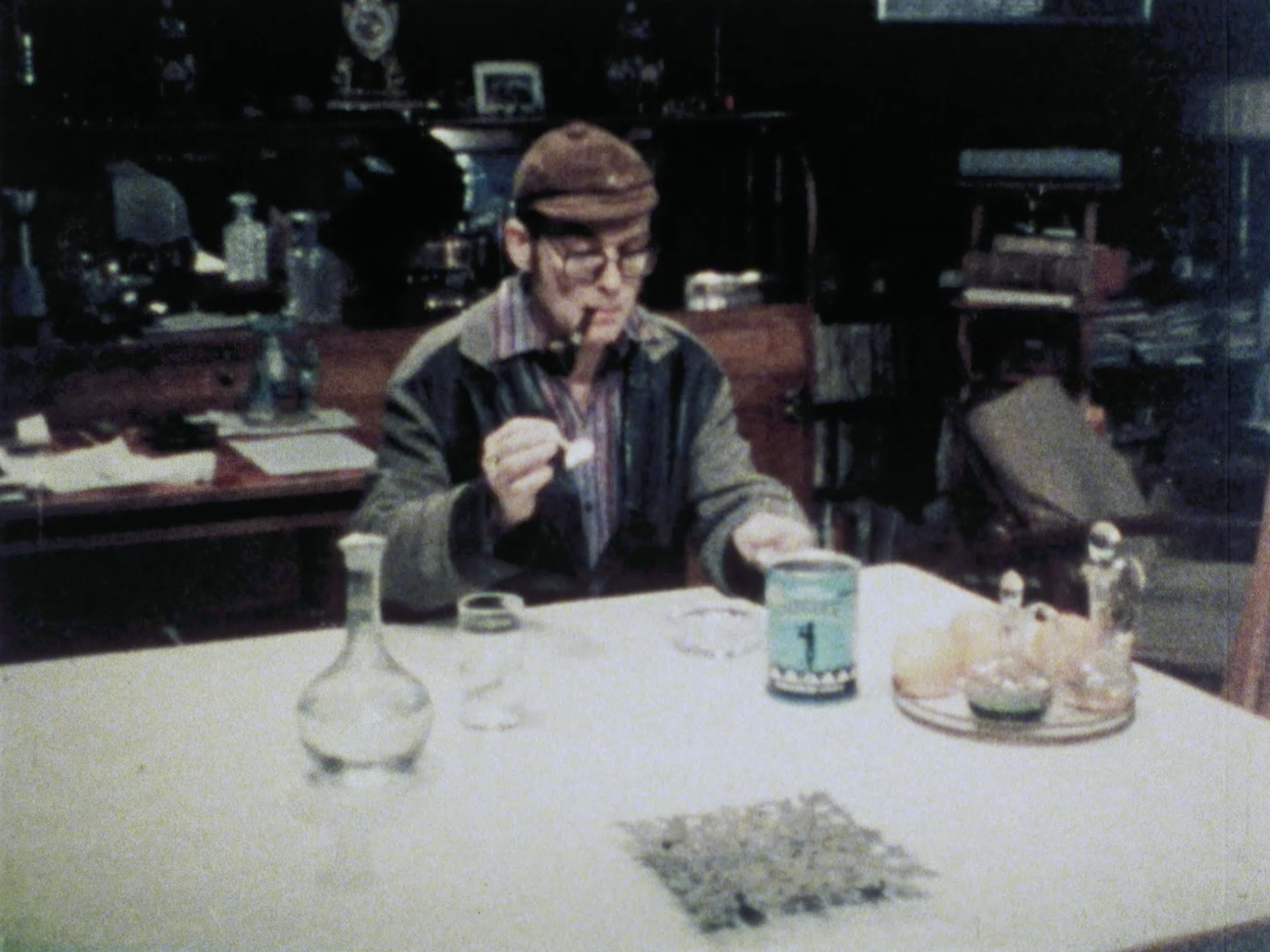
The duplication process leaves visible scars across the filmstrip. Scratches cling like residue from a failed attempt at preservation, as though the act of repetition itself had worn down the material. Adrian appears caught between intention and interruption, his small domestic ritual transformed into a loop that cannot conclude. What might have been an act of unwinding instead becomes a tightening coil, a choreography of deferred release. Blackout’s notion of “the impression of manic behavior” lingers, though it feels less like mania than a quiet suffocation. The accompanying music hovers delicately, never resolving into comfort, its presence amplifying the unease.
2. Die Geburt der Venus / The Birth of Venus (1970-72, 35mm/digital, 5 min)
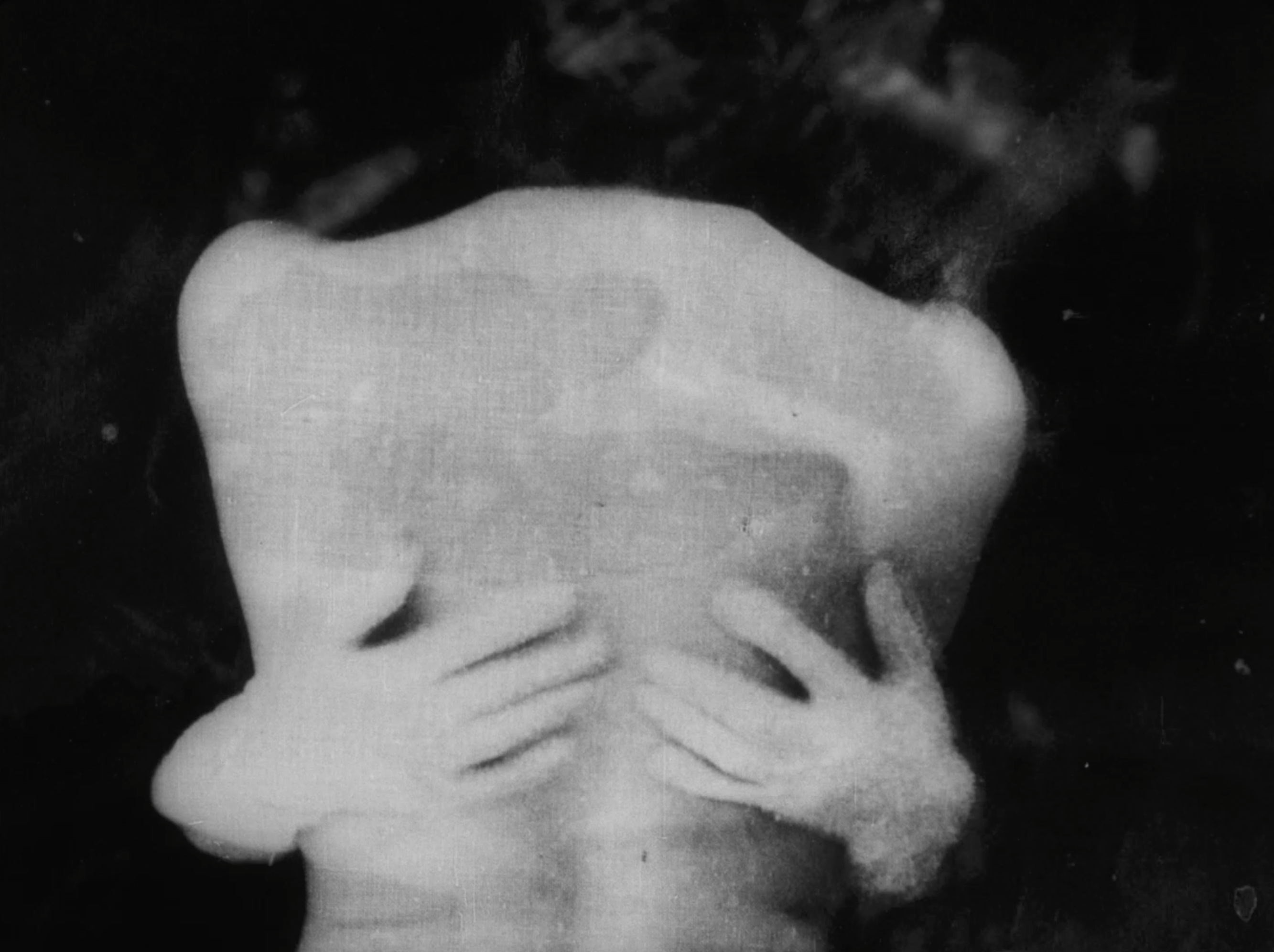
Here, the titular birth opens onto a charged terrain where pleasure and violence occupy the same visual field without settling into hierarchy. Photographs of exuberant sexuality among friends are interwoven with the stark presence of a pig carcass discovered on a roadside, a juxtaposition that resists easy symbolic closure. Flesh appears in multiple registers, one animated by desire and agency, the other reduced to inert matter, abandoned and exposed. Through motion montage, the images slide symmetrically across a central axis, mirroring themselves into shifting patterns that hover between abstraction and recognition. The repetition produces a visual grammar that both unifies and destabilizes, suggesting correspondences that remain perpetually unsettled.
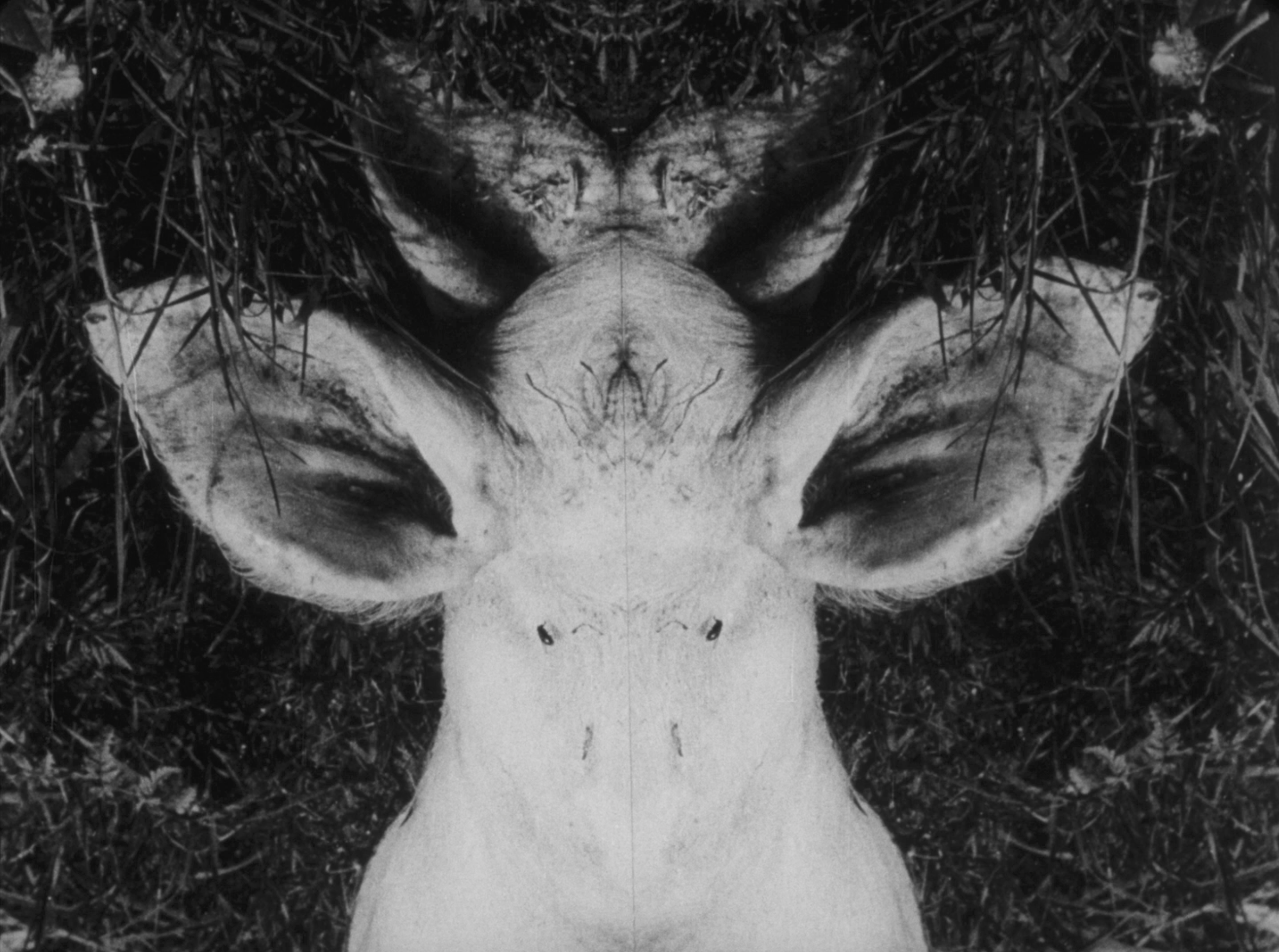
The pig emerges as a mutable figure, at times evoking victimhood, at times broadcasting pure form, while the human bodies retain a sense of volition that resists reduction. Songs by The Beatles weave throughout, their presence feeling less like accompaniment than revelation. “Tell Me What You See,” “Happiness Is a Warm Gun,” “Why Don’t We Do It in the Road?” circulate throughout, each track inflecting the visual play with shifting tonalities in a field where liberation and vulnerability remain entangled.
3. Stoned Vienna (1976-79, 16mm/digital, 20 min)
Stoned Vienna unfolds as a portrait of a city caught between preservation and disintegration, its surfaces layered with histories that refuse to settle into coherence. Emerging alongside Ernst Schmidt jr.’s Wienfilm 1896-1976 (see INDEX 044), it echoes another cinematic project while maintaining its own distinct pulse, as though two parallel observations had briefly intersected without fully merging. Vienna appears at once monumental and fragile, its historical architecture standing beside modern interventions that already seem fatigued, their promise of progress tinged with obsolescence.
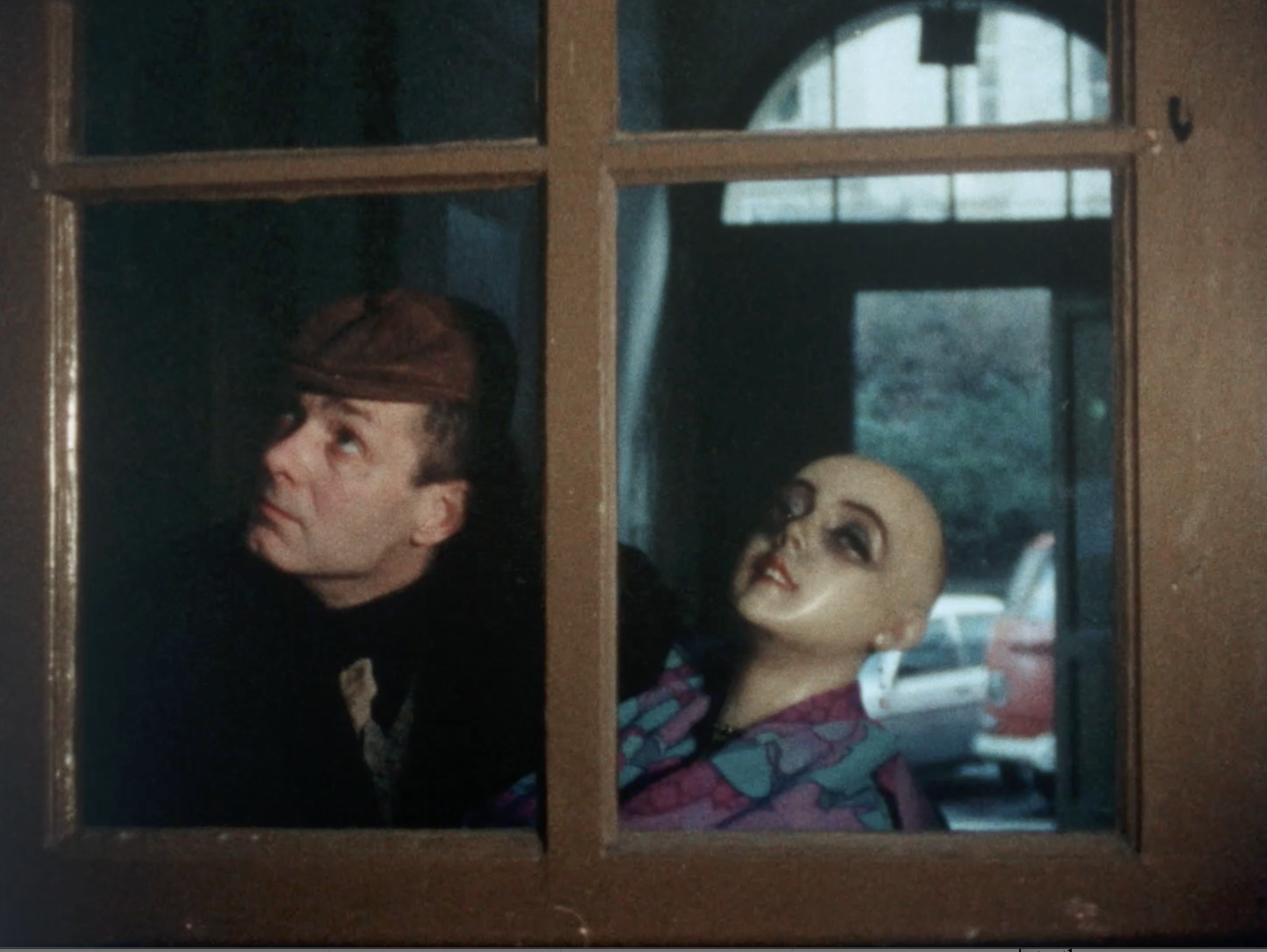
A wax doll named Dolly occupies this landscape, a figure that condenses the city’s condition into a single uncanny presence. She is handled, displayed, and displaced as a surrogate for a Vienna that is both preserved and manipulated. Double exposures have their say, negative and positive collapsing into one another until the city itself becomes a shifting surface. Male comportment hovers between care and absurdity. Apartment blocks scroll past in relentless succession, their repetition suggesting a form of urban anonymity that absorbs individuality into pattern.
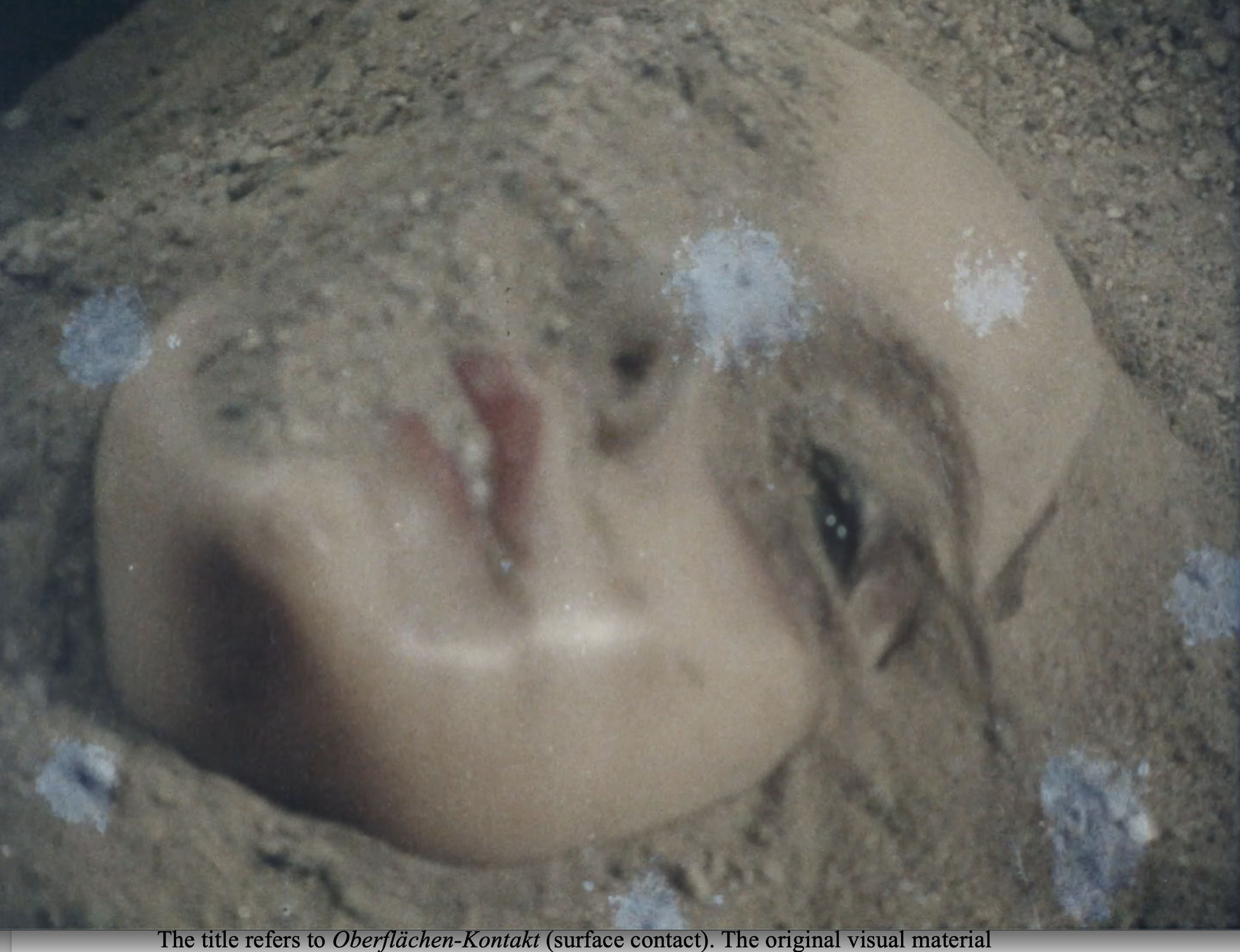
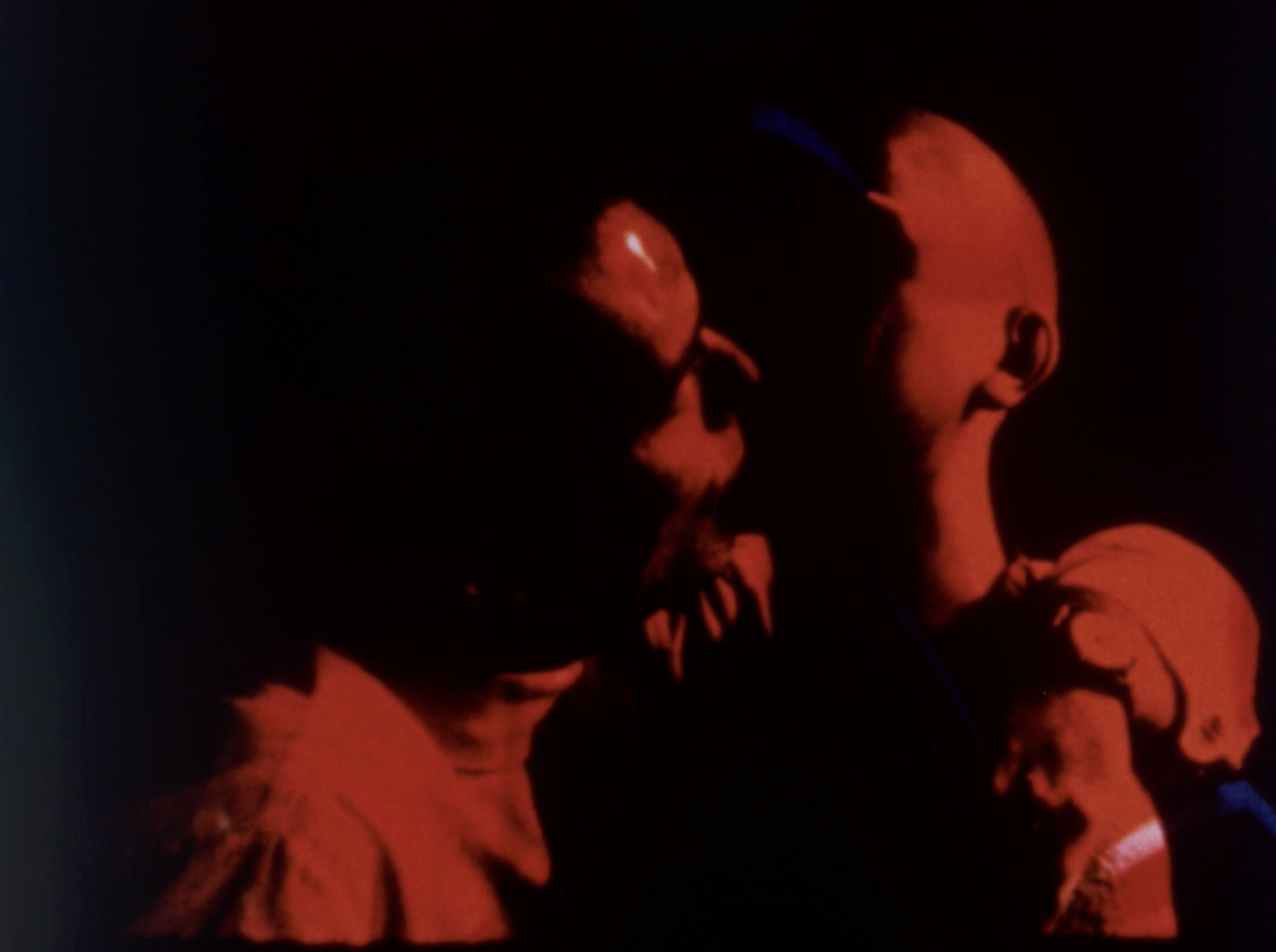
The burial of Dolly within the debris of demolished buildings introduces a subdued violence. The soundtrack invokes anxious rhythms, shaker and organ weaving a sonic texture that offsets things further. Then the color palette shifts abruptly, erupting into garish, almost radioactive tones. The editing accelerates, its resulting friction vibrating with a special agitation. When the man kisses Dolly, the gesture lands with a hollow resonance, an attempt at connection that collapses into artifice. Vienna remains suspended between beauty and decay, its identity perpetually rewritten by forces that cannot fully erase what came before.
4. o.k. (1987, 16mm/digital, 5 min)
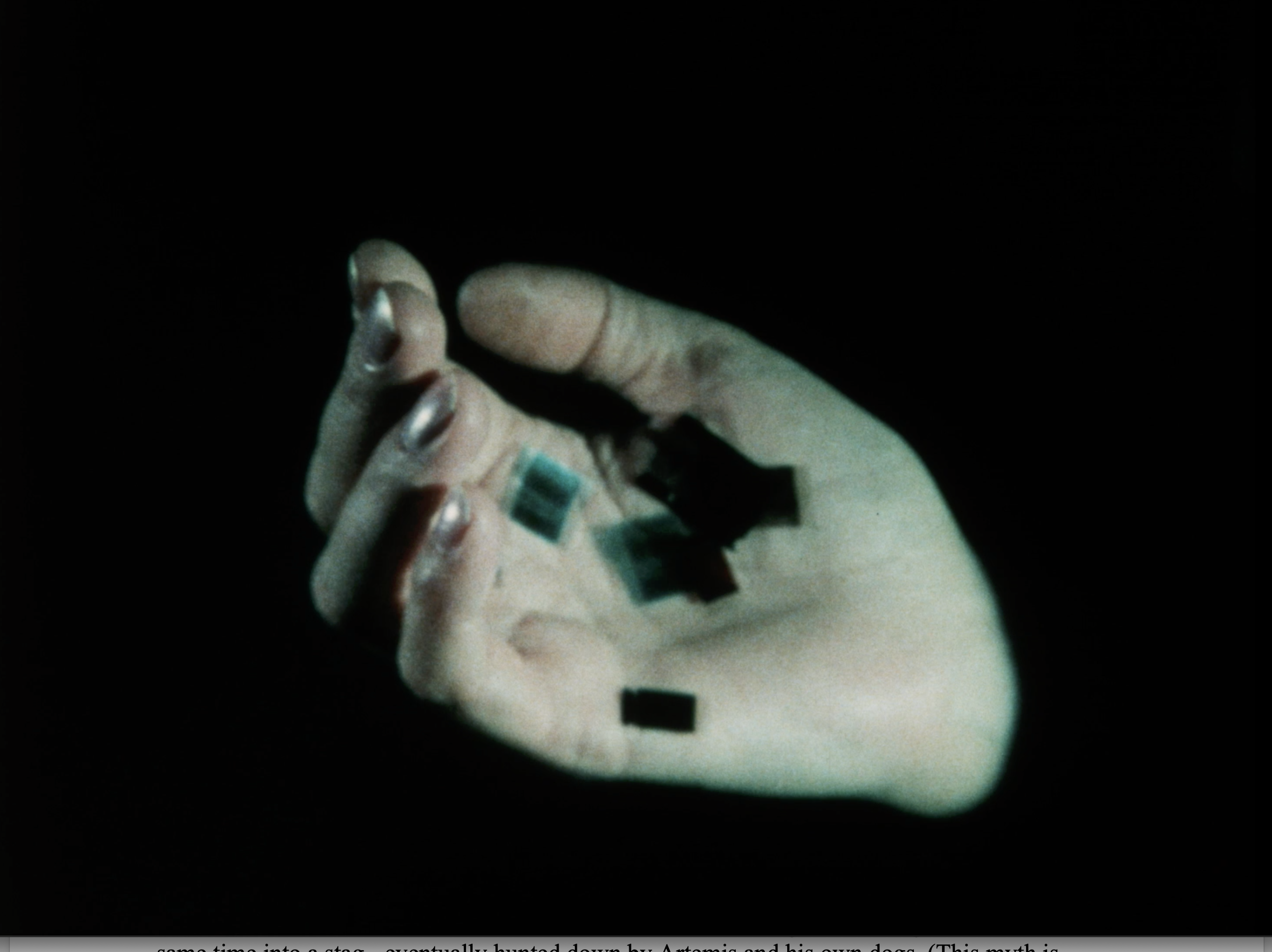
In o.k., perception is folded back onto its own conditions of existence, drawing attention to the fragile interface between projection and surface. The title’s reference to Oberflächen-Kontakt (Surface Contact) anchors the work in a palpable reality, even as it destabilizes any simple notion of contact. Footage originally captured on Super-8 is re-projected onto Blackout’s hand, then re-filmed in 16mm, creating a layered structure in which each iteration transforms what came before. The hand becomes both support and participant, its contours shaping the image even as the image redefines the hand.
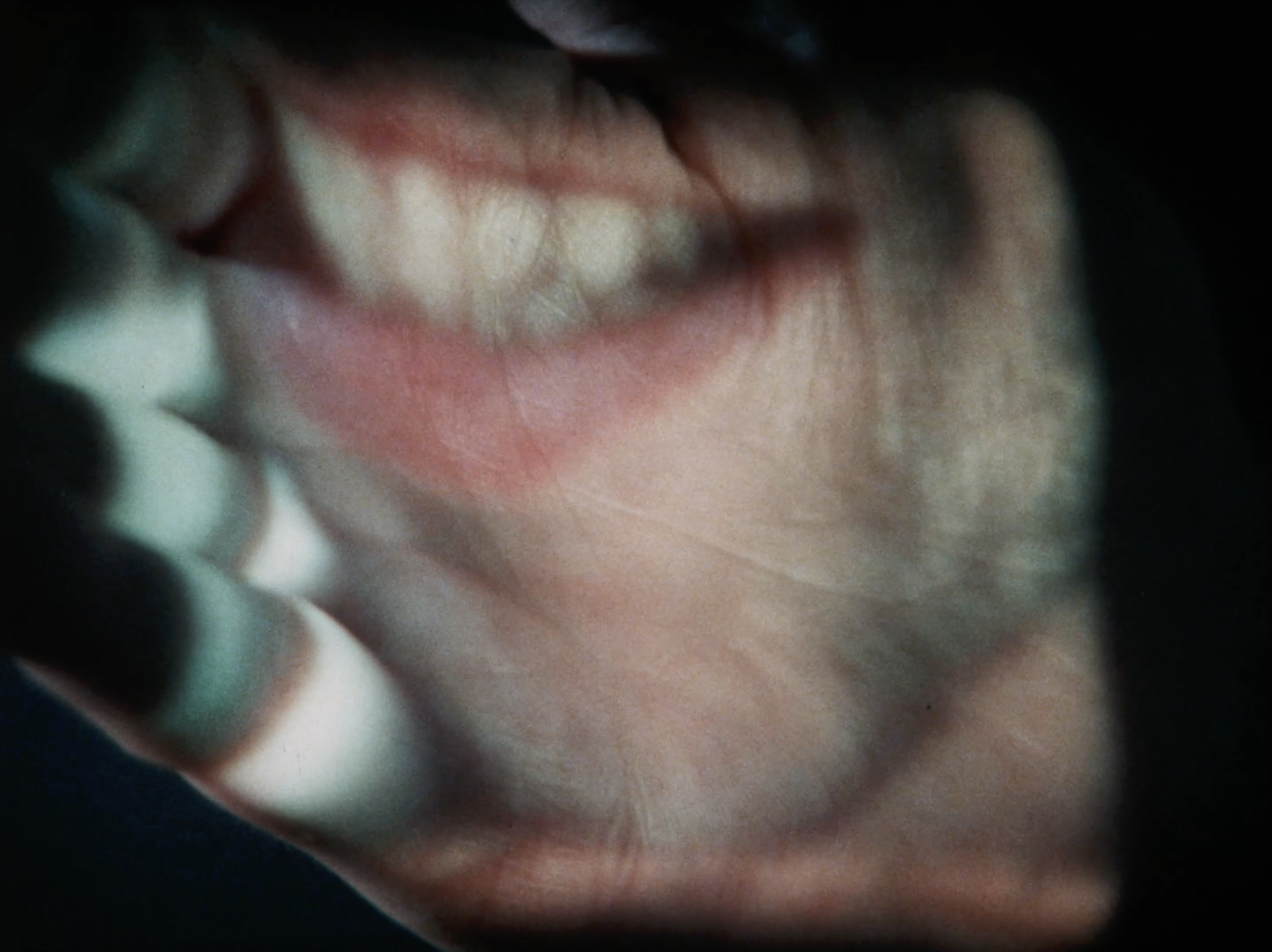
This recursive process generates a sense of temporal slippage, as though remembering itself in real time while simultaneously forgetting its origin. Water moving over stones, a man eating, the sudden appearance of a bee: these fragments circulate without coalescing into narrative, their repetition producing a kind of haunted continuity. Bruckner’s symphonism erupts subcutaneously, lending the sequence a gravity that feels disproportionate to its ephemerality.
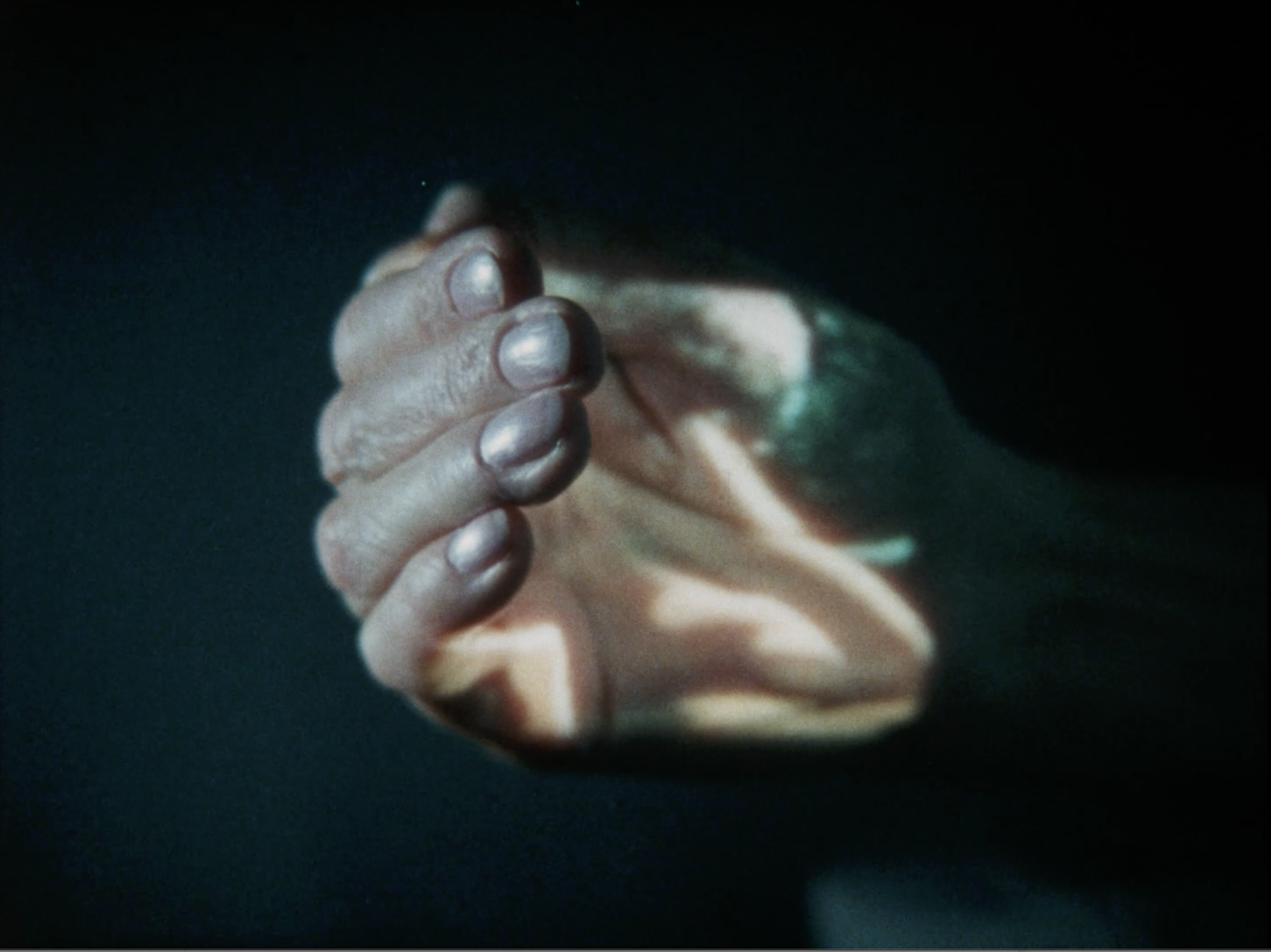
As the hand closes and opens again, revealing physical fragments of film, the illusion of permanence proves itself to be dependent on surfaces that can never fully stabilize it. What remains is an awareness of cinema as an act of holding and releasing, a temporary convergence of light, matter, and perception that resists any claim to lasting solidity.
5. Der Galaktische Nordpol liegt im Haar der Berenice / The Galactic North Pole Lies in the Hair of Berenice (1992, 16mm/digital, 14 min)
This work unfolds like a myth refracted through unstable time, where narrative threads intertwine without resolving into a single trajectory. The story of Berenice II of Egypt, who sacrifices her hair to ensure her husband’s safe return, drifts alongside the fate of Actaeon, whose desire leads to his transformation into prey. These figures move as volatile chemicals, their actions filtered through layers of dissolves and double exposures.
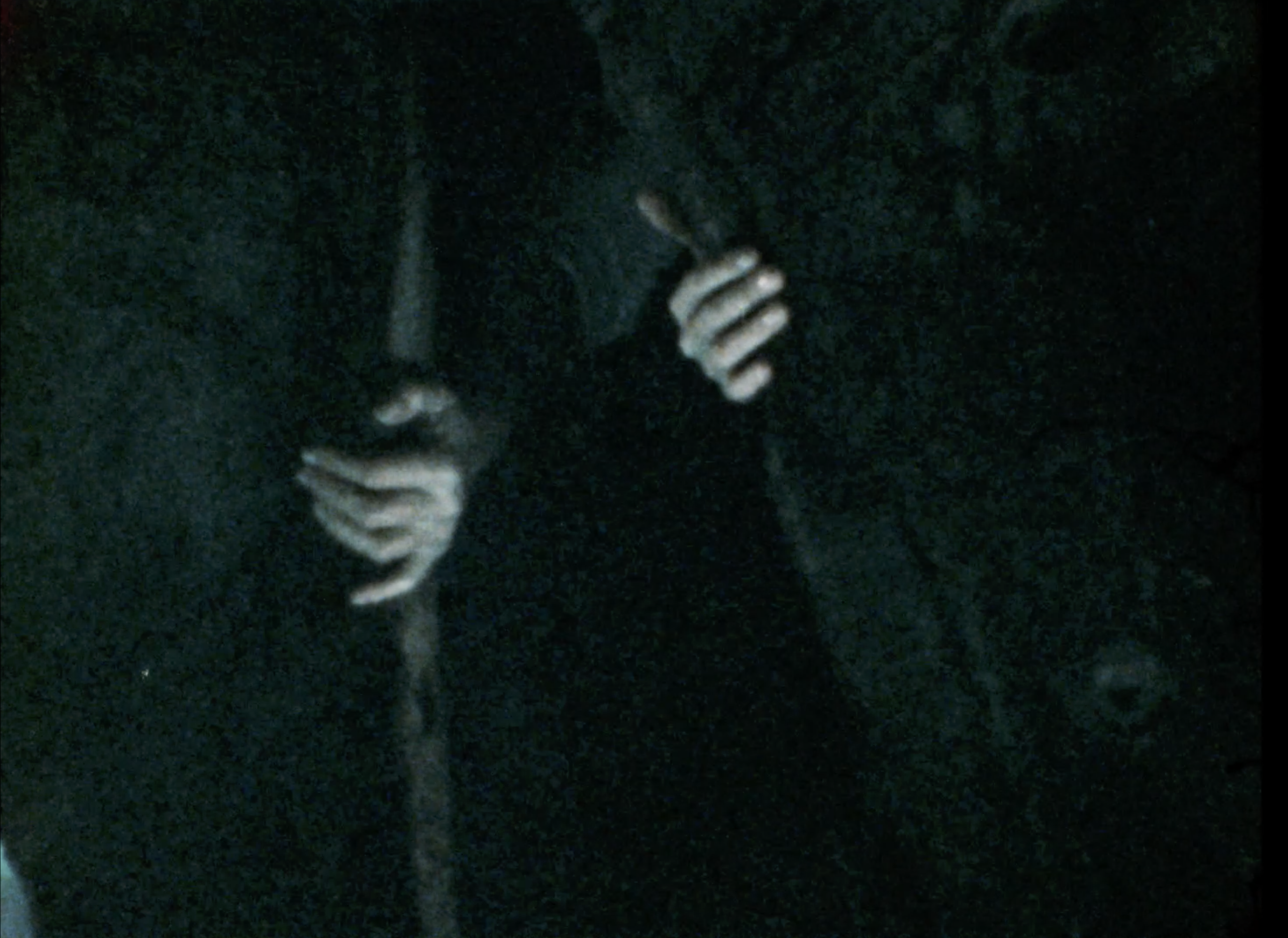
Acts of survival—eating, drinking, sex, and violence—accumulate into a sequence that oscillates between preservation and destruction. The body emerges as both agent and site of vulnerability, caught within cycles that cannot be easily disentangled. A star map flickers intermittently, suggesting a cosmic dimension that reframes the narrative as something both intimate and vast. The transformation of Berenice’s hair into a constellation lingers as a gesture suspended between offering and relic, a trace that resists disappearance even as it becomes abstract.
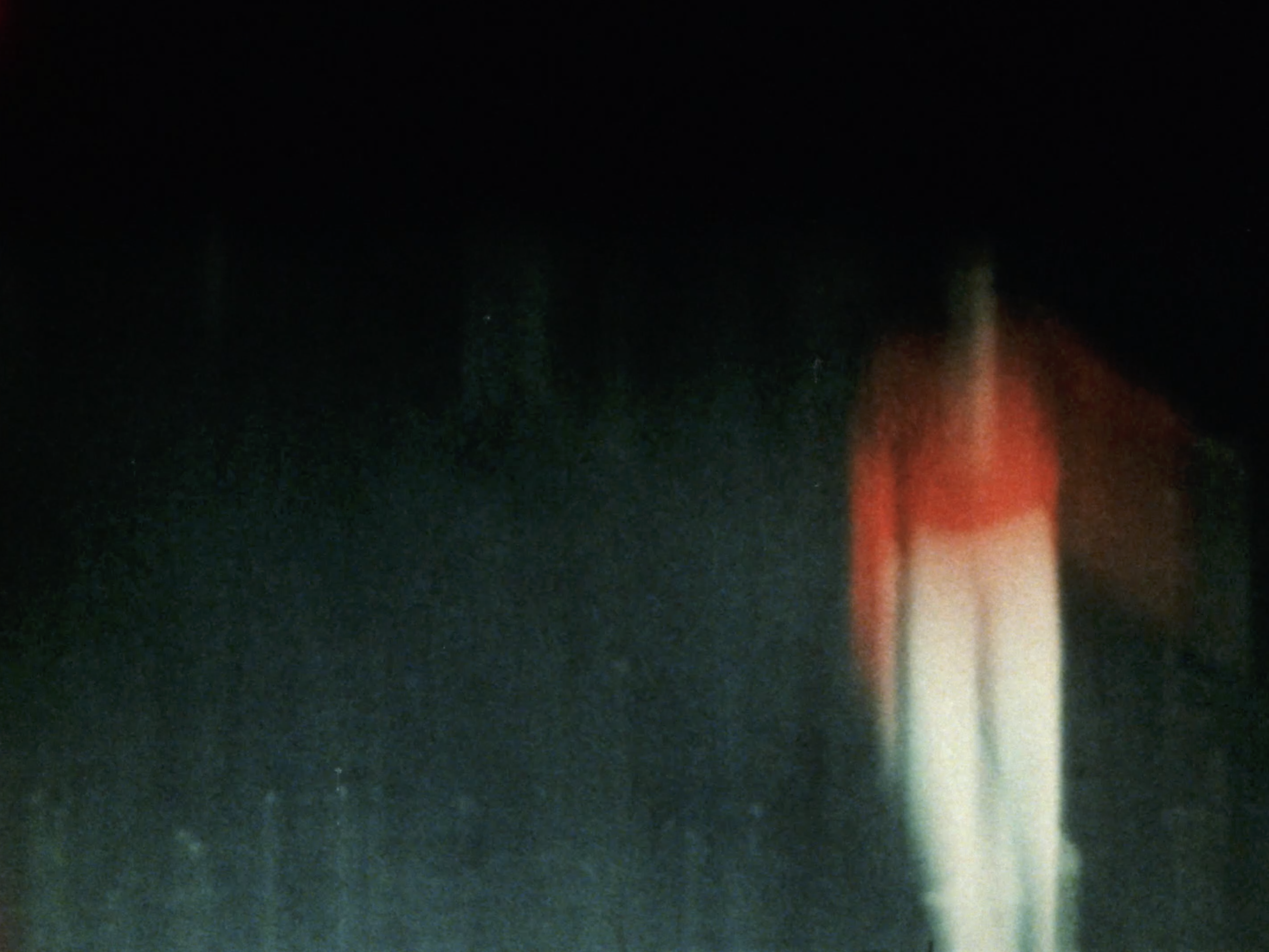
Images of decay, a rotting meal, blood, and moments of penetration interrupt the flow, grounding the myth in a fiercely material reality that refuses transcendence. A red beast appears, then recedes, its presence marking a threshold between recognizable form and something more elusive. Everyday fragments surface unexpectedly, seeking to exceed the frame’s containments in disorientation, where the underworld awaits its fleshly meal.
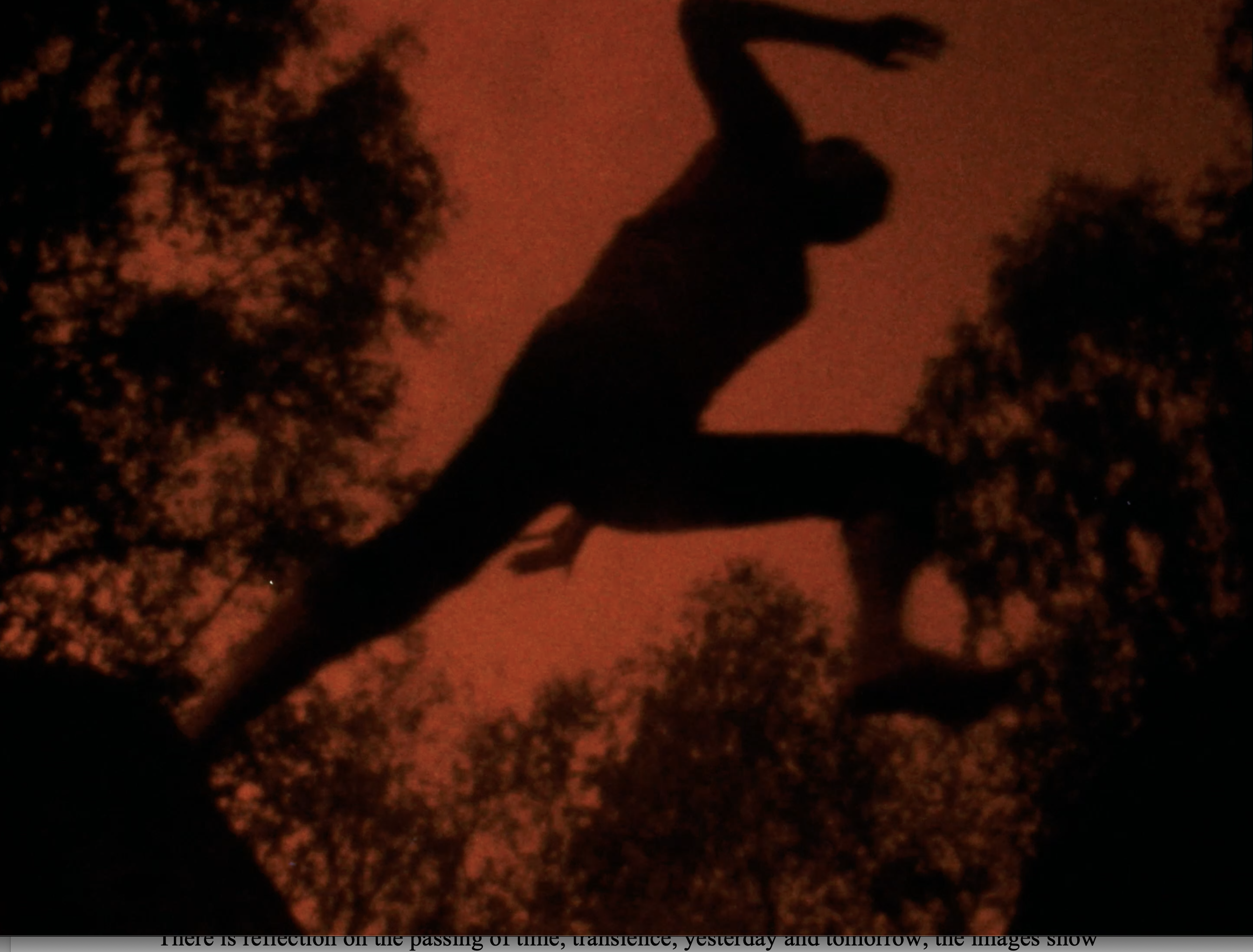
6. Loss (1998, 16mm/digital, 12 min)
Loss gathers its materials from disparate geographies, weaving together home movies from the Canadian wilderness with documents from Australia and Europe into a meditation on mourning that unfolds without overt declaration. Landscapes stretch outward, even as they are shaped by the weight of memory that presses inward from all sides.
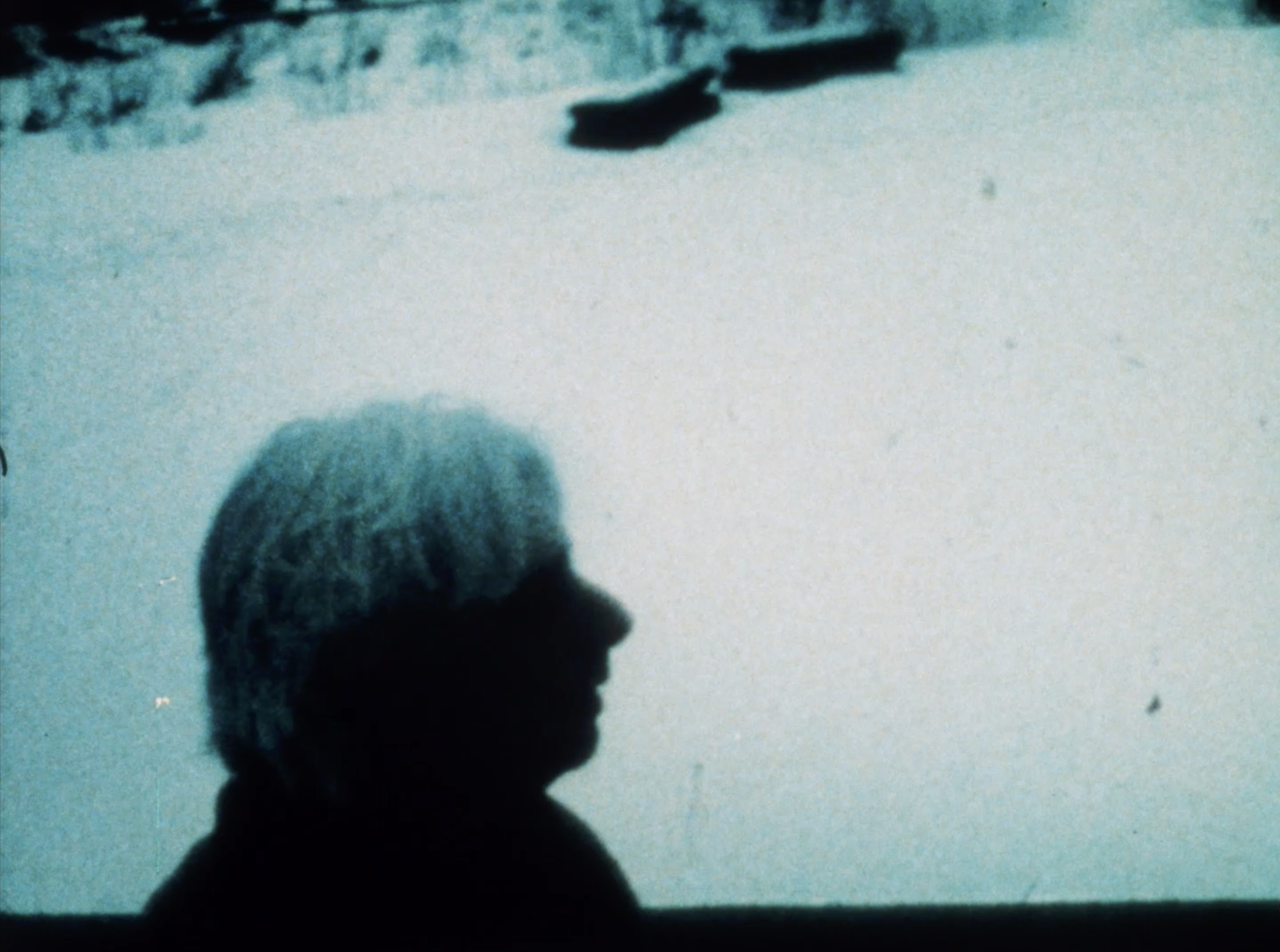
The suggestion of a mother losing her child emerges not as a singular event but as a continuous undercurrent. The footage acquires a strange inflection of agency, as if it were the viewer who had been summoned rather than the other way around. Recurrent motifs, including a stone wall and fragments of play, return with subtle variations, their circularity nevertheless buckling against closure.
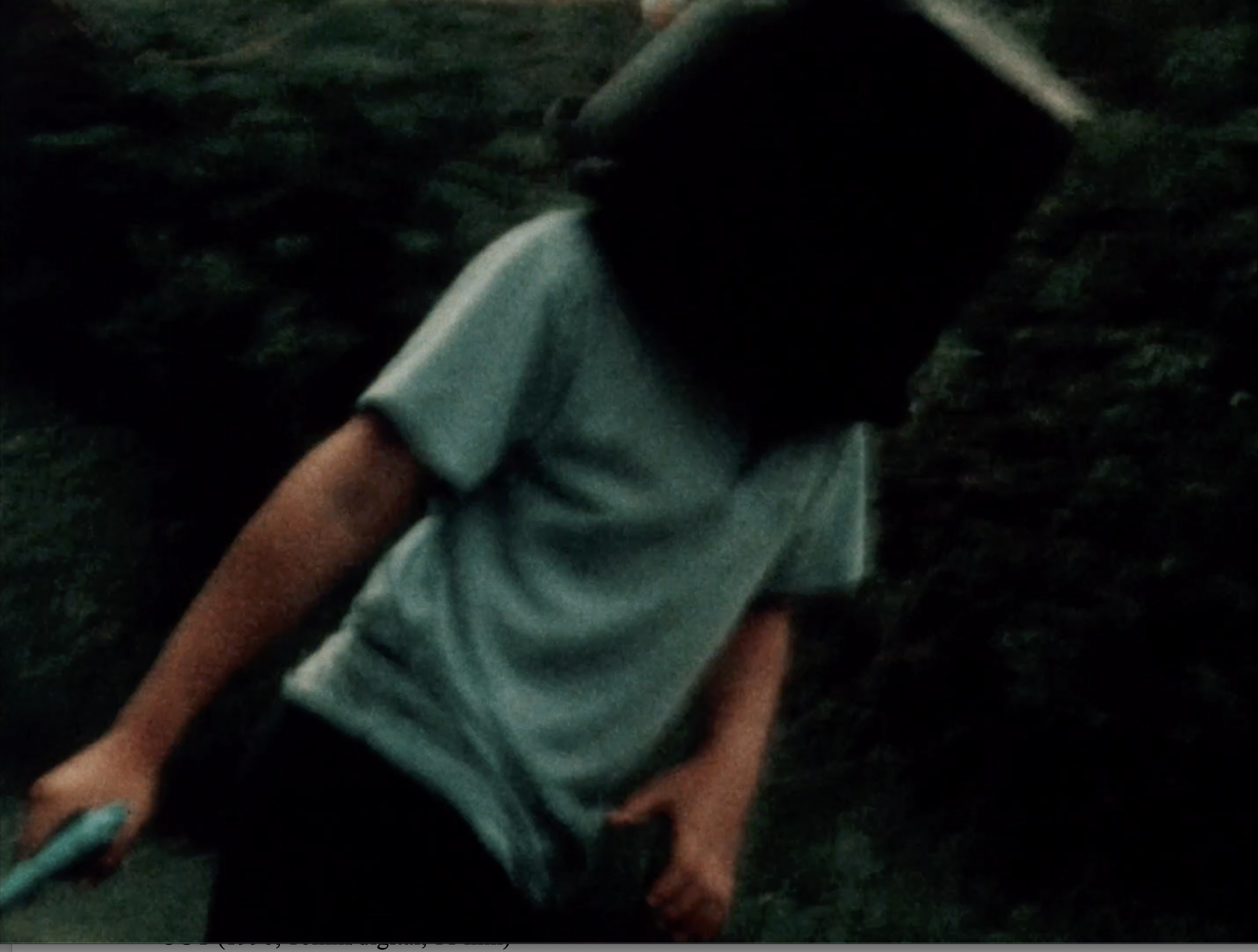
Peter Mudie’s voice introduces language into the visual field, describing it as “silence interrupted by language.” The montage begins to move in reverse, time folding back upon itself in an attempt to retrace what has been lost. This reversal does not restore what is gone. Instead, it reveals the persistence of absence.
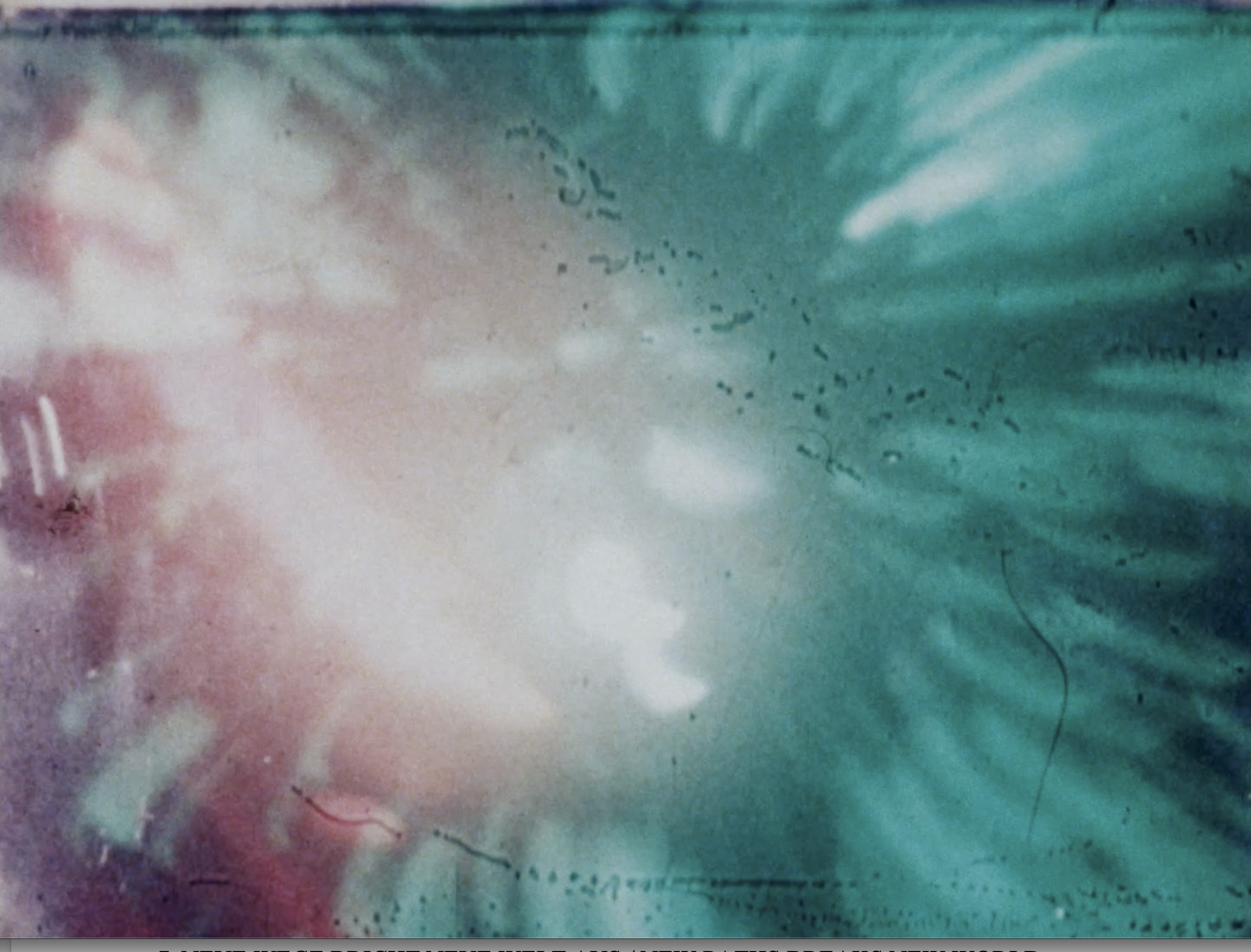
7. Neue Wege bricht neue Welt aus / New Paths Breaks New World Out (1996, 16mm/digital, 11 min)
This collaboration with Karin Schöffauer unfolds as a dialogue that never fully aligns, each element maintaining a degree of autonomy. Its opening situates the viewer within a space of exhaustion and self-doubt, a final push into an undefined void undertaken with a sense of misalignment, as though the timing itself were already off.
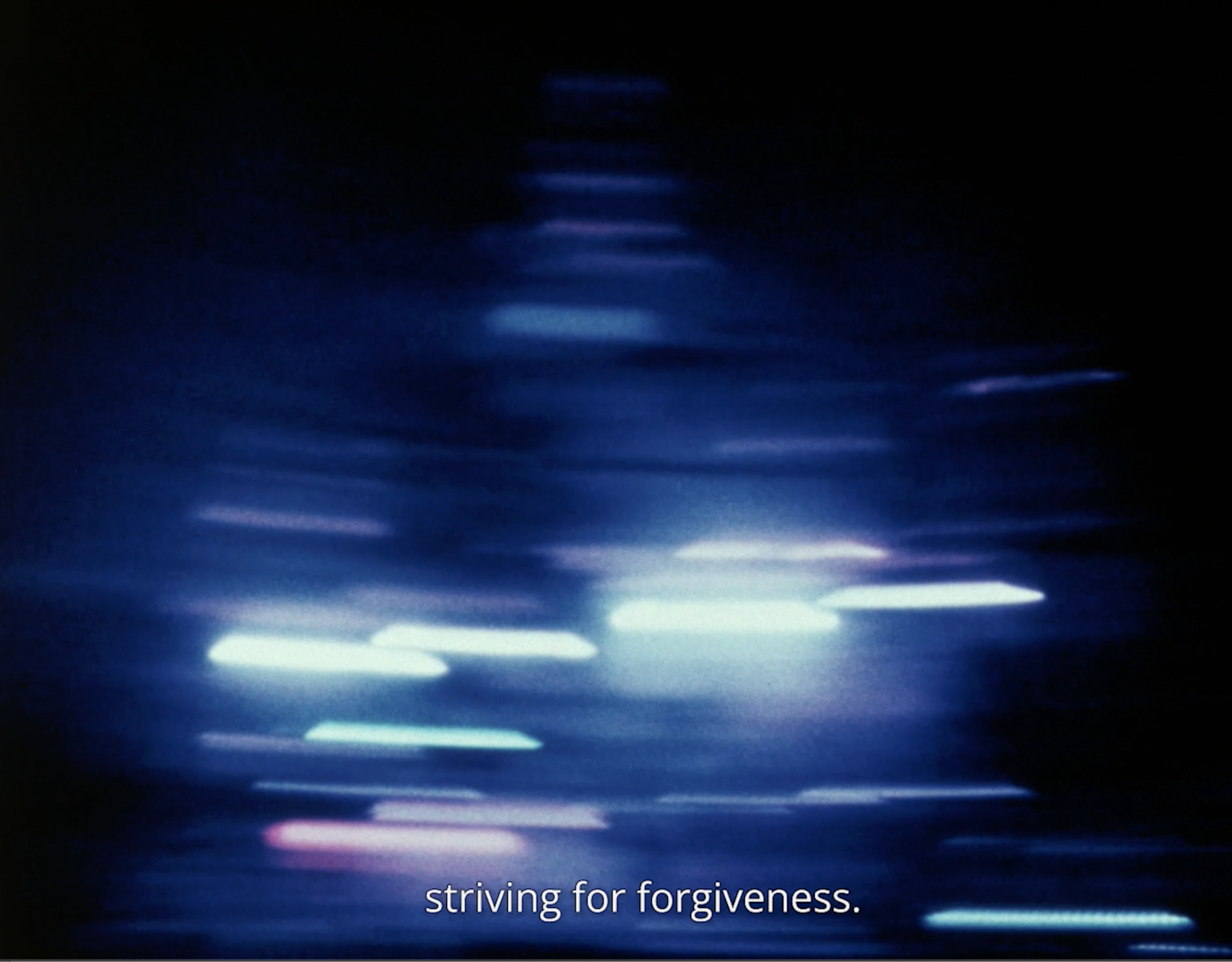
Flashes of physical exertion, of bodies engaged in sport, refinement, and displays of vitality, circulate alongside a textual voice that distances itself from corporeal pleasure, describing a terrain that feels hopeless and illuminating. The body becomes a site of contradiction, celebrated and estranged simultaneously.
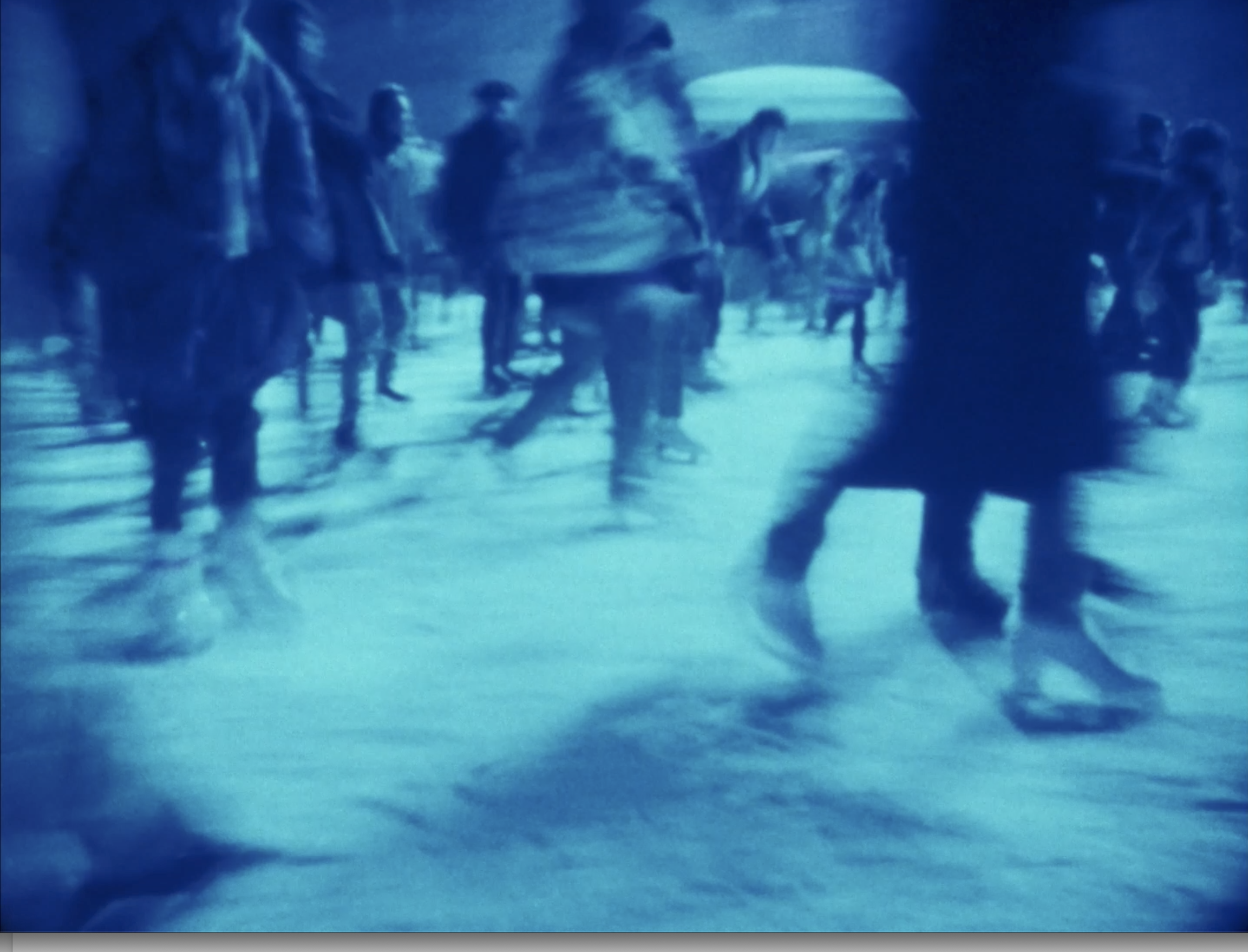
“With fade-ins, darling, I am at the cinema, wallpapering the breaks,” the text declares, introducing a notion of cinema as both construction and concealment. The appearance of an empty sanatorium intensifies this atmosphere, its vacancy suggesting a waiting that may never be fulfilled.
Afterimage, Residue, Name
To watch these films in one go is to encounter the living questions they continue to nurse. What does it mean to look without mastery? How does repetition alter power? Where does pleasure reside in the act of making? Such questions are afterimages in and of themselves.
And then there is the name.
Moucle.
Blackout.
Letters recur.
The “l” overlaps.
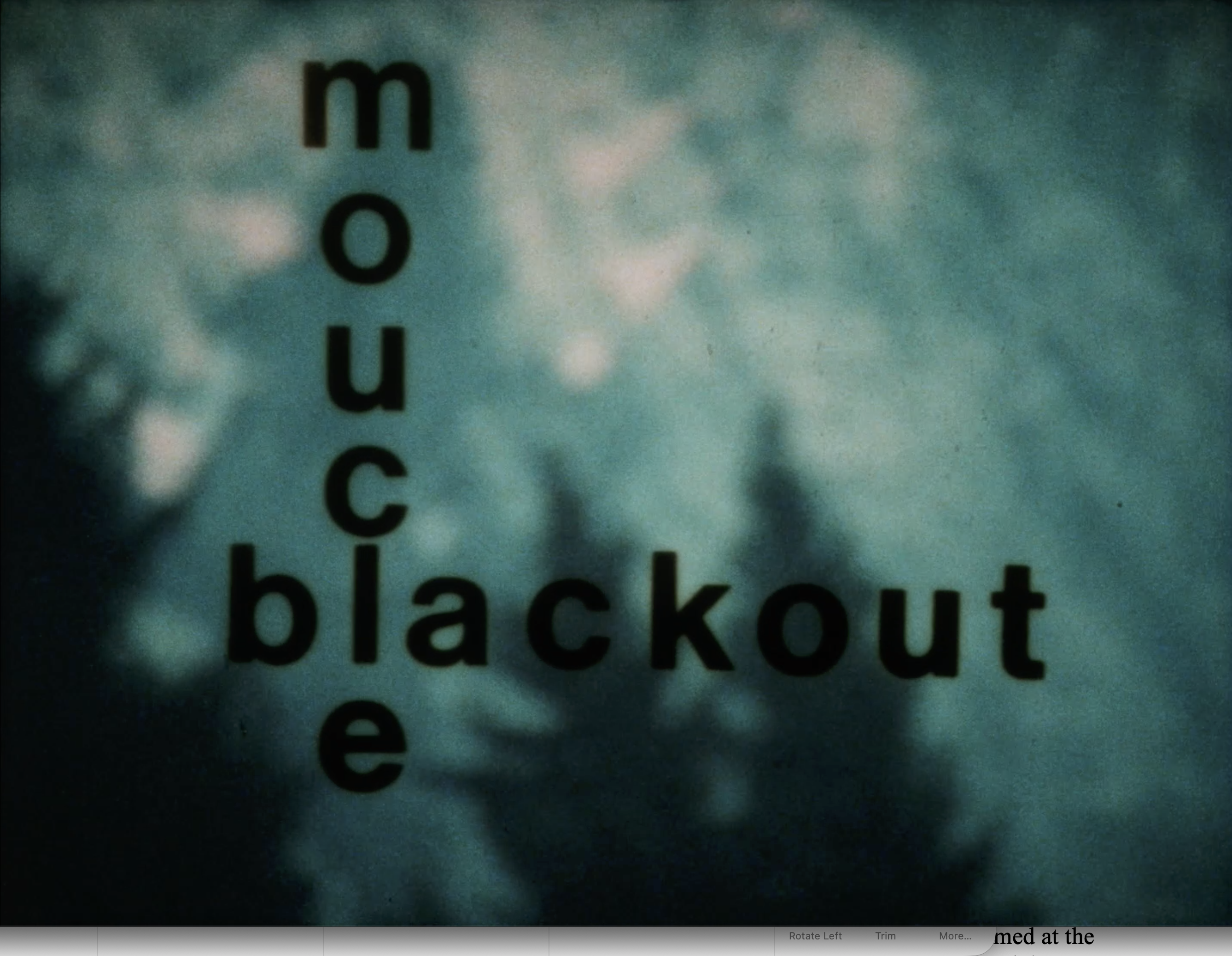
The “c” overlaps.
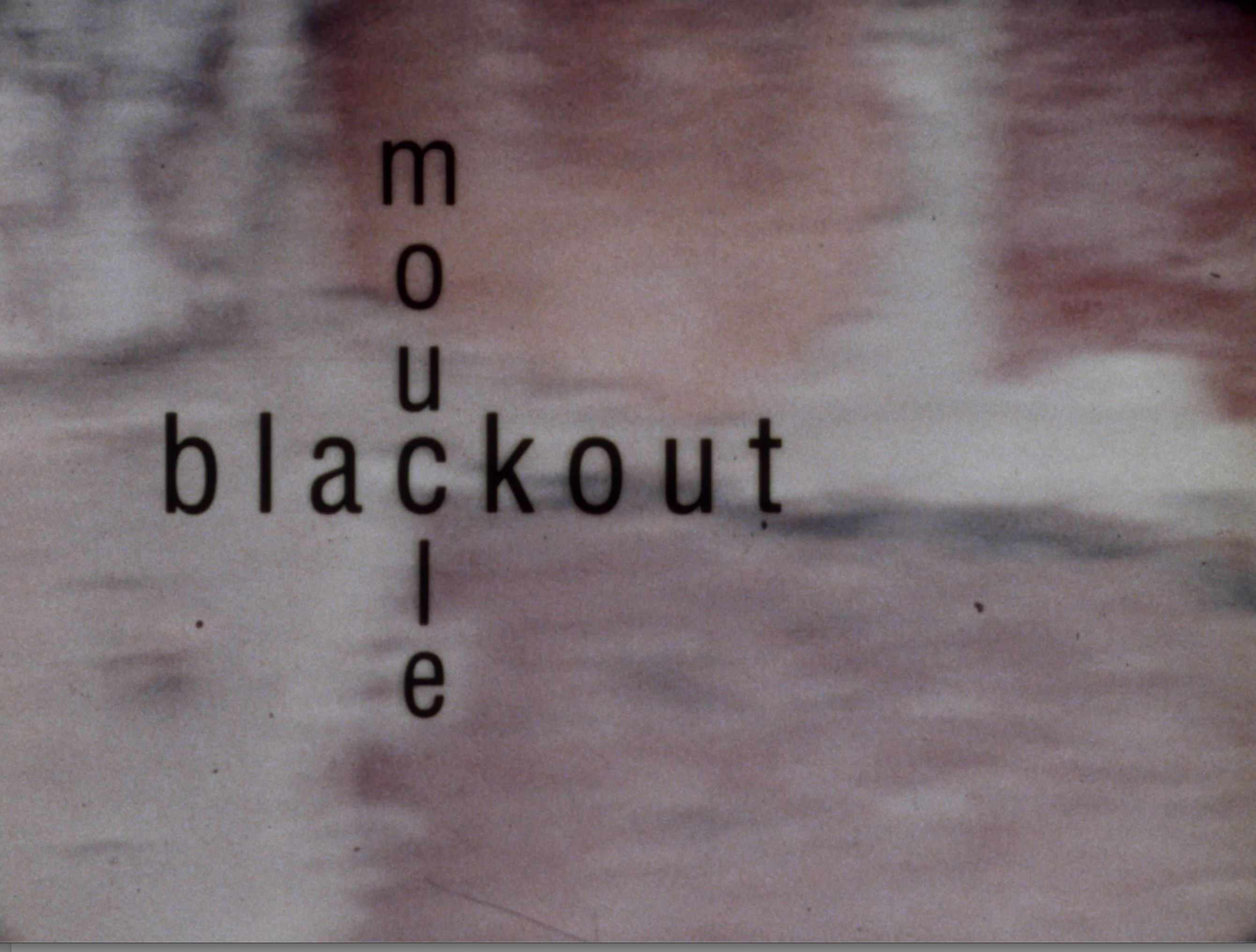
Small intersections suggest identity folding into itself, as though the name were a loop akin to her cinematic imagination. Not one name, in fact, but two. Not one form, but an overlap. A self intersecting with itself in the space between light and its disappearance.
A blackout that reveals rather than obscures, exposing the fragile architecture through which vision becomes inescapable.
 Between Sound and Space: ECM Records and Beyond