

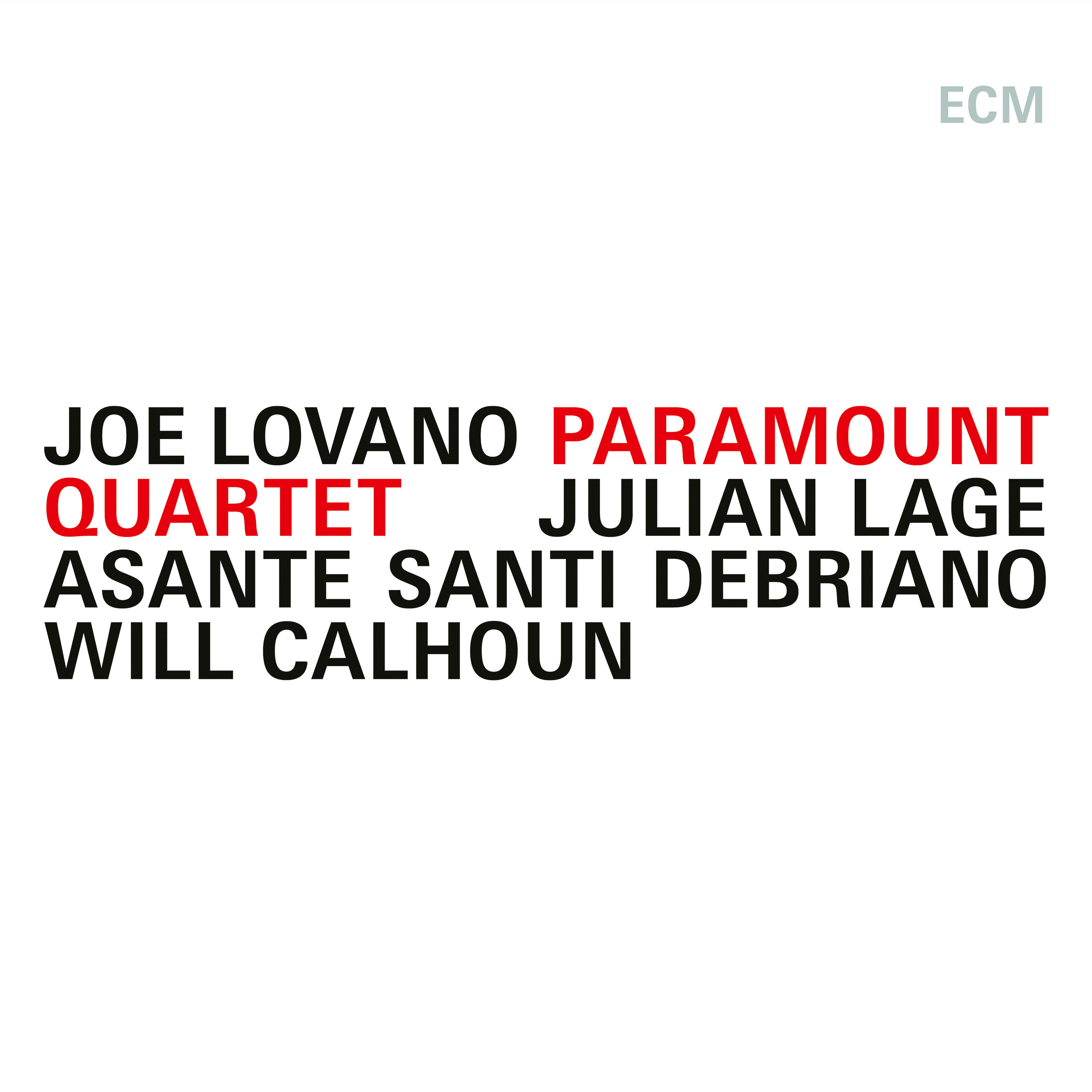
Joe Lovano
Paramount Quartet
Joe Lovano tenor and G mezzo soprano saxophones, tarogato
Julian Lage guitar
Asante Santi Debriano double bass
Will Calhoun drums
Recorded February 2025 at Studios La Buissone
Engineer: Gérard de Haro
Mastering: Nicolas Baillard
Produced by Manfred Eicher
Release date: May 29, 2026
Since making his ECM debut on Paul Motian’s Psalm in 1981, saxophonist Joe Lovano has carried himself like an artist forever standing at the threshold of another doorway, one hand still touching the past while the other disappears into a future no one can predict. His discography refuses the comfort of a straight line. One hears instead a constellation, each recording illuminating a different contour of the same restless spirit. Whether navigating post-bop abstraction, folk lyricism, or the broad geometry that ECM has so often cultivated as its own secret dialect, Lovano approaches reinvention as a moral condition. Paramount Quartet, his new collaboration with guitarist Julian Lage, bassist Asante Santi Debriano, and drummer Will Calhoun, deepens that philosophy into something cartographic. The music feels concerned with passage itself: migration between traditions, between cities, between inwardness and communion. Lovano has described the ensemble as carrying “a real global awareness,” yet the phrase barely contains the sensation of listening to these musicians move through one another’s instincts. After meeting Debriano and Calhoun at a 2023 fundraiser for Puerto Rican hurricane relief, Lovano recognized a current already running beneath the conversation. Bringing Lage into the fold, after nearly two decades of imagined possibilities, completed the circuit with uncanny inevitability.
Lage, making his own ECM debut here, plays with remarkable translucence. His guitar rarely announces itself as accompaniment because it is atmosphere incarnate, altering the temperature of every phrase around it. Sometimes he arrives as a flicker in the corner of the eye, a filament of thought stretching across Lovano’s meditations. Elsewhere, he becomes startlingly corporeal, dragging steel across silence until the music smells faintly of rain striking hot pavement. There is an almost frightening sincerity in his touch.
Lovano’s longstanding affection for Charlie Haden’s “First Song” finally finds its ideal habitat here. The performance opens with Lage casting chords into the darkness like silver coins into black water, each ripple widening across the band’s collective breath. Lovano enters without ceremony, his tenor carrying the grain of memory itself. The sound feels lived in, rain-stained, touched by years that no longer separate grief from tenderness. He does not merely interpret the melody so much as trace his fingers across the cracks in its walls. Debriano and Calhoun move beneath him with exquisite patience, allowing an underlying emotional gravity to reveal itself slowly. What lingers is not melancholy exactly, but the strange warmth of realizing how loneliness can preserve the shape of love long after language has failed it.
“Amsterdam” shifts the perspective dramatically, opening onto a landscape of reflective surfaces and impossible angles. The quartet navigates the piece as nocturnal pedestrians crossing bridges slick with electric glow. Lovano’s improvisational logic slithers through the composition with reptilian elegance, hugging corners, vanishing into harmonic crevices before reappearing somewhere unforeseen. Debriano’s solo unfolds with muscular lyricism against Calhoun’s finely threaded percussion, each note carrying the heft of wrought iron suspended above moving canals. Lage responds by loosening the tune’s internal knots until his phrases spiral outward in widening rings. The titular city gradually ceases to feel geographical, becoming a psychic terrain assembled from fragments and sleepless reflections.
“The Call” draws us inward again. The chamber-like interplay between saxophone and guitar generates harmonies of microscopic precision whose emotional consequences feel almost cosmic. Debriano’s arco bass darkens the atmosphere with strokes that resemble charcoal dragged across damp stone. Lovano’s movement between reeds produces ghostly impressions at the edge of perception, subtle hauntings that alter the barometric pressure of the room without announcing their arrival. Ideas dissolve before they can fully materialize, replaced by others equally transient. Listening becomes an act of wandering through unfinished corridors where every open door reveals another unanswered question waiting patiently in half-light.
“Fanfare for Unity” erupts with kinetic exuberance, though even at its most rhythmically charged, the quartet avoids simple catharsis. Calhoun presides over the track with dazzling elasticity, shaping pulse into something simultaneously grounded and volatile. Beneath Lovano’s acrobatic phrasing, Lage stretches harmonic thread into intricate lattices that shimmer on the verge of collapse. His solo arrives like a sudden burst of graffiti across concrete, angular and luminous and impossible to ignore. Yet what makes the performance resonate beyond technical brilliance is the sense of collective trust animating every turn. The musicians lean toward one another with fearless attentiveness, creating a music that swings hard while retaining the vulnerability of open conversation.
Wayne Shorter’s “Lady Day” receives perhaps the album’s most psychologically expansive reading. Lage introduces the piece with reverential restraint, leaving enough space around each chord for silence to gather its own emotional residue. Lovano responds with phrasing that feels almost autobiographical, every note carrying the weight of private reckonings never fully disclosed. The quartet approaches the composition from within its emotional bloodstream rather than from its exterior form. Seasons seem to pass through in miniature, tiny climates of sorrow and resilience blooming and fading in the same breath. Lage’s counterpoint hovers beside Lovano like a second soul, intimate without imitation, shadowing the saxophonist’s movements while preserving the integrity of his own distinct language.
“The Great Outdoors” channels a life force unmistakably indebted to Motian, though the influence surfaces less in imitation than in attitude. The tune drifts with loose-limbed intuition. Each musician contributes with striking equality, allowing the composition to evolve communally rather than hierarchically. Lage sounds especially liberated here, his lines bouncing with almost childlike wonder, while Lovano pulls rougher-hewn textures from his horn. The music evokes open air without lapsing into pastoral cliché. One hears instead the wilderness of consciousness itself, untamed pathways winding through instinct and recollection.
By the time “Congregation” arrives, the album has already transformed fellowship into something sacred without ever announcing sacredness as its destination. The track glides forward with disarming warmth, its rhythmic ease carrying the listener into an atmosphere of genuine collective presence. There is joy here, certainly, though it is the kind born from survival rather than naïveté. The quartet sounds profoundly at ease inside one another’s company, every gesture shaped by trust accumulated in real time. Yet beneath the celebratory surface runs a quieter revelation. As the music fades, one begins to sense that the album has never truly been about collaboration at all. What Lovano and company uncover across these performances is the fragile miracle of permeability, the terrifying possibility that identity itself may only exist through continual exchange with others. Every solo becomes a temporary shelter built inside another person’s listening. Every rhythm carries fingerprints from elsewhere. By the end, the quartet no longer resembles four musicians negotiating shared space. They sound like evidence that self-awareness may itself be communal, that somewhere beneath the noise of individuality there exists a deeper reservoir where all voices dissolve into one trembling human breath moving through darkness toward whatever waits beyond it.
 Between Sound and Space: ECM Records and Beyond