

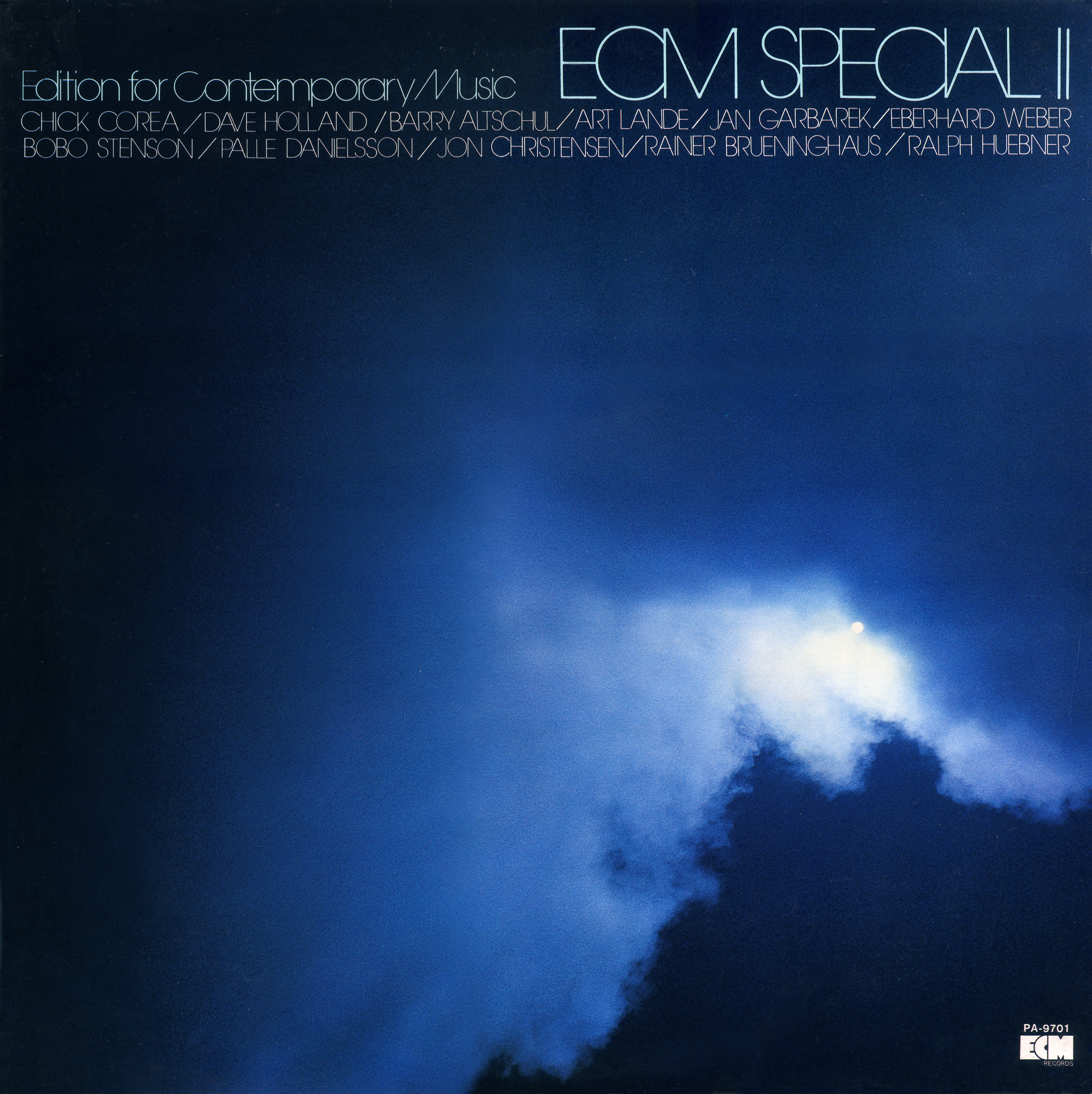
Returning to ECM’s formative years can feel like entering a chamber where the future has been stored in mineral form. The label’s early catalog still radiates that paradoxical condition of sounding both newly born and long remembered, and in the context of this rare Japanese compilation series, the effect deepens into something almost ceremonial. Following its 1973 predecessor, ECM Special II gathers fragments from separate iterations of the same dream, arranging them not as a set of nested thresholds. Taken as a concentric circle, the album moves from exploratory outskirts toward a luminous core, asking us to hear outtakes and canonical statements as parts of one larger organism, a spiral of unfinished thoughts becoming articulate in the dark.
At the outer rim are two outtakes from the classic album A.R.C., with Chick Corea at the piano and Dave Holland on bass, while Barry Altschul’s percussion scatters sparks across the floorboards. Holland opens “Country Song” with a line that seems to hitch itself to some imaginary caravan, sturdy yet strangely weightless, giving the track its momentum. Altschul adds a granular shimmer, while Corea moves between muted-string color and full-throated pianism with an Americana feeling that never settles into nostalgia. The foot-stomping vamp has charm, certainly, but its deeper value lies in the sense of musicians testing the tensile limits of a shared intuition. Holland’s soloing is robustly delightful, his amplified twang stretching across flat plains and invisible roads until the music begins to smudge at the edges. Corea’s atmospherics gradually loosen the frame, and what might first appear to be a minor archival curiosity begins to glow as a document of cognition in motion. “Vadana II” pulls the circle outward into more abstract terrain, where the trio’s passion seems almost too volatile for the vessel meant to contain it. The thread loosens, vanishes, returns with a changed face. Structures rise and collapse into their own scaffolding. What remains is a sonic kaleidoscope whose beauty comes from the audible heat of refinement.
One ring inward brings us to two pieces from Red Lanta, the singular collaboration between Arte Lande and Jan Garbarek, one of the most quietly enchanted productions of ECM’s first decade. Their pairing possesses a delicacy that never becomes fragile, a pastoral intelligence sharpened by inward pressure. Garbarek’s flute enters with a lilting candor, while Lande’s pianism opens corridors inside the harmony. In “Miss Fortune,” the duo cultivates a bucolic edge without turning picturesque, breathing through a faintly impossible geometry of sunlight combed over fields. “Cherifen Dream of Renate” leans further toward folk inflection, yet its dream logic resists any simple earthbound reading. The piece seems to remember a village that may never have existed, a place built from half-sung names and the amber residue of sleep. Together, these tracks deepen the compilation’s circular design, translating the restless inquiry of A.R.C. into a more inward grammar of tenderness.
At the album’s center stands “Kukka,” from Garbarek’s seminal Witchi-Tai-To, where his tenor assumes the foreground with a calm intensity. Bobo Stenson’s piano keeps opening new surfaces beneath him, Palle Danielsson’s bass crests with lyrical force, and Jon Christensen’s drumming seems to occupy every corner of the room without crowding it. Though it is among the more laid-back selections from an often kinetic album, “Kukka” is no less dizzying for its abundance of internal motion. Stenson’s soloing has that rare quality of sounding inevitable only after it happens, while Christensen transforms time into a field of hidden hinges. Danielsson’s lines rise with a singing patience, giving the performance one of its most quietly magical moments. What makes the piece endure is its refusal to announce its profundity. It simply unfolds, and in unfolding reveals that restraint can be a form of velocity.
And then there is “The Colours of Chloë,” from Eberhard Weber’s album of the same name, a masterpiece whose presence here serves as a subterranean engine. With Rainer Brüninghaus on keyboards and Ralph Hübner on drums, Weber shapes a sound that remains unmistakable even when stripped of context, intimate yet vast in its truth. Against the rolling tide of synthesizer, images of the past flicker with cinematic charge, allowing the ears to remember what the eyes never witnessed. That whistling threadline comes alive with possibility, opening a path for Weber’s elastic bass and Brüninghaus’s photoreal sense of color to shine forth. Few artists have ever assembled atmospheric and melodic architecture with such uncanny poise. Weber’s sound world found its perfect complement in Manfred Eicher’s production sensitivity, which here feels like a form of listening made visible.
ECM Special II embodies a small philosophy of adjacency, a record of how music migrates from margin to center and back again without losing its ambient temperature. The outtake, the duo miniature, the iconic statement, the remembered masterpiece: each occupies its place in a mandala that turns archival miscellany into metaphysical cartography. These tracks arrive from the past without behaving as relics, each bearing questions that have not finished asking themselves.
Perhaps that is the unexpected gift of this album. It does not merely remind us that ECM’s early years were fertile; it suggests that listening is a form of archaeology practiced on the unborn. We lower the needle and discover not what was, but what still waits inside what was.
 Between Sound and Space: ECM Records and Beyond