

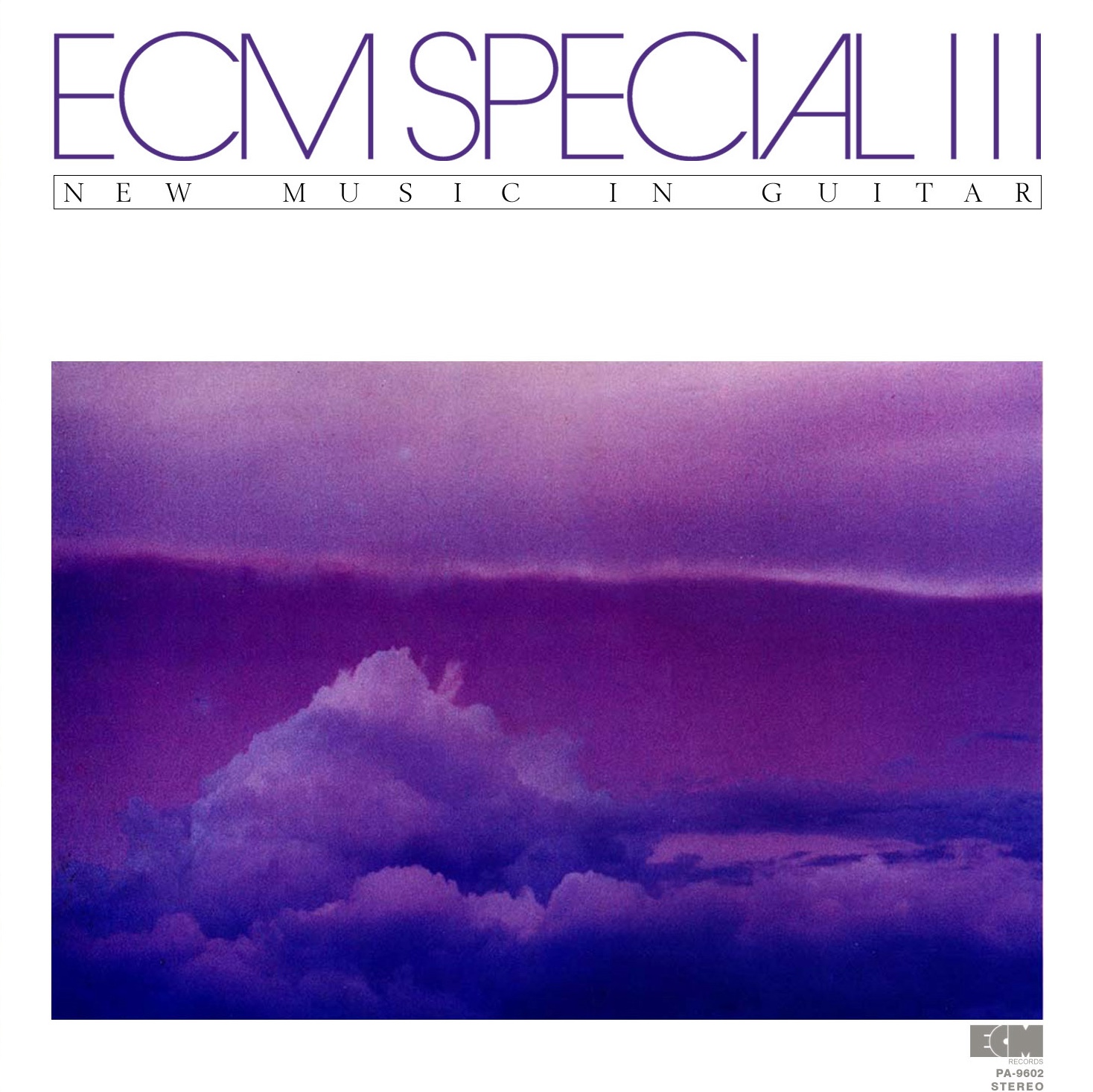
Following the first two ECM Special albums from the Japanese Trio Records imprint, this subsequent volume is the series’ first proper compilation, drawing finished tracks from a handful of canonical albums in the label’s history under the subtitle New Music in Guitar. That phrase is already a small philosophical disturbance. Not new music for guitar, as one might expect, but in guitar, as though the instrument were an interior world all to itself. Across these selections, the guitar becomes a threshold between the solitude of the hand and the vastness that opens when strings agree to tremble.
The journey begins with “Love Song” from John Abercrombie’s Timeless. On acoustic guitar, Abercrombie is joined by Jan Hammer on piano for a reverie that seems to hover in the afterglow of an otherwise phenomenally kinetic listening experience. The melody is tender and circular, a moonflower in fullest bloom of night. Interestingly, although drummer Jack DeJohnette is billed on the album, he does not appear on this duo track. Yet DeJohnette emerges alongside Abercrombie in the next selection, “Unshielded Desire,” taken from the first Gateway session, and the contrast is electrifying. This improvised powerhouse awakens the nervous system to the inspiring forces of these late greats, as Abercrombie’s guitar opens a fissure in the floor of the music, revealing a furnace underneath.
Next comes “Sad Hero” from Bill Connors’ enchanting Theme To The Gaurdian. Although Connors made only a handful of appearances on ECM, none were as intimately crafted as this. The present selection is a multitracked wonder in which different moths seem to gather around a single hidden lamp, each one casting a separate shadow from the same source. Connors plays with heartfelt attention to detail, yet the result never feels polished into sterility. The music carries the ache of an inward epic compressed into a few minutes of glowing filament. This track feels strangely inevitable beside Terje Rypdal’s “Like a Child, Like a Song,” the concluding piece from After The Rain. Another superior example of a single musician creating an entire world from scratch, it is characteristically fluid and dreambound in its quiet intensity. Amplified strings and piano are the primary voices, for all an elegiac vapor that erases the wall between composition and dream inscription.
No such sequence would be complete without Pat Metheny, and here we receive two prime examples of his early ECM language. “Watercolors,” from the album of the same name, threads his seamless lines through the fine needles of Dan Gottlieb’s drums and Eberhard Weber’s bass, giving the music a buoyancy both relaxed and exacting. Metheny’s phrasing already has that unmistakable sensation of forward motion carried by inner light, each note advancing with the composure of a traveler who knows the road because he has invented it beneath his own feet. “Missouri Uncompromised,” from Bright Size Life, shifts the terrain with Bob Moses and Jaco Pastorius at his side. The track veers into more twisted paths of improvisational continuity, its angles brighter, its logic more elastic. Metheny’s unwavering commitment to notecraft remains intact, but here the music refuses the straight corridor, choosing instead a route through mirrored stairwells and sideways doors.
“Matchbook” brings together Ralph Towner and vibraphonist Gary Burton, and the title track of their first duo record holds up beautifully for its shining atmosphere and fluid morphology. Towner’s guitar finds an ideal counterpart in Burton’s luminous attack, and together they construct a miniature habitat of suspended lines in which every tone has a tensile purpose. Last is “Elbow Room” from Sargasso Sea, which carries Towner forward with Abercrombie, bringing the compilation full circle. Its combination of electric and 12-string signatures continues to sparkle through an inventive exchange that feels conversational without lapsing into casualness.
Listening to this album now, one can only imagine what it must have felt like for Japanese audiences encountering these sounds at the time, gathered under careful curation. What a treasure, certainly, but the treasure may not reside only in the tracks themselves. Perhaps it lies in the act of transmission, in the record as a vessel crossing languages without translating anything, carrying the grain of fingers, circuits, wood, and breath into another listening culture. In that sense, ECM Special III is a small ceremony of distance overcome. The guitar, held close to the body, becomes a machine for imagining elsewhere. And somewhere in that elsewhere, the listener discovers that music’s deepest intimacy may be its refusal to belong entirely to the one who made it.
 Between Sound and Space: ECM Records and Beyond