

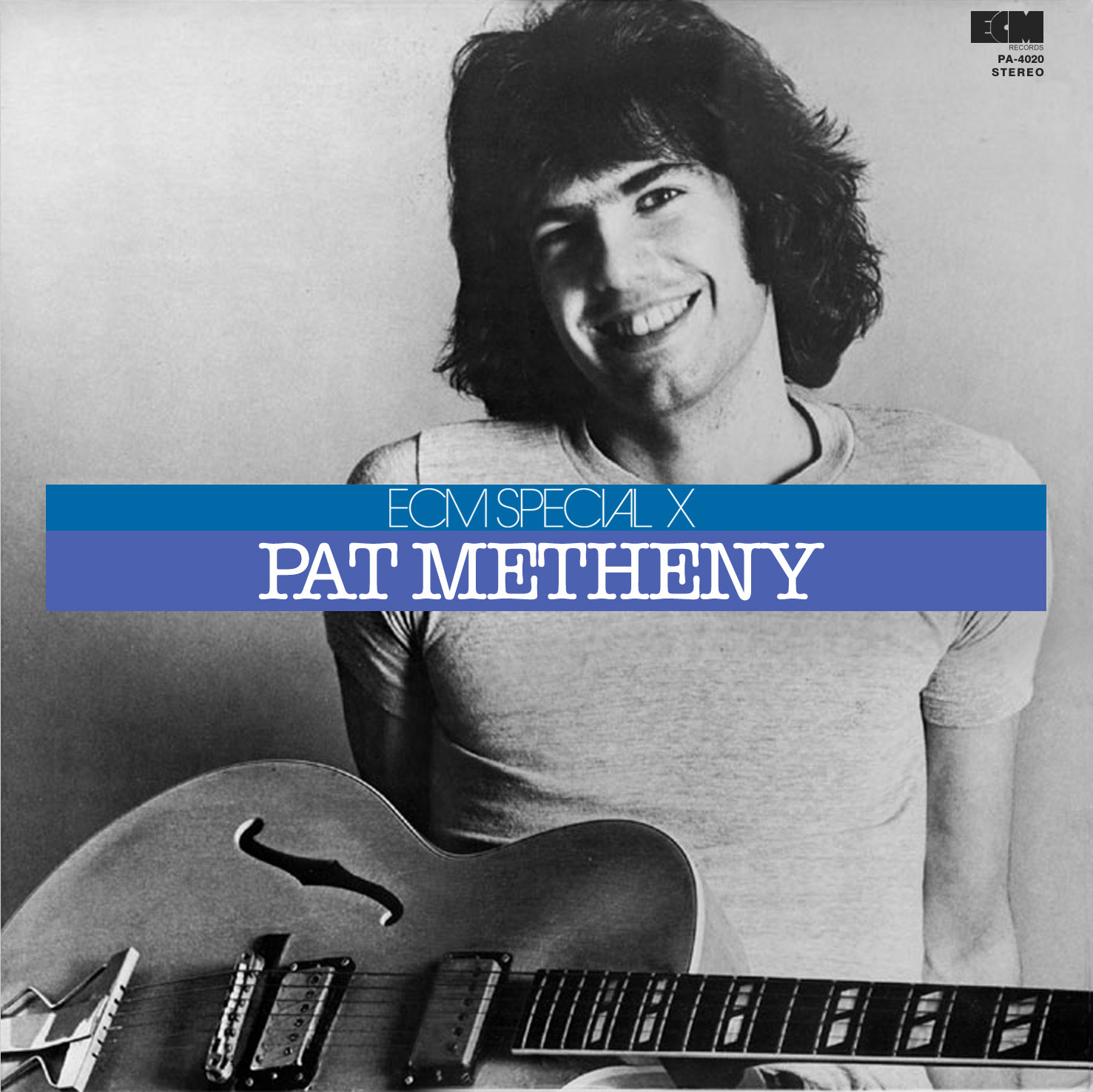
For the final volume of the ECM Special series, released in 1980, we are given not merely a selection of standout Pat Metheny tracks, but a small atlas of an artist still discovering that a guitar could become a horizon-making instrument. The set begins with “April Joy,” taken from the Pat Metheny Group’s 1978 debut, where Lyle Mays sits at the piano with a mind attuned to hidden geometries, while Mark Egan and Dan Gottlieb give the music its bright musculature. Even now, the performance seems to arrive from some impossible corridor between pastoral memory and future tense. Metheny’s sound is already fluent in distances, already committed to that strangely American act of turning motion into meditation. He and his crew do not simply occupy a tune; they survey it, stake it out, raise beams inside its silence, then leave enough air between the walls for the listener’s own interior life to wander through. “April Joy” remains quintessential because its open-road feeling never collapses into postcard sentiment. Its chording gleams with patient intelligence, while its lyrical changes suggest a landscape being thought into existence one bend of melody at a time.
The rest of the compilation draws from Bright Size Life and Watercolors, two albums that catch Metheny at an early stage of astonishing self-possession, before his language had hardened into signature and while every phrase still seemed capable of inventing a new law of motion. From Bright Size Life, “Sirabhorn” and “Unquity Road” present the trio of Metheny, Jaco Pastorius, and Bob Moses in a state of luminous unfastening. The former moves with the soft confidence of someone crossing a border that has not yet been drawn, its pulse carrying the mild danger of freedom before freedom receives a name. The latter, by contrast, has more iron in its stride. The tune understands its destination without surrendering mystery, laying out its harmonic wager with the calm audacity of a gambler who knows the deck is life itself. Metheny’s background chords are not decoration, nor are they simple support; they function as a nervous system of resonance, sending bright impulses through the body of the performance. His soloing then rises through that circuitry with a startling grace.
From Watercolors, the compilation offers “River Quay” and “Icefire,” each revealing a different ventricle in Metheny’s imagination. “River Quay” remains one of the most evocative beauties in his ECM years, but its gentleness should not be mistaken for ease. Beneath the tune’s surface drift, there is a subtle discipline at work, a careful arrangement of emotional angles that allows tenderness to appear without theatrical pleading. Returning to it in the context of this rare sampler deepens its spell, since the piece now feels less isolated than reframed, a quiet inlet in the broader cartography of Metheny’s early art. Its charm still rings true because it refuses to announce itself as such; instead, it lets feeling gather in the margins, where melody begins to behave almost botanically, unfurling according to some private rhythm of light. “Icefire” moves inward by stranger means. Alone with his 15-string harpguitar, Metheny draws out pigmental bleed-throughs from the instrument, coaxing tones that seem excavated from a subterranean fresco.
As the last ECM sampler in this series, ECM Special X is modest in form but quietly revelatory in effect. It does not attempt to summarize Pat Metheny so much as illuminate the moment before a personal vocabulary becomes a world. The music gathered here is full of roads, but its deepest concern is not travel. It is the problem of how sound builds a place where thought can stand without becoming still. Metheny’s early work turns lyricism into inquiry and virtuosity into an ethics of attention. What lingers most profoundly is not the guitar’s singing line, nor the glint of ECM space around it, but the sensation that these performances are drawing a map of a country that exists only while being listened to. Yet the unexpected revelation is this: the country was never outside us. It was the listener, briefly made habitable.
 Between Sound and Space: ECM Records and Beyond