

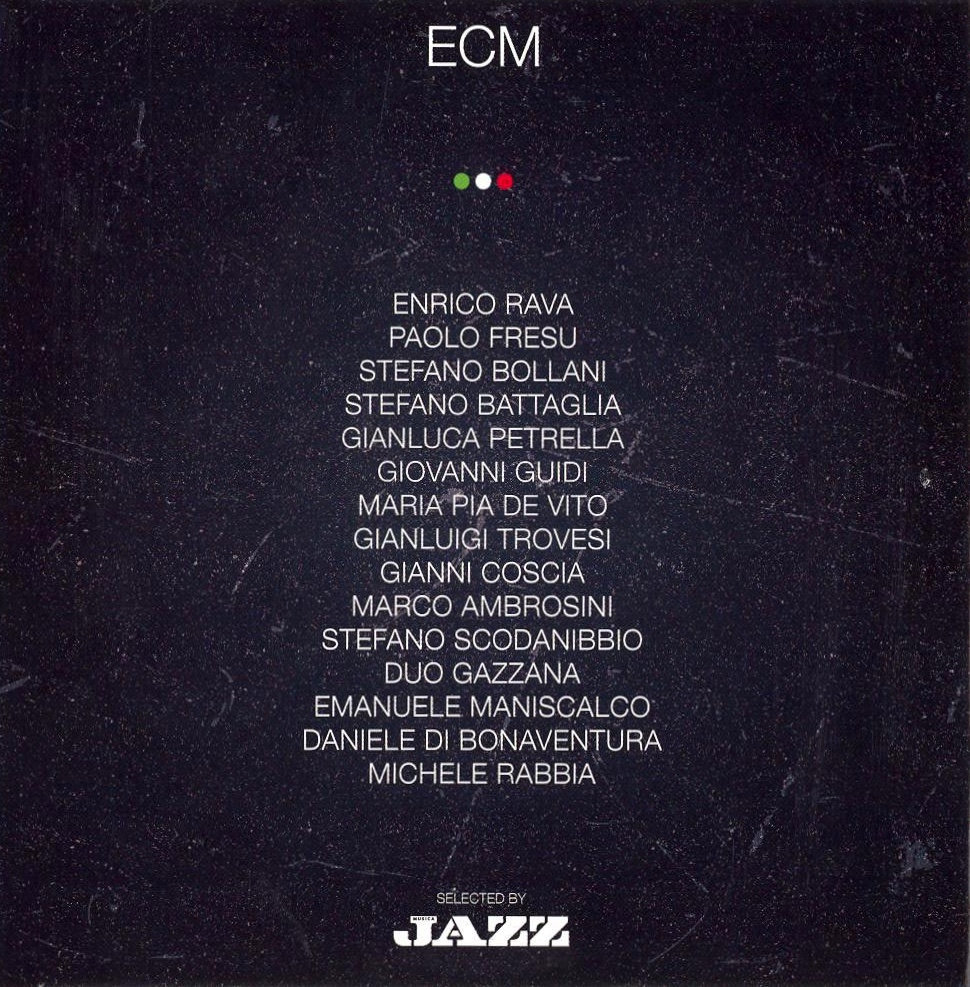
The sampler collaborations between Musica Jazz and ECM Records grew from a partnership woven into European jazz history. Founded in 1945, Musica Jazz is the world’s second-longest-running jazz magazine, and since November 1981, it has included an exclusive record or CD with every monthly issue. These releases extend the magazine’s criticism into sound, giving its features a parallel musical life. Producer Manfred Eicher has often helped curate these issue-specific compilations, each one a compact map drawn by tone and attentive listening.
On this 2015 sampler, one could spin the wheel of ECM’s Italian roster and land on greatness every time. The Stefano Battaglia Trio makes a fitting entry with “Moon And Sand,” drawn from In The Morning (ECM 2429). The performance carries Battaglia’s early encounters with Alec Wilder through Keith Jarrett’s refracting influence. Recorded live in 2014, it seems to discover its shape while already inhabiting it. Battaglia gives the melody a nervous system, then allows the trio to think through it collectively. The band’s phrasing transforms each transition into a subtle shift of gravity. Enrico Rava follows with “Cornette” from Wild Dance (ECM 2456), joined by Gianluca Petrella on trombone. Rava’s restraint is a cultivated pressure, keeping the music incandescent without losing definition. Even at their most unleashed, the musicians preserve their unity. Petrella broadens the ensemble’s grain while Rava’s trumpet opens a narrow passage through it.
Two fascinating trios continue the journey. Third Reel places drummer Emanuele Maniscalco beside guitarist Roberto Pianca, with saxophonist Nicolas Masson completing the group on Pianca’s “Happy People,” from Many More Days (ECM 2431). The piece settles between them in a mosaic of endearing immediacy. A brushed cymbal and suspended guitar tone alter the room’s dimensions as Masson’s saxophone turns inward. Their lyricism is intimate without becoming fragile. The Giovanni Guidi Trio then recalibrates the playing field. With bassist Thomas Morgan and drummer Joao Lobo, Guidi reaches a rare expressive balance on This Is The Day (ECM 2403). Their account of “I’m Through With Love” recalls Tord Gustavsen’s trio at its finest, though Guidi’s touch carries its own lucid ache. As a song without words, it says more than language could contain. The melody approaches confession, then withdraws before explanation can diminish it.
From trio to duo, Inventio (ECM 2438) pairs accordionist Jean-Louis Matinier with nyckelharpa virtuoso Marco Ambrosini in a dialogue across centuries. Their engagement with Bach’s Two- and Three-part Inventions yields the album’s title and its most luminescent notecraft. Ambrosini’s folk inflections draw the Baroque selections beyond reverence’s glass case and toward a deeper origin myth. Interpretation becomes ancestry invented in real time. Clarinetist Gianluigi Trovesi and accordionist Gianni Coscia offer “Alabama Song” from Round About Weill (ECM 1907). Excitement and reverie exchange masks as the elaborations seem excavated from a cabaret beneath conflicting histories. The tune becomes a compass pointing toward mischief.
Other duos appear as small republics of sound. On In maggiore (ECM 2412), trumpeter Paolo Fresu and bandoneón player Daniele di Bonaventura approach Chico Buarque’s “O que será” and Sergio Ortega’s Chilean resistance song, ”El pueblo unido jamàs serà vencido,” with an intimacy that makes public memory feel almost cellular. Fresu holds enormous distance inside a band of air, while di Bonaventura folds it into the squeezebox’s breathing chambers.
Duo Gazzana, consisting of violinist Natascia and pianist Raffaella, enters Francis Poulenc’s Sonate pour violon et piano through its third movement on ECM New Series 2356. Their reading treats elegance as a volatile substance. Precision becomes a threshold beyond which polished surfaces reveal quicksilver argument and sudden tenderness.
The ensembles that close the collection widen the map. On Joy In Spite Of Everything (ECM 2360), the Stefano Bollani Quintet offers the pianist’s buoyant original “No Pope No Party.” Bollani’s playfulness has real teeth, bending charm until it acquires an oblique philosophical edge. Reinventions (ECM New Series 2072) then draws us into composer Stefano Scodanibbio’s idiosyncratic reworking of the Mexican song “Sandunga.” He exposes the source’s subterranean possibilities, turning familiarity into a trapdoor. The tune descends through the instrument and returns with another face, its cultural memory stretched across the strings.
Last comes “Il Pergolese,” from the album of the same name (ECM 2340), by singer Maria Pia De Vito. Her interpretation of eponymous composer’s “Tre giorni son che Nina” is a thing of surreal beauty and drawn shadows. De Vito sings from the border where voice ceases to be a vehicle and becomes a material with its own grain.
As a whole, these selections reveal ECM’s Italy as a geography composed through relation. Instruments become cities and intervals become roads. Tradition survives by consenting to transformation. Bach speaks through folk memory as Poulenc shares a border with resistance song. National identity loses its passport to discover a more difficult citizenship. The sampler’s deepest proposition may be that culture becomes most alive where ownership fails. Music passes through bodies that cannot keep it and eras that cannot contain it. What reaches us is evidence of a larger intelligence moving through human attention. Listening briefly permits us to participate, leaving the unsettling possibility that consciousness itself may be only another instrument, waiting for an unknown hand to remember the piece.
 Between Sound and Space: ECM Records and Beyond