

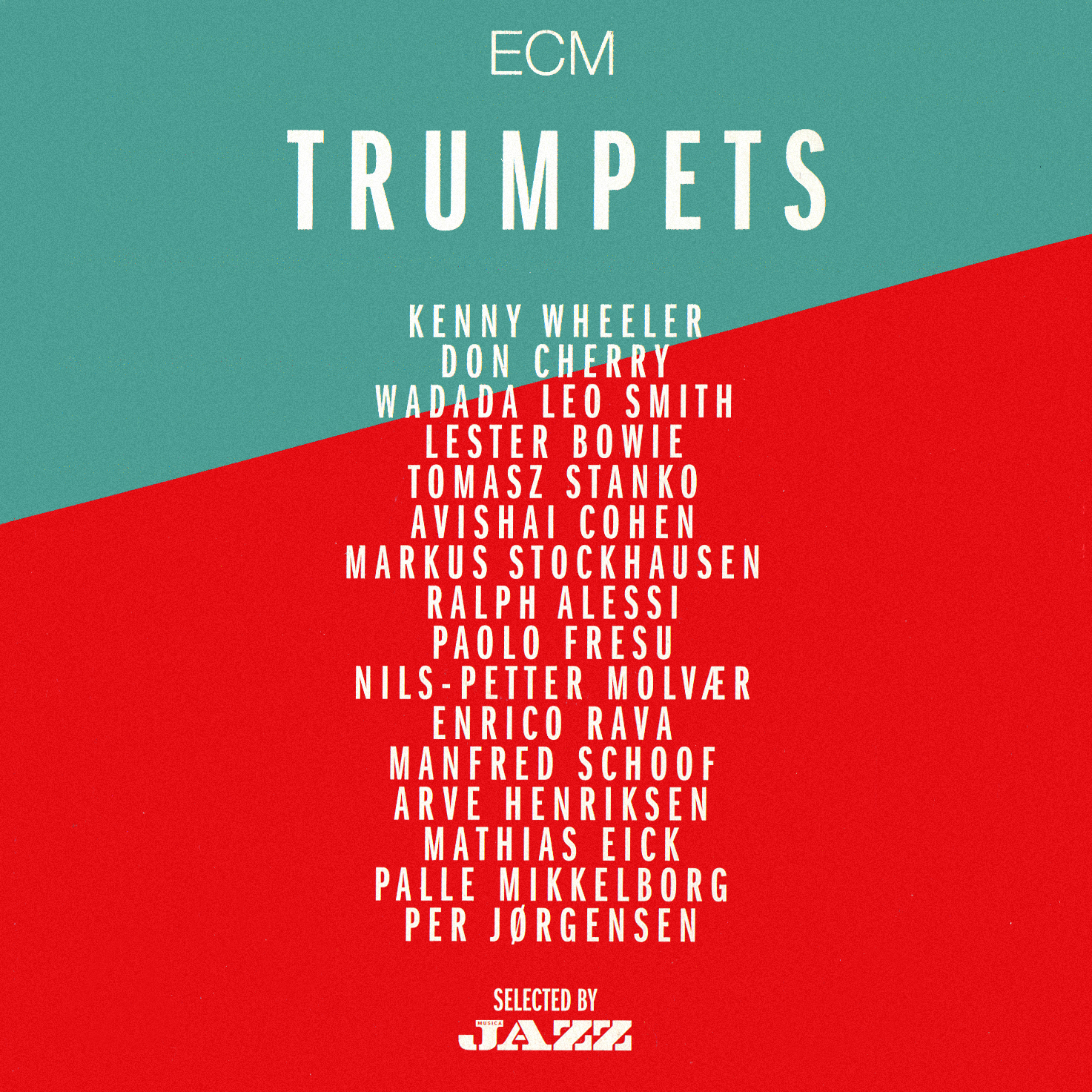
The trumpet is an instrument of thresholds. Its voice arrives from beyond the visible world, bearing summons and warning within the same breath. It can illuminate a melody’s architecture, then dissolve it until only a gleam remains. This rare sampler, included with the April 2016 issue of Musica Jazz, gathers master trumpeters associated with ECM and reveals how differently each has negotiated the border between declaration and disappearance.
Mathias Eick’s “Dakota,” from Midwest (ECM 2410), makes an ideal point of departure. He plays with quiet joy and rare melodic acuity, enlarging the distance between notes until each interval feels inhabitable. His harmonizations with violinist Gjermund Larsen enchant, while pianist Jon Balke brings wonder and space. Bassist Mats Eilertsen and drummer Helge Norbakken keep microscopic currents moving beneath the calm surface.
The compilation then turns toward late-1970s Germany and Manfred Schoof’s quintet. “Resonance,” the North Star of Light Lines (JAPO 60019), is also the credo of a musician whose concentration unsettles through its precision. Schoof diverts the ear even as he guides it toward revelation. Out of that misdirection comes Michel Pilz’s bass clarinet solo, an utterance rising from the ensemble’s depths with real grit.
Time soon becomes part of the sampler’s argument. ECM history appears as a chamber of revolving walls, where past and present overhear one another. Vijay Iyer and Wadada Leo Smith’s A Cosmic Rhythm With Each Stroke (ECM 2486) marked a watershed for the label in the 2010s. The seven-part title suite responds to Indian artist Nasreen Mohamedi, whose diary supplied every title therein, including “All becomes alive.” Iyer’s severe but permeable chords meet Smith’s trumpet, which seems to contain circuitry and blood. Tension observes its own emergence, taking shape one wordless body-jump at a time. Smith reappears later through “Tastalun,” from Divine Love (ECM 1143), joined by Kenny Wheeler and Lester Bowie. Their muted brass incises the music’s dialect with spontaneous intent. The three occupy intersecting dimensions, discovering kinship through breath alone.
A leap to the mid-1980s brings us into the fold of Arild Andersen’s Masqualero group. “3 For 5,” from Bande À Part (ECM 1319), features Nils Petter Molvær beside saxophonist Tore Brunborg. Molvær ascends with muscular elegance, while Jon Christensen’s skipping snare throws a delicate net across Balke’s piano strains. Rhythm sheds its skeleton mid-stride, yet the trumpet preserves direction, carrying within its sling the electronic landscapes Molvær would later cultivate.
Avishai Cohen’s “Behind the Broken Glass,” from Into the Silence (ECM 2482), turns fragmentation into a law of grief and repair. Yonathan Avishai’s pianism offers yielding terrain for Cohen’s roaming tone, which hovers near speech while refusing the finality of words. Edward Vesala’s “Star Flight,” from Satu (ECM 1088), features a young Tomasz Stanko alongside Palle Mikkelborg. Terje Rypdal’s guitar glows beneath Stanko’s scorched solo, recorded as though the microphone had entered another century. (One wonders, however, why none of Stanko’s work as leader made it onto this compilation…) Horns and drums reach a tense agreement while guitar and trumpet fuse into a voice where chaos and reason become the same force viewed from opposing sides.
Contemporaneous brightness arrives through Codona, the trio of Don Cherry, Collin Walcott, and Nana Vasconcelos. “Colemanwonder: Race Face / Sortie / Sir Duke” combines Ornette Coleman with Stevie Wonder in a singular collage. Cherry’s history with Coleman lends it private gravity, though the performance dances through inheritance rather than kneeling before it. Vasconcelos’s cuíca adds grunts, barks, poundings, and knocks, turning recognition into a trapdoor of play.
“Happy Shades,” from Enrico Rava’s Wild Dance (ECM 2456), displays exacting interplay and the bond between virtuosity and restraint. Arve Henriksen’s “Migration,” from Cartography (ECM 2086), nests the trumpet inside dense electronics, sustaining its tone until continuity becomes dramatic. Markus Stockhausen and pianist Florian Weber bring composed whimsy to “Befreiung,” from Alba (ECM 2477), while Per Jørgensen, Balke, and Audun Kleive invent instantaneous freedom in “Horla,” from Outland (ECM 2413). Ralph Alessi’s “Here Tomorrow,” from Quiver (ECM 2438), moves toward the next brushstroke before the present one has dried.
Paolo Fresu joins bandoneónist Daniele di Bonaventura on “La mia terra,” from In maggiore (ECM 2412). The piece emerges from an old film and offers passage away from what the world has become. Fresu’s tone carries an intimacy older than the melody, while di Bonaventura’s bellows open rooms inside the nervous system. Nostalgia offers no shelter; it reveals the past as a foreign country whose borders shift whenever one approaches.
The sampler closes with Molvær’s “Song of Sand II,” transformed by Rockers Hi-Fi on Khmer: The Remixes (ECM 1560/M). The recalibration adds momentum without sacrificing the original’s spectral core. Molvær’s trumpet passes through as a substance resistant to decay, confirming ECM’s claim on futurity as surely as on memory.
ECM Trumpets is proof positive that a trumpet note is a peculiar form of evidence. Breath enters metal, crosses an engineered emptiness, and returns changed beyond recognition. The body cannot follow it. Only the trace survives, suspended between the musician’s interior life and the listener’s unknowable one.
 Between Sound and Space: ECM Records and Beyond