

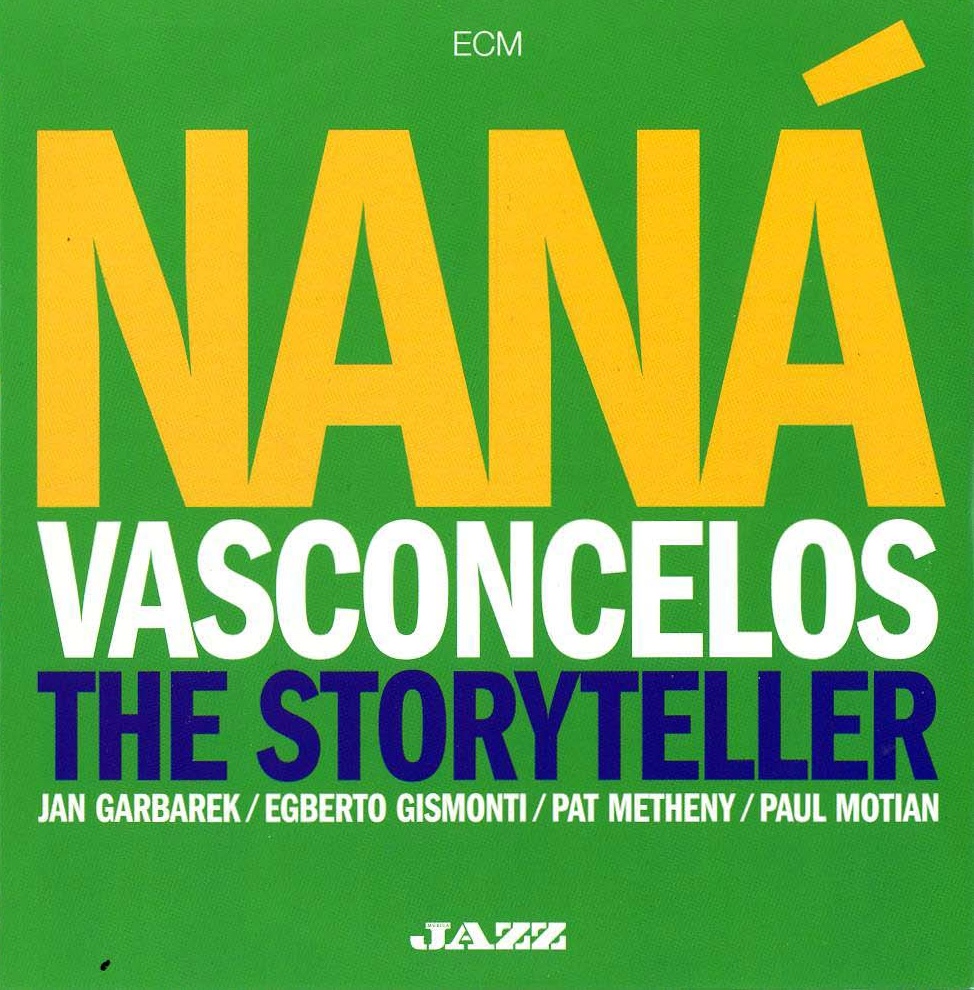
Originally included with the September 2016 issue of Musica Jazz, The Storyteller is dedicated to the life and art of Naná Vasconcelos, one of the most accomplished percussionists in the ECM constellation and, by any reasonable measure, one of the most singular musicians to have walked the earth. Aptly titled, this collection presents Vasconcelos as a keeper of narratives. For admirers of his contributions to recorded art, it is both an invaluable sampler and a small chamber of remembrance.
Vasconcelos had died only a few months prior to this release. Peppe Consolmagno’s liner notes preserve one of the truths most essential to understanding him: “For Naná, even silence was music.” He recognized the spiritual value of knowing when to stop speaking and allow space to reveal itself. Silence, in his hands, was never a vacancy. It possessed an almost animal vigilance. Yet he also knew how to fill that space by exposing what had always been stirring inside it.
He often returned to a few elemental principles. The voice was the first instrument, the body the finest, and everything manufactured afterward merely an extension of those original resources. Music learned through the body could not be misplaced because the flesh retained its equilibrium. Most revealing of all was his declaration, “I am a Brazil that Brazil does not know.” Vasconcelos taught Brazil to listen for the Brazil concealed within itself, beneath official portraits and approved histories. He led his people by the hand into a shadow country that had taken refuge in childhood recollections, ancestral ceremonies, street processions, and voices nearly erased by those who preferred culture to arrive already polished. In doing so, he gave percussion an international vocabulary without sanding away its local grain. Until his final days, music remained his therapy, although the word feels almost too clinical for a practice through which he repeatedly reassembled the fragments of being alive.
Born Juvenal de Holanda Vasconcelos on August 2, 1944, in Recife, the capital of Pernambuco, he entered music before adulthood could teach him to distrust that instinct. At 12, he played beside his guitarist father in the cabarets of his native city. By 14, he was already working as a professional orchestral drummer in Recife and performing dance music with permission from the juvenile court. The detail seems almost mythic: a child granted legal passage into contexts where adulthood was measured not in years but in one’s ability to hold time together for strangers.
In 1965, he traveled to Rio de Janeiro to participate in a festival featuring music by Lourenço da Fonseca Barbosa, better known as Capiba. There he met Milton Nascimento, another artist standing at the threshold of his career, who invited Vasconcelos to collaborate and participate in the recording of his first two albums. Work with guitarist Nelson Angelo and singer Geraldo Vandré helped bring Vasconcelos to national attention. In 1969, Gato Barbieri, during a stay in Brazil, proposed that he travel to the United States and join him on recordings that included Fenix and El Pampero. Vasconcelos lived in New York for ten months with filmmaker Glauber Rocha and producer Fabiano Canosa before touring Europe with Barbieri. He eventually settled in France, where he recorded his first album, Africadeus. His movements across continents formed a system of human magnetism, each new setting enlarging the resonant cavity of his art without severing the cord that bound him to Recife.
This associative way of living entered the music at a cellular level. And so it was that the berimbau became an instrument of impossible scale, one string opening onto an entire civilization, while the voice passed through cries, mutters, laughter, prayer, and invented syllables until the boundaries between speech and percussion could no longer be defended.
His corporeal approach deepened in Paris, where he worked with children living with congenital and motor conditions, using music as a means of contact and discovery. From that work emerged an increasingly expansive conception of the body as both instrument and manuscript. He began to treat sound production as poetry without words, guided by an intensely onomatopoetic awareness of the surrounding world. His music often feels synesthetic in this respect, extracting color from rhythm and motion from timbre. The ear encounters shapes that seem to bend outside ordinary space. A scrape gathers a horizon around itself. A rattle releases miniature constellations into the dark interior of the skull.
The body, for Vasconcelos, was more than a reliable memory device. It was an archive excluded from conventional archives, preserving histories that paper could not adequately hold. Books may record the date of an event or the genealogy of a rhythm, but they cannot contain the muscular knowledge passed from one generation to another through participation. The body remembers what institutions omit, and rhythm can retrieve what power has attempted to bury.
A symbol of Pernambuco culture, Naná became in his later years the king of carnival and maracatu. For 15 consecutive years, he opened the celebrations by leading more than 500 batuqueiros from the 11 Nações de Maracatu de Baque Virado. “To be celebrated while alive,” he observed, “is already a victory; but to be celebrated in your own country is a double victory.” For decades he carried the culture of Recife throughout the world, then returned that international attention to the city from which his music had drawn its first blood. His work foregrounded the African presence within Brazil, particularly in Recife, where that inheritance remained foundational even as its value was diminished or selectively concealed.
Through his advocacy, maracatu regained visibility and social cache. More important, it recovered its capacity to gather people into a communal body. Vasconcelos helped loosen barriers that had seemed immovable. Women entered spaces from which they had once been excluded. Recife’s middle class began participating in a form previously treated as marginal, and maracatu traveled throughout Brazil before extending into Europe and the United States. One of his greatest achievements was this ability to bring distant social classes into proximity, introducing new color and illumination into the favelas while refusing the paternalism that so often contaminates such descriptions. He did not descend from elsewhere bearing culture as a gift. He revealed that the culture was already there, immense and breathing, awaiting the removal of whatever had been placed over its mouth.
Against this vast biography, The Storyteller begins with an intriguing act of indirection. One might expect a solo performance or a duet with his longtime associate Egberto Gismonti, but the collection instead eases into Vasconcelos’s art through “Main Main,” taken from If You Look Far Enough (ECM 1493), his collaboration with Ralph Towner and Arild Andersen. The piece offers a delicate, virtuosic species of funk, restrained in its treatment of groove yet crowded with minute life. Towner’s guitar glints around Andersen’s buoyant bass, while the underlying beat advances with calm assurance. Vasconcelos’s voice punctuates the background with bright, communal accents, becoming a multitude housed within one throat. He seems to stand both inside the music and at its perimeter, encouraging it, astonished by it, and adding sparks to the very fire he has helped kindle. The track welcomes us without ceremony, though its apparent ease conceals a prodigious attentiveness. Every gesture feels aware of the air displaced by the others.
“He Comes From the North,” from Jan Garbarek’s Legend of the Seven Dreams (ECM 1381), draws us farther inward. Garbarek’s soprano saxophone and Rainer Brüninghaus’s keyboards initially establish a suspended northern drift, cool and spacious, until Vasconcelos’s immediately recognizable berimbau enters and changes the gravitational laws of the piece. What follows becomes an inauguration ceremony in sound, its 14-minute duration unfolding without waste. Garbarek’s soprano carries a remote ache, while Vasconcelos supplies a ritual logic beneath the surface. The music does not announce where it is going because destination has ceased to matter. What matters is the alteration of consciousness along the route, the subtle rewiring through which listening becomes participation.
Another membrane is shed with “Walking on Eggs,” from Codona 2 (ECM 1177), the second album by Vasconcelos’s trio with Don Cherry and Collin Walcott. The piece occupies a fertile border between composition and improvisation, proceeding with playful poise while keeping its internal mechanisms deliciously unstable. Walcott’s sitar sends bright filaments through the texture, and the animated rhythms acquire the buoyancy of a game whose rules are being invented by those already playing it. (Little-known fact: Vasconcelos would go on to keep Walcott’s sitar and tablas after the latter’s untimely death, a fact that charges such performances retrospectively with genuine gravity.) Instruments can become reliquaries without surrendering their usefulness. They retain fingerprints, habits, and the minute hesitations through which a musician’s presence once entered the material world. Here, however, no elegy has yet hardened around the sounds. The piece remains alert to pleasure, catching its balance at the rim of surprise.
A wholly different path opens through Pat Metheny and Lyle Mays’s “As Falls Wichita, So Falls Wichita Falls,” the monumental title track from ECM 1190. Across nearly 21 minutes, Vasconcelos unravels a mastery of distance. The piece emerges from field-recorded human activity, chanting voices, shaken textures, and half-legible traces of collective motion. Mays establishes a drone through which Metheny begins mapping an immense social web. The guitar arrives from low rumblings and extends a hand into the crowd, its slackened tone suggesting a message bent by the enormous distance it has crossed. Vasconcelos dresses this slowly forming world in local color without pinning it to any single locality. His work with percussion and drum machine (he was a great admirer of technology) complicates the boundary between inner pulse and extracorporeal repetition. Each seems to dream the other into existence. Synthetic accents mingle with acoustic resonance until the piece enters a radiant, autoharp-laden release. Strings rise beneath a voice reciting numbers in code, as though some buried civic intelligence were transmitting coordinates from below the visible landscape.
After that vast construction, “Saudades” (ECM 1147) offers a few minutes of radical concentration. Vasconcelos performs alone on berimbau, and the result may be his purest articulation of heartspeak. Nothing feels bare because the smallest alteration contains an abundance of consequence. The berimbau’s voice carries solitude without isolation, summoning unseen companions into the room through the precision of its address. One string becomes an axis around which absence slowly turns.
“Carneval of the Four,” from Singing Drums (ECM 1274), follows with a dramatic expansion of the percussive field. The rarely discussed collaboration joins Vasconcelos with Pierre Favre, Paul Motian, and Fredy Studer, four percussionists whose distinct sensibilities interlock without being reduced to a common accent. The piece is transportive, filled with textures that appear distant in scope yet intimately legible in the story they communicate. African and South American cadences move through one another with effortless charge.
The sampler concludes with the 25-minute suite that also closes Egberto Gismonti’s Sol do Meio Dia (ECM 1116). Garbarek appears only in the opening section, where his mournful ululations cast a pale radiance over the ensemble. Towner’s inviting solo clears an interior space for a fluted passage anchored by percussion and handclaps. The surrounding forest becomes palpable at such moments as an organism whose breathing has entered the performance. Although guitar dominates the surface, Vasconcelos gives the suite its detailed humanity. His colors infiltrate the structure until the entire landscape starts answering him. The hands that clap are also branches meeting in the dark. The voices carry mineral traces. Rhythm rises from below as though the earth were remembering the first body that ever struck another surface and waited for an answer.
This is where The Storyteller finds its deepest coherence. Its selections span different leaders, ensembles, periods, and aesthetic conditions, yet Vasconcelos remains unmistakable because his identity was never dependent on stylistic uniformity. He possessed a rarer form of continuity. Wherever he appeared, sound became capable of remembering more than its immediate circumstances. A rhythm could contain Recife, Paris, New York, carnival, childhood, bereavement, and the mute witness of the hand. None of these elements had to be announced.
To call Vasconcelos a storyteller is therefore to recognize that his tales did not unfold primarily through plot. They moved through the duration between impact and echo. His narrative art concerned the body’s passage across history and the histories that take up residence within the body. He understood that percussion begins with contact, yet every contact also raises an ethical question: What touches us, what do we touch in return, and what changes hands through that meeting?
 Between Sound and Space: ECM Records and Beyond