Paul Bley: Ballads (ECM 1010)

1010

Paul Bley
Ballads

Paul Bley piano
Gary Peacock bass
Mark Levinson bass
Barry Altschul drums
Recording engineered by Tommy Nola, Nola Studios, NYC
Recorded 28 July 1967 (Side 1) and 31 March 1967 (Side 2)
Mixing engineer: David Baker
Produced by Paul Bley
Executive production by Manfred Eicher/ECM
Release date: 1971

As an early ECM release, this all-Annette Peacock set already demonstrated the crystal clear recording and wide open spaces for which the label would come to be so well known. Throughout the long opener, ironically titled “Ending,” pianist Paul Bley handles most of the thematic legwork, while bassist Gary Peacock and drummer Barry Altschul skitter across his ivory surface like ice skaters so skilled they can stumble on cue. The title is multifarious. It’s the ending of a turn; the ending not of a life, but of the fallacy of its fulfillment; an ending of circumstance; an ending of watersheds; an ending of all the things in this world that buy us freedom, only to spit it back in our face. Altschul steals the show, soloing in slow-moving surroundings. The lagging pace lends further prominence to his playing, underscoring far more than mere virtuosity. As the piece goes on, it trickles like water, perhaps cluing us in on the title’s central meaning: that is, the music’s own loss of energy and creative source, a broken dam letting out its final drops. This is restrained music-making by a trio we know can swing with the best of them. Next is “Circles,” which seems to sweep up the mess of a long-waged battle, all the while showing an immense amount of fortitude in dealing with the prospect of an unclear future. Lastly, “So Hard It Hurts” gives a vivid sense of Annette Peacock’s compositional audacity and her unique way of turning gentility into pain, and vice versa. This time, Altschul is less cymbal-oriented and more focused on hitting the skins, providing ample room for bassist Mark Levinson’s own inspired finger work.

A delicate ridge rises between the musicians like a pyramid in every song, casting a moving triangular shadow as the sun marks its passage through time. The adlibbing is insightful and melodically well-aged. There is a crunchiness to this music, like biting into a confection filled with ever-changing flavors.

In 2019, this album was at last given the new life it needed through an ECM Touchstones reissue.

<< Corea/Holland/Altschul: A.R.C. (ECM 1009)
>> Dave Holland/Barre Phillips: Music From Two Basses (ECM 1011)

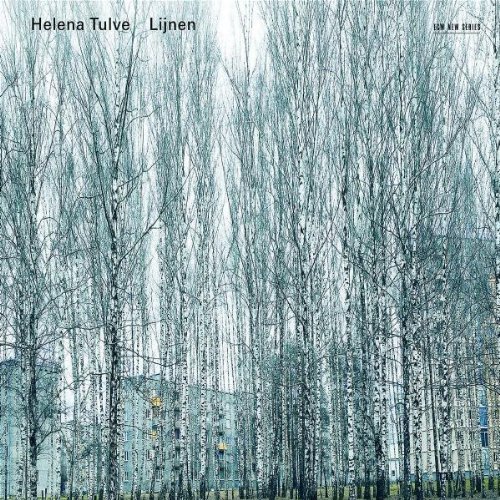
Helena Tulve: Lijnen (ECM New Series 1955)

Helena Tulve
Lijnen

NYYD Ensemble
Olari Elts
Arianna Savall voice
Stockholm Saxophone Quartet
Sven Westerberg soprano saxophone
Jörgen Pettersson alto saxophone
Leif Karlborg tenor saxophone
Per Hedlund baritone saxophone
Emmanuelle Ophèle-Gaubert flute
Mihkel Peäske flute
Silesian String Quartet
Szymon Krzeszowiec violin
Arkadiusz Kubica violin
Lukasz Syrnicki viola
Piotr Janosik violoncello
Recorded between November 1997 and June 2006

Helena Tulve, part of a new generation of young Estonian composers, has the honorable distinction of being the only pupil of Erkki Sven-Tüür. Like her mentor, Tulve breaks down her music into bite-sized morsels, so that even her large-scale works feel like congregations of chamber ensembles. In this representative selection, we get a taste of the latter. Encountering these works for the first time, I hear them as a single story:

In à travers (1998), the ensemble opens with distant calls. A pack of animals wanders, guided by communication alone. These calls come closer as they are taken up by woodwinds. Rather than antagonize one another, they join forces, comingling in search of a new language through which they may repopulate their frozen world. An oboe soloist raises its cry, occasionally overblowing as if to wrench out as much emotion from its solitude as it can: the firstborn of the newly formed colony, flexing its hybrid voice as the pack falls into silence to hear what it has wrought. A viola bravely joins in. Lijnen (2003) continues this conversation, and introduces the lone soprano, who approaches with trepidation. She wanders the landscape like an anthropologist on her first solo field assignment. Her mind desires all the fame this study is sure to bring her, even as her heart yearns to be accepted into the fold, that she might shun the world’s obligations in favor of danger. She scours the terrain with her instruments, her notepads, and her books: all the material culture she has brought from a faraway land. The animals respond with confusion, putting up a dense resistance, not so easily thwarted by her sensitive approach. Her song is half lament and half appeal. Öö (1997) gives us a peek into the anthropologist’s dream. Only in slumber can she approximate this animal language in private. Abysses (2003) awakens her with warning cries. In her half-sleep they seem to come from beyond the forest, but as she grows more aware of the gravity of the situation, she reacts. In the opening haze of cendres (2001), she immediately abandons her tent and hides in the trees, peering out into the valley below. She watches the slow, careful dance that signals the battle to come. There is so much tension in the air that every hair on her body stands on end, and for that instant an invisible thread instinctively connects her to the very subjects of her study. There is a swipe of claws, a bid for distance, but this sets all eyes aflame as reinforcements emerge from thickets and underground hovels, with more yet hidden in reserve. Brief spats of chaos erupt. Eventually, these conflicts subside. The territory has been successfully defended. In the final piece, nec ros, nec pluvia… (2004), the anthropologist weeps because her favorite has been brutally killed. She stumbles down into the valley and weeps over the fallen body. The more she holds it, the more she smells like blood. The rest of the pack surrounds her and kneels to the ground. Once they have licked her clean, they watch her until she has shed her last tear. They no longer fear her, for she no longer fears them.

Lijnen is among the more exciting recordings to grace ECM’s New Series in the past few years. The beginnings and endings of these pieces are open links, flowing into one another in an ongoing chain. This allows us to approach them any way we wish and makes for an utterly genuine listening experience. Tulve is not interested in resolution, but in leaving us with more questions than we started with. In this way, the music stays with us, even if we don’t stay with it. Let’s hope partnership with the label continues.

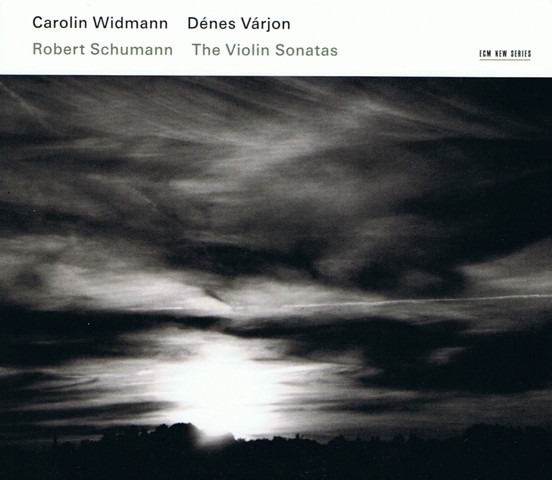
Schumann: The Violin Sonatas (ECM New Series 2047)


Robert Schumann
The Violin Sonatas

Carolin Widmann violin
Dénes Várjon piano
Recorded August 2007 at Auditorio Radio Svizzera, Lugano
Engineer: Markus Heiland
Produced by Manfred Eicher

“Maybe Schumann, as opposed to so many other composers, really is the one whose black dots on white paper represent the least that is actually to be said.”
–Carolin Widmann

Musicologists and historians alike often paint Robert Schumann as a tragic figure. The mental degeneration of this prominent composer has become a prototypical example of the genius in decline and of the ineffability of humanity’s most creative energies. Admittedly, I have been guilty of this characterization myself. But when we hear a recording like this, all that myth-making goes straight out the window. These sonatas are among Schumann’s final works, the first two having been written in 1851 and the third in 1853, and are no less engaging for it.

Sonate Nr. 1 für Pianoforte und Violine in a-Moll, op.105
This is an absolutely glorious sonata. The piano parts are alive with ideas and seem to come in waves. The second movement is one of Schumann’s most questioning, cautiously approaching the knowledge it seeks before growing into confidence. The third movement catches us almost unawares with its colorful changes in rhythm and atmosphere. This is the most eclectic portion of the sonata, a beautifully synchronized braid of instrumental forces. After the dainty, lively introduction, suspicions loom threateningly over the finale’s exuberant communion until they crumble into piles of declamatory dust. Only then do we realize the goal no longer means anything, now that it’s unobstructed.

Sonate Nr. 3 für Violine und Pianoforte in a-Moll, WoO 2
Schumann’s third sonata was withheld by his wife Clara for years before it was ever heard. Its central position in the album’s program isn’t an apology, but a gesture perhaps meant to ensure that it be taken seriously. The opening piano thumps like a nervous heartbeat. Its balance is so fine that one false move could easily upset it, but the virtuosity of our duo keeps it perfectly intact, so that we may admire it from every angle and with every assurance of safety. The second movement evolves in retrograde motion to an arousing end, after which the piano’s bass note lingers beyond the violin’s curtailed exultation. The third movement climbs determinedly, aware of its own lightness, its many open paths. The cascading pianism here renders the music into a raging river. Like a salmon swimming upstream, the violin must struggle with all its might to get to where it’s going. Because its life is determined by that very struggle, it relies solely on the challenge of the current.

Sonate Nr. 2 für Violine und Pianoforte in d-Moll, op. 121
Also known as the “Grand Sonata,” Schumann’s second shows off its complex unity at every turn. The opening movement is an epic journey, finding its resolution no fewer than three times before bowing out, while the sonata’s remainder combs through the populous landscape of human interaction. The lesson: in agreement there is no unity, but only the semblance of disparate voices blending into one, whereas true unity is achieved in keeping those voices separate, sharing the awareness of an internal bond that can never be made externally aware.

Widmann and Várjon both see much in the way of modern sensibilities in these sonatas, bringing their progressive approach to every nuance therein. Their dynamic control is so effortlessly realized, they never manage to lose the energetic thread that binds them, even in the quietest moments. Widmann intentionally plays on open strings whenever possible, allowing the rich sonority of her instrument to ring through with an almost harsh beauty, while Várjon take full advantage of the studio’s acoustics to further flesh out the piano’s inherent resonance. If these sonatas are pieces of a larger puzzle, then these two fabulous musicians have foregone the corner pieces and worked their way from the center to the margins.

Mozart: Piano Concertos – Jarrett/Davies (ECM New Series 1565/66 & 1624/25)

Wolfgang Amadeus Mozart
Piano Concertos I and II

Keith Jarrett piano
Stuttgarter Kammerorchester
Dennis Russell Davies conductor
Recorded November 1994 and January 1995 (I); May 1996 and March 1998 (II), Mozart-Saal/Liederhalle, Stuttgart
Engineer: Peter Laenger
Produced by Manfred Eicher

Taken as a whole, the music of Wolfgang Amadeus Mozart (1756-1791) remains one of European classical music’s most indestructible pantheons. Among the many symphonies, operas, songs, and chamber pieces in his formidable oeuvre of over 600 works is a handful (at least in Mozartian terms) of twenty-seven piano concertos. Theatrical, eclectic, and epic in scope, the concertos are the epitome of instrumental music written in the eye of an operatic storm. Their dramaturgy is put on full display in these two stunning double-albums from Keith Jarrett and the Stuttgart Chamber Orchestra under the baton of Dennis Russell Davies. The selections therein were approached improvisationally—that is, Davies never knew exactly what Jarrett was going to do, and vice versa. The end result is warm, spontaneous music-making that tickles the ears and invigorates the soul.

1565

The first set, released in 1996, instituted a major breakthrough in Jarrett’s classical career. If no one had taken him seriously with his ECM recording of the Shostakovich 24 Preludes and Fugues, then certainly he was turning a few heads now. From the moment he lays his fingers upon the keys, Jarrett transports us—and himself, I imagine—to a spacious and familiar world of sound, and in the company of such a finely tuned and responsive orchestra his pianism soars to new heights.

Concerto for Piano and Orchestra No. 23 in A Major K.488 (1786)
This concerto moves in sweeping gestures, spreading its arms over grand vistas, secret gardens, and mazes from which one never wishes to escape. The Allegro is sprinkled with moments of colorful synchronicity in which the piano doubles the flutes, further underlining the symbiotic relationship between the soloist and the landscape he inhabits (this doubling is later picked up by strings for an even broader sense of cohesion). The Adagio pulls away its own skin to expose an arduous inner conflict before trusting its resolution to the pianist’s capable hands. An ever-changing ensemble pairs the piano with different combinations of winds, all “strung” together by the orchestral whole of the infectious final movement. The wind writing is superb throughout and provides some of the concerto’s most insightful moments.

Concerto for Piano and Orchestra No. 27 in B-flat Major K.595 (1791)
Mozart’s final piano concerto opens on a playful note, swinging its way confidently through the branches of a singular musical path. The piano solos glow like childhood, which is to say they are entirely without fear. The central Larghetto begins with a light solo before French horns signal the orchestra to follow, weaving a solitary song. Only then do the piano and orchestra find each other after what feels like eons of separation. The Allegro begins again with piano alone, and as the orchestra picks up the theme in a grandiose call-and-response we find ourselves bathed in a scintillating resolve. The many solo moments injected into the final passage make for a provocative finish.

Masonic Funeral Music K.477 (1785) was written for two of the composer’s Masonic brethren, though sources suggest the piece was more indicative of the Society’s ideological spirit than it was of its dedicatees’ service to it. Nevertheless, its minor shifts and mellifluous wind writing make it an elegant experience all the same.

The Concerto for Piano and Orchestra No. 21 in C Major K.467 (1785) is heavier on the strings and is distinguishable by its overtly march-like rhythms. The piano seems to act in the opening movement as a complicated ornament rather than as the focus of attention. The ubiquitously famous Andante sounds fresh and crystal clear as Jarrett carries the orchestra along its pastoral journey with a precise left hand, dropping a trail of breadcrumbs into the encroaching twilight. The virtuosic final movement is nothing short of breathtaking.

The Symphony No. 40 in G Minor K.550 (1788) is one of only two Mozart symphonies in a minor key and is almost as recognizable as Beethoven’s 5th. It comes gloriously alive in this passionate performance, of which the third and fourth movements stand out for their stately precision.

<< Robin Schulkowsky/NPM: Hastening Westward (ECM 1564 NS)
>> Terje Rypdal: Double Concerto (ECM 1567)

… . …

1624

The second set of Jarrett/Davies Mozart collaborations, released in 1999, shows the two interpreters exploring this fine material from an even deeper point of articulation.

The Concerto for Piano and Orchestra No. 20 in D Minor K.466 (1785) is the most somber of either program. Its Allegro builds a structure of monumental darkness. Ironically, the slow movement has far more energy than its predecessor, while the third is one of the masterpieces of collection, bristling with plenty of Mozart’s character-defining trills.

Concerto for Piano and Orchestra No. 17 in G Major K.453 (1784)
This is an epic concerto with another gorgeous Andante and an inspiring Presto that abounds with the liveliness one would come to expect from the younger Mozart.

Concerto for Piano and Orchestra No. 9 in E-flat Major K.271 (“Jeunehomme”) (1777)
The ninth concerto is the earliest piece of either album, written when the composer was just 21. This picturesque concerto is considered exemplary of the classical aesthetic. The opening Allegro is deceptively simple and endlessly colorful; a lush Andantino seems to yearn for an impossible love; and the final movement dutifully carries out its joyful mission, reporting back with most resplendent success.

The piano concertos are so long that, on a 2-CD set, they only leave room for shorter fillers, like the humble Adagio and Fugue in C Minor K.546 (1788), one of his most “filmic” pieces. While the Bach influence is clear, there is a dramatic undertone that is distinctly Mozart’s own and which provides a fitting close to another thoughtful and finely executed album.

Mozart constructed his piano concertos in such a way as to encapsulate all of the space embodied by the strings in the piano’s introductions. In this way he delved microscopically into the larger orchestral organism, revealing hidden biologies with laboratorial precision. Every movement is like a pianistic symphony in and of itself, a fully fleshed musical entity whose relationship to its neighbors is more genetic than it is formal. Davies shows a profound aptitude for the music at hand, as does Jarrett, who breathes clear diction into every phrase. Jarrett also excels in the ornamentations, especially in his many exuberant trills. This is classical music at its “grooviest” and is sure to please. Despite the epic length of the concertos, many surpassing thirty minutes, this could be a demanding listen were it not for Mozart’s continual innovation and unwavering commitment to circumstance. At any rate, the combined forces of Jarrett and Davies make even the heftiest doses easy to swallow.

I find it baffling to see that what little criticism these recordings have garnered focuses solely on Jarrett’s playing, calling it mechanical and lacking in the improvisational flair one would expect from the consummate jazzman. For what it’s worth, I find his performances to be nothing less than inspired and uplifting. I should make the reader aware, however, of the recording itself, which in the first set places the piano curiously distant in relation to the orchestra, as if at the back of the hall or even in a separate room. While this positioning works more fluidly in certain movements over others, ultimately the listener’s discretion will determine whether or not it is a successful arrangement. I find that it takes some getting used to every time I put the album on, but that once I do the effect is quite haunting.

<< John Abercrombie Trio: Tactics (ECM 1623)
>> Crispell/Peacock/Motian: Nothing ever was, anyway (ECM 1626/27
)

Paganini: 24 Capricci – Zehetmair (ECM New Series 2124)


Niccolò Paganini
24 Capricci

Thomas Zehetmair violin
Recorded December 2007, Monastery of St. Gerold, Austria

The 24 Caprices for Solo Violin by Niccolò Paganini (1782-1840) will forever be the Italian composer’s most vivid mark left on the classical landscape. Born in Genoa, Paganini grew to fame through a rigorous touring schedule and established himself as one of the leading violinists of his generation. Chronic illness, coupled with his promiscuous lifestyle and ill-conceived treatment for a bout of syphilis in 1822, contributed greatly to his physical decline, finally catching up with him in a state of destitution. His incendiary technical prowess and eccentric compositions were such that some believed him to be in commiseration with the Devil, hence the sometimes outlandish nicknames appended to certain high points of his oeuvre. Despite his seemingly sensational life, Paganini’s music is the most immediate medium through which to communicate with this mythical figure of violinry. And what better way to experience it than in the chameleonic grip of Austrian virtuoso Thomas Zehetmair in the gorgeous acoustics of the Monastery of St. Gerold, and all under ECM’s prudent gaze.

Here’s a violinist who isn’t afraid to tear through the crunchy layer of No. 1 with the ravenous abandon of a starving beast.The throaty call of No. 3 turns to liquid gold in his hands, and No. 5, with its astonishing runs up and down the fingerboard, is nothing short of enthralling. The otherworldly trills of No. 6, dramatic leaps to the violin’s most piercing registers in No. 7, swaying double stops in No. 8, and deftly executed harmonics of No. 9 all bring a feverish improvisatory fervor to the fore. No. 10 runs like a deer that has escaped the hunt that preceded it. No. 13, known as “Devil’s Laughter,” enchants with its mockery. Zehetmair displays an uncanny grasp of the technical demands at hand: the triple and even quadruple stops of No. 14 fly of his bow with the ease of a practice scale, and the détaché-laden No. 16 dazzles with its speed and fluid execution of the challenging octaves in the middle section. No. 17 is like a conversation between a highly agitated provocateur and two twins in agreement, while the lilting double stops of No. 21 cry out with unparalleled desire. And then there is No. 24. Perhaps the pinnacle of Paganini’s entire output and often believed one of the most difficult pieces ever conceived for the instrument, it has been taken up by a host of composers and performers, including such diverse talents as Yngwie Malmsteen, Sergei Rachmaninoff, Eliot Fisk, and Benny Goodman. Throughout its compact four minutes, Zehetmar blasts through eleven variations of its opening theme, plus a finale. His handling of the notorious pizzicato passage is particularly noteworthy in this relatively straightforward rendering. While there are more somber invocations to be had—such as those of Nos. 2, 4, 11, and 20—they always seem to be usurped by Paganini’s penchant for the dramatic, exploited here to colorful effect and leaving us thoroughly out of breath by the time we reach the end.

Zehetmair has boldly taken the Caprices and peppered them with his own distinctive embellishments, a task akin to adding a hundred figures to a Bosch triptych: there just doesn’t seem to be any room for them. And yet, he pulls them off with such grace and gusto that I cannot help but smile at his achievement. Even so, he is quick to remind us these aren’t showpieces but “improvised character pieces” that speak to the depth of their creator’s musical reach. This, coupled with a belief in the authenticity of the moment, is woven into every fiber of Zehetmair’s bag of tricks. Only rarely do I use the word “definitive” to describe a recording, but in this case any other adjective seems inadequate.

Morton Feldman: The Viola in My Life (ECM New Series 1798)

Morton Feldman
The Viola in My Life

Marek Konstantynowicz viola
Cikada Ensemble
Norwegian Radio Orchestra
Christian Eggen conductor
Recorded August 2001 at NRK Studios, Oslo

Morton Feldman’s The Viola in My Life (1970/71) is a work of great scope and detail. Each of its first three parts is scored for viola and a variety of chamber ensembles, while the last pairs viola with orchestra in what Feldman calls a “translation” of the first three. Unlike his earlier forays into indeterminacy, Viola is thoroughly composed. Its genius lies in Feldman’s ability to forge massive amounts of empty space into a layered resonance that is anything but “minimal.” The music slowly undulates in tune with the viola’s crests and fades, touched by patches of darkness like a figure slowly walking through lattice-obstructed sunlight. The viola is the center around which the other instruments revolve. This revolution brings the listener full circle with each new phrase, for despite the seeming regularity, each marks an uncertain orbit. The piano in parts I and III grazes the edges of silence, in pursuit of nothing but its own pursuit; the celesta in part II dots our minds with stars; and the orchestral backdrop of part IV carries the viola like a feather riding an upward breath. Such ethereality harbors no romantic promise of freedom. As Feldman himself admits, “The viola’s crescendos are a return to a preoccupation with a musical perspective which is not determined by an interaction of corresponding musical ideas—but rather like a bird trying to soar in a confined landscape.” Eventually we must reperch, and Viola is constantly skirting the boundaries of our cage like a silent but ever-watchful eye. And as I drift off to sleep during the final movement, I feel the eye closing around me, like a lost child embracing himself in lieu of human contact.

This album could easily be titled “The Life in My Viola,” for it is so rich with intimations of a generative spirit. The recording and performances are finely attuned to the music’s inner core, the Cikada Ensemble creating a fine setting for Marek Konstantynowicz’s restrained soloing throughout. Morton Feldman can be a challenge, but his rewards can be even more internal than his music.

<< Trygve Seim: Sangam (ECM 1797)
>> Cikada String Quartet: In due tempi (
ECM 1799 NS)

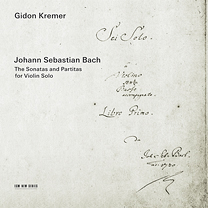
Bach: Sonatas and Partitas (ECM New Series 1909/10 & 1926/27)

Johann Sebastian Bach
The Sonatas and Partitas for Violin Solo
as played by John Holloway and Gidon Kremer

Recorded July and September 2004, Propstei St. Gerold (Holloway)
25-29 September 2001, Lockenhaus, Pfarrkirche St. Nikolaus, and 10-15 March 2002, Riga (Kremer)
Engineers: Stephan Schellmann (Holloway) and Niels Foelster (Kremer)
Produced by Manfred Eicher (Holloway) and Helmut Mühle (Kremer)

I first heard Bach’s Sonatas and Partitas for solo violin on vinyl under the bow of Thomas Zehetmair in his awe-inspiring Teldec recording, which remains my interpretation (and format) of choice. Ever since Zehetmair signed with ECM, I have constantly wondered what untold pleasures a repeat performance for the label might bring. Sadly, this has yet to be realized. Thankfully, however, ECM listeners have two complementary representations to choose from, and for this reason I review them side by side.

Looking Back
As one of the world’s foremost Baroque violinists, John Holloway brings four decades of intimate engagement with these masterworks to the proverbial table. Working from the original autograph score, Holloway takes meticulous care in observing every detail of articulation as a means of arguing for the composer’s own deeply informed knowledge of the instrument. His supple playing and humble approach make for one of those rare “historically informed” performances that actually dusts off the ravages of time and breathes cleanly rather than calling attention to its antiquity. Not only does he bring a visceral robustness to the Adagios and a refreshing regularity to the Prestos, but he also makes sure that every tempo in between is given its own dynamic quality.

I have always cherished the Allemanda of the B minor Partita over all, as it is the last piece I learned to play on the violin before I abandoned the instrument to focus on training my voice. It is typically the standard I go by when encountering a new version for the first time and I am proud to report that Holloway draws from it a wealth of seductive material for our auditory perusal. He adopts a similar posture in the Fuga of the A minor Sonata and in the Siciliana of the G minor sonata, both of which scintillate like dark pools in moonlight. But the true gem of this collection is the D minor Partita, where we encounter one of the most heartrending Sarabandes imaginable, an absolutely resplendent Giga, and as finely executed a Ciaccona as one could hope for. The C major Sonata brings out another exemplary performance, especially in the haunting vulnerability injected into the Allegro assai. The E major Partita is pitch-perfect. Its immediately recognizable Preludio shines with renewed verve in Holloway’s hands.

Looking Ahead
What can one say about Gidon Kremer? He is one of the leading innovators among contemporary classical performers, having inspired a wealth of commissioned music and a somewhat controversial discography of variable projects. Kremer first recorded these pieces for Philips in 1980 and returns to them here in a self-professed “final statement” on Bach. As any avid Kremer listener can expect, this interpretation is at once fiercely idiosyncratic and deeply aware of its roots. His G minor Sonata is appropriately subdued and sets an introspective tone for the entire performance. Kremer truly stands out in the fast movements, such as in the Double Presto of the B minor Partita and the delicately executed Allegro assai of C major Sonata, where he is able to put his dynamic energy on full display. He also puts his “GK” stamp on the more dance-like movements, such as his ravishing Tempo di Borea from the B minor Partita and the Gavotte en Rondeau of the E major Partita. This is not meant to imply, of course, that he is without sensitivity. Under Kremer’s agile fingers the Andante of the A minor Sonata weeps with unrivaled ardor, the Sarabanda of the D minor Partita stumbles with an unusually supplicatory air, and his C major Sonata Adagio brings a whole new sense of tortured emotion to a movement so often played with reserve. Kremer revels in the rhythmic possibilities afforded to him by the score, stretching out as many moth-eaten holes in its musical fabric as he can, so as to emphasize its polyphonic structure and harmonic integrity. He also shows a predilection for sharp attacks. Witness, for example, his crisp Ciaccona, which punctures the ether with the power of a thunderclap. And what of my beloved B minor Allemanda? It has taken some getting used to, but I can now appreciate Kremer’s halted style and flawless tuning, and the liveliness he brings to this somber dance is uniquely his own.

I would never venture to say which of these performances is “better” than the other. Holloway plays at period pitch, while Kremer opts for a modern tuning, resulting in two entirely different experiences. Holloway’s opaque sonorities become Kremer’s airy glitter. These are both recordings to be savored and revisited. The reverberant acoustics and attentive microphone placement put Holloway’s a head above the rest in sound quality, while its somber undertones speak to the violinist’s humility in the face of Bach’s complex symmetries. Then again, Kremer’s staggering attention to detail and variation prove once again why he is one of the instrument’s sharpest proponents. I can only recommend both for their technical spread and complementary attitudes. Not to mention that the pieces themselves belong on any music lover’s shelf.

Meredith Monk: Atlas (ECM New Series 1491/92)

Meredith Monk
Atlas

Carlos Arévalo voice
Thomas Bogdan voice
Victoria Boomsma voice
Janis Brenner voice
Allison Easter voice
Robert Een voice
Emily Eyre voice
Katie Geissinger voice
Dana Hanchard voice
Wendy Hill voice
Meredith Monk voice
Ching Gonzalez voice
Dina Emerson voice
Robert Osborne voice
Wilbur Pauley voice
Radall Wong voice
Shi-Zheng Chen voice
Stephen Kalm voice
Susan Iadone violin
Darryl Kubian violin
Kathleen Carroll viola
Anthony Pirollo cello
Meredith Monk cello
John Cipolla clarinets
Wayne Hankin shawm, sheng, recorder
Wayne Hankin conductor
Steve Lockwood keyboards
Cynthia Powell keyboards
Thad Wheeler percussion
James F. Wilson french horn
Recorded June 1992 at Power Station, New York
Engineer: James A. Farber
Produced by Manfred Eicher

Meredith Monk’s first opera Atlas received its premier at the Houston Grand Opera in February of 1991 and is by far one of her most beautifully realized works. Much of the opera came to the studio in sketches, only to be solidified through improvisation and the synergy of performing with a handpicked group of singers. Inspired by Alexandra David-Néel’s classic book Magic and Mystery in Tibet, the opera’s three acts trace the personal quest of its heroine, also Alexandra, through a life rich in material and spiritual experience. The libretto is so scant that it fits snuggly into this review in its entirety. And while the lack of words certainly challenges operatic norms, it is to no ill effect. If anything, it heightens the work’s profundity.

I. Personal Climate
A young Alexandra takes solace in the domestic comforts of her girlhood, all the while dreaming of what awaits her once she goes out in the world. A minimal overture opens into the comely “Travel Dream Song.” Keyboard arpeggios and a small instrumental ensemble cradle Alexandra’s yearning in a tender embrace. She looks skyward on her swing, running through the majestic details of a life lived in transit:

Mountains…cities…steamships…grass skirts…canyons…cinnabar.

After the haunting overtone singing of “Rite of Passage A,” we come to a crucial intersection in the opera’s crossroads. “Choosing Companions” presents Alexandra’s recruitment of the travelers who will help make her dream a reality. A knock at the door introduces each potential companion, who arrives with a résumé of attributes. The first knock reveals a man who speaks in Mandarin before continuing in English:

Wǒ hěn jiānqiáng.
I am strong.
My heart is broken.
I am a good cook.

The Chinese translates to “I am strong,” and the repetition in English opens a linguistic crack in the opera’s already fragile edifice. Another knock, and in walks a boastful, well-seasoned adventurer:

I own my own equipment.
I’ve got a strong stomach.
I’m good looking.

The last knock introduces the practical explorer:

I have desire.
I have a dry sense of humor, good hiking boots.

Each of these spoken lists is followed by a bit of singing meant to convey the constitution of each character, and takes a rather humorous turn when the egotist sings terribly off key despite his most valiant efforts. “Airport” is the most complex section of the opera, and builds to a fiery climax as a man intones, “Three, Four, One,” until silence overtakes him.

II. Night Travel
This central section features some of the most eclectic sounds in the opera. From the exquisite introductory melody to the apocalyptic “Possibility of Destruction,” we are treated to a sort of aural travel by which the listener is transported along with its subjects. Of note here are the working songs of “Agricultural Community,” and of course Janis Brenner’s brilliant banshee-like vocals and Shi-Zheng Chen’s fearful tremors in “Hungry Ghost.” A glass harmonica introduces a major climate shift in “Ice Demons,” carrying on with laughter and thematic resolution. “Explorer #5” brings more spoken text into the fray:

She can hear for miles.
She is very patient.
She has royal blood.
She drives both shift and automatic.
She has a green thumb.
She can read Sanskrit.

Soon after, the supremely evocative “Forest Questions” bubbles with turgid vocabularies, wailing sirens, and lupine howls. Here, the travelers happen upon the world’s oldest man, of whom they ask:

Has anything changed?
Can I find love?
But I still hear noise.
What is pain?
Will all this last?

If any answers are given here, they are lost in the music, for in being asked they are already gone. “Desert Tango” and “Treachery (Temptation)” provide the opera’s most frivolous moments. The latter in particular is an amusing, almost Heiner Goebbels-like gallery of fools that takes pleasure in drowning in its own vanity:

Finish by five, by five.
Finish by five.
By five, finish by five.
You know you have to, you know you have to do it.
If you put the first one here, and the second there, well then the third…

III. Invisible Light.
The final act is all about reflection, as Alexandra looks back on her life and recounts the ups and downs of her journey. This act works more as a cohesive whole, and in “Explorers’ Junctures” provides a detailed aural map of its entire musical landscape. “Earth Seen From Above” is the most divine portion of the opera, melting into “Rite of Passage B,” which leaves us floating in the upper atmosphere.

Although the staging of Atlas adds a vital component of movement, the “incidental” soundtrack is no less powerful here for its absence. This is motion personified in sound, the poetry of life’s easily forgettable details wrapped in a cloud of human contact. Behind closed eyes we can feel the primordial depth of these performances and of the final destination they seek to illuminate, so that by the time we open them we are already there.

<< Gary Peacock/Ralph Towner: Oracle (ECM 1490)
>> Andersen, et al.: If You Look Far Enough (ECM 1493)

Jan Garbarek/The Hilliard Ensemble: Officium (ECM New Series 1525)

Officium

Jan Garbarek soprano, tenor saxophones
The Hilliard Ensemble
David James countertenor
Rogers Covey-Crump tenor
John Potter tenor
Gordon Jones baritone
Recorded September 1993, Propstei St. Gerold
Engineer: Peter Laenger
Produced by Manfred Eicher

Behold now, I shall sleep in the dust:
and if thou seek me in the morning, I shall not be.

1994 was an intriguing year in music. Jeff Buckley had begun his tragically halted rise to fame with the debut studio album Grace; Portishead brought trip-hop to the mainstream with Dummy; Kurt Cobain shocked many of my generation with his suicide; Pierre Boulez won the Grammy for Best Classical Album with his Deutsche Grammophon recording of Bartók’s The Wooden Prince; and the wildly popular Chant by the Benedictine monks of Silos had taken the North American market by storm. And then there was Officium, a humble recording with the distinction of being the only ECM album I have ever seen advertised on television. I don’t think anyone knew what to expect of its unique combination of soprano and tenor saxophones and choral skimmings from the 12th, 15th, and 16th centuries, but I can still remember the splash it created, selling the better part of a million copies. I made sure to buy mine on the day of its release, simply because of its label and its musicians, and continue to be mesmerized by its sounds to this day. With so many ECM recordings floating through my CD player, it had actually been years since I’d heard this album before revisiting it for this review. I’m pleased to say that, despite the unwarranted flak it has drawn (which, as much as I can tell, is far less than the praise), Officium has aged beautifully and remains a pinnacle of nostalgia in my life as a listener, for it provided some of the most delectable nourishment imaginable at a time when my budding mind was ravenously hungry for new sounds.

At its core is the Hilliard Ensemble’s choice of music, much of it open to interpretation even in its day, by composers such as Pérotin, Pierre de la Rue, and Guillaume Dufay, in addition to a range of earlier anonymous (much of it Czech) material. The opening track, combining Garbarek’s liquid improvisations with the Parce Mihi Domine of Cristóbal de Morales, will always be the one that speaks to me most clearly, if only because it was first to lure my heart into the album’s many inner sanctums. I would say that any claims of disjointedness are quickly dispelled by the anonymous Primo tempore that follows, in which Garbarek’s tenor swells with the mournful quality of an additional human voice. Some tracks are more seamless than others, which is to be expected in the first release of this innovative and ongoing project. Regnantem sempiterna, for example, gives Garbarek less room to work with, forcing him to wriggle his way through a narrower set of possibilities. But then there is the Pulcherrima rosa, during which I sometimes need to remind myself he is even there. There are also those fascinating moments, especially in the Sanctus, when Garbarek descends into unexpected territories, as well as his seductive solo turn in Virgo flagellatur. Either way, Garbarek has an acute ear for vocal contours and matches his playing accordingly. The Hilliards are in typically fine form. Procedentem sponsum and Beata viscera both feature sublime solos from David James, who navigates the droning landscape with utter faith, and Gordon Jones’s* lone rendition of the Gregorian chant Oratio Ieremiae provides some of the loveliest moments on the entire album. Parce mihi domine is reprised at the program’s center (without saxophone) and again at the end (this time, with), thus enacting a tripartite ritual throughout its overall cohesion.

I like to think that Officium led listeners to look at some of ECM’s other fine recordings, if not at other choral albums in general, both new and old. Regardless of any dismissals of this album as a failed New-Age experiment, I like to think of it as a glorious window into a timely solace that enriched the lives of many. Like any album, it may not be for everyone, but one need only take a peek to see what effect(s) it might have.

*Many thanks to Joanna Z. for this correction.

<< Sidsel Endresen: Exile (ECM 1524)
>> Louis Sclavis/Dominique Pifarély: Acoustic Quartet (ECM 1526)