Keith Jarrett: Facing You (ECM 1017)

ECM 1017

Keith Jarrett
Facing You

Keith Jarrett piano
Recorded November 1971 at Arne Bendiksen Studio, Oslo
Engineer: Jan Erik Kongshaug
Produced by Manfred Eicher

Keith Jarrett will always be something of an enigma to me. Not because he is more than human, but because he plays with an honesty that is practically unfathomable. His melodies have a way of spiraling in on themselves and the effect is intoxicating.

This seminal album (his first for ECM) arguably finds Jarrett at his most focused and at his most transparent. Every note seems perfectly placed. His intuition is on fire here and we are only too happy to be engulfed along the way. “In Front” establishes a flavorful and scintillating mood from the get go before taking things down a notch with a requisite set of ballads. Of these, “My Lady, My Child” is achingly beautiful and gets only more so as it unspools. “Starbright” lifts the spirits with a shade of whimsy and gushes with the natural force of a breached dam, with “Vapallia” comprising its final trickles. Last but not least is “Semblence,” which rolls and bounces with the sheer exuberance Jarrett is known for.

What can one say about Jarrett’s performance style? Words like “fluid” and “unbridled” don’t even begin to capture it. His fingers seem to have minds of their own, anticipating each and every note before the next key is struck. Jarrett transcends the rubric of improvisation into something else entirely: improvisition. By this, I mean that his ability to call upon the music to speak is so compositionally disguised that it can only occur when one surrenders oneself to the freedom of the empty score. This produces not objective music, but rather the utmost subjective experience one can have with an instrument.

While Jarrett has been given all the credit for instituting the solo piano as a viable instrument beyond the confines of classical music, let us not forget his wonderful predecessors on ECM (and whose work I have previously reviewed on this blog). This disc is, I daresay, downright groovy. A real discovery to be treasured. Just listening to it makes me want to contort my face and screech along as if I were the one at the keys.

Essential.

<< Terje Rypdal: s/t (ECM 1016)
>> Circle: Paris Concert (ECM 1018/19)

Chick Corea: Return To Forever (ECM 1022)

Chick Corea
Return To Forever

Chick Corea electric piano
Joe Farrell flutes, soprano saxophone
Flora Purim vocal, percussion
Stan Clarke basses
Airto Moreira drums, percussion
Recorded February 2 and 3, 1972 at A & R Studios New York City
Engineer: Tony May
Produced by Manfred Eicher

I fist heard Chick Corea when a jazz pianist friend of mine, knowing how much I loved ECM (I was mainly listening to New Series releases at the time), lent me a copy of this album. For whatever reason, it did not make much of an impression on me. In retrospect, I don’t feel like I was at the right point in my life to welcome such music into my heart. Fast forward some ten years later, and now I can hardly listen to it at all without being overwhelmed by its magic. Fresh from his work with Miles Davis et al., Corea forged a new personal direction with this “electrifying” album, the title of which later spawned a super group of the same name that would become a lasting institution, albeit with a roving lineup, through the late 1970s.

One can hardly listen to Return To Forever without first noting its distinctive mesh of sound. Stan Clarke keeps things running smoothly on bass, and Brazilian jazz singer Flora Purim gives us evocative (sometimes wordless) vocals throughout while her husband Airto Moreira provides ample rhythmic springboards for Corea’s electric piano acrobatics and Joe Farrell’s windy passages on sax and flute. Each instrument is like a voice in a small choir, and the album has been recorded accordingly. Certain passages, like the well-known “Crystal Silence,” dim the lights with a more trio-like aesthetic, but overall the sound is vast and unified. “What Game Shall We Play Today” puts the spotlight on Purim and is a lovingly arranged song that adds just the right amount of color to the album’s palette. Bookending the album are two epic pieces. The opening title track is actually a series of shorter numbers that flow into one another with such continuity that one almost doesn’t notice the pauses, and closes with some impassioned ad-libbing from Purim. At the other end of the spectrum is “La Fiesta” which, after an improvisatory intro, once again features Purim at the helm, leading the way for some inspired solos from Farrell and Corea.

Of all the fine musicians on this set, I cannot help but single out Clarke for his sumptuous bass playing. Never rushed and never forced, his lines thread every needle with unfailing intuition; quite a feat for someone who was only 20 years of age at the time of this recording.

Gorgeous cover art + gorgeous music + gorgeous engineering = a truly definitive experience. What more could one ask for?

This might be as good a place to start as any for those who are new to ECM.

<< Keith Jarrett/Jack DeJohnette: Ruta And Daitya (ECM 1021)
>> Paul Bley: Open, To Love (ECM 1023)

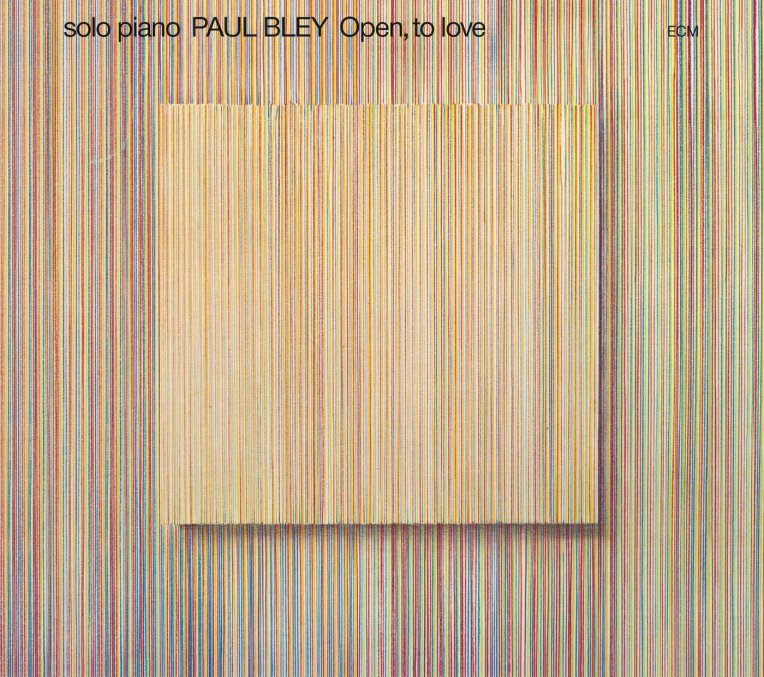
Paul Bley: Open, to love (ECM 1023)

ECM 1023

Paul Bley
Open, to love

Paul Bley piano
Recorded September 11, 1972 at Arne Bendiksen Studio, Oslo
Engineer: Jan Erik Kongshaug
Produced by Manfred Eicher

Hot on the heels of Chick Corea’s diptych for ECM, and certainly not to be outdone, Paul Bley offers up this sizable helping of solo jazz piano. For lack of a better analogy: if Corea’s improvisations were a large family dinner, Bley’s arrangements would be the lemon meringue to follow. Each track doesn’t so much tell a story as try to make us savor its finer details. Bley seems to channel Keith Jarrett at times (or is it the other way around?), as occasionally his voice will creep in with hints of the latter’s seemingly unbounded ebullience. He also directly plucks and strums the strings inside the piano selectively and with tact, adding a fine metallic ring to his otherwise crystalline playing. Bley coaxes our willing ears and leaves us wanting more of his sweet sounds. The album never seems to stray, even if linear melodies are sometimes difficult to pick out. These pieces are duly heartfelt and his version of Carla Bley’s “Ida Lupino” here is stunning.

If ever the word “lovely” was at risk of going out of style for its kitschy implications, let me make a case for this music as a means of reclaiming its validity. Bley’s intimacy is refreshing and comes across beautifully in the present recording. And while one might make a case for Corea’s improvisations as being “dated” (and this is not a bad thing, for its archival value is only heightened as such), Open feels somehow timeless. It is an album that one grows into. The music is for the most part calm and reflective, but ends with “Nothing Ever Was, Anyway” on a bit of an aggressive note; a catharsis, if you will. So does Bley leave the listener with an intriguing question mark that can only be erased with another listen.

<< Chick Corea: Return To Forever (ECM 1022)
>> Gary Burton/Chick Corea: Crystal Silence (ECM 1024)

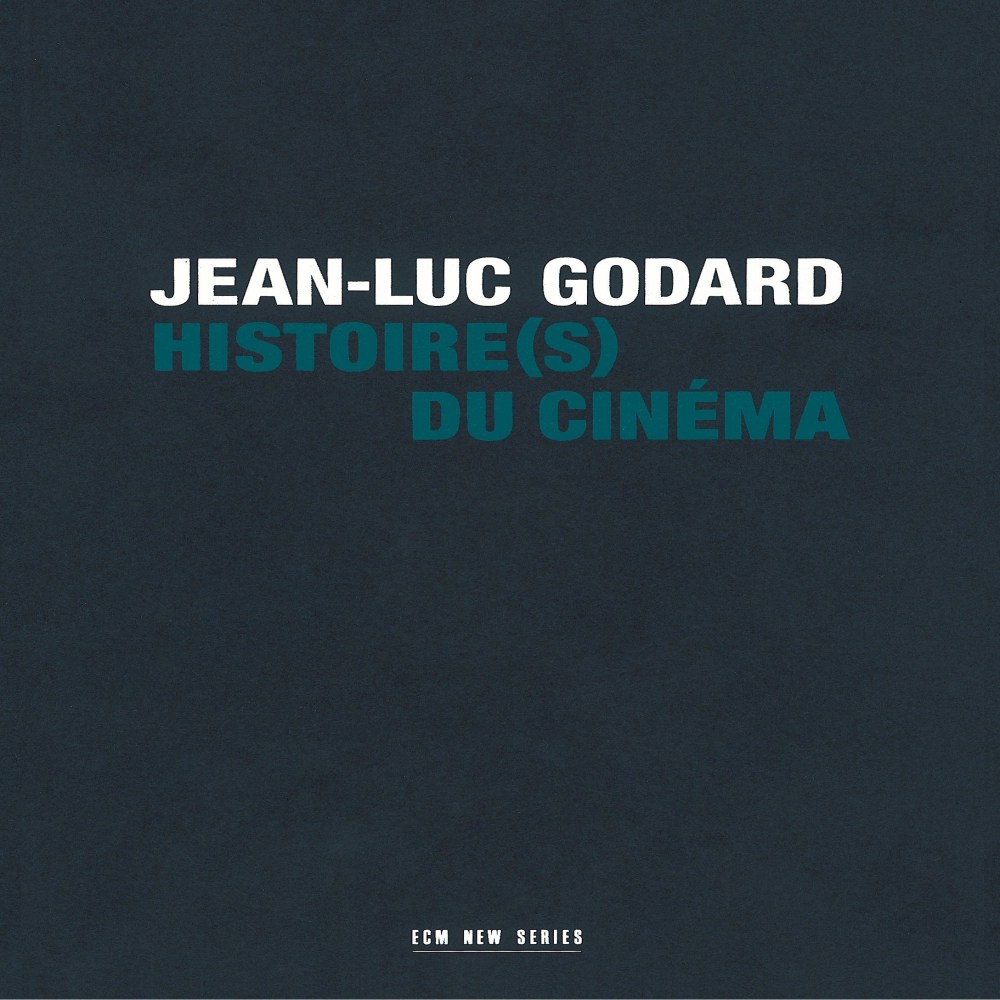
Jean-Luc Godard: Histoire(s) du cinéma (ECM New Series 1706-10)

Jean-Luc Godard
Histoire(s) du cinéma

As one of the world’s most distinctive and important filmmakers, Jean-Luc Godard has not only an amazing eye for images, but also an astute ear for sounds. I first encountered the work of Godard in the singular experience that is Je vous salue, Marie (1985). Having now seen the film dozens of times (it remains one of my most cherished), aside from its unflinching tongue-in-cheek narrative, intimate atmospheres, and visual parallels I am always struck by the film’s innovative deployment of sound. Godard’s splicing of the Dvořák Cello Concerto simply makes sense. Like a rapid-fire commentator, he throws in descriptive snippets wherever and whenever appropriate, never afraid to cut them off at their most soaring moments. This technique has continued to dominate his subsequent work, and nowhere is it more fully realized than in his Histoire(s) du cinéma. What separates Histoire(s) from its predecessors and followers alike is an unequivocal sense of time and image. It is far more than a developmental exposé of the art form, twisting itself as it does into an utterly personal Möbius strip. With his characteristic rough-hewn grace Godard skirts the line between the sacred and the profane, holding a floodlight behind every palimpsestial theme to reveal the ravages of sight and the idolatry of retrospection.

After seeing Godard’s Histoire(s) I felt my view of the imagistic world forever changed; not because what he was doing was particularly revolutionary, but because it was so honest. Whatever one may think of Godard, one can hardly fault him for laying himself bare in every project he takes on. Histoire(s) is so unabashedly mitigated that it becomes translucent.

The ECM enthusiast will already know Godard, whether having seen his films or not, through the occasional visual borrowings manifest in a representative spread of album covers (Voci, Trivium, and Asturiana, to name a few). Regardless, the stereophonic intertextuality of Histoire(s) is obvious. More than just a thoughtfully arranged ECM greatest hits album, this complete soundtrack slithers through a provocative obstacle course sculpted and collaged from a vast archive.

Godard hammers his thoughts into the ether with his automatic typewriter, and its steady rhythm provides a pedal point to Chapter One as he calmly sketches the divisive nature of cinema, upholding its founders while reviling its abusers. Cinema was forged in black and white, he asserts: that is, in the colors of mourning. This is not to say that film was already dead the moment it was born (even if it was never alive to begin with), but that it has always been interested in that which is lifeless. Indeed, Godard believes the only two viable stories of the cinema since its inception have been sex and death.

“that which has passed through cinema
and been marked by it
can no longer get in anywhere else”

The sounds represented on this collection, slip-cased in minimal beauty, are as much something to behold as they are to be held. We may read the words, flipping through their corresponding pages with the careful patience of a novice, and yet we can never disassociate their orality from the visual cultures they describe. The cinema has already taken shelter in our heads by the time its music finds us. Godard is more literary than literal, undermining our wonder for celluloid in favor of the patchwork that is its constructedness.

“if George Stevens hadn’t been first to use
the first sixteen millimetre colour film
at Auschwitz and Ravensbrück
there’s no doubt that
Elizabeth Taylor’s air of wellbeing
would never have found a place in the sun”

By no means is Godard drawing a direct correlation here, luring the nascent viewer with the smoldering promise of self-destruction. Elizabeth Taylor flickers with all the iconicity of a votive candle, unspooling from her reel with a single expulsion of breath. She cannot last like death, and yet that is precisely the dichotomy we fervently hold dear. The march of cinema is a march of faces, each one more clearly disassociated from its body than the last, and serves to ritualize the art of viewing to the point of absurdity.

“technicians will tell you
it’s not true
but it’s worth remembering
that the nineteenth century
which invented all the technologies
also invented stupidity”

Such pronouncements remind us of our own complicity in the ethical vacuum of the cinematic enterprise. In the same way that every film is edited, so too do we clip our lives and adhere them back together in a series of lies and convenient elisions. That being said, I see no reason to believe that Godard is trying to be antagonistic. He is certainly not on a mission to open our eyes, for clearly they are already observing his work in tandem with its message. Rather, he seems to desire nothing but the recording of his desire. He doesn’t make films to be seen, but makes films to be read. With his hands hidden, revealed only by their periodic contact with an ever-present cigar, Godard is able to reform himself with the deceptive real time of his narration.

Chapter Two draws an implicit parallel between the development of recorded sound and recorded imagery. While the former preceded the latter, the two would require decades to synchronize. Godard is perhaps addressing the cinematic turn to melodrama, all the while lamenting over his slumber within, and painful awakening into, the whirlwind of moving-picture production. In human grasp, such a marriage is unavoidable and inviolably tethered to defaulted outlets of mass entertainment.

“to me, big history
is the history of cinema
it’s bigger than the others
because it’s projected”

In this sense, history is not the token of its own achievement, but the extant scar welted from centuries of picking and contortion. The master narrative in which we are schooled turns out to be nothing more than a flat image—there is none of the dimensionality we so readily accepted in our youth.

Time cannot be the sustenance of reason.

Chapter Three is a measured attack on the atrocities of European conflict. It is a scathing about-face related in a half-whisper, caressing the facts with self-reflexive pauses and audible punctuation. Politics ooze into a diatribe on the nature of their unraveling. The traversed border becomes the broken sentence, spilling its meaning like an inkblot across the map. Godard’s musical selections here are especially attuned to his subject matter, mimicking the mass media effect upon history: the dramatization of tragedy via the juxtaposition of graphics and sound bytes. It is the mise-en-scène of everyday life splashed against a backdrop formatted to fit our television screens. Our feelings are led down the aisle, wedded as we are to the didactic interpretations spun for our supposed protection, only to realize too late that the moving image is, at heart, motionless. If we accept Godard’s famous idiom that film is “truth 24 times a second” and that “every cut is a lie,” then the only way we can accept the truth of film is to package it in a lie. The editing room becomes the kill floor.

Chapter Four presents us with a critique of individualism through a visually marked conception of time. The filmic medium is no longer just a tool, but a way of life, a means of extending the reach of oneself beyond the world as one knows it.

“Alfred Hitchcock succeeded
where Alexander, Julius Caesar, Hitler, and Napoleon
had all failed
by taking control of the universe”

Cinema is not the key to conquest, but is one way in which we can visualize conquest and thus ensure its permanence. It allows us the luxury of repetition, the illusory mastery of time. And if the only mediation between an audience and the event depicted is the film itself, then the director has essentially offered him- or herself as a living replacement of the cause, in effect of the forces of nature.

“perhaps there are ten thousand people
who haven’t forgotten Cézanne’s apple
but there must be a billion spectators
who will remember the lighter
of the stranger on the train”

Although film, in Godard’s estimation, evolved out of painting, it has also destroyed the highly wrought image with the illusion of movement. Suddenly we can relate, seeing connective tissue where it had atrophied before. Like the film noir detective, we flit in and out of shadow—in and out of existence—as much in life as on screen. And so, whereas the museum piece reminds us of our transience by visually foregrounding an object that will outlive us, at least in cinema we find a kindred spirit willing to share in our self-deception to the point of death. Yet its indifference keeps us coming back for more:

“the cinema doesn’t cry
it doesn’t comfort us
since it is with us
since it is us”

Godard’s video essay is polyglottal and non-linear, a watershed composition for and of the twentieth century. Listening to the film on CD, however, I find that it speaks more directly. While the accompanying stills allow me to reenact the full experience as I see fit, I almost find them distracting when approaching Histoire(s) as a purely audio experience (assuming this is even possible). Godard’s voice becomes one of many, stripped of its paternalism through the concrete approach of his pastiche. We are implicated, imbricated, and insulated at every moment. Histoire(s) is inescapable. And yet, we can never be its prisoners, for the cage is honed in our very flesh.

<< Louis Sclavis Quintet: L’affrontement des prétendants (ECM 1705)
>> Kim Kashkashian: Bartók/Eötvös/Kurtág (
ECM 1711 NS)

Heinz Holliger: Beiseit/Alb-Chehr (ECM New Series 1540)

Heinz Holliger
Beiseit/Alb-Chehr

David James countertenor
Elmar Schmid clarinet
Teodoro Anzellotti accordion
Johannes Nied double bass
Klaus Schmid clarinet
Paul Locher violin
Marcel Volken Schwyzerörgeli
Markus Tenisch Schwyzerörgeli
Oswald Bumann bass
Recorded 1992/1993, Schweizer Radio DRS, Studio Zürich (Alb-Chehr)
March 1994, Psychiatrische Klinik, Münsterlingen (Beiseit)
Engineer: Peter Laenger
Produced by Manfred Eicher

This earthly offering from Heinz Holliger finds the inimitable composer comfortably at home. As with in the more recent Schneewittchen, Holliger has chosen to set the words of Robert Walser in the whimsical collection of vignettes that is Beiseit (Apart), scored for countertenor, clarinet, accordion, and double bass. Focused, fecund, and delightful, these are highly perceptive pieces delineated in small brushstrokes that are few and far between. While certain sections—most notably “Und ging” (“And Went”)—are gorgeously lyrical, for the most part these pieces allow the texts at hand to dictate their own arrhythmias, thereby allowing an open intimacy to shine through. The performances are uniquely suited to the work (David James’s recitation is wonderful to hear for its stark contrast) and are impeccably recorded—in a psychiatric institute, no less. The epilogue “Im Mondschein” (“In Moonlight”) is particularly evocative, both in word and in feeling:

I thought when the night was deep
that the stars must be singing,
for, roused from my sleep,
I heard a gentle ringing.

But it was a little harp
that pierced the walls of my room,
and through the cold, the sharp
night it rang out like doom.

I thought of vain struggles, vain clinging,
the prayer, the curse breathed away,
and long I still heard the singing,
long awake I lay.

It is an introspective and unabashedly nocturnal coda, leading us out with a wolf’s distant cry.

Alb-Chehr recounts the Valaisan tale of a cowherd’s ghostly encounter and the boorish village cheese-maker whose jealousy and prying ways lead him to a tragic end. The title means “return of the ghosts but also music of the Alps and music of ghosts,” and clearly outlines the divergent personalities of the music to follow. This piece plays like a Holligerian Peter and the Wolf and must have been a joy to compose. I say this not because Holliger is such a modernist that this was just a pleasurable one-off for him, but precisely because such music lies at the core of his process in its directness and unmitigated commitment to feeling.

Holliger is not one to impose his compositional will upon a text, but to become its willing ally. He composes from the heart and it is into the heart that his music directly falls.

<< Prague Chamber Choir: Dvořák/Janáček/Eben (ECM 1539 NS)
>> Edward Vesala/Sound & Fury: Nordic Gallery (ECM 1541)

Heinz Holliger: Scardanelli-Zyklus (ECM New Series 1472/73)

Heinz Holliger
Scardanelli-Zyklus

Aurèle Nicolet flute
London Voices
Ensemble Modern
Terry Edwards
Heinz Holliger
Recorded September 1991, Inselhalle Lindau, Germany
Engineers: Andreas Neubronner, Markus Heiland
Produced by Manfred Eicher

The rivers are, like plains, the shapes of wildness
Are scattered also, more revealed the mildness
Of life continues, and our cities’ traces
Appear most clearly in unmeasured spaces.
–F. Hölderlin

Scardanelli-Zyklus (Scardanelli Cycle) is Heinz Holliger’s crowning compositional achievement. It is so lovingly crafted that I cannot help but bask in its atmospheres anew with each listen. This was my inaugural Holliger encounter—as either musician or composer—and will always hold a special place in my life for that among other reasons. I first heard Scardanelli-Zyklus when I was sixteen (as many years as it took to compose), and the experience was nothing short of a revelation. To compare it to anything else would be an injustice.

The cycle is a composite work and is comprised of:

The Seasons, three sets of four songs for a cappella choir
Exercises for Scardanelli for small orchestra
comments, mirrors, responses, marginalia to The Seasons
(t)air(e) for solo flute
Excerpts from:
Tower Music for solo flute, small orchestra and tape
Ostinato Funebre for small orchestra

These are squared and shuffled like a deck of cards. Holliger sets vocal passages to the words of famed German poet Friedrich Hölderlin (1770-1843), and for this has selected poetry from the latter years of Hölderlin’s life, a period of mental instability and obsessive writing and revision. Much in contrast to the free verse at his peak, Hölderlin eventually took to penning rhymed quatrains on rather innocuous subjects, many of which he signed with the nom de plume “Scardanelli” and which he dated with absurd imprecision, sometimes years into the future. In many ways, this is exactly what the music feels like: caught in time against the blatancy of its own transcription.

The Seasons are the glue that holds Scardanelli-Zyklus together. Each is divided into three sections and sprinkled liberally throughout. While Hölderlin tends to opt for traditional seasonal imagery, he occasionally surfaces with rather insightful readings of nature. In Scardanelli’s world, Spring is less about new life than the reinvention of its vocabulary. Peaks graze the sky in order to emphasize the darkness between them, looming over the explicit deference to perfection and valorization of the lowly-wise agrarian. Summer is fittingly presaged by Holliger’s Summer Canon IV, in which precision is no longer mathematical, but emotive. Here, the season is about life, the body in all its fragile stages. It is a landscape of rippling water rife with intimations of unity. Holliger makes sure to leave its surface tension unbroken. Sunlight is reduced to a whisper, no longer a blinding presence. We see the wonders of production and learn to appreciate the harvest all over again. These are hymns of heat waves, hair-thin rays of light woven into audible dimensions. Summer is uneasy, unpredictable, more causal than caustic. Glittering streams feed the valley, made known more by light than sound. Autumn is the brittle leaf transformed into a promissory spirit underfoot. We are treated to a stunning confluence of voices and instruments in Holliger’s arrangements thereof. Each word is given equal weight, gilded by an underlying drone. It is supremely unsettling and undeniably gorgeous. A glass harmonica ushers in Winter, lending an icy repose to deadening voices. Some tremolo is introduced, as if of a thrashing possibility yearning for the distant thaw. It is one incarnation of Winter that ends the cycle, growling and scraping the bottom of each singer’s vocal range.

The more instrumentally focused works are cue cards signaling new turns in the cycle’s narrative flow: Fragments is a flute-driven explication of the incomplete; Bell-Alphabet features Japanese bells cradling flute and orchestra on a tonal journey through speech unspoken; Paddlewheel revolves until it is the rasping of strings and air; Ice Flowers burgeons slowly into a frosty cornucopia of sound; Ostinato Funebre is a sketched crease in time overlaid with a warped deconstruction of a Mozart motif; The Distant Sound is a stunning instrumental reworking of an earlier Winter section; (t)air(e) is to the solo flute what Holliger’s Studie über Mehrklänge is to the oboe, and then some (taire = keep secret, not to talk; air = air, song, aria, breath; te = you)…a masterful exposition piece for the non-exhibitionist; Ad Marginem, based on a Paul Klee painting of the same name, utilizes taped frequencies thinner than a molecule’s breath to elicit an inescapable effect.

For all of its complexity and ambition, Scardanelli-Zyklus is a refreshingly straightforward work. Voices sing with little trickery (the most adventurous of which merely requires singers to follow the beat of their own pulses) and instruments faithfully follow the mechanics of their titular signposts. This music carries itself neither programmatically nor incidentally. Scardanelli-Zyklus is not only Holliger’s magnum opus, but is also undoubtedly one of the most compelling masterpieces of twentieth-century music. What a joy to have this recording to preserve its existence.

<< Kancheli/Schnittke: Vom Winde beweint (ECM 1471 NS)
>> Terje Rypdal: Q.E.D. (ECM 1474)

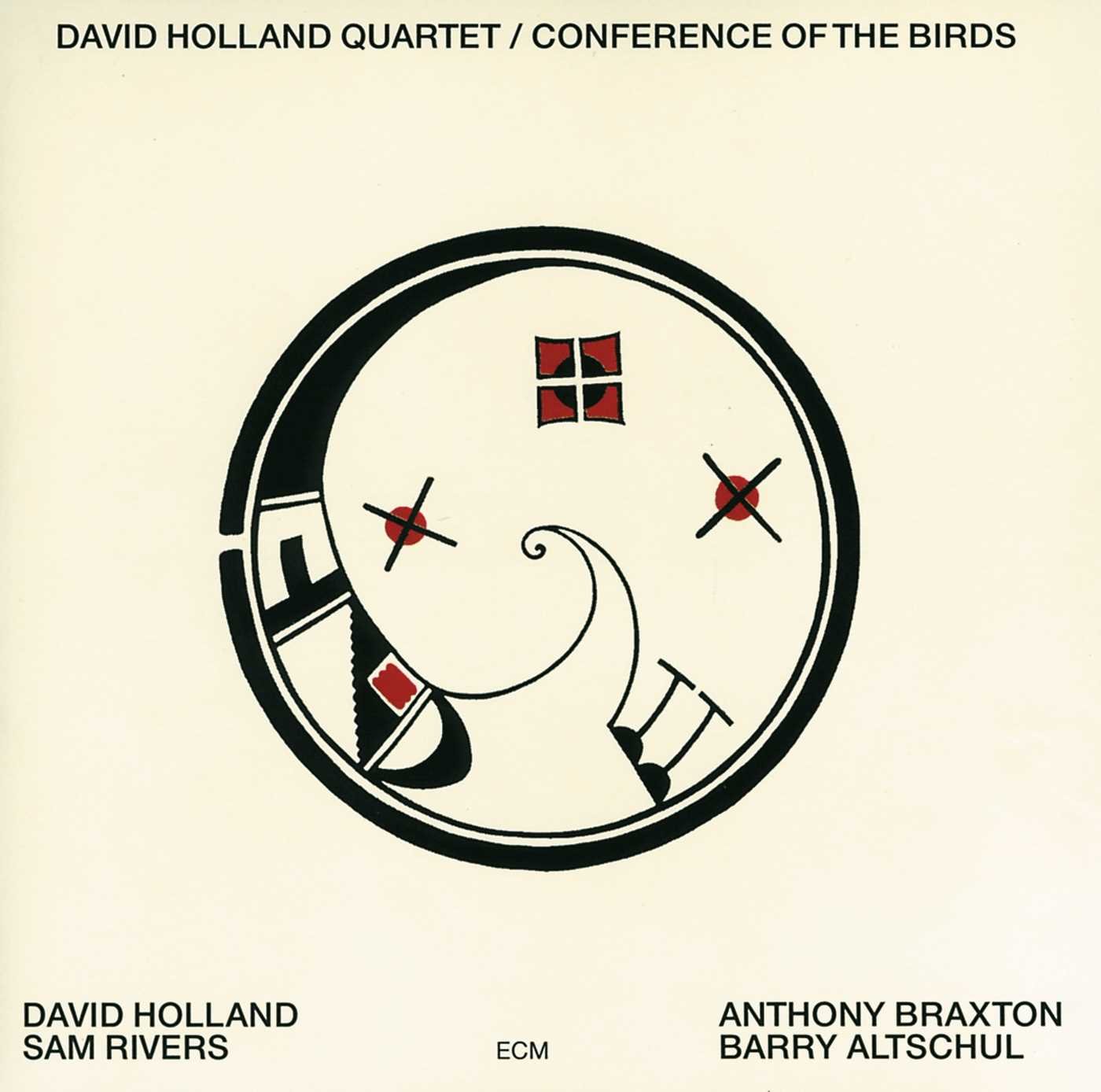
Dave Holland Quartet: Conference Of The Birds (ECM 1027)

1027

Dave Holland Quartet
Conference Of The Birds

Dave Holland bass
Sam Rivers reeds, flute
Anthony Braxton reeds, flute
Barry Altschul percussion, marimba
Recorded November 30, 1972 at Allegro Studio, New York City
Engineer: Tony May
Produced by Manfred Eicher

As someone who began with ECM New Series releases long before easing into the world of ECM proper, my initial explorations of the latter led me to decidedly contemporary avenues of jazz and to a particular fondness for the many Norwegian projects represented by the label. Only in recent years have I begun to pan for gold in the massive back catalog that was produced before I was born, and among the many fine nuggets to emerge from the sediment is this most splendid effort.

Phenomenal wind work from Braxton and Rivers makes this a decadent studio treat, grinding out equally captivating solos, whether over a tight rhythm section or in the throes of a looser backdrop. Though easily billed as a “free jazz” album, Conference Of The Birds remains a fine testament to a relatively accessible strand of the form. A child of the post-bop generation, Holland takes the back seat for the most part and lets his reedmen take center stage. Whimsical elements such as the unexpected coach’s whistle in “Q & A” comingle with the solid relay races of “Four Winds” and “See-Saw.” The title track provides the most delicate textures on the album with its effortless flourishes and gorgeous bass intro, acting as a fragrant palate-cleanser before launching us into the ecstatic free-for-all that is “Interception.” Each cut has its own distinct flavor, lending a vibrant anticipation to every break.

Conference Of The Birds is special to me for at least three reasons: (1) It evokes an important period of musical and political transition that I will never experience directly. Moods are wrought in iron and blown glass, so that no matter how many times the structure is destroyed, one can always melt the pieces down again into something new. This was a time in which the entire world was either on its knees or throwing off the shackles of normalcy in favor of unrestricted forms of expression. This duplicitous spirit of oppression and liberation is embodied perfectly in the sounds. (2) One can trace a dark and lasting thread from Holland’s early work to the present. This set in particular allows us to see his foundational strength, the whimsical order for which he has become so well known. (3) This album is, for me at least, one example of what makes jazz so uplifting: a spirit of shared knowledge, a hermetic seal ruptured for the sake of communal awareness, and the letting go of one’s own inhibitions amid an unforgiving social order.

Offer it your hand, and you may be surprised where it leads.

<< Stanley Cowell Trio: Illusion Suite (ECM 1026)
>> Paul Motian: Conception Vessel (ECM 1028)

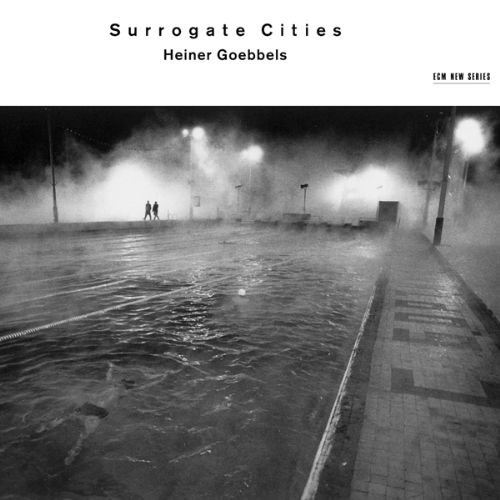
Heiner Goebbels: Surrogate Cities (ECM New Series 1688/89)


Heiner Goebbels
Surrogate Cities

Junge Deutsche Philharmonie
Peter Rundel conductor
Jocelyn B. Smith vocals
David Moss vocals
Recorded 1996, Bayerische Rundfunk, Munich / 1999, Frankfurt
Engineer: Peter Jütte
Produced by Heiner Goebbels & Manfred Eicher

As a longtime fan of David Moss, I needed only to learn of his involvement in Surrogate Cities before rushing out to buy the CD. Sadly, at the time I had no idea who Heiner Goebbels was. I couldn’t have asked for a more comprehensive introduction. The reader will forgive my penchant for abstract analogies when I say that Surrogate Cities is like pricking a piece of paper with a pin and shining a metropolitan nightscape through it so that one may connect those rays of light with brittle chalk. Practically speaking, the project is meant to be an ode to the city of Frankfurt in celebration of its 1200th year. As such, it is an amalgam of atmospheres, moods, and sensual provocations. This project unfolds like a massive suite with instruments drawn from architecture and flesh alike. Each section reads like a novella in the grander scheme of its binding.

Suite for Sampler and Orchestra
Preluded by snippets of cantorial singing, computer-controlled voices seek dominance over the imperialistic power of the orchestra in a kaleidoscopic and utterly focused vision of the urban sprawl. Rather than penetrating the city, Goebbels turns it inside out for our inspection. The samples are not so much quotations as they are memories shaken loose from long-neglected nooks and crannies. The digital flick of “Menuett/L’ingénieur” is haunting in its subtlety, appropriated like so much data flowing through the airwaves. The conclusion, “Air/Compression,” is a chamber piece for the overlooked sounds of our post-industrial comfort. Admirers of John Zorn’s Kristallnacht will find themselves on familiar ground here, as the archival instinct is similarly apparent.

The Horatian – Three Songs
Based on words by Heiner Müller, this song cycle relates a conflict between Rome and neighboring Alba. A lot is cast to determine who will fight as representative of each city. A Horatian is chosen for Rome, a Curiation for Alba. During the course of the ensuing battle, the Horatian strikes down the Curiation and does not spare his life. His sister, who is betrothed to the Curiation, weeps upon his return. He rewards her grief by slaying her. Thus is the victor’s valiant heart tainted with murder. According to Müller, Goebbels “proposes a new form of reading, a different, no longer touristic approach to the landscape of a text.” In this sense, The Horatian is far from the bombastic cantata it could have been. Rather, it heaves with the weight of its own moral conundrum. Joselyn B. Smith is superb as the voice of bipartisanship, weaving in and out of its allegiances with the acuity of a practiced raconteuse. She emotes with a confident Broadway twang that is gorgeously appealing against Goebbels’s orchestral backdrop.

D & C sounds like someone knocking at the outside of a building with no entrance; a book one has been dying to read, but which opens to reveal rain-soaked pages. It is a film noir standing on its head, loose change and candy wrappers falling out of its pockets. The music circles until it loses hope and collapses onto the wet asphalt.

Surrogate, with words by Hugo Hamilton, is the moment I was waiting for during my first listen. Over a lush carpet of piano, Moss runs into the night along with the nameless character of Hamilton’s text. His indulgent enunciation of “surrogate” is priceless, prelude to a tranquil, breathy fade.

In the Country of Last Things
The words here are by Paul Auster. Bleak and morose, they paint a fatalistic picture of urban living. Moss provides the narration here as Smith wails plaintively in the background: “A house is there one day, and the next day it is gone. A street you walked down yesterday is no longer there today…” The city has become the ephemeral soldier, running AWOL from the army of its own becoming. All convictions remain unrequited, leaving the barest puffs of cigarette smoke as the only indications that they ever breathed.

Smith and Moss are the clear winners here. Not to be outdone, however, is the superb orchestra. The presentation is sharp, the sound so crisp you want to teethe on it, and the arrangements fantastically varied. Probably not the best album to play in your greenhouse, but for our psychological biota it does the trick.

<< Veljo Tormis: Litany To Thunder (ECM 1687 NS)
>> Gudmundson/Möller/Willemark: Frifot (ECM 1690
)

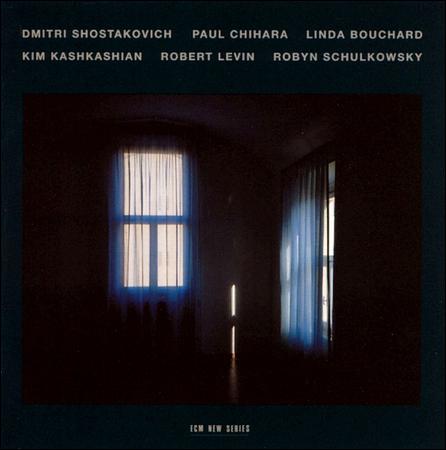
Shostakovich/Chihara/Bouchard (ECM New Series 1425)


Shostakovich/Chihara/Bouchard

Kim Kashkashian viola
Robyn Schulkowsky percussion
Robert Levin piano
Recorded June and October 1990
Engineer: Jan Erik Kongshaug
Produced by Manfred Eicher

Kim Kashkashian’s third disc for ECM is a curiously mixed bag. Although the liner notes give some delightful anecdotes and insider’s information, I am torn over how much said information enriches my experience of the whole. For example, Kashkashian points to the percussiveness of Shotakovich’s piano writing in his Sonata for Viola and Piano op. 147 as justification for the two companion pieces scored for “actual” percussion and viola. To be sure, this is a fascinating connection, though one that perhaps only the performers can intuit with such immediacy. Either way, the knowledge does guide my listening in new directions and pushes me to burrow into the music wholeheartedly.

We begin with Pourtinade by Linda Bouchard, consisting of nine sections that may be rearranged at will and which are otherwise meticulously notated. Each chapter breeds freshness in this indeterminate order and points to a hidden vitality behind the deceptively ineffectual surface. This is a piece that finds precision in its looseness. Deftly realized, Schulkowsky’s percussion work is porous and minutely detailed like a spiked pincushion through which Kashkashian threads her song.

Next we have Paul Seiko Chihara’s Redwood. Chihara, a film composer who has collaborated with such greats as Louis Malle, was inspired by Japanese ukiyo-e woodblock prints for this piece largely built around melodic phrases volleying between viola and tuned drums. I doubt that one would ever guess its source from the music alone, and I can’t say for sure whether this really informs the way I listen to it. Nonetheless, the programmatic music has its heart set on something beautiful.

Last but not least is Dmitri Shostakovich’s Sonata for Viola and Piano op. 147. This being his final work, it unfolds like the imminence of death and the timid promise of afterlife. The central Allegretto is filled with concentrated ardor, held back every time it threatens to transcend its cage, and the final 15-minute Adagio is as visceral a swan song as one could expect from such a towering figure in modern music. While this sonata does sound haggard, conserving its energy for selective crescendos, there is a glint of affirmation for every cloud of resignation, so that by the end there is only neutral space.

Even after repeated listenings, I am still not sure how successful this program is as a whole. While the Bouchard and Chihara pieces have their own merits, knowing that Shostakovich is waiting around the corner throws a much different shadow on already obfuscated atmospheres. It’s not that the conceptual approach of the percussion pieces is out of place with the op. 147, but simply that they feel like different languages in want of an intermediary (and, to Kashkashian’s credit, she tries her best to fulfill that role). They rather put me in mind of the stark stop-motion artistry of the Brothers Quay, and would perhaps be better suited to such imagery, crying as they are for visual accompaniment. Nevertheless, all three musicians’ rich talents scintillate at every moment, breathing vibrancy into still notes on a page with oracular fervor.

Knowing the context of a piece biases our interpretation of it. This can be a hindrance, or it can lead to an enlightened understanding. In this case, I find it to be both—hence my complicated reactions to this release. Sometimes the most memorable musical experiences are also the most unexpected. Albums such as this remind us that music is its own reward.

<< Gavin Bryars: After the Requiem (ECM 1424 NS)
>> Paul Giger: Alpstein (ECM 1426)