Eberhard Weber: Colours (ECM 2133-35)

ECM 2133-35

Eberhard Weber
Colours

Eberhard Weber bass
Charlie Mariano soprano saxophone, shenai, nagaswaram, flutes
Rainer Brüninghaus keyboards, piano, synthesizer
Jon Christensen drums
John Marshall drums, percussion

“I would not be you, El-ahrairah. For Frith has given the fox and the weasel cunning hearts and sharp teeth, and to the cat has given silent feet and eyes that see in the dark, and they are gone awry from Frith’s place to kill and devour all that belongs to El-ahrairah.”
–Richard Adams, Watership Down

For six years, Eberhard Weber’s Colours enthralled the European tour circuit. A unique entry into the growing number of fusion outfits of the seventies, Weber charted a distinctly introspective path into jazz’s most unanswerable questions. The ensemble’s inimitable blend of improvisational and chamber music aesthetics was a perfect fit for ECM, not so much filling a gap as defining one. By the time he had recorded for the label, Weber had already honed a most distinctive skill, brought to its worthiest fruition on his custom electrobass, and was even present in Wolfgang Dauner’s much-neglected Output. Without a doubt, Colours created some of the label’s most mellifluous music. The sound is unmistakable, coiling like a snake around some of the most gorgeous atmospheres to grace your ears.
ECM 1066

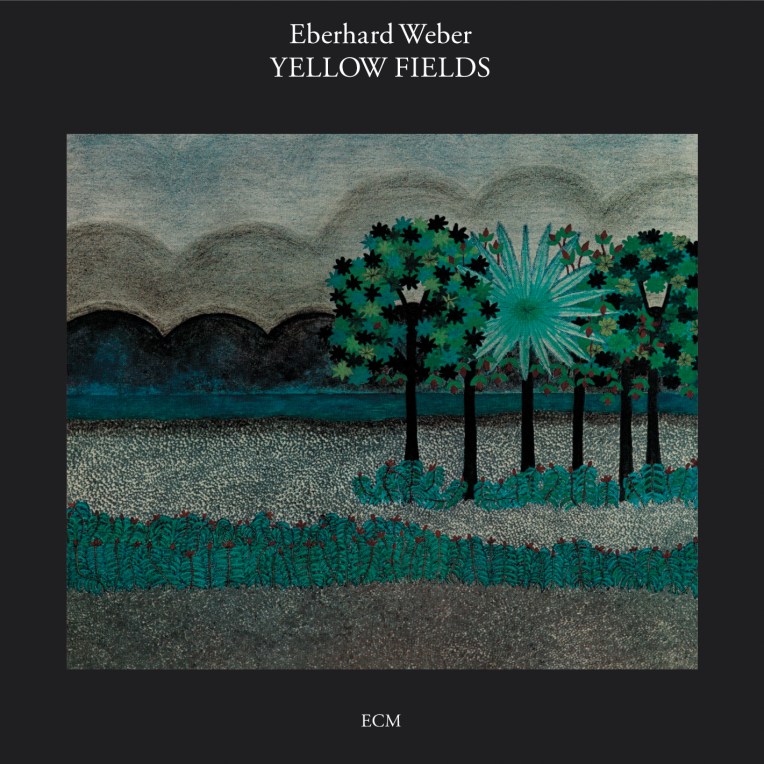
Yellow Fields (ECM 1066)

Recorded September, 1975 at Tonstudio Bauer, Ludwigsburg
Engineer: Martin Wieland
Produced by Manfred Eicher

With “Touch” we are immediately privy to a groove-oriented game between piano and bass. The lush, open sound is heightened by the presence of synth strings, prefiguring Weber’s later orchestral collaborations. Charlie Mariano’s soprano floats with positive energy and unbounded enthusiasm as the strings morph into trembling sirens. Jon Christensen adds backbone to otherwise invertebrate music. Weber is subdued in this first track, leaving Mariano to take the lead with a soulful stride toward a quick fadeout, leaving us wanting more of what could have been.

“Sand-Glass” begins with water droplets and the occasional artfully placed rim shot. High notes on bass provide a constellatory framework. Within these borders, seemingly drawn but only imagined, Mariano solos like a comet, his sentiment flaring against a limpid night. Mariano flaps his wings around the fuselage of Weber’s bass line before being rocked to sleep in an electric piano cradle. Inspirations grow more pronounced as Mariano picks up the shenai, a quadruple-reed North Indian oboe that tunnels into the brain like a shawm. We ride this wave until the drums pick us up and drop us back into a shattered world of aftershocks and quieting energy.

The title track is an auditory hermit. With the theme quickly dispensed with, improvisation turns joyful fancy into gorgeous abandon. All the while, discipline reigns as abstractions build into a more melodic whole in which the sound and the message are one and the same. Weber takes a more supportive tack, allowing Brüninghaus a cosmic solo on electric piano. Statements conveyed and time regained, the band wraps up with a fleeting thematic revival amid an interlacing of rhythms and supportive flourishes.

Lastly, we merge onto the “Left Lane,” which opens with a pensive bass, soon joined by electric piano. Christensen defibrillates, turning this slow drive into a cruise. The piano sings in its higher regions before trickling down like rain on a window. Weber returns to spark a new groove, moving from elegiac to jazzy in a flash. A seemingly tame sax solo quickly turns dramatic, opening our hearts to a visceral farewell.

<< Keith Jarrett: The Köln Concert (ECM 1064/65)
>> Terje Rypdal: Odyssey (ECM 1067/68)

… . …
ECM 1107

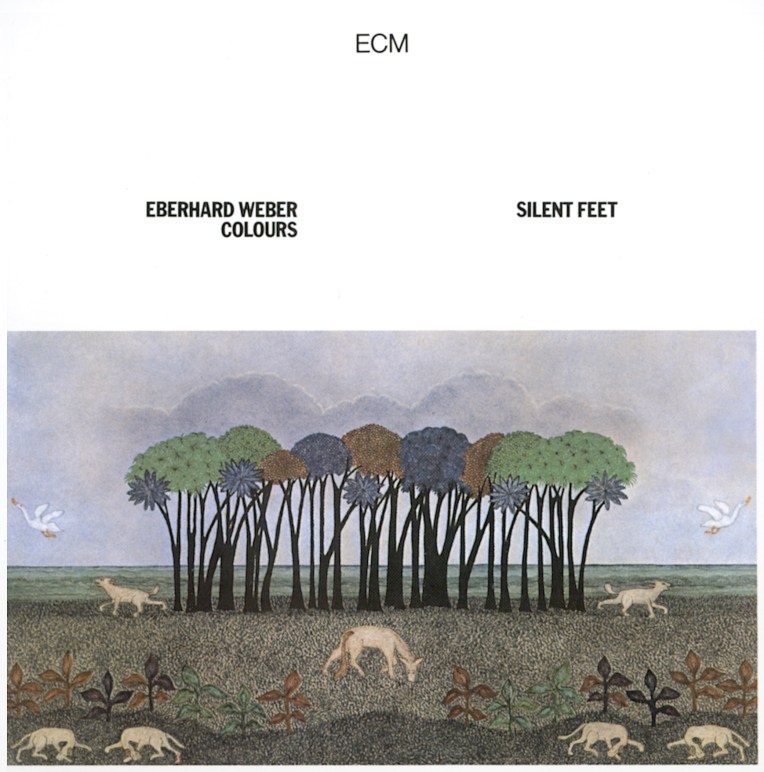
Silent Feet (ECM 1107)

Recorded November 1977 at Tonstudio Bauer, Ludwigsburg
Engineer: Martin Wieland
Produced by Manfred Eicher

“Seriously Deep” throws a light blanket of tender drones and electric piano, quilted with gorgeous solos on soprano sax and bass. Steady rhythms (hereon provided by ex-Soft Machine drummer John Marshall) turn something otherwise mournful into life-affirming joy. The title is not a pretentious statement of the music’s emotional cache, but rather a description of its physical path as it digs toward the center of the earth. The second, and title, track of the album’s modest three is an ironic one, requiring active hands to evoke silent feet. The helix that is Weber and Brüninghaus spirals in place as cymbals connect like base pairs within, thus leading to one of the latter’s most captivating pianistic passages. It is the kind of balanced exuberance that characterizes Pat Metheny at his most potent stretches of imagination. Stellar breath control from Mariano plays beautifully off Weber’s every move, making for one of the finest cuts in the collection. We end nocturnally, watching with “Eyes That Can See In The Dark.” A smattering of percussion sets off a wooden flute in a floating auditory reverie. While one might think that an electric bass would upset this delicate atmosphere, Weber is one of the few who can pull it off with such fluid precision. From this pool arises a specter of winds, blown like gusts of air from pursed lips across outstretched hands. Again, Mariano turns out some incredible soloing to finish.

Those who, like me, grew up reading Watership Down will doubly appreciate the occasional references Weber draws from the classic novel. “Silent Feet” and “Eyes That Can See In The Dark” both refer to a central creation myth among the story’s protagonists, a herd of rabbits fleeing in exodus from the warren they once called home. Storytelling becomes a central diversion in these hard times, and the origins narrative is a favorite: At a council of the animals, Frith the creator and sun god gives each its own ability to forever pursue the wily and celeritous rabbit. To the cat, he gives Weber’s cited traits, all the better to seek out its foe under cover of night. Respectfully, Weber takes a more romantic view of the hunt and allows us into the animal mind without malice.

<< Art Lande and Rubisa Patrol: Desert Marauders (ECM 1106)
>> Paul Motian Trio: Dance (ECM 1108)

… . …

ECM 1186

Little Movements (ECM 1186)

Recorded July 1980 at Studio Bauer, Ludwigsburg
Engineer: Martin Wieland
Produced by Manfred Eicher

The vast drone of “The Last Stage Of A Long Journey” cuts a thick line below the Steve Kuhn-esque intro. Like the silent monolith of 2001: A Space Odyssey, it mystifies as it enlightens. Saxophonic clusters punctuate a deep recurring thrum. Brüninghaus introduces a plaintive ostinato behind Weber’s crisp solo over brushed drums. Every gesture therein lifts us into cloudier airspace. “Bali” gives us more drone, until Marshall and Weber lock us into a solid trek to outlying territories. Like a train through the mountains that suddenly part to reveal a lively village, it shows passengers an idyllic vision of life on the margins. The piano keeps us moving forward, however, so that we only get a glimpse. Weber provides the coal, while Mariano lights a fire to feed it. A beautiful arpeggiator opens the door on a transcendent detour before bringing us back on track. The energy and motivic clarity remind one instantly of Steve Reich’s Tehillim. Next, Colours weaves “A Dark Spell” over us. Over a distant cascade of piano, bass and sax congregate in thematic clusters. Mariano outdoes himself, performing back flips in the sky as our speed increases in the last stretch. Engaging harmonies between bass and sax offer an incredible display of dynamic control that recedes like a classical riff. The title track begins with a repeated motif on piano as random sounds—accordion, gongs, and breaking glass—populate the background. From this, we get a thematic highlighting by Mariano against Weber’s delightful counterpart. The smooth and easy ending sweeps up any remaining debris with every repetition. “‘No Trees?’ He Said” is a straightforward track that appears smooth from every angle. From its tight rhythm to its reed doublings, this is simply stunning music. There is nothing little about these movements.

Though palpable in every amplified note, Weber’s legacy is about more than just assembling a handful of incredibly talented beads and threading them with smooth production. “Telepathic” is hardly the word to describe the sound of Colours, but it steers us in the right direction. The music in this set remains untouched, a sign of its far-reaching clarity of purpose. It is chaos theory epitomized in sound: every note goes where it must, never to be repeated. Weber’s music not only soars, it transcends the atmosphere. I like to think that, somewhere, an extra-terrestrial is glowing with delight at these sounds, pulsing through space-time with the energy of all creation.

<< Miroslav Vitous Group: s/t (ECM 1185)
>> Rainer Brüninghaus: Freigeweht (ECM 1187)

Egberto Gismonti: Dança Das Cabeças (ECM 1089)

ECM 1089

Egberto Gismonti
Dança Das Cabeças

Egberto Gismonti 8-string guitar, piano, wood flutes, voice
Nana Vasconcelos percussion, berimbau, corpo, voice
Recorded November 1976 at Talent Studio, Oslo
Engineer: Jan Erik Kongshaug
Produced by Manfred Eicher

Egberto Gismonti’s first ECM appearance is also his most understated. Dança das Cabeças (Dance of the Heads) was to be a solo album, due to the fact that the Brazilian government had inflated travel expenses for he and his band to the questionable figure of 7000 dollars a head. Gismonti was the only among them able to make the journey, but as fate would have it, he met Nana Vasconcelos quite by accident while in Norway to prepare for this recording. According to Alvaro Neder, when Vasconcelos asked him to describe the concept behind this project, Gismonti told him it was “the history of two boys wandering through a dense, humid forest, full of insects and animals, keeping a 180-feet distance from each other.” It was a history the two musicians shared without articulation, and Vasconcelos immediately agreed to join, thereby bringing another visionary into the label’s fold.

“It sounds just like a rain forest!” Perhaps you have heard this assessment being made in reference to many a New-Age album, sporting lush trees on its cover and layered within with preprogrammed synthesizers and wooden flutes. Dança, by contrast, is as far as one can get from the contrived exotica that haunt our commercial soundscapes. We are fully situated in the acoustic benefits of live musicianship, captured in all their immediacy in ECM’s standard-setting clarity. And so, while the birdlike sounds of Part I do indeed evoke a forest practically dripping with fecundity, it is populated with more than a few brightly colored animals. Like Marion Brown’s Afternoon Of A Georgia Faun, its sound is as deliberate as it is organic. From these canopied beginnings, we get some jangly strums from Gismonti’s guitar, slaloming between frenzied hand drums. Rhythms and melodies build to infectious heights, diving into our blood with every fluted moment. The musicians raise their cries, from which Gismonti spins a free-flowing grace, as if to trace lines of varying distance in a vast topographic map. Vasconcelos returns in all his fullness with drums, maracas, and shakers, while Gismonti’s fingers move on in their quiet persistence. Changes in syncopation and a few helpings of dissonant harmonies enact a skeleton dance of sorts, soaring resolutely into the music’s ritual heart. Gismonti’s classical training shines through in Part II, for which he puts his fingers to keys in a spacious and revelatory stroll through Keith Jarrett territory. From this heartwarming nostalgia, built in arcs with only the occasional angles, Gismonti morphs into a bellowed vocalise and storm of handclaps. He returns to the guitar before closing with another pianistic statement in improvised space.

This remains the Brazilian multi-instrumentalist’s most direct effort. In it, we find him without masks. It is the kind of music that makes one glad to be alive, a breath of clarity in polluted air. Essential for anyone who appreciates what music can bring to the heart, mind, and body.

<< Edward Vesala: Satu (ECM 1088)
>> Keith Jarrett: Staircase (ECM 1090/91)

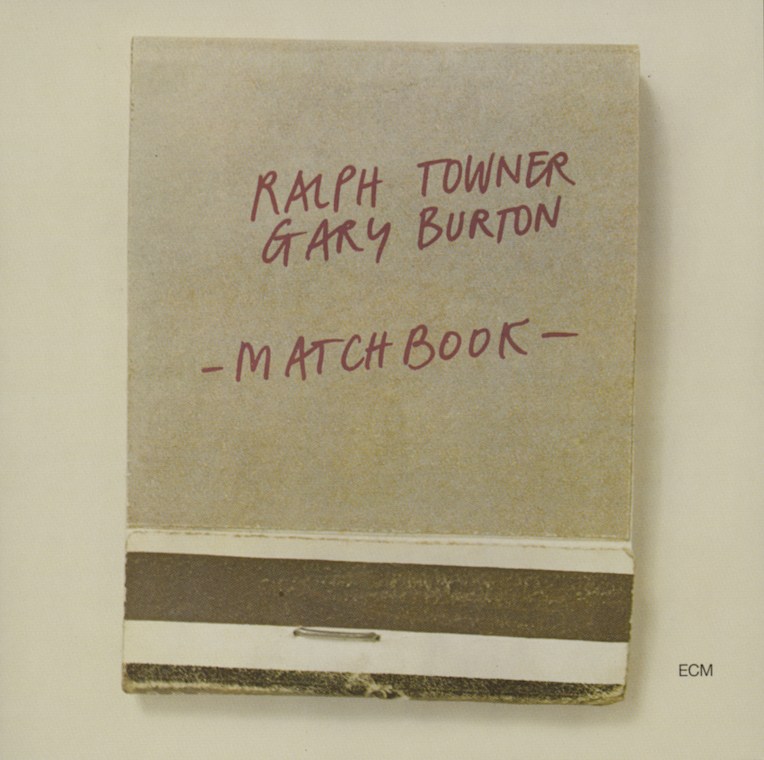
Ralph Towner/Gary Burton: Matchbook (ECM 1056)

ECM 1056

Ralph Towner
Gary Burton
Matchbook

Ralph Towner 12-string and classical guitars
Gary Burton vibraharp
Recorded July 26/27, 1974 at Tonstudio Bauer, Ludwigsburg
Engineer: Martin Wieland
Produced by Manfred Eicher

A matchbook doesn’t typically provide a surface for lasting statements. On its flap, one scrawls a phone number, an address, or any other piece of information as ephemeral as the flames for which it is mass-produced. Such is not the case with guitarist Ralph Towner and vibraphonist Gary Burton. Instead, we get indelible marks of grace and humility, each a brighter spark at the wick of our attention.

Towner originals form the bulk of this project, of which the opening “Drifting Petals” is a quintessentially evocative example. Between his 12-string and Burton’s plaintive returns, we get an emotive handful of light poured directly into our ears. This combination recurs in an intimately redacted version of “Icarus,” which paves new avenues of understanding through one of Towner’s most popular compositions. Burton’s touch adds a metallic fervor that contrasts well with the softer piano version on the previous year’s seminal Diary. Twelve strings of bliss continue in “Goodbye Pork Pie Hat.” In this delicate, dark arrangement, Mingus’s classic tune wilts into a devastating ending.

The album’s remainder gives us Towner in a more classical mode, thereby halving the number of strings at his disposal, but with no loss of distance. “Some Other Time” builds an enchanting synchronicity, throughout which both instruments connect and drift apart like memories and expectations. Burton’s plush chords give Towner’s fingers plenty of forgiving terrain. The two switch roles, as they often do, for their respective solos. “Song For A Friend” is a bleaker piece wrapped around a gentle persuasion. As an affirmation of beauty, it is sometimes painful, shaded by the same colors with which all relationships are rendered. Towner draws the album’s most endearing solo here across an ideal tidal accompaniment. A notable highlight is Towner’s buzzed introduction of the title track, achieved by weaving a matchbook into the strings of his guitar. This sets off a flurry of whimsical activity and attentive soloing, meshing in a tightly knit cloth that leaves no dangling thread.

Three instrumental angles converge in the triangular “Aurora”: classical and 12-string guitars occupy the left and right channels, while vibes bond them with living energy and song. In addition, Towner and Burton are each given their own moments in two brief, but beautiful, tracks. “Brotherhood” is a haunting piece by Burton alone, its musical nether regions fluttering in anticipation of the higher notes dropping into its dark pool, while “1×6” is a classical guitar solo that ends before it begins.

The sound of this album is like no other and unfolds itself with the delicacy of a morning glory, yet with melodies as indestructible as the sunlight that sustains them. Its many colors are provided not only through finely wrought melodies, but also through a wealth of rhythmic variations throughout. If you like either of these artists apart, then you can’t go wrong with them together.

<< Gary Burton/Steve Swallow: Hotel Hello (ECM 1055)
>> Bill Connors: Theme To The Gaurdian (ECM 1057)

Alfred Harth: This Earth! (ECM 1264)

Alfred Harth
This Earth!

Alfred Harth tenor, alto and soprano saxophones, bass clarinet
Paul Bley piano
Trilok Gurtu percussion
Maggie Nicols voice
Barre Phillips bass
Recorded May 1983, Tonstudio Bauer, Ludwigsburg
Engineer: Martin Wieland
Produced by Manfred Eicher

This Earth! represents Alfred Harth’s second ECM appearance, supporting a stellar cast of musicians that includes Barre Phillips on bass, Paul Bley at the keys, Trilok Gurtu on percussion, and the inimitable Maggie Nicols doing what she loves. The words are by Vicky Scrivener, which could easily be a pen name for Nicols herself—such is the immediacy with which the words seem to pour from her lungs.

“Female Is The Sun” is the album’s anthem. Structured around a counterpoint of bass clarinet and pianistic asides, its skeleton comes to life through Nicols’s animations. Each verse hoists us deeper into the sky, until we begin to feel the heat of that “old gold woman” who oversees our every waking moment:

The earth’s hot eye reels
fenced
and groans before
vestal temperament

The piano and bass in “Relation To Light, Colour and Feeling” are like two adjacent houses. Between them, a sagging clothesline, from which wordless songs, doubled by sax, hang in the breeze of a balmy afternoon. Words await us at the end, each a folded cloth, a swaying branch, a chirping bird.

Luxurious mezzotints and shades
glowing wash of tones

A percussive introduction opens us to the fabulous spoken word performance of “Studying Walk, A Landscape.” Nicols carries us along with her unpretentious tugs, inscribing the scenery with tightened, almost saxophonic squeals. There is an urban whimsy to be found here, refreshing but also tinged by world-weary bitterness. Phillips also has a lovely solo in this whimsical track with heft and shape.

A wish, relief from a circle

In “Body & Mentation,” piano and bowed bass engage Harth’s tenor with bright energy. Gurtu spreads his palms wide through these aural veins, Harth tracing with a palmist’s care. Their interplay vacillates: a few steps from Gurtu, a few expulsions from Harth. Each move forward italicizes the piece’s sentence structure, closing on an elegiac statement from Bley.

Love’s tug –
our barge;
sweet clamorous tidings
on the unique
journey backwards
to progression.

“Energy: Blood/Air” reveals the album’s most porous textures. Over a tightly knit ostinato, Harth breathes life into Nicols, who skims a poem’s surface before slipping into protracted improvisation. Bley floats a light solo over our heads, gathered up amid a handful of bass.

Today she sits
in the angled skies…
lowering lids
at the blushing
earth.

The “Three Acts Of Recognition” that follow slip a contemplative card into this highly charged deck as Harth’s tender yet robust tenor ladles sound into our silence. Some well-chosen reverb lends a throated quality his song. Overtones mingle as piano chords lay down new ground for every self-aware step. A pause. Bley reaches into his instrument, plucking and strumming strings directly, while Harth spins molecules in the air. Another pause. We return to the keyboard, flowing through to the end.

Between the clean
and tender sheets
we’ll hear us out.

“Come Oekotopia” crackles in rain sticks and cymbals, drawing bass from the soil. Harth improvises over Phillips’s nimble strumming. His long-held note midway through is one of the album’s highlights. Percussive bells diffuse this energy. Nicols makes a phonemic cameo at the end.

The mind streams
to pulse
relinquishing

Her subsequent recitative in “Waves Of Being” offsets a gorgeous solo from Bley, who cannot help but raise his own voice in the flare of the moment. Phillips’s bass is bright and bleeds into Gurtu’s string of metal (gongs), wood (sticks), and exoskeletons (shells). Harth’s bass clarinet bubbles with finality, fading into a sustained pluck of piano strings.

Accapella
flourishing
descants…
Acoustically
tonic.

“Transformate, Transcend Tones and Images” shows Nicols in fine melodic form. As the album’s last image, seems to thrive at its center. Nicols adlibs the remainder, as if to dissolve these impressions just enough so that no one can claim them. “Woman in a violet tail-coat,” she sings, “blows her soul-blue sax on south bank.” But we never hear that sax. Instead, we get a string of unrecorded words:

…translate…
…transcend…
…transform…

leading us into the unknown discoveries of the journey ahead.

Harth is an attentive player who writes without erasing, sings without opening his mouth, exhales without hypocrisy. His notes are often shared on This Earth!, but he is never the mimic. Among this session’s band mates, Gurtu proves to be a particularly interesting choice. His cymbal-focused work adds the illusion of a full kit without the overbearing weight thereof. Bley and Phillips, on the other hand, are unmistakably present. Yet Nicols’s voice is the real poetry of the album. She transcends the words she sings even as she inhabits them, bringing genuine physicality to their contours.

Another out-of-print gem, its elusiveness makes it all the more visceral an experience once it finds its way to your turntable.

<< Terje Rypdal/David Darling: Eos (ECM 1263)
>> The George Gruntz Concert Jazz Band: ’83 Theatre (ECM 1265)

Erkki-Sven Tüür: Crystallisatio (ECM New Series 1590)

Erkki-Sven Tüür
Crystallisatio

Tallinn Chamber Orchestra
Estonian Philharmonic Chamber Choir
Tõnu Kaljuste Conductor
Recorded 1994-1995 at Estonia Concert Hall, Tallinn
Engineer: Maido Maadik, Estonian Radio
Produced by Manfred Eicher

Estonian composer Erkki-Sven Tüür (b. 1959) admits that we are products of our environment. To be sure, he and his compatriots would seem to have carved out a distinctive niche in the terrain of classical music, chipped from the ice that locked their creative heritage under Soviet rule. In the same breath, however, he cautions us about adhering our identities to any particular place over another, lest we shun the illustrative details of our indeterminable experiences. In that sense, there is something to be said for music, which in Tüür’s case is as close to audio refraction as one can get: there is no distinguishing its inner and outer upheavals. Enter architectonics, an abiding process through which Tüür discloses the chemical compositions of his singular auditory experiences. As a onetime prog rock musician, he brings a “band” sensibility to his sound, in which one hears an undeniable cohesion.

Architectonics VI (1992) for flute, vibraphone, and strings descends from violins into a series of complex resolutions. It is mathematical in the truest sense, making a case for chaos as its primary expression. Convoluted outbursts from winds, neither spastic nor deliberate, are punctuated by strings, shining a light into this lively debate of inter-instrumental politics.

Passion (1993) for string orchestra is a rare achievement. Its development recalls Henryk Górecki’s Third Symphony, working its way from ground level into the stratosphere of our emotional purview. Its shifts from minor to major keys glisten in a dew-drenched field, accepting the sun’s slow rise. There is, in this piece, as much lateral movement as vertical. Each stage is both a revival of the past and a rehearsal of the future. As the upper strings tighten their grip on reality, the cellos resound with a note for the ages, not unlike a certain tenor’s proclamatory crest in Arvo Pärt’s Magnificat, if relatively foreshortened.

Illusion (1993) for string orchestra dances with every sinew of its bowed body. Though brimming with dynamic suppleness, it turns every statement into a new paragraph. As double basses mark staccato points of articulation, violins reassert their seemingly innate desire to lead. Tõnu Kaljuste’s immaculate direction brings phenomenal dynamic control to bear as the piece builds into an ecstatic reinstatement, an aesthetic lock that grows progressively quieter until the final exultation.

Crystallisatio (1995) for 3 flutes, glockenspiel, strings, and live electronics ushers us into a congregation of drowsy banshees, draping themselves in the canopy of a darkened forest. Electronically processed flutes echo like spirits recast in the image of their own reflection. The cellos are given a mournful urgency, through which they enact a promise of daylight. The glockenspiel’s doublings tickle our very spirits with their arousing pinpoints. The frenzy mounts as the processing reveals its illusions more explicitly. We end on an overblown flute and a single glockenspiel note—a drop in the cosmic pond.

Requiem (1994) for soprano, tenor, chorus, triangle, piano, and strings is the masterpiece of this program, and beyond reason enough to buy this album. Written for friend and conductor Peeter Lillje, it gives us the clearest portrait of an artist working in real time. A struck triangle opens the proceedings, from which baritones spin the Introit. Strings operate sympathetically as the cellos double the tenor line, and the violins skip along their own skyward paths. A tenor introduces the Kyrie eleison as the violins continue their improvisatory pirouettes. Vocal constituents volley back and forth, while at their center a piano comes crashing down in a rupture of spiritual information. Altos and sopranos emerge from the rubble as wavering sirens. They keen and shout in Orff-like exuberance before cracking open a breathtaking Rex tremendae in tutti. A lithe soprano provides reflection in the Recordare. A violin wanders abstractly in timid, almost insectile, commentary. All the while, choral forces are gathering themselves toward a somber end that reenacts the cycle’s beginnings.

Violins play a key role throughout, scratching like an animal searching for something buried but long decayed, a kernel of faith long sprouted into the tree under which it claws in vain. The triangle that opens and closes the Requiem is proof positive that the most direct access to enlightenment isn’t always the grandest, but that sometimes the keyhole rupture of the blinking eye, and the single glint of light upon the tear that falls from it, are sufficient to show the way. The piano, too, plays a commensurate role, a voice of reason at center stage.

This is a transportive album—absolutely so—and one that I will always champion. Like the frozen surface of the jacket photo, it seems at first glance a field of stars, forever locked at the height of brightness. Although I do not feel that ECM’s subsequent Tüür releases have quite attained the magical realism of this one, anyone who shares an enthusiasm for Crystallisatio would do well to place the others alongside it. Tüür’s resolutions are always revolutions in that they, through the promise of completion, only bring forth further fragments for consideration. Rather than trying to achieve balance through this process, Tüür seems to want to make a meta-statement regarding the nature of his compositional process, which is constituted by a need for discourse and reevaluation. Like the tintinnabulations of Arvo Pärt, his atmospheres lay out for us the very topography of a nameless musical environment. Every turn brings about a new needle of contention by which to sew our physiological threads. This is music that makes no promises, yet in doing so fulfills countless numbers of them. As one of ECM’s most groundbreaking releases, second perhaps only to Giya Kancheli’s Exil, this is a must-have for the New Series enthusiast.

<< Meredith Monk: Volcano Songs (ECM 1589 NS)
>> Arvo Pärt: Alina (ECM 1591 NS)

Alfred Schnittke: Psalms of Repentance (ECM New Series 1583)

Alfred Schnittke
Psalms of Repentance

Swedish Radio Choir
Tõnu Kaljuste conductor
Recorded at Högalidskyrkan, Stockholm, Sweden by P2 Swedish Broadcasting Corporation in February 1996
Engineer: Ian Cederholm
Produced by Manfred Eicher

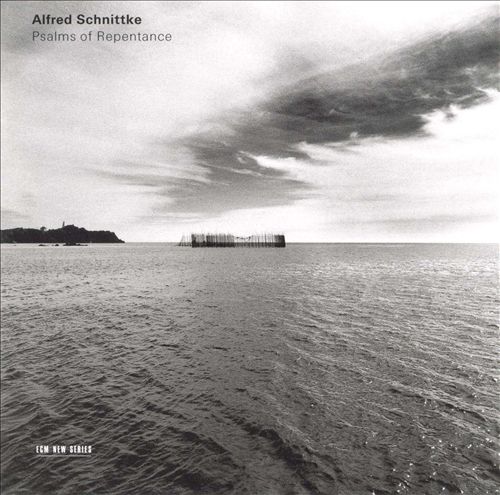
There is a coastal town in Japan, documented by video and performance artist Yamashiro Chikako, where a neglected gate runs off the land and into the sea (not unlike the cover for First Avenue). As the camera tracks its crooked slats and sagging wire, we watch it being swallowed by the waters, marking a border that no longer has any physical meaning. Alfred Schnittke’s Psalms of Repentance are very much like that indefinable territory: the border is there, and at one time provided utilitarian purpose, but has now transcended itself into the realm of the abstract, where it survives only in memory. Because repentance also requires a conception of time and the emotional projections that bind us to its passage, charting one’s hardships in the printed score becomes an exercise in faith, whereby divinity is converted into audible form.

These settings of fifteenth-century poetry were composed to mark the millennial anniversary of Russia’s Christianization. While not known for a cappella choral music, Schnittke unravels himself in these pieces like no other. Each numbered section is its own flower in a plot that only expands with each listen, pollinating the life (and death) of its totality. The heartfelt tenor solo in II, for example, strips us to our core with its solemn insistence, marking the earth like farmland: regular scars gouged into the skin of the earth, from which arise the flora of regret. Dark swaths of orthodox atmosphere and glorious resolutions make IV one of the album’s profoundest sections, and give us the clearest picture of their composer’s distresses and affirmations alike. Women’s voices often gather in dissonant streams of commentary, such as can be heard in VI, while VIII floats from transparency to opacity. There is a quality to these shifts and to this music that can only be described in simile. Like a bolt of light from between the clouds, it is but a blink of cosmic eyes that stills the heart because one cannot think of anything else upon witnessing it. The final Psalm is a singular implosion to behold, its subdued insights melting into a sinful world, a river running through the gorges of a landscape chiseled in the likeness of history.

The instrumentally minded arrangements are sensitive to their texts, while also drawing out inner relationships with such weight that one remains immobile. The album’s recording level is low, thereby necessitating a quiet space for listening, and heightening its more declamatory moments. Conductor Tõnu Kaljuste lends his leading hands to the Swedish Radio Choir, whose earthen sound drips with energy. This is contemplative music at its finest from a composer who continues to enchant, now and forever.

<< Egberto Gismonti Trio: ZigZag (ECM 1582)
>> Pierre Favre: Window Steps (ECM 1584)

Herbert Henck: Alexandr Mosolov (ECM New Series 1569)

Alexandr Mosolov

Herbert Henck piano
Recorded March 1995, Festburgkirche, Frankfurt
Engineer: Andreas Neubronner

“I must compose, and my works must be performed! I must test my works against the masses; if I come to grief, I’ll know where I must go.”

These words, written by Alexandr Mosolov (1900-1973) in a 1932 letter to Joseph Stalin, reveal a composer of fierce disposition and ardent dedication to his craft. The young Mosolov, who had already fought for the Red Army but was discharged for PTSD, continued to see himself as an arm of the Revolution. After earning a living as a silent film pianist, during which time he studied music with Reinhold Glière and Nikolai Myaskovsky, Mosolov had made of himself a pastiche of trenchant modernism and preservationist grace. Of equal dedication is pianist Herbert Henck, who places Mosolov’s work squarely at the crossroads of late Scriabin and early Prokofiev, yet imbues this neglected contemporary with a shadow all his own. Despite being a staunch proletariat, Mosolov was met with resistance from the very faction in whose honor he composed. Enemies in the Soviet Composers’ Union even had him expelled for public disorder and sentenced to eight years in the Gulag. Fortunately, he was released after just as many months when his mentors vouched for his character in a bid for his freedom. During his recuperation, Mosolov extended his interest in the music of Central Asia, particularly in the folk songs in Turkmenistan and Kyrgyzstan, where he traveled to enrich his archive.

The 1920s were Mosolov’s most productive period, well represented by the selections offered here. The Sonata for piano No. 2 in B Minor op. 4 (1923-1924) gives us hints of the “futurism” for which he was most known in such orchestral works as Iron Foundry. Where Foundry is thrumming with productivity, the sonata’s contrast of high clusters and low chords reenact a failing industrial landscape. More confrontational than progressive, it treads with ever-heavier footsteps toward a goal it knows it cannot reach. A morose Adagio applies desperation as a cosmetic and admires itself in a mirror of repetition. Resolve is found only in the culmination of silence, from which the finale is reaped like a crop at the height of ripeness. The Two Nocturnes op. 15 (1925/26) constitute a ponderous, if dynamically diverse, pair, seemingly predicated on a traumatic inward glance and sketchable only in tragedy. After the heartrending opening movement of the Sonata for piano No. 5 in D Minor op. 12 (1925), we come to a whimsical aside, which dances like a childhood dream of Shostakovich before twisting ever so incrementally into a cloudy nightmare. The following Scherzo becomes a violent attempt to awaken oneself in a flurry of futile pinches, all tumbling inward into the physiological certainty that reality is so close and all the more unendurable for its lack of self-awareness. A gorgeous final movement coalesces in dense punctuations in the right hand before plunging into a pool of chords with only potential as life preserver.

Performances of Mosolov’s music were restricted until as late as 1985, since which time it has slowly crept into revival. Leading this quiet march was Detlef Gojowy (1934-2008), musicologist and tireless champion of modern Russian music, whose 1979 “Encounter with the Soviet Union” festival first exposed Henck to the previously obscured composer. Once again, Henck has turned his discovery into ours. He nourishes our ears with palpable meticulousness, playing these pieces as if for the first time, which in some ways he is, liberated as they have been from the annals of unwarranted censorship. These modest offerings are continually fascinating, for they always seem bound to a discernible core surrounded by storms of activity. The entire album is an effigy in sound, every musical gesture describing, however much in artifice, the contours, the ligamenture, the structural integrity of a human body whose only purpose is to burn in remembrance of those who once moved of their own accord. This album is truly a most splendid feather in Henck’s multifaceted cap, and a prime example of ECM’s tireless mission to give forgotten music our undivided attention.

<< Giya Kancheli: Caris Mere (ECM 1568 NS)
>> Eleni Karaindrou: Ulysses’ Gaze (ECM 1570 NS)

Azimuth (ECM 1546-48)

ECM 1546_48

Azimuth

John Taylor piano, organ, synthesizer
Norma Winstone voice
Kenny Wheeler trumpet, fluegelhorn
Ralph Towner 12-string and classical guitars

Azimuth:
1. The arc of the horizon measured clockwise from the south point, in astronomy, or from the north point, in navigation, to the point where a vertical circle through a given heavenly body intersects the horizon.
2. A group made up of vocalist Norma Winstone, husband John Taylor on keyboards, and trumpeter/fluegelhornist Kenny Wheeler whose music, measured from any point, draws an arc through countless heavenly bodies before intersecting with the enchanted listener.

Azimuth was (and remains) emblematic of the ECM label, marking its timelines from 1977 to 2000 with a handful of indelible punctuations. The group’s characteristically expansive sound was overshadowed only by its utter commitment to the melodic line and the trustworthiness of its expression. In the three albums collected for this timely rerelease, the journeys upon which we are taken are the same as those taken by the musicians themselves. Such immediate correspondence is a rare achievement in any vertical circle, and is to be cherished for its productive honesty.

ECM 1099

Azimuth (ECM 1099)

Recorded March 1977 at Talent Studio, Oslo
Engineer: Jan Erik Kongshaug
Produced by Manfred Eicher

The group that would become Azimuth began its journey on this self-titled album. “Siren’s Song” rests on the forgiving laurels of a repeated motif, gilded by a horn-flanked voice amid pianistic accents. Like a Steve Reich riff dropped in a pool of jazz, it treats the pulse as the animating force of its creation. Wheeler broadens Winstone’s palette in the melodic relays of “O.” The title track is buoyed by a stunningly gorgeous arpeggiator, over which Winstone sets to flight a pair of overdubbed birds. Once they have flown away, Wheeler draws between their pinpointed forms a sinuous trajectory, along which one is able to chart the album’s path with even more fluid precision. The synthetic backdrop builds in scope, turning what might otherwise be a repetitive New Age loop into an elegiac improvisational exercise. The plaintive piano introduction of “The Tunnel” extends this supportive electricity, into which Winstone begins to sow her potent words. Semantics trail off into further meanderings, reminiscent of the previous track, before the backdrop morphs into a stunning change of key. This makes “Greek Triangle,” a curious piece for brass, all the more whimsical for its appearance. Though outwardly incongruous, it breathes with the same focused spirit that animates the whole, thereby elevating it beyond the status of fanciful diversion. It also serves to refresh our palette for the lyricism of “Jacob,” in which Winstone’s braids and Wheeler’s fluid accents close an altogether fascinating mosaic of atmospheres.

<< Julian Priester and Marine Intrusion: Polarization (ECM 1098)
>> Keith Jarrett: Sun Bear Concerts (ECM 1100)

… . …

ECM 1130

The Touchstone (ECM 1130)

Recorded June, 1978 at Talent Studio
Engineer: Jan Erik Kongshaug
Produced by Manfred Eicher

Azimuth’s second ECM effort is also the group’s most enigmatic. The organ that underlies “Eulogy” gives just enough air for Wheeler to glide, and injects all that follows with deep, warm breath. The trio writes a more intimate letter in “Silver,” answered in the unsteady penmanship of “Mayday,” over which our soloists take great care to dot every i and cross every t. The distant muted trumpets of “Jero” mesh with Winstone’s ambulatory menageries. Taylor draws a fluid line through their incantations, ignoring the periphery all the way to the end of “Prelude,” a track so lovely that it makes one want to listen to the album backwards. This is an elusive set, to be sure, filled with quiet, seething power, but also one that builds its nests comfortably over our heads. It can only fly, because it knows no other way to travel.

<< Steve Reich: Music for 18 Musicians (ECM 1129 NS)
>> Pat Metheny: New Chautauqua (ECM 1131)

… . …

ECM 1163

Départ (ECM 1163)

Recorded December 1979 at Talent Studios, Oslo
Engineer: Jan Erik Kongshaug
Produced by Manfred Eicher

For its third outing, Azimuth welcomed the strings of guitarist Ralph Towner. “The Longest Day” opens in Solstice territory, setting out through a drizzle of piano and 12-string. Winstone’s overdubs visualize gossamer veils of more distant storms, while Wheeler’s soulful trumpet shines like the sun beyond them. Winstone takes her voice to unexpected heights, pulling a banner of time across the sky into the contemplative piano introduction of “Autumn.” There is no falling. Rather, we get the stillness of those leaves before they die, hanging on with their last vestments of color as the winds arrive to shake them from their boughs. Winstone hangs words in the air amid Towner’s almost pianistic fingerings and Wheeler’s staccato cries. “Arrivée” is just that, but is one of many destinations in this sojourn. Incising solos leave their wounds, closed at last by the plasma of Winstone’s mellifluous protractions. This is followed by a quartet of so-called “Touching Points,” which further extrapolate vocal information from instrumental sources, and vice versa. Wordless fibers are at once spun and frayed in passages of intense physicality. Towner is put to improvisatory task, adding tentative yet appropriate ornaments of his own. The organ drone of the title track respires beneath Winstone’s dips into thermal bliss. Words spread their branches, wrought in tinsel and blown glass. The album ends with a reprise of “The Longest Day” for piano alone. Resplendent and far-reaching, it is a bittersweet ending to Azimuth’s most fully realized effort, through which the project honed its sound to an art.

Azimuth was one of ECM’s most deftly realized acts, and it continues to open like a slow cloudburst every time I immerse myself in it. Its malleable formula provides seemingly endless room for possibility. Winstone’s voice sparkles in the soft focus of consistently sensitive production, a slowly flapping bird with nowhere to go but up. She and Taylor are ideal partners, forging as they do a silent smolder of emotional bonds, while Wheeler heaves his own powerful feathers with conviction. The brief addition of Tower heightens their collective sound, even as it tethers them to the earth. This is a classic set of three seminal albums, each a movement in a larger suite, where souls can dance in motions so slow that they appear as still as ice, and are just as vulnerable to heat.

<< Sam Rivers: Contrasts (ECM 1162)
>> John Abercrombie Quartet: Abercrombie Quartet (ECM 1164)

… . …

<< Bjørnstad/Darling/Rypdal/Christensen: The Sea (ECM 1545)
>> hr-Jazzensemble: Atmospheric Conditions Permitting (ECM 1549/50)

Heinz Reber: MA – Two Songs (ECM New Series 1581)

1581

Heinz Reber
MA – Two Songs

Kimiko Hagiwara soprano
Dohyung Kim baritone
Junko Kuribayashi piano
Recorded June 1994 at Radio DRS, Bern
Engineer: Hans Küenzi
Produced by Manfred Eicher

Freed from the weight of the will towards expression
things come and go.
where it is,
within us,
like an empty glass,
in which something may be poured at any moment.

Heinz Reber’s premature death in 2007 left a musical gap that is never likely to be filled. The Swiss composer didn’t so much chart new paths as abandon the idea of paths altogether. In their place, he enacted an idiosyncratic (yet unusually selfless) comportment of sound in which bodies, voices, and instruments came to describe their own conditions without academic partitions. All of which makes MA – Two Songs all the more remarkable. In its contradictory impulses, one finds auditory portraits of the Second Viennese School (think Arnold Schönberg, Alban Berg, and Anton Webern) and its tonal expansions, as well as, in the words of one press statement, the “relationship of Asiatic singers to the Romantic song tradition.” Although a fascinating album in its own right, as Reber’s projects usually are, this one bids our total attention in order to appreciate not only its texts and their conceptual milieu, but also the brittle agency of its voices, which breathe with all the beauty of a slow-motion breakdown.

“School of Vienna” lives in the depths of a piano, beyond which we hear only the acrobatic soprano of Kimiko Hagiwara. Her tender blend of forced vulnerability and highly trained exposition make for an especially balanced piece, one that both reifies and breaks everything a prototypical Lied should be. This 20-minute diatribe thus becomes an eloquent statement of its own incremental demise. The high note functions here neither as a point of resolution or fulfillment of expectation, nor as the promissory engagement with the listener through the articulation of a lyrical ploy. Rather, it secures the act of singing into place, each piercing vibrato a lynchpin of a broader vocal image. The language is soft to the aural touch, cautious in its extemporization, playing out the ruse of development with a secretly romantic pleasure before being washed out to sea in a robust waver. “School of Athens – School of Noh” drips upward from finger-dampened strings as baritone Dohyung Kim vocalizes the dramaturgy of Antigone alongside an aphasic Hagiwara. The latter reveals herself in fully sung sentences only in the second half, in which she is foregrounded. All the while, Junko Kuribayashi’s pianistic puffs of air act as pre-commentary to the text, opining on every secretive occasion before it is uttered.

As with the equally visceral Mnaomai, Mnomai, there has been a slippage of interpretation I feel I must address. In his liner notes, Hans-Klaus Jungheinrich notes that the “MA” (intermediate space) of the album’s title is a Japanese ideogram combining the characters for “door” (門) and “moonlight” (月) when in fact the calligraphed Kanji in question is made up of the characters for “door” (門) and “sun” (日), which combine to form: 間. While historically, “sun” could have been replaced with “moon” without any change in meaning, nowadays one will likely only see it as it is portrayed on the cover. A subtle error, to be sure, but one that misrepresents a language that is so often prone to a curious overlay of mystique. I point this out only to clarify the music’s underlying structure, as I personally fail to see the “sublime appeal of alienation” that is supposedly inculcated in these pieces. In a musical context at least, I don’t believe this is what MA is all about. To be alienated, especially at one’s own will, is to consciously set up a parallel space to the one being rejected, which is equally viable in its own nothingness. At any rate, Jungheinrich offers poignant insight when he notes the significance of Reber’s overt challenge in “a time of renascent xenophobia.” The combinations inherent in these pieces are unsettling in the present climate, for they posit music both as an act above the confines of the nation-state and one that highlights its own rootedness in land and ideology. As a historical document, music is already archival the moment it is rendered.

Is this deconstruction, or reconstruction? Refreshingly, Reber frames this question as moot.

<< Keith Jarrett Trio: At The Blue Note – The Complete Recordings (ECM 1575-80)
>> Egberto Gismonti Trio: ZigZag (ECM 1582)