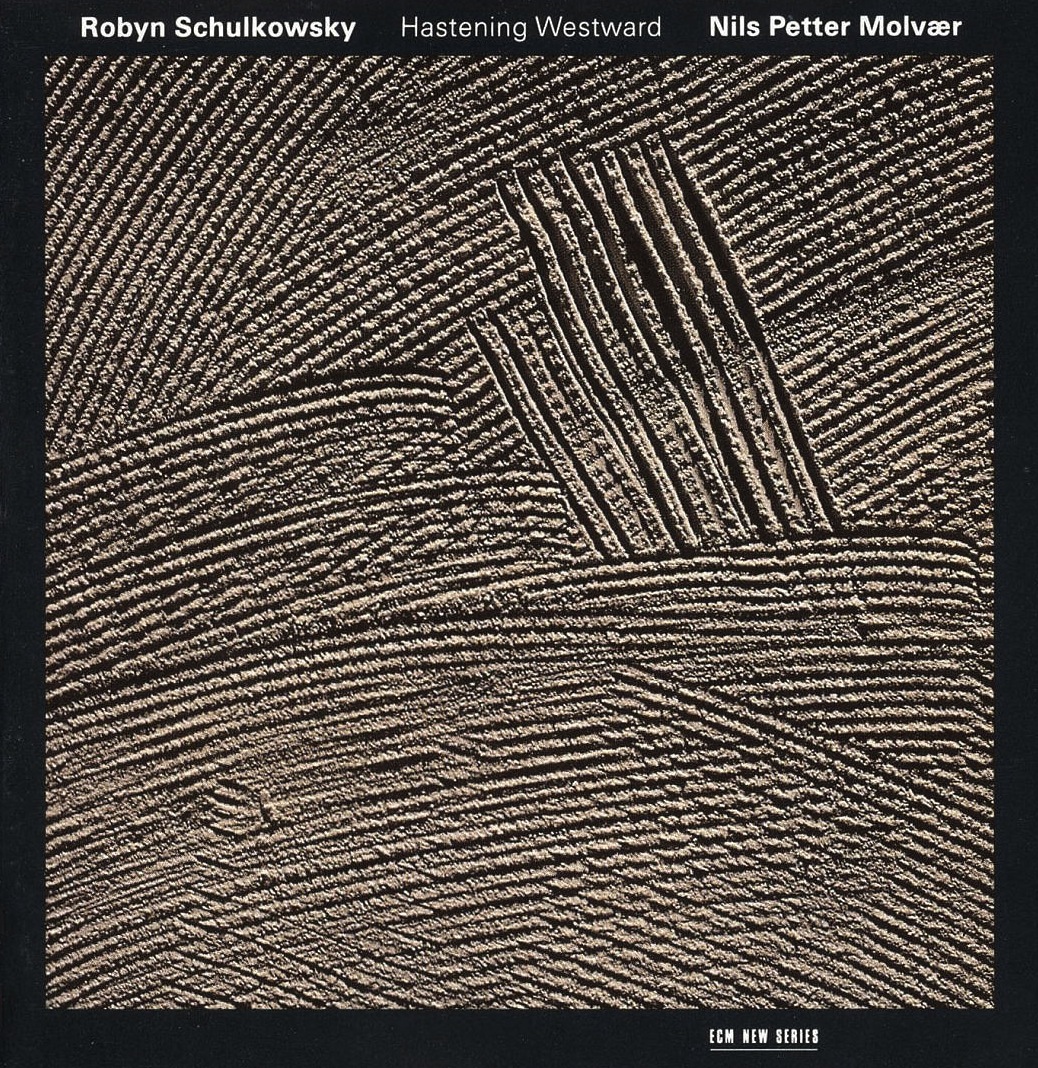
Robyn Schulkowsky/Nils Petter Molvær: Hastening Westward (ECM New Series 1564)

Robyn Schulkowsky
Nils Petter Molvær
Hastening Westward

Robyn Schulkowsky drums, gong, plate bell, crotales, cymbals, bronze bells
Nils Petter Molvær trumpet
Recorded January 1995 at Rainbow Studio, Oslo
Engineer: Jan Erik Kongshaug
Produced by Manfred Eicher

“Grain upon grain, one by one, and one day, suddenly, there’s a heap, a little heap, the impossible heap.”
–Samuel Beckett, Endgame

Berlin-based percussionist Robyn Schulkowsky, heard most recently with Kim Kashkashian on Hayren, joins forces with Norwegian trumpeter Nils Petter Molvær for a singular and lasting document. Schulkowsky has worked with some of the biggest names in modern music—Heinz Holliger, Karlheinz Stockhausen, John Cage, and Iannis Xenakis have all benefited from her dynamic breadth and open precision—but her performance style consistently balances humility with fortitude. In 1991, Schulkowsky composed a percussion ensemble piece entitled “Hastening westward at sundown to obtain a better view of Venus.” The title was lifted from Beckett’s final prose work, Stirrings Still, which, aside from being a vastly important book for Schulkowsky herself, sums up the feeling of this “extension” thereof most succinctly. Originally conceived as a solo project, the album was enriched with a snap decision from Manfred Eicher, who introduced Molvær into the mix. The two musicians had never met, but together they described a challenging world that remains effortless to explore.

The album is comprised of two works. Pier and Ocean, in three parts, begins freely, with more explosive drums lying in wait. Its final part is heaviest, shifting from shamanism to survivalism in a single beat. The title work fills out the bulk of the album. Over seven chapters of varying lengths, it takes its first steps in the whitened paragraphs of a wintry page. A lonesome piano airs its grievances in background. Deep drums inhale the air of mallet percussion. Yet no matter how enervated the music becomes, it always looks down at its own feet. Even the timpanic battle cries in Part 3 are laced with melancholy. Part 4 is the album’s most brilliant, as Molvær falls into a spread of echoed clangs, thus inaugurating a psychosomatic transition from rhythm into rhyme. Part 6 sounds like a seaplane landing on a lake, only we are the water receiving its foreign presence with the same yielding attention as we might give to a bird fishing from our depths. The final “hastening” is anything but, a slow drone with metallic percussion and a few brassy notes divinely attuned to the resonance of gongs.

Sadly, this project was never repeated. Considering the unusual confluence of events that produced it, however, a sequel is hardly necessary. Either way, what it has left behind is solid enough to withstand eons of peripheral development. Hastening Westward is a sublime experience that calls to you when you least expect it. It is neither the thrill of the hunt nor the agony of capture, but the single thread that connects them both.

<< Ralph Towner: Lost And Found (ECM 1563)
>> Mozart: Piano Concertos, etc. (ECM 1565/66 NS)
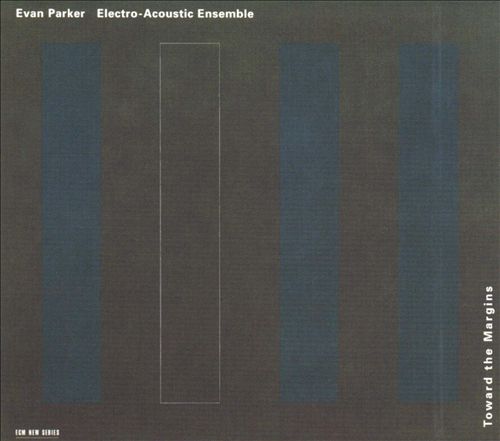
Evan Parker Electro-Acoustic Ensemble: Toward the Margins (ECM New Series 1612)

Evan Parker Electro-Acoustic Ensemble
Toward the Margins

Evan Parker soprano saxophone
Barry Guy double-bass
Paul Lytton percussion, live-electronics
Philipp Wachsmann violin, viola, live electronics, sound processing
Walter Prati live electronics, sound processing
Marco Vecchi live electronics, sound processing
Recorded May 1996, Gateway Studios, Surrey
Engineer: Steve Lowe
Produced by Steve Lake

What’s given:
If ECM had a musical attic, it would sound like Toward the Margins. Not to imply that the Evan Parker Electro-Acoustic Ensemble’s debut is filled with unwanted or forgotten things, but that it exists toward the margins of a human life, its shed skins stacked like boxes above our heads, waiting for a breath to blow the dust away. Parker has been with ECM almost since the beginning, having first appeared on The Music Improvisation Company and subsequently on Gavin Bryars’s After the Requiem, among others. An abiding interest in electronics as an improvisational medium led him to the present project, which draws from disparate disciplines bonded by an infatigable spirit of sound production.

What’s taken away:
Grating strings first clear out the rafters, shafting like light from behind a broken cloud. Parker’s soprano scratches gently at their back. Grumblings and sampled ether flutter and churn, tripping down sand-covered stairs like a creature covered with feet, so that it is always standing no matter how it lands. Compartmentalized echoes share their cubicles with shallow utterances of deeper assignments. Barry Guy’s double bass ties its strings into a tangle of self-awareness as Parker trembles within his own computer-augmented aftershocks. Like a flock of geese in overdrive, he burns in the upper atmosphere before he dares dream of land. Melody is but an afterthought to the sputtering multitudes, caught in the welcoming stare of an unwanted stranger. The overall sound is subdued yet robust. It inhabits the crawlspace of our dreams. The haunting final track lingers in our bones, long after the silence comes, animating a body whose only fear is cogency.

What’s left behind:
Parker is the rare musician who treats improvisation as composition—not so much an offering to the aleatoric gods as a vocabulary articulating its real-time derivations. His saxophonic work is high but far from mighty. He listens more than he plays, as the musicians faithfully tune themselves to a radio signal only they can hear. Washes of precipitation and other climatic changes stipple these aural landscapes, leaving Andy Goldsworthy-like rain shadows in their wake. Sometimes he rolls through rough detours, kicking up sparks and gravel; other times he hovers like an appraising insect, every note a kaleidoscopic cell unfolded into the whole of its vision. As the title makes unabashedly clear, this is an asymptotic experience with nowhere to hide but our ears, and there it burrows, hibernating until the next thaw.

<< Ralph Towner: ANA (ECM 1611)
>> The Hilliard Ensemble: A Hilliard Songbook (ECM 1614/15 NS
)

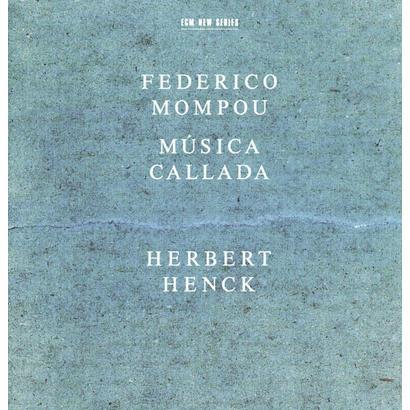
Federico Mompou: Música Callada (ECM New Series 1523)

Federico Mompou
Música Callada

Herbert Henck piano
Recorded August 1993, Festburgkirche Frankfurt am Main
Engineer: Andreas Neubronner
Produced by Manfred Eicher

The calm night
Announcing the advent of the dawn,
The silent music,
The sounding solitude,
The dinner that delights and enamors.
–Sister Juana Inés de la Cruz (1651-1695)

Federico Mompou (1893-1987) lived a long life filled with a quiet love for music. Although much has been said of his three decades spent in Paris, during which time he crossed paths with the likes of Debussy and Satie, it was in solitude that his crowning relic would be fashioned, already in a state of alluring dilapidation, and ultimately far from any of the geographic reference points that dotted his travels. Música Callada came into existence between 1959 and 1967, and represents one of the Catalan composer’s last major works. The untranslatability of its title (most renderings will have it as “Silent Music,” though certain nuances escape) is a key to its enigmatic construction, culled as it is from “Song between the Soul and the Beloved” of sixteenth-century Spanish Carmelite St. John of the Cross (1542-1591). This mystic poem was written as an imagined conversation between the Soul (Bride of Christ) and the Beloved (Christ the Spouse), describing in metaphor the human relationship with the transcendental word and its tangible effects. In the estimation of Nicky Losseff, “‘silent music’ can only be a conceptual audition, perceived not through the fleshy senses but directly through the soul’s inner ear, and as a concept it serves to demonstrate in a way that cannot be grasped at all—and yet cannot be grasped in any other way.” Yet we would be mistaken in thinking of this as a paradox, Losseff goes on to say, for what we hear in Mompou is anything but contradictory. Silent music exists all around us. Not only does it reside in images, dreams, and in our heads, but quite simply in the musical score itself, where notes await the touch of a bow, a fingertip, a human breath to animate them.

Of his Música Callada, Mompou wrote, “This music is silent because it is heard in one’s inner self. Restraint and discretion. The emotion remains hidden, and the sounds only take shape when they find echoes in the bareness of our solitude.” Over time, it has gelled into a slumbering touchstone of the pianistic landscape. The music bypasses all other organs and floods straight into the heart, its songs wavering like the surface of a large body of water describing its own unknowable depths. And while the effect is undeniably gorgeous, it is just as often ponderous, if not mournful. “Lento” is the operative time signature here, and threads the entire work with a tear-stained presence. That being said, no one mood dominates, for each is its own picture in a boundless physiological scrapbook. The crosshatched dissonances of No. 3 tickle the mind’s eye with a slow-motion frolic. The indeterminacy of everyday action animates No. 5, giving way to rustlings in moonlight. Such is the sadness also in No. 6, which drips like rain from the eaves of a house covered in hermetic vines. No. 9 is one of many inward glances, stunning in its honest impressionism. No. 13 haunts with its nervous expulsions of energy, while the final of the work’s four books closes its eyes in darkness.

Mompou’s atmospheres are honed to fine edges, made all the more so for their brevity and sense of direction. Brittle as they are, they manage to slice away our expectations layer by layer, until they rest on a bed of subcutaneous vulnerability. This is delicate music, to be sure, but it also thrives on sacrifice. Speaking practically, fans of his aforementioned French contemporaries will find much to love. Speaking spiritually, anyone might find something here to hold on to, tender and trembling in its infancy, but ever potent in melody and in stillness.

<< Charles Lloyd: The Call (ECM 1522)
>> Sidsel Endresen: Exile (ECM 1524)

Hommage à R.Sch. (ECM New Series 1508)

György Kurtág
Robert Schumann
Hommage à R.Sch.

Kim Kashkashian viola
Robert Levin piano
Eduard Brunner clarinet
Recorded August 1992, May and September 1994, Kammermusiksaal Beethovenhaus, Bonn
Engineer: Peter Laenger
Produced by Manfred Eicher

During his lifetime, the idiosyncrasies of Robert Schumann earned him little of the posthumous admiration that now abounds. A Romantic to the core, he found solace in the hollow spaces of his rich musical ideas, manifested to greatest effect in the potent miniatures he left behind. Perhaps no one has inherited this legacy in such a life-affirming way as György Kurtág. In this brilliantly realized album, which pairs both composers in a fortuitous program, we hear not only the bridge that arches between their worlds, but also the river that flows beneath it. Kurtág’s micro-compositional Neun Stücke für Viola solo are threaded by thinnest of intentions and a captivating dynamic contrast between nervousness and lyricism (though, to be sure, what qualifies as lyricism here exists always at the molecular level). The fragment takes on sensory completeness, compensated as it is by the symbiosis of performance and listening, so that even in absence of an audience, the performer remains the immediate receiver of the audible gesture. Jelek (Signs) op. 5 brims with the rich, heady double stops of Kim Kashkashian’s faultless phrasing, ensuring that hidden messages ring with all the robust fragility that surrounds them. Kurtág’s lines are by turns pliant and rigid, vaccinated with moribund attention. Distinctions between “interior” and “exterior” become irrelevant and fold into a shapeless entity with neither. The album is ordered in such a way as to centralize the viola, so that when the piano and clarinet emerge in Hommage à R.Sch. op. 15d, they seem to flank it from all sides. Through this transition, the music becomes more “visible.”

With the Märchenbilder (Fairy Tale Pictures) op. 113, we finally encounter Schumann in the flesh, though “stumble over” might be the more accurate term, as Kurtág’s ghostly echoes release us so effortlessly that we barely have time to breathe. These four vignettes for viola and piano melt into the ecstatic dramaturgy of the Fantasiestücke op. 73, in which the clarinet has its say before merging with the viola in the uniquely scored Märchenerzählungen (Fairy Tales) op. 132. These are profoundly embodied works that render any descriptive words mute to the touch, leaving me with little to offer for all their wonders.

Steady performances from all three musicians—but especially from Kashkashian, whose strings unravel like a mummy in the dusky light of an interstellar awakening—make for an engaging experience from front to back. Therein lies a pyramidal cycle, with the composers at its base, and a thread of life at its apex, pulled ever taut by an unseen alien hand.

<< Wadada Leo Smith: Kulture Jazz (ECM 1507)
>> Egberto Gismonti Group: Música de Sobrevivência (ECM 1509)

Jack DeJohnette’s Directions: Untitled (ECM 1074)

ECM 1074

Jack DeJohnette’s Directions
Untitled

Jack DeJohnette drums, tenor saxophone
John Abercrombie electric and acoustic guitars
Alex Foster tenor and soprano saxophones
Mike Richmond bass, electric bass
Warren Bernhardt piano, electric piano, clavinet, cowbell
Recorded February, 1976 at Talent Studios, Oslo
Engineer: Jan Erik Kongshaug
Produced by Manfred Eicher

With Untitled, Jack DeJohnette’s Directions popped a jazz milestone into ECM’s prolifically expanding oven, and it still smells as fresh as the day it was baked. Building off DeJohnette’s robust intro to the 14-minute “Flying Spirits,” a compelling quintet completed by guitar (John Abercrombie), bass (Mike Richmond), sax (Alex Foster), and keyboard (Warren Bernhardt) makes for an aerial interweaving of complementary signatures. The band kicks up a whirlwind of activity, leaving DeJohnette’s delicate applications to rustle like the last stray leaves blowing down the road, out of sight but ever in mind. “Pansori Visions” is an eccentric duet of hand drums and detuned guitar, slack strings sounding like the amplified offspring of a koto and a human voice. Not coincidentally, the title refers to a traditional Korean art form of often-satirical storytelling, also to the accompaniment of a single drummer. “Fantastic” is just that, its colorful percussive accents giving way to some infectious saxophonic action. In spite of the killer title, “The Vikings Are Coming” unfolds like something straight out of Pat Metheny’s Watercolors session, again striated by fluent reeds. “Struttin” evolves into a rather punchy face-off between saxophone and guitar, refereed superbly by DeJohnette. The only victory to be had is in the brief but bitter groove as it closes in resolute harmony. Bernhardt’s “Morning Star” begins with a duet of piano and acoustic guitar, the latter always one step behind. From these dream-like beginnings come a pronounced rhythm section and more melodic fortitude from alto. Capping off this invigorating set is “Malibu Reggae,” which slinks like a drunken dancer in slow motion, its delightfully kitsch keyboard gnawing at the edges of our curiosity with a familiar burn. A tune that would have sat easily among John Zorn’s Naked City abstractions in their heyday, it’s a whimsical ending to a powerfully direct album, ever blushing with hints of its own enigma.

These compositions—all but “Morning Star” are by DeJohnette with or without his collaborators—are bright, resilient, and vociferous. Having stood the test of three-plus decades, they will easily hold up to three more, and then some. And while our leader captivates with his usual kinesis, Foster’s vocal modulations and the unobtrusive support network of Abercrombie/Bernhardt/Richmond make this one for the ages. When you’ve had enough blues for one day, Untitled is as good a pick-me-up as you could ask for. A prime candidate for reissue.

<< Pat Metheny: Bright Size Life (ECM 1073)
>> Jan Garbarek: Dansere (ECM 1075)

Collin Walcott: Cloud Dance (ECM 1062)

ECM 1062

Collin Walcott
Cloud Dance

Collin Walcott sitar, tabla
John Abercrombie guitar
Dave Holland bass
Jack DeJohnette drums
Recorded March 1975 at Tonstudio Bauer, Ludwigsburg
Engineer: Martin Wieland
Produced by Manfred Eicher

The late, great Collin Walcott made his proper ECM debut on Cloud Dance (after an appearance three years earlier on Trios/Solos), where he was joined by the Gateway trinity—John Abercrombie, Dave Holland, and Jack DeJohnette—for one of his most powerful albums ever to grace ECM’s vinyl (and later, digital, thanks to a vital Touchstone series reissue) grooves. The marrow-warming twang of Walcott’s sitar sets up the opening “Margueritte” to be a long raga, when suddenly Abercrombie’s electric appears in kind, beckoning a chill entourage of bass and drums and touching off a pair of graceful solos from Abercrombie and Holland. The album’s remainder is fleshed out by a variety of intimate configurations. “Night Glider” and “Vadana” both feature guitar, bass, and sitar, the latter two instruments feeding beautifully off one another, the guitar weaving in and out where it may. The two duets between Walcott and Holland, however, are really where this album gilds its worth. Our frontman lays out plush carpets of tabla and sitar on “Prancing” and “Eastern Song,” respectively, over which Holland takes stock of every variation of pattern and thread count. The second of these pieces, while the briefest of the album, is also one of its most mesmerizing. Contrary to what the titles might have us believe, these are all genuinely realized pieces where the word “exotic” is but another puff of smoke in the breeze. And so, the heavy tabla and shawm-like guitar of “Scimitar” describes not the weapon wielded in the hands of countless white actors in uninformed filmic productions, but rather an exploration of the object on its own terms, tracing forms and histories, battles and silences alike, with due abandon. So, too, with the final and title cut that brings DeJohnette back into the mix for an animated closer.

The telephone wires on the cover are like the strings of some large instrument, with the sky as its sound box. Its clouds don’t so much dance as perform, caressing endless waves of voices careening through the ether. The joy of Cloud Dance is that it makes those voices intelligible. Fans of Oregon, of which Walcott was of course an integral part, need look no further for likeminded contemplation.

<< Abercrombie/Holland/DeJohnnette: Gateway (ECM 1061)
>> Enrico Rava: The Pilgrim And The Stars (ECM 1063)

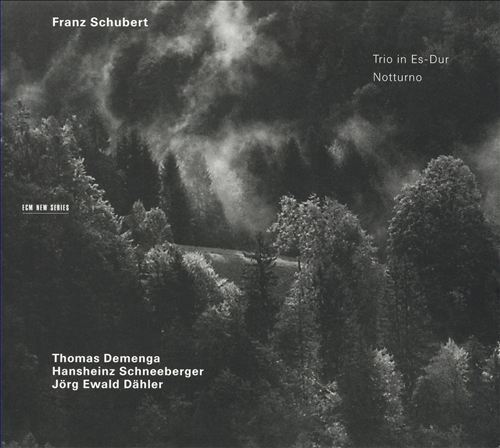
Schubert: Trio in Es-Dur/Notturno (ECM New Series 1595)

Franz Schubert
Trio in Es-Dur/Notturno

Jörg Ewald Dähler fortepiano
Hansheinz Schneeberger violin
Thomas Demenga cello
Recorded July 1995

ECM has nobly benefited the classical music industry by continuing to draw bold lines back to the works of Franz Schubert with consistently thoughtful performances and pairings. Although he never wrote for piano trio until his final year of life, Schubert seems to have put his all into the two masterworks that are the op. 99 and op. 100. For this major release, the latter has been paired with the often-neglected “Notturno,” published two decades after his death.

Harriett Smith calls the Trio in Es-Dur für Klavier, Violine und Violoncello op. 100, D 929 a “bridge between the trios of Beethoven and Brahms,” and was the longest ever composed (it equals, if not surpasses, the average symphony in scope) until Morton Feldman’s Trio of 1980. Penned in 1827, four years into the advancement of his syphilis, Schubert’s second piano trio came about when a close friend, Josef von Spaun, requested the piece for his wedding. Schubert would die in a matter of months after its premier, which reached his ears once before they heard no more.

The musicians superbly evoke the careful tension Schubert has worked into every phrase of the first movement. In its cosmos, one hears the voices of the stars, throttling the engine of space-time in dreamy suspension. A tinge of classicism adorns the Swedish folk song-enriched interior of the second movement, its delicate modality reflected in the pizzicato from both strings. An Austrian country-dance provides the basis for the Scherzo that follows, leading us into a massive Allegro moderato, which inventively brings back the theme of the second movement. Despite the daunting length of this and the first movement, our sense of progression never wavers. Schubert’s magical touches make exuberant experiences out of these longer narratives.

If, in the full trio, we get four worlds as one universe, in the Trio in Es-Dur für Klavier, Violine, Violoncello op. posth. 148, D 897 we get a glimpse into a newborn nebula. This single movement, dubbed “Notturno” (Nocturne) by publisher and composer Anton Diabelli, is believed to have been a rejected Adagio for the first piano trio in B flat major. As fragile as it is taut, it continues to thrive, a gorgeous offspring wrought in filigree and grace.

Jörg Ewald Dähler’s historically informed fortepiano, combined with the profoundly contemporary approaches of resident label cellist Thomas Demenga and the legendary Hansheinz Schneeberger on violin, infuses every moment of these performances with equal parts innovation and ritual. One need only listen behind closed eyes to see the images they recreate.

<< Peter Erskine Trio: As It Is (ECM 1594)
>> Misha Alperin: North Story (ECM 1596)

Pat Metheny: Watercolors (ECM 1097)

1097 X

Pat Metheny
Watercolors

Pat Metheny guitars
Lyle Mays piano
Eberhard Weber bass
Dan Gottlieb drums
Recorded February 1977 at Talent Studio, Oslo
Engineer: Jan Erik Kongshaug
Produced by Manfred Eicher

From the opening strains of Pat Metheny’s second album, we immediately know that we have a calming yet powerful journey ahead of us. The present company—among which keyboardist Lyle Mays, a Pet Metheny Group fixture, makes his first appearance—renders his characteristic combination of form and style into an instinctive wash of comfort. Mays’s pianism proves the perfect complement to the guitarist’s untainted sound. Just listen to the way he buoys the music in the opening title track, and his fluent solo in “River Quay,” and you will hardly be able to imagine the music without him. We get a lingering look at Metheny’s own abilities in “Icefire,” in which he solos on a cleverly tuned 12-string that lobs between solid chords and higher callings. Midway through, the music melts into its second titular half, flowering in a cluster of Ralph Towner-esque harmonics. “Oasis” introduces the harp guitar, a sympathetically strung instrument that shines in Metheny’s hands like the charango in Gustavo Santaolalla’s. A mournful electric sings at its center, ever shielded by an unrequited embrace of acoustics. Varied rhythms and bold chord changes animate its otherwise stagnant beauty. After these quiet submersions, we come up into air, and into light, with the beautiful “Lakes,” which positively glows with quiet ecstasies. Again, Mays broadens the edges to new waterlines, cresting like a wave that never crashes upon its thematic shores. A two-part suite proves a complex call and response with the self before the 10-minute “Sea Song” reprises the harp guitar for its swan song. The music here is beyond aquatic, and could easily have seeded a Ketil Bjørnstad project. Eberhard Weber’s smooth bass introduces the morning’s regular activities with the first rays of sunrise in countless awakening eyes, before rolling out once again, drawn back into the depths like the tide that gives them life.

Metheny’s precision dives and soars, a most selfless bird, his fingers running together like the colors of the album’s title. His supporting crew is in tune at every moment (and one mustn’t fail to praise Dan Gottlieb’s drumming in this regard), protecting every melody with passionate detail. This is perfect music for travel, for the music travels itself. It’s a plane ride above a shimmering landscape, a hang-glide over open valleys, a dive into crystal waters—and yet, our feet never leave the ground. One might call it otherworldly, were it not so firmly rooted in the earth in all its glory. Pure magic from start to finish.

<< Collin Walcott: Grazing Dreams (ECM 1096)
>> Julian Priester and Marine Intrusion: Polarization (ECM 1098)

Chick Corea: Solo Piano (ECM 2140-42)

Corea Solo Piano

Chick Corea
Solo Piano

Chick Corea piano
Ida Kavafian violin
(Children’s Songs, Track 20)
Fred Sherry cello
(Children’s Songs, Track 20)
Release date: March 26, 2010

Much of the jazz that has come to characterize the “ECM sound” is known for its pellucid solemnity. Conversations between sound and space abound, in which vestiges of their own histories mark the passage of time. To younger listeners like myself, it is sometimes easy to forget that the label remains rooted in the youthful immediacy one finds in these formative efforts from Chick Corea. While his refreshing approach to pianism inhabits the same continent as other formidable players, Corea is very much his own culture. Much of the later material that would come to define the “Corea sound,” however, is in clear evidence throughout these discs, and especially in the improvised efforts.

1014 X

Piano Improvisations Vol. 1 (ECM 1014)

Recorded April 21 & 22, 1971, Bendiksen Studio, Oslo
Engineer: Jan Erik Kongshaug
Produced by Manfred Eicher
Release date: 1971

From note one, these improvisations abound with the freedom of an artist who is ever at his peak. Their many tender touches and nostalgic leanings are shielded by a powerful optimism. Such exuberance makes them all the more embraceable in their poignancy. Tunes such as “Noon Song” twirl like a skirt in the breeze. Others (“Sometime Ago” and “Song For Sally”) are flirtatious and skip from one thought to another: a love in overdrive. The pièce de résistance, however, is the eight-part suite “Where Are You Now?” In this series of “pictures,” Corea renders for us a film whose soundtrack precedes its images. There are no mysterious titles to ponder; each tells us exactly what we are going to hear. The playing is at once pliant and mechanical, carrying across its feelings with such genuine appreciation for the listener that one cannot help but smile.

<< Dave Holland/Derek Bailey: Improvisations for Cello and Guitar (ECM 1013)
>> Jan Garbarek Quintet: Sart (ECM 1015)

1020

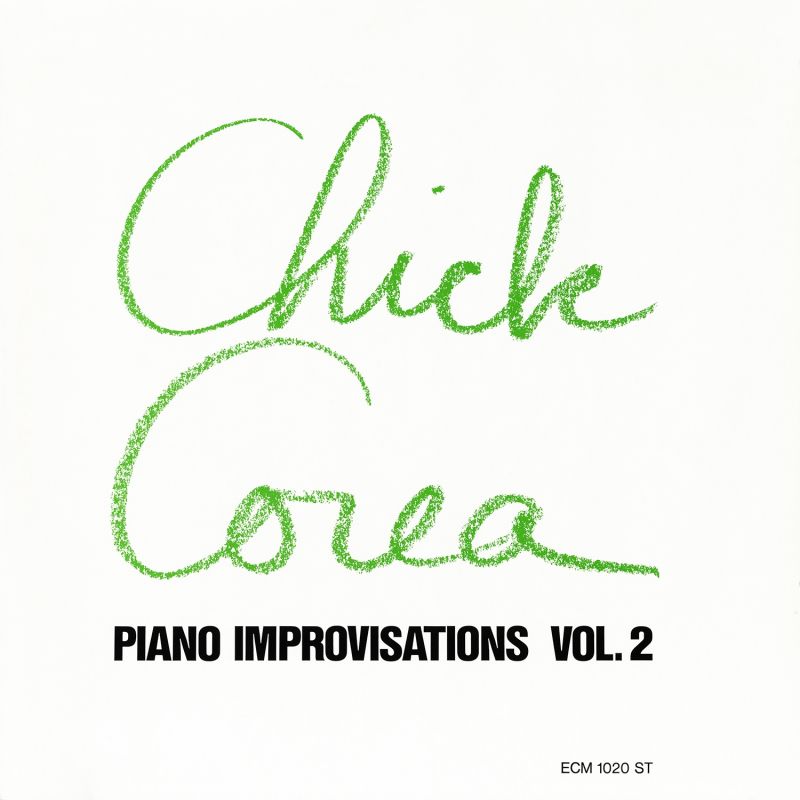
Piano Improvisations Vol. 2 (ECM 1020)
Recorded April 21 & 22, 1971, Bendiksen Studio, Oslo
Engineer: Jan Erik Kongshaug
Produced by Manfred Eicher
Release date: March 1, 1972

This companion volume of Corea’s improvisations doesn’t merely continue where the first left off, but fleshes out finer details unexplored in its neglected depths. This volume is more nocturnal than the last, a siesta in songs without words. “After Noon Song” starts us off alluringly before the crisper interjections of Thelonius Monk’s “Trinkle Tinkle” and Wayne Shorter’s “Masqualero.” The second act is where the album begins to fray at the edges, and becomes all the more mystical for it. At first, experiments like “Departure From Planet Earth” seem to stray into unnecessarily weighty territory. Yet with each listen, they tell us more about their travels. And while Corea’s often-discussed religious predilections (I dare not invoke the “S” word here) may give us even greater insight into the music’s enigmatic borders, in this instance such forays into biographical details provide little advantage. Either way, Corea reacclimates into “A New Place.” This is polyglot music, of which each melody its own tongue. Though some are more readily interpretable than others, we always know what is trying to be said.

<< Circle: Paris Concert (ECM 1018/19)
>> Keith Jarrett/Jack DeJohnette: Ruta And Daitya (ECM 1021)

1267

Children’s Songs (ECM 1267)
Recorded July 1983 at Tonstudio Bauer, Ludwigsburg
Engineer: Martin Wieland
Produced by Manfred Eicher
Release date: April 1, 1984

By a similar twist of fate that kept me from The Köln Concert for so many years, I only discovered this album recently, and I must say that it deserves a throne alongside Keith Jarrett’s magnum opus for its unfathomable hidden power. Beneath the album’s contemplative veneer beats a furnace of a heart stoked by creative flames, the heights of which are rarely surpassed in today’s genre-hungry climate. Begun in 1971, and recorded here twelve years later, Children’s Songs gives us Chick Corea at his compositional best. At first, the title is an enigma: Are these songs to be played by children or for children? But as we soon discover, the child has already outgrown itself. Like clouds, these pieces take on whatever shapes we project onto them. On the one hand, their steady obbligatos and carefully chosen points of contact resemble the latent energies of Philip Glass (No. 1) and Steve Reich (No. 9). On the other, they pantomime a range of influences, from ragtime to Satie (No. 19 is like something lifted straight out of Gymnopédies) to Bartók (the Mikrokosmos parallels being almost too obvious to mention). One can also clearly see how influential this music must have been to others. The filmic beauty of No. 4 cannot have been lost, for example, on Michael Nyman. These are also pieces about contrast. Take, for example, the left hand in No. 6, which lays out a triadic darkness, while the right hand insists on spinning light before our very eyes. Corea’s characteristic ornaments, as in the descending trill at end of No. 3, grow richer every time, and the sweeping elegies of No. 10, 12, and 13 allow the Corea we know and love to shine through. Violin and cello add delightful pliancy to the “Addendum,” a classically minded closer that puts a stylish bow on an already crisply wrapped package.

Corea and his legacy blossom at every moment throughout these three seminal albums, with which he singlehandedly revitalized the solo piano program as an art form to be taken seriously in the post-Art Tatum era. He is the reliable narrator, the quiet provocateur, and the entertainer. He is also none of these. He bids us to listen without pretense, knowing that a carefully defined surface is nothing without the depth to support it. At the same time, he wastes no time in trying to intellectualize what lies beneath, secure in the knowledge that his music will carry on the conversation. This is an essential collection that belongs on any ECM fan’s shelf, not to mention a prime candidate for reissue of the century.

<< Rainer Brüninghaus: Continuum (ECM 1266)
>> Ulrich P. Lask: Sucht+Ordnung (ECM 1268)