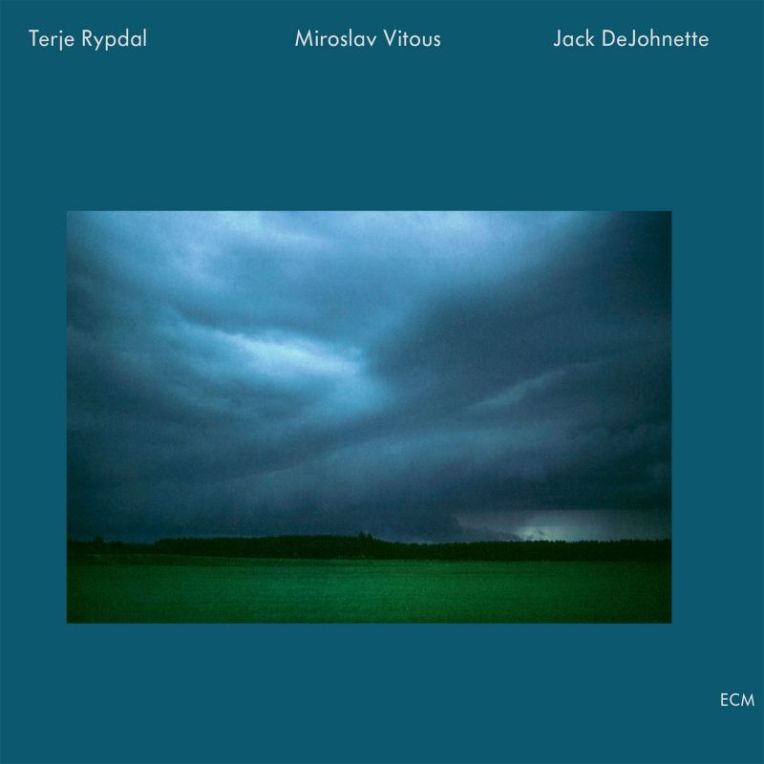
Rypdal/Vitous/DeJohnette: s/t (ECM 1125)

ECM 1125

Terje Rypdal/Miroslav Vitous/Jack DeJohnette

Terje Rypdal guitar, guitar synthesizer, organ
Miroslav Vitous double-bass, electric piano
Jack DeJohnette drums
Recorded June 1978 at Talent Studio, Oslo
Engineer: Jan Erik Kongshaug
Produced by Manfred Eicher

Terje Rypdal/Miroslav Vitous/Jack DeJohnette joins its eponymous crew in a one-off trio date for the ages. Although billed as something of a Rypdal venture, the album is primarily a canvas for Vitous, who bubbles forth with all the viscous potency of oil from a crack in the earth. The bassist and Weather Report founder culls from that selfsame influential oeuvre his classic tune, “Will” (a lilting and sentimental ride which made its first appearance on Sweetnighter), and pairs it with “Believer,” another original that is more Rypdal-driven. These two form the heart of a tripartite experience that begins with a pair of Rypdals. The first of these, “Sunrise,” floats in on DeJohnette’s scurrying drums, spurred by the air currents of Rypdal’s Fender Rhodes. Suspended plucking from bass stands out like heat lightning against Rypdal’s grittier monologues. Overdubs balance out the spacious surroundings with their fallow echoes. The guitar dominates here, its trembling accents seeming to grab clouds by their collars and shake them until melodies come falling out in patchy storms. He scrapes his pick along the strings, as if tearing holes in the very fabric of space-time. With respectful stealth, his gorgeous chording in “Den Forste Sne” manages to undercut the bowed bass, the latter recalling the tender songs of David Darling. This one is a stunner in its grandiose intimacy, accentuated all the more by Rypdal’s low-flying passes. We end with a diptych of group improvisations, each the shadow of the other. Between the frenetic syncopations of “Flight” and the pointillism of “Seasons,” we are given plenty of poetry with which to narrate our inner lives.

While, arguably, a pronounced variety of modes would have made this a “stronger” record, it seems content in being the languid organism that it is, and constitutes another enchanting landscape deservedly hung in the hallowed ECM Touchstones gallery. It might not be the best place to start, but what a detour to be had along the way…

<< Steve Kuhn: Non-Fiction (ECM 1124)
>> Art Ensemble of Chicago: Nice Guys (ECM 1126)

Steve Kuhn: Non-Fiction (ECM 1124)

ECM 1124

Steve Kuhn
Non-Fiction

Steve Kuhn piano, percussion
Steve Slagle soprano and alto saxophones, flute, percussion
Harvie Swartz bass
Bob Moses drums
Recorded April 1978 at Tonstudio Bauer, Ludwigsburg
Produced by Manfred Eicher

Steve Kuhn is the all-purpose element: his presence heightens any musical concoction. Like no jazz pianist I know, he is aware of the negative spaces between his notes and shapes those spaces to suit the emotional needs of the tune. And what a set of tunes we have in Non-Fiction, a sorely out-of-print firecracker in dire need of a digital fuse. Speaking of conflagration, nothing singes our brow in any Kuhn project quite like “Firewalk,” which, despite its characteristically spacious feel, is clear and present (I bow to the uncredited engineer on this one). Kuhn accolades aside, it’s the sopranism of reedman Steve Slagle that really sets these coals to glowing and cradles every assured step in the liberation of play. Bob Moses and Harvie Swartz—an ideally suited rhythm section if there ever was one—lock the “Random Thoughts” that follow into lively traction. Slagle opts for flute and alto sax over a constantly shifting sonic palette. Whenever he isn’t breathing, he keeps his hands busy with additional percussion. (Unfortunately, the latter comes across as intrusive to my ears during headphone listening. External speakers will remedy this.) “A Dance With The Wind” and “The Fruit Fly” reverse the scales with a collective dose of whimsy and nostalgia. Swartz is simply fantastic here, weaving deftly through Kuhn’s canvas of vamps with distinct yet harmonious brushstrokes of its own. If anything has been missing so far, we find it all collected in “Alias Dash Grapey,” which has it all: a sweeping piano intro, replete with unrestrained cries from Kuhn, a spirited collage of solos (Moses ever palpable), and a deep sense of communication.

This is a tight album with plenty to unpack through repeated listening. Its energies fluctuate in volume, but always to the beat of Kuhn’s erudite dictation. As worth tracking down on vinyl as it is waiting for an appearance on CD.

<< Barre Phillips: Three Day Moon (ECM 1123)
>> Rypdal/Vitous/DeJohnette: s/t (ECM 1125)

Barre Phillips: Three Day Moon (ECM 1123)

ECM 1123

Barre Phillips
Three Day Moon

Barre Phillips bass
Terje Rypdal guitar, guitar synthesizer, organ
Dieter Feichtner synthesizer
Trilok Gurtu tabla, percussion
Recorded March 1978 at Talent Studio, Oslo
Engineer: Jan Erik Kongshaug
Produced by Manfred Eicher

I have said it before and I will say it again: Barre Phillips is one of ECM’s most underrecognized treasures. A maverick of the upright bass, his is a mind in which one revels getting lost. This follow-up to 1976’s Mountainscapes is the genesis to the latter’s messiah. From Dieter Feichtner’s opening synth in “A-i-a” and its attendant bass line, we are immediately engaged in a dialogue that is untranslatable except via the grace of its performance. Electric guitar accents from Terje Rypdal, who feels right at home here, billow backwards from the stratosphere into fissures of sonic earth. Rypdal swaps axe for organ in “Ms. P.,” unfurling a shimmering heat in which the breath of bass turns to steam. Even spacier touches await us in “La Folle” and “Ingulz-Buz.” Farther-reaching abstractions mesh into the neutral colors of electric guitar and bowed bass, respectively, throughout these intertidal interludes. “Brd” puts me in mind of Paul Schütze’s Stateless (especially the track “Cool Engines”): strung by a steady bass line and tabla, the latter courtesy of Trilok Gurtu, and Rypdal’s continued ploys, each bead reveals new insights with every listen. If Rypdal has been a key figure in the album’s narrative thus far, for the final “S. C. & W.” he morphs into a demigod. Backed by an insectile arpeggiator, alongside bombilations from bass, Rypdal gets tricky with the effects, at times lapsing into R2-D2-like articulations, but always with integrity. An emblematic closer.

Grandiose, cinematic, and meticulously constructed, Three Day Moon once more proves Phillips to be one of jazz’s best-kept secrets. The album also sports one of the most evocative ECM sleeves of the seventies, with sonic innards to match.

<< Enrico Rava Quartet: s/t (ECM 1122)
>> Steve Kuhn: Non-Fiction (ECM 1124)

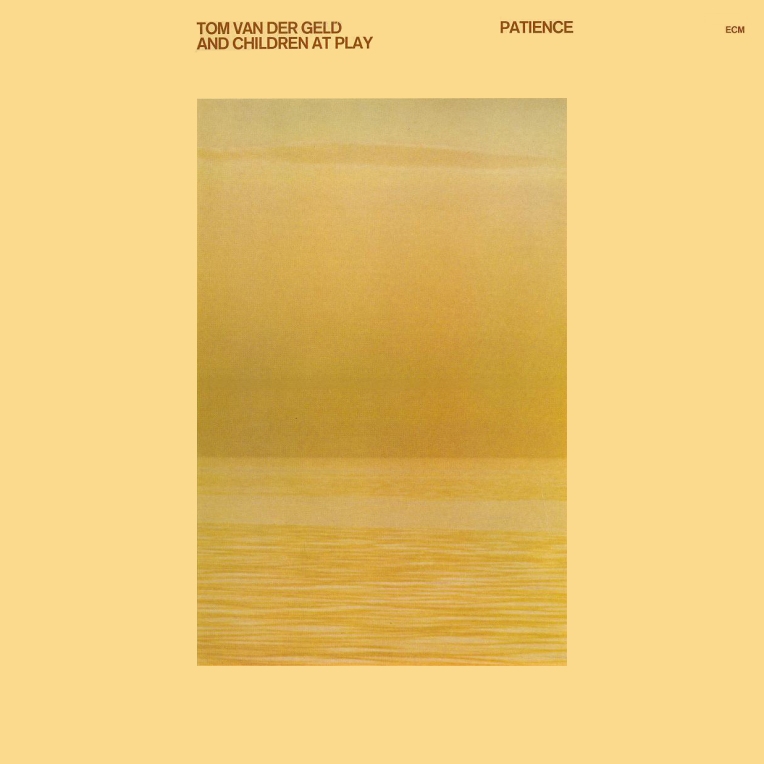
Tom van der Geld and Children At Play: Patience (ECM 1113)

ECM 1113

Tom van der Geld and Children At Play
Patience

Tom van der Geld vibraharp, percussion
Roger Jannotta soprano and baritone saxophones, flutes, oboe, bass clarinet
Kent Carter bass
Bill Elgart drums, percussion
Recorded May 1977 at Tonstudio Bauer, Ludwigsburg
Engineer: Martin Wieland
Produced by Manfred Eicher

As yet to provide choice “vibes” for Kenny Wheeler’s around 6, in addition to his elusive but well-worth-owning Path, mallet man Tom van der Geld made his ECM debut with this, his second of three “Children At Play” recordings. Less specific than his later work with the group, which was perhaps never meant to be a stable collective/concept in the first place, Patience may require just that. That being said, the abstractions of the opening title track have a charm all their own, seeming to inhabit that blurry space between fading night and the coming dawn. This diurnal circle unrolls into a relatively straight line in the flute of multi-instrumentalist Roger Jannotta through the vibes’ infrared lobs. With “Golden Stabs” we feel that dawn acutely, warming our faces with a gorgeous soprano that always remains tonally centered despite its erratic rays. Those smooth reeds carry over into the even smoother melancholia of “Alison.” “Celia” is an ever-changing mosaic of continental winds and underwater railways. Like a broken vial of liquid mercury, it recedes, unrecoverable, into the cracks of a melodious tessellation. “And Then…” ends the album on a pointillist reverie with the oboe as storyteller. We get the barest intimations of traction in the bass (Ken Carter) and drums (Bill Elgart) before taking shelter in more densely woven brush. It is here where the album at last begins to gel and its trajectory becomes known to us.

Viscous and profoundly solitary, van der Geld’s is an intimate world to be sure. Like the flute that haunts its darkest corners, it is a half-remembered death given a new body through the resurrection of the musical act. One feels Patience in degrees of heat, each track an incremental setting on a toaster that sets the coils aglow with varying intensity, leaving us with a distinct char every time.

<< Keith Jarrett: Ritual (ECM 1112)
>> Pat Metheny Group: s/t (ECM 1114)

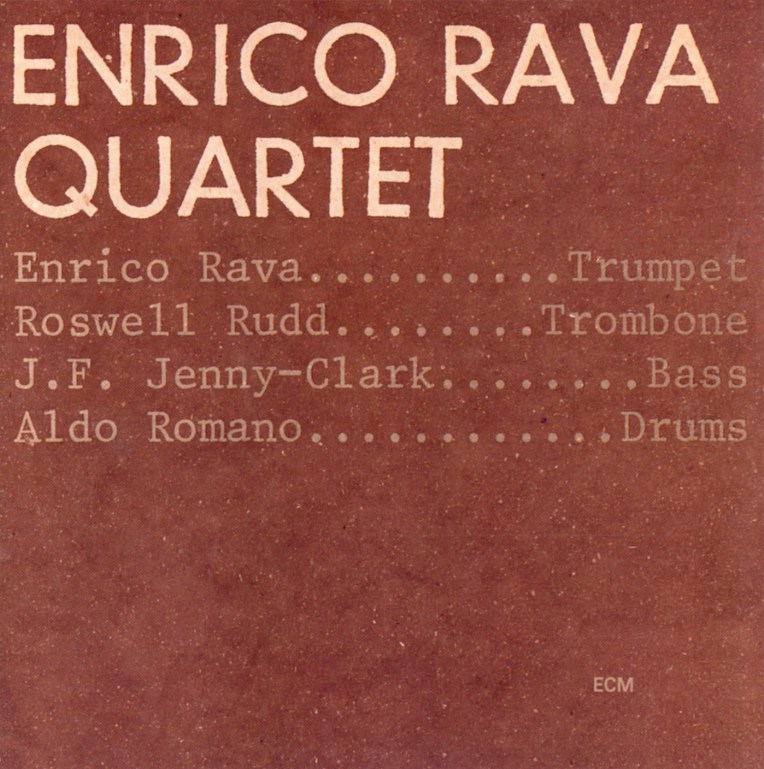
Enrico Rava Quartet: s/t (ECM 1122)

ECM 1122

Enrico Rava Quartet

Enrico Rava trumpet
Roswell Rudd trombone
Jean-François Jenny-Clark bass
Aldo Romano drums
Recorded March 1978 at Tonstudio Bauer, Ludwigsburg
Engineer: Martin Wieland
Produced by Manfred Eicher

Enrico Rava, one of the trumpet’s unsung heroes, unearthed a gem in this self-titled quartet offering from 1978. Although one can always expect an expertly realized variety in any Rava project, what makes this date so special is the assembly of its players. The Italian virtuoso’s hit-you-in-the-chest lyricism—matched perhaps only by label mate Kenny Wheeler—is foiled beautifully by trombonist Roswell Rudd, a free jazz specialist and Archie Shepp go-to whom ECM enthusiasts will recall from Michael Mantler’s CONCERTOS and a smattering of Carla Bley releases on Watt. Rudd’s fluid undertow brings our leader’s more incisive melodic lines to vivid light, gently laying down long thematic carpets upon which every improvisatory step leaves behind an indelible print.

The opening chunk of “Lavori Casalinghi” doesn’t so much kick things off as pull the curtains to reveal a slow sunrise. The drumming of Aldo Romano sets off a spate of powerful statements from the two brassmen, each linked by a chain of highly charged relays. The rhythm section never lags, and even spawns a nimble-fingered turn from bassist Jean-François Jenny-Clark before sliding back into the mournful twists with which it began. This is one of two substantial cuts, the other being “Tramps,” a fifteen-and-a-half-minute swell of sometimes frenzied proportions. Rava and Rudd draw each other into ecstatic exchanges, their playing at its most soaring. Wilder moments are short-lived, but always tasteful. Romano shows off one of the most fluid snare rolls in the business here, flanked by rousing phrasings from Rava and Rudd both. “The Fearless Five” is the first of three shorter numbers that flesh out this balanced effort. A bit of Monk creeps in, foreshadowing the well-worn “Round About Midnight,” which the crew buffs to like-new shine. Finally, the upbeat intro of “Blackmail” leads into some prime playtime for Rava. And as he skips his way across the sky, we take comfort in the somber closure into which he lays his final rest.

All in all, a fine session bubbling with personality and heft, and one well worth owning for the Rava newbie and veteran alike.

<< Ralph Towner: Batik (ECM 1121)
>> Barre Phillips: Three Day Moon (ECM 1123)