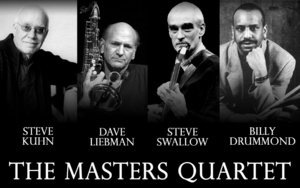
“Music We Order Our Lives To”: The Masters Quartet Live Report

August 20, 2011
Birdland
8:30 pm

Steve Kuhn piano
Dave Liebman saxes
Steve Swallow bass
Billy Drummond drums

A brief dictionary perusal of the word master yields variations on a theme of dominance: one who uses, controls, even disposes of that which is mastered. It’s with this hierarchical vision of mastery in mind that I entered the hallowed doors of Birdland for a late-summer performance by The Masters Quartet. None could earn such a title, of course, without verifiable skills and the countless hours necessary to hone them. As longtime collaborators, Kuhn and Swallow are strangers to neither, having made their first recorded appearance alongside Liebman on the bassist’s 1979 debut, Home, with over a decade’s worth of friendship and gigging already between them. Listening with eyes closed, one could hardly guess that Carla Bley band regular Drummond is a relatively new addition to this veteran nexus. Their blend was so seamless that by the time I stepped out into the humid streets, dominance was farthest from my mind.
To be in the presence of all four was already an honor, but the venue made it exponentially more so. This being my first Birdland experience, I finally understood why Charlie Parker dubbed it “The Jazz Corner of the World.” From its candlelit murmur, non-invasive wait staff, and intermittent tick of silverware to its top-flight roster, carefully considered sightlines, and one-on-one feel, the setting was ambiance incarnate. Though nothing remains of Birdland’s original digs, one can glimpse those glory days in the monochrome gallery of talents that adorns its walls. All the more reason, then, to bask in the present, where four incomparable musicians filled our ears with concoctions both pungent and smooth—not unlike the French martini at my fingertips—as they took to the stage and eased us into the evening’s intensities with a pair of trios.

A lush opening surge as only Kuhn can elicit swept this heart away in the standard, “There is No Greater Love.” With a sigh and a smile, he made us feel part of the band, creating music simply by bearing witness to its spontaneous unfolding. Through peaks and valleys, Kuhn navigated every turn of Swallow’s unshakable bass lines and the cymbal-happy squint of an ecstatic Drummond. The latter’s locomotive rolls opened a lyrical path for Swallow before kicking up a bit of dust as he exchanged jabs with Kuhn. His increasingly frenzied snare, along with Swallow’s leapfrogging bass, wound us into a state of high expectations. Thus did these gentle beginnings feed a dancing conflagration which, rather than brazenly overstepping those expectations, passed lithely through them like ghosts.

A milky intro stirred us into the coffee-like consistency of “Dark Glasses” (S. Swallow), resolving itself into a galactic swirl. With organic care, the music loosed ribbons of bass amid Drummond’s delicate knocking. Kuhn’s Möbius strip of a solo titillated (as a tongue, it would have rolled every “r”) and brought us ever closer to the filmic imagery lurking therein. Like its titular accessory, this joint at once clarified and obfuscated, cutting out the glare while hiding choice secrets.

“All the Things That…” (D. Liebman) marked its composer’s entrance to the stage. Inspired by the standard “All the Things You Are,” this smooth excursion was a prime vehicle for that oh-so-sweet soprano. With the magic of a mirage shimmering into shape, it showed us a level of tonal acuity that one can only dream of producing. Drummond provided sympathetic response, matching each of Liebman’s calls with joyful paroxysms of his own. Such were the beauties that awaited us also in “Adagio” (S. Kuhn). Here, Liebman’s slide into resplendence fogged our view with a long exhalation. Meanwhile, Kuhn tumbled in careful somersaults, marking the swaying rhythm that caught this listener from the get-go. Swallow traced a wide embrace with an engaging solo turn that seemed to welcome us all into its arc.
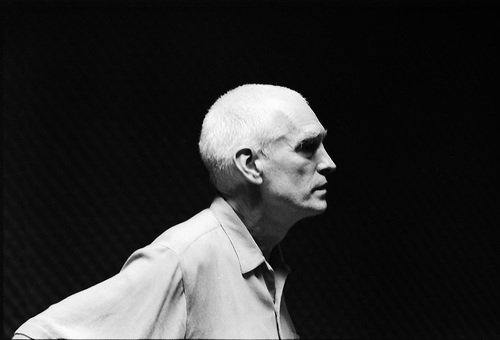

(photo by Manuel Cristaldi)

We were then treated to an unfailing rendition of “Village Blues” by John Coltrane, a “mentor to us all” as Kuhn so respectfully noted before its trio intro buttered our bread like nobody’s business. This proved a solid launching pad for a dramatic color shift as Liebman’s tenor awoke from its slumber. It, too, spoke in wooden riddles and guttural dreams, but those gritty squeals layered on the sonic paint—Van Gogh to his soprano’s Monet—and added a new dimension to surrender. His blows were softened only somewhat by Kuhn’s detasseling pianism, diving instead into an epic exchange with Drummond.

For the standard, “My Funny Valentine” (the “romantic highlight” of the show, as Kuhn artfully quipped), we were back to the smoky grain of soprano. Here the pianist’s poetry shone at its brightest, dissolving into lute-like strains of bass, as if in watercolor.
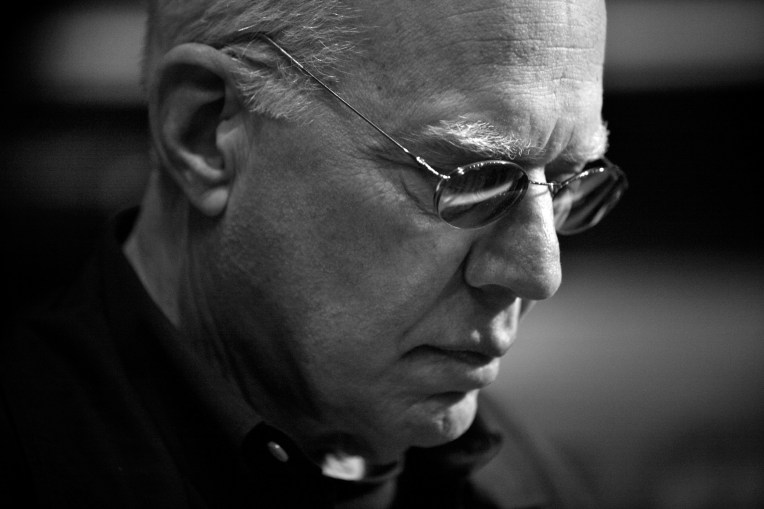

(photo by Robert Lewis)

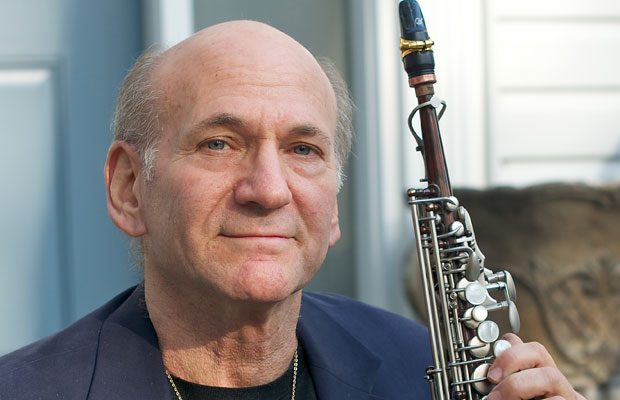
Liebman’s robust tenor then inscribed “A Likely Story” (S. Kuhn) onto the pages of our attention. Against a grounded bass line and deep piano digs, he was lively and on point. Kuhn held a steady clip across his tightropes, tethers to an inspiring synergy with Drummond, who dotted the sky with sparks as this log was cast onto the evening’s kindling. I couldn’t help but note how “keyed in” Liebman was as his fingers mimed on the sax during a sit-out before he dove back in for the final splash.

(photo courtesy of the Montréal Gazette)

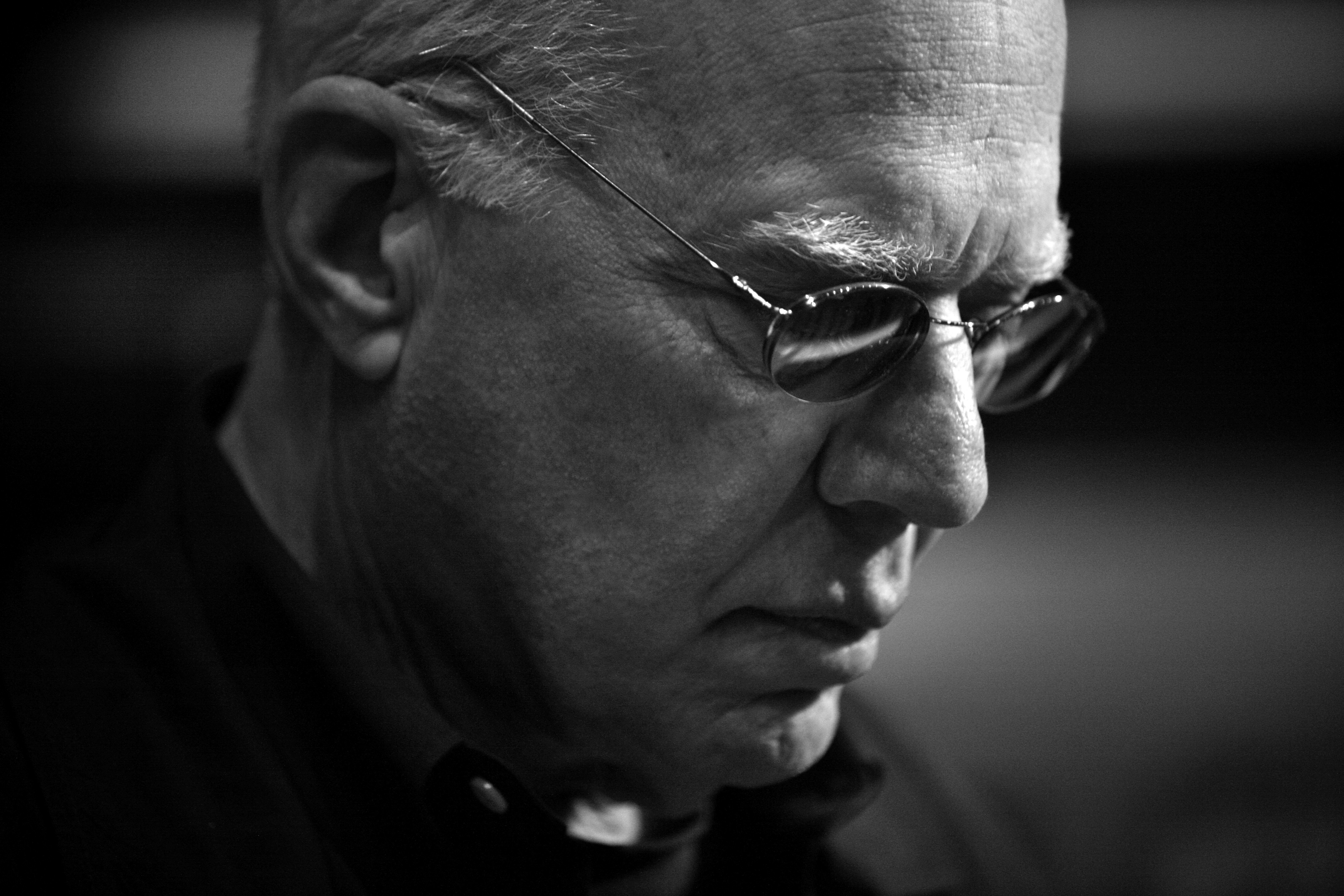
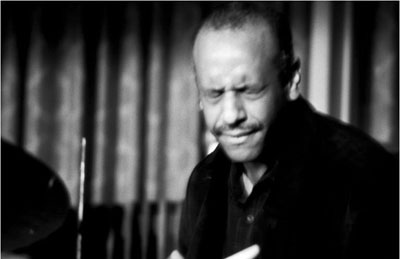
Mastery revealed itself in many guises throughout the show, but chiefly by the adroit ways in which the group always held fast to the tightly wound spring that thrummed at the heart of every tune they played. Their thematic cohesion was due in no small part to Swallow, who electrified with his unparalleled anchorage and fluid anticipations. Kuhn, ever the picture of concentration, threaded each of his needles with mindful improvising, those unmistakable octave splits crying with such epic grace that captivation was our only option. With every run of his fingers he seemed to travel miles’ worth of emotional distance. Against such broad pointillism, Liebman’s richness came across as filamented, teetering on edge, and all the more visceral for it. He was every bit the vocal performer, untangling seemingly impossible knots in a fraction of the time it took to tie them. As for Drummond, he seemed to squeeze every last drop of soul from the most delicate gestures, treating each as a gig in and of itself. He positively stole the show in its final gasps.

(photo by Albert Brooks)

In short, the quartet put the “band” back in “abandon” and proved yet again what for me is the blessing of jazz, an art form that makes the immediate effects of improvisation feel as if they have been growing inside us all along.

Furthermore, I discovered that true mastery bleeds from art into one’s countenance, one’s approachability as a human being, one’s humility offstage. In other words, it is nothing without the light of graciousness that permeated each of these four men, their loved ones, and the fans in attendance. In the end, their performance might very well have been but a flash in New York City’s overcrowded pan, but their afterimages are safe with me.
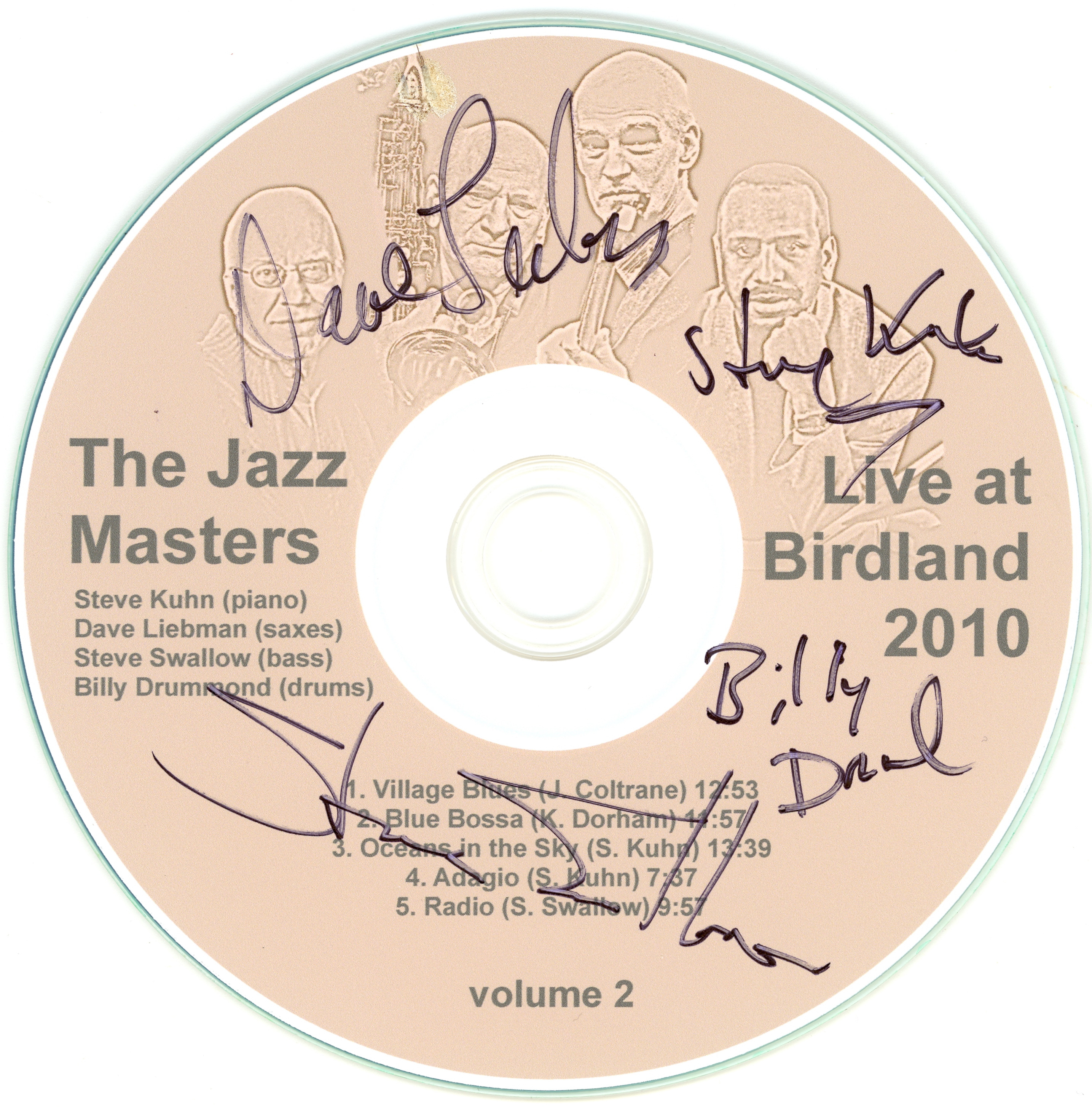

Autographed CD of last year’s gig, purchased at the club
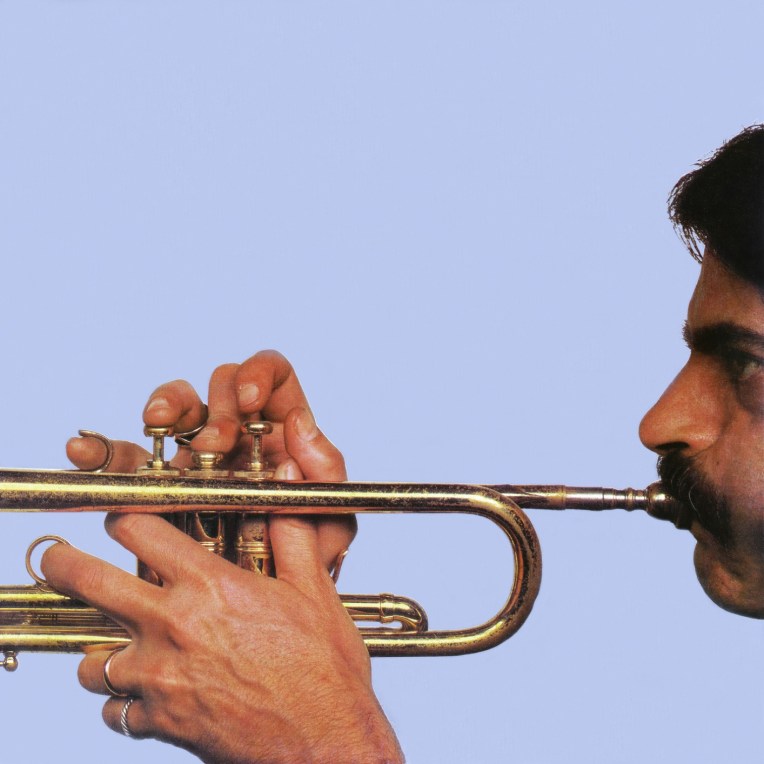
Enrico Rava and Thomas Stöwsand (ECM 1166 & 1224)

On October 5, 2006, the audible world lost a tireless champion. Thomas Stöwsand was a musician and journalist by trade when he joined forces with Manfred Eicher in 1970. Over the next decade he helped lay earth for the secluded pantheon that the label would soon become. From early on he believed that the best way to promote ECM’s quickly growing scene was to bring it directly to the consumer. The crowning achievement of his efforts was the booking agency Saudades Tourneen, which he founded in 1983. Consequently, Keith Jarrett, Chick Corea, and Pat Metheny found themselves touring for the first time before European audiences. A healthy chunk of Stöwsand’s complete roster reads like an ECM hall of fame: John Abercrombie, Bill Frisell, Egberto Gismonti, Ralph Towner, Paul Motian, Dave Holland and many others all had the great fortune of being sucked into his whirlwind of passion. “I know he loved their music,” observes Nonesuch’s Bob Hurwitz, “but I think Thomas loved them as people even more.” This was, as Hurwitz goes on to say, a part of his legacy. I imagine it is also part of the legacies of every musician he represented. These were the people he surrounded himself with, the ones who fanned a flame much too extroverted to contain. Stöwsand lived fast, drove fast, and seems to have made connections as easily as one might breathe. His personal touch was felt, and still is felt, worldwide, as Saudades carries on his mission through the pioneering forces of John Zorn, the Kronos Quartet, Fred Frith, and the many others who funnel decades of close working relationships with the man into their unquenchable creative thirsts.

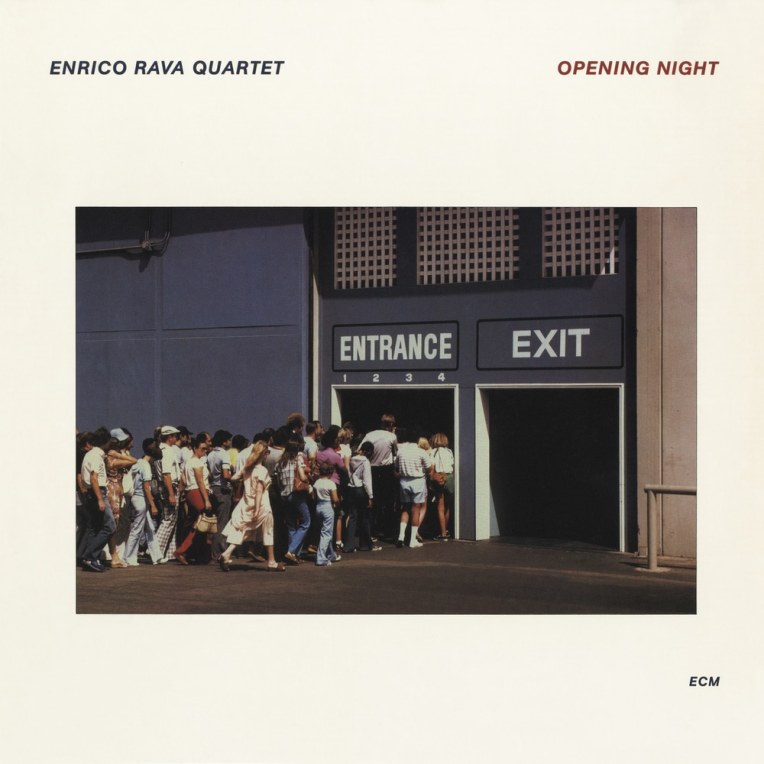
Yet behind his acute business acumen, infectious personality, and resounding laugh, Stöwsand was also quietly producing a fascinating catalogue of albums. Nearly all of these were available only on JAPO, though thankfully a gleaming handful of Manfred Schoof material has since been reissued on CD. There were two albums, however, that dropped needles directly to flagship vinyl. Both were recorded with Italian trumpeter Enrico Rava’s fledgling quartet at the famed Tonstudio Bauer and were the only two Rava albums not produced by Eicher. The first of these, the curiously titled >>Ah<< (released 1980), featured bassist Giovanni Tommaso and drummer Bruce Ditmas, while 1982’s Opening Night placed Rava alongside bassist Furio Di Castri and the great Aldo Romano on drums. Both feature Franco D’Adrea, whose pianism lights up even the darkest corners. Bafflingly, neither album has felt the touch of a laser, and so, for what it’s worth, here’s a play-by-play.

ECM 1166

Enrico Rava Quartet
>>Ah<< (ECM 1166)

Enrico Rava trumpet
Franco D’Andrea piano
Giovanni Tommaso bass
Bruce Ditmas drums
Recorded December 1979 at Tonstudio Bauer, Ludwigsburg
Engineer: Martin Wieland
Produced by Thomas Stöwsand

Feeling a little under the weather? Then open up and say Ah, because Doctor Rava is in! This warm rainy day session is the perfect sonic elixir for what ails you. The sumptuous diagnostics of “Lulu” lay their pianistic hands upon us first, and with them the album’s leitmotif. Rava and D’Andrea are in fine conversational form here, as they ever are, cracking open a Pandora’s Box of free improv before re-attuning to a smoldering vamp. Rava starts us off strongly in “Outsider,” in which he swings his rhythm section around and around like children holding hands in a field. A swift kick from Ditmas brings us solid thematic closure. “Small Talk” allows Tommaso his just airtime in what is by far the highlight of the examination. Rava checks our pulse in the groovier “Rose Selavy,” breezes wistfully through the title track, and gives way to “Trombonauta,” the album’s brief yet impactful ballad, before ending “At The Movies.” This eclectic ode breathes with the magic of Cinema Paradiso while threatening to topple from the weight of its own remembrance.

<< Gary Peacock: Shift In The Wind (ECM 1165)
>> Art Ensemble of Chicago: Full Force (ECM 1167)

… . …

ECM 1224

Enrico Rava Quartet
Opening Night

Enrico Rava trumpet, fluegelhorn
Franco D’Andrea piano
Furio Di Castri double bass
Aldo Romano drums, guitar
Recorded December 1981 at Tonstudio Bauer, Ludwigsburg
Engineer: Martin Wieland
Produced by Thomas Stöwsand

“I’m Getting Sentimental Over You” welcomes us with open arms as Rava skips, keens, wails, and laughs his way along this journey filled with nostalgia and multilingual communication. D’Andrea is downright ecstatic as he stumbles into a teaser of an ending. The title track is the album’s showpiece, unraveling from its languorous intro into an urgent stretch of virtuosity. Rava brings unwavering life to his playing, always playful, always present. “Diva,” on the other hand, is far mellower and arches its back across dusky skies.

Side B kicks off with a “Grrr.” Aside from being perhaps the greatest title in the Rava catalogue, it also ignites D’Andrea as he runs through prickly fields with supremely targeted chording. “F. Express” brings some pop to the album’s snap and crackle, further accentuated by unstoppable antics at the piano, while “Venise” again turns down the lights to a comforting level of solitude. “Thank You, Come Again” brings some rat-a-tat-tat platitudes to bear upon one of Rava’s catchiest tunes. Replete with cascading pianism and downright transportive trumpeting, this is as good as it gets.

This diptych shows off Rava at his liveliest and hones noticeable edges in the freer passages. For this listener, however, D’Andrea nails the spotlight every time he puts his fingers to those black-and-whites, leaving us with two exciting dates that are beyond ripe for reissue, and which are a vibrant testament to a producer, promoter, and friend whose indelible fingerprints continue to glow in even the darkest ignorance.

<< Jan Garbarek: Paths, Prints (ECM 1223)
>> Dewey Redman Quartet: The Struggle Continues (ECM 1225)

Gary Peacock: Shift In The Wind (ECM 1165)

ECM 1165

Gary Peacock
Shift In The Wind

Gary Peacock bass
Art Lande piano
Eliot Zigmund drums
Recorded February 1980 at Columbia Recording Studios, New York
Engineer: David Baker
Produced by Manfred Eicher

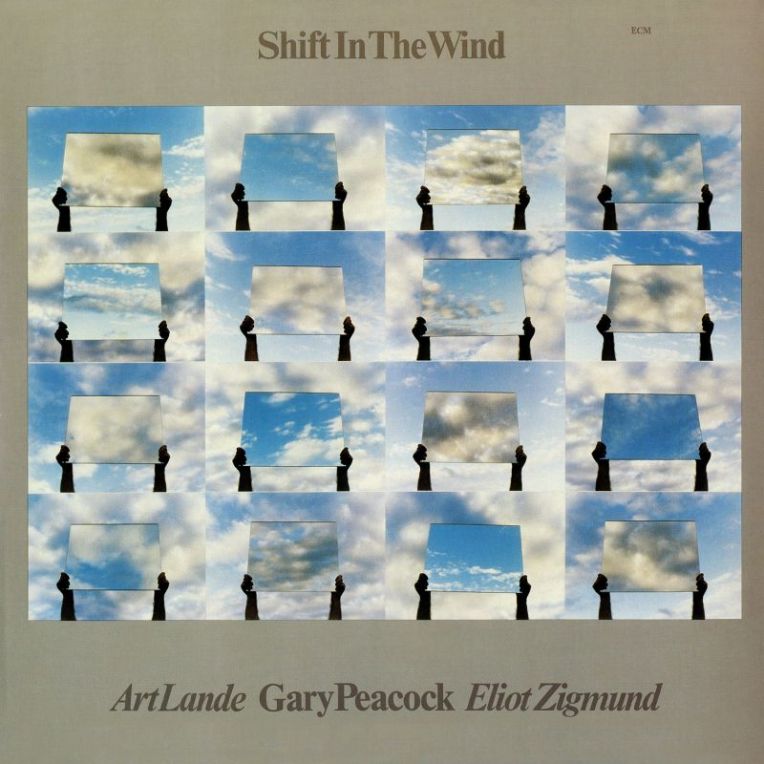
Though cataloged as a Gary Peacock joint, Shift In The Wind has Art Lande written all over it. It shows a different side of Peacock as he is taken in unforeseen directions by the grace of that delicate Lande touch. The latter’s pianism is majestic yet intimate in the opener, “So Green,” and sets the stage for an album in which he and Peacock share most of the compositional credit. The two consistently turn fleeting moments into epic sentiments, and vice versa, all the while thrown skyward by Eliot Zigmund’s hip sensibilities at the kit. With completion of these exercises, “Last First” comes as a fresh sunrise. With its solid arpeggios and bright rolls in the piano’s upper register, it teeters between reverie and jubilation, brought to fullest equilibrium in Peacock’s solo turn. The title track soars between whistles through detached mouthpieces, whispering piano, and percussion. So begins an abstract free-for-all which, like an ephemeral tornado of blown leaves, makes recognizable shapes out of stillness. This, along with “Fractions” and “Centers,” takes a divisional approach to the cumulative. “Caverns Beneath The Zoth,” on the other hand, funnels into a steady counterpoint. The trio lays the icing on the cake with “Valentine,” a precious ballad that exposes the magic of which Lande is capable at his best.

This is a vital session in the archives of everyone concerned, bringing home as it does a focused sense of craft, performance, and, above all, sensitivity. Lande, it bears repeating, dominates as much as one of his delicate sensibilities can, while Peacock carries his characteristically somber brand of exuberance to new depths.

<< John Abercrombie Quartet: Abercrombie Quartet (ECM 1164)
>> Enrico Rava Quartet <<Ah>> (ECM 1166)

Sam Rivers: Contrasts (ECM 1162)

1162 X

Sam Rivers
Contrasts

Sam Rivers soprano and tenor saxophones, flute
George Lewis trombone
Dave Holland bass
Thurman Barker drums, marimba
Recorded December 1979 at Tonstudio Bauer, Ludwigsburg
Engineer: Martin Wieland
Produced by Manfred Eicher

It’s a funny thing about getting lost: the more one tries to do it consciously, the more one discovers new pieces to fit into the jigsaw puzzle of familiar things. Jazz legend Sam Rivers, who made his only other ECM appearance on the classic Conference of the Birds, proved this sonically when he brought his patented “inside-out” technique to bear alongside Dave Holland, George Lewis, and Thurman Barker upon this free jazz date from 1979. Now in his 88th year, Rivers’s legacy continues to yield new nuggets of audio wisdom through such albums as Contrasts.

The album opens in “Circles” with some chewy improv. Thick horns and brittle drumming provide plenty of interplay to keep our wits on a tight leash. Lewis seems the most at home here, providing a bubbling cauldron of likeminded flights. It is the first in a smattering of freer tracks, the others being the slowly building “Solace” and perhaps the most abstract aside, “Images.” This leaves us with a hefty set of rhythm-driven powerhouses. “Zip” tightens the purse strings with an ever-moving tenor for some wholesome, head-nodding goodness. This joint also serves up a heaping drum solo on the side. Our frontman opts for flute in the swinging “Verve” with a renewed spring in his step. Convincing monologues from Holland and Lewis ease into a slow and timid end. “Lines” reprises that contagious soprano sax against an omniscient rhythm section before bowing out for some quality bass time. “Dazzle” brings exactly that, freeing our minds with a Braxton-esque tenor and tap-dancing bass work. Lewis is more than up to the task, scurrying in with Rivers in their joint commitment to going deeper.

As one of ECM’s bolder sessions, Contrasts deserves shelf space right next to George Adams’s Sound Suggestions. It is nothing if not about contrasts: the cohesive and the fractured, uprightness and vertigo. Colorful, straightforward, stirring.

<< David Darling: Journal October (ECM 1161)
>> Azimuth: Départ (ECM 1163)

David Darling: Journal October (ECM 1161)

ECM 1161

David Darling
Journal October

David Darling acoustic and electric cello, voice, percussion
Recorded October 1979 at Tonstudio Bauer, Ludwigsburg
Engineer: Martin Wieland
Produced by Manfred Eicher

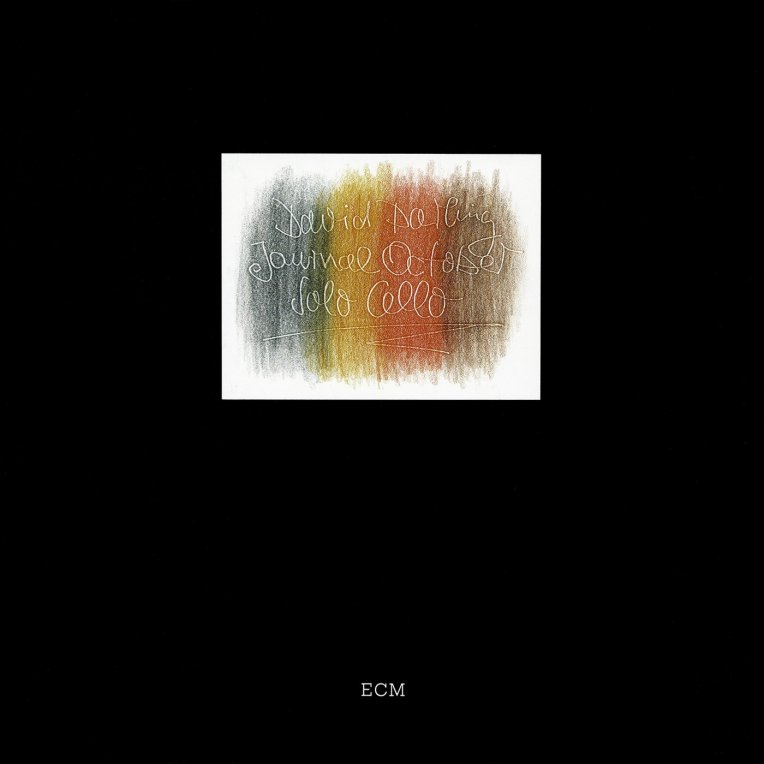
Having recently seen the film adaptation of James Redfield’s The Celestine Prophecy, which cycles through the book’s eight manifold insights on the path to another, the number nine is fresh in my mind. And so, as I pore through the sonic pages of David Darling’s Journal October on this fallen winter night, I inevitably see each of its nine tracks as an insight in and of itself. Darling’s music is one of ECM’s most invaluable treasures, and one could hardly find anything more beautiful than what he has left behind in its archive. His electric cello bays like a resurrected voice, an insight in and of itself into the lucidity of “Slow Return.” This introductory track is also the longest, drawing every jagged line like the echo of a mountainous horizon. From this potent doorway issues a host of transient forms.

Darling shifts the chronology of his recollections, grafting each to the new experiences of these studio performances. Their breath fills the album’s two solo cello improvisations, each of which cycles through grief’s most harrowing stages toward an inner peace. Rapture comes through in his involuntary vocalizations, in the dissonances that feed them. Darling foregrounds his body in “Solo Cello And Voice,” a self-division of high reaches and archaeological digs, while “Far Away Lights” gives us a taste of his pizzicato technique, which on his electric cello resounds like a tambura undone.

Two Darling touchstones—“Minor Blue” and “Clouds”—also make their first appearance in Journal October, both revisited in his masterful 8-String Religion. The former comes across with more impactful effect, less obscured by gossamer veils of reverb. The latter’s rocking ostinato buoys atmospheric vocals with vulnerable clarity, amplified harmonics ringing out with all the power of a waterfall compressed into a single string. The closing piece sails like an entire biography gathered into one vessel. Notes ascend into birdcalls, circling a teetering falsetto that reshapes the drone dynamic as one suspended rather than suspending.

This album began a walkabout of sorts that has borne some of ECM’s most humbling revelations. Such sounds still the heart and lure our inner eyes with their slow-motion lobs. Darling clears out the detritus of arrangement, the ornaments of song, and the obligations of tradition, forging an improvisatory path that is all his own. It may be trimmer than his later treks along more fluid paths, but his subtle intensities are all there, waiting to embrace the next aching spirit that comes along.

<< Steve Swallow: Home (ECM 1160)
>> Sam Rivers: Contrasts (ECM 1162)

Steve Swallow: Home (ECM 1160)

ECM 1160 2

Steve Swallow
Home

Sheila Jordan voice
Steve Kuhn piano
David Liebman saxophones
Lyle Mays synthesizer
Bob Moses drums
Steve Swallow bass
Recorded September 1979 at Columbia Recording Studios, New York
Engineer: David Baker
Produced by Manfred Eicher

Quiet as is proper for such places;
The street, subdued, half-snow, half-rain,
Endless, but ending in the darkened doors.
Inside, they who will be there always,
Quiet as is proper for such people—
Enough for now to be here, and
To know my door is one of these.
–Robert Creeley, “Return”

Home is a title, and an album, of many masks. Though by the time of this recording, bassist Steve Swallow had been involved in a string of projects with Gary Burton and Carla Bley, here his creative sediments sifted into their comfort zone on a label that was to become a home in and of itself. A kindred home may be found in the poetry of Robert Creeley, whose tender colloquialism is Swallow’s sounding board throughout. With the unmistakable smolder of Sheila Jordan’s vocal warmth, its meaning is never lost. Recorded just two months after Playground and featuring three from that Steven Kuhn-led quartet (Swallow being the only substitution), Home betrays yet another of its valences through the sympathetic approach of its musicians.

Lilting and lovely are the names of the game in “Some Echoes.” The verdant synth work of Lyle Mays draws us immediately into Dave Liebman’s soprano leaps. The rasp of each inflected phrase wafts like a breeze through the open doors of the album’s cover, bringing with it the scents of a long-dead memory gradually reanimated with every freshly raked word. These Jordan plants carefully and from a safe distance, allowing Kuhn’s busy fingers to prance across the ivories in her afterglow (“She was young…” and “Colors”). During the slow-motion somersault that is “Nowhere one…,” a sumptuous horn pulls out any lingering threads from Jordan’s introductory call to melodic arms. Rather than see the battlefield as a place of violence, however, the music embraces it as a place of adoration; a landscape replete with fading lives and their instant renewals. In all of these, we feel the nostalgia that enlivens such lyrical swathes as the title track and the engaging “In the Fall.”

The album saves its most indelible marks for those moments where whimsy and mysticism entwine. The pinnacle thereof is reached in “Ice Cream.” From Swallow’s sublime opening to Jordan’s varicolored sprinkles, not to mention a cosmic turn from Kuhn, this one caramelizes to perfection. The playfulness continues in “Echo,” which not only sports Liebman’s best solo in the set, but also practices what it preaches with some didactic volleys between Kuhn’s right and left hands. The band plays us out in the throes of “Midnight,” where quotations of “Three Blind Mice” rub shoulders with a haunting drone before falling into a stream of nocturnal consciousness. The moonlight of Jordan’s voice at last cuts a soft figure from the clouds, becoming one with the dawn.

Swallow is a joy. He is always on the move, bringing a range of moods to the table. From the swagger of youthful ignorance to the pensive affair between the self and regret, it’s all here in one slick package. Jordan’s involvement makes it all the more so. In contrast to her extended poetics in Playground, here she is the keystone to the music at hand, setting the stage for every scene. One need only listen to the way she infuses “You didn’t think…” with such guttural optimism using only a couplet to gain insight into her brilliance.

This is simply infectious music, smooth and tessellated, with not a single false step to be noted.

<< Steve Kuhn/Sheila Jordan Band: Playground (ECM 1159)
>> David Darling: Journal October (ECM 1161)