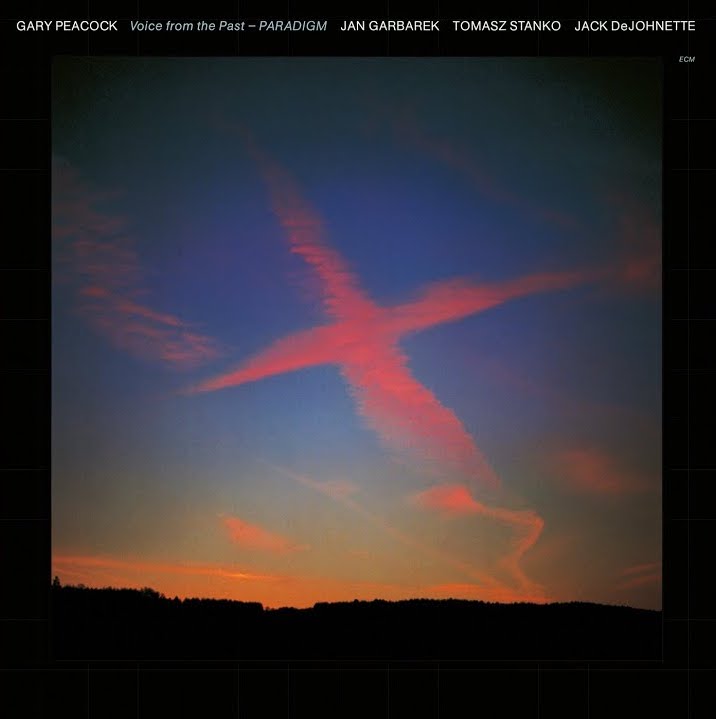
Gary Peacock: Voice from the Past – PARADIGM (ECM 1210)

ECM 1210

Gary Peacock
Voice from the Past ­– PARADIGM

Gary Peacock bass
Jan Garbarek tenor and soprano saxophones
Tomasz Stanko trumpet
Jack DeJohnette drums
Recorded August 1981, Talent Studio, Oslo
Engineer: Jan Erik Kongshaug
Produced by Manfred Eicher

Jazz, sometimes, is like acting: a group of performers starts with a script of prewritten material, which then must be spun into a convincing world of characters. This is not to say that the music isn’t genuine. Quite the contrary: through the art of improvisation, through the indeterminacies of creative interaction, these musicians reveal their ability to give themselves to the moment, at the same time expressing something so deeply personal that one could never mistake their diction for that of anyone else. Saxophonist Jan Garbarek (in one of his more creative sessions) and trumpeter Tomasz Stanko play their roles with gusto on this formative recording from bassist Gary Peacock, whose dialogues with Jack DeJohnette in tunes like “Ode for Tomten” give us shades of their upcoming journey in Keith Jarrett’s trio. Our two horns slink as easily into the opening saunter of “Voice from the Past” as they do into more honed territories like “Moor” and the album title’s second half. Stanko is on slow fire in “Legends,” which also sports a fascinatingly threaded solo from Peacock, while “Allegory” fills for us a deep, earthy caldron that bubbles with DeJohnette’s percolations.

Like the surname of its composer, this music surprises the more it unfurls. Come for Peacock’s mature writing, stay for the fantastic soloing, and leave knowing you’ve gained a new perspective. One not to be buried.

<< Lester Bowie: The Great Pretender (ECM 1209)
>> Art Ensemble of Chicago: Urban Bushmen (ECM 1211/12)

Jan Garbarek: Paths, Prints (ECM 1223)

ECM 1223

Jan Garbarek
Paths, Prints

Jan Garbarek tenor and soprano saxophones, wood flutes, percussion
Bill Frisell guitar
Eberhard Weber bass
Jon Christensen drums, percussion
Recorded December 1981, Talent Studio, Oslo
Engineer: Jan Erik Kongshaug
Produced by Manfred Eicher

December of 1981 was a magical month for ECM, producing such treasures as Psalm and Opening Night. On Paths, Prints, however, Manfred Eicher raised the bar yet again in bringing together another of his unique dream teams. Jan Garbarek, Bill Frisell, Eberhard Weber, and Jon Christensen in the same studio? Engineering complexities aside, one need only have hit Record, taken a nap, and awoken to masterful results. Throughout this session, Garbarek’s sharply defined reveries prove the perfect fulcrum for Frisell’s broadly sweeping clock hands. Garbarek also exposes a softer side, as in the whispered edges of “The Path” and “Arc,” and in the seesawing contours of “Still.” The painterly movements of “Kite Dance,” on the other hand, foreground Weber’s globules of sound against the blush and heartwarming soloing of Frisell’s omnipresent guitar. Not too far behind are “Footprints,” which shows Christensen in an especially colorful mood, and “The Move,” which pours on Garbarek’s signature lilt like heavy cream. Certainly his most effective passages are also the most intimate: “Considering The Snail” and “To B.E.,” the latter a duet with Frisell, are concave, while their surroundings are convex.

One can easily fall into the trap of painting ECM jazz as forlorn, breezy, and overwhelmingly lonesome. Yet one journey through Paths, Prints is all it takes to realize that the music is always our companion.

<< Paul Motian Band: Psalm (ECM 1222)
>> Enrico Rava Quartet: Opening Night (ECM 1224)

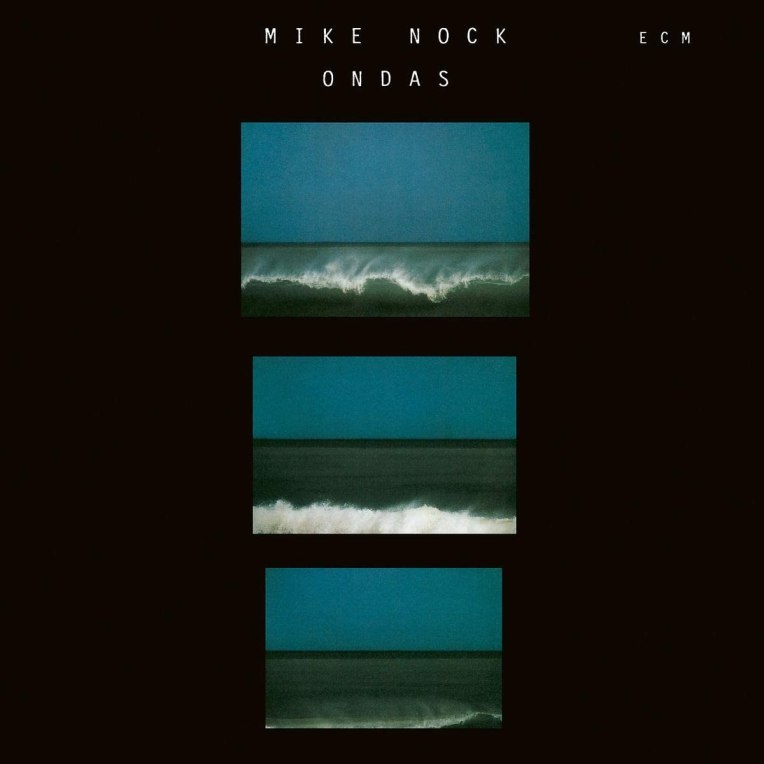
Mike Nock: Ondas (ECM 1220)

ECM 1220

Mike Nock
Ondas

Mike Nock piano
Eddie Gomez bass
Jon Christensen drums
Recorded November 1981, Talent Studio, Oslo
Engineer: Jan Erik Kongshaug
Produced by Manfred Eicher

How can one not marvel at Mike Nock’s Ondas? Drawing as much from Keith Jarrett as Bill Evans, and in the enviable company of Eddie Gomez and Jon Christensen no less, the sadly overlooked New Zealander left us with one of ECM’s most enduring documents at a time when the label was really getting its bearings. Nock’s pianism gives the illusion of distance, even when up close and personal, as if it were some long shadow, the feet of which are obscured by the horizon. It is also a magnifying glass of vast insight.

Central to this circumscribed detail is the 16-minute opener, “Forgotten Love.” Before a lacy ostinato it unfolds a sheet of paper as landscape, sketching fleeting affections and unrequited maybes. This sets Gomez up for a moth-like solo, as earthbound as it is winged, which then blends into the piano’s left hand. The right, meanwhile, stumbles off and returns with recollections of its travels, each framed by the thinnest of photographic borders. Christensen’s characteristic cymbals patter like rainfall across the title track and on through “Visionary,” in which he also foregrounds a touch-and-go snare. Yet against such a sweeping backdrop, these gestures forget their search for a groove and look more ponderously at where their feet are already planted. Plaintiveness thrives in “Land Of The Long White Cloud” and reveals the set’s most cinematic moments. Nock’s turns of phrase gnarl into a lichen-covered network of roots through which an insectile bass crawls, leaving a melodic honey trail for us to follow in its wake. With such a solemn road behind us, we open ecstatic “Doors” to our final destination.

While Nock may not carry the weight of some of ECM’s more widely recorded movers and shakers, one can hardly begin to quantify the wealth of impressions he leaves behind. This is not music to get lost in, but music that gets lost in you.

Another essential date from the 80s.

<< David Darling: Cycles (ECM 1219)
>> Adelhard Roidinger: Schattseite (ECM 1221)

David Darling: Cycles (ECM 1219)

ECM 1219

David Darling
Cycles

David Darling cello, 8-string electric cello
Collin Walcott sitar, tabla, percussion
Steve Kuhn piano
Jan Garbarek tenor and soprano saxophones
Arild Andersen bass
Oscar Castro-Neves guitar
Recorded November 1981, Talent Studio, Oslo
Engineer: Jan Erik Kongshaug
Produced by Manfred Eicher

Cellist David Darling has had a long, if sporadic, association with ECM, quietly forging—either under the guise of solo artist or buried in an album’s roster—some of the label’s most lyrical atmospheres. With Cycles, however, Darling magnified his sound-world through the inimitable talents of Jan Garbarek and Collin Walcott in a space both selfless and uniquely his own. Add to that the astonishing pianism of Steve Kuhn and the depth of Arild Andersen on bass, and you get what is, to this listener at least, one of ECM’s finest celestial alignments.

While I am tempted to give my usual track-by-track impressions, here the album’s title clues us in on another way me might listen to it: that is, as an ever-roving caravan without need of maps or guides. As it stands, Cycles is a bubble of possibility that only expands with every listen. In its opening strains, we kneel atop a cliff of unraveling. Darling’s needlepoint brings light to fullest dark, breathing through Walcott’s tabla and Garbarek’s shawm-like expectorations. Those fluid horsehairs sing like portals, beginning and ending in the same draw. Harmonies linger as afterthoughts of infinite space. From nebulae to star and back to billowing gauze, the music flows into rivers of light—quiet, intense, forgiving. Grooves flicker into life, voices settle into afterlife. Cello and sitar sing into one another, while Kuhn’s wafting fragrances remind us of what it felt like to be on Earth.

Were I to single out one track, however, from this multivalent exhalation, it would have to be “Fly,” a brooding intertwining of cello and saxophone that is a Mt. Everest in the ECM landscape. Garbarek emits some of his most satoric playing here, floating ever skyward. He is a lantern hung in the clouds, a riddle whose denouement only reveals further mystery.

The stellar playing throughout is only enhanced by the sound. The engineering on Cycles is pristine beyond measure and raised the bar of the label’s usual auditory standards. To prattle on any more would ruin the effect. Suffice it to say: don’t miss this one.

<< Steve Tibbetts: Northern Song (ECM 1218)
>> Mike Nock: Ondas (ECM 1220)

Steve Tibbetts: Northern Song (ECM 1218)

1218 X

Steve Tibbetts
Northern Song

Steve Tibbetts guitars, kalimba, tape loops
Marc Anderson congas, bongos, percussion
Recorded October 26-28, 1981, at Talent Studio, Oslo
Engineer: Jan Erik Kongshaug
Produced by Manfred Eicher

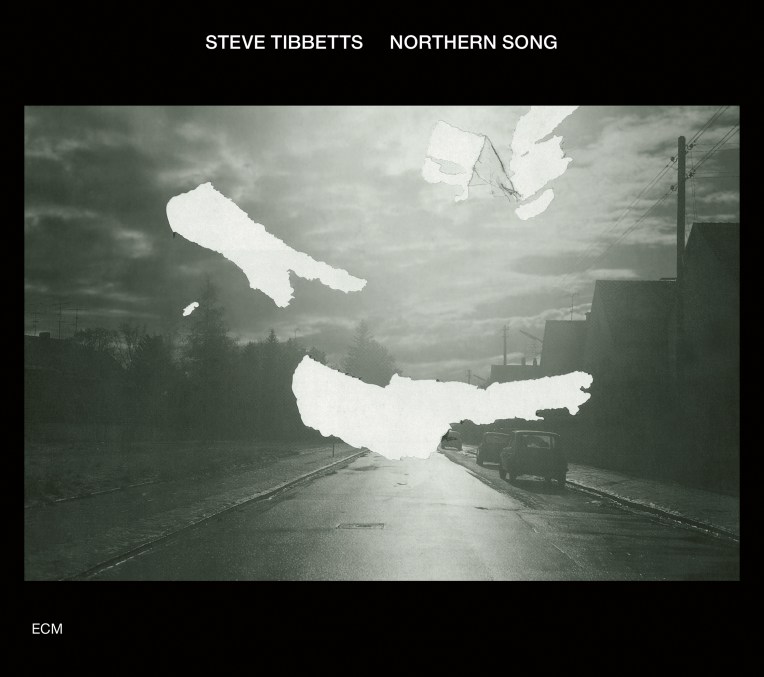
With Nothern Song, Steve Tibbetts made his ECM debut and introduced listeners to what remains one of the label’s most enchanting, if slowly unfolding, maps. The cover seems to tell us everything: silhouettes of islands superimposed on the journey that takes us to them, as if the dream of arrival were potent enough to burn itself across the rearview mirror of our lives. Tibbetts leaves a trail of quiet footprints easily obscured by “The Big Wind,” yet whose direction is not so easily forgotten. With circumpolar affinity and a sensitivity that is for all intents historical, Tibbetts traces the borders of our lives in “Form.” His shimmering guitar finds spirit in Marc Anderson’s verdant whispers. “Walking” continues in very much the same vein, only this time with a more pronounced wash of 12-string steel that eventually lifts us into an “Aerial View.” And because so much of the Northern Song experience is above ground, we are able to slip more intensely into the meditations of “Nine Doors / Breathing Space,” throughout which strings creak like an old house, if not an old body.

Tibbetts lavishes his instruments with respect, strumming them as he might harps of glacial light. In them we hear diaries, voices, and ideas that need never completed to say everything they need to say. And every delicate application of Anderson’s percussion carries us deeper into the overgrowth before we emerge, forever changed, in the dwindling sunlight. This album is an ocean, and we the birds who range its waters.

<< Ulrich Lask: Lask (ECM 1217)
>> David Darling: Cycles (ECM 1219)

Ulrich Lask: Lask (ECM 1217)

ECM 1217

Ulrich Lask
Lask

Ulrich Lask alto saxophone, synthesizer
Meinolf Bauschulte drums
Maggie Nicols voice
Recorded November 1981 at Tonstudio Bauer, Ludwigsburg
Engineer: Martin Wieland

“Not many people see the wisdom in madness.”

Take a little Mr. Bungle, mix in some Elliot Sharp, add a dash of Claudia Phillips, and you may just get something akin to this strikingly outlandish rarity from 1982. The voice of Maggie Nicols is the solder that holds everything together, while Ulrich Lask’s laser-like sax and labored synth weave an industrial spell at every turn of the set’s assembly line. The bubbly electronics of “Drain Brain” spray-paint the malaise of a post-punk modernity, where duties and obligations engage one another in a rather debilitating tango with the children’s rhyme “Rain, rain, go away.” Our core confrontations are laid out on the dissecting table of the “Tattooed Lady,” whose multiphonic screams burrow into the urban web of ignorance that clothes us in prescription. This brings us to the album’s reigning highlight. “Kidnapped” is a tongue-in-cheek yet visceral autobiographical experiment about woman who is snatched away for the sole purpose of recording “that new-fangled…funny music with a beat” in ECM’s Ludwigsburg studio. Lask manages to keep pace with the boggling skitters and saxophonic squeals of Nicols, who stretches these enchantments well into “Should We, Geanie?” This speculative exercise in authoritarianism looks at social relations through a glass darkly as neither catalysts nor inhibitions, but rather as tattered newspapers stuffed into the human dichotomy, exploitable only through the vocal act. Thus does the stormy narrative of “Unknown Realms” transform maternity into ancestral longing. Here, the landscape is treated like an entity, a plane where inception is breathlessness, breathlessness is signal, and signal is song. Walking hand in hand with the “Poor Child,” we find a klezmer-like essay on worldly power and the lone citizen just trying to make ends meet on a puddle-splashed street corner. But when we pull our pockets out to cartoonish lengths, we find, as prophesied in “Too Much – Not Enough,” that the generative force of all meaning is its very emptiness.

Lask might seem like an anomaly in the ECM catalog, when really it stays true to the label’s ever-adventurous spirit. Dementia as the new art, or art as the new dementia? You decide.

<< Pat Metheny Group: Offramp (ECM 1216)
>> Steve Tibbetts: Northern Song (ECM 1218)

Pat Metheny Group: Offramp (ECM 1216)

Pat Metheny Group
Offramp

Pat Metheny guitar, guitar synthesizer
Lyle Mays keyboards
Steve Rodby basses
Nana Vasconcelos percussion, berimbau, voice
Dan Gottlieb drums
Recorded October 1981 at Power Station, New York
Engineers: Jan Erik Kongshaug and Gragg Lunsford
Produced by Manfred Eicher

When I was a freshman in high school, our science teacher brought us outside one day to observe a partial solar eclipse. Though he had set up a telescope, provided us with special glasses, and prepared a lecture, my eyes were glued to the ground. As anyone who has experienced a solar eclipse knows, the sun’s light pocks the shadows like Swiss cheese, splashing the earth with countless little crescents of a half-eaten sun.


Eclipse shadows (photo source: Ketchum family blog)

Every note of Pat Metheny’s heavenly soloing on Offramp is its own crescent. His is a talent spun from sunlight, and one that might damage the eyes were its full force to be unleashed at once. Thankfully, we need no special equipment but our own ears to appreciate the intensities he brings to this immortal PMG date, which after the global reach of As Falls Wichita… expanded the compositional and technical prowess of Metheny and keyboardist Lyle Mays to deeper, more serpentine caverns of experimentation.

The Synclavier-enhanced calls of “Barcarole” are the album’s birth cries, each a punctilious footstep into the greater semantic complexities of “Are You Going With Me?” This smooth ride through sun-kissed plains drips with the tears of an unrecoverable past, Metheny’s guitar bellowing like a human trumpet keening at the speed of travel. “Eighteen” inoculates the proceedings with the livewire exuberance in which these musicians so deeply excel. Metheny is light on his feet and infinitely careful about his twists and turns, infusing each with that unmistakable audible grin. Dan Gottlieb kicks up a dust storm in the title song, which also features Metheny in one of his wildest excursions yet. Fractured pianism, an explosive glockenspiel, and Steve Rodby’s fantastic ground lines paint just the right ambiance to allow Metheny to uncork a bottle of some unrepeatable tincture that he seems to have been saving for this very occasion. After this flip and a half, “James” comes across as an acrobatics of its own kind, gracing our cochlea with heartwarming electricity, leaving the wispy skies of “The Bat Part 2” as our only postcard.

Yet all of the above combined barely tickles the underbelly of “Au Lait,” which still stands as Metheny’s most perfect statement. Though something of a carnivalesque on the surface, complete with rolling snare and haunting vocals courtesy of Vasconcelos, one also feels sung to of something far more serious. Whatever that might be, we experience it in real time, every wordless call a way station to where it all began. Metheny is as transcendent as he will ever be, each swing more harmonic than the last over the Joe Hisaishi-like touches from Mays. Oracular and airborne, this is a space we never wish to leave. And on the inside, it never does.

Metheny is a skillful writer who, with heart in place of pen, takes a kernel of an idea and draws every imaginable root before starting in on the leaves. Like a solar eclipse, such music comes all too rarely in any given generation. The beauty of Offramp is that it always feels like the first time. Is your turn signal on yet?

<< Steve Reich: Tehillim (ECM 1215 NS)
>> Ulrich Lask: Lask (ECM 1217)

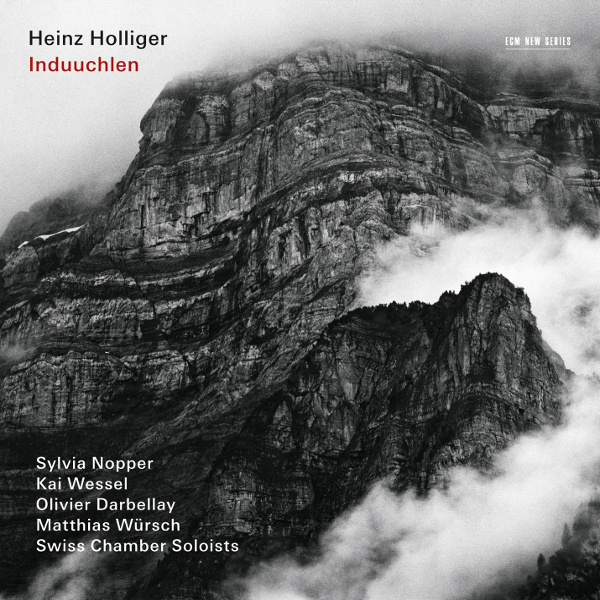
Heinz Holliger: Induuchlen (ECM New Series 2201)


Heinz Holliger
Induuchlen

Anna Maria Bacher recitation
Albert Streich recitation
Sylvia Nopper soprano
Kai Wessel countertenor
Olivier Darbellay horn
Matthias Würsch percussion
Swiss Chamber Soloists
Heinz Holliger conductor
Recorded 2007-2010
Engineer: Andreas Werner
Produced by Manfred Eicher

Ever since the star-covered Scardanelli-Zyklus found its way into my life, Heinz Holliger’s increasingly fractal compositions have been a vital part of my personal development. As a teenager, I felt such an intense connection to the early ECM Holliger releases that I used an online message board (back when such things were novel) as a venue to proclaim Holliger as one of the most important composers of the century. I was immediately met with a smattering of criticism, of which one comment remains lodged in my mind: “Though Holliger is a talented musician and, I admit, an interesting composer, I don’t think his colleagues or family members would ever consider him ‘important.’” In my youthful naïveté, I accepted this contention and shied away from mine. And yet now, some fifteen years later, I find my initial reactions being confirmed by critics and friends, all of whom have long recognized the significance of his multifarious deeds. I relate this anecdote not to underscore my prophetic abilities, nonexistent as they are, but only to direct the listener’s attention to the depth of Holliger’s output and the uncanny ways it has of getting under our skin over time.

This is an album of many things: silence and half-language, shadow and movement, liminality and articulation. Through a technique that Holliger calls “vocal masking,” potentially straightforward motives are turned in on themselves, such that by the end our memories speak not in solos but in delicate aftershocks. Continuing the composer’s interest in marginal voices begun in such works as Beiseit is Puneigä. Reading like a well-compressed Scardanelli dissected under a microscope, it begins with the Walser-German poetry of Anna Maria Bacher (recited by Bacher herself) followed by Holliger’s spidery and biologically attuned settings thereof. In the absence of English translations, these pieces are left for the rest of us to emote on their own terms. And perhaps this is for the best, as Holliger has always seemed to approach a given text from the inside looking out, such that we need never concern ourselves with the arbitrary contours of its many surfaces. Either way, in them one can hear the cellular approach of his craft, an approach that seems as interested in unpacking language as it is in dismantling it. One hears this especially in the rattles and hums of the Zwischenspielen, each a wondrous division of spatial relationships that is incidental only to itself. Rotating through a series of watery reflections (“Wen mu plangät), earthly contacts (“Hêif!”), and reverberations (“Der Toot”), images stick out with the quiet interruption of a rock protruding from the glassy sheet of a waterfall. Within each rests the lock to a key.

Albert Streich’s poem “Induuchlen,” also prefaced from the author’s lips, provides a verbal runway into the soaring title piece for countertenor and natural horn. Holliger’s work gains facets the more its performers are reduced in number, and here one finds a wealth of such demands. Yet these are handled with such grace that one might think the results were entirely improvised. The countertenor is asked not only to plumb the depths of his baritone register, but even to step beyond them into some uncanny quotidian realm of, I daresay, Wagnerian anxiety, for indeed the music’s deepest secrets are, not unlike the sword in Die Walküre, fully visible yet can only be dislodged with the attendant promise of self-destruction. Here is a matrix of auditory gravel in which tremolos gasp, where overlays misalign, and from which arises a golem who seeks clouds more than land.

Embracing these throated reliefs is a frame of chamber works. Toronto-Exercises speaks in aphasic mumblings, which is to say in a vocabulary at once molecular, somnambulate, and exquisite. Scrapings, flaps, shivers, and overtones carve a broken chain of stone through this gorgeous little quatrain of forested sounds, while the fractured virtuosity of the percussive Ma’mounia deciphers its own fingerprints one vein at a time, releasing the screams and helical motives squirming therein.

Holliger’s is the music of a soul in search of those intricate gifts that enliven our bodies and minds. It is highly idiosyncratic and yet speaks of a wide-reaching science. For the sake of analogy, one might say he sits comfortably between Lachenmann and Kurtág, singing through the sometimes haunting immediacy of the former while holding close the latter’s appreciation for the miniature. In doing so, he gives us a medium of the anti-essence, wherein breathes only the potential for quiet rupture. He speaks more than any other composer I know, and yet never proselytizes.

Like an Italo Calvino novel, this music ladles over us a pathos we have long forgotten and through which we only now find a chance to embrace anew.


James Newton: Axum (ECM 1214)

ECM 1214

James Newton
Axum

James Newton flutes
Recorded August 1981 at Tonstudio Bauer, Ludwigsburg
Engineer: Martin Wieland
Produced by Manfred Eicher

Composer, flutist, and conductor James Newton is about as renaissance as renaissance men get. Currently a professor in the Department of Ethnomusicology at UCLA, Newton seems always to be looking for ways to expand his knowledge. And while his command of repertoires may be staggering, a humble primacy of the body has ever been at the heart of his activities. Breath, movement, and time trace zones of sonic blossoming in his music, to the point where one cannot help but visualize the bodywork of his many recorded performances. Out of a discography going on 60 albums, we might point to 1982’s Axum, his only for ECM, as a seed. Its fantastic range of colors comes together in an enduring piece of sonic archaeology.

Half of the album is drawn from overdubbed territories, where bass and alto flutes share the air with their concert cousin. Within the first minute of “The Dabtara,” we already get a sense of Newton’s idiomatic breadth, as flickers of modern jazz blend into a backdrop of medieval piping. Thus does Newton find unity in division. Among the more mirthful turns is “Addis Abada,” which sounds like some form of worship through which one breaks from the self on the way to belonging. Another turn of the kaleidoscope brings into focus the title track, a veritable symphony of multiphonic splendor. “The Neser,” however, is the most accomplished here. With a Debussean elegance fringed in shadow, Newton hangs every melodic intention in the air like some vast ornamental mobile turned by forces unknown.

The five solo pieces constitute more than just the other half of Axum. Rather, they stick to the palate in a pleasing mingling of flavors. Utilizing a wealth of extended techniques and saturnine divinations, Newton is at one moment descriptive (“Mälak ’Uqabe”) and self-multiplying (“Choir”), at another lithe (“Feeling”) and intensely personal (“Susenyos And Werzelya”). The album’s prismatic center is found in the gnarled pathways of “Solomon, Chief Of Wise Man.” Here, we find ourselves face to face with distant calls that are, while ancestral, undeniably of the future. We listen to these sounds from the confines of our privacy, be they circumscribed by headphones and wires or by the larger spaces of our homes. Yet in doing so we find a broader path along which to place our feet. This is this sense of transit that Newton brings, each flutter charged by a nascent realization awakening of daybreak. Even as it shrugs off the blanket of night, it cannot help but see itself reflected in the mirroring sky, where only memories dance in lieu of lived experience. Keeping one eye on the past, these meditations walk sideways, hoping that we might do the same…on our own time.

<< Steve Kuhn Quartet: Last Year’s Waltz (ECM 1213)
>> Steve Reich: Tehillim (ECM 1215 NS)