Frances-Marie Uitti / Paul Griffiths: there is still time (ECM New Series 1882)

there is still time

there is still time

Paul Griffiths speaking voice
Frances-Marie Uitti violoncello
Recorded August 2003 at Rainbow Studio, Oslo
Engineer: Jan Erik Kongshaug
Produced by Manfred Eicher

“I shall th’ effect of this good lesson keep
As watchman to my heart.”
–Ophelia

Subtitled “scenes for speaking voice and cello,” the fortuitous meeting of music writer, novelist, and librettist Paul Griffiths and cellist Frances-Marie Uitti that resulted in there is still time wears no masks. Using only the 482 words available to Ophelia in Shakespeare’s Hamlet, Griffiths works with a vast magnetic poetry set on a refrigerator that runs on Uitti’s often-haunting improvisations. It is neither Ophelia nor Griffiths who speaks, but someone in between, a voice not so much twice removed as one once excavated and once buried. And while the backstory to this recording is fascinating in and of itself, its aural language is such that one may enter it blind and emerge from it fully sighted, if not the other way around. Griffiths treats language as a precipice from which to hang rather than as a spine from which to sprout nerves and muscle. Thus does the music’s grip deepen our mood with each weakening finger.

“I cannot remember” are the first words to awaken our senses, “when this is all over” the last before silence engulfs us: a brief life forgotten, regained at death’s door. Only the future can be held close, swaddled in opaque linens as it slips slowly from our hands into Uitti’s mournful fundaments and harmonic firmaments alike. Her reverberation becomes a stencil, and breath the paint sprayed through its glyphic wounds, where plasma congeals at the hinges of revelation. Griffiths’s intonations are fatigued, as if from the effort of articulation alone. In “think of that day,” he asks, “what should I fear?” A question that slithers thence, only here we get one of its clearest answers: what the voice fears is that “you,” the other to whom is being spoken, will say nothing. Such trepidations are thematic, hidden like Hamlet behind the curtain, stabbing at the wrong enemy. This troubled air returns for “how I wish,” over which the cello looms, a commentary on a commentary. Again, Griffiths speaks as if the very effort were much to bear, as if utterances of desire were the sole means of undoing it. The “you” remains silent, stagnant like a pool in some deserted landscape where the wind is never missed beyond perpetual cloud cover.

Griffiths doesn’t merely read his words, but comports them. If there is such a thing as method reading, then via his delivery we find an especially potent example in “call from the cold.” Its poetry draws a series of contact points between the body and the intangible, between expectation and inception, between the cello’s snowy scrapings and the listener’s suspension of disbelief. The narrative then sprouts bittersweet fruits from the buds of “touching,” skins of hope peeling away from flesh of horror. The melodious “there it was” measures the past like some vast diurnal clock compressed into the mouth before being expectorated in but a fleeting conjuration of lips, teeth, and tongue as Uitti draws whisper-screams in the air with her sobbing. Where the sunrays once frolicked at dawn, we find traces of “the bells,” no longer immortal yet still haloed by a lost cause, fading beyond every closing ear-lid. We are alone with their voices “some where,” bound by a capsule of parallel selves and places split by the prism of a single morpheme. The internality of it all is lifted once “for you” flies off the tongue with urgency. As much a question as it is a challenge, it emotes like an animal peering through the foliage at its own reflection, cello rasping, a gravelly Echo. “I did look” further slices open memory—an impossible dissection, it seems, for only more memory lies within, beating to the rhythm of an extended arco meditation, drawing out this operation to its most healing conclusion yet.

These points of contact are at once a source of expression and a denial of the self-generation implied by spoken words, such as in “my one fear.” The verb “touching” rings truest here and surfaces vividly as a means of grappling with the unknown. The nameless other is drawn in whispers and time, through which all is revealed, vulnerable and contrived. At this point, I cannot help but extend a line to King Lear, for it is speech over which the maddening patriarch harbors the deepest anxiety. Without Cordelia’s obligatory words of praise, for instance, he is but a blank page before her. (We hear this again in Lear’s deprecation: “She hath…struck me with her tongue.”) Similarly, in “the door,” the voice fears finding what it searches for: the mouth shut like a gate to possibility. In light of this, Griffiths’s final words (every detail captured by the superb engineering) are perhaps the most Ophelian. They lie in wait beneath the surface of the lake, grabbing hold of refractions baited on the cello’s fish hooks, pulled like a sheet from a sleepless bed.

Uitti’s ability to sound as if she were at once reacting to the words and birthing them is captivating, as are her wordless interludes, four of which trail-mark the program. The recitations strung between them make statements by enhancing the fallibility of statements, each utterance a fantastic implosion. Griffiths’s circadian rhythms are sometimes off center, sometimes regular to the point of apathy, and in being so speak with immediate effect. This is, perhaps, why Uitti’s art meshes so organically, for it pulls at the same frayed edges in hopes of unraveling a color, a texture, and a pattern unfamiliar to them both. Whether or not that unfamiliarity extends to us depends on our willingness to touch the text as a living sound, so that by the end we are renewed through impermanence, redrawn in monochrome by a parallel self in the here and now. What we fear is not to receive but to give and be received.

My own humble gift, then, is an offering cast from those same 482 runes:

his breath does honour to the words
his countenance more patient than a soldier’s
cold letters compos’d in noble fashion
in them I know doubt

it is not for naught
that the lady is here
the daughter of a lord
nay, of an owl

there’s a saint
larded with false affection
please, fear him not
for he hath bore it all for you

what is a courtier’s mind but a steward
held on the tongue of a king
a watchman in the closet
touching his eye with tragedy

belike the lady rises on this day
and becomes snow
on a mountain of dead flowers
as grace is deceived by remembrance

quoth she,
“steep is the way to dalliance”

a scholar’s tongue is his sword
it becomes a play
a chorus of tragedy
a shroud of charity

lock’d by his command of speech
the key to which is
something of a piteous fear
in our rich perusal

I know not where
I twice observ’d
the maid unkind and shaking
like a glass mould blasted by the night

I was lost
promis’d to another
when these eyes
wither’d in fennel perfume

down a thorny path
the music treads
long o’erthrown by horrors
young and beauteous

quoth she, “take them again
these flaxen columbines
and cast them by your deathbed
for they will keep you heavenly”

some may call it sweet
I call it an oath to memory
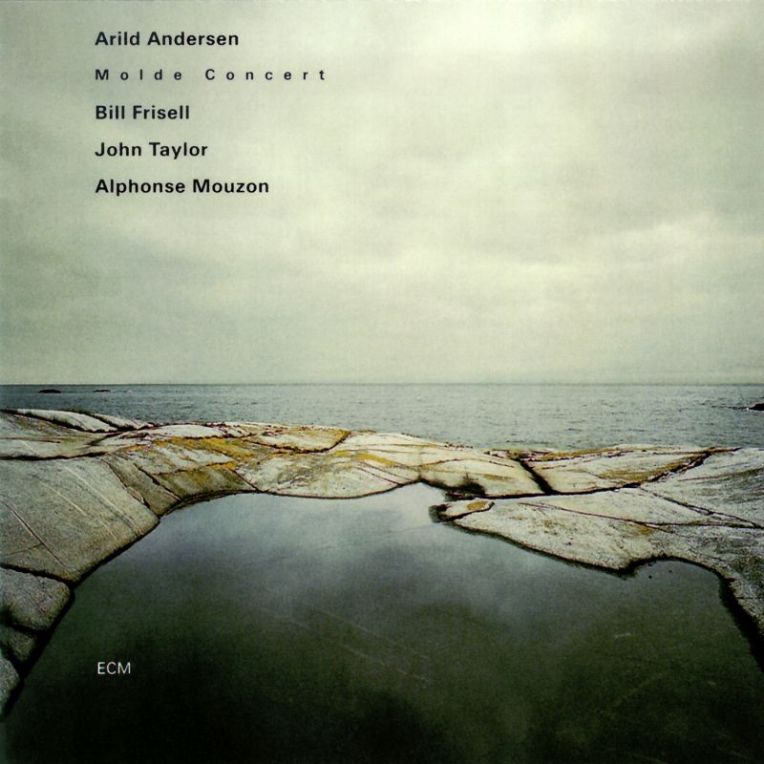
Arild Andersen: Molde Concert (ECM 1236)

ECM 1236

Arild Andersen
Molde Concert

Bill Frisell guitar
John Taylor piano
Arild Andersen double-bass
Alphonse Mouzon drums
Recorded live August 1981 at the Molde Jazz Festival, Norway
Engineer: Tore Skille

Arild Andersen created some of the most melodic jazz in the latter half of the twentieth century, and the music on this CD reissue of 1981’s (A) Molde Concert adds 20 glorious minutes of unreleased material to this historic date at the prestigious Norwegian festival. Here, the bassist is joined by names which, though now celebrated, were still fledgling at the time: guitarist Bill Frisell (still seeking out his characteristic warble among the increasingly populated trees of the 1980s), pianist John Taylor, and ex-Weather Reporter Alphonse Mouzon on drums. These days, such a line-up would create another—long out the door of wherever they might be playing. Yet if the audience’s reactions are any indication, back then it must have been a welcome surprise.

After an elastic opening, “Cherry Tree” slingshots into a set consisting entirely of Andersen originals, save for the romping “Dual Mr. Tillman Anthony” (Miles Davis) that concludes the show. From the beginning, the breadth of arrangement is apparent, Frisell laying out embracing themes as Andersen and Mouzon work double time. A tumbling Taylor spins his own brand of liquid magic into “Targeta,” bringing its blissful chording into a slow-motion groove. If every solo tells a story, then most prosaic on Molde is Frisell’s here. “Six For Alphonse” is a standout. Featuring rich interplay between guitar and piano, it also explodes with a stellar solo from Mouzon. “Nutune” is far more viscous, a creeping vessel over the helm of which hunches Andersen’s loamy bass. His subsequent duet with Frisell in “Lifelines” dances Weber-like and carries us gently into the epic “The Sword Under His Wings,” which after a few stirrings of blown leaves, spirals into a more shapely cyclone. Andersen delights with a rare arco solo before springing into a forward groove backed by Mouzon and Taylor as Frisell hurls his bends skyward. After the whimsical provincialism of “Commander Schmuck’s Earflap Hat,” the rough-hewn ore of Frisell’s strings hardens into “Koral.” The band’s inspiring precision works to a heartwarming finish that is the essence of Andersen’s soulful wit. “Cameron” bristles with Frisell’s sonic quills, each brushed back carefully with the grain, while “A Song I Used To Play” serves up a steaming bowl of nostalgia.

Andersen’s recognition of these young talents is proof of both his incisive mind and welcoming spirit. The depth of his choices is enhanced by the pristine recording, which holds up well after all these years. For those Andersen fans wanting the perfect balance of ice and fire, look no further.

<< Hajo Weber/Ulrich Ingenbold: Winterreise (ECM 1235)
>> Pirchner/Pepl/DeJohnette: s/t (ECM 1237)

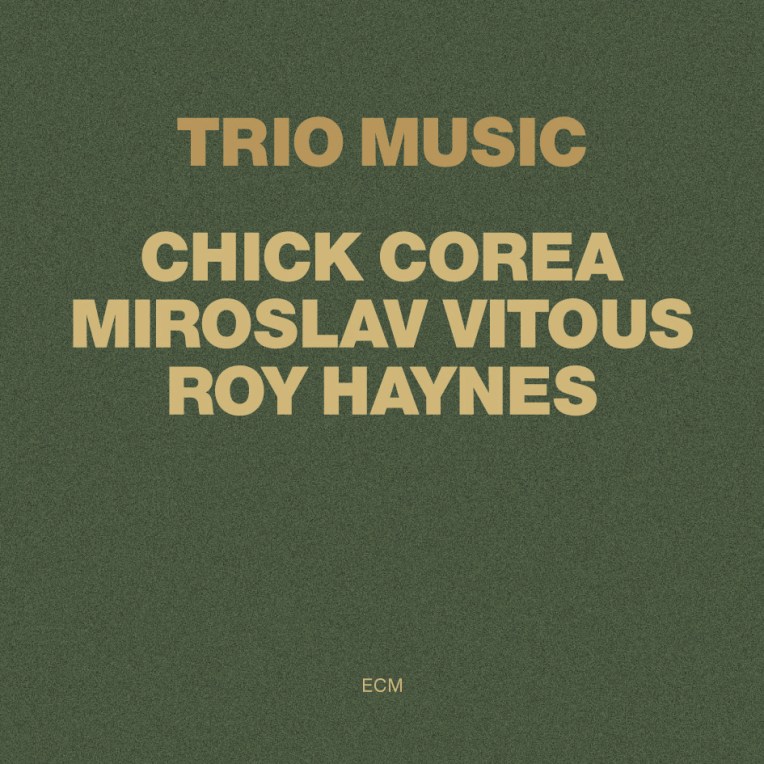
Chick Corea: Trio Music (ECM 1232/33)

ECM 1232_33

Chick Corea
Trio Music

Chick Corea piano
Miroslav Vitous bass
Roy Haynes drums
Recorded November 1981 at Mad Hatter Studios, Los Angeles
Engineer: Bernie Kirsh
Produced by Manfred Eicher

Trio Music boasts the same formidable lineup—pianist Chick Corea, bassist Miroslav Vitous, and drummer Roy Haynes—as on the seminal Now He Sings, Now He Sobs. Yet formidable is not a word I would use to describe this curious double album, for as many peaks as there are, it is in the valleys where the most potent combinations occur. Half of this diptych is painted by improvisations: five for trio and two for duo. The trios are intense and from the first chart themselves through engaging, if wayward, territory via Haynes’s astute “cymbalism” and Vitous’s determined phonics, all the while enlivened by Corea’s full-on sound. From the thick to the thin of things, the second trio sounds like an infirmed train dreaming in spats of its onetime locomotive glory, while even more fractured affairs await us on the horizon of the third. Some of the more effective comings together can be found on the fourth, as when pointillist pianism sews itself into snare with lightning-fast kinship. The final trio, on the other hand, features a looser, perhaps prepared, piano and amplified arco bass and drums, which after a bit of running around are mixed together in a staccato brew. The two duets between Corea and Vitous are fascinating in and of themselves, winding down their personal rabbit holes with multifarious conviction. The last tune of first disc, “Slippery When Wet,” is exactly that, this one penned by Corea. After some lithe snare work it slides effortlessly into an upbeat swing.

For the second disc, we are treated to a hunk of Monk. Thelonious lives and breathes (he would pass away not three months after this album was recorded) in these hip arrangements. And certainly in “Rhythm-A-Ning” we get to see what this trio is truly capable of, for as intriguing as the improvisations are, there is something transcendent about the ring of their swing in Monk’s world. From these hot threads is spun a lasso that holds our attention with excitement and joy. Haynes, reason enough to buy this album, steals the show here, as also in the ascending quality of “Think Of One” and throughout the inescapable groove of “Hackensack.” Not to be outdone, however, are Vitous, who adds piles of jazz club beauty to “Eronel” and enhances every playful step of “Little Rootie Tootie” with his nimble fingerwork, and the unforgettable Corea, who, as he does in each of these, spreads his warmth and sparkle in turn over the gently burned toast of “’Round Midnight” and “Reflections” with a lushness all his own.

One need hardly expound at such length upon this album. The music speaks with far more eloquence. Highly recommend for the lovely Monk set alone, but give the improvisations a chance, and you will surely find a wealth of colors to explore again and again.

<< Eberhard Weber: Later That Evening (ECM 1231)
>> Everyman Band: s/t (ECM 1234)

Eberhard Weber: Later That Evening (ECM 1231)

ECM 1231

Eberhard Weber
Later That Evening

Eberhard Weber bass
Paul McCandless soprano saxophone, oboe, English horn, bass clarinet
Bill Frisell guitar
Lyle Mays piano
Michael DiPasqua drums, percussion
Recorded March 1982 at Tonstudio Bauer, Ludwigsburg
Engineer: Martin Wieland
Produced by Manfred Eicher

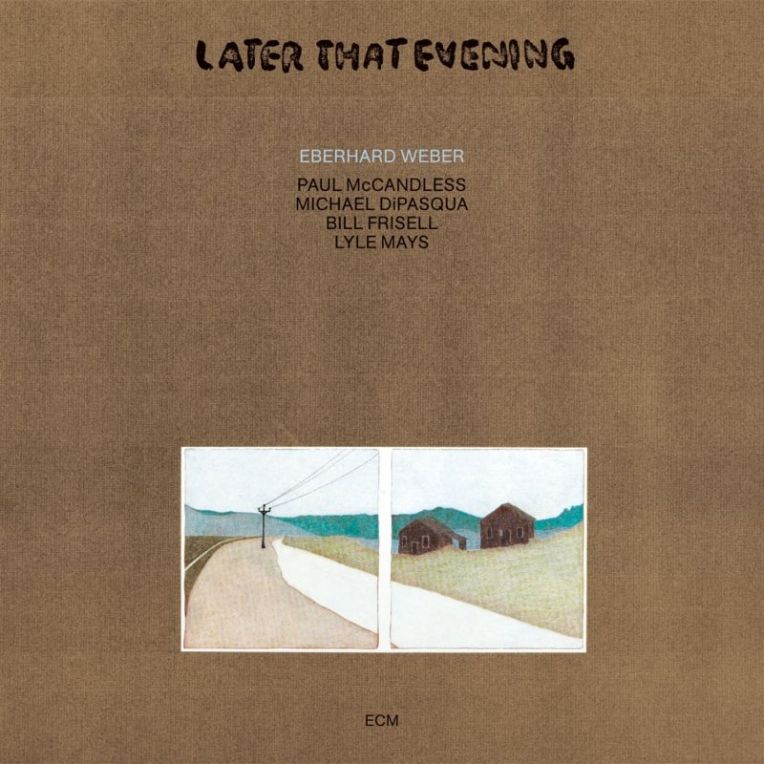
If you’ve ever stared at a body of water and been entranced by the play of reflections on its surface, then your ears will appreciate the sonic equivalent thereof on Eberhard Weber’s Later That Evening. Though one misses on this date the unmistakable sweep of Rainer Brüninghaus’s keys, in his place we get the likeminded sensitivity of Lyle Mays alongside the various reeds of Paul McCandless and interstellar meows of Bill Frisell. Completing this sonic package are Michael DiPasqua on drums and of course Weber himself in a sweep of a different kind on his leading electro-bass. Over the course of four Weber originals, averaging nearly 11 minutes each, this never-repeated ensemble lays down some of his farthest-reaching tracks ever committed to disc.

Mays scrims his shaw within the first minute of “Maurizius,” one of two shorter extensions in the album’s liquid flow. Riding a foamy wave of cymbals and English horn, Frisell’s blurry curls find solace in the darkening sky, which pushes the sun down silently behind the middle horizon all the way to the title track, where Weber’s bass winds into its fleshiest expressions. Yet it is in that middle horizon where this set’s true richness is disclosed. The ghostly voices that open “Death In The Carwash” seem to approximate footsteps, each traced by soprano saxophone. Weber’s gorgeousness stretches this elastic band to a state of near-snap as Frisell and Mays weave their growing kinship into the trampoline from which Mays springs, arms spread. Back on the ground, “Often In The Open” finds piano and drums in a darkly grained dialogue. The drumming picks up quietly, suddenly, stringing soprano by spidery pulls from guitar, leaving us in a circular theme from McCandless, who finishes alone.

One can always expect fluidity from Weber, and the music on Later That Evening is no exception. It cages the air like waterspouts in the distance, kept at bay from their potential destruction through a screen of remembrance.

<< Don Cherry/Ed Blackwell: El Corazón (ECM 1230)
>> Chick Corea: Trio Music (ECM 1232/33)

Don Cherry & Ed Blackwell: El Corazón (ECM 1230)

Don Cherry
Ed Blackwell
El Corazón

Don Cherry pocket trumpet, piano, melodica, doussn’gouni, organ
Ed Blackwell drums, wood drum, cowbell
Recorded February 1982 at Tonstudio Bauer, Ludwigsburg
Engineer: Martin Wieland
Produced by Manfred Eicher

Two powerful proponents of the avant-garde—Don Cherry and Ed Blackwell—bare their tender souls on this set for trumpet and drums. While on paper this looks like an unusual combination, one thinks nothing of it once they start playing. Blackwell’s approach to his kit is melodic enough to carry its own, and the superb engineering gives him a wide berth, ensuring that every element has its place. Cherry’s sidelong glances into piano, melodica, and organ, meanwhile, provide plenty of traction in the duo’s more adventuresome tunes. Blackwell slips only into samplings of rat-a-tat-tat sumptuousness, favoring instead headlong flights into innumerable and equally favorable directions. The opening cluster of tunes is calm but never restrained. Allowed to go where it may, it swings and stomps in the same fluid motion. On trumpet, Cherry works in arcs, while on piano he finds solace in sharper angles. The melodica-infused “Roland Alphonso” carves its delicate reggae lines into a pathway toward the more monochromatic “Makondi,” a brief incantation led by kalimba, which sweeps silently under Blackwell’s solo in “Street Dancing” before reemerging in “Short Stuff.” The latter sets off another trio of interlocking themes, cinched by Cherry’s clear-as-day trumpeting, and bringing us to  “Near-In.” This enchanting kalimba solo, dedicated to Blackwell’s daughter, debunks the myth of thumb pianos as touristy curios left unplayed on our shelves by laying its potential thick across common misconception. Cherry ends on a high note, literally, with “Voice Of The Silence,” a gentle yet declamatory trumpet solo, drawn into trailing threads by a tasteful appliqué of reverb. A rather heavenward ending to an otherwise firmly rooted chain of scenes.

Like sugarcane stripped of its husk, this is immediate music, pared down to its fibrous core, and in some ways feels like a child of CODONA taking its first well-formed steps into a sonic life. In the end, it’s really Cherry who provides the rhythmic impetus for this collaboration, and Blackwell the lead. Such comfortable switching out of roles is central to their message of liberation and expression.

<< Keith Jarrett: Concerts – Bregenz/München (ECM 1227-29)
>> Eberhard Weber: Later That Evening (ECM 1231)

“A Confusion of Fusions” – Chick Corea/Gary Burton Live at Blue Note

Chick Corea and Gary Burton with the Harlem Quartet
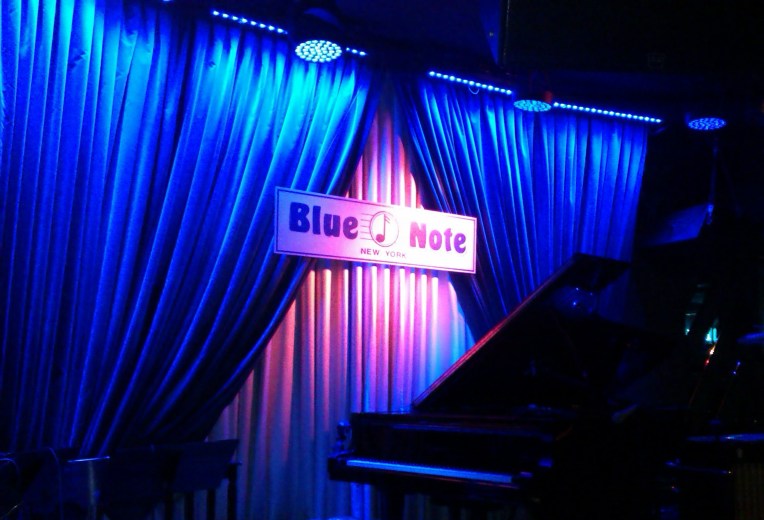
Blue Note Jazz Club, New York City
Sunday, November 13
8:00 pm

Chick Corea piano
Gary Burton vibraphone
The Harlem Quartet
Ilmar Gavilan violin
Melissa White violin
Juan Miguel Hernandez viola
Paul Wiancko cello

Setting the stage

The year is 1959. A young Chick Corea, just out of high school and newly arrived in New York City, quits Columbia University after only one month and immerses himself in the City’s sixties Jazz scene, its second golden age. In the coming years he makes a name for himself, and his exuberant playing soon catches the ears of Miles Davis, Stan Getz, and many others. Jump to the 1972 Berlin Jazz Festival, where his fingers join the mallets of Gary Burton on record for the first time. So begins a musical partnership that has spun nothing but gloriousness ever since and brings us to 2011.

Burton and Corea

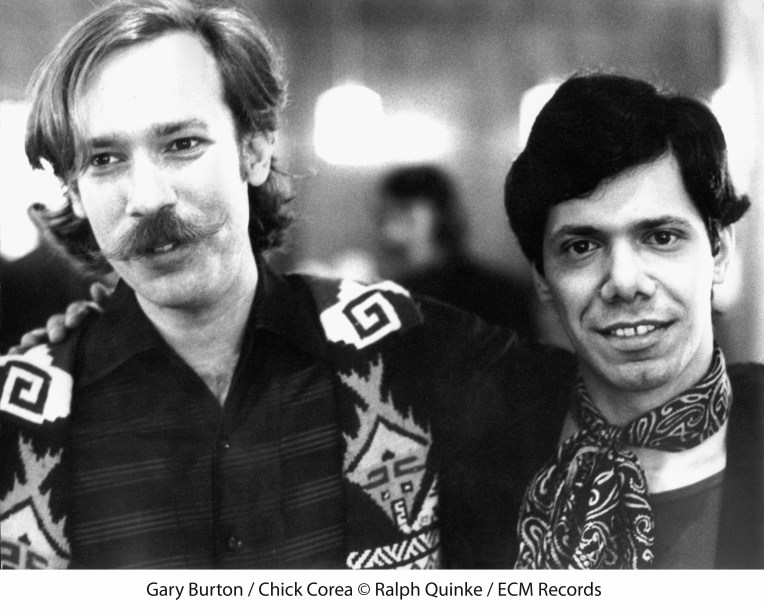
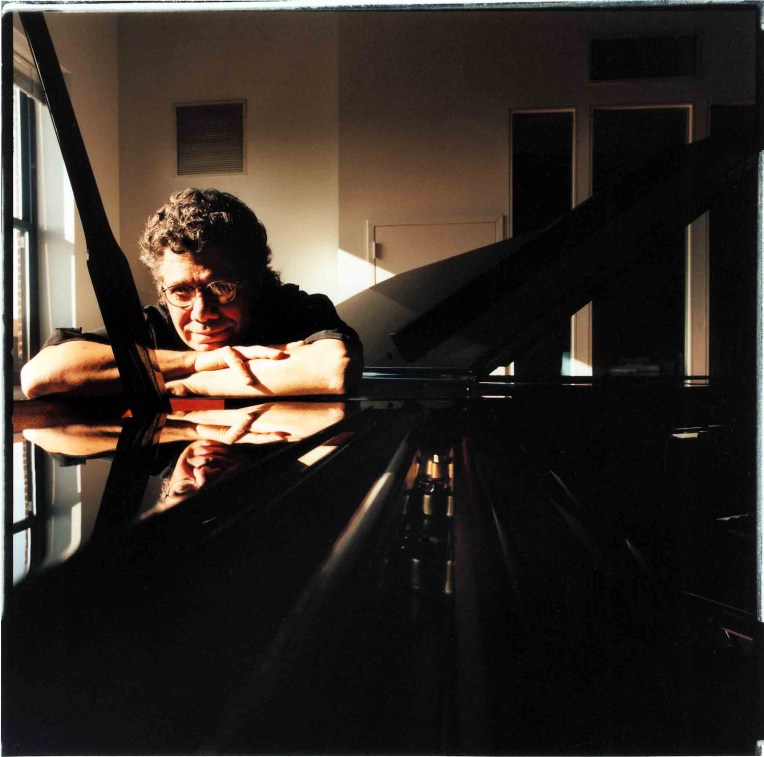
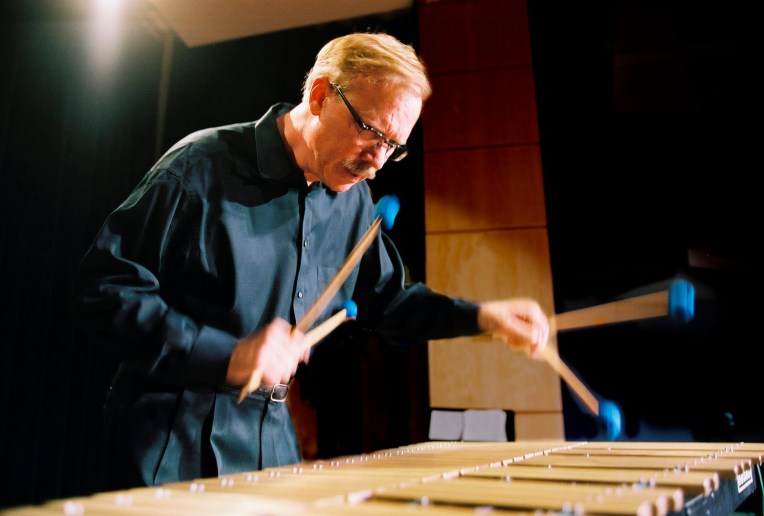
“The vibe is just conducive to making music,” says Corea of the Blue Note, a venue of personal choice for years, and where he now celebrates his 70th birthday with a month-long series of concerts. If anything, his flames burn brighter, bringing characteristic verve to every shade of his pianism: dynamic, utterly precise, and sparkling to the last drop. The Corea/Burton alignment is world-renowned, a boon to ECM and to the field as a whole for decades, and hopefully for decades yet.

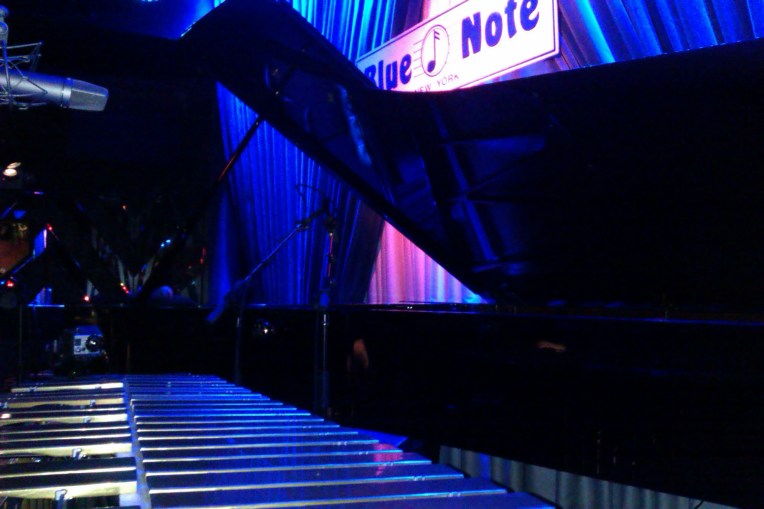
The energy here at Blue Note is kept to a soft boil, every laugh seemingly exaggerated by anticipation. Tables are tightly packed, and one shares them with strangers, who by the end of the night leave their mark for having shared in such bliss. Our six-seat arrangement abuts the very front of the stage. It is my first time to this hallowed institution, and being in proximity to such avid Jazz fans, and to the music we’ve all come to witness, it feels good to be alive.

Tonight, Corea and Burton are joined by the Harlem (String) Quartet for a concert preview of their new Chamber Jazz collaboration, Hot House (due out on CD in February 2012). While on the surface this may seem like an unusual combination, in fact both Burton and Corea have already explored such crossovers. Burton was the first to do so when, after he and composer Samuel Barber had been toying with the idea for some time, he refashioned the mold with his Seven Songs For Quartet And Chamber Orchestra in 1973, then later with Corea himself on 1983’s Lyric Suite For Sextet and again on The New Crystal Silence (released 2008 on Concord). With such a varied palette from which to choose, the results promise to be extraordinary.

And indeed, extraordinary hardly begins to describe the sounds that wash over us once Corea and Burton take to the stage, made all the more so by the tasteful amplification and reverb. “Love Castle” kicks off the first of three duets, each a different glint from the same well-polished jewel. From chord one, we find ourselves wrapped in an expansive intimacy that only decades of collaborative playing can bring to bear. Burton is downright acrobatic on those gradated strips of metal and brings a cool fire to every lick he elicits from them. The duo takes a cue from Art Tatum in “Can’t We Be Friends.” Lush syncopations that would provide hours of head-scratching for many a frustrated player only give Burton further excuse to stretch his arms before applying his lightning runs to a crowd-pleasing rendition of “Eleanor Rigby,” in which Corea digs deep over a lithe ostinato.

Corea and Burton are both very personable, doing their utmost to make the crowd feel right at home between songs. Corea quips requisitely about cell phones and bids us to talk freely during the show as the Harlem Quartet makes its entrance. It is something of a dramatic one, as cellist Paul Wiancko navigates the narrow human corridor with his charge held carefully above our heads.

After a bit of tuning (more on this below), we’re off on two adventures from the aforementioned Lyric Suite. The quartet seems like a trampoline in “Overture,” sending piano and vibes flying into the neoclassical shades of “Waltz.” Here, Wiancko provides some welcome pizzicato on the way to a rosy finish. The quartet intros a shapely version of “’Round Midnight” as Corea jumps into the thematic deep end, leaving his partner to walk along the surface above. Last is a new Corea original entitled “Mozart Goes Dancing.” Burton’s flights are particularly noteworthy in this economical dialogue.

When both of these players perform, they appear so utterly focused on their task that one wonders how they connect so seamlessly. Corea’s answer: one need only serve the music and style will “take care of itself.” (This is exemplified in his penchant for conducting or clapping along from the bench whenever his hands aren’t on the keys.) Whatever the method behind their brilliance, it is the compatibility of their intentionality—the simple yet profound choice of where to place a note—that brands their synergy into the brain. They don’t so much trade places as constantly flit in and out of time, turning on a dime from supremely lyrical, almost elegiac passages, to head-nodding grooves. Such contrasts are like big bangs in miniature, each the potential for a new solar system of sound.


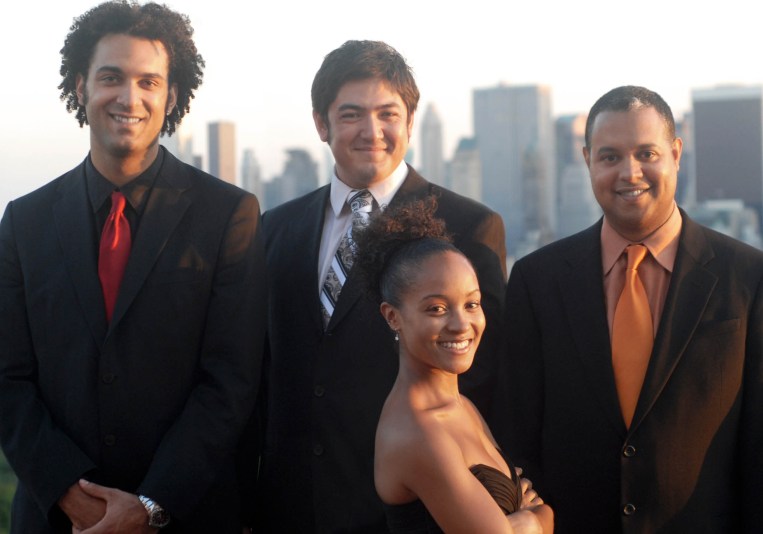
Harlem Quartet

And what of the Harlem Quartet? This seems to be the question of the night, for while these fresh-faced and spirited musicians clearly bring oodles of passion to the table, they are given little to work with in Corea’s often stilted arrangements. They are also, I feel, unfairly slighted by Corea and Burton’s last-minute encoring of the classic “La Fiesta,” which, though a powerful conclusion, keeps the faithful foursome on stage awkwardly for a good ten minutes while the two old-timers everyone has come to see weave their spell. (On that note, I strongly urge readers to hop on over to the Harlem Quartet’s homepage and take a gander at their many projects and inspiring commitment to outreach.)

There was, however, an unforgettable moment before the Lyric Suite selections commenced when, after taking their seats, the quartet took a minute or two for a tuning session. During this, Corea and strings spun some free improv that was, ironically, the most fruitful connection displayed between the two halves of the stage during the show, and perhaps territory they might explore in the future beyond the otherwise peripheral role assigned to them. Burton and Corea are such fully minded players already that one is hard-pressed to find any gaps in need of filling. How does one add more wind to a tempest?

In the end, the Corea/Burton experience, regardless of its augmentations, has never been at heart about blending idioms, but rather about exchanging them. In that exchange, one hears an ever-changing conversation, and we are lucky to have been a part of it on this balmy spring night. To walk through their sonic forests is to feel one’s feet on the earth, where soundtracks flitter through dusty, cobwebbed pathways of memory like Corea’s famous mouse. In traveling through these spaces, one finds the windows still crystal and silent, wiped clean from years of pressing our ears up against them.

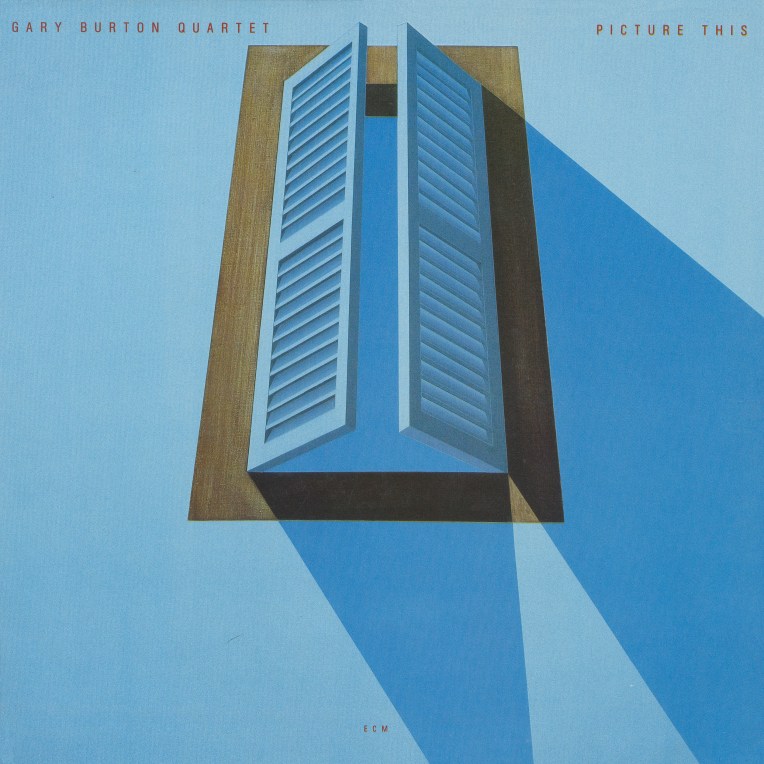
Gary Burton Quartet: Picture This (ECM 1226)

ECM 1226

Gary Burton Quartet
Picture This

Gary Burton vibraharp
Jim Odgren alto saxophone
Steve Swallow bass guitar
Mike Hyman drums
Recorded January 1982 at Columbia Recording Studios, New York
Engineer: Stan Tonkel
Produced by Hans Wendl

As I listened to Picture This for the first time, spring had just begun, and the music could hardly have been more fitting. Like an animal emerging from hibernation, its joyous frolics resonate in heart and mind with equal wit. Burton’s breath of fresh air is easy on the ears, never bogging us down with overly intellectual presumptions. For this transient quartet, he finds himself fronting a trio comprised of Jim Odgren on alto sax, Steve Swallow on bass, and Mike Hyman on drums. The mingling throughout from the two leads makes for some evocative motives and adds a curl to every letter written.

Burton never ceases to captivate, for here is a musician who is so—if you will excuse the pun—vibrant on his own terms, yet allows balance to flourish wherever he may be. Take, for instance, this new spin on the Carla Bley classic “Dreams So Real,” on which his presence is so integral yet so unassuming that at times one hardly notices, providing as he does only those key anchors needed for Odgren’s lithe restraint, only to unleash a primary force when soloing. This is the first of a few dips into the work of Burton’s favorite composers. Another, even deeper, plunge comes in the form of “Waltz.” This spindly Chick Corea tune cycles through far more rhythmic variations than its rudimentary title would indicate, and also sports a leapfrogging solo from Swallow that is by far the album’s highlight. Swallow also makes fine work of “Duke Ellington’s Sound Of Love” (Charles Mingus), where his lyrical sway is flexible enough to support both Burton’s superbly attenuated malleting and Odgren’s beautiful reed work. The latter makes a winner out of “Tanglewood ’63” and lends itself to the saxophonist’s own two offerings, “Tierra Del Fuego” and “Skylight,” both gifts of pure delight wrapped in bright melodic bows.

Burton has uncovered some of the most potent melodies in ECM’s dense and knotted trees. Every strike of his mallet is like a woodpecker, revealing that which only the most attuned ears can hear.

<< Dewey Redman Quartet: The Struggle Continues (ECM 1225)
>> Keith Jarrett: Concerts – Bregenz/München (ECM 1227-29)

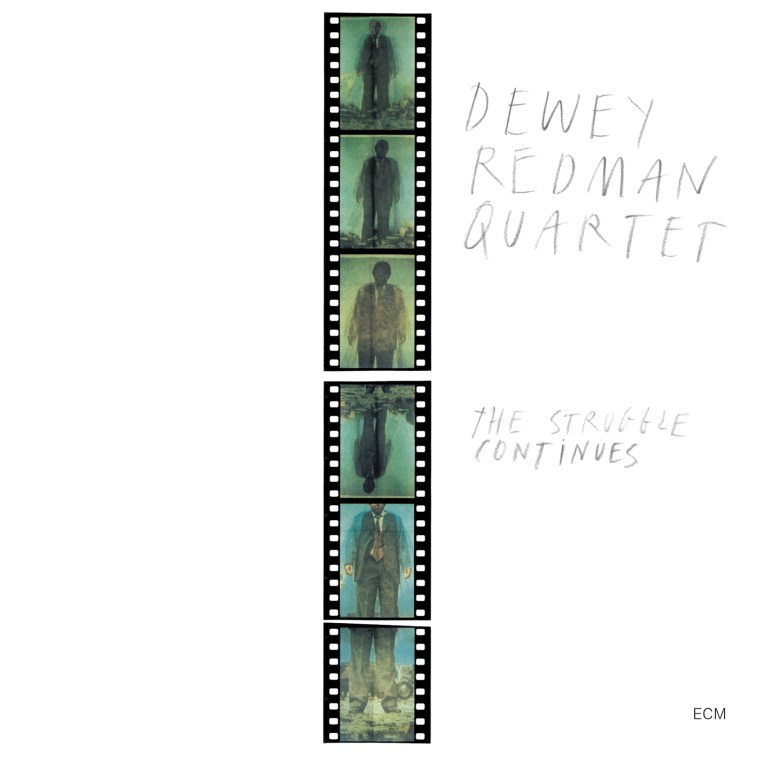
Dewey Redman: The Struggle Continues (ECM 1225)

ECM 1225

Dewey Redman
The Struggle Continues

Dewey Redman tenor saxophone
Charles Eubanks piano
Mark Helias double-bass
Ed Blackwell drums
Recorded January 1982 at Columbia Recording Studios, New York
Engineer: David Baker
Produced by Robert Hurwitz

Somewhere along the way, Dewey Redman must have lost an “e” from his last name, for he was a reedman if ever there was one. A self-taught Texas boy, he was already playing with Ornette Coleman by his teens. Still reeling, I imagine, from the two Old and New Dreams joints produced by ECM just a few years before, listeners were sobered by an unforgettable experience with The Struggle Continues—an experience felt afresh when the album was at last reissued on CD in 2007, just one year after Redman’s death.

Those Coleman roots spring right from the soil and grab us in “Thren.” Bookended by a frolic and a march, its fancy footwork from bassist Mark Helias and edgy pianism from Charles Eubanks make sure we aren’t going anywhere. All of this is just a pretext, of course, to get us hooked before Redman presses a saxophonic iron into the wrinkles of “Love Is.” Like a new morning in suburbia, its speaks its promises in voices calm and familiar, the brushed drums moving our worries into the gutter like a street sweeper, the sun peaking over the distant hills and stretching its light to those less fortunate. Eubanks is as rosy as ever in a cut that, as the album’s longest, makes it clear where the band’s heart truly lies. Things get even steamier in “Turn Over Baby.” Raw and curvaceous equation that it is, it fronts smoldering lines above Ed Blackwell’s watery cymbals, further fueled by the passions of “Joie De Vivre.” Legato phrasings on tenor only heighten the punctilious quality of the rhythm section and its inspiring uplift into “Combinations,” the latter a tangled yet pleasing confection with a sweet bass center and drummed sprinkles on top. The not-so-secret ingredient is Redman himself, who samples every course before licking his plate clean in an upright rendition of Charlie Parker’s “Dewey Square.”

As someone so utterly attuned to everything going on, around, and within him, Redman was almost peerless for his time, and seemed only to grow in the context of this one-off combo. “At the top of their game” is not a phrase one need apply to these players, for by the time we encounter this music they’ve already scaled down the other side of the mountain and climbed another. One feels they could have easily extended each of these tunes to an album’s length. As it stands, the final set connects its dots in perfect time.

This is by far one of the swingingest albums in the ECM backlog, and is anything but a struggle. Its fluid, forward-looking, and stichomythic playing is its own history. Produced by the great Bob Hurwitz, then head of ECM’s American operations and now president of Nonesuch, this one will stand the test of age.

<< Enrico Rava Quartet: Opening Night (ECM 1224)
>> Gary Burton Quartet: Picture This (ECM 1226)

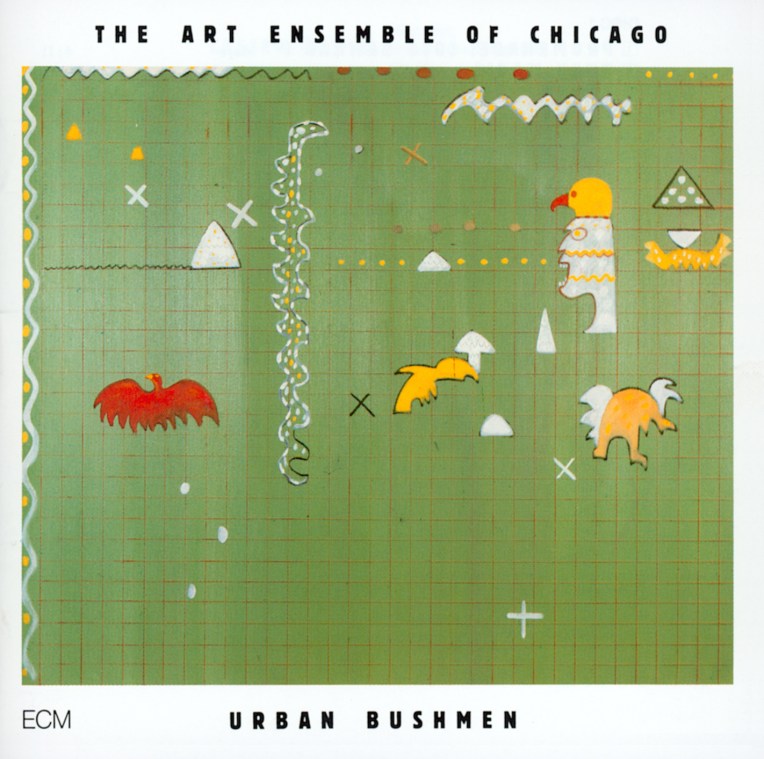
Art Ensemble of Chicago: Urban Bushmen (ECM 1211/12)

ECM 1211_12

Art Ensemble of Chicago
Urban Bushmen

Lester Bowie trumpet, bass drum, long horn, vocals
Joseph Jarman saxophones, vocals, clarinets, bassoon, flutes, percussion
Roscoe Mitchell saxophones, flute, percussion, clarinet, vocals
Malachi Favors Maghostus bass, percussion, melodica, vocals
Famoudou Don Moye sun percussion, vocals
Recorded May 1980, Amerika Haus München
Engineer: Martin Wieland
Produced by Manfred Eicher

While the breadth of the Art Ensemble of Chicago’s palette is certainly astonishing, what distinguishes the group from so many others is not a matter of quantity but of stride. Like its acronym, the heart of the 1980 performance recorded here is a trio of creative shapes: Lester Bowie, Joseph Jarman, and Roscoe Mitchell are wellsprings of improvisatory energy whose intermingling at times describes an entire album’s worth of material in a passing exchange.

Much of the concert’s first half moves in an uninterrupted chain, of which “Urban Magic” is the summit. With requisite edginess, Bowie contrasts piercing cries and caramel echoes as megaphone-enhanced incantations gnaw at the shadows. These postulations tighten into some sweltering hard bop from Don Moye and Jarman, all the while offset by a mousy squeak toy and Bowie’s raw acrobatics. “Sun Precondition Two” opens another vast suite, this one clocking in just shy of 22 minutes, with an incendiary storm from Moye. It is a fearless moment, springing forth like some giant clock unwinding itself in fast-forward, and will win you over if the journey so far has only ticked a few of your tocks. This then morphs into what I can only describe as a Civil War-era Sephardic carnival ride.

To start us off on the second half, Bowie breaks out a slice of heaven in “New York Is Full Of Lonely People.” Its smooth backing of bass and percussion would be enough to put any beatnik poetry reading to shame. Yet this does little to set the tone for the remainder, which is for the most part contemplative and cerebral. Though the weighty darkness of “Ancestral Meditation” and the snail-crawl of “Uncle,” the music develops like slow, studied breathing.

A glossary of shorter collaborations fills out this hefty package, which contains the most well-rounded portrait of a group at the height of its soothsaying powers. These include the two tinctured “Promenades” and “Peter And Judith.” The latter is at once swanky and mystical in that way only the AEC can be, while the concluding “Odwalla / Theme” shows us a no less powerful straight-laced side of things.

Out of a discography of nearly 50 albums, some of the AEC’s best work can be found on its handful of ECM recordings. An ideal place to start for those who like to jump right into the deep end, this is an affirmational experience that deserves your ears immediately.

<< Gary Peacock: Voice from the Past – PARADIGM (ECM 1210)
>> Steve Kuhn Quartet: Last Year’s Waltz (ECM 1213)