Schubert: Sonate B-Dur op. posth. D 960 – Edition Lockenhaus, Vol. 3 (ECM New Series 1682)

ECM 1682

Edition Lockenhaus, Vol. 3:
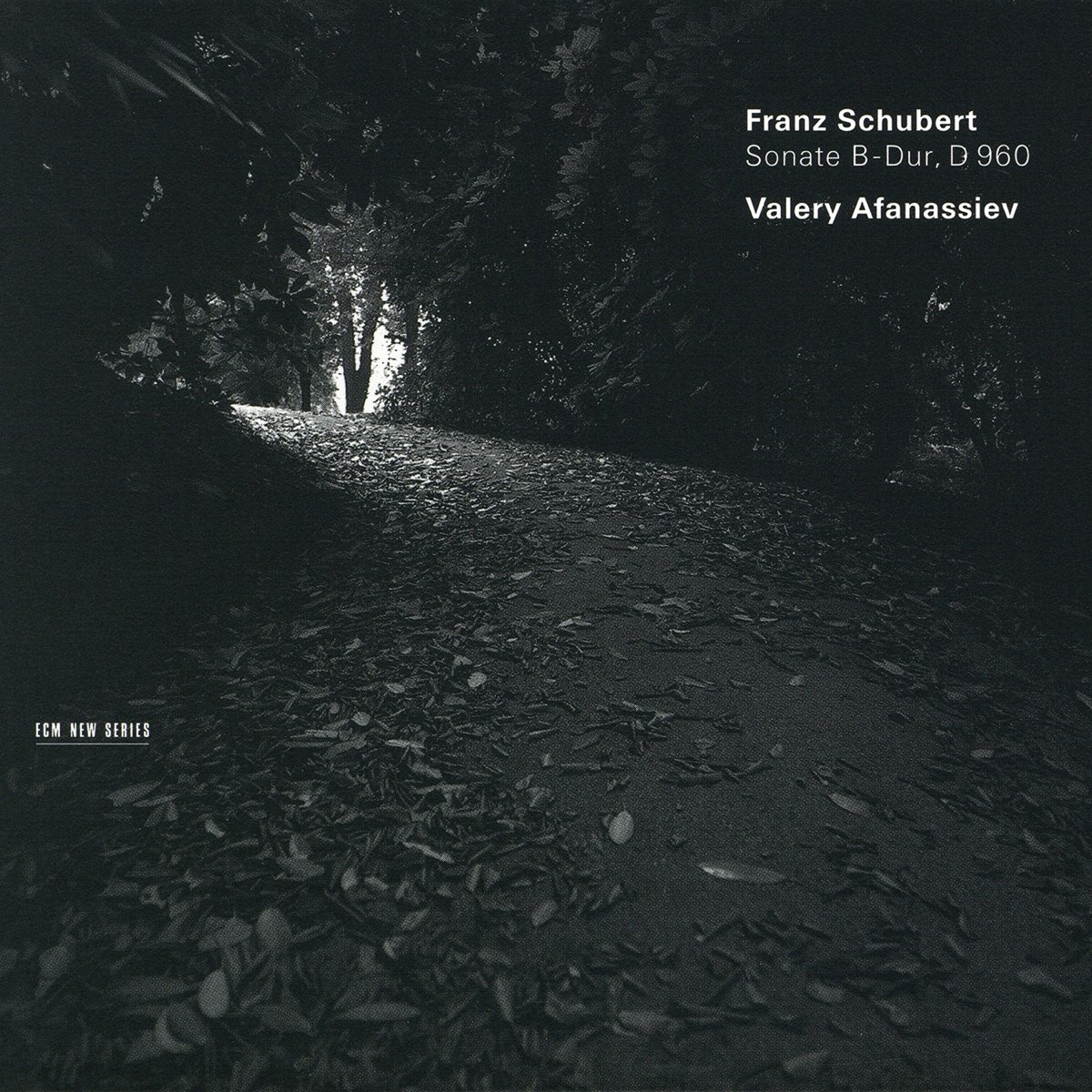
Franz Schubert: Sonate B-Dur op. posth. D 960

Valery Afanassiev piano
Recorded July 1985 at the Lockenhaus Festival
Engineers: Peter Laenger and Stephan Schellmann
Produced by Manfred Eicher and Gidon Kremer

With over 100 recordings of Franz Schubert’s last sonata, one might ask: Why another? Valery Afanassiev gives us a resounding answer with this performance from the 1985 Lockenhaus Festival (a last-minute substitution for a canceled trio), bringing to glorious life what Bryce Morrison has called “the pianist’s Hamlet.” As a swan song, the B-flat Sonata may easily be read as a tarnished mirror where our mortality balks at its own reflection. Yet in the listening, I am wont to hear not the looming specter of death, but rather the fluttering of a curtain letting in the light. Like a piece of fruit rotting in reverse, the B-flat Sonata awakens to find that its decay was but a dream, that it is as crisp and as ripe as the day it was born.

As it stands, Afanassiev’s interpretation is broader than most and respires through a powerful dynamic range. In his liner notes the Moscow-born pianist speaks of absolute truth, and of how the low flutter of the opening movement—what he calls “the most uncanny trill in the history of music”—grounds us from our high horses. For him, this sonata is a monstrous thing, the shock of horror behind a veil of art. He also critiques himself for leaning on sentimentality, though I think we can forgive his brazenness, for it is of the gentlest kind.

The first movement begins where many would end: in utter suspension. Every rustling is a bird falling into an abyss of yearning, where memories collide with the yet to be. Voices bubble up from that seismic trill, shielding us from our own expectations. Afanassiev’s punctuations are expectorate and his ascending lines as lilting as they are forlorn. Implications of perpetual motion interlock their fingers with weighty pauses and distant considerations, resolving into stained-glass intimations of “Adeste Fideles.”

The formidable Andante—a Largo in Afanassiev’s hands—whispers in half-light. He builds this slow prance brick by ephemeral brick, as if through a haze of recollection. At eleven and a half minutes, it is among the longest versions on record, and clothes a heart that one finds beating even more nakedly in the piano works of Valentin Silvestrov. Reason enough to own this disc.

After the stark wash of this silent film, we are thrown into the sparkle of a Technicolor spectacle in the Scherzo before sliding down its rainbow into the final Allegro. Here Afanassiev’s deep breath acts as emotive bellow, seeming to blow dust at the feet of the finale, which remains frozen in mid air—racing but never quite touching ground, flapping but never quite lifting off.

Despite the breadth of his tonal spectrum, Schubert is not a composer who works in gradations, but in densities. The light is always there. We simply see or less of it depending on how porous the scrim of the music becomes. Some sections, like the opening leitmotif, are latticed; others are tightly woven baskets; still others, nets through which any hope may pass unfiltered. It is music that works in ages, by turns dancing and hunched on the gnarled cane of infirmity.

If Schubert speaks in tenses, then Afanassiev is a master conjugator. This is a rendering at once flagrant and conservative. A valuable performance to have on record.

<< Paul Giger: Ignis (ECM 1681 NS)
>> John Abercrombie: Open Land (ECM 1683
)

Steve Tibbetts: Exploded View (ECM 1335)


Steve Tibbetts
Exploded View

Steve Tibbetts guitars, tapes, kalimba
Marc Anderson percussion
Bob Hughes bass
Marcus Wise tabla
Claudia Schmidt voice
Bruce Henry voice
Jan Reimer voice
Recorded 1985-86 in St. Paul, Minnesota
Engineer: Steve Tibbetts
Produced by Manfred Eicher

Two chipmunks of the oak at last found a way into the tree house, and would run cheerfully over us, breathing our heated breath; they slept in Blink’s lap for three days of blind violent storms that sheathed the forest in ice, which seemed to make music in the fine blue morning that followed, music too blinding to look at.
John Crowley, Engine Summer

Bless the day Manfred Eicher decided to give Steve Tibbetts his own country in the ECM continent, where he has produced some of the label’s most transportive folkways. On Exploded View, we get a few licks of the fire that would utterly consume us in The Fall Of Us All (if not the other way around). This sits somewhere between that later masterpiece and the quieter heart of Northern Song. “Name Everything” bursts like a freshly lit match onto a geyser-pocked landscape, each beat from percussionist Marc Anderson an eruption of steam that proclaims the earth’s inner desires. “Another Year” is anchored by a glistening acoustic and gilded by that incendiary electric as spiraling internal avenues come to a head in an expansive choral palette. “A Clear Day And No Memories” carries on those vocal menageries with the prominent cries of Claudia Schmidt, who trails her song across an oceanic sky. These quiet into an acoustic aside, alive with rhythmic whispers. The pliant guitar of “Your Cat” is a wonder to behold in the full efficacy of its power, and evidences Tibbetts’s programmatic flair: the music is indeed feline in the way it arches its back, wiggles and pounces, purrs and dreams of the savannah, plays and loves. “Drawing Down The Moon” locks us into the subtlest of grooves, linked by the forward-looking tabla at its core, while “The X Festival” throbs with the voice of history. This superb blend of local and far-reaching mysteries cracks open the dawn, spilling its sunny yolk across the floodplains. The album’s most rhythmically intense moments can be found in “Metal Summer,” which again thrums at the core of something ineffable yet so visceral it can never be denied. Forgoing speech, its finds its voice in the elemental language of grinding flame that is Tibbetts’s modus operandi. Last is “Assembly Field,” another biting trek that ripples across the sands with the slow-motion whip of a sidewinder in search of an oasis it already carries inside, finding solace at last behind the closing eyes of a shimmering acoustic reflection.

Tibbetts chooses his grooves and comings together with tact and with grace, so that we never forget the vivacity of their placement. He shines his light through a necklace of motifs and cellular sound paintings. Take, for instance, the short but unforgettable “Forget,” which has all the makings of a universal anthem. It bristles with a fast head nod and electrical break in the production, keying us in to the malleable style of its surroundings. Like the guitarist at its center, it pulls the strings of time rather than plucking them for trite effect. In doing so, it unleashes an entire culture’s worth of footsteps.

<< Keith Jarrett: Spirits (ECM 1333/34)
>> Meredith Monk: Do You Be (ECM 1336 NS)

Keith Jarrett: Spirits (ECM 1333/34)

Keith Jarrett
Spirits

Keith Jarrett piano, flutes, soprano saxophone, guitar, percussion
Recorded May through July 1985 at Cavelight Studios, New Jersey
Engineer: Martin Wieland
Produced by Keith Jarrett and Manfred Eicher

Spirits is more than a jewel in the rough. It is the rough of a jewel. By this, I mean to say that through its hard-won journey Keith Jarrett has peered into the heart of darkness that is life and compressed it into a diamond so honest that no amount of polishing will wear away its blemishes. Recorded at his home studio, then post-processed by ECM engineer Martin Wieland, this is a most personal album of boundless expression. Then again, so is every Jarrett album. The difference is in the instrumentation: an unusual array of flutes, keys, and percussion, overdubbed in various combinations and densities (Jarrett even picks up a guitar, which he treats more like a sitar). Jarrett also sings, wails as if in and of the earth, finding in Nature a single feather plucked from nowhere. Bird-less, it has no recourse to flight, and can only call to a sky it will never know.

Though splashed over two discs in 26 parts, this heartrending session takes breath into the same pair of lungs throughout. Moods range from jubilation to a burrowing pensiveness, but always with an ear attuned to catharsis. The nearly two-hour purge turns repression into a path, beginning deep in the heart of ritual, where drums and flutes tread in place of feet and throats, and ending in the recesses of a Renaissance dream, where shepherds, troubadours, and shamans share their slumber. Jarrett’s occasional chants flirt with the exigencies of articulation, all the while forming steady yet somehow ungraspable touchstones along the way. The expected pianism is kept to a graceful minimum, giving way instead to wondrous ruminations on soprano saxophone and other suspended airs.

In so many other hands, such an album would come across as a trite exercise in tribalism, but in Jarrett’s it emotes with full transparency. By far his most colorful release, it marks a shift in method. Where before he charted every possible recess of the structure at hand, here he allows that structure to build itself around him in a shelter of the psyche. The result is a freestanding insight into the pathos of creation. Probably not the one you’ll want to start with, but by no means a prism to bar from the light of your curiosity.

<< Paul Hindemith: Viola Sonatas (ECM 1330-32 NS)
>> Steve Tibbetts: Exploded View (ECM 1335)

Gary Burton Quintet: Whiz Kids (ECM 1329)


Gary Burton Quintet
Whiz Kids

Gary Burton vibraphone, marimba
Makoto Ozone piano
Tommy Smith saxophone
Steve Swallow bass
Martin Richards drums
Recorded June 1986, Tonstudio Bauer, Ludwigsburg
Engineer: Martin Wieland
Produced by Manfred Eicher

This aptly titled date from the Gary Burton Quintet showcases two wunderkinds: saxophonist Tommy Smith and pianist Makoto Ozone. It was Chick Corea who recommended the up-and-coming Smith, just 18 at the time, as a Burton sideman. One year later, Smith was thrust into the ECM spotlight, bringing his robust tenor voicing to one of the finest outfits in the business. And speaking of Corea, one would be hard-pressed to find a more kindred spirit than Ozone, who at 25 was already a longtime phenom in his native Japan, and whose tutelage at Berklee led him to work with Burton.

These talents are showcased not only technically, but also compositionally. Smith leads the way with “The Last Clown.” This warm, nocturnal cityscape is the perfect appetizer for what’s in store. The space afforded to every musician is a testament to the group’s democratic flair. Those unmistakable vibes glisten like rain-slicked streets, Burton taking his sweet time to let every note sing, while Ozone deepens the proceedings with every key he touches. Yet the pianist shines brightest in his own two upbeat contributions. Of these, “La Divetta” shows the group at its finest and is honed to a formidable edge by Smith’s aerial attack and the breakneck pacing of drummer Martin Richards. The balance of Ozone’s “Yellow Fever” is invigorating to say the least. Burton shows off his mindboggling precision, as do Smith and Ozone, one cream to the other’s coffee. Both of these pay homage to Corea, whose tune “The Loop” caps off a diamond-solid set. A couple of rarities complete the picture. “Soulful Bill” is a lovely ballad that features an even lovelier bass line from Steve Swallow, who dances with his own quiet magic through a gallery of fine solos. And the mid-tempo “Cool Train” brings on the love tenfold, especially in its sweeping pianism, which here recalls Bruce Hornsby.

The themes on Whiz Kids are ripe, the playing even more so, and the recording pristine. This is a quintessential example of ECM’s tender side, perfect for those lazy afternoons during which dreaming is the best kind of travel. Sadly, this smooth-as-silk recording would mark the end of Burton’s 14-year run on ECM. All the more appropriate, then, that his selfless respect for new generations of talent should take center stage.

<< Jon Hassell: Power Spot (ECM 1327)
>> Paul Hindemith: Viola Sonatas (ECM 1330-32 NS)

Enrico Rava/Dino Saluzzi Quintet: Volver


Enrico Rava
Dino Saluzzi
Volver

Enrico Rava trumpet
Dino Saluzzi bandoneón
Harry Pepl guitar
Furio Di Castri bass
Bruce Ditmas drums
Recorded October 1986 at Tonstudio Bauer, Ludwigsburg
Engineer: Martin Wieland
Produced by Manfred Eicher

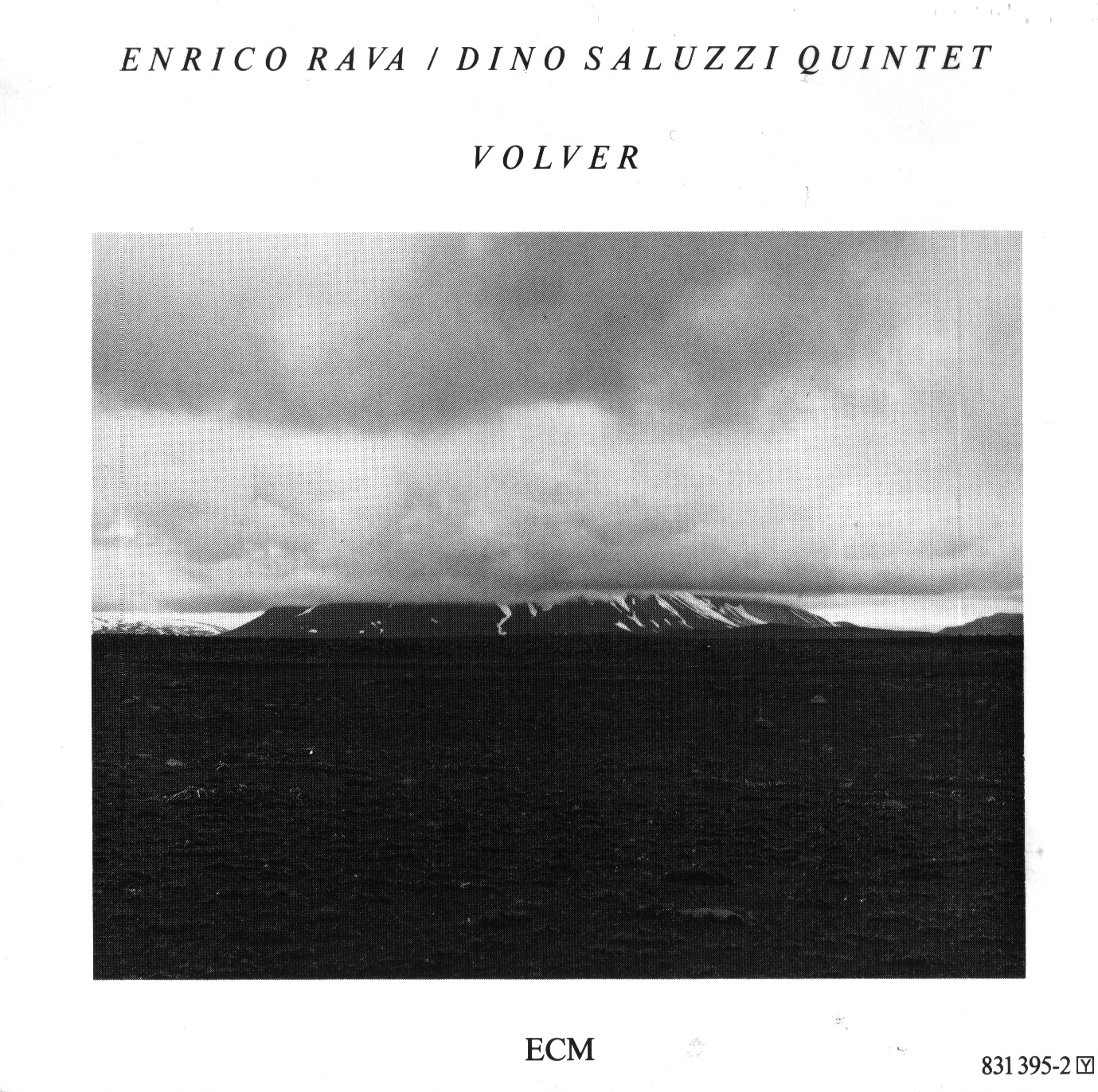
Before the title of Volver (Spanish: to return; to come back) graced Pedro Almodóvar’s colorful 2006 film, it found a home two decades previously on the cover of this most intriguing date from bandoneón master Dino Saluzzi, who joins the roving Enrico Rava Quartet. Harry Pepl starts things off right with a plaintive guitar in “Le But Du Souffle,” providing a yielding surface for Saluzzi to carve his ethereal shapes. Add to this the earthbound bass of Furio Di Castri and Rava’s heavenly blowing, and you get a formula for pure sonic bliss. This typically rubato ECM intro smoothes into the jaunty territories of “Minguito,” which form a unique sound brought to fervent life by Bruce Ditmas at the kit. After a killer thesis statement, Rava draws from a single note an ever-flitting butterfly of a solo. Pepl follows in his wake with effervescence, plowing that same field of perpetual energy before Saluzzi arcs forward with the album’s most resplendent solo. The rhythm section builds to fervor underneath him, as if pointing fingers skyward in want of flight. “Luna-Volver” is a lilting piece for bandoneón alone, which in this resonant space develops like a sepia-tinted photograph, a tender prelude to the ecstatic expression of audible love in “Tiempos De Ausencias.” A slab of free jazz awaits us in “Ballantine For Valentine,” which from a wrenching Bill Frisell-like guitar throws delicious textures to the wind before the dark spiral of “Visions” catches the light of finality as if on a glassine edge.

The band gives plenty of space to contemplate each section, taking long, deep breaths between solos. Like a tree, the results maintain rootedness, no matter how high they climb. Rava is the sap through its veins, Saluzzi the sunlight in the branches. The two make for quite a pair, and it’s a shame they never conversed more often. My only caveat is the mid-heavy production. While normally I like being drowned in reverb, in this case it’s just a bit too plush for its own good. It obscures some of the finer gradations of the musicianship and forces a final fadeout into premature silence.

<< Christy Doran: Red Twist & Tuned Arrow (ECM 1342)
>> Keith Jarrett: Book Of Ways (ECM 1344/45)

Steve Tibbetts: Yr (ECM 1355)


Steve Tibbetts
Yr

Steve Tibbetts guitars, kalimba, synthesizer
Marc Anderson congas, drums, percussion
Bob Hughes bass
Steve Cochrane tabla
Marcus Wise tabla
Tim Weinhold bongos, vase, bells
Recorded ca. 1980 at Atma-Sphere and Oxit Roxon, St. Paul
Engineer: Steve Tibbetts
Produced by Steve Tibbetts

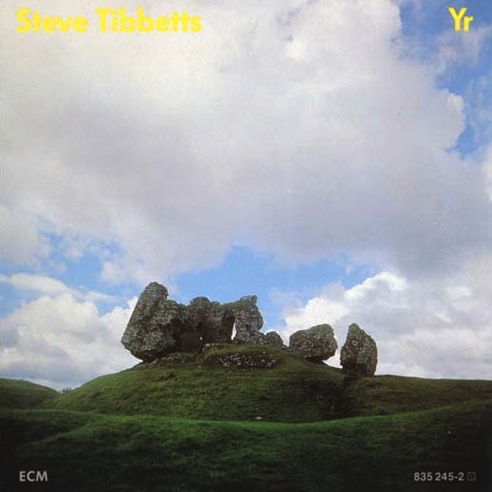
Yr is yet another fascinating peek into the Steve Tibbetts sound-verse. The feeling of open plains that so characterized his previous efforts remains, only now the production is more immediate, such that the 12-string intimations unlocking the doors of “Ur” set us adrift in our own mysteries. Percussionist Marc Anderson soars, seeming to grow out of Tibbetts’s hollow-bodied heart before the heavy thrum of the latter’s electric curls itself into a ball and rolls down a hill of unrelenting melody. After an explosion of beats and guitars settles us into the soothing reverie of “Sphexes,” we find our expectations blotted by an interlude of kalimbas before Tibbetts spreads his buttery axe over this acoustic toast with sweetness in “Ten Years.” Fantastic. “One Day,” much like the opener, rises from the ashes of a campfire, but not without leaving an aftertaste of the prairie. “Three Primates” is a pocket of sunshine that shifts masterfully between tones and timbres. Now darkened by shadow, now blinded by noon, it dives headfirst to a tabla-infused conclusion. “You And It” is another shimmering slice of life. Backed by strings and icy sleigh bells, it breathes life into a new day. This opens the doors even wider, letting in the dawn’s early electric and unleashing a torrent of dreams made real. “The Alien Lounge” traipses through tall grasses, weaving past abandoned foxholes and memories of warm nights toward the starlight of “Ten Yr Dance,” spun like a home movie rewound to one’s first days on earth.

This is by far Tibbetts’s most uplifting date and one sure to win you over with its no-frills charm, emoting as it does with an artistry at which we can only shake our heads in wonder. It also shows just how deftly and appropriately he takes advantage of the studio, flipping prerecorded bits on end and adding just the right touch of electronics for depth. The spaces therein are constantly morphing, content to move on once they have achieved a certain kind of beauty while always looking forward to the next.

Timeless, as all Tibbetts releases are.

<< Oregon: Ecotopia (ECM 1354)
>> Pepl/Joos/Christensen: Cracked Mirrors (ECM 1356)

Mark Isham/Art Lande: We Begin (ECM 1338)

Mark Isham
Art Lande
We Begin

Mark Isham fluegelhorn, trumpets, synthesizer, percussion
Art Lande piano, synthesizer, percussion
Recorded January 1987 at Rainbow Studio, Oslo
Engineer: Jan Erik Kongshaug
Produced by Manfred Eicher

“All art is at once surface and symbol.”
–Oscar Wilde

This brooding session from Rubisa Patrol alumni Mark Isham and Art Lande is an odd one. Odd, because with the immensity of acoustic talents to be found in both musicians, the results tend toward a saccharine blend of electronics that detracts from the heavenly beauties being painted before them. Take, for instance, Isham’s swaths of trumpeted gorgeousness in “The Melancholy Of Departure,” which are at pains to harmonize with the drum machine that is the piece’s frail backbone. Neither does Lande have reason to augment his resonant pianism with the synthetic gamelan that deadens “Ceremony In Starlight” when he might have further explored the inside of the piano for similar effect. And are not Isham’s muted calls here far more cosmic than a few patching of wire ever could be? The same goes for the title piece and for the closing “Fanfare,” in which Isham might easily have multi-tracked himself (as he does later on) in lieu of the thin choir that we get.

Lande’s piano becomes more prominent as the album progresses, most effectively so in his tender solo piece, “Sweet Circle.” All the more ironic, then, that the live feel of “Lord Ananea” never quite gets off the ground. “Surface And Symbol,” on the other hand, is as transcendent as transcendent gets. One only wishes this veritable flower of layered horns, echoing like voices of ages past, and veiled pianism were more representative of the whole.

In spite of this album’s shortcomings, the melodic pictures it paints are so downright beautiful that one can forgive its cheap gilded frame. And far be it from me to criticize what was then an exciting new tool of the moment. Neither a must-have nor one to ignore. I’ll leave it for you to decide where it falls.

<< Norma Winstone: Somewhere Called Home (ECM 1337)
>> Edward Vesala: Lumi (ECM 1339)

Jon Hassell: Power Spot (ECM 1327)

Jon Hassell
Power Spot

Jon Hassell trumpet
J. A. Deane percussion, alto flute
Jean-Philippe Rykiel keyboards
Michael Brook guitar
Richard Horowitz keyboards
Brian Eno bass
Richard and Paul Armin RAAD electro-acoustic strings
Miguel Frasconi flute
Recorded October 1983 and December 1984, Grant Avenue Studio, Ontario
Assistant  engineering: David Bottrill and Roman Zack
Produced and engineered by Brian Eno and Daniel Lanois

American composer and trumpeter Jon Hassell is best known for his music of the Fourth World, which he describes as “coffee-colored classical.” The definition becomes clearer once you immerse yourself in the sounds of Power Spot. Hassell’s career is as varied as his education. A student of both Karlheinz Stockhausen and Pandit Pran Nath, he is known for overlooking idiomatic barriers in favor of something far broader. Nath left an indelible mark in Hassell, who turned to the master’s voice for guidance in his own playing. His unmistakable tones are achieved by singing into the instrument, thereby drawing clusters of sounds from a single exhalation. This recording is significant for a number of reasons, not least for indicating a moment in sonic history in which the electro-acoustic universe was beginning to spin some of its richer, more majestic galaxies. The music on Power Spot radiates like a supernova waiting patiently for the traction of celestial bodies to fan its clouds away, revealing softly spinning globes of breath and vapor. With such evocative titles as “Wing Melodies” and “The Elephant And The Orchid,” one feels almost overwhelmed by the range of possible imagery. And yet, like any question of mode or genre thereof, these words disappear behind the music’s waterfall.

At first listen the album may seem to blend into a broad wash of sound, but lean in closer and you begin to hear the details emerge. The title track is perhaps the most potent, opening this portal to a wellspring of beats and train whistles. Brian Eno’s amphibian bass slithers through a pond of liquid mercury, fading into the gaseous darkness from which it sprang. Otherworldly connotations are bound to reveal themselves, and nowhere more so than in “Passage D.E.,” which sounds like the soundtrack to a documentary of some undiscovered planet. Notable also is “Miracle Steps,” where live percussion provides marked contrast to the synthetic overlay, drawing in the process the album’s most beautiful cartography.

Power Spot is one protracted aerial view, a bubbling primordial soup of circuits and blips, funneled through such progressive sense of direction and atmosphere as only Hassell can activate. Unlike much of the knob-turning to grace the many electronic albums of the 80s, its sound is strikingly effusive and organic. In this ocean, one finds that the light of life shines brightest on the inside. It is a light that no clouds can obscure, a light that no darkness can close its eyes around. It is a journey of transience, of transport, of futurism and antiquity, of none of these things. Influential? More than words can say. Just listen to Paul Schütze’s Stateless, or the works of countless others who’ve clearly drunk from the Hassell font.

A perfect specimen.

<< Lester Bowie’s Brass Fantasy: Avant Pop (ECM 1326)
>> Gary Burton Quintet: Whiz Kids (ECM 1329)

Lester Bowie’s Brass Fantasy: Avant Pop (ECM 1326)

Lester Bowie´s Brass Fantasy
Avant Pop

Lester Bowie trumpet
Stanton Davis trumpet
Malachi Thompson trumpet
Rasul Siddik trumpet
Steve Turre trombone
Frank Lacy trombone
Vincent Chancey French horn
Bob Stewart tuba
Phillip Wilson drums
Recorded March 1986, Tonstudio Bauer, Ludwigsburg
Engineer: Martin Wieland
Produced by Manfred Eicher

Lester Bowie’s Brass Fantasy is all about joy. The joy of making music, the joy of turning the popular inside out, revealing the beating heart of that which makes sound accessible. In this respect, the title of Avant Pop might as well mark the genre that this most talented trumpeter forged. And the sound? Aromatic, clean as a whistle, and affirmative. What with the heaping portions of brass sandwiched between Bob Stewart’s gorgeous tuba bass lines and Phillip Wilson’s otherworldly percussive colors, something’s bound to move you, sparking a dormant memory into animation.

Bowie pulls out all the stops on this album, blatting with ease through the opening waves of “The Emperor” and on into a lyrical rendition of “Saving All My Love For You.” The latter’s big band sound hits you right in the gut of your denial. Like a swing you never want to jump out of, it builds to a swooning climax. The vocal colors of “B Funk” add another spice to the stew and leave us spinning on “Blueberry Hill.” Stewart digs deep here and follows Bowie wherever he leads. Things get a little swanky in “Crazy,” while homage is the name of the game in “Macho (Dedicated To Machito),” which spins from a prayerful bell an infectious montuno vamp that would have made the Afro-Cuban jazz master proud. This is followed by “No Shit,” which besides having the honor of boasting the only curse word in the ECM lexicon (?) also gives us the album’s catchiest motif—a cross between “Pride and Joy” and a distorted C jam blues. “Oh What A Night” provides an irresistible and punchy conclusion.

Never has Bowie sounded so tonally corpulent, a feat only underlined by the superb engineering. And while he may blow shooting stars across a universe of familiar tunes, in this context we cannot help but hear them anew. The album is indeed a fantasy, not only in its backward glance but also in its very revival of popular song, which speaks to the sometimes-magical escapism of the form. Rather than enhance it, Bowie seems intent on bringing it down to earth in a crash landing of goodness. The breadth of idioms represented on Avant Pop is inspiring and barely scratches the surface of his legacy of wit and good cheer.

As epic as it is intimate, this is a sonic child that could only have been nurtured by a mind like his.

<< Arvo Pärt: Arbos (ECM 1325 NS)
>> Jon Hassell: Power Spot (ECM 1327)