Jan Garbarek: All Those Born With Wings (ECM 1324)

Jan Garbarek
All Those Born With Wings

Jan Garbarek solo
Recorded August 1986 at Rainbow Studio, Oslo
Engineer: Jan Erik Kongshaug
Produced by Manfred Eicher

As one of ECM’s most passionate and prolific contributors, Jan Garbarek has left us with a varicolored, sometimes watery, archive. For All Those Born With Wings, the Norwegian saxophonist went solo, painting an evocative album of relic-laden vistas. The result is a six-part session filled with a variety of instruments and tastes. The hammered dulcimer is a welcome sound to the Garbarek palette, and is used tastefully in the 1st Part, where Garbarek’s saxophone refracts into a flock of large-winged birds. An army of chants floods the 2nd Part, as martial drums resound like the introductory sequence of a classic martial arts film.

While such dramatic flourishes make for a powerful start, the album’s hold begins to wane in the 3rd part, which comes across as tentative and in need of deeper thought. By the same token, such moments reveal an endearing vulnerability, one of which I like to think Garbarek was conscious when drawing this album from his psyche. Another drawback, though likely not at the time of recording, are the electronics, which don’t hold up as well as the melodies they articulate. Note, for example, the visceral edge Garbarek gets using only piano and saxophone in the 4th Part. This combination is so effective (cf. Stella Malu), one wishes it comprised the entire album. Its permeable lullaby haunts, as do the strains of the next part. This time, Garbarek pairs himself with a shoddy synthesized guitar, which makes me wonder why an acoustic couldn’t have been brought in. The subtle live percussion, however, adds flavor and sparkle to both of these pieces. I also find the multi-tracking to be an unnecessary diversion. Garbarek’s tone is already so full that additional voices seem superfluous. The final part brings together the album’s quiet logic at last and breeds its greatest clarity for the lack of contrivance.

There is something delicate, almost childlike, in these pockets of stars that makes them worth exploring. Still, those new to Garbarek may want to look elsewhere in his evening sky before connecting the dots of this particular constellation.

<< Gavin Bryars: Three Viennese Dancers (ECM 1323 NS)
>> Arvo Pärt: Arbos (ECM 1325 NS)
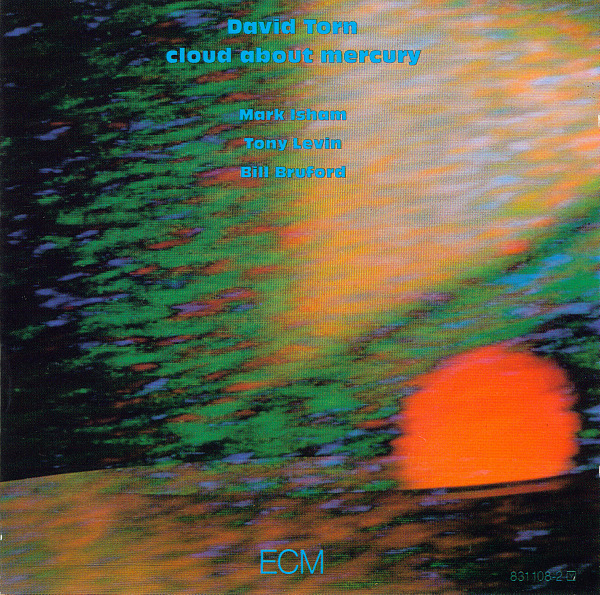
David Torn: cloud about mercury (ECM 1322)

David Torn
cloud about mercury

David Torn guitars
Mark Isham trumpets, synthesizer
Tony Levin bass
Bill Bruford drums, percussion
Recorded March 1986 at Audio International, London
Engineer: Andy Jackson
Produced by Manfred Eicher

Guitarist David Torn defines jazz fusion, proving that the genre is more than add and stir. With cloud about mercury he made his most personal statement to date. The album sounds like many things: a sweep of Steve Tibbetts dimensions, a Jon Hassell think piece, a tree with many cultural branches, a spider’s web in sound. Torn roams freely throughout these territories, shouldering a vast load of thematic material. The opening wash of heaven that is “Suyafhu Skin…Snapping The Hollow Reed” condenses much of that material, letting fall a quiet storm of continental activity. Detuned guitars and a bubbling synthesizer part the way for Tony Levin’s grounded bass lines and trumpeter Mark Isham’s sustained flights, while drummer Bill Bruford chases after, somehow keeping pace. Next is “The Mercury Grid,” another engaging rhythm piece that boasts Isham in a Molværian mode. Torn flexes acrobatically here, swinging from every branch of this sonic corridor. The curiously titled “3 Minutes Of Pure Entertainment” is a mid-tempo groove that again features soaring guitar. Torn’s fractal precision speckles “Previous Man,” which begins with two guitars before engaging drums and synth bass in staggered syncopations. The likeminded “Network Of Sparks: The Delicate Code” sets off an intriguing chain of electric events, all the more enigmatic for their brevity. Which brings us to “Network Of Sparks: Egg Learns To Walk…Suyafhu Seal,” a warm, gelatinous mosaic that slices the night into ribbons like light through a window blind, rendering empty space into a virtual stairway by curls of cigarette smoke.

cloud about mercury represents a pinnacle of Torn’s craft and is must-have for the adventurous.

<< John Abercrombie: Getting There (ECM 1321)
>> Gavin Bryars: Three Viennese Dancers (ECM 1323 NS)

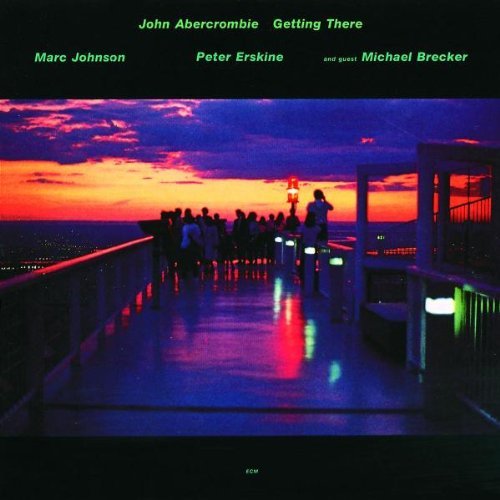
John Abercrombie: Getting There (ECM 1321)


John Abercrombie
Getting There

John Abercrombie electric and acoustic guitars, guitar synthesizer
Marc Johnson bass
Peter Erskine drums
Michael Brecker tenor saxophone
Recorded April 1987 at Power Station, New York
Engineer: James Farber
Produced by Lee Townsend

This trio—consisting of John Abercrombie on guitars (still favoring synth treatments at this point), Marc Johnson on bass, and Peter Erskine on drums—was one to be reckoned with in the 80s. Getting There seems, like many of ECM’s dates from the decade, to have been overlooked by many, but its rewards are plentiful. All the more so for the presence of saxophonist Mike Brecker, whose buttery tenor graces a smattering of its tracks. First and foremost among these is “Sidekicks.” This fishhook of a tune reels us into the album’s sweep, sped along by Erskine’s anthemic drumming and Johnson’s springy lines before ending on a classic fadeout as Brecker careens into outer space. “Remember Hymn” is another Brecker-heavy capsule of nocturnal medicine. With wondrous lyricism, the group constantly reforms itself here in one of the frontman’s finest. Marc Johnson spikes the compositional punch with “Furs On Ice”—one of only two non-Abercrombie tunes on this set (the other being Vince Mendoza’s “Thalia,” which finds Abercrombie in a Metheny mode)—lays down a smooth groove for Hammond organ-like chording and Brecker’s smooth emotive pinwheels. Abercrombie glows in his solo, drawing his electric sound like a dull razor across the stubble of time. Speaking of which, “Upon A Time” gives us plenty, taking the trio form down memory lane as Abercrombie’s fingers squeak along the fret board like birds.

This album is also marked by thoughtful choices in distortion and amplification, as exemplified in the title track, in which Abercrombie lets fly his laser-honed melodies, burning like a welding torch in a silent film. Erskine is epic on this cut. “Chance” brings a more delicate body language to that same immortal circle, while “Labour Day” gives Johnson a turn at the helm over Erskine’s precise brushes before Abercrombie returns for his most spirited solo yet.

Abercrombie has a tendency to catapult his notes, sending listeners on clean, high lobs. These are some of his brightest, not least because of Lee Townsend’s sparkling production. And in the company of such comparably strong wings, this flock can do no wrong. This is captivating music-making that welcomes us into the joy of musicians at the peak of their expressive powers.

<< Paul Bley: Fragments (ECM 1320)
>> David Torn: cloud about mercury (ECM 1322)

Paul Bley: Fragments (ECM 1320)

Paul Bley
Fragments

Paul Bley piano
John Surman soprano and baritone saxophones, bass clarinet
Bill Frisell guitar
Paul Motian drums
Recorded January 1986 at Rainbow Studio, Oslo
Engineer: Jan Erik Kongshaug
Produced by Manfred Eicher

Of all the chamber jazz experiments perfected by Paul Bley over the years, Fragments is arguably his most profound. This fascinating date finds Bley in the studio with reedman John Surman, guitarist Bill Frisell, and drummer Paul Motian. The pianist pens two pieces here. First is “Memories,” which opens the set and features the burnished sound of Surman’s bass clarinet against Bley’s spindly keys and Frisell’s insectile drones. A soothing and get-under-your-skin kind of track, it breeds a unique power, one that creaks into the bones of the album’s remainder like an oncoming winter. On the flipside is “Hand Dance,” which sounds more like a Motian piece and holds tight to its thematic cliff, never looking down. “Monica Jane” (Frisell) is like the rings of Saturn: separate yet one. Motian’s slow tumble carries us over into every new phrase with delicacy. The composer finally comes out of the woodwork with this one, varnishing his own brand of knotted grain.

“Line Down” (Surman), aside from sporting a pun of Wheelerian proportions, is an even freer tracing of incendiary threads, roped across vast differences yet never breaking. Surman proves yet again why his baritone is unmatched, twisting in and out of all manner of pretzels before sailing into Frisell’s ports of call. Two ballads by Carla Bley lower us into those same nocturnal waters. The bass clarinet swims like a beluga whale through “Seven,” Frisell spiraling around it like dolphin song. “Closer” crawls at its own pace, touched by the guiding hand of history. What else can it be closer to but closeness itself, in which music breathes like fragrance in spring’s last gasp?

Paul Motian counters with two numbers. “Once Around The Park” focuses the lens a little further. Dipped again in the bronze of Surman’s baritone, it sings darkly while Bley’s fingers press the keys like footprints into sand. The conversation continues in “For The Love Of Sarah,” a harmonic duet for baritone and guitar. Combined, these two otherworldly energies make something touching and familiar.

Last is Annette Peacock’s “Nothing Ever Was, Anyway,” a breeze through dying leaves that carries with it the voices of memory with which the album began. It ends on a dark and quiet chord, dropped like a feather on the surface of our slumber.

While it may not be to everyone’s liking, for me Fragments is a pinnacle of ECM production, musical language, and sheer depth of commitment to every moment it documents. Another personal Top 10 candidate and perhaps the most haunting album on the label. I encourage you to let it speak to you.

<< Masqualero: Bande À Part (ECM 1319)
>> John Abercrombie: Getting There (ECM 1321)

Masqualero: Bande À Part (ECM 1319)


Masqualero
Bande À Part

Arild Andersen basses
Nils Petter Molvær trumpet
Tore Brunborg saxophones
Jon Balke piano, synthesizer
Jon Christensen drums, percussion
Recorded August and December 1985 at Rainbow Studio, Oslo
Engineer: Jan Erik Kongshaug
Produced by Manfred Eicher and Masqualero

Masqualero was the Arild Andersen Quintet by another name, a name that both tipped its hat to Wayne Shorter while casting its gaze toward a future that was decidedly Andersen’s. Note the formidable cast of up-and-comers: Nils Petter Molvær on trumpet, Tore Brunborg on saxophones, and Jon Balke on keys. Add to that Jon Christensen on drums, and one can hardly go wrong. Andersen himself flexes his compositional muscles on three cuts, filling each with his depth of tone. Yet his presence is, as ever, non-invasive, and allows a porous democracy to seep through. The skipping snare and soaring trumpet of “3 For 5” throw a lacy net over Balke’s gorgeous strains, leaving us buffed for the varnish of “Natt.” In this we find one spiral after another, sliding down the throat of the freely improvised “Sort Of” before cresting on the wave of “Vanilje.” Andersen digs deep for this one, excavating cloudy jewels of wisdom. Balke’s “Bali” is especially moving and finds unity in Brunborg’s horn. A rolling drum solo closes this frenetic weave. Christensen throws his compositional hat into the ring with “Tutte,” a stretch of arco strains and slow tumbles. Molvær does likewise with “No Soap (A Jitterbug Jamboree),” another stunner that glows at the edges. “Nyl,” Balke’s other offering, draws a protracted groove, indicated by bass and then set free into an expanse of vocal energy.

The strength of Bande À Part lies in the writing, ever rooted in the soil of reflection. Andersen’s is a sound-space where we may float or lie prone as we see fit, laughing and crying in the same breath. An essential release for Andersen enthusiasts that speaks to the heart of his craft.

<< Stephan Micus: Ocean (ECM 1318)
>> Paul Bley: Fragments (ECM 1320)

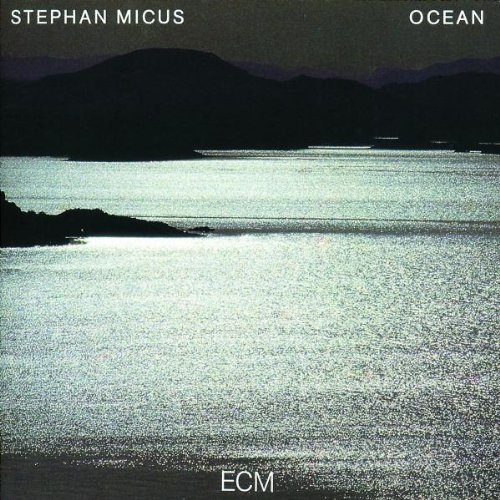
Stephan Micus: Ocean (ECM 1318)


Stephan Micus
Ocean

Stephan Micus voice, sho, nay, shakuhachi, Bavarian zither, hammered dulcimer
Recorded January 1986
Engineer: Martin Wieland

Stephan Micus is more than the sum of his parts. The German-born multi-instrumentalist has done that rare thing: absorbed rather than pilfered a wealth of musical traditions and means and molded from them an entity all its own. As one of his earlier recordings for ECM, Ocean is a tinted window into an artistry of full-blown brilliance. Part I opens with his unaffected, wordless incantation before opening into a flower of hammered dulcimers. As the mournful cries of the nay replace his voice, it is as if the bodily has become breath incarnate, airing out its gentle patchwork of sound in a breezy sky, while meditations rise like pedestals beneath souls. The shō (Japanese mouth organ) opens Part II, treading its feet upon cloud, every step forward an exhalation, every step backward an inhalation, such that one remains poised on the brink of falling. From this congregation of threads arises a shakuhachi, unspooling in reverse, its fatigued song but a dream on a wistful day. Zithers enter in with their skittering rhythms, fluttering like the wings of some vast diurnal insect whose wing covers are its feet, and for whom landing is but a memory of a past in which humans never spoke. In the opening dulcimer meditation of Part III, we feel the kinship into which Micus so profoundly invites us, a promise of stillness in its embrace. The shakuhachi whispers its secrets across the waters, ending in a delicate waterfall, a lifetime’s worth of tears compressed into a single fade and pooled in the cupped hands of silence. Part IV ends (or does it begin?) with a moving shō solo, which turns like a crystal spun from Philip Glass-like filaments and melted by body heat into a fluted garden, churning with the song of every earthworm below.

Micus lets unfold a territory so personal that it becomes selfless, somehow unmarked the human elements of its creation. In his playing, names, labels, and covers, even personages and politics, cease to matter. The only restriction is its very lack. Such music goes beyond the pathos of meditational action, looking into the soul of stillness, where only music can express that which all the languages of the world, lost and extant alike, never could. Their cage is not one that surrounds us but one we surround with the promise of creation, waiting with closed eyes and open hearts.

<< Keith Jarrett Trio: Standards Live (ECM 1317)
>> Masqualero: Bande À Part (ECM 1319)

John Abercrombie: Current Events (ECM 1311)

John Abercrombie
Current Events

John Abercrombie guitar, guitar synthesizer
Marc Johnson bass
Peter Erskine drums
Recorded September 1985 at Rainbow Studio, Oslo
Engineer: Jan Erik Kongshaug
Produced by Manfred Eicher

Current Events marks an incubatory period of sorts for John Abercrombie. The evolving guitarist found willing collaborators in drummer Peter Erskine and bassist Marc Johnson, both of whom decorated his synth-heavy experiments with bold care. Erskine excels in the more upbeat numbers, bringing sparkle to “Clint” and to an all-acoustic version of “Ralph’s Piano Waltz” (see Timeless and Towner’s Solo Concert for reference). The ghostly intro of “Alice In Wonderland” wings into a free-flowing liquid of a tune that will tug at your childhood. Each touch of cymbal is a splash and the bass a slinking amphibian making its way to the present with a jewel of remembrance in its mouth. The loving acoustic solo “Lisa” segues into “Hippityville,” which somersaults along Abercrombie’s electronic ladder. “Killing Time” (exactly what this album doesn’t do) modestly titles a shimmering veil of slumber, carried into wistful awakening by declarations from the trio in full. Last is “Still,” a carpet for Johnson’s lumbering gait and the shimmering cellular network of Abercrombie’s acoustic. Sharp and gorgeous.

This is for the most part a subtle album, though it does possess its fair share of catharses, and promises new returns every time. Like the last track, it slides into your soul before you know it, making it one of Abercrombie’s most enjoyable dates.

<< Chick Corea: Trio Music, Live In Europe (ECM 1310)
>> Miroslav Vitous: Emergence (ECM 1312)

Jan Garbarek Group: Wayfarer (ECM 1259)

Jan Garbarek Group
Wayfarer

Jan Garbarek tenor and soprano saxophones
Bill Frisell guitar
Eberhard Weber bass
Michael DiPasqua drums, percussion
Recorded March 1983 at Talent Studio, Oslo
Engineer: Jan Erik Kongshaug
Produced by Manfred Eicher

The Jan Garbarek Group has ever been among ECM’s more formidable. Its winning inclusion of bassist Eberhard Weber ensured a fluid foil to Garbarek’s scalpeled lines. The brief tenure of guitarist Bill Frisell made that balance even more promising. That being said, Wayfarer tends to meander as much as its eponymous protagonist, although who’s to say this wasn’t the intention. Gone is the full-on dreaminess of Paths, Prints. In its place: a session that walks in a half-sleep through picturesque territories without ever really looking at them, never quite knowing which reality it is committed to. Drummer Michael DiPasqua gives us hope in the inaugural “Gesture,” carrying over the cymbal rides one misses in Jon Christensen’s absence, but his surroundings only seem to wander in circles. “Gentle” is another case in point, though Weber manages to enliven this piece into something beautiful. At ten and a half minutes, “Pendulum” is the album’s central epic and gives Frisell plenty of room to stretch. But the ponderousness wears thin, and one loses sight of the destination. Likewise, “Spor” seems more like a studio warm-up to something that never made the final cut. The album’s reigning exception is the title track, which from a brooding crawl through dimly lit catacombs bursts with DiPasqua’s incredible frenzy as Frisell sharpens his axe along the periphery. It also gives us a taste of the old Garbarek.

Despite occasional flashes of brilliance and fine musicianship all around, the themes on Wayfarer are relatively weak and don’t seem to add up. In my journey through ECM’s back catalogue thus far, this is the only Jan Garbarek Group album I would hesitate to recommend. This may be one, however, to grow with time.

<< Oregon: s/t (ECM 1258)
>> Chick Corea/Gary Burton: Lyric Suite For Sextet (ECM 1260)

Chick Corea: Trio Music, Live In Europe (ECM 1310)

Chick Corea
Trio Music, Live In Europe

Chick Corea piano
Miroslav Vitous bass
Roy Haynes drums
Recorded September 1984 in Willisau and Reutlingen
Engineer: Martin Wieland
Produced by Manfred Eicher

In 1983 the Keith Jarrett trio was just getting on its feet. That shadow would prove to be a difficult one to step out of in the coming decades. But if anyone could have thrown a light onto it, it was Chick Corea, who, along with bassist Miroslav Vitous and drummer Roy Haynes, emoted a live recording for the ages. Corea seems to have done much soul searching in the 70s, and on this set one hears his chrysalis crackle with uncontainable vivaciousness. After his warm intro, “The Loop” kicks off the band’s deep combinatory powers with fortitude. Vitous is a joy to experience, his rich, oblong sound surrounding us like a wooded glade, brought to the life by the rustlings of Haynes’s snare and the trickling sunlight of Corea’s keys. “I Hear A Rhapsody” cocks its ear toward rapture. Lost along the winding staircase of its motive, it is a while before we realize these musicians have been keeping us in sight all along. We are reminded of this with every shift, and in the way Corea draws Haynes into whimsical conversation. “Summer Night / Night And Day” gives us the album’s first double-header, Vitous fluttering his wings in ways few others can. From this upbeat wonder, the trio transitions seamlessly into its inverse, seeming to fill every gap in the former’s carving with glorious relief. The second double-header tears a page from the Scriabin playbook with “Prelude No. 2,” making for one of Corea’s most beautiful stretches of internal life ever committed to disc. This bleeds into the staggered breathing of “Mock Up.” Vitous solos us through “Transformation,” while “Hittin’ It” pours the light on Haynes. Eicher has done us a service in including these, for, as so often happens in jazz recordings, long solos are either cut or curtailed. Yet here they are fully fledged elements in the album’s molecular pathways. We end on “Mirovisions,” which writes an arco bass across soaring pianism before diving hawk-like into the Valley of the Groove. A colorful unraveling follows, marked by flashes of buoyancy against a thoughtful backdrop.

A perfect album from Alpha to Omega, this is one of ECM’s finest and a delightful new addition to my Top 10. Invigorating to the last.

<< Dino Saluzzi: Once upon a time – Far away in the south (ECM 1309)
>> John Abercrombie: Current Events (ECM 1311)