Alexander Knaifel: Svete Tikhiy (ECM New Series 1763)

Svete Tikhiy

Alexander Knaifel
Svete Tikhiy

Keller Quartett
András Keller
 violin
János Pilz violin
Zoltán Gál viola
Judit Szabó cello
Oleg Malov piano
Tatiana Melentieva soprano
Andrei Siegle sampler
In Air Clear and Unseen recorded October 2000 at Radio Studio DRS, Zürich
Engineer: Peter Laenger
Svete Tikhiy recorded1994/95 at Film Studio Lenfilm and 1997 at St. Petersburg Recording Studio
Engineers: Mikhail Shemarov, Victor Dinov, and Andrei Siegle
Produced by Manfred Eicher

Nature is not as you imagine her:
She’s not a mold, nor yet a soulless mask—
She is made up of soul and freedom
She is made up of love and speech…
–Fyodor Ivanovich Tyutchev (1803-1873)

For its first conspectus of St. Petersburg-based composer Alexander Knaifel, ECM presents  Svete Tikhiy (O Gladsome Light). Side by the side, the program’s two works—each a triptych—seem vastly different in scope. And perhaps they are on the surface. But they are also part of an ongoing braid of interest on the part of the composer in what is lifted from the score and held in the spirit of the performers to whom he entrusts interpretation: in essence, the reading of the word. For this recording, the word comes to us both lower- and uppercased.

The former flexes its waking hour throughout In Air Clear and Unseen (1994) for piano and string quartet, peeking from behind the Orthodox veil through which Knaifel’s music is often so diffused. Steeped in the poetry of Fyodor Tyutchev, each tableau reads through gestures of slowly measured time. “In Some Exhausted Reverie” begins in Silvestrov-like fashion: with a piano postlude. It touches the ether with a delicacy so organic it almost falls away by merely being gazed upon. Its stillness may be illusory, but the potential emotional connection it makes with the listener flows into the ribcage and finds room to conform.

If encouraged to compare, one could cite Pärt’s Alina as an analogous atmosphere, if only for its breathing room. Distinct here is the feeling of something titanic, as if an entire history were being grappled with in a single note. All of which makes the opposite point: that there is never just one note, for each is a combination of many more, and those of still others. The air is unseen, yes, but it can be felt. It is a field of touch. Hence the tactility of Knaifel’s performers, whose own lives are filtered through their contact with the music. Instructed as they are to intone that which is ultimately “unvoiced,” the instrumentalists embrace each living moment with their entire being, itself a resounding instrument of warmth and illumination.

The central section, “An Autumn Evening” (for string quartet), finds a more distant analogue to the music of Tavener, whose The Last Sleep of the Virgin is also of Byzantine cast (and, coincidentally enough, composed the same year as the accompanying work on this disc). The lucidities of both shimmer in slow motion. Unique to Knaifel’s aesthetic is the unity of the assembly: the quartet is one flesh, a portrait of humanity drawn through what he calls “chain breathing.” The combination becomes something of a filter through which death renews life. It is the dreamed-of ribbon still in hand upon waking. The final section marries these two impulses, pulling childhood memories like a hood against blasphemy and lighting many candles from a single, originary flame.
The title composition, Song of the Most Holy Theotokos, is composed for soprano Tatiana Melentieva and sequencer. The eponymous hymn, which appears only at the end of the piece, is among the oldest Christian hymns, a folding of light into Christ and both into the world. It is force of life, but also agency of solace. Here the self-reflexivity of the replenished soul is expressed in the electronic manipulations and multi-tracking of Melentieva’s voice. The result is a ponderous, overtly crafted chorus of the self, giving way to echoing caverns of implosion. These, in turn, impart life to the openness of God. From mantra-like quivers and resonant tongues to the rounded grace of the central unaffected voice, it turns lullabies into dust and dust into starlight. And as the final fragments blur skyward, worship becomes a shroud for the ears.

On the whole, Svete Tikhiy is also a master class in engineering. Were the content not afforded the spaciousness it deserves, its inner voices might never reach us. This is not to say that technology adds something not already there, only that it brings out inherent tendencies toward infinite expression. The echo becomes a primary signifier of its referent, but also something more: a reference in and of itself to yet another echo, ad infinitum.

<< Anders Jormin: Xieyi (ECM 1762)
>> Seim/Brække/Johansen: The Source and Different Cikadas (
ECM 1764)

Skimming the Lake: A Conversation with ECM’s Undercover Producer

Put on an Evan Parker record. Now, put on a Hilliard Ensemble record. The difference is huge. Or is it? Such a question is both arbitrary and fascinating to consider. On the one hand, our fetishistic relationship with genre already precludes the possibility of approaching such disparate streams as anything else, while on the other we may just as easily ignore the perlocutionary category as a means of liberating ourselves into some universal sonic experience. The truth is far simpler than this quandary would suggest: The impulse that moves them is one and the same.

Such philosophy should feel like old hat to the veteran ECM listener, a listener who presumably understands the value of softening boundaries, if not sidestepping them altogether—surely a characterization befitting of a label that has forever changed the modern soundscape with its seriousness, integrity, and artfulness. At the same time, through the heart of it all has run an electric, vivacious, and at times whimsical thread. In the latter vein we have musicians like the late Hal Russell, whose latter-day documents are particularly enjoyable flings with a life-affirming timelessness. It is for these and more that we can thank Steve Lake. Having been a public voice of ECM for decades, the prolific wordsmith and former journalist has also moonlighted as a producer of striking vision and taste. Would we know the Maneris or the Russells of this world without him? I dare say some of us would not. From the Trevor Watts/Moiré Music Drum Orchestra collaboration A Wider Embrace to, most recently, Judith Berkson’s Oylam, the depth of his interests can be matched only by the label on which his productions have found a stable home.

My first encounter with Lake the producer was by way of the Joe Maneri Quartet’s In Full Cry. A perplexing yet mesmerizing experience, and one that took some years of investigative listening to worthily parse. Yet once I had learned to diagram the peerless language it was espousing, there was no turning back: by then I was caught in its web. It is in this vein of shared appreciation for hermetic talent that I began a conversation with Mr. Lake as a means of unfolding the hidden contributions he has over the years so selflessly brought to light.

Tyran Grillo: How would you describe artists such as Hal Russell, Joe/Mat Maneri, and the Bley/Parker/Phillips trio (personal favorites among those you’ve produced) to those who have never heard them?

Steve Lake: Independent spirits. Mad inventors. Geniuses.

What were your gut reactions when you first encountered these visionaries?

I have to go back a very long way to try and recall. The Bley/Parker/Phillips trio was formed in the studio to record Time Will Tell in 1994, but I’d known the three participants much longer. I’ve been listening to Evan Parker’s music, for instance, for 45 years, and bought his first recording, Karyobin with the Spontaneous Music Ensemble, while still a school kid. I was hungry for the strangest stuff available and luckily there was no shortage of it in the late 1960s. This meant, however, that I heard a lot of free jazz before listening closely to the unfree variety, which I found harder to follow at first. To naive and inexperienced ears, bebop could seem more cryptic than the collective sound-and-texture explorations of the free players.

I can sympathize with this. I also entered jazz through the back door, so to speak: starting out with John Zorn, Anthony Braxton, and Peter Brötzmann, not to mention the wealth of European artists introduced to me via ECM—Barre Phillips comes to mind—before ever stepping foot into a Duke Ellington joint. By no means a regression, of course, but certainly a new direction for me with its own learning curve.

Barre Phillips’s solo bass album Unaccompanied Barre on the Music Man label amazed me with its inventiveness…I used to listen to it on my little Dansette LP player until practically hypnotized by it. I loved Barre also in The Trio with John Surman and Stu Martin, one of the greatest groups of the late 60s/early 70s. Their double-disc white album was better than the Beatles’.

Evan Parker I checked out every chance I could. I’ve heard him play so often that I’m no longer sure what the first occasion was—I think probably in duo with John Stevens, around 1968. When I lived in London I’d see him play several times each month in contexts from the joyfully leaping African jazz of Chris McGregor’s Brotherhood of Breath to the confrontationally experimental duo with Paul Lytton—like two dervishes whirling in a junkyard—to a casual ad hoc gig in a pub somewhere, usually with John Stevens involved. Evan made artistic decisions to focus on specific sound areas in his own work, but he can play anything.

Paul Bley I first heard on his most uncharacteristic recordings, the ones where he’s doing battle with early analog synthesizers while Annette Peacock purrs suggestively through a ring modulator. Who wouldn’t appreciate that? John Stevens insisted I listen to specific Bley trio albums, and bought me a secondhand copy of Footloose with Steve Swallow and Pete La Rocca at the Record & Tape Exchange shop in Notting Hill. And Evan made me aware of the Jimmy Giuffre Trio with Bley and Swallow. I remember listening to Free Fall for the first time in his house in Twickenham in the early 70s. This gentler end of the free spectrum which the Bley and Giuffre trios represented was scarcely talked about in the music press at that time, but Footloose and Free Fall were key records for a number of London musicians. Big influences on Manfred Eicher and ECM, also, as I later found out.

When the Jimmy Giuffre Trio was revived and played some gigs in Germany in 1992, I went to a few of them, and spent some time talking to Paul Bley. Or the other way around—Paul is the master talker, a man of few notes and many words. Turn on your tape recorder and Paul can effortlessly talk you a book (several such available already on Amazon). In the course of his soliloquies he said several times that the only genuinely new music he’d heard in decades was being made in Boston by an elderly sax-playing professor whose son accompanied him on electric violin. Of course this made me curious. Did they have any records out? “No.” After some months I was able to get a tape from Radio Canada of a Bley concert in Montreal where Joe and Mat Maneri had joined Paul for a set. It was a very odd performance and obviously polarized the audience. Boos amongst the cheers on the tape, always a sign that something lively is happening. But it took me a while to make up my mind about it. The Bley/Maneri team-up wasn’t entirely compatible musically and the Maneris were so unlike anything else in improvisation it was as if they’d beamed themselves down from the moon. I breathed the air of another planet, and was puzzled.

The Three Men Walking trio was born out of email exchanges with guitarist Joe Morris. Morris and Mat Maneri had been playing together and father Joe jammed occasionally. I said make it a band and maybe it could be an ECM album. Morris sent some really promising rehearsal tapes which completely convinced me and helped persuade Albert Mangelsdorff to bring the trio to the Berlin Jazz Festival, where they made their debut. That was a fantastic break, and gave us the opportunity to take the group into the studio while they were in Europe. Live, Joe Maneri’s personal charisma overrode the superficial “difficulties” of the music: he sort of charmed and loved the audience into submission, irrespective of their views on microtonal improvising. A beaming Buddha with a saxophone.

Hal Russell caught me by surprise. I didn’t know him or the NRG Ensemble until their Moers Festival appearance in 1990, where they played before Einstürzende Neubauten. My first thought, looking at Hal in his business suit and Mars Williams in his psychedelic cowboy regalia, was: “This can’t possibly be a band,” but they were terrific. I hadn’t encountered a comparable combination of anarchy and humour and tightness and typhoon-strength free blowing since the heyday of the Willem Breuker Kollektief.

What do we lose sight of by shelving them under “avant-garde” or some such category?

I don’t know. What do you think? My favourite musicians don’t always fit too neatly into the genres yet we need I suppose some kind of approximate shorthand terminology to be able to talk about the stuff at all.

Yes, practicality typically wins out over idealism. As I see it, the term “avant-garde” is a double-edged sword. It pigeonholes its referent as being on the outside, and therefore “abnormal.” As such, it becomes at worst an annoyance, better a guilty pleasure, and at best a way of life. “Experimental” doesn’t seem to do the trick, either. Both terms fall flat for their inability to magnify the physical process of, in this case, fringe music. An avant-garde art is an embodied art, and at its best one can feel that presence as if the listener (or viewer, reader, etc.) were a network of sympathetic strings. In any case, how has such music pushed and/or enhanced ECM’s evolution as a label?

I haven’t given it much thought. In my first period of work at ECM, 1978-1980, Manfred Eicher encouraged me to do some production for JAPO, ECM’s sister label. So I did, inviting artists including Howard Riley/Trevor Watts/Barry Guy/John Stevens, Takashi Kako, Elton Dean, Eddie Prévost/Keith Rowe, etc., and at that time I was concerned that ECM’s beginnings in free improvising should have a continuation. Early ECM records like the Music Improvisation Company album, Marion Brown’s Afternoon of a Georgia Faun, and Circle’s Paris Concert were important to me as a young listener. And I liked the idea of careful recordings of improvisation rather than rough and ready recordings which were and are the norm elsewhere. Somewhere along the line, though, I stopped worrying about it. ECM has always maintained an experimental component as part of the whole picture, with or without my particular efforts.

How would you characterize your role as a producer?

Mostly it’s been about helping a project towards a result, helping a musician get heard. It feels to me like a natural extension of my job as journalist. A step forward from writing “you have to listen to this artist” by doing something concrete to make his or her work available. But writing/producing/promoting all seems part of the same impetus—an expression of enthusiasm. I hope that the character of the musicians comes through on the albums; I’m interested in them as individuals, as well in their ideas about music-making—the two things are interwoven. I don’t have any overriding sound ideal. And although I have learned also by watching Manfred Eicher in action, I wouldn’t presume to try and imitate his work. As you know, he’s perpetually producing recordings. I can cheerfully go for years without any studio work. But then I’ll hear something special or unique and think, Oh this should really be documented. And off we go again.

When do you get involved, and when do you step back?

It differs. Generally, I get involved early, and step back late. Some projects have felt like campaigning for a cause. The Hal Russell and Joe Maneri projects, the Evan Parker Electro-Acoustic projects, and also the Robin Williamson projects all had this flavour for me. In the 1990s I had a little tour-booking agency with my then-wife Caroline Mähl, and we found gigs around Europe for Hal and NRG, the Maneris, Trevor Watts, Krakatau and others, just trying to put the word out there—this also was an extension of “production,” at least in my mind. For sure, the work doesn’t stop when the studio door closes.

In terms of involvement in the individual projects there’s been no pattern. There might be no preparation for a given session, while sometimes a production begins a year before we get to the recording. Or there might be a mixture of preparation and risk-taking. I think for instance of Robin Williamson’s Skirting The River Road, which is a particular favourite of mine. We’d already made the solo album based on Dylan Thomas texts (The Seed-at-Zero) and were looking towards another poetry-related project. Over a period of many months Robin was developing the idea of “poetry of visions” as a theme and we were both researching this. I was mailing big packages to Cardiff of poetry which I thought he might like to sing. Then it was narrowed down to three poets—William Blake, Walt Whitman and Henry Vaughan—inspiring and enjoyable reading, of course, and we made a pre-selection of text material. I assembled the band for the project—with Mat Maneri, Paul Dunmall, Mick Hutton and Ale Möller. Robin knew none of the musicians previously, and they didn’t know each other, and we all went to the Gateway Studio in Kingston in England, with Steve Lowe as engineer, and improvised. Everything fell into place. The whole process unfolded like a dream. There was instant rapport between the players, and top-flight creativity from the first moment.


Anders Jormin: Xieyi (ECM 1762)

Xieyi

Anders Jormin
Xieyi

Anders Jormin double-bass
Robin Rydqvist trumpet, flugelhorn
Krister Petersson french horn
Lars-Göran Carlsson trombone
Niclas Rydh bass trombone
Recorded December 17, 1999 at Artisten, Göteborg
Engineer: Johannes Lundberg
Produced by Manfred Eicher

The Chinese title of Anders Jormin’s Xieyi (寫意) means, literally, “to write one’s intentions.” It also names a style of ink painting. Both conceptions—the linguistic and the visual—adequately describe the Swedish bassist’s attempts to sing with his instrument. The result is a session of quiet drama that purges expectations in favor of in-the-moment expressivity. Emerging here on his own after successful ECM tenures with Charles Lloyd, Bobo Stenson, Tomasz Stanko, and Don Cherry, Jormin dips us into a unique world of robust tension, for what began as a solo bass project soon grew, at producer Manfred Eicher’s suggestion, to incorporate morsels for brass quartet. The latter begin, end, and dot the program with cellular interludes, each mobilizing a general reflective theme. These passionate, moveable cores constitute the printing press of all the verbal excursions that occur between them.

The accompanying CD booklet informs us that Xieyi was recorded in one swoop on a rainy December evening. Yet the music is anything but compressed or dank. Rather, it soothes with a warm respect for the many sources recalled at Jormin’s fingertips. From Sibelius to Ornette Coleman and Violetta Parra, Swedish tone poems to children’s songs and improvisations, the sequencing carries us through a globetrotting journey, crystallizing in that single instrument.

Jormin’s unpretentious ability to pluck out the melody behind the melody (listen, for instance, to his harmonic-infused take on Parra’s “Gracias a la vida”) establishes and upholds a strong corporeal presence. Rounded and emotionally descriptive, his musculature acts out every story at hand with interlocking grace. Like teeth biting the edge of a coin, it tests every note for its integrity. At times he folds private shapes from the mind’s origami paper (as in “Idas sommarvisa”), while at others he flings open notions of love like church doors to the world at large. The spontaneous notecraft of tracks such as “Decimas” and “Tenk” further connect ideas by dividing them, thus appreciating their individuality by means of an emerging collective effect. Animated gestures intertwine with winged reciprocation, marking time with glissandi and gaping sluices, through which the trickle of things melodiously passes…

Jormin presents two pieces by composer Stefan Forssén. “Och kanske är det natt” is the album’s most lyrical, a gnarled thing of beauty steeped in nature. “Sonett till Cornelis” is another gem, a recitation of invisible texts. Jormin then pairs his own “Scents” with the ornamental language of “Fragancia” by composer Evert Taube. Its slow trills and deep returns lend plenty of wonder to the scenery. And in that scenery the clearest figure takes shape in the jazz touchstone that is “War Orphans,” realized here with arco brilliance as a dirge of infinite wisdom under the close watch of finitude.

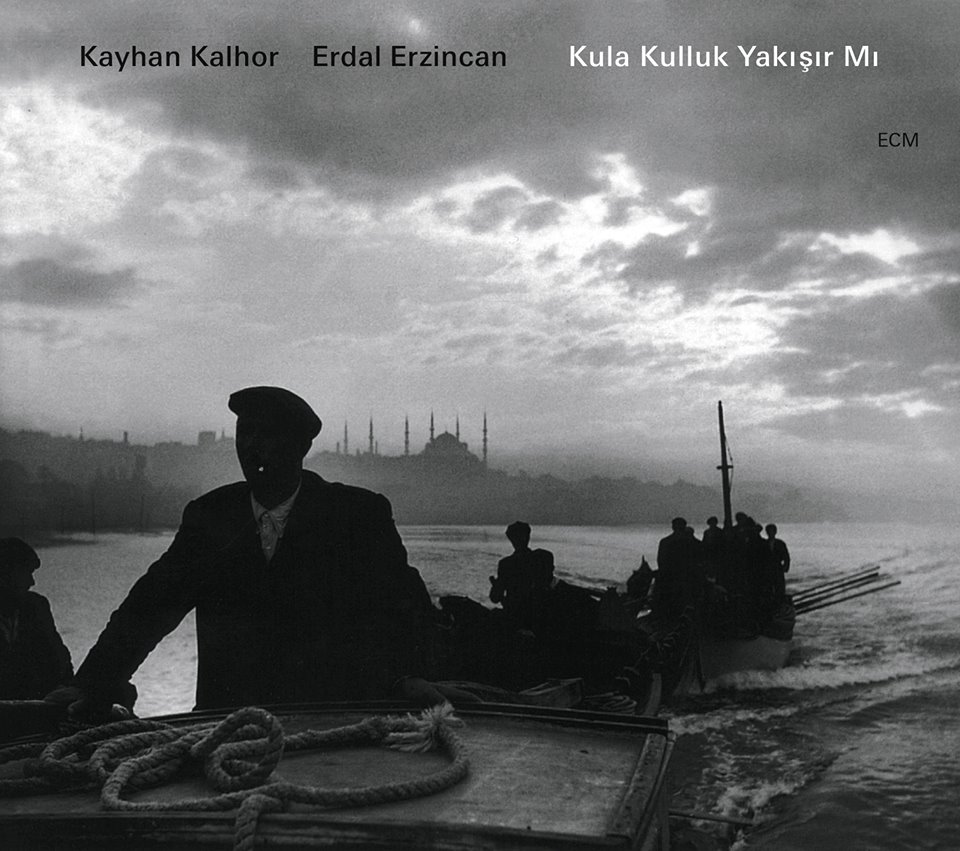
One look at the album’s cover should tell you what this is like: a swath of ever-changing monochrome across which hymns and songs leave their intermittent trail.

<< Harald Bergmann: Scardanelli (ECM 1761 NS)
>> Alexander Knaifel: Svete Tikhiy (
ECM 1763 NS)

Stephan Micus: Desert Poems (ECM 1757)

Desert Poems

Stephan Micus
Desert Poems

Stephan Micus sarangi, dondon, dilruba, doussn’gouni, kalimba, sinding, steel drums, shakuhachi, ney, sattar, flowerpots, voice
Recorded 1997-2000 MCM Studios

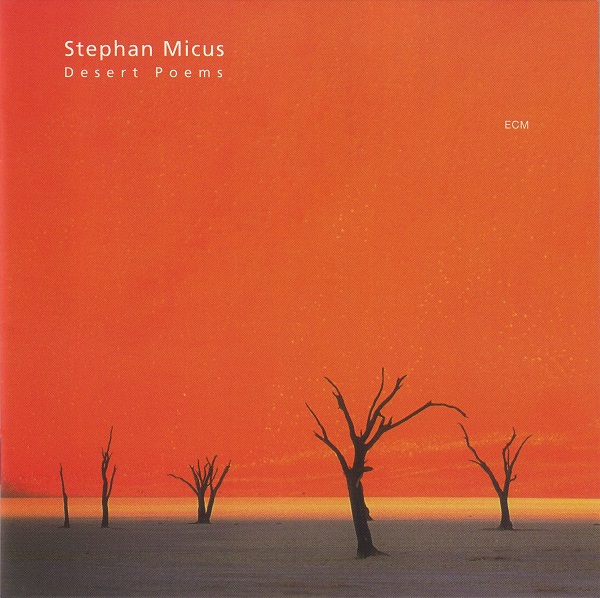
On Desert Poems, Stephan Micus’s 15th solo excursion, the intrepid musical sojourner introduces a few new actors to his already extensive roster of instruments: the doussn’gouni (West African harp), kalimba (Tanzanian thumb piano), and dondon (Ghanaian talking drum). These he nestles among more familiar veterans: his modified 10-string sarangi, dilruba (another bowed instrument from India), ney, and sattar (an upright Uighur fiddle). As always, Micus is attentive to the Janus nature of the instruments he touches. On the one hand each has a history, while on the other it enables new paths of expression. He embraces both as equals.

Characteristic histrionics speak of a thousand other worlds in “The Horses of Nizami” (for sarangi, 5 dondon, and 23 voices) and in “Mikhail’s Dream” (2 kalimba, voice, sinding, 2 steel drums, percussion). In these multi-tracked biospheres, a self divided becomes a self magnified and therefore needs its own language to breathe properly. Indeed, at Micus’s touch the sarangi body becomes a wooden lung through which a chanting chorus activates its array of sympathetic strings. Buzzing kalimba then glow with firefly steps, a ladder of light into the rising dune heat. Amid this flowering conference of souls, a single voice rises into, even as it drops down from, the ether and places its song on a fulcrum of memory and future paths.

The blood of this album’s earthly incarnation is purified by “Adela” (for 22 dilruba), for it speaks of a mirroring heaven in which all that has come to pass awakens to the possibility of a self-aware now. These sounds take human shape: a warrior walking upside down, feet treading sky, his horse long dead behind him, turned to cloud and dropping rain somewhere on more fertile land. With a grating pulse, he marks his footfalls by way of a dotted moon. By nightfall, only his afterimages remain, thrumming in the counterpart of “Shen Khar Venakhi” (6 dilruba, 6 sattar), a 13th-century choral piece from Georgia which Micus arranges in wordless tonsure.

“Thirteen Eagles” (doussn’gouni, 20 ney) and “For Yuko” (2 flowerpots, 8 voices, shakuhachi) share another soul. One is a blissful trek over land and under emotion that focuses purely on movement and shape, ney pleated many times over like feathers and free as heroines of the open sky. The other bears dedication to the performer’s daughter in a galaxy of nascent voices, hurtling through space along a trajectory of sentience and love.

If these are the internal organs, three solo tracks comprise the external features. The eyes flicker into being by way of “First Snow.” Although not a title one might expect amid all this warmth, the continuity is not lost. Its lone shakuhachi is an arid instrument. Cored and lacquered, it rasps like wind through wheat and digs through the soil with deeply grained fingertips. Its song dreams of water, and like the snow remains dry until the warmth of sun or living touch renders it fleeting. Lips speak in “Contessa Entelina,” a voice solo in English that is named for, and inspired by, a village Micus encountered while riding through the Sicilian countryside, and tells the story of a countess who provided solace to Albanian immigrants some centuries ago. This intimate portrait folds perfect divinity into the imperfect cage of human language and means. Ears listen in “Night,” a far-reaching doussn’gouni reflection that bears gifts from the heavens to the caverns.

Seemingly enamored with the same consuming silence of the desert that captured the heart of writer Paul Bowles, Micus translates the hidden energies of landscape into a form that escapes all measure of mortal grasp. World music? Perhaps. But not entirely of this one.

A selfless masterpiece.

<< Joseph Haydn: The Seven Words (ECM 1756 NS)
>> Dave Holland Quintet: Not For Nothin’ (
ECM 1758)

Larry Karush/Glen Moore: May 24, 1976 (JAPO 60014)

May 24, 1976

Larry Karush
Glen Moore
May 24, 1976

Larry Karush piano
Glen Moore bass, violin
Recorded May 1976 at Talent Studios, Oslo
Engineer: Jan Erik Kongshaug
Produced by Manfred Eicher

Bassist and Oregon cofounder Glen Moore joins pianist Larry Karush (who can be found lurking elsewhere on ECM as part of Steve Reich’s ensembles) in a fascinating encounter recorded on the titular date for the JAPO label. Perhaps because the two had already nurtured a deep synergy, what might have been a straight-up duo project instead turned into a spacious and variegated statement. Karush serves up four memorable solo portions, including opener “Untitled.” Balancing cloudy textures with sudden intakes of breath, it leaves only ash to tell of the fire that once burned there. “Transit Boogie,” on the other hand, is a forward-moving piece of ragtime nostalgia that delights in interlocking parts. “Vicissitudes” and “Pamela: At The Hawk’s Well” round out the solo ventures with introspections and intense descriptiveness. Moore’s single lone contribution is “Flagolet,” an overdubbed piece for bowed basses that grinds and twists its own sonic licorice.

“Duet,” the first in a handful of the same, marries these two uncompromising talents in such intuitive ways you’d swear they were separated at birth. Moore’s resonant bassing swims, keens, and prophesies at horsehair’s touch. Like a pinwheel tickled by the fringe of an incoming storm, his energies flourish in a whirl of colors. “Country” finds the bassist leaving deep pizzicato footprints along Karush’s sandy trail. The bluesy serration of this emerging path arcs beautifully into the late-night atmosphere of “Abstinence.” This masterful exchange of air and water finds likeminded release in “Triads,” which concludes with pointillist reflections at the keyboard from behind a David Darling-like gauze. The session’s crowning jewel, however, is “Violin Suite,” which places a smaller bow in Moore’s hands. Its flip-flopping of scratching and melodic itching makes for a sparkling field of contrast that pairs well with the Pifarély/Couturier vintage of Poros.

Sitting at a cerebral interstice between categories, Karush and Moore cover their cardinal bases and then some, leaving us in the end with one of the most wondrous JAPO sessions, period.

Claudio Puntin/Gerður Gunnarsdóttir: Ýlir (ECM 1749)

Ýlir

Ýlir

Claudio Puntin clarinet, bass clarinet
Gerður Gunnarsdóttir violin, vocal
Recorded 1997-99 at Radio Bremen, Sensesaal
Engineers: Dietram Köster and Christine Potschkat
Recording producer: Peter Schulze
Co-production ECM Records/Radio Bremen

Claudio Puntin and Gerður Gunnarsdóttir make their ECM debut with Ýlir, a musical portrait of Iceland utilizing a mixture of techniques, realities, and understandings of that fabled volcanic jewel. Gunnarsdóttir, a violinist and vocalist of eclectic professional associations, calls Iceland home, while clarinetist Puntin hails from Switzerland. The latter also possesses a wide-ranging talent across idioms, and has continued his association with ECM as a regular member of the Wolfert Brederode Quartet. As a duo, these partners operate under the moniker Essence of North, folding seamless improvisations into a batter of original and traditional material, but always with an ancestral taste on the tongue. The culmination of all this is a unique chamber recital of magical dimensions.

Puntin and Gunnarsdóttir seem most in their element when there are stories to be told. In particular, “Huldufólk”—literally “hidden people” but translated more colloquially as “fairies”—speaks to a world within a world, a world from which the duo draws its breath and feeds an interpretive grace back into the hollows. The piece takes shape in three divided parts. “Draumur” (Temptation) and “Tæling” (Seduction) each open a blank diary and inscribe it with mythological phonemes, a siren’s song in points and lines. Here, as elsewhere throughout, the clarinet embodies an unsuspecting Alice. The violin, meanwhile, slithers Cheshire-like across an outstretched branch, leaving a trail of streaking teeth and fur. “Hringekja” (Whirligig) finishes with a dance on a miniature scale, leaping up fungus steps and swinging from dripping leaves.

Evocative highlights include “Hvert örstutt spor” (Each Little Step), for which Gunnarsdóttir sings words by Icelandic writer Halldór Laxness, winner of the 1955 Nobel Prize for literature, as adapted by Darmstadt disciple Jón Nordal. This forlorn song for voice and bass clarinet closes our eyes in anticipation of “Sofðu unga ástin min” (Lullaby For An Abandoned Baby), a thrumming folk tune. “Kvæðið um fuglana” (Fantasy About Birds) is another visceral episode. This piece by Atli Heimir Sveinsson, a composer whose interest in folk music bears ripe fruit, positively glows in Puntin’s arrangement.

Whether the ebony drones of “Einbúinn” (The Ermite) and “Enginn láì öðrum frekt” (Contemplation), the Lena Willemark-esque excitations of “Peysireið” (Gallop), or the blend of near and far that is “L’ultimo abbraccio” (Last Embrace), there is much to explore in these vignettes. In the title track a pliant violin draws footpaths in snow (“Ýlir” means “winter”), joined by a clarinet that sings with memories of autumn. Like a bird caught in a blizzard, it ululates in the throes of indecision, thus giving melodious name to isolation. The yang to this yin comes with “Leysing” (Melting, Thaw), which sounds as if someone had placed a microphone inside a spring landscape and recorded its renewal. Through scrapings and lilting phrases, the musicians find a treasure trove of messages lurking below, just waiting to see the sky above and reach for it while they still can. In “Vorþankar” (Reflections On Spring), too, the harshness of winter is softened, glistening off icicles as if they were instruments, each a note with its own song to sing. Resonant and glassine, they waver at the edge of waking, like the lonesome goodnight of the “Epilogue,” a kiss forever locked on the lips of the moon.

All in all, this storybook journey peeks through the trees even as it uproots them, one microscopic tendril at a time, and with them strings a loom of thick emotions. Worth seeking out, if it hasn’t already sought you.

<< Eberhard Weber: Endless Days (ECM 1748)
>> Suite For Sampler – Selected Signs II (
ECM 1750)

Carla Bley: Trios (ECM 2287)

Trios

Carla Bley
Trios

Carla Bley piano
Andy Sheppard tenor and soprano saxophones
Steve Swallow bass
Recorded April 2013, Auditorio Radiotelevisione svizzera, Lugano
Engineer: Stefano Amerio
Produced by Manfred Eicher

As the first leader date by Carla Bley to appear on ECM, Trios is a benchmark event. Having populated the label’s satellite ventures—notably WATT and JCOA—for four decades, there was never any need to shelter the legendary pianist-composer from the rain under the parent umbrella, for her climate is her own and here brings a quiet storm. With bandmates Steve Swallow (electric bass) and Andy Sheppard (saxophones) she hands to the eager listener a thoughtful program of original material that crystallizes decades more of intuitive collaboration.

Bley notes the oddity, if not also the liberation, of recording in the presence of producer Manfred Eicher: “This was the first time in my life that I’d worked under the direction of a producer and I wanted to know what it was like, and what I could gain from it. He had some wild ideas—like starting with ‘Utviklingssang,’ which we’d normally play after a few fast numbers, or as an encore.” Indeed, caught in the spell of the album’s opener, one can’t help but feel welcomed by Swallow’s introductory embrace. Its shape is horizontal but its feel is aquatic, adrift in a vessel fashioned from hammers and reed. Bley’s unity with Swallow is the perfect seascape for Sheppard’s quiet Schooner. The latter’s tenoring is, by turns, unbreakable and thin as winter ice, at times hiding behind a veil of bare audibility, while Swallow’s tone is more rounded and resonant to the core. The Norwegian title of this lilting theme translates as “Development Song,” and is as apt a description as any of Bley’s compositional craft, for this and every piece that follows shows evolution internally and in combination with others.

Although it would be futile to single out any one musician above the others in such an intimate congregation, each player does have moments of peak clarity. Sheppard’s silken soprano, for one, enchants in “Vashkar” with fluid moon-bursts and leaping, yet never overextended, arpeggios. Lightly stitched by Swallow’s skeletal bass line, the unit builds methodical ascent into an attic of potent melodic storage. This is also the album’s oldest partition, well worn by ECM listeners from its appearance on 1975’s Hotel Hello, the classic duo session between Swallow and Gary Burton. As writer Paul Haines, of whom the titular Vashkar was a dear friend, once noted, “Swallow seems always to be playing from within the music,” and one need listen no further than “Les Trois Lagons” for evidence. This triptych of “Plates” draws its inspiration from a 1947 book of paper cutouts by Henri Matisse entitled, appropriately enough, Jazz. That these pieces achieve the album’s deepest traction is due in large part to Swallow’s effortless continuity, which keeps Sheppard’s effervescence from touching sky by holding it to roots. Even when Bley embraces the foreground for a little while, she cannot help but coax the ever-vibrant Swallow from hiding into an interactive fairytale. The central tableau emotes a club feel. One can almost feel the warmth of a glass-enclosed candle flame flickering at the center of a corner table while the din of conversation makes way for the rustle of clothing and nostalgic gazes. Melodically unfolded and deepened by Swallow’s pliant sensibilities into a cocktail of regret and resolution, it stretches the night as if it were made of muscle. The final section boasts a wondrous economy of expression from Bley. Her spiral staircase of block chords ushers in echoes from Swallow and Sheppard and brings dark inflections into light.

The album’s second threefold suite comes in the form of “Wildlife,” which finds the pianist enamored by her artful surroundings and shaded yet fertile atmosphere. Like a child lifting a fallen tree, it revels in the wealth of life squirming beneath. Some moments are bound to remind listeners of early Lyle Mays, simultaneously grounding and singing with unwavering insight. It is the pinnacle of the album’s many achievements.

Last but far from least is one final trilogy, “The Girl Who Cried Champagne.” What begins as a tender groove of introspective proportion turns into an excursion of great distance. With the regularity of ocean surf, Bley paints waves with her eyes closed and by this rhythm Swallow is inspired to adorn the ether with his curvaceous filigree. Along with Sheppard’s language, it forges a nonabrasive ebullience that flows without impediment until the reedman leads the trio with responsive brushwork to a halt, pitch-perfect and smiling.

Trios is the virtuosity of restraint personified and is played with a breeziness that speaks of immense experience and shared knowledge. The music enacts a logical, astute progression—from gas to liquid to solid—that is so open one can lie down and float comfortably into its spell. It’s a level of comfort and freedom that only the most heartfelt journeying can bring, and its first step touches earth the moment you press PLAY.

(To hear samples of Trios, click here.)

Trygve Seim: Sangam (ECM 1797)

Seim Sangam

Trygve Seim
Sangam

Trygve Seim tenor and soprano saxophones
Håvard Lund clarinet, bass clarinet
Nils Jansen bass saxophone, contrabass clarinet
Arve Henriksen trumpet
Tone Reichelt french horn
Lars Andreas Haug tuba
Frode Haltli accordion
Morten Hannisdal cello
Per Oddvar Johansen drums
Øyvind Brække trombone
Helge Sunde trombone
String Ensemble
Christian Eggen conductor
Recorded October 2002 and March 2004 at Rainbow Studio, Oslo
Engineer: Jan Erik Kongshaug
Produced by Manfred Eicher

Jazz is typically honed through interaction and a sense of shared community. One can also find in its heart a chambered, hermetic science. Trygve Seim’s Sangam validates both conceptions in a seamless infusion of liberatory and deferential impulses. As much a nod to Gil Evans as it is folk music of an undiscovered country, it is in some ways a “jazzier” album compared to its predecessor, Different Rivers, while in others it stretches the mold of that internationally acclaimed ECM debut to a larger yet no-less-defined shape. Accordion virtuoso Frode Haltli is a new voice in Seim’s milieu, as are clarinetist Håvard Lund and Cikada Quartet cellist Morten Hannisdal—all of whom contribute organically and without pretense to this program’s meditative and often astonishing sound.

More than ever, Seim’s atmospheres carry a cinematic charge in their subcutaneous circuitry. The fade-in comes with Lund’s bird-like solo. He introduces the title track with a call to unify, thus opening the brass choir as might the sun tickle the pollen from morning glories. A close-up on the film’s protagonist comes with the sweet, flavorful swing of “Dansante,” in which Haltli’s accentuations set up a handful of dramatic reveals. The camera seems to follow every footstep from childhood to adulthood in “Beginning an Ending.” Trumpeter Arve Henriksen provides the melodic lead, etching a runway for the soul. With these flight preparations underway, we feel ourselves swept up in the potential for winged existence. Hannisdal’s bow articulates a line of sight, a smoke trail fading in the sky like a healing scar, leaving bluest skin behind.

Conductor Christian Eggen (cf. a string of Terje Rypdal crossovers, including Undisonus and Q.E.D.) leads a string ensemble in the four-part suite “Himmelrand i Tidevand.” A film within a film, it acts as a talisman for the surrounding material. The subterranean whispers of Part I trace a sister song to Górecki’s Third Symphony in its upward expansions. Whether or not the similarity is conscious, its effect is strong. Seim’s eastward predilections come fully throated in Part II, emoting flexibly against the drone. Henriksen glows again in Part III through terrain of creek and glen. He guides a poised art from Point A to Point Z. At this point, if not already, we realize something cosmic is going on here as Haltli and Nils Jansen (on bass saxophone) point their telescopes toward a supernova’s quiet domain. Part IV gives us the end-title sequence, tranquil and smooth.

Returning to the narrative proper, a breathy “Trio” spawns quiet reflections from drummer Per Oddvar Johansen. Deeper brass tightens its emotional resolve in the face of impending doom, a gaseous planet in mourning. Hands come together in the concluding (but not conclusive) “Prayer,” a jewel of strings that lifts us beyond the pale of our emotional boundaries. Haltli’s bellows remind us of our earthly lives while brushed drums rustle like the leaves of Heaven: a foundation broken, dissolved, and washed down a throat of silence.

<< John Surman/Jack DeJohnette: Invisible Nature (ECM 1796)
>> Morton Feldman: The Viola in My Life (
ECM 1798 NS)