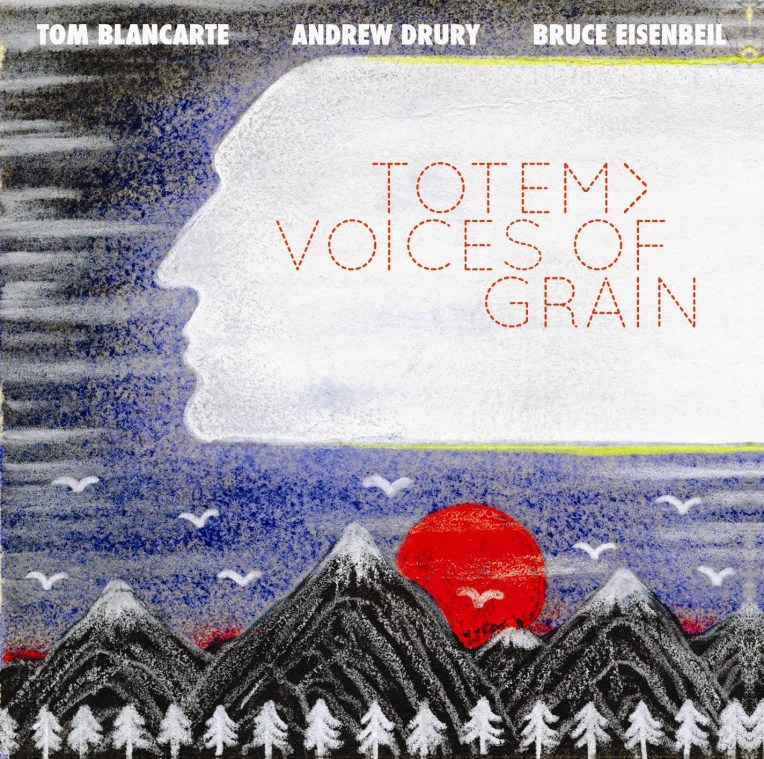
 In his seminal essay “The Grain of the Voice,” French philosopher Roland Barthes asserts the failure of language to interpret music for the precise reason that language and music are one in the same. Needing no self-projection to justify its existence, music is a signifier without identity that expresses its materiality by what he calls the “grain.” During a recent interview with between sound and space, guitarist Bruce Eisenbeil, who alongside bassist Tom Blancarte and drummer Andrew Drury is part of the free improvisation triangle known as TOTEM>, explains the importance of the grain in a mode of sonic production that may seem far afield of its roots but which in fact burrows past them: “The history of what I’ve been involved with, which is jazz-based, brought me to these sounds. When I look at the music of, for instance, of Cecil Taylor, John Coltrane, and Albert Ayler, and how each had his own musical influence—for Taylor it was classical; for Coltrane, world music; and for Ayler, folk—as a springboard for improvisation, I see those same influences in my own evolution. All of this and more, including contemporary classical music from the second half of the twentieth century (Xenakis, Reich, Lachenmann, etc.), has made me realize that playing guitar is in large part about imitating my own environment. It’s not unlike a child who acquires language just by being around family members and learning to communicate. For me, it’s as simple as that. I take everything I’ve ever heard or experienced and pass it through my filter, using my guitar as an instrument for the exploration of that sound by way of communication. So concepts of music, noise, or sound—really, all of these things are part of the same thing.” We may easily connect this way of thinking to Barthes, who avers that music, “by natural bent, is that which receives an adjective,” an assertion that renders moot any question of genre. Subjecting music to the violence of nominalization precludes the lived experience of its descriptive realities. In less uncertain terms: adjectives are active, while nouns are dead matter. The creation and absorption of sound functions as an act of translation, a way to experience the afterlife of sonic production through another form, be it in words or in reverberations.
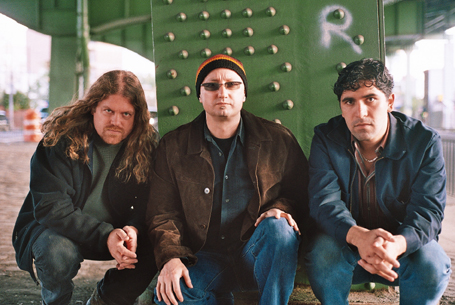
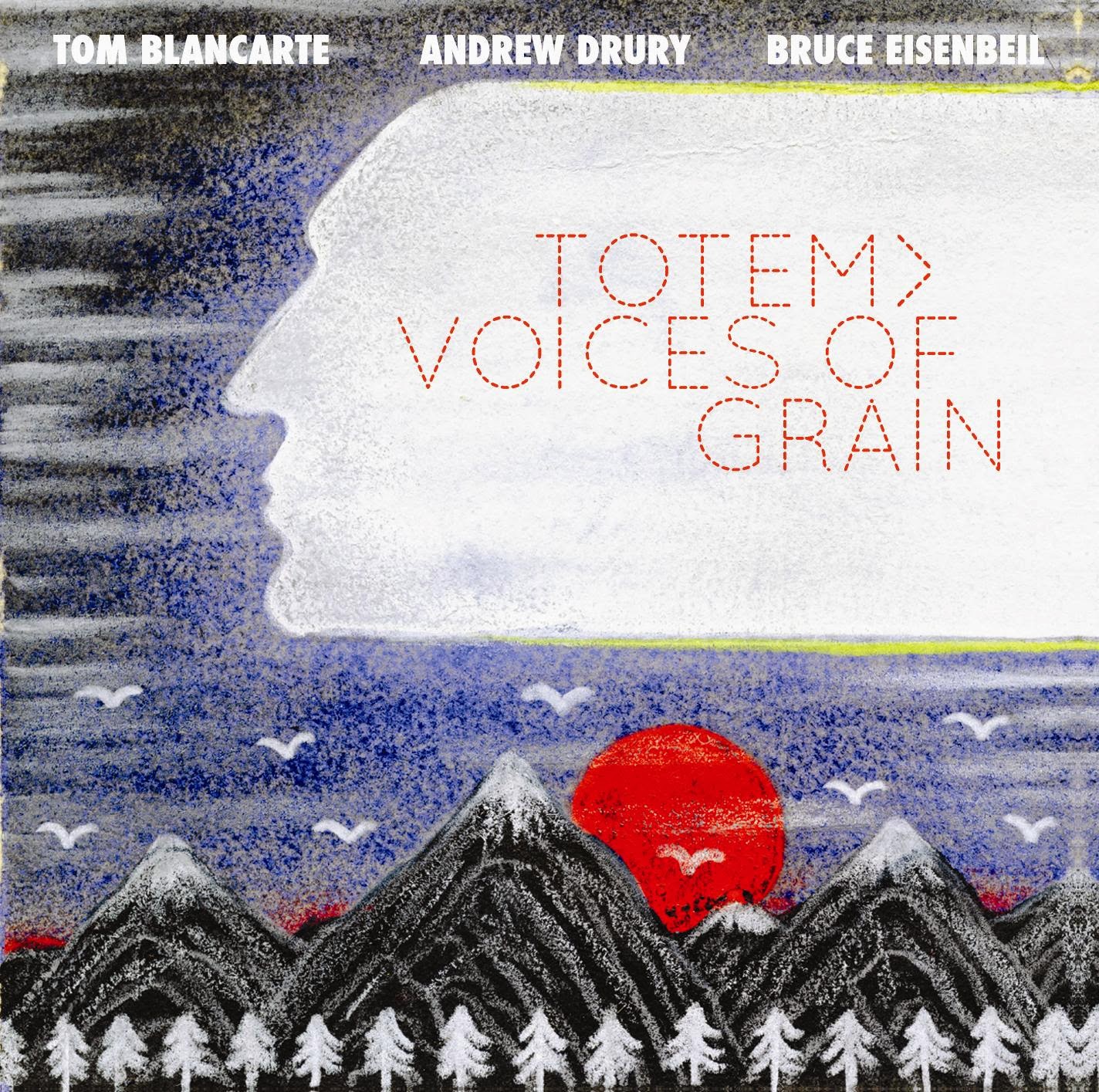
To be sure, the matter-makers of TOTEM> know a thing or two about adjectives. Voices of Grain, which comes five years after their 2008 debut Solar Forge, brims with them. Although thoroughly established on the lunatic fringe of New York’s jazz scene, their presence is mappable by no coordinates, save the curtain behind which an ancestral Oz beats his drum. The virtuosity of each member is formidable, but when standing in the center of their galactic fury we needn’t understand any means of execution. We are more likely to find strange comfort in the mystery behind every utterance. Despite the frenzy, there is hardly a trace of urgency to the sounds, which come to us through noose-outlined ovals of sky, each a window into another, ad infinitum. And where does all of this leave the hapless writer, who struggles with words as if severed from the music they entail? Eisenbeil has an answer for that, too: “A vast majority of sound is created in the world and how that sound is used in situations is predicated on people being engaged in one form or another. Writings by those who sit removed just expecting to be fed say more about the writer’s environment than about the music’s. Musicians will tell you that the more the audience is involved, the better the experience is. It turns into something larger than everyone and everything involved. It’s an ancient process.” As indeed the free qualities of “Genosong” take shape, and in my own attempts to participate in the conversation, I initially struggle for reference points. To wit, possibilities include the Laswell/Haino/Ali joint Decided … Already The Motionless Heart Of Tranquility, Tangling The Prayer Called “I” (1999, Tzadik) and the pioneering work of Derek Bailey. Yet the confluence of signatures that is TOTEM> discloses another genealogy entirely, one quoted above yet also expressed by spontaneous architectures. The result is a hulking vessel that becomes indistinguishable from the waters it plows. Between the breakers of Drury’s drumming, Blancarte’s thick knot-work, and the guitar’s ever-fractal song, the trio trades shine for brine in a pirated helix of comportment. One can almost feel the mitochondria warming up. There’s a sense here of tentacles grasping on to something, of suction and underbellies barnacled by nocturnal passage. What seems a maritime nightmare is in fact a jazz dream, each strand of braid taking a solo while the others lock into supporting grooves. Such moments are brief, although periodic enough to prove TOTEM>’s three-dimensional locution. From oceans eternal to motions internal, from ship to submarine, creaks and water pressures abound in the claustrophobic symphony of “Written in the Body.” What appears to be a dive inward marks its clip by friction of strings and osmosis of skins. Chronology, then, becomes not an ordering of events but an event of orderings, each strand one possible pathway through the mind’s eye, a constant breaking and reconnecting of bare life. Further tensions ravel in “Toward Jouissance,” which stretches and rubs a balloon to the brink of rupture, and in “Counter Memory,” which draws a whirlpool of collective becoming. The latter is more explicitly layered as guitar elicits a frantic cartography across insectile spectrums. “Message Without a Code” not only names the next track, but might as well be the band’s slogan: despite the seemingly cryptic methods (extended techniques, and so on) of execution, the sounds produced are stark naked. Acceptance of that nakedness, molecular it may be, are the listener’s only entrance fee to a full experience of these goings on. More than that, it’s an awareness of one’s physical universe and the planetary alignments of performance. No mere analogy, this image reaches back to Eisenbeil’s genealogy of forms, which taps into a decidedly Foucauldian sense of biopower, that elusive yet pervasive technology of physical management: “Noise is the grain of the voice, and with the grain expresses power,” the guitarist goes on to say. “The idea is that all of the leading exponents of jazz have always had this kind of noise in their sound. Whether it was Ornette Coleman or Charlie Parker, or Evan Parker, or William Parker…many of these musicians were criticized early on for this grain that comes through their sound, which people initially perceived as noise because their emotional filter didn’t allow it to penetrate their being. Yet now that noise is accepted. It must be heard.” Perhaps this is the message of “Post-Repeating,” the album’s most outward statement by far. It cuts a vast horizontal plane, a frozen ocean cracking in the sun with meditative cause, and paves our way toward the final “Silence On Its Road.” In the end, there is only the beginning, a gesture that resounds with every possibility at its fingertips. All explosions look like implosions with enough mirrors around. “Music,” says Eisenbeil, “is best when formed when people have an open heart.” It need be nothing more or less. Like the arrowhead that ends the band’s name, it points forward, no more knowing of the future than the rest of us. And so, while the album does proceed in an extremely physical manner, it orbits us at such a rate that the distinction between the body and its environment collapses in endless porosity. Eisenbeil agrees: “I love playing with Tom and Andrew. It’s a fantastic experience for being completely natural. Every single time we get together, whether in public performance or in the studio, it’s a transcendental experience that is much bigger than the three of us. The sound is an entity in and of itself, a universal life force that the three of us are part of.” To that life force will be added the curious who, with open ears and hearts, find themselves drowning in the sandbox of TOTEM>’s sound-world, swallowing every last grain until it screams.




 Between Sound and Space: ECM Records and Beyond