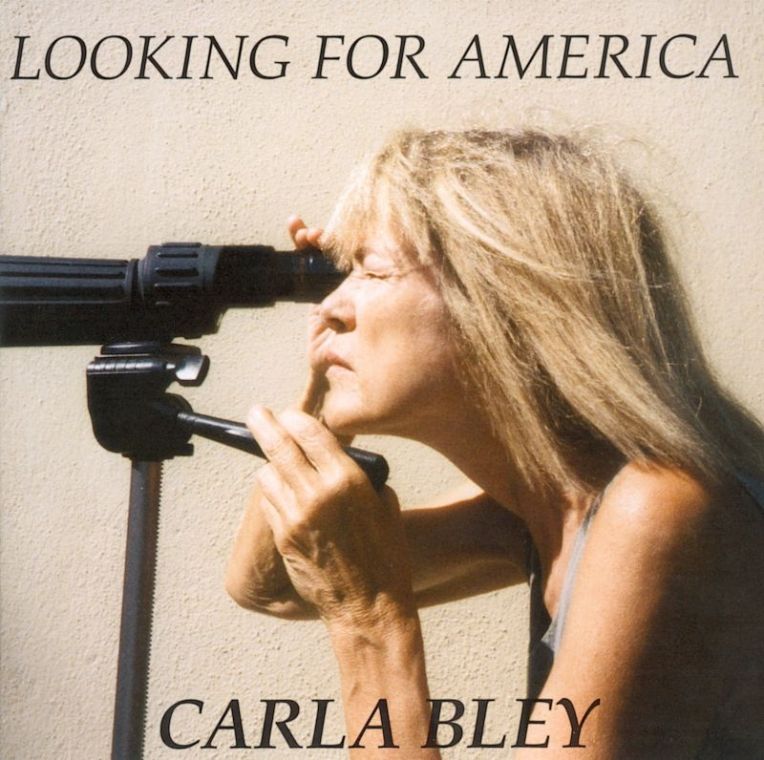
The Carla Bley Big Band: Looking For America (WATT/31)

Looking For America

The Carla Bley Big Band
Looking For America

Earl Gardner, Lew Soloff, Byron Stripling, Giampaolo Casati trumpets
Robert Routch French horn (“The Mothers”)
Jim Pugh, Gary Valente, Dave Bargeron trombones
David Taylor bass trombone
Lawrence Feldman alto and soprano saxophones, flute
Wolfgang Puschnig alto saxophone, flute
Andy Sheppard, Craig Handy tenor saxophones
Gary Smulyan baritone saxophone
Karen Mantler organ, glockenspiel
Carla Bley
piano, conductor
Steve Swallow bass
Billy Drummond drums
Don Alias percussion
Recorded October 7 & 8, 2002 at Avatar Studios, New York
Engineer: Tom Mark
Assistants: Brian Montgomery and Josh Benezra
Mixed November 2002 by Tom Mark and Steve Swallow at The Make Believe Ballroom, West Shokan, New York
Mastered by Greg Calbi at Sterling Sound
Produced by Steve Swallow
Release date: May 5, 2003

Looking For America is yet another milestone in Carla Bley’s discographic adventure as leader of a big band. In addition to being her first to be recorded in New York’s famed Avatar Studios, it’s also a backdoor introduction of one of my favorite drummers, Billy Drummond, into her gene pool. Add to that a twisted smile across the visage of modern politics, one so derisive that it prompted a disclaimer on the back page of the CD booklet exempting the musicians and label from the views expressed therein, and you have a cogent musical essay on the spirit of its age.

Starting and trail-marking the album are four maternal preludes: “Grand Mother,” “Step Mother,” “Your Mother,” and “God Mother.” These blushes of horns, cymbals, and bass are letters to ancestors that came before and those yet to be, each a torchbearer of memory and moral legacies that change with the times. An equally deep nod to adaptation is “Fast Lane,” which enchants by virtue of Wolfgang Puschnig’s superb alto playing. Drummond and bassist Steve Swallow are locked in and give the band a secure springboard off which to jump before deferring to a tangle of horns.

“The National Anthem” swears itself into office over the course of five parts that hinge on a funky bass line from Swallow. Drummond and percussionist Don Alias dig deep and, over the next 22 minutes, adapt their color schemes to suit the message of every given moment. Feelings of patriotism butt up against cynical revisionism, each depending on the other to keep the harmony of free speech alive. Despite kaleidoscopic effect, if not because of it, allusions to Americana become borderless in a larger mosaic of meaning.

Running crosswise to this nationalistic angle are the moody dances of “Los Cocineros” and “Tijuana Traffic,” the latter a hat tip to the Tijuana Brass that looks back on memories as if through a flipbook. Sunbursts from trombonist Gary Valente and trumpeter Lew Soloff spearhead downright orchestral textures on the whole. Tying it all together is Bley’s arrangement of “Old MacDonald Had A Farm.” Valente has tons of down-home fun with this staple, so thoroughly transplanted that it’s almost unrecognizable. Inspired to the last drop!

Carla Bley: 4×4 (WATT/30)

4x4

Carla Bley
4×4

Lew Soloff trumpet
Wolfgang Puschnig alto saxophone, flute
Andy Sheppard tenor saxophone
Gary Valente trombone
Carla Bley
piano
Larry Goldings organ
Steve Swallow bass
Victor Lewis drums
Recorded July 1999 at Rainbow Studio, Oslo
Engineer: Jon Marius Aareskjold
Mixed and mastered at Grog Kill Studio, Willow, New York
Engineer: Tom Mark
General co-ordination: Ilene Mark
Produced by Carla Bley and Steve Swallow
Release date: September 25, 2000

While touring across Europe with a newly fashioned octet in July of 1999, Carla Bley and friends stepped into Oslo’s Rainbow Studio to record 4×4. The set opens its eyes as if waking from a bygone dream in “Blues In 12 Bars / Blues In 12 Other Bars.” These two mirrors are faced toward each other, so that an infinity reflection ensues. Running between them, as far as the ear can hear, are her familiar horn section of Lew Soloff (trumpet), Wolfgang Puschnig (alto saxophone and flute), Andy Sheppard (tenor saxophone), and Gary Valente (trombone), while Bley herself from the piano helms a crew of Larry Goldings (the sole newcomer, on organ), Steve Swallow (bass), and Victor Lewis (drums). The welcome mat thus laid, we step into as pleasant an introduction to the band’s rapport as we might imagine. Likeminded contrasts abound in “Baseball,” thereby throwing the first pitch of a tight game between the two quartets, whose crosstalk gives rise to a leaping catch from Valente. Sheppard’s whispering tenor in “Útviklingssang” closes out the season with what is by far the most superior arrangement of this beloved tune. “Sidewinders In Paradise” revives the playfulness of earlier Bley and shuffles rainforest chatter with urban chic, setting up a menagerie of in-house solos.

But the reigning queen is “Les Trois Lagons (d’apres Henri Matisse).” Originally commissioned by the Grenoble Jazz Festival and inspired by Jazz, a series of cut-outs by Henri Matisse, it was first performed by her trio with Swallow and Sheppard in 1996. At nearly 16 minutes, it’s a viable piece of history. As cigarette smoke and laughter hang over the heads of upwardly mobile socialites and starving artists alike, it morphs into an aural cubism.

So much of Bley’s output by now is worth listening to that the word “essential” loses more meaning with each subsequent release. Don’t hesitate to dive into this one and trust its air supply to bring you safely back to the surface.

Carla Bley/Steve Swallow: Are we there yet? (WATT/29)

WATT-29-front

Carla Bley
Steve Swallow
Are we there yet?

Carla Bley piano
Steve Swallow bass
Recorded live on tour in Europe, October 1998
Engineer: Bill Strode
Mixed and mastered at Grog Kill Studio, Willow, New York
Engineer: Tom Mark
General co-ordination: Ilene Mark
Produced by Carla Bley and Steve Swallow
Release date: June 21, 1999

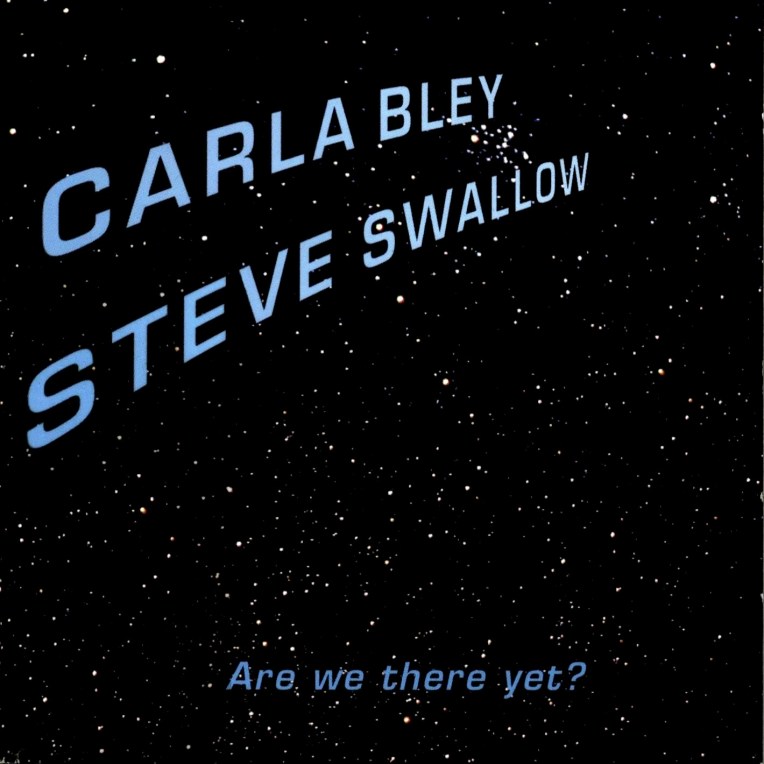
After expanding their sonic universe over two phenomenal duo albums, pianist Carla Bley and bassist Steve Swallow now make that metaphor explicit in their choice of cover art. From the first licks of “Major,” one of a handful of Bley originals, it’s clear we’re inhabiting a galaxy that is indeed far, far away. Recorded live during a 1998 European tour, it’s the first of an artisanal selection of performances that tickle the ear and the heart alike. Other Bley gems include “King Korn,” in which Swallow’s delicate propulsions copy themselves like sentient DNA, and a gloriously bare-boned “Musique Mecanique,” in which the appearance of something so simple as a metronome shows mature reconsideration of the past.

Swallow lets us in on the secrets of three magic tricks of his own. Between the bluesy undercurrents of “A Dog’s Life” and the flatland ballad of “Playing With Water,” we witness especial thoughtfulness in “Satie For Two.” An elegant homage to the French composer, it spreads its butter across an expansive slice of proverbial bread. The brightness of Swallow’s solo climbs the ladder of Bley’s chords until he reaches the very clouds.

The set rounds out with an interpretation of Kurt Weill’s “Lost In The Stars,” for which Swallow embraces the full range of his instrument, moving with guitar-like fluidity. As throughout the album, it’s a vibrant embodiment of life itself, photorealistic and honest to the core.

Carla Bley: Fancy Chamber Music (WATT/28)

WATT-28-front

Carla Bley
Fancy Chamber Music

Carla Bley piano
Steve Morris violin
Andrew Byrt viola
Emma Black cello
Steve Swallow bass
Alison Hayhurst flute
Sara Lee clarinet, glockenspiel
Chris Wells percussion
Recorded December 5 & 6, 1997 at SnakeRanch Studio, London
Engineer: Robin Prior
Assistant engineer: Mark Chambers
Mixed and mastered at Grog Kill Studio, Willow, New York
Engineer: Tom Mark
General co-ordination: Ilene Mark
Produced by Carla Bley and Steve Swallow
Release date: June 22, 1998

Carla Bley has always been known for spinning the wheel, but in this instance she lands on one of her most unusual and enchanting projects to date. The pieces assembled on Fancy Chamber Music are the results of commissions, leading to a program that could emerge from no mind so hybrid as hers. The touchstones are carved by “Romantic Notion #4” and “Romantic Notion #6” (incidentally, #3 made an appearance on her Duets with bassist Steve Swallow). Scored as they are here for winds and strings, they are re-orchestrated from eight piano pieces originally written for Ursula Oppens. Both are exercises in seeking, self-contained in appearance yet connective in spirit.

“Wolfgang Tango” adds piano and drums to those same instrumental forces. A thread of clarinet renders this one a wonder, as does Swallow’s bass, which moves in fine accord. The tango, such as it is, comes across as subdued, more cerebral than sensual, and gives the listener pause to connect the dots it highlights across the continental map of art music history. “End Of Vienna” swaps drums for vibraphone and anchors a translucent web of melody. As noted in the CD booklet, this “isn’t a waltz and it marked the end of a disturbing propensity to write pieces in three-quarter time.” Nevertheless, it undulates with a comforting regularity, drawing an unwitting (?) line of inspiration from the ensemble pieces of Gavin Bryars, and is among her most exquisite creations.

Strings, clarinet, piano, and percussion are the communication tools of choice for “Tigers In Training.” This 19-minute suite spans four parts and, in Bley’s words, “describes the tigers’ feeling toward their trainer and the other circus animals, memories of life in the wild, and various tricks and routines.” From hardboiled resignation to optimistic dreams, shades of Gershwin to anti-nostalgic airs, it sounds like an animal language translated for human ears. The crack of a whip cutting through strings enhances the imagery at hand to dazzling effect.

Bley harnesses the same combination for her encore, “JonBenet.” Despite being named after the six-year-old beauty queen who was viciously strangled in 1996, it is more benignly inspired by a faulty musical toy Bley once had as a child. Its tear-stained image of trauma fogs the windows of collective memory and overlays messages of hope with her fingertips. The cumulative effect of all this will surely stand the test of time as a masterwork, and is one of the few albums I would point to if someone asked me to define “chamber jazz.”

WATT-28-inside

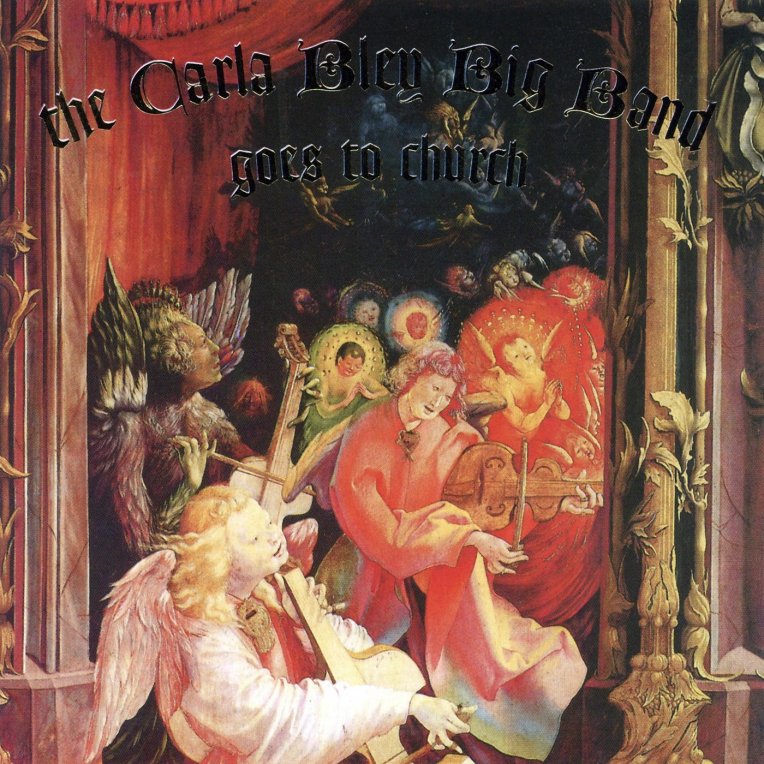
The Carla Bley Big Band: Goes To Church (WATT/27)

Goes To Church

The Carla Bley Big Band
Goes To Church

Lew Soloff, Guy Barker, Claude Deppa, Steve Waterman trumpets
Gary Valente, Pete Beachill, Chris Dean trombones
Richard Henry bass trombone
Roger Jannotta soprano and alto saxophones, flute
Wolfgang Puschnig alto saxophone
Andy Sheppard, Jerry Underwood tenor saxophones
Julian Argüelles baritone saxophone
Karen Mantler organ, harmonica
Carla Bley piano
Steve Swallow bass
Dennis Mackrel drums
Recorded live at Chiesa San Francesco Al Prato, Umbria Jazz, Perugia, Italy, July 19-21, 1996
Engineer: Mirco Bezzi
Live sound: Bill Strode
Assistants: Vittorio Albani and Sandro Giudici (Gianni Grassilli Sound Services)
Mixed at Grog Kill Studio, Willow, New York
Engineer: Tom Mark
Mastered by Tom Mark at The Make Believe Ballroom
General co-ordination: Ilene Mark
Produced by Carla Bley and Steve Swallow
Release date: November 1, 1996

Recorded live in July of 1996 at Italy’s renowned Umbria Jazz Festival, Goes To Church pits the Carla Bley Big Band against its own reputation, only to exceed it. The title in this case is a reference to the venue in which it was performed and recorded—the Church of San Francesco al Prato—rather than to any spiritual agenda (Bley grew up in the church but left it behind at 15 when she fled home and landed in New York City to make history). This doesn’t, however, prevent any listener fortunate enough to sit in these pews from having a metaphysical experience.

“Setting Calvin’s Waltz” is a prime example of Bley’s mastery in a program consisting of nothing but. Commissioned by the Berlin Jazz Festival, the 24-minute extravaganza feels like walking through an apartment complex of episodic blocks, allowing glimpses into the everyday lives therein. A rocking introduction floats us on bluesy waters while Karen Mantler’s organ brings a gospel feel to the undertow. The tenor of Andy Sheppard awakens the surrounding horns from their catatonic state. From here, trumpeter Lew Soloff and trombonist Gary Valente take over in a more theatrical mode. Mantler gets the quietest of spotlights for her forlorn harmonica solo before opening the floor to Wolfgang Puschnig’s potent altoism. A likeminded reverence imbues the triptych that follows. Opening with Carl Ruggles’s “Exaltation” and flowing into Bley’s “Religious Experience” and “Major,” it lays a groundwork of horns as an excuse to riff on Handel’s “Hallelujah” chorus. Puschnig’s alto barrels through as Dennis Mackrel’s drumming crushes the devil’s adversaries on its way to upbeat salvation.

The set’s deepest enlightenment is embodied in the appropriately titled “One Way,” a hymn of burnished brass and patient world building that leaves one tenderly fulfilled. It shares oxygen with “Permanent Wave,” another unusual sequence of development, and feeds the “Beads” between them. The latter tune, commissioned by the Carnegie Hall Jazz Band, is smooth at the center yet frayed at the edges. Sheppard’s tenor is once again the star, paving the way for Soloff and Mackrel to strut their stuff. The benediction of “Who Will Rescue You?” leaps for joy as Puschnig goes for closing gold.

A personal favorite among Bley’s live big band excursions.

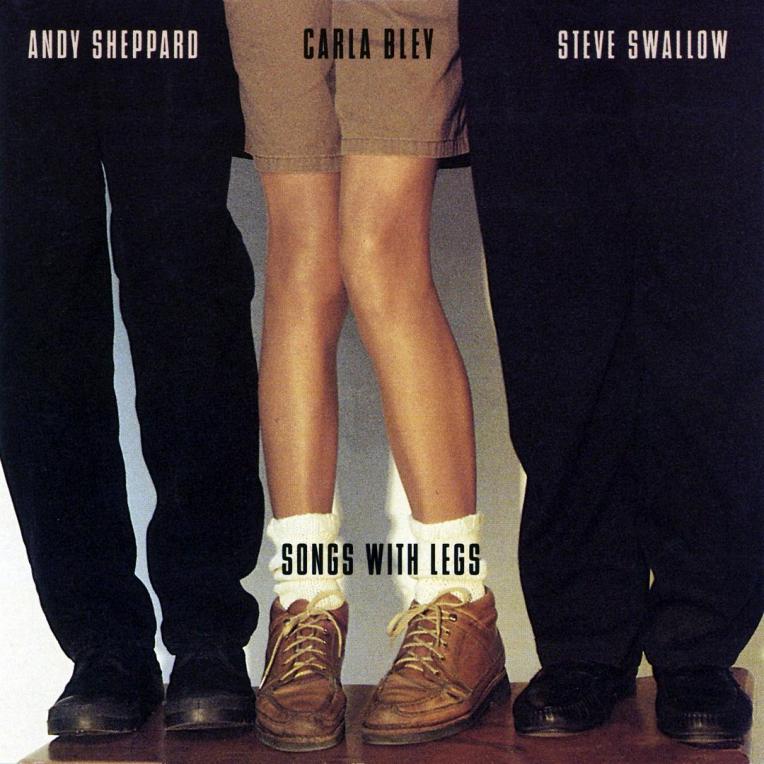
Bley/Sheppard/Swallow: Songs With Legs (WATT/26)

Songs With Legs

Carla Bley
Andy Sheppard
Steve Swallow
Songs With Legs

Carla Bley piano
Andy Sheppard tenor and soprano saxophones
Steve Swallow bass
Recorded live on tour in France, Italy, Austria, Germany, Turkey, and England, May 1994
Engineer: Bill Strode
Mixed at Grog Kill Studio, Willow, New York
Engineer: Tom Mark
General co-ordination: Ilene Mark
Produced by Carla Bley and Steve Swallow
Release date: January 1, 1995

Songs With Legs is easily among my Top 5 WATT releases. Not only for the wonderful music it contains, but also for debuting of one of the finest trios still working today (see my review of their performance at Denver’s Dazzle last year). By this time, pianist/composer Carla Bley had already found her soulmate in electric bassist Steve Swallow and had released a couple of duo albums to prove it. But saxophonist Andy Sheppard had appeared on a few of Bley’s big band projects and was proving himself to be a natural fit in her sonic nucleus. This first triangulation of their gifts is magic from corner to corner to corner.

Slightly off-kilter pianism introduces “Real Life Hits,” a scene that only Bley could have painted with these two allies. Recorded live during a European tour in May of 1994, this performance captures the spirit of in-the-moment interplay. Swallow assumes a guitarist’s role, adding delicate chords and harmonies, while Sheppard, thus far notable for his muscular tenor playing in larger ensemble contexts, assumes the rounded comportment through soprano. That said, his smoky tenor pairs exceptionally well with the Thelonious Monk standby “Misterioso” and Bley’s own “The Lord Is Listenin’ To Ya, Hallelujah!” The latter, having undergone a soulful mellowing since its last appearance on Carla Bley’s Live!, feels more like a prayer of gratitude than a desperate call for grace. Swallow’s comforts know no bounds here.

As ever, whimsy waits in the wings, and we get plenty of it in “Chicken” (more of a duo showcase for piano and bass, with some subtle tenor swing for good measure) and “Wrong Key Donkey,” which peaks at 12 minutes and, as with Bley’s previously iterated tunes, gives up its secrets without hesitation so that we might feel its story from the inside out. Bley’s reading is linear and honest, while Sheppard’s soprano waters flower after expository flower. Swallow’s solo is subdued yet rich. The trio ends with “Crazy With You.” This love letter to creativity, laid sweetly on the altar of life, points our attention to self-evident truths, and by that gesture confirms Bley’s star in the constellation of jazz history.

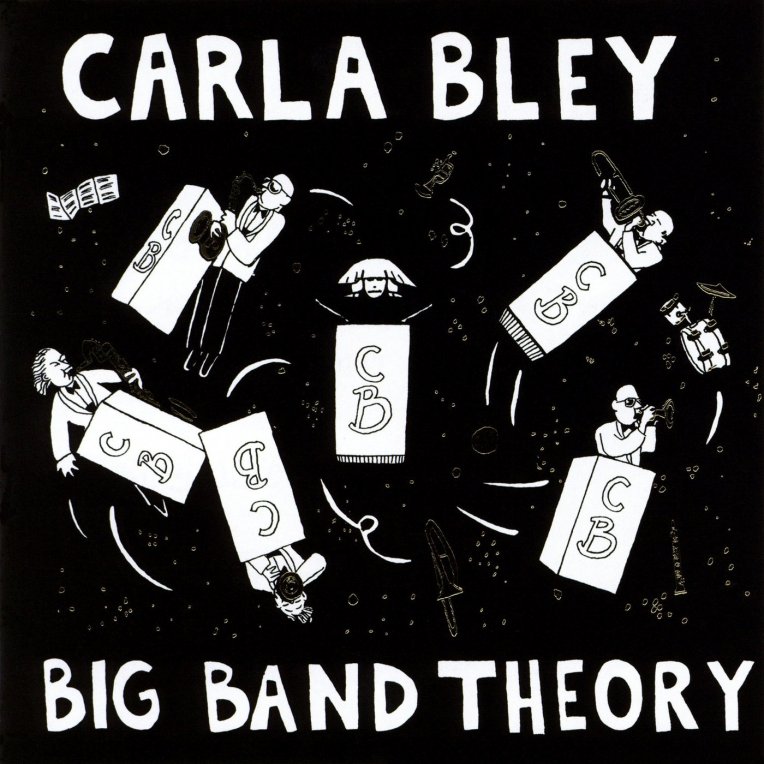
Carla Bley: Big Band Theory (WATT/25)

Big Band Theory

Carla Bley
Big Band Theory

Alex Balanescu violin
Lew Soloff, Guy Barker, Claude Deppa, Steve Waterman trumpets
Gary Valente, Richard Edwards, Annie Whitehead trombones
Ashley Slater bass trombone
Roger Jannotta soprano saxophone, flute
Wolfgang Puschnig alto saxophone, flute
Andy Sheppard tenor and soprano saxophones
Pete Hurt tenor saxophone
Julian Argüelles baritone saxophone
Carla Bley piano
Karen Mantler organ
Steve Swallow bass
Dennis Mackrel drums
Recorded July 2/3, 1993 at Angel Studios, London
Engineer: Gary Thomas
Mixed at Grog Kill Studio, Willow, New York
Engineer: Tom Mark
Mastered by Greg Calbi at Sterling Sound
General co-ordination: Ilene Mark
Produced by Carla Bley and Steve Swallow
Release date: October 1, 1993

In the footsteps of her last (very) big band effort—which, despite its competence isn’t my favorite—Carla Bley returns with a masterstroke of the genre. It’s all here: catchy titles, musicians who share a profound cohesion, and tunes to unpack with joy. “On the Stage in Cages” sets the tone by jumping into the woodwork and rearranging every whorl with confidence. Bley’s band, holding firm at 18 members, swings with renewed purpose, as if waking up from the slumber of hiatus in a sublime return to form. This is followed by one of the highest peaks in the Bley mountain range: “Birds of Paradise.” Commissioned by the 1992 Glasgow Jazz Festival, it foregrounds violinist Alex(ander) Balanescu, whose folk-tinged glow warms this body from the inside before morphing into a moody and dramatic pile of brass. Bley’s characteristic attention to detail throughout this 20-minute journey is as varied as any life that could contain it.

Bley taps the inkwell of her muse, Charles Mingus, in a personal arrangement of “Goodbye Pork Pie Hat,” which despite its straight-laced veneer sports a dark monologue from bass trombonist Ashley Slater, alluring trumpeting by Lew Soloff, and a gentle swing beneath it all. Bley comes up from this dedicatory nod with her own “Fresh Impression” firmly in hand. This blast of sunshine yields a robust solo from Andy Sheppard on tenor, as if to emphasize the flow of memory he and the others ride to the present moment. It and everything that precedes is indeed fresh music that imparts its invitation to all listeners. This is Bley’s house, and the catering has been perfectly laid out before we even walk in.

Carla Bley/Steve Swallow: Go Together (WATT/24)

Go Together

Carla Bley
Steve Swallow
Go Together

Carla Bley piano
Steve Swallow bass
Recorded Summer 1992 by Steve Swallow, with assistance from Tom Mark, at Grog Kill Studio, Willow, New York
Mastered by Greg Calbi at Sterling Sound
General co-ordination: Karen Mantler
Produced by Carla Bley and Steve Swallow
Release date: April 1, 1994

This sequel to 1988’s Duets finds pianist Carla Bley and bassist Steve Swallow in finer form than ever. As per the last time around, composing credits go mostly to Bley. After a soft intro, the rhythms in “Sing Me Softly of the Blues” showcase the duo’s gentle funk in spades. Bley solos in that way she often does, leaving proper space between the keys so that individual notes can stretch their wings. Later in the set, she pulls out some of the most treasured tomes of her melodic library, including a measured and reflective take on “Copyright Royalties” and a heartening “Fleur Carnivore,” which glistens like a diver peeking over the ocean’s surface, seeking an island of rest. “Ad Infinitum” likewise sheds new layers in the current version. The synergy between these musicians has rarely been so apparent as here, where their interlocking signatures form an entirely new entity.

The dour “Mother of the Dead Man” makes its first appearance, and provides an artisanal segue into Swallow’s “Masquerade in 3 Parts.” Clearly inspired by Bley in its trefoil structure, it plays on her wryness in both concept and self-interpretation. The bassist also gifts us “Peau Douce,” a slice of downtempo whimsy that works its improvisational magic until we no longer need to distinguish between beginnings and endings. Such is the spell they cast.

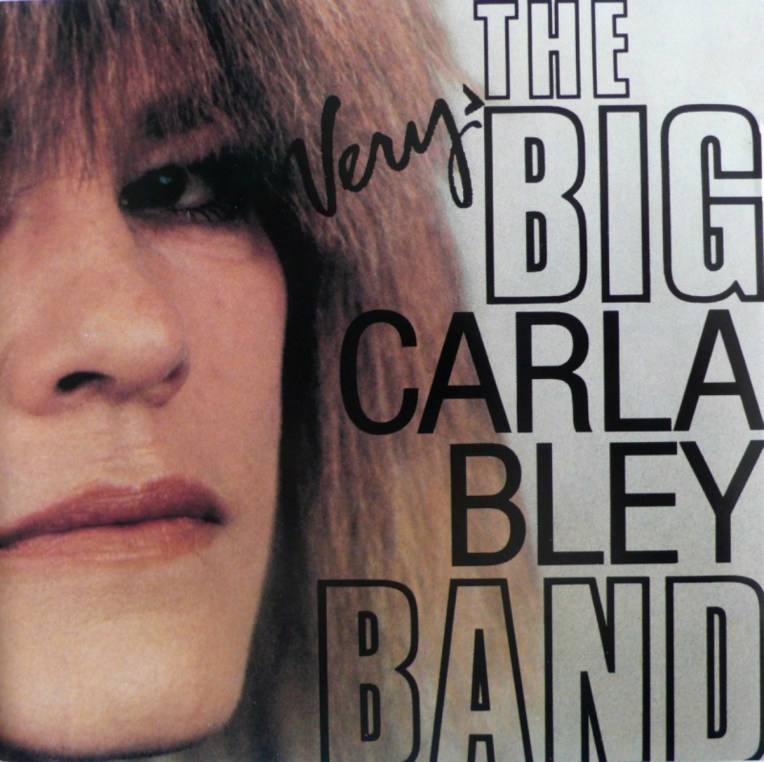
The Very Big Carla Bley Band: s/t (WATT/23)

The Very Big Carla Bley Band

The Very Big Carla Bley Band

Lew Soloff, Guy Barker, Claude Deppa, Steven Bernstein trumpets
Gary Valente, Richard Edwards, Fayyaz Virji trombones
Ashley Slater bass trombone
Roger Jannotta oboe, flute, clarinet, soprano saxophone
Wolfgang Puschnig alto saxophone, flute
Andy Sheppard tenor and soprano saxophones
Pete Hurt tenor saxophone, clarinet
Pablo Calogero baritone saxophone
Steve Swallow bass
Carla Bley piano
Karen Mantler organ
Victor Lewis drums
Don Alias percussion
Recorded October 29/30, 1990 at Bauer Studios, Ludwigsburg, Germany
Engineer: Carlos Albrecht
Mixed at Grog Kill Studio, Willow, New York
Engineer: Tom Mark
Mastered by Greg Calbi at Sterling Sound, New York
General co-ordination: Michael Mantler
Produced by Carla Bley and Steve Swallow
Release date: April 1, 1991

If the explosion of sentiment that embraced Carla Bley in the mid-1980s led to a soul-defining period, then let this 18-piece extravaganza be the backdraft that pulled her into a wider angle. Despite boasting trumpeter Lew Soloff, trombonist Gary Valente, and saxophonists Wolfgang Puschnig and Andy Sheppard as frontline soloists, it’s not the most groundbreaking of sessions, but a respectable enough jewel in the Bley crown.

Right off the bat, “United States” shows us just how much Bley’s sense of humor has grown. From the splashing cymbals of Victor Lewis to the anthemic inflections of bassist Steve Swallow, there’s much to admire in this ensemble’s knack for unpacking a giant suitcase and leaving it the way they found it by the time they’re through. The initial feeling is one of almost sardonic pleasure, but as the soloing becomes more forthright, we find that honesty is indeed the best policy. The proverbial soapbox serves as a stage for Soloff’s biting cynicism, Valente’s political edge, Puschnig’s street smarts, and Sheppard’s down-home wisdom.

“Strange Arrangement” dons the set’s cheekiest title, as the arrangement is rather tame compared to her earlier work. The primary focus here (as throughout), however, is on her fabulous horn section. Whether opening with their bouquet in “All Fall Down” or tooling the binding of “Lo Ultimo,” they add flavor upon flavor without reserve. The latter’s baritone spotlight, courtesy of Pablo Calogero, is one of many elements that make the tune an album standout, even if we must drag our ears a bit to get there. Like the bluesier “Who Will Rescue You?” it slides into home by the skin of its teeth.

Though not as multidimensional as what came before, the feeling is sincere, the compositions solid, and the performances top-notch. This album is also notable for being recorded in Tonstudio Bauer in Ludwigsburg, Germany, where many classic ECM albums were also laid down. The sound is consequently impeccable. Nothing dominates. Given that the influence of Mingus lives large in Bley’s arrangements, we might do best to read this session as a snapshot of a mood expertly crafted for posterity.