

Lucian Ban
Mat Maneri
Transylvanian Dance
Mat Maneri viola
Lucian Ban piano
Recorded live at CJT Hall in Timișoara, October 29, 2022
Recording engineer: Utu Pascu
Mixing: Steve Lake and Michael Hinreiner (engineer)
at Bavaria Musikstudios, Munich
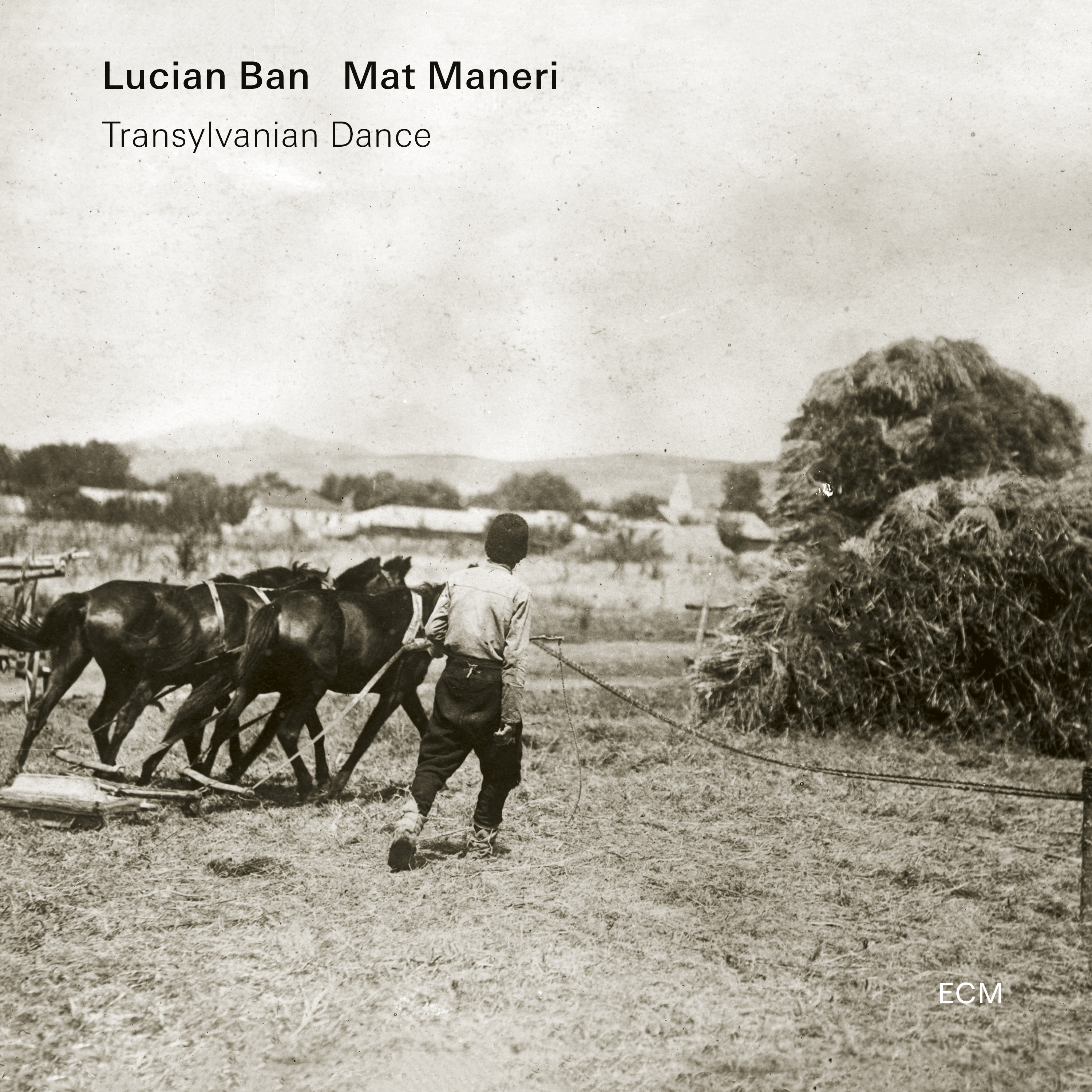
Cover photo: Romania farm scene, 1919 (courtesy Library of Congress, Washington)
Album produced by Steve Lake
Release date: August 30, 2024
Transylvanian Dance is the long-awaited follow-up to 2013’s Transylvanian Concert. The latter ECM debut of pianist Lucian Ban and violist Mat Maneri’s collaboration was a landmark showcasing the duo’s ability to immerse and blend in a partnership written in the stars. The present program, recorded live in October 2022 in the context of the Retracing Bartók project in Timișoara, is based entirely on songs and dances collected by Béla Bartók in Transylvania. And yet, the recapitulation of this music is more than a gesture of preservation; it’s an act of solidarity. If Ban and Maneri are archaeologists, they regard every artifact on its own terms. Rather than dust off the caked sediment, they appreciate it as a part of what the object has become.
In his liner notes for the album, Steve Lake invokes the “treasure-house,” a term used by Bartók and fellow composer Zoltán Kodáldy to describe the folksongs that may have gone lost without their efforts and one that feels duly appropriate to label the container built by these four hands. Drawing from his own experience growing up in Transylvania, Ban stains the wood with an ancestral quality, while Maneri carves adornments patterned after the imprints of far-reaching histories from within.
Open the door and take any interpretation stored a few steps beyond it, and you’re sure to find something to connect to. That being said, “Poor Is My Heart” is about as sparkling an introduction as one could hope for into this archive of still photographs come to life. To be welcomed into this space so freely is more than a privilege; it speaks to the human right of free expression against tyrannies of silence. Appropriately, the pianism is lithe yet strong, while the viola is a pliant voice that speaks of reeds and winds from bygone eras, its harmonics turning shafts of recollection into particles of real-time action. Like the title track later in the program, it keeps no secrets from us. However near or far the musicians feel, their balance of extroversion and introversion is superbly rendered. If Ban is the earth, then Maneri is the tiller of its collective memories. “Romanian Folk Dance” is another ripe harvest. Through disjointed yet natural movements, it breathes with an unsettled (but never unsettling) quality. The instruments circle each other, closing but never tightening the knot past the point of loosening.
What might seem to be a discerning focus on revelry is the oxygen for the darker flames of “Lover Mine Of Long Ago,” which treats its garments as layers of skin to be shed at will. Ban’s exploration of the piano’s inner strings, whether by plucking or muting, polishes a dowry of coins and other trinkets to be left behind with it. Meanwhile, “The Enchanted Stag” is a keening hymn in which bluesy accents bend to the will of the compass’s needle. Both “Harvest Moon Ballad” and “The Boyar’s Doina” turn the concept of the soul into a playing style. Wavering yet never faltering, each is a house creaking in the night, reminding us of the fragility of what we call home. Settling ever deeper into the ground, their candlelit windows beacons for wandering dreamers, they create a breezeway for the final song, “Make Me, Lord, Slim And Tall.” Not a single note feels wasted: percolating, germinating, and fragrant as a forest floor after the rain. With so much fertility, we can only wonder at the gifts it will yield with repeat listens.
 Between Sound and Space: ECM Records and Beyond