

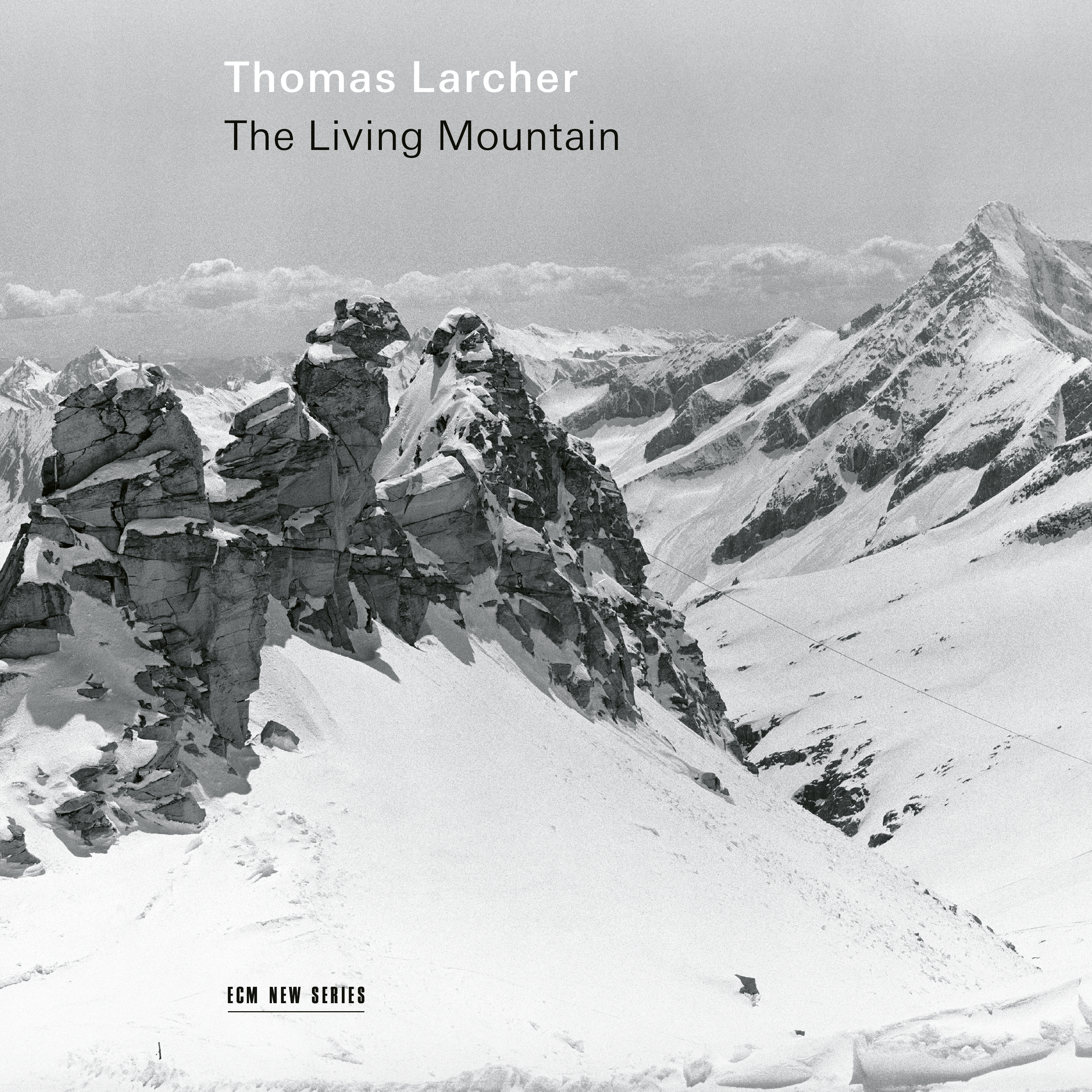
Thomas Larcher
The Living Mountain
Sarah Aristidou soprano
Alisa Weilerstein violoncello
Aaron Pilsan piano
Luka Juhart accordion
André Schuen baritone
Daniel Heide piano
Münchener Kammerorchester
Clemens Schuldt conductor
The Living Mountain / Ouroboros
recorded June 2021
Bavaria Musikstudios, München
Unerzählt
recorded May 2022
Gemeindezentrum Weerberg
Engineer: Christoph Franke
Cover photo: Awoiska van der Molen
Produced by Manfred Eicher
Release date: October 6, 2023
“At first, mad to recover the tang of height, I made always for
the summits, and would not take time to explore the recesses.”
–Nan Shepherd
The Living Mountain is the fourth ECM New Series album dedicated to the work of Thomas Larcher, whose previous programs have proven the Austrian composer to be, much like his mentor Heinz Holliger, a human magnifying glass. His attention to detail grows only more precise as his instrumental forces increase. Meanwhile, the chamber works unfurl in grand (but never grandiose) imaginings of times and places that we would never experience except through the filter of his awareness of the past. The eponymous song cycle for soprano and ensemble is a particularly vibrant example. Composed between 2019 and 2020, it sets selections from the memoir by Scottish poet Nan Shepherd, whose own penchant for highlighting the intimate in the vast suits Larcher’s sensibilities hand in glove.
From an introductory heartbeat, the landscape pulses with the music of blood flow, visceral and true. Larcher articulates this anatomy with surgical precision on his way to Part II, where we feel ourselves on the verge of falling over. That sense of vertigo—at once glorious and terrifying—sweeps through every crevice. Singer Sarah Aristidou expresses Shepherd’s words as if they were her own. Whether in brief expulsions of accordion breath or the hammering of piano strings, the diurnal reigns supreme. The final movement’s evocation of snow, as sparkling and wind-roused as it is blinding, runs down the text’s spinal cord.
At the other end of this proverbial tunnel is another song cycle, Unerzählt (2019-20), this one for baritone and piano based on the poetry of W.G. Sebald. These vignettes turn stills into moving pictures. Moods range from the programmatic (e.g., “Die roten Flecken,” which evokes the red spots on Jupiter in dramatic fashion, and the prepared piano rattlings of “Wenn die Blitze herabfuhren”) and the morose (“Am 8.Mai 1927”) to the contemplative (“Gleich einem Hund”) and painterly (“Blaues Gras”). One highlight is “Es heißt daß Napoleon,” from which we get this wry piece of historical revisionism:
They say
that Napoleon
was colorblind
& blood for him
was as green as
grass
The delicacy of Larcher’s setting brilliantly toes the line between mockery and empathy. Another standout is the final song, “So wird, wenn der Sehnerv zeerreißt”:
And so, when the optic nerve
is torn, the silent airspace
turns as white as the snow
on the Alps.
Thus reconnected to the snowy expanse in which we began, we can take strange comfort in its inhospitable nature—which, in the end, makes us all the more human. Pianist André Schuen and baritone Daniel Heide mesh beautifully, allowing bell-like sonorities to percolate through deeper gravel.
Stretching out the darkness between these is Ouroboros (2015). Cellist Alisa Weilerstein and the Munich Chamber Orchestra navigate three movements, opening with a dance of slow-motion detections. Despite the nominal instrumentation, the piano plays a vital moderating role in this relationship. Neither call nor response, theirs is a symbiosis that implies an eternal path to nothingness. The tempestuous middle movement deals in fear with a squealing, unrelenting grind. The conclusion reveals an ethereal balancing act, Weilerstein reaching the most pristine high notes I’ve heard on a cello in a long time before a frenzied crackle of fire and ash consumes itself. As the flame goes out, it moans one last time, just before comprehension and death become one and the same.
 Between Sound and Space: ECM Records and Beyond