

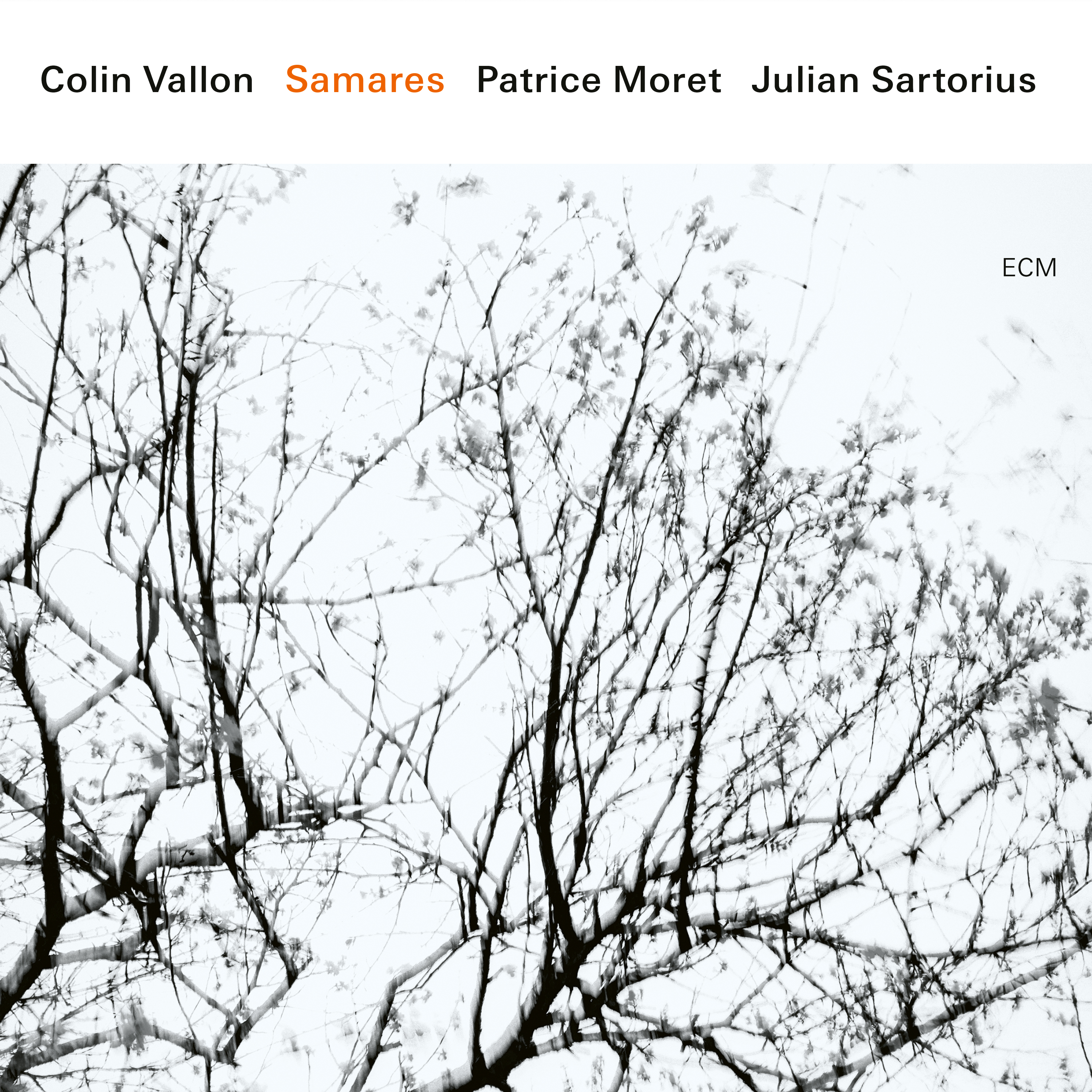
Colin Vallon
Samares
Colin Vallon piano
Patrice Moret double bass
Julian Sartorius drums
Recorded June/July 2023 at Auditorio Stelio Molo RSI, Lugano
Engineer: Stefano Amerio
Cover photo: Woong Chul An
Produced by Manfred Eicher
Release date: November 15, 2024
With Samares, Colin Vallon completes a trilogy that began with 2014’s Le Vent and continued with 2017’s Danse, bringing its themes into the present. The Swiss pianist, reunited once again with bassist Patrice Moret and drummer Julian Sartorius, deepens his telepathic sense of touch across nine original compositions. The album’s title refers to what I grew up calling “helicopter seeds,” which often fall from maple trees in protracted flights. The image is an apt one, as each tune lends itself to plentiful regard as it makes its way toward the ground, so that by the end, we are left with a clearer view of the sky than ever.
“Racine” opens with brushed drums and prepared piano before morphing into piano proper with bowed cymbals and other gilding from Sartorius (who proves himself to be a phenomenal colorist here and in the later track, “Étincelle”). This exploration of morning light allows us to take in the scenery as it emerges, one frame at a time. Next to this awakening, “Mars” introduces the trio’s subtle feel for groove. Blending distance and proximity, the atmosphere is cushioned by the softness of its vision. There is a sense of privacy, of one looking out toward the mountains, of waiting for new constellations to shed the blanket of the horizon and reveal themselves. The underlying pulse is a comforting reminder that we are always moving forward, bound for life itself. Akin to tracks 4 (“Ronce”) and 8 (“Souche”), it emits a subtle yet locked-in pulse that always ensures Vallon has a light, no matter how dark the mood gets.
“Lou” is one of two pieces named for his children (the other being the progressively whimsical and lively “Timo”). It features piano preparations with objects bouncing on the strings as if to convey the trepidations of parenthood. Finally, “Brin” evokes the rustling of leaves, a shifting light, and faces from the past—fading but not forgotten. It is a photograph in a darkroom developing in reverse, leading the eyes (and ears) into shadow.
What has always caught my attention with Vallon’s trio, and with particular maturity this time around, is the ability to disturb the surface tension of its melodic waters without ever breaking it. It cradles the spinning seeds of the title track in their delicate demise, knowing that fresh growth will always find a way to take root.
 Between Sound and Space: ECM Records and Beyond