

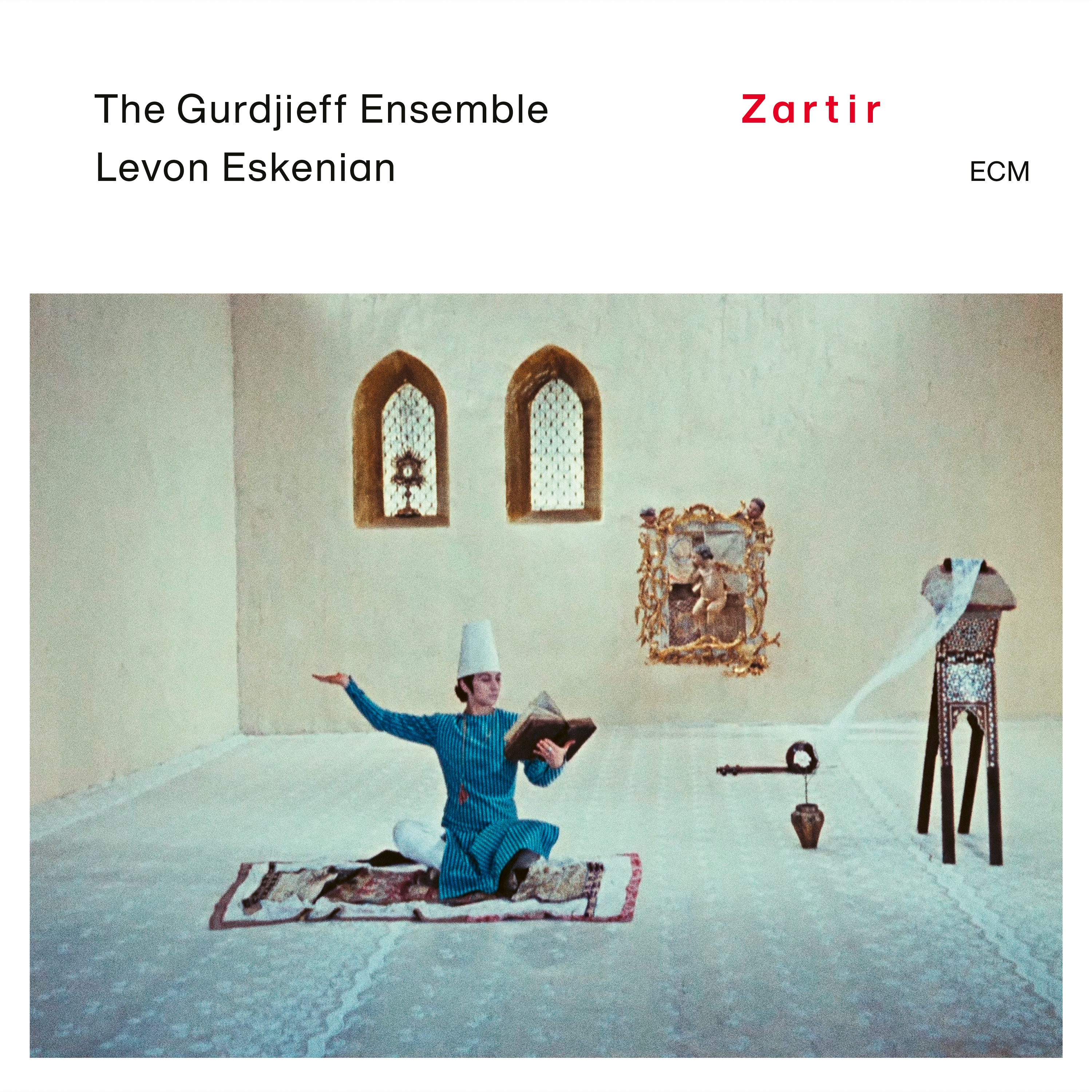
The Gurdjieff Ensemble
Zartir
The Gurdjieff Ensemble
Levon Eskenian artistic director
Vladimir Papikyan voice, santur, burvar, tmbuk, singing bowls
Emmanuel Hovhannisyan duduk, pku
Meri Vardanyan kanon
Armen Ayvazyan kamancha, cymbal
Gagik Hakobyan duduk
Norayr Gapoyan duduk, bass duduk, pku
Avag Margaryan blul
Aram Nikoghosyan oud
Astghik Snetsunts kanon
Davit Avagyan tar
Mesrop Khalatyan dap, tmbuk, bells, triangle
Orestis Moustidis tombak
National Chamber Choir of Armenia
Robert Mlkeyan director
Recorded December 2021 at Radio Recording Studio, Yerevan
Engineer: Tigran Kuzikyan
Mixed November 2022
by Manfred Eicher, Levon Eskenian, Michael Hinreiner (engineer), and Tigran Kuzikyan (engineer)
at Bavaria Musikstudio, Munich
Cover photo: Still from Sergei Parajanov’s film The Color of Pomegranates
Album produced by Manfred Eicher
Release date: October 27, 2023
“Who can say that I will live from dawn till dusk? Man’s entry and man’s exit is simple work for the hand of God.”
–Sayat-Nova
Continuing the journey on which they first embarked for ECM in 2011, Levon Eskenian and The Gurdjieff Ensemble deepen their relationship with the enigmatic Georges I. Gurdjieff (c. 1877-1949). Given the mystery surrounding the Armenian-born teacher/philosopher, one can hardly say that the music on Zartir is a historically informed recreation. Rather, writes Steve Lake, “Eskenian’s ensemble resituates the music along the paths of its possible interpretations.” On said paths, one encounters travelers of Armenian, Assyrian, Greek, Caucasian, Kurdish, Persian, and Arabic persuasion, each a reflection of the other in the grander sense yet simultaneously individual enough to lend historico-cultural insight. Given that the bulk of Gurdjieff’s music is preserved in 250 pieces for piano (an instrument he saw as a compromise at best), Eskenian has once again brought new life (or is it old life?) to melodies that speak of their lineage more deeply than whatever we might glean from biographical speculations. Lake calls these “triple-distilled reverse transcriptions,” reflecting how they might have been intended to sound on the folk instruments that would surely have been a familiar soundtrack to Gurdjieff’s own itinerancy.
The album’s title, which means “Wake up!”, seems to evoke the Zen concept of satori, referring to a sudden enlightenment of mind, body, and spirit. However paltry that comparison might be, it nevertheless points to the undeniable alignment of this trifecta in the music arranged for us by Eskenian here. For example, in the twilit sagacity of “Pythia,” the first of many tears in the veil of obscurity, the mood is almost regal, as if welcoming some great royalty to step on a carpet woven just for the occasion, only to be torn to shreds and burned after so that no mere mortal feet dare taint it. At the same time, however, the palace and any tokens of grandeur it might contain are not on display. Rather, this is music that lives in the nooks and shadows of its architecture, so that we might know its inner secrets before sharing them with the world. Even in the briefest glimpses, including “Sayyid Chant and Dance No. 41” and “Oriental Dance,” we stand at the edge of a precipice with an eye seeking the unsettled territories as yet before us, ignoring the opulence at our backs. In “Introduction and Funeral Ceremony,” flight becomes possible so that we might leave the trappings of men in favor of the natural resources they all too often neglect. Whether in the sound of the duduk or the touch of percussion, the listener is rendered a spirit in search of a body, if only to feel the burden of gravity once again.
Beyond Gurdjieff himself, the program expands its reach to invoke the bards and troubadours of Aremania known as the ashughs, a tradition to which Eskenian’s father, Avedis (to whom this album is dedicated), was a vital link. This introduction of voices to the milieu adds another layer of fragile humanity. Ashugh Jivani (1846-1909) gives us
“Kankaravor Enker” (Friend of Talents), a poignant lament on the weaponization of humility in the land of the self-righteous. “Ee Nenjmanet Arkayakan Zartir” (From your royal slumber, awake) by Baghdasar Dbir (1683-1768) is a song of love from a distance (always from a distance). Nothing is ever touched, felt, or tasted; nothing more than an impression that must be concretized in music. And in the sound paintings of the legendary Sayat-Nova (1712-1795), namely “Dard Mi Ani (Do Not Fret)” and “Ashkharhes Me Panhjara e” (The World Is a Window), the mortality of love serves as a prayer against entropy.
Speaking of prayer, we end with Gurdjieff’s “The Great Prayer,” for which the National Chamber Choir of Armenia joins the ensemble. Eskenian calls this “one of the most profound and transformative pieces I have encountered in Gurdjieff’s work.” Indeed, it unfolds like a metastatement among metastatements. A culmination of life and death into a single neutral point, it is existence for its own sake, divine yet without doctrine, the lifeblood of our every waking hour.
 Between Sound and Space: ECM Records and Beyond