

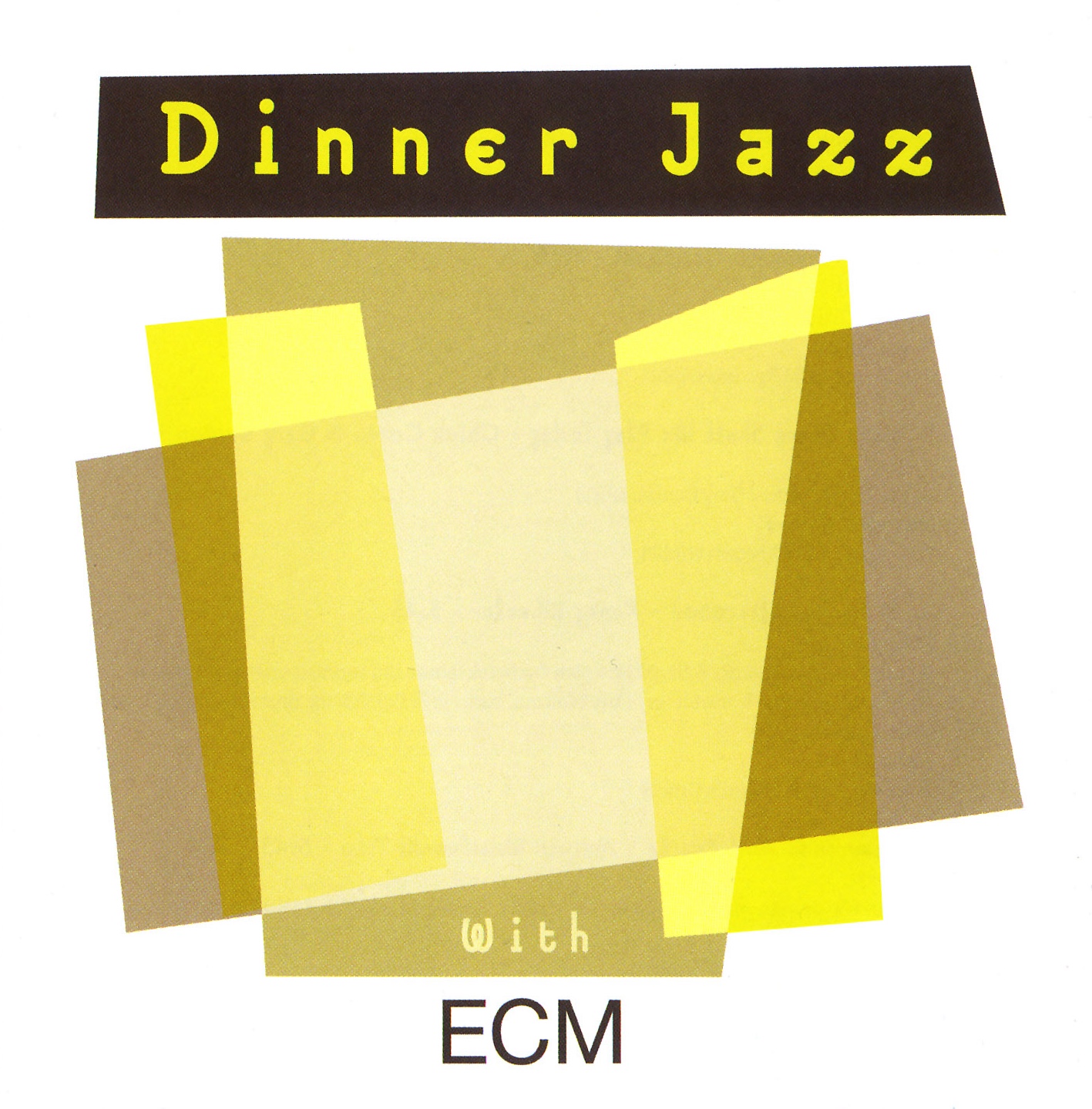
Dinner Jazz With ECM is a fascinating anomaly in the label’s history. Released in 2011, the compilation did not emerge from a conventional studio project or from Manfred Eicher’s austere curatorial imagination. It was assembled through a partnership between ECM, Universal Music Canada, and the Canadian radio station JAZZ.FM91, where host and music director Brad Barker had cultivated a popular evening program under the same title. Barker selected some of the catalog’s most accessible and contemplative recordings, drawing the album toward melody, acoustic spaciousness, and the gentler end of improvisation. The stated purpose was functional enough: music for dining, relaxing, or withdrawing from the day’s accumulations. Yet the compilation’s finest moments resist such domestication. They refuse to remain tasteful vapor hovering above the table. Each piece alters the room in which it is heard, entering the meal as an invisible guest whose conversation gradually becomes impossible to ignore.
The cover’s aesthetic is quite contrary to ECM’s usual visual grammar. It resembles packaging for a product that has mistaken refinement for soft focus. The music inside, however, has been chosen with genuine care. Pat Metheny’s “Bright Size Life” serves as the opening course, though it arrives with enough sinew to overturn any expectation of polite accompaniment. Metheny’s guitar draws its lucid geometry across the stereo field while Jaco Pastorius’s electric bass moves beneath it with feline intelligence. The performance remains smooth without becoming boneless. Its surfaces gleam, but a muscular current keeps the piece alert, giving the listener something closer to appetite than ambiance.
From there, the compilation performs its first act of culinary mischief. Instead of easing further into softness, it presents Egberto Gismonti’s “Loro,” an umami-rich piano solo from Alma, released on ECM’s CARMO imprint. Gismonti’s hands scatter sparks across the keyboard, then gather them into intricate figures of joy. Chick Corea and Gary Burton continue this recalibration with “What Game Shall We Play Today,” where piano and vibraphone turn the familiar composition into a give and take of refracted light. The tune’s richness makes the designation of dinner music feel almost mischievous. One may eat while listening, certainly, but the music keeps moving the plate.
The album then settles into a sequence governed by the slow deepening of color. Kenny Wheeler’s “3/4 in the Afternoon,” from Deer Wan, relaxes the pulse without surrendering its structural intelligence. Wheeler’s tone opens an immense interior space, while Jan Garbarek’s soprano saxophone threads a bright filament and Ralph Towner’s twelve-string guitar supplies a recollective grain. Wheeler’s playing occasionally approaches the bruised lyricism associated with Enrico Rava, making the appearance of Rava’s “The Man I Love” feel logical. Drawn from TATI, the Gershwin standard arrives steeped in monochromatic nostalgia. Tomasz Stańko’s “So Nice,” taken from Dark Eyes, completes this inward movement with a tenderness that feels almost granular. His trumpet exposes the fragile mineral structure from which such emotions are built.
At this point, the meal abandons any notion of fixed recipes. Familiar songs return altered by the musicians’ attention, their recognizable contours serving as vessels for entirely new substances. The Marcin Wasilewski Trio’s version of Prince’s “Diamonds and Pearls,” from January, rises above the song’s melodic terrain and reveals pathways concealed within the original. Bobo Stenson’s “Send in the Clowns,” from Goodbye, moves in the opposite direction, entering the Sondheim standard at the level of hesitation. Anders Jormin and Paul Motian surround Stenson with a quietude that feels carefully portioned. His lyrical gift lies partly in the ability to place freedom and restraint inside the same gesture, allowing a phrase to wander while preserving the gravity of its destination.
Charles Lloyd’s “What’s Going On,” from Lift Every Voice, expands this act of reinterpretation into something communal. John Abercrombie’s guitar and Geri Allen’s piano create interlocking planes around Lloyd’s saxophone, while Marc Johnson and Billy Hart give the performance a supple internal life. The arrangement becomes a table at which every voice retains its accent, even as the conversation acquires a shared syntax. Lloyd’s tone carries a quiet spiritual charge. He seems to breathe through the melody rather than stand outside it, finding within Marvin Gaye’s song a reservoir of unresolved compassion.
Annette Peacock’s “Circles,” as performed by Paul Bley and Mark Levinson, draws the collection into older, deeper territory. Coming from the early years of ECM, the track reveals how thoroughly the label’s sense of space had already been established. It also interrupts the easy social function implied by the compilation’s title, turning the dining table into a place of interrogation. What have we consumed without noticing? Which voices have passed through the room while our attention remained elsewhere? The track’s placement gives the anthology historical depth, but its greater value lies in the disturbance it introduces, leaving a faint metallic taste behind.
The guitar selections occupy another region of the collection, one shaped by tactile memory. Jacob Young’s “The Promise” represents a newer generation without sounding like it was inserted merely for balance. Bill Frisell’s “Lonesome” offers an acoustic delicacy whose simplicity conceals exquisite calibration. Pat Metheny returns with “Au Lait,” one of the most luminous recordings in the ECM catalog. The title suggests a final cup brought to the table, but the music pours itself into a vessel that cannot contain it.
Manu Katché’s “Pieces of Emotion,” from Playground, draws the album toward a sleek modern pulse without sacrificing compositional substance. The piece understands polish as a form of articulation rather than a method of concealment. Its surfaces are immaculate, yet tiny tensions remain active beneath them, giving the music an alertness that keeps it from dissolving into lifestyle décor. Oregon’s “Beside a Brook,” taken from the group’s 1983 self-titled album, provides a quietly eccentric conclusion to the sequence. Its atmosphere is finely detailed, concerned with the strange density of occupying one particular place at one irretrievable moment.
While, on the surface, Dinner Jazz With ECM would seem to reduce this music to a social utility, placing extraordinary performances beside plates, glasses, and the choreography of casual banter, the compilation gradually reverses that hierarchy. The meal becomes the accompaniment. Eating turns into a secondary rhythm beneath the more consequential act of listening. Across these tracks, nourishment ceases to mean the filling of an absence. It becomes an encounter with forms that cannot be possessed, only received. The musicians offer melody without enclosing it, intimacy without demanding ownership. Even the compilation’s commercial premise begins to acquire philosophical weight. A table, after all, is one of the few human inventions designed around an emptiness at its center. We gather along its perimeter and place what sustains us into that open space, trusting that others will leave enough for us to reach.
Perhaps this is the album’s accidental wisdom. Its most profound invitation has little to do with refinement, relaxation, or the cultivation of atmosphere. It asks whether attention itself might be a form of nourishment, and whether listening can teach us how to share a world without devouring it. The finest performances here preserve an inviolate region within every note, a chamber no interpretation can fully enter. To hear that boundary and honor it is to practice a rare kind of hospitality. The music sets a place for what cannot speak in our language, then waits without impatience for it to arrive.

