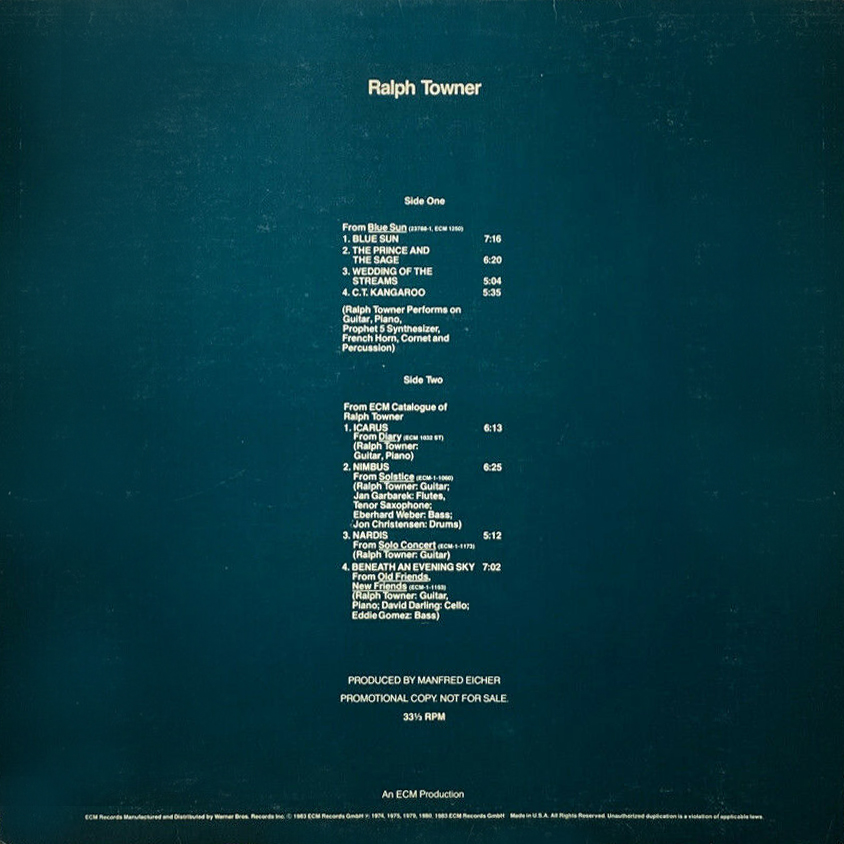
This 1983 promotional album surveys the work of one of ECM’s most enduring and quietly formative artists: Ralph Towner. Having by this point recorded for the label for nearly a decade, his presence had already defined an aesthetic in which every note appeared to have crossed a considerable interior distance before reaching the ear. This rare vinyl offers a compressed map of an imagination folding vast musical territories into the small, resonant body of a guitar.
Side One is devoted to Blue Sun (ECM 1250), presenting four of the album’s seven tracks. On that recording, Towner performs on guitar, piano, Prophet-5 synthesizer, French horn, cornet, and percussion, gathering an entire private ensemble around himself. His solo compositions already contain such harmonic density that the additional instruments often seem to externalize voices embedded within the guitar itself. In “The Prince And The Sage” and “Wedding Of The Streams,” the intimate plucking hovers before the listener with almost architectural clarity, each phrase suspended between disclosure and concealment. Towner leaves enough open space around a chord for its implications to continue multiplying after the fingers have moved elsewhere. Beneath the apparent delicacy lies something skeletal, though the bones cry out for flesh without betraying any incompleteness. The tension emerges from his inward balance, every gesture containing both its arrival and its elegant undoing.
Among the many instruments Towner employs, the Prophet-5 occasionally disturbs this inward equilibrium. Its timbre now carries undeniable period charm, yet charm can become a bright surface laid across deeper materials. The synthesizer feels unnecessary beside the extraordinary range of acoustic colors already available to him, turning a concave musical space outward until its subtle curves become reflective and glaring. “C.T. Kangaroo,” playful in conception, protrudes from the surrounding majesty with strange insistence. Its absence of guitar deepens the incongruity, as though a painted door had suddenly appeared in the middle of a stone wall. Elsewhere, Towner’s instruments seem to emerge from the same hidden source. Here, the source fractures into novelty, leaving the listener briefly stranded beneath a neon sun.
Side Two reaches backward through Towner’s catalogue, yet the sequence avoids the inert quality of a retrospective. The inevitable “Icarus,” taken from Diary (ECM 1032), appears first. Among Towner’s most beloved compositions, it has never sparkled with such effervescence as in this landmark recording. His 12-string guitar and piano engage in a dialogue that seems to divide a single intelligence into two hands dreaming separately. Plucked harmonics erupt in crystalline constellations while bursts of improvisation open beneath them, widening the piece from private reverie into a field of radiant instability. The title’s ancient ascent persists, yet Towner rejects the myth’s blunt morality. His Icarus inhabits the moment before consequence hardens into meaning, when flight remains a form of thought and the sun has not yet acquired the authority of judgment.
“Nimbus,” from Solstice (ECM 1060), begins with a transcendent 12-string passage, gently deepened by Eberhard Weber’s bass. The guitar establishes a space that feels both elevated and inward, a vaulted chamber constructed from resonance rather than stone. Flutes enter alongside drums, while bowed bass releases a grainy, liquid cry suggestive of the sarangi without imitating it. Jan Garbarek’s tenor saxophone then ignites the ensemble from within, its fire harmonious yet untamed. His deftly overdubbed flutes return and briefly widen the horizon before receding into a distance that seems less geographical than psychological. The piece keeps revising its own scale. What begins in the fingers becomes panoramic, then contracts again into a filament of breath. Towner’s gift lies partly in this elastic command of proportion. A miniature figure can contain an abyss, while an ensemble passage may suddenly narrow to the width of a nerve.
From Solo Concert (ECM 1173), “Nardis” enthralls through its ferocious attention to detail. Played on classical guitar, it plunges immediately into the composition’s themes before loosening them into a wave of transformations. Harmonies open within harmonies, and the fingerboard becomes a site of controlled astonishment. His precision never stiffens into display. Virtuosity here behaves as a kind of heightened listening, the hands discovering implications faster than language could name them. Each turn of phrase seems to step outside itself, examine its own shadow, then return altered by the encounter. The result is both exact and dream-struck, a musical proof whose equations have begun producing open variables.
Completing the survey is “Beneath An Evening Sky,” from Old Friends, New Friends (ECM 1153). David Darling’s cello and Eddie Gomez’s bass draw long arco lines around Towner’s piano, creating a dark lattice through which the later strings may pass. Towner then weaves twelve strings through six, crossing the instruments with ornamental delicacy until the distinction between accompaniment and atmosphere becomes indistinguishable. His crosshatchings do more than decorate the ensemble. They alter the density of the surrounding silence, making each pause feel inhabited by the afterimage of a chord. Beneath their elegance runs a quiet extremity, the sensation of consciousness observing itself from an impossible angle.
Taken together, these selections reveal an artist whose work repeatedly converts limitation into depth. The guitar may be a finite object of wood, wire, and tension, yet Towner treats it as an instrument for questioning the boundaries of interior space. His finest music seems to understand that beauty does not abolish uncertainty. It gives uncertainty a body intricate enough to inhabit. Even the less convincing synthetic passages clarify this achievement by contrast, exposing how powerfully Towner’s acoustic language depends upon the minute friction between touch and resistance.
Perhaps that is the deeper subject hidden within this promotional artifact. A retrospective usually asks us to look backward, but Towner’s music bends chronology into a more mysterious shape. These recordings do not preserve a completed past. They suggest that certain sounds have been waiting ahead of us, patient and fully formed, while we spend years becoming the person capable of hearing them. The needle enters the groove, yet the groove may also be entering us, inscribing a path whose destination remains invisible.