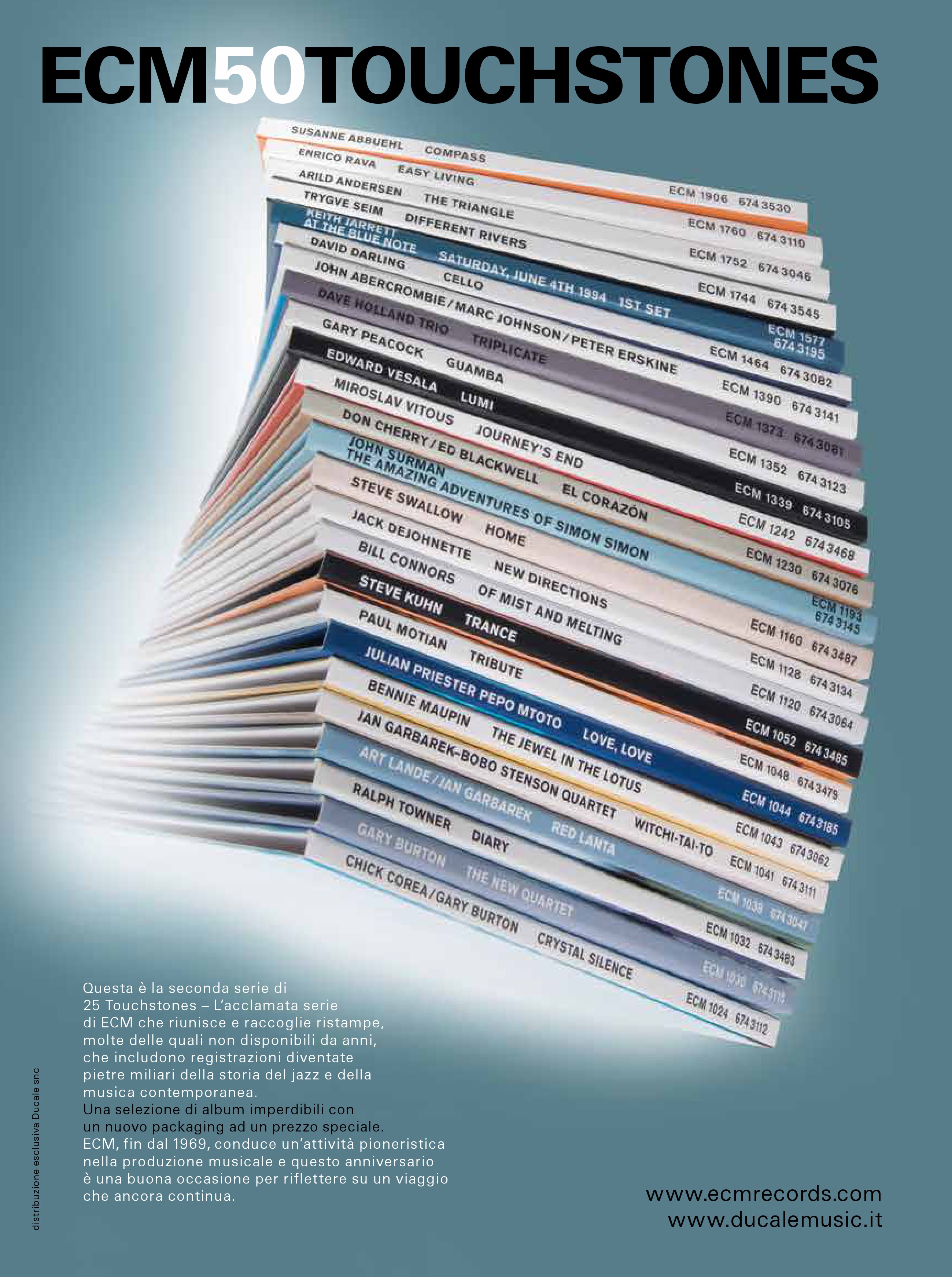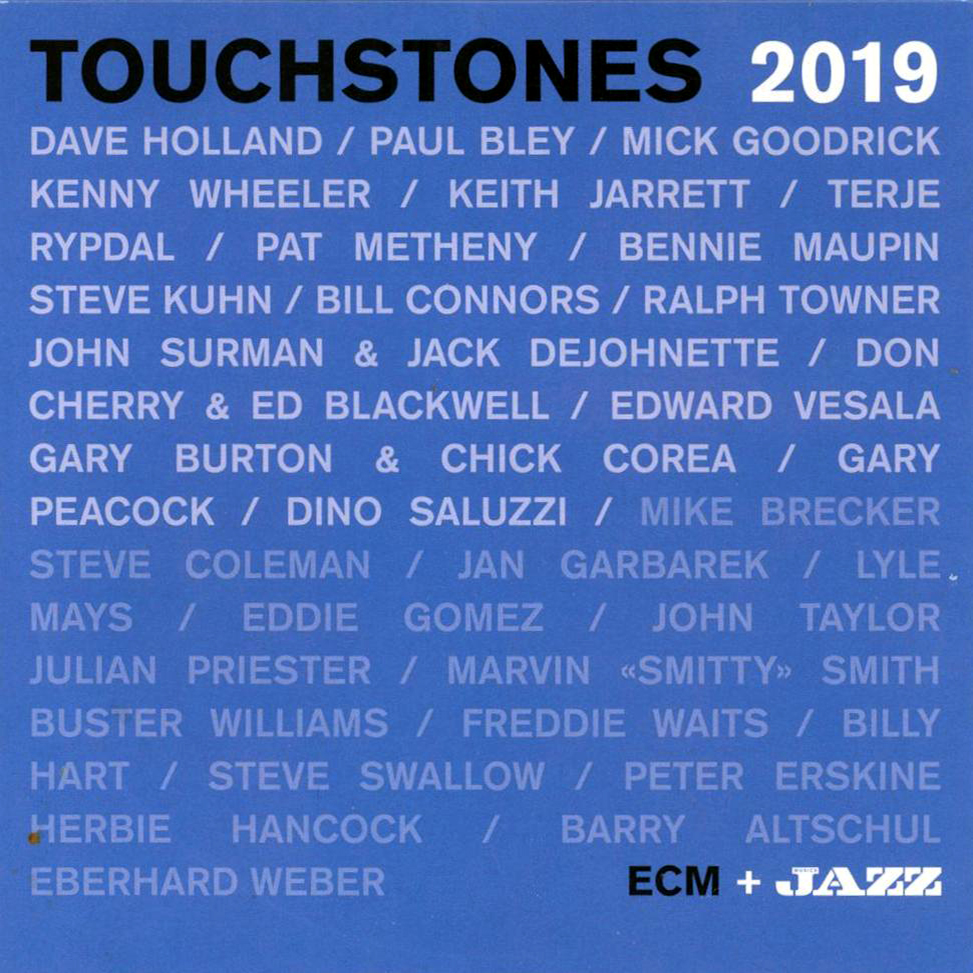
Issued by the Italian magazine Musica Jazz, this sampler was released in 2019 to commemorate ECM’s 50th anniversary. Its source was the label’s “Touchstones” campaign, a group of fifty albums returned to circulation in two waves of twenty-five, first in January and again in June. Luca Conti and Sandro Cerini selected and sequenced the tracks with care, producing more than a commemorative digest. Earlier archival efforts, including the “Re:Solutions” series begun in 2014, had stalled after a handful of releases. “50 for the 50th,” by contrast, fulfilled its duties with a flourish.
No obvious principle governs the 50 albums. “Reissue” is too blunt a word, since some titles never disappeared from the catalogue. Recovery from oblivion also fails, because several remained obtainable and had never become collectors’ relics. The project is better received as a testimony in continuity with the eight volumes of Selected Signs curated by Manfred Eicher between 1997 and 2014. The Musica Jazz disc compresses that selective gesture into a second order of selection.
Any attempt to summarize ECM revives the old dispute over its identity. Enthusiasts hear an aesthetic intelligence shaped by Eicher’s vigilance over sonority, pacing, silence, and spatial depth. Skeptics hear a manner hardened into doctrine, a cosmopolitan refinement whose polished surfaces risk severing signifier from signified. In that reading, the label manufactures a certain idea of seriousness, even a lifestyle of austere sleeves and carefully rationed resonance.
Wherever one might fall on that spectrum, the chronology here leans heavily toward the 1970s, which account for nearly a third of the total, while the 1970s and 1980s together make up well over half. Those were the decades in which ECM’s identity moved from hypothesis to institution. Paul Bley’s Ballads (ECM 1010) pursued abstract beauty through ensembles without rigid hierarchy. Kenny Wheeler’s Double, Double You (ECM 1262) made individuality and collectivity feel inseparable. John Surman and Jack DeJohnette’s The Amazing Adventures of Simon Simon (ECM 1193) still carries the tensile freshness of an idea discovered in real time. Keith Jarrett’s At the Blue Note: The Complete Recordings (ECM 1575–80) captures a trio many regard at its summit, while the young Pat Metheny of Watercolors (ECM 1097) appears in a piece whose oblique contours anticipate some of Bill Frisell’s later vocabulary.
The recovered gems deepen that portrait. Lumi (ECM 1339), by Edward Vesala’s Sound & Fury, returns with its nerves exposed. Bennie Maupin’s The Jewel in the Lotus (ECM 1043) had long circulated as a coveted object despite a 2007 reissue. Mick Goodrick’s In Pas(s)ing (ECM 1139) and Bill Connors’ Of Mist and Melting (ECM 1120) occupy neighboring regions where guitar touch becomes psychosomatic. Alongside them stand Crystal Silence (ECM 1024) by Gary Burton and Chick Corea, Ralph Towner’s Diary (ECM 1032), Dave Holland’s Seeds of Time (ECM 1292), Steve Kuhn’s Trance (ECM 1052), and Dino Saluzzi’s Andina (ECM 1375). Gary Peacock’s Guamba (ECM 1352), Don Cherry and Ed Blackwell’s El Corazón (ECM 1230), and Terje Rypdal & The Chasers’ Blue (ECM 1346) reveal Eicher’s gift for assemblies whose chemistry seems ordained after the fact.
The chosen tracks often resist the obvious route. “Falling Grace” is taken from Crystal Silence rather than the more expected title piece, “Señor Mouse,” or “What Game Shall We Play Today.” This gesture acquires electricity through the door it leaves closed so another corridor may appear.
Dave Holland’s “Homecoming” opens that corridor with jubilant precision. The piece turns on every coin struck from the bassist’s strings, curving according to an internal geometry. The horns coil around the pulse, with Kenny Wheeler lifting the solo language into a rarer pressure. Paul Bley’s “Circles,” alongside bassist Mark Levinson, enters carrying the debris of a forgotten battle. Bley moves through twisted avenues of thought, each passage narrowing toward an answer that withdraws upon approach.
Mick Goodrick’s “Summer Band Camp” follows with brightness sharpened by memory. Brief yet densely alive, it glows through Eddie Gomez and Jack DeJohnette, while John Surman’s soprano smiles. Gomez’s doubled figures generate a chorused rhythmic aphasia, and Goodrick’s picking activates a warm, comforting twang. Kenny Wheeler’s “W. W.” gathers further heat once the rhythm section takes hold. The horns are exquisitely attuned, especially Michael Brecker’s soaring tenor, which consumes its available oxygen and leaves Holland moving among the residue. Keith Jarrett’s “Bop-Be” answers with compact mastery, its melody, timing, and whimsical freedom moving with uncanny ease.
“Kompet Går” by Terje Rypdal & The Chasers turns bass motion into gravitational law. With Bjørn Kjellemyr and Audun Kleive, Rypdal creates a trio sound whose cohesion feels incandescent. His guitar begins in manic pursuit, then broadens into long aerial lines suspended over the rhythm section’s undertow. Pat Metheny’s “Florida Greeting Song” follows naturally, the first part of an evocative suite in which lyricism and propulsion continually exchange authority.
Bennie Maupin’s “Past Is Past” drifts into romantic territory, with Herbie Hancock supplying irresistible fullness amid flowering percussion. The title is less secure than it appears. The past keeps touching the present through the wall. Steve Kuhn’s “Life’s Backward Glance” turns that pressure into metaphysical theater, folding memory inward until origin and aftermath blur. Bill Connors pulls the sequence from that morose recursion with “Café Vue,” where Jan Garbarek’s tenor cuts around the acoustic guitar with surgical elegance.
Ralph Towner’s “The Silence of a Candle” finds the guitarist at the piano, tracing dusk-lit waves through a patient language of withheld speech. It prepares the tonal contrasts of Surman and DeJohnette’s “Merry Pranks (The Jester’s Song),” where bass clarinet and cymbals trade fables across three enchanted minutes. Don Cherry and Ed Blackwell’s “Roland Alphonso” extends the spell through delicate melodica reggae and rolling snare. Edward Vesala and Sound & Fury’s “Calypso Bulbosa” is rougher, with electric guitar abrasion clinging to every clouded facet. Birdcalls and earthbound reeds occupy the same forest, twisting through distorted reflections.
The final sequence begins with Burton and Corea’s exhilarating “Falling Grace.” Gary Peacock’s “Requiem” follows by bringing a merciful heart forward, bass and drums settling low before Garbarek’s sharpened interventions cut through tenderness. Dino Saluzzi closes with “…And the Years Went By,” a solo bandoneón meditation that polishes the mirror of retrospection without pretending it can tell the truth.
That final gesture clarifies the collection’s central conundrum. Touchstones appears to survey a label’s past, yet it is concerned with the instability of remembrance. Every such attempt manufactures ancestry to some extent, and ECM’s 50 years no longer resemble a line running from origin to anniversary. They form an interior whose rooms change dimension whenever the mind enters them. Memory may belong neither to those who lived an event nor to those who inherit it, but to the infinitesimal delay between sound and recognition, where the archive becomes an organ of perception. The compression mainly removes extended elaborations while retaining every album, track, musician, and interpretive thread from the longer revision.