

Promotional samplers are made with an expiration date hidden inside them. They announce new releases, then yield to the next campaign. The four rare ECM/Polydor records gathered under the “New Music” banner have resisted that planned obsolescence. Originally pressed for radio stations and in-store programming, they now reach us as documents of a label defining the dimensions of its own voice one release at a time.
Each track has been lifted from its native sequence and asked to speak in unfamiliar company. That displacement creates a second composition at the level of curation, with affinity and friction doing the work of continuity. These compilations let us hear taste becoming history while it is still provisional and curious, with surprise left in its bloodstream. Their scarcity explains the collector’s interest; their deeper fascination lies in the changed terms of attention they demand. Music, once selected to guide a purchase, has become a route back to the act of choosing itself.
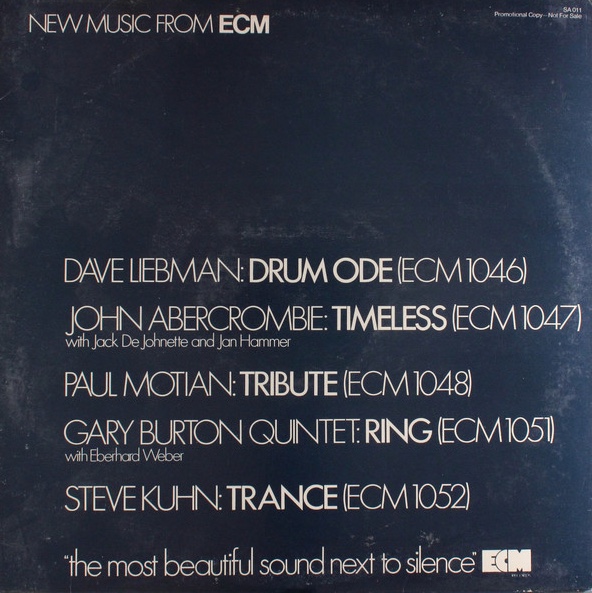
New Music From ECM (SA 011)
John Abercrombie’s Timeless (ECM 1046) gives the sampler its deepest charge. In “Red And Orange,” Bach seems to have slipped into the 1970s under cover of jazz, his contrapuntal discipline concealing a private pulse. “Love Song” begins the collection’s exquisite conversation between piano and acoustic guitar. After the organ has furrowed the listener’s attention, the piano arrives as release, giving the guitar room to ripen inside its glow. The sampler proceeds by association rather than decree, each excerpt opening a door that the next quietly declines to close.
Steve Kuhn’s Trance (ECM 1052) draws that inward motion tighter. The elegant title track compresses an epic spell into an impossibly modest span. Beneath it, a prominent bass line lays down an airy ostinato, as Kuhn prises open the music’s molten center. “Something Everywhere” turns toward a hip electric idiom, with Steve Swallow carrying much of the argument. Kuhn briefly seizes the floor through quick key changes while Jack DeJohnette keeps every seam alive.
The Gary Burton Quartet’s Ring (ECM 1051) contributes “Unfinished Sympathy,” more than a verbal wink and a gorgeous vessel for Goodrick’s rolling solos. A recurring guitar motif circles an idea it cannot quite complete, preserving the tenderness of a thought still getting to know itself. On Paul Motian’s Tribute (ECM 1048), “Victoria” entwines flowering classical guitar with tenderly placed percussion beneath Carlos Ward’s smoldering alto. The scene feels nocturnal and urban, its darkness holding messages that refuse translation.
Dave Liebman’s Drum Ode (ECM 1046) gives us “Loft Dance.” Richie Beirach’s electric piano and John Abercrombie’s lively guitar feed the saxophonist’s infectious rhythms. Gene Perla supplies the ballast, while whistles loosen the music’s gravity. Baked to a crisp and scathingly uplifting, the performance keeps its feet in the soil even as its upper frequencies test the air above it. That tension prepares the freedom explored by the next sampler.
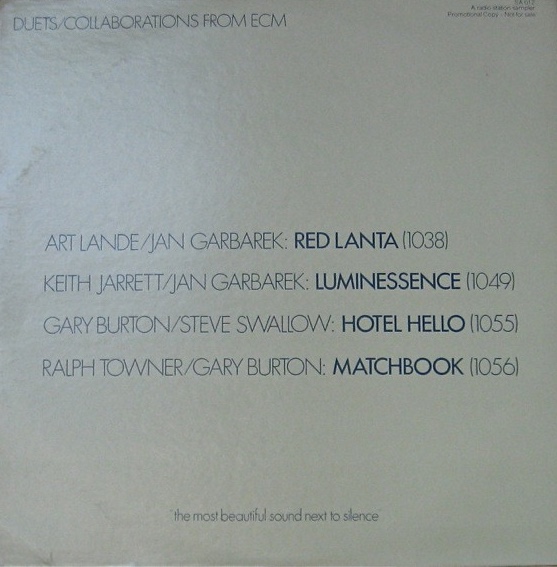
Duets/Collaborations From ECM (SA 012)
The cover of Duets/Collaborations From ECM (SA 012) includes Luminessence (ECM 1049), although no selection from it appears on the record, presumably because of a printing error. That small absence suits a collection devoted to the charged space between musicians, where what remains unsaid can shape the encounter.
Art Lande and Jan Garbarek’s Red Lanta (ECM 1038) folds Edvard Grieg into jazz improvisation and gentle abstraction. Lande’s writing seems to yearn for larger arrangements, yet the intimacy of piano paired with flute or reed gives the music its lucid charm. “Waltz for A” begins the sampling; “Meanwhile” and “Quintennaissance” gaze forward through a past-inflected vocabulary. Garbarek’s flute on the last is bucolic and whimsical without surrendering melodic purpose.
Keith Jarrett and Jack DeJohnette renegotiate balance in “Sounds of Peru / Submergence / Awakening,” selected from Ruta and Daitya (ECM 1021). Piano and hand drums settle into the groove they have been seeking. Jarrett grants DeJohnette greater room, inviting the percussion out of the margins and into the music’s living center. His delighted coos prepare a passage in which grinding bass notes contend with the running right hand.
On Chick Corea and Gary Burton’s Crystal Silence (ECM 1024), “Desert Air” and “Falling Grace” reveal a partnership capable of hearing thought before it becomes gesture. Their exhilaration gains depth from the shadows they articulate. Gary Burton and Steve Swallow’s Hotel Hello (ECM 1055) offers another kind of intimacy. “Chelsea Bells (For Hern)” opens a shaded affair whose distant promise of love glints across a watery surface, while “Sweet Henry” carries the genial polish of a seventies television theme with precisely enough kitsch to sharpen its smile.
Ralph Towner and Gary Burton complete the arc with Matchbook (ECM 1056). Their pared-down “Icarus” reveals fresh paths through Towner’s familiar composition, Burton’s metallic fervor pressing against the softer piano version on Diary (ECM 1032). For the title track, Towner weaves a matchbook into his guitar strings. A humble object becomes the hinge of an exchange whose precision never curbs its mischief.
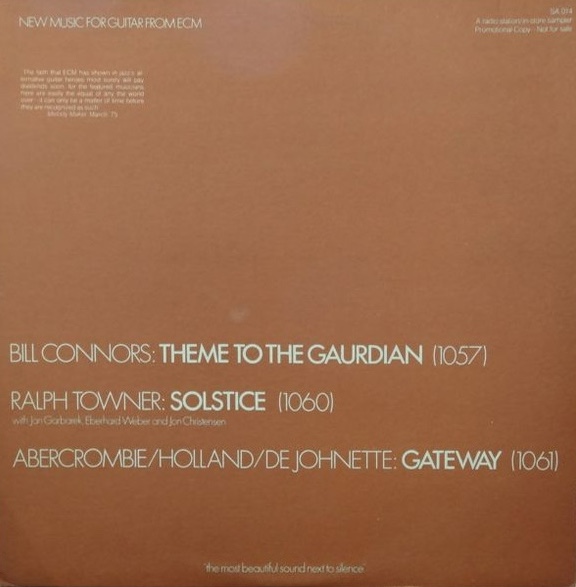
New Music For Guitar From ECM (SA 014)
After the conversational poise of the duets, New Music For Guitar From ECM (SA 014) brings the instrument’s many selves into focus. Ralph Towner’s Solstice (ECM 1060) begins with “Nimbus,” where a transcendental 12-string solo receives gentle dimensional support from Eberhard Weber. The piece opens into flutes and drums before a bowed bass cries with the grating fluidity of a sarangi. Garbarek’s saxophone enters with harmonious fire, and the overdubbed flutes briefly unfurl before retreating. “Piscean Dance” gives Towner’s 12-string a supple rhythmic partner in Jon Christensen, while “Winter Solstice” narrows the field to classical guitar and Jan Garbarek’s soprano saxophone, each voice illuminating the grain of the other. Towner gives resonance a second life, allowing it to hover at the edge of every phrase.
Bill Connors approaches solitude more directly on Theme To The Gaurdian (ECM 1057). Having left Chick Corea’s Return to Forever in 1974, he exchanged electric force for acoustic concentration and recorded his first solo album with virtually no classical training. That history lends the performance an air of self-invention. Connors overdubs his way through a soulful set of guitar-scapes, his gossamer tone supported by melodic lines that remain purposeful yet elastic. “Song For A Crow” sets dissonant chords against emotionally fervent playing, its tactile details bearing Connors’s unmistakable touch. The title track gathers time-worn motifs until their cumulative form appears one mosaic tile at a time.
On Gateway (ECM 1061), John Abercrombie joins Dave Holland and Jack DeJohnette as “Sorcery 1” moves from tentative unscriptedness toward a ring of fire, with the guitar serving as a possessed medium. “Back-Woods Song” inhabits murkier ground, foreshadowing a mood later associated with Bill Frisell. Holland’s solo ricochets off the cymbals after Abercrombie’s wonderfully unsettling turn. This is viscous jazz, opaque and alive with unseen motion, a fertile darkness beneath the guitar sampler’s polished surface.
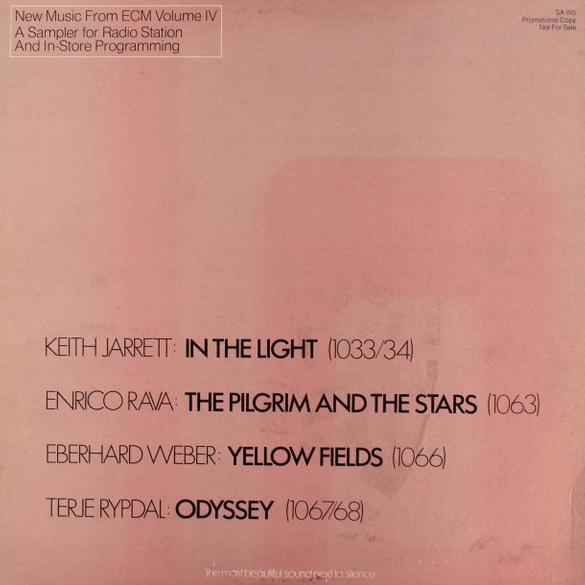
New Music From ECM Volume IV (SA 015)
New Music From ECM Volume IV (SA 015) turns outward without surrendering inward detail. Eberhard Weber’s Yellow Fields (ECM 1066) begins with “Touch,” a groove-oriented game between piano and bass. Synth strings enlarge the field and anticipate Weber’s later orchestral collaborations. Charlie Mariano’s soprano carries bright energy as those strings turn into trembling sirens, while Jon Christensen gives the music its spine. Weber remains subdued, allowing Mariano to guide the piece toward a quick fadeout whose incompletion feels deliberate.
The title track of Weber’s The Colours Of Chloë (ECM 1042) turns to a more spectral register. An ethereal ocarina circles into Rainer Brüninghaus’s resplendent piano solo until color seems almost audible. Two selections from Keith Jarrett’s classical crossover album In the Light (ECM 1033/34) extend that spectrum. “Fughata For Harpsichord,” played by Jarrett on piano, cuts sharp angles through a gospel-Baroque pastiche. “Short Piece For Guitar And Strings,” with Ralph Towner on nylon strings, reveals a quieter depth in Jarrett’s creative reach.
Terje Rypdal’s magnum opus Odyssey (ECM 1067/68) yields “Darkness Falls,” whose plangent cry moves through a terrain of emotional clarity without settling into a single contour. “Over Birkerot” is punchier, Rypdal standing firm amid a chain of horn blasts before a cathartic rock-out sends the piece beyond restraint.
Enrico Rava’s The Pilgrim and the Stars (ECM 1063) brings the journey to its most human scale. In “Blancasnow,” his trumpet floats above the murky pull of the rhythm section, then draws the music toward richer melodic ground. “Parks” finds him at his most incisive, his lively exchange with acoustic guitar carrying a nostalgia whose origin cannot be named. Rava never treats lyricism as retreat. His tone keeps a blade beneath its warmth, and the guitar answers by turning accompaniment into a second line of inquiry. Their dialogue leaves the sampler poised in alertness rather than repose.
These records were conceived as arrows, each one pointing beyond itself toward the full albums it advertised. Time has reversed their direction. The promotional object now commands attention precisely because no one expected it to need an afterlife, and its former disposability has become part of its aura.
That reversal exposes something quietly unsettling about preservation. We tend to imagine an archive as a defense against loss, yet it can preserve an object while allowing the form of attention it requires to disappear. Vinyl can survive inside a sleeve; patient listening has no such shelter. It must be remade each time someone consents to the duration of a phrase or hears curation as a creative act rather than an interruption of one.

