

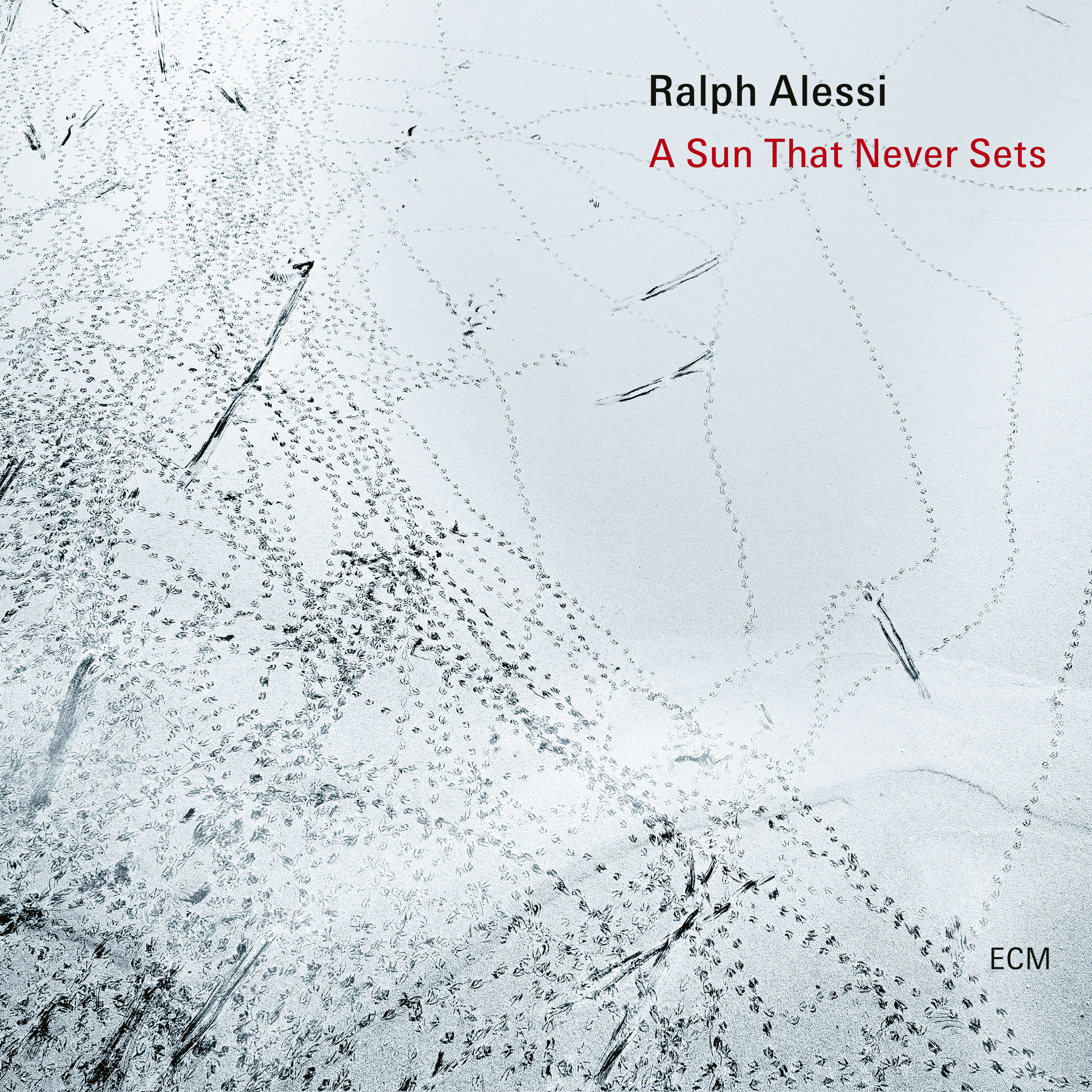
Ralph Alessi
A Sun That Never Sets
Ralph Alessi trumpet
Joseph Alessi trombone
Matt Mitchell piano
John Hébert double bass
Ches Smith drums, vibraphone
Recorded February 2025
Oktaven Audio Studio, Mount Vernon, NY
Engineer: Ryan Streber
Mixed by Manfred Eicher, Ralph Alessi, and Michael Hinreiner (engineer)
Bavaria Musikstudios, München
Cover design: Sascha Kleis
Produced by Ralph Alessi and Manfred Eicher
Release date: July 3, 2026
On A Sun That Never Sets, Ralph Alessi expands the architecture of his quartet by adding a second horn: his brother Joseph, a trombonist best known for his work with the New York Philharmonic. Their shared history gives the music an immediate intimacy, but the album draws its energy from the differences between their voices. Joseph is more than a featured guest. His burnished tone changes the ensemble’s center of gravity and reveals new colors in Ralph’s compositions. The result is an album concerned with kinship, not only between brothers but also between freedom and form.
Pianist Matt Mitchell and bassist John Hébert return alongside Ches Smith, who moves between drums and vibraphone. The musicians navigate Alessi’s writing with confidence, allowing angular ideas to open into clearings where lyricism can emerge without becoming sentimental. The influences of Ornette Coleman and Igor Stravinsky remain present without sounding imitative. Coleman’s example encourages melodic liberty, while Stravinsky’s is evident in the music’s rhythmic disruptions and structural precision. These forces help the album sound cerebral but never clinical. Each musician receives ample space, yet every contribution remains connected to the group’s larger movement.
The title track establishes this language through a precise theme that gradually loosens into exploratory improvisation. Smith’s vibraphone and Hébert’s bass approach the music from different angles, creating productive uncertainty over where its rhythmic and harmonic direction originates. Mitchell supports Alessi’s trumpet without restricting it, enabling the bandleader to move beyond the tune’s apparent boundaries while retaining a thread back to its central idea. The performance captures the strength of a quintet that can surrender a fixed destination without losing its sense of direction. Unity comes through the negotiation of contrasting approaches rather than strict agreement.
Several pieces turn that tension inward. “Nothing Is Dead” suspends piano and vibraphone within an elusive harmonic atmosphere, allowing its meaning to emerge gradually. Alessi’s trumpet is assured but guarded, conveying emotional weight without forcing a single interpretation. In “Ether,” Smith’s brushed drumming opens space beneath Mitchell’s wide range of touch, attracting fragments of memory into the present.
The closing “Behind Clouds” extends this fascination with concealed presence. Over Hébert’s steady, intoning bass, the ensemble proceeds with melodic care. Placed beside “Nothing Is Dead,” it creates correspondence across the record, as both compositions examine how absence can remain active.
The brothers’ most prominent duets, “Relaxed Misery” and “Of Trees (Variations on a Theme by TB),” bring the album’s interest in inherited language into sharper focus. Trumpet and trombone circle one another through muted exchanges, sometimes converging and sometimes letting the space between them carry the conversation. “Relaxed Misery” earns the sardonic tension of its title, turning discomfort into buoyancy and giving Ralph room for some of his most animated soloing. “Of Trees” is more oblique, developing its theme through disparities that keep the source partly hidden. The pieces share a jaunty, alert quality, but their emotional charge comes from the brothers’ ability to recognize and challenge one another in real time.
A familial current also runs through “Twichild,” “Slow Dancing Bear” and “Duck Face,” whose titles suggest private humor and childhood memory. Each uses wonder as a disciplined way of reconsidering familiar materials. “Twichild” follows delicate, winding lines toward a more inward mood, with Ralph’s precision made unusually vulnerable. “Slow Dancing Bear” finds tenderness in an awkward rhythmic gait, allowing weight and grace to coexist. On “Duck Face,” Hébert provides a perceptive countervoice before Smith’s solo releases the tune from its established footing. Together, the tracks treat play as a vital form of communication.
“Sweet Spot” occupies a warmer region. Its spacious, glowing color recalls Enrico Rava, while Mitchell’s piano creates a suspended foundation beneath the horns. Joseph’s trombone contributes a dusky depth that approaches a lullaby without becoming overly sweet. Small harmonic disturbances keep the tune’s balance alive. “Transitional Imagery,” by contrast, converts instability into propulsion. Mitchell and the rhythm section move with fierce clarity, shapeshifting as they proceed. The title could describe Alessi’s broader method: his music is most alive when one shape gives way to another.
Across these 11 originals, Alessi’s fluency as a player and composer gains a more varied context. The expanded ensemble shows how strongly his music depends on the willingness to offer an unfinished thought and let another musician transform it. His writing gives each player a distinct orbit while maintaining a field of mutual consequence. Freedom, therefore, carries responsibility, since every spontaneous gesture changes what is available to the others.

