

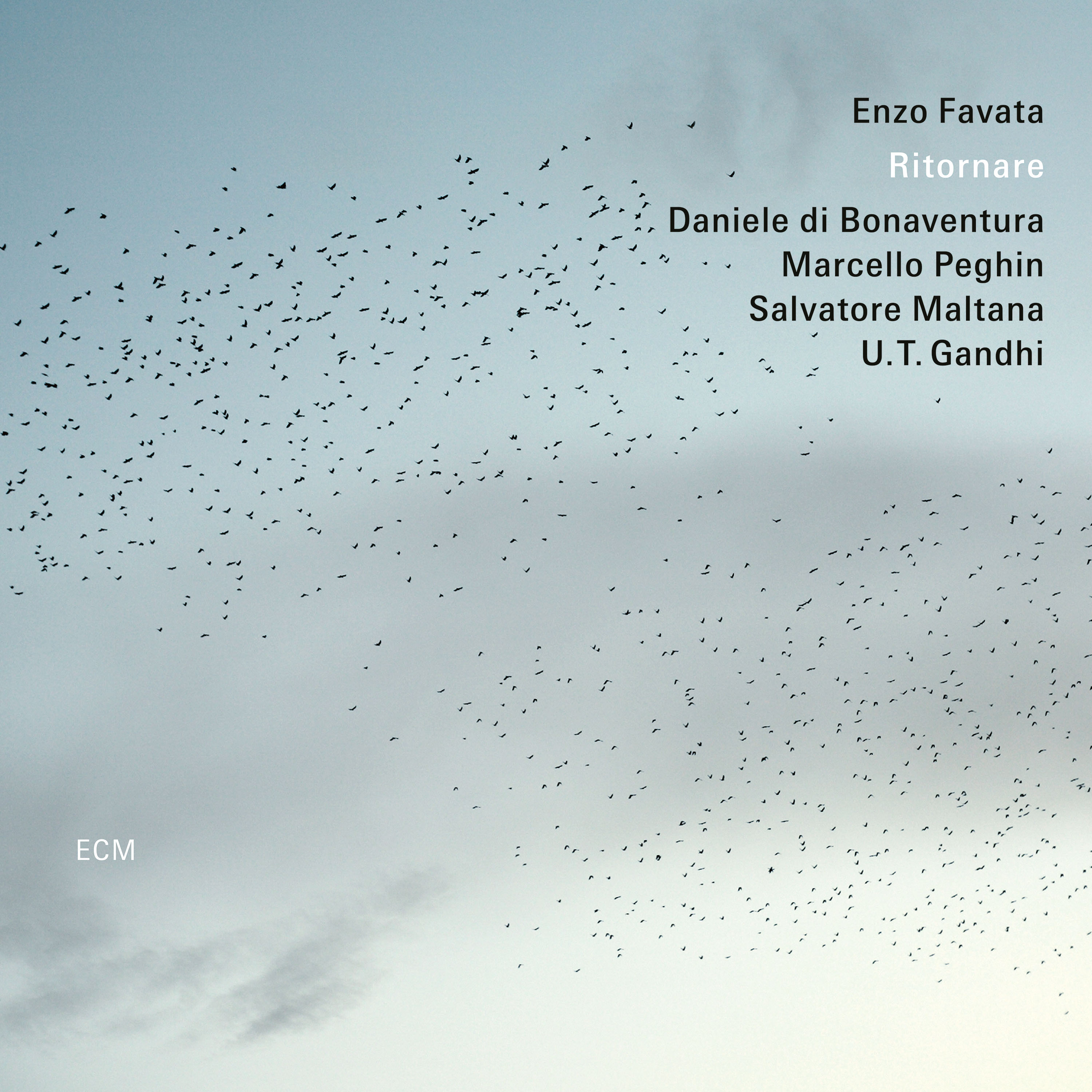
Enzo Favata
Ritornare
Enzo Favata soprano saxophone, clarinet, bass clarinet
Daniele di Bonaventura bandoneón
Marcello Peghin ten-string guitar
Salvatore Maltana double bass
U.T. Gandhi drums
Recorded January 2026
Bavaria Musikstudios, Munich
Engineer: Stefano Amerio
Cover photo: Jan Kricke
Produced by Manfred Eicher
Release date: September 18, 2026
Every return contains a betrayal. The place may remain where it was, yet the person approaching has been revised by distance, while memory has moved the streets. On Ritornare, Enzo Favata treats return as imaginative recovery that transforms whatever it retrieves. Music carries landscape within experience, with literature serving as a compass across waters whose histories mingle beneath imposed names. The title points backward, though the album keeps opening forward. Home survives as an activity of attention and belonging that has quietly learned a foreign language in one’s absence.
Favata has long listened for submerged connections. Born in Alghero, Sardinia, in 1956, the saxophonist and clarinetist developed a musical language shaped by his native island, then widened it through the greater Mediterranean and distant shores. Atlantico, formed in 1999, gathered impressions during South American travels while attending to African inheritances across the ocean. “Tukuman” makes this migratory history palpable. Brushed drums and double bass establish a softly revolving ground, soon deepened by Daniel di Bonaventura’s bandoneón. Marcello Peghin’s guitar rises through it, and Favata’s soprano traces the theme in lucid arcs. The tune begins in transit, already pondering somewhere beyond its horizon.
Such movement never requires Atlantico to surrender its center. Favata and Peghin share decades of collaboration rooted in southern Italy, while bassist Salvatore Maltana and drummer U.T. Gandhi join di Bonaventura in a collective whose music expands without compromising its infrastructure. On the above-mentioned “Tukuman,” Favata dances through sudden turns as di Bonaventura weaves through a zoetrope of half-recovered scenes. A locomotive pulse gathers below the surface; elsewhere, the ensemble skims forward on the tensile calm of open water. Their travel is purposeful without submitting to destination, driven by the joy of motion itself.
The album’s journeys are as much literary as they are musical. Favata has recognized portions of his imaginative territory in Isabel Allende and Jorge Luis Borges, whose visible worlds admit secret laws. Gabriel García Márquez occupies another canopy in this forest of affinities. Favata describes Atlantico’s music as suspended between dream and reality, and “El Sur” dwells within that tension. Its melody seems to have waited inside the listener for years, requiring these musicians to pronounce it. Favata’s soprano carries a warm tone through each key change, altering its shape as the harmony breaks into tessellated color. No player merely accompanies another. The music passes among them as collective evidence from a dream whose witnesses recall different aspects of the same event.
That equality of attention gives the album much of its emotional authority. “Escuchame” brings Favata’s clarinet forward with grave tenderness, carrying a winding theme that seems to hold dust in its mouth and an old key beneath its tongue. Gandhi places minute percussive touches around it, while Maltana’s bass turns through the harmony with unforced intelligence. Di Bonaventura and Peghin shelter the theme without enclosing it. The performance reveals an ethical awareness in which each voice makes space for another to become more fully itself. Such intimacy rises from years spent hearing the fraction of a second before a friend decides where to place a note.
The quintet’s history therefore enters the recording as an invisible player. In “Donde nace el viento,” Peghin’s delicate strumming draws reverie into three dimensions, each chord swaying above an imagined Mediterranean courtyard. Favata’s soprano gives the moving air a throat, while marine salt flavors every unspoken word with distant relatives and childhoods spent along the shore. Recorded at Bavaria Studios in Munich in January 2026 with Manfred Eicher producing, Ritornare is Favata’s first album for ECM and Atlantico’s most finely illuminated acoustic statement. Eicher allows silence to acquire mass while every tone retains its contour. Sardinia remains audible beneath the compositions, and other continents move within their rhythmic memory as currents rather than destinations.
This spacious acoustic world carries echoes of classic ECM sessions without collapsing into homage. Ralph Towner and Egberto Gismonti can be sensed in its meeting of lyricism and space. John Surman occupies a nearby constellation, his shadow passing across the low reeds. “Sine nomine” opens a cinematic chamber where Dino Saluzzi’s tenderness meets the patient visual imagination associated with Theo Angelopoulos. Yet influence behaves as nourishment rather than costume. Associations surface and blur into Atlantico’s own language, one assembled from human contact and therefore resistant to distillation. The composition’s title, therefore, feels apt. It moves through identities without accepting permanent residence in any of them, leaving an outline that the mind continues to fill with speculation.
“Milonga del Sol” extends that cinematic feeling through a haunted dance, holding sweetness near an ache it never attempts to cure. Eleni Karaindrou’s bittersweet gravity hovers at the edge, then Favata veers into improvisational flight and loosens the reference’s claim. His phrases persuade gravity to reconsider its loyalties while the band maintains an exquisite balance between ritual and surprise. Di Bonaventura compresses whole lifetimes of longing into the bellows, and Peghin answers with translucent chords. Gandhi and Maltana keep the dance moving from centuries beneath their feet.
Such ambiguity gives Ritornare its peculiar attraction. The music recognizes places the listener has never visited, awakening the impression of a past that belongs to no single lineage. “Ventana” sharpens that paradox through an unprecedented view of a landscape already seen through other eyes. Its window also examines the act of looking, the secret appetite through which attention changes its object. Favata frames the view, then disrupts it, before the ensemble follows him into a terrain where recognition morphs into estrangement. Familiar materials are angled until their concealed surfaces catch the light. The piece asks how long a life can contain beauty before the mind finally notices, leaving a window open inside the question and the observer exposed to an answering gaze.
“Albatros” gathers the album’s virtues into a final statement of astonishing restraint. The tender throatiness of bass clarinet gives the piece an earthbound gait that brightens from within. When the soprano opens above it, the instrument spreads a wing across the morning and calls toward the sea, a prayer for the hidden catch to rise. The ensemble avoids spectacle, allowing desire to lose its dominion in favor of something selfless. Impeccably performed and recorded, Ritornare contains some of the most enduring melodies to emerge from a Manfred Eicher production in recent years, making it a persuasive contender for ECM album of the year. Its deeper triumph resists ranking. Perhaps the self is only the harbor’s temporary arrangement of ropes and salt-worn voices, held together long enough for one vessel to recognize another. Far beneath that exchange, the drowned map turns over in its sleep, and every border drawn upon it opens a patient ear.

