

Verily, verily, I say unto you, except a corn of wheat fall into the ground and die, it abideth alone:
but if it die, it bringeth forth much fruit.
–John 12:24
In The Karamazov Brothers, a grievance can become so precious that giving it up feels like a kind of death. Dostoevsky’s people protect their resentments with an ingenuity they seldom extend to anyone’s happiness, then wonder why their lives have grown uninhabitable. Before we meet the family, the Gospel places something almost weightless in our hands. Christ’s words promise life for others through his death, and the epigraph carries that promise into a household where giving is inseparable from keeping accounts. The grain’s descent also suggests an inward surrender. To let another life reach us, we must relinquish the self we have made indispensable. This prospect terrifies the Karamazovs more consistently than the possibility of doing wrong. They can confess to almost anything, provided the confession lets them stay as they are.
The family offers ample occasions for such confession. Fyodor Pavlovich Karamazov has allowed fatherhood to happen around him, leaving others to discover that his children require care. When his sons return to the provincial town where he lives, their reunion exposes debts no sum of money could settle. Dmitry, the eldest son, quarrels with him over an inheritance, a dispute entangled with their mutual desire for Grushenka, a young woman living under an elderly merchant’s protection. Each man imagines that her choice will determine his worth. Ivan, the middle son, finds little rest in the things his intelligence can explain, while his youngest brother Alyosha, a monastic novice, arrives bearing an affection the family scarcely knows how to receive. The mysterious killing of the family patriarch eventually brings these relations before the law. Yet I found the human follies, including the murder and subsequent trial, the least interesting aspect of a novel so attentive to them. Their unfolding reveals an impoverishment that could otherwise pass for ordinary life. We spend hundreds of pages examining responsibility for a single act, already knowing the culprit, while the daily evasion of it continues almost undisturbed.
Fyodor Pavlovich makes that evasion uproariously entertaining. He anticipates contempt and hastens to justify it, behaving disgracefully before anyone can wound him by expecting better. In the presence of Zosima, the starets whom Alyosha reveres, he confesses to the buffoonery that has made him increasingly difficult to address. How does one speak to someone who turns his own exposure into another performance? Zosima’s answer keeps returning beneath the more elaborate arguments: “The important thing is not to lie to yourself.” An inward lie can survive the collapse of every outward excuse. The father’s candor offers him a comfortable arrangement with wickedness, making an admitted fault seem beyond amendment. Alyosha runs a hand across the watery surface of that comfort. Fyodor is still moved by someone who sees his degradation without enjoying it. This small response complicates our wish to have finished understanding an appalling man.
The household’s religious conversations reveal a quieter estrangement in Smerdyakov, its cook and Fyodor Pavlovich’s rumored illegitimate son, whose upbringing has mixed care with contempt. The servant Grigory, who has raised him, helps preserve his life yet assaults the dignity of the child he has taken in. Under such instruction, sacred language is something one learns to survive. Smerdyakov’s later arguments about renouncing Christianity search ingeniously for escape clauses. Perhaps an inward loss of faith has already removed him from the religion he would outwardly deny. His reasoning turns confession inside out, preparing an acquittal before conscience can speak. It is disturbing, though the adults who helped educate him deserve no easy refuge in our disapproval. We hear what can happen to a religious question in a house where the one asking it has already been made to feel unwelcome.
Dmitry’s struggle with himself is more violent. His declarations frequently outrun his ability to live by them, and his abasement retains the extravagance of his pride. He recognizes the sacred even as he rushes toward its desecration. The customary division of the brothers into separate faculties leaves too much living matter outside the arrangement. Dmitry thinks through the very passions that scatter his thought. “You can be in love even while hating someone,” he tells Alyosha, admitting an intimacy in which desire clings to its object while refusing to care for her. His hunger for beauty contains a religious longing, although he repeatedly makes others bear the cost of his search. The question remains whether this abundance can bear fruit. For that to happen, remorse would have to outlast the pleasure of declaring himself ruined. A changed life must eventually begin on a morning when nobody is present to admire the change.
Katerina Ivanovna, Dmitry’s fiancée, gives this problem a devotional grandeur. Her attachment began when he supplied the money to save her father from disgrace. Her determination to save Dmitry invests his degradation with a purpose almost too precious to relinquish. “I’ll be the god to whom he will pray,” she declares, revealing how easily sacrifice reserves a throne for the one making it. What would be left of her generosity if its recipient no longer needed to kneel? The question hurts because her suffering is sincere. Dostoevsky entangles that sincerity with an ambition it cannot excuse, without reducing her to an illustration of hypocrisy. Grushenka, meanwhile, lives beneath judgments that precede her into every room. The rivalry surrounding her encourages us to see her as the occasion of other people’s failures, until her vulnerability demands the attention their explanations have withheld. These women give the love affairs their spiritual consequence. Loving someone may require surrendering the indispensable role we have assigned ourselves in that person’s unhappiness. There is a kind of benevolence whose secret prayer is that the wound never heal.
Ivan approaches suffering from a distance that ought to make benevolence easier. Instead, he assembles a case against the order of creation. His accounts of cruelty toward children strip away the consolations adults use to make one another’s pain comprehensible. No future reconciliation of the universe can entitle them to ask the children’s retrospective consent to their torment. “But then, what about the children, what shall I do about them?” he asks. “That’s the question I cannot answer.” And so, to turn another’s suffering into the seed of one’s own spiritual harvest would make redemption an instrument of the very cruelty Ivan condemns. Christ’s giving of himself grants nobody permission to volunteer a child for the cross. I cannot read this objection as an obstacle the novel merely plants in order to remove. Ivan has found a wound that every subsequent affirmation must acknowledge. A theology capable of stepping over it has already lost its way.
His revolt also carries a longing he cannot comfortably disown. He loves the spring leaves before he can justify loving the world that produces them, and he wants Alyosha to understand that this attachment survives his rejection of its order. Beauty arrives without having settled the argument. Their conversation draws its extraordinary attention to detail from this discrepancy, as each brother hears something in the other that a successful rebuttal would fail to reach. Ivan’s difficulty loving his neighbor belongs here, too. Humanity is magnificently lovable until a particular face brings an intolerable demand, one that cannot wait for the universe to explain itself. He grasps the scandal of innocent suffering with a force that makes indifference impossible, yet understanding offers little guidance in meeting the obligations that follow.
In “The Grand Inquisitor,” Ivan’s story within a story, the author enlarges this predicament into a vision of religious authority. His imagined Christ returns to a world whose custodians regard freedom as an injury requiring correction. The Inquisitor, an elderly cardinal, believes ordinary people cannot endure the responsibility of choosing what they worship. Bread makes allegiance tangible, while a miracle spares the believer the uncertainty of trusting. Christ’s temptations become proposals for managing human beings, and his rejection of them appears, in the Inquisitor’s account, an unbearable demand upon the weak. The horror lies in the tenderness this argument claims for itself. Its speaker will undertake the burden of governing consciences so that others may be relieved of having them. Under his care, the wheat may feed everyone, provided nobody asks who owns the field. Christ’s refusal to compel belief preserves a freedom that can reject him. The Inquisitor finds this risk unforgivable because his promised happiness depends upon ending the possibility of refusal.
Zosima meets the same human weakness without requiring its abolition before he can love. The ascetic practice of entrusting oneself to an elder promises release from captivity to the self, though the narrator also acknowledges the pride into which such obedience may harden. Religious submission offers another way of feeling exceptional. Zosima’s authority is most searching when it unsettles that satisfaction, directing us toward the people a supposedly spiritual life has made easier to avoid. His teaching on shared responsibility extends the household beyond the boundary of its surname. Fyodor’s neglected children have survived through the care of others, including the servant Grigory and his wife, Marfa. Their imperfect tenderness supplies what the father’s legal place cannot guarantee. Kinship is a duty someone may accept without owing anything by blood. Against the fantasy of self-sufficiency, Dostoevsky places the child whose survival depends upon another’s decision to stay.
This responsibility asks what we have withheld from another’s life, including the attention that might have interrupted an injury. The distinction between committing a crime and helping sustain a world where cruelty prospers is essential, however widely conscience extends its reach. Zosima’s teaching gains its force by turning the inquiry toward ourselves. Reversed into a demand that somebody else accept blame, it is grotesque. A neighbor’s suffering gives one no authority to arrange his burial. The book’s Christianity draws its gravity from this difficulty, keeping the wish to redeem others answerable to their existence beyond our wishes.
For Zosima, active love means continuing the labor after imagination has ceased finding it beautiful. His instruction to rise from bed and finish an uncompleted duty makes the principle exacting. Spiritual life has reached the hour when a comfortable person would prefer to consider the day concluded. “Be forever active,” he avers, giving words that might otherwise float free of conduct an ordinary task to fulfill. His insistence upon work accompanies an equally insistent invitation to “ask God for joy.” The request changes the emotional color of holiness. There is no special virtue in growing too embittered to receive the created world, nor does delight absolve us from attending to its pain. Zosima’s love of the earth makes room for mourning within gratitude. The ground beneath is now something we might touch, and the body kneeling upon it belongs to this world.
Alyosha brings these teachings into encounters that test them. His goodness seems disarmingly immediate, yet it requires an attentiveness the other characters repeatedly fail to sustain. When Ilyusha, a schoolboy whose father has been publicly humiliated by Dmitry, bites his finger, he tries to discover the grief behind the apparently senseless injury. After the boy’s father, an impoverished former army captain, rejects financial help, Alyosha recognizes how exposed need brings fresh shame. Charity must learn to approach without forcing the recipient into a posture of gratitude. Such moments give smallness a precision the grand declarations often lack. A benefactor may correctly identify a material need and still misunderstand the one who has it. Alyosha’s awkwardness helps preserve this distinction. His affection is capable of embarrassment, and his desire to do good does not exempt him from learning how. For all the praise surrounding him, he stays open to experience, which gives his faith somewhere to grow.
That openness also draws him into Ivan’s struggle. Devotion to Zosima tempts Alyosha to ask the world to acknowledge the worth of someone he loves. Even without a theological push behind it, love may want a visible guarantee. At this painful point the brothers’ vocabularies cross, unsettling any division that would keep belief safely apart from revolt. The narrator’s earlier suggestion that miracles follow faith grows more exacting once the believer longs for vindication. Alyosha must discover whether his devotion can survive without the evidence it desires. Much of what may bear fruit takes place where a spectator would see only loss. To insist upon watching the seed open would be to dig it up each morning and wonder why nothing grows.
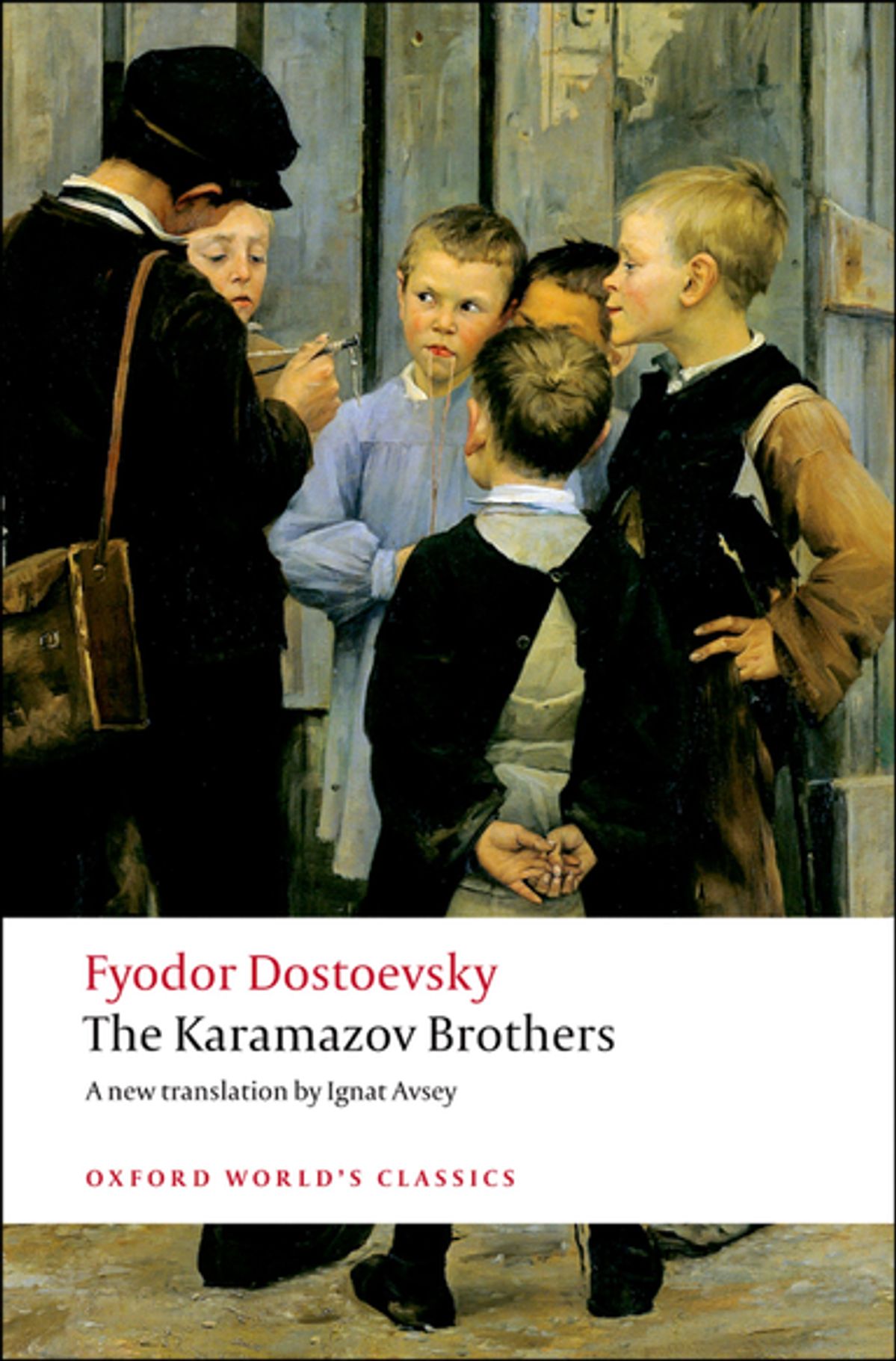
Translator Ignat Avsey’s English gives these changes of scale a persuasive intimacy. The plain imperative of “ask God for joy” inhabits the same book as Fyodor Pavlovich’s obscenities, with no safe demarcation between sacred speech and a world beneath it. Dmitry’s confessions continually threaten to turn into theater, while Zosima’s gentleness can suddenly require more of a listener than an accusation would. Avsey accommodates these shifts, allowing exaltation to retain the awkwardness of actual speech. I was especially struck by the way a seemingly excessive declaration leads, through embarrassment, to something unexpectedly bare. Dostoevsky’s characters have seldom finished explaining themselves when the need they were explaining away becomes audible. Their eloquence is exhausting, as is their determination to force every exchange to bear the magnitude of an ultimate question. That weariness belongs to the experience of reading them. Occasionally one wants someone to stop speaking long enough to hear the person beside him.
The demonic thrives in precisely this failure to listen. Dostoevsky gives evil a familiarity more disturbing than grandeur, allowing it to sound conversational and to concern itself with appearing respectable. It borrows the mind’s objections until inquiry is scarcely distinguishable from the pleasure of making commitment impossible. Doubt is indispensable, though it turns corrupt when every answer must preserve the questioner’s exemption from acting. Such intelligence keeps an entire life suspended. Zosima’s account of hell gives this postponement a terrifying finality, calling it “the suffering caused by not being able to love any more.” The fuller horror lies in the will that resists the love still offered to it, nursing its refusal until that refusal is the only identity it can bear. The seed has kept its shell, and eternity has given it no reason to open.
When Ivan, feverish after his final conversation with Smerdyakov, finds himself entertaining Satan in the guise of an impoverished gentleman, anxious to please and determined to be treated with respect, the bewildered Karamazov is internally struck. “What am I on this earth, if not a parasite?” the visitor asks. In so saying, he inhabits Ivan’s very thoughts, borrowing their language and returning their discarded arguments with a familiarity that makes dismissal almost impossible. Ivan recognizes his own worst ideas in the conversation, yet recognition gives him no power to end it. His humiliation lies partly in the visitor’s vulgarity, as a mind so accustomed to intellectual distinction must now hear itself speaking through an unwelcome dependent. The Gentleman’s concern for his reputation deepens the injury. “I value only my reputation as a respectable man,” he explains, having almost casually acknowledged that he is a fallen angel. Even Satan would prefer that his conduct not interfere with his standing. His agreeable manners make the family’s evasions recognizable on a more terrible scale. Here is another speaker who can admit what he is while making that admission a reason to expect indulgence. Ivan’s fury registers the difficulty of confronting an evil that already knows the accusations against it and can incorporate them so organically into the flow of one-on-one conversation.
The visitor’s real ingenuity, however, lies in keeping Ivan suspended between conviction and doubt. He admits to administering vacillation, exploiting the “uncertainty, worry, the conflict between belief and disbelief” that can torment a conscientious person. He even promises to plant “only a tiny seed of faith,” beginning with belief in his own existence and elaborating a grotesque prospect of Ivan’s eventual salvation. The language of saintly growth becomes suspect in the mouth of someone cultivating dependence upon himself. This encounter brings the novel’s arguments about freedom and responsibility into Ivan’s orbit of unrest. Every motive can be questioned until action becomes impossible. Yet Ivan’s torment also reveals a conscience that his explanations have failed to silence.
Seen in this light, the courtroom’s elaborate competition over motives takes on a peculiar sadness. Psychological insight supplies an explanation for almost anything, and opposing speakers use its discoveries to make incompatible accounts appear inevitable. The legal inquiry matters because acts have particular authors and consequences, and mercy cannot make accuracy dispensable. Yet the soul’s capacity for renewal exceeds what a public account can establish. A verdict must concern what someone has done. To claim that it exhausts what he might yet become would assume an authority the epigraph has already placed in question. Wheat grows beyond the hand that first held it, without ceasing to have come from that grain.
By this point, my impatience with the characters’ romantic entanglements had begun to expose a failure in my own attention. What if we brought to our spiritual lives even a portion of the ingenuity expended here on discovering who loves whom? So much feeling goes toward making another person confirm an identity its owner scarcely believes in. Dostoevsky gives this waste its full, often comic duration, then lets a gesture of kindness interrupt its apparent importance. A remembered act of tenderness may survive for years before finding an occasion to help. Its giver need never witness the result. Here the fruit promised in the New Testament exceeds the individual’s desire to inspect his own goodness. The act passes into a future beyond his possession, carrying the possibility of further giving. A field has no single center from which every stalk can be counted.
I return, then, to the smallness of what Dostoevsky places before this immense novel. The corn of wheat bears a promise whose fulfillment requires surrender to a ground it cannot survey. Christ’s words touch characters struggling to give up the versions of themselves that have made love impossible, even as Ivan refuses to let anyone’s hope cancel a child’s cry. Both claims must stay audible. The book’s religious force depends upon how deeply the cry troubles the hope, and how persistently love answers by staying with the sufferer. Reading it, I grow less interested in possessing the right explanation of a life than in what my explanation might prevent me from giving. Somewhere beyond the last sentence, an unrequited duty waits for the reader who would rather remain moved. The grain is still in our hands.

