
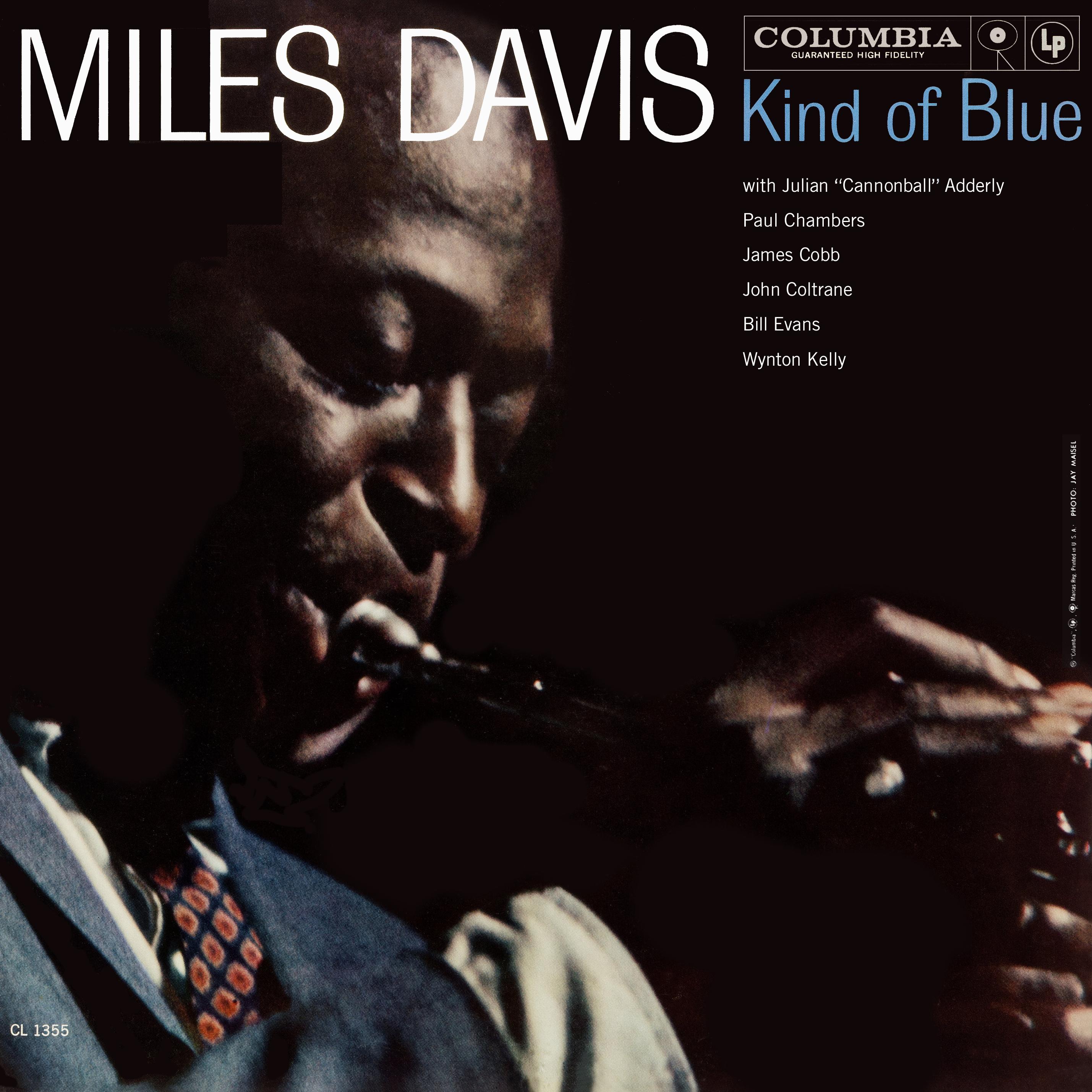
Miles Davis trumpet
Julian “Cannonball” Adderley alto saxophone
John Coltrane tenor saxophone
Wynton Kelly piano (“Freddie Freeloader”)
Bill Evans piano (all other tracks)
Paul Chambers bass
Jimmy Cobb drums
Recorded March 2 and April 22, 1959, at Columbia 30th Street Studio, New York
Engineer: Fred Plaut
Cover photo: Jay Maisel
Produced by Irving Townsend
Release date: August 17, 1959
I learned to love jazz on ECM records. I heard Jan Garbarek before I heard John Coltrane, and Tomasz Stanko before Miles Davis. I liked the way a bass line could change the harmony under a note the lead was still holding. Sometimes a drummer would answer a phrase with a mere tap of a cymbal, and I’d replay the track just to catch what he’d picked up on. After years of writing about the label, I’ve decided to swim upstream back through the canon and dive into the records my favorite players have taken to heart. And so it is that I come to Kind of Blue with a fondness for musicians who have demonstrated the value of listening.
Even now, decades after he put down the trumpet and left this mortal coil, Davis is still finding out what he can do with a stretch of time. On the title track of Milestones in 1958, he let a scale stand long enough for a soloist to double back on an idea. That same year, Gil Evans gave him a single scale to improvise from on “I Loves You, Porgy” for Porgy and Bess. A player could return to the same pitch and give it a different life by letting it fall elsewhere against the beat. When Davis recorded Kind of Blue in a converted Manhattan church on March 2 and April 22, 1959, he made that freedom part of the arrangement. In his original liner notes, pianist Bill Evans writes about Japanese ink painting, in which the brush leaves a mark the painter has to live with. In a band setting, somebody else is already reaching for the paper while your ink is still wet.
I cannot help but encounter that reach in the opening of “So What,” where Chambers takes a few delicate steps and Evans sets down chords with enough space inside them for the bass to move through. Once the tempo gathers, Chambers asks the question outright and the piano and horns give it a two-syllable answer. The bridge lifts the exchange a semitone, and for eight bars I can feel the floor slide upward through my shoes. Cobb’s great crash at the start of the trumpet solo frays so slowly that the burr in Davis’s sound seems to belong to the same vibration. Coltrane winds a figure so tightly around the beat that the empty middle of it starts spinning. Adderley puts his speaking voice into the way he leans on a note, and a single lengthened vowel can change the subject. Evans opens up the intervals again, and when Chambers brings the theme back, his question has acquired the warmth of a greeting.
“Freddie Freeloader” gets its particular bounce from Wynton Kelly, who had taken over the piano chair in Davis’s band. Evans came back for four pieces, and this blues is where we get to hear what Kelly can do with the bench to himself. He tucks quick replies into the gaps in the horn theme, then carries that good humor into the first solo, where a little extra weight at the end of a phrase can tip the whole bar toward him. On the session tape, Davis whistles the band to a stop during Kelly’s solo and asks him to leave out the chord going into A-flat. On the issued take, I wait for a chord that has already been crossed out of the future, and somehow the expectation begins to swing. There’s a delicious bit of proportion in the distance between Davis’s repeated high notes and the length of the line Coltrane sends across the bar. Adderley puts an entire cry into the last inch of a phrase, and when Chambers steps out on his own, Kelly’s clipped replies keep the blues swinging at the level of a private joke.
The mute on “Blue in Green” gives the trumpet a light so concentrated it seems to illuminate only the inside of the bell. The melody makes its way around a ten-bar circuit, and when Evans lets the chords go by at a quicker rate, I get the feeling of standing in the same room under a clock with a different number of hands. Adderley sits this one out, and against the sweep of Cobb’s brushes I can hear something close to a human throat in Coltrane’s tenor. It leaves some of its warmth in the folds of the muted sound that follows. With Davis still in my ear, I ache for the moment Chambers takes up the bow under Evans’s last statement. The friction of hair against string makes the melody seem close enough to touch.
The band gives that intimacy a larger body on “All Blues,” with Chambers holding the rolling figure in six while Evans’s tremolo stirs between pulses. The saxophones move in harmony above them, and Davis threads his muted melody through the openings their riff keeps making. When Davis takes the mute out and Cobb switches to sticks, the first open trumpet tone goes straight to the sternum and stays there, warm enough to make the bone seem hollow. Cobb gives the beat a hinge with those taps against the rim, and Adderley swings it wide. Coltrane crowds the turn with notes, and somehow Chambers’s pace seems even more deliberate for all the commotion above it. Evans has been reworking the saxophone figure behind the horns, and as he begins his own solo I keep listening to his left hand for some trace of what they’ve put there.
In “Flamenco Sketches,” the players share a sequence of five scales, and each soloist decides how long to stay with any one of them. Cobb’s timekeeping now includes the less measurable business of hearing when it’s time. Coltrane’s solo is among the tenderest things I know from him, especially when the fourth scale darkens the line and he lets that color work its way through. Adderley can put the richness of a whole register into a handful of pitches. In the gaps Evans leaves, a single pluck from Chambers makes a chord seem to enter the piece from a different direction. When Davis comes back, he needs little breath to make himself heard.
Columbia released Kind of Blue that August, and it went on to sell in numbers few jazz records have approached. Some of the distance it traveled is easier to measure in the grooves of other records. The following year, Coltrane took up the soprano for “My Favorite Things” and gave a Broadway melody nearly fourteen minutes to transform itself. Each turn of the vamp makes it stranger to think that such a tune once had to give way to the next event in a predetermined plot sequence. The route from Davis’s studio to ECM ran through Dave Holland and Jack DeJohnette, who played on Bitches Brew and made Gateway with John Abercrombie in 1975. Holland has described the way Davis set a direction and gave his players room to find their own ideas. I hear that latitude when Holland shifts an accent he’s picked up from Abercrombie and DeJohnette gives it the weight of a downbeat while the guitarist is still in the middle of the line.
Nils Petter Molvær traces his interest in combining acoustic and electronic sound to the electric Davis of Bitches Brew through Agharta. On “Tløn,” from 1997’s Khmer, a rhythm built from a Coldcut sample gathers momentum while Eivind Aarset’s guitar makes its edges porous. When Molvær comes in softly over that beat, I hear a vast animal breathing through a hole the size of a trumpet bell. ECM’s club remixes, a first for the label, gave other ears a say in the shape of the piece around that horn. I think of the chord Davis whistled out of “Freddie Freeloader” when I hear what a remixer can move around after the players have gone home.
Ralph Towner and Paolo Fresu bring me back to “Blue in Green” on 2009’s Chiaroscuro. Fresu had already made his own Porgy and Bess, and Towner had long wanted to play this tune with a trumpeter. The harmony thins quickly on the guitar, and Fresu can decide with the timing of a breath how much of the chord will still be there to meet him. On 2017’s Tangents, Gary Peacock took up the tune with Marc Copland at the piano and Joey Baron on drums. Peacock had recorded Trio 64 with Evans and counted Chambers among the bassists who shaped his playing. There’s particular pleasure in following Peacock’s hands through a melody I’ve long associated with the trumpet.
The name of Molvær’s “Tløn” sends me to the planet Borges imagined, where two people can go looking for the same lost pencil and each come back with one. That second instrument comes into the world courtesy of the person expecting to find it. I can mark the place on the 1959 tape where Chambers draws the bow, and some of the sound I hear there has traveled backward from Tangents. What a wonderful indignity to the calendar that somebody can arrive too late to meet you and still be in time to put something in your hand.

