

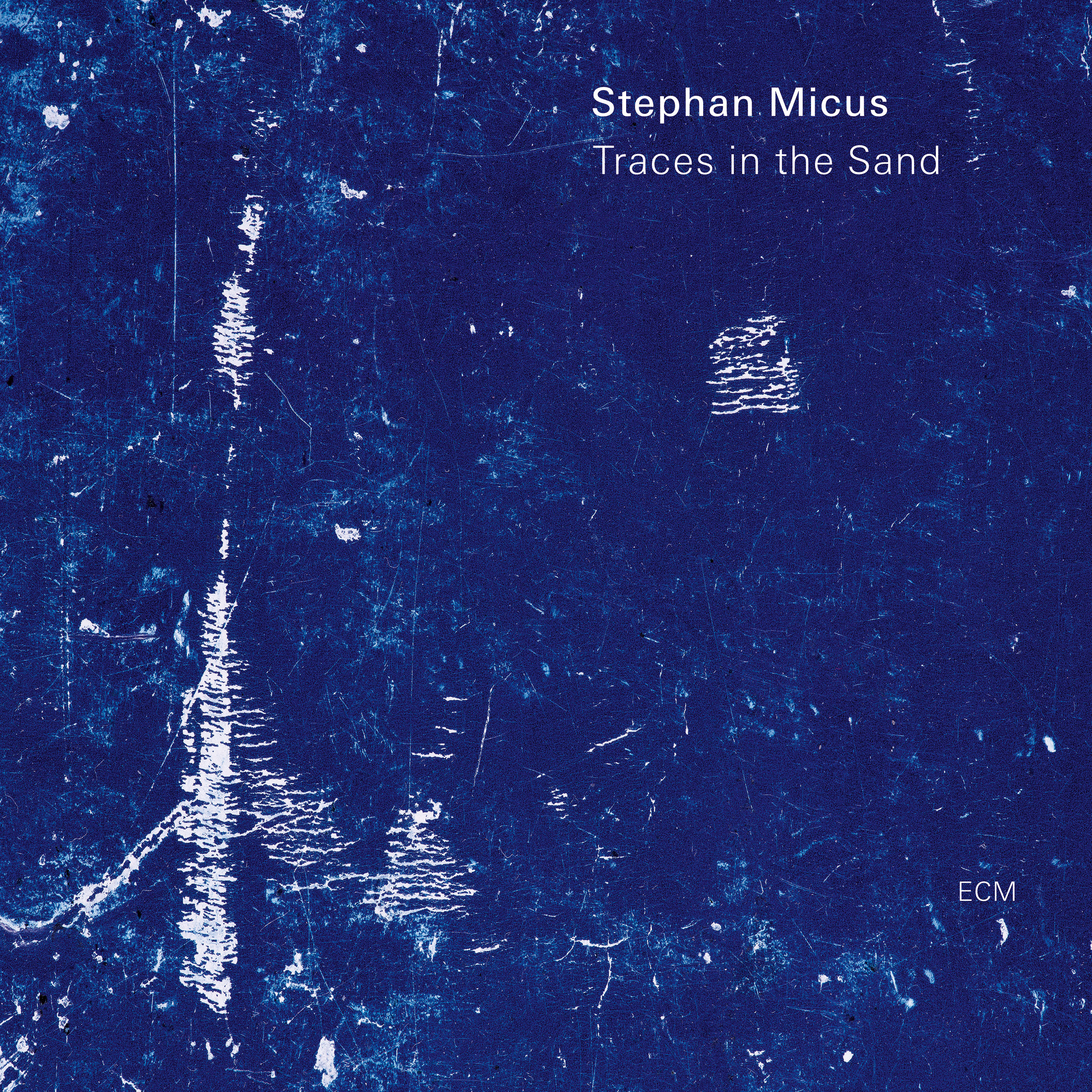
Stephan Micus
Traces in the Sand
Stephan Micus hang, kalimba, shakuhachi, duduk, Indian crane flutes, sapeh, Bavarian zither, bodhran, genbri, dilruba, shō, chord zither
Recorded 2023-25 at MCM Studios
Cover: Sara Micus
An ECM Production
Release date: November 13, 2026
At the edge of the sea, Stephan Micus lets the horizon undo the small enclosure of composition. Months spent on a few minutes of music require a concentration that his almost daily swims in Mallorca open outward again, returning the body to dimensions no studio can delineate. That exchange runs through Traces in the Sand, his 27th solo album for ECM, dedicated to the sea as the bearer of all music. Having lived on the island for more than three decades, the Bavarian-born musician approaches its expanse with the seclusion of someone whose teacher has never needed to speak.
A dozen instruments gathered across the world enter this relationship, carrying the grain of their origins into unprecedented encounters. Among them, African kalimbas, whose metal tongues are attached to resonators, furnish an especially tactile vocabulary, each syllable opening a pore in the music’s skin.
Out of that interior, the resonance of three hang drums and the buzzing of four kalimbas establish the gorgeously sunlit vista of “The First Light,” mists of night still clinging to the fields and hills. Just when we think there might be no other life, shakuhachi and duduk raise their breathy heads, two deer craning their necks toward the horizon in search of a traveler’s path. The Japanese flute’s higher register parts the air above the Armenian reed, yet neither claims the other’s territory. Their melodies frolic with the grace of a river’s flow, while the continuously shifting accompaniment occasionally rises into the foreground, granting the ground itself a turn to wander.
A single kalimba supports the footsteps of two Indian cane flutes through “Dancing Cranes,” concentrating the opening’s animal blood into an even deeper circulation. Caught in the wonder of their own existence in space and time, the flutes alternate until each finds its continuation in the other. Such crossings take on a fable’s flesh in “The Pearldiver And The Mermaid,” where a plucked sapeh, the five-stringed Bornean lute carved from a single piece of wood, duets with duduk. A Bavarian zither adds another watery layer, guiding the soul into reflections within reflections, where each image carries a depth the eye cannot settle. The reed that walked on hooves now spreads wings, a mighty crane in flight above the submerged body of its song.
The flashes of light crossing the surface of “Another Day At Sea” bring us nearer to the kalimba’s smallest gestures, with Irish bodhran and plucked Moroccan genbri softly adding a touch of bass. A whole expanse balances on the tip of an unspoken word, its apparent weightlessness anchored in the pulse beneath it. Against that buoyancy, the four plucked sapeh and single bowed dilruba of “For Layla And Majnun” give the titular ill-fated lovers of Middle Eastern legend unequal bodies. The latter’s robust voice speaks of unrequited pain, drawing a filament through the strings’ scattered brightness. Here, longing becomes a disagreement about how time should move, the bow sustaining what the plucked notes must continually surrender. Separation acquires a texture one might touch, although every attempt to grasp it only lengthens the ache.
From this fable’s wound, the solitary duduk of “When You Are Near” draws a more personal measure of closeness. With a lighter touch and a beauty that comes from within, it floats and traces its travels with a dream in its jaw. The intimacy here seems almost anatomical, a second heart discovered in the place where breath usually gathers. When the kalimba returns for “Brother Dolphin,” again with bodhran and genbri shading its lower reaches, kinship slips beyond the human couple. Its glints connect us to a creature whose passage through the sea requires no justification, and whose indifference to our explanations feels a form of welcome, admitting us without making us the center of its world.
With three shō braided into an equal number of dilruba, “Light On Water” opens a luminous chamber whose walls seem to have migrated from the inside of a shell. Two duduk lend their breath to these spiritual kin, the Japanese reed mouth organs suspending their haunting radiance across the bowed strings. One can almost feel the skeleton of a drowned star assembling itself inside the harmonies. That density opens onto the playful sincerity of “Swimming With Turtles,” where hang and four kalimbas flower as light incarnate. Fully committed to its interactive bliss, this meeting with nature allows delight to remain a sufficient reason for existence, carrying the philosophical gravity of a creature utterly absorbed in play.
From the more distant perspective afforded by “Far Horizon,” alternating sapeh and duduk solos recall their earlier encounter across a greater interval. The sapeh’s bright edges graze the skin, while the duduk carries a depth that resists any measurement the hand could make. Between them, three chord zithers touch the wind as if born to receive it, opening their arms to what cannot be held. The distance gives each utterance room to reach beyond the speaker, and the music’s tenderness gradually becomes inseparable from this relinquishment. We return to the sea carrying less certainty about where the body ends, its edges briefly porous to another order of being.
Such this is the sea’s least expected instruction: even a mountain can become worn down enough to enter a shoe. The sand carries that knowledge without a doctrine, submitting the grandeur of geological time to the tenderness of an exposed foot. In Micus’s hands, the smallest vibration makes a comparable passage, bringing an immensity into contact with the body’s unguarded places. Our desire to leave a lasting trace begins to seem strangely provincial beside such willingness to be changed, and the earth, having given up its monument, settles into the unbearable precision of entropy.

