David Torn: Best Laid Plans (ECM 1284)

David Torn
Best Laid Plans

David Torn guitars
Geoffrey Gordon percussion
Recorded July 1984 at Rainbow Studio, Oslo
Engineer: Jan Erik Kongshaug
Produced by Manfred Eicher

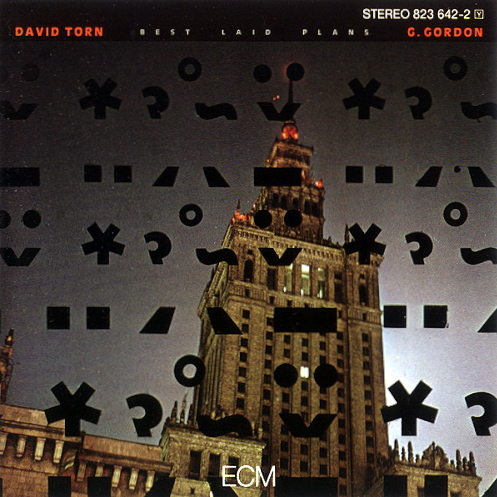
David Torn is one of the more indefinable guitarists on planet Earth and has left an alluring hatching of marks on ECM’s wall. Vivid among them is this unusual session with percussionist Geoffrey Gordon. Their pastiche navigates a territory that lies somewhere between Elliott Sharp, Steve Tibbetts, Terje Rypdal, and Bill Frisell. Torn’s electric is a storm of spirals and tails, surges and dissolves. The smooth arpeggios and inevitable disruptions of “Before The Bitter Wind” and the title track project a life lived through dreams and nightmares alike. The glow of “The Hum Of Its Parts” unfolds through Torn’s itching and pliant core, dramatized by Gordon’s highly connected tabla. One highlight, if in name only, is “Removable Tongue,” a guitar solo that twists its way around a relatively melodic caduceus and seems to have a good influence on “In The Fifth Direction,” which is perhaps the most unified blend of rhythm and texture on the album. After the sweltering heat rash of “Two Face Flash,” Torn rattles the firmament with “Angle of Incidents,” every grating cry a search for lost questions to extant answers.

Torn’s playing is a unique beast. It is oblique in such a way that, even when fully formed, it remains somehow distant, calling to us as if from the future and gone by the time we catch up. The best we can do is to stand where we are and wait for its evocative disintegration.

<< Paul Motian Trio: it should’ve happened a long time ago (ECM 1283)
>> Bruno Ganz: Hölderlin – Gedichte gelesen von Bruno Ganz (ECM 1285 NS)

Chick Corea: Voyage (ECM 1282)

Chick Corea
Voyage

Chick Corea piano
Steve Kujala flute
Recorded July 1984 at Tonstudio Bauer, Ludwigsburg
Engineer: Martin Wieland
Produced by Manfred Eicher

Steve Kujala is a flutist of exceptional ability known for his “bending” and other extended techniques, which immediately distinguish his sound from anyone else’s. After touring with Chick Corea in the early eighties, the two of them stepped into the studio to record Voyage, a shuffled yet modest deck of three Corea originals and two freely improvised interludes. Though a suitable companion to Red Lanta, this duo session could hardly be more different. As musicians both well versed in the avant-garde, Kujala and Corea forge an undeniably cerebral brand of magic. The lushness of “Mallorca,” for example might easily blind us to the microscopic approach of “Star Island,” for where the former dances like some ethereal Flamenco reflection, threaded by birdsong and fast-forwarded tongue fluttering, the latter is a piano solo that indeed takes form like a dollop of land in an oceanic expanse. It is also the deeply beating heart of the album, a stunning piece of wizardry that could easily run its entire course without ever growing fatigued. Corea continues this subdued brilliance in his intro to “Free Fall” before Kujala makes his theatrical entrance, singing to us of days and years gone by. This is much in contrast to “Diversions,” a far more abstract intertwining of airy improvisations which, even after their rousing finish, leave us scrambling for narrative traction. “Hong Kong” is also very abstract, but by way of its title at least gives us a place to hold on to. Like that city’s bustling streets, connections come and go as they please, sometimes utterly unaware of one another in the constant blur of lights, faces, and smells.

This is a highlight in the Corea discography on any label and an ideal opportunity to discover, as I did, a flutist of outstanding innovation along the way.

<< Michael Fahres: piano. harfe (ECM 1281 NS)
>> Paul Motian Trio: it should’ve happened a long time ago (ECM 1283)

Egberto Gismonti/Nana Vasconcelos: Duas Vozes (ECM 1279)

Duas Vozes

Egberto Gismonti guitars, piano, flutes, dilruba, voice
Nana Vasconcelos percussion, berimbau, voice
Recorded June 1984 at Rainbow Studio, Oslo
Engineer: Jan Erik Kongshaug
Produced by Manfred Eicher

Sometimes I wonder. I wonder what forces were at work to have brought two brilliant music makers like Egberto Gismonti and Nana Vasconcelos together on this earth. I wonder what energies nourish their spirits any time the two of them step into the studio, alone or otherwise. I also wonder how a surefire recipe for continued enchantment could come out of the oven as this misshapen improvisation session from 1984. Neither musician has ever needed a definitive structure around which to coil his respective song in order to be captivating (just listen to, for example, the breadth of freedom in Gismonti’s Solo or Vasconcelos’s Saudades), but during the first few steps of Duas Vozes I find myself craving it. It’s not that the images painted therein aren’t unique, only that the colors with which they are painted simply don’t blend. Thus is the album’s first half the backside of a one-way mirror: we can see through its devices, even if the microphones can’t. Thankfully, in the latter half we come face to face with a reflection that shows us only the depth of our awe.

Our first confusions arise in “Aquarela Do Brasil,” which begins playfully enough, but quickly degrades into six long minutes of Vasconcelos’s whooping (compare his sparing use thereof on “Carneval Of The Four”). “Rio De Janeiro” also breaks its promise when, after the lively pulse that opens it, Gismonti’s guitar wanders in circles without ever enlarging any of them. And while much of this sounds like outtakes between jam sessions, there are some flashes of brilliance in which these longtime friends explore insanely microscopic avenues of their craft, particularly during a passage for which Gismonti plays the little strings at top of his instrument. The cavernous flute of “Tomarapeba” opens the portal just a little more, as do Vasconcelos’s calls from the treetops in “Dancado.”

It isn’t until “Fogueira” that we get something undeniably special, something far beyond what I would already have expected. Its balance of restraint and full-out effusiveness blossoms with a Ralph Towner-like sensibility, Vasconcelos adding masterful color all the while. With this, the portal is thrown open, letting in the floodlights that are “Bianca” and “Don Quixote.” In the latter, Vasconcelos’s insectile tongue-fluttering adds the perfect environmental touch, even as Gismonti unveils his piano for a final stretch of droning brilliance.

For an album that is only half the masterpiece it could have been, how it ever came to be included in ECM’s Touchstones series would seem unwarranted were it not for its destination. But even if we aren’t quite sure about how it gets there, Duas Vozes is worth your attention for that destination alone.

<< Pat Metheny Group: First Circle (ECM 1278)
>> Jack DeJohnette’s Special Edition: Album Album (ECM 1280)

Pat Metheny Group: First Circle (ECM 1278)

Pat Metheny Group
First Circle

Pat Metheny guitars, synclavier guitar, guitar synthesizer
Lyle Mays trumpet, synthesizers, piano, organ, bells
Steve Rodby acoustic bass, bass guitar, drum
Pedro Aznar voice, guitar, percussion
Paul Wertico drums, percussion
Recorded February 15-19, 1984 at Power Station, New York
Engineer: Jan Erik Kongshaug
Produced by Pat Metheny

By the release of First Circle, expectations for the Pat Metheny Group surely ran high, but with the appearance of new drummer Paul Wertico (replacing Danny Gottlieb) and Argentine percussionist Pedro Aznar (who took the place of Nana Vasconcelos, and whose vocals elevated the group to new levels) the results coalesced into something timeless. Don’t let the hokey “Forward March” fool you, however. Everything that follows is as solid as it gets. Were you to map out a flow chart of listeners’ favorites here, the largest field would likely be taken up by the effervescent title cut. And while indeed this vocalese-laden train of stunning pianism from Lyle Mays and Metheny’s equally locomotive acoustic is a glorious masterstroke if there ever was one, one can hardly refuse the wide vistas of “Yolanda, You Learn” or the heartrending brushwork of “If I Could,” one of the most utterly beautiful statements Metheny has ever recorded. “Tell It All” and “End Of The Game” hark back to Offramp, the latter especially in its soaring synth guitar lead. Both are spurred along by a gentle guiding hand, born of a palpable synergy and given traction in Wertico’s fantastic timekeeping. Although Metheny’s presence is vivid throughout, for me it is Mays who gilds this project with its distinguishing colors. And hats off to Aznar, whose singing in “Más Allá” (this album’s “What Game Shall We Play Today?”) adds another highlight. It’s fantastic to hear lyrics being added sparingly to the Metheny universe, if only because his melodic lines already describe so much without them. Aznar shines again in “Praise,” thereby ending things with a revelry more than worthy of its title. Listen to this already.

<< John Adams: Harmonium (ECM 1277 NS)
>> Egberto Gismonti/Nana Vasconcelos: Duas Vozes (ECM 1279)

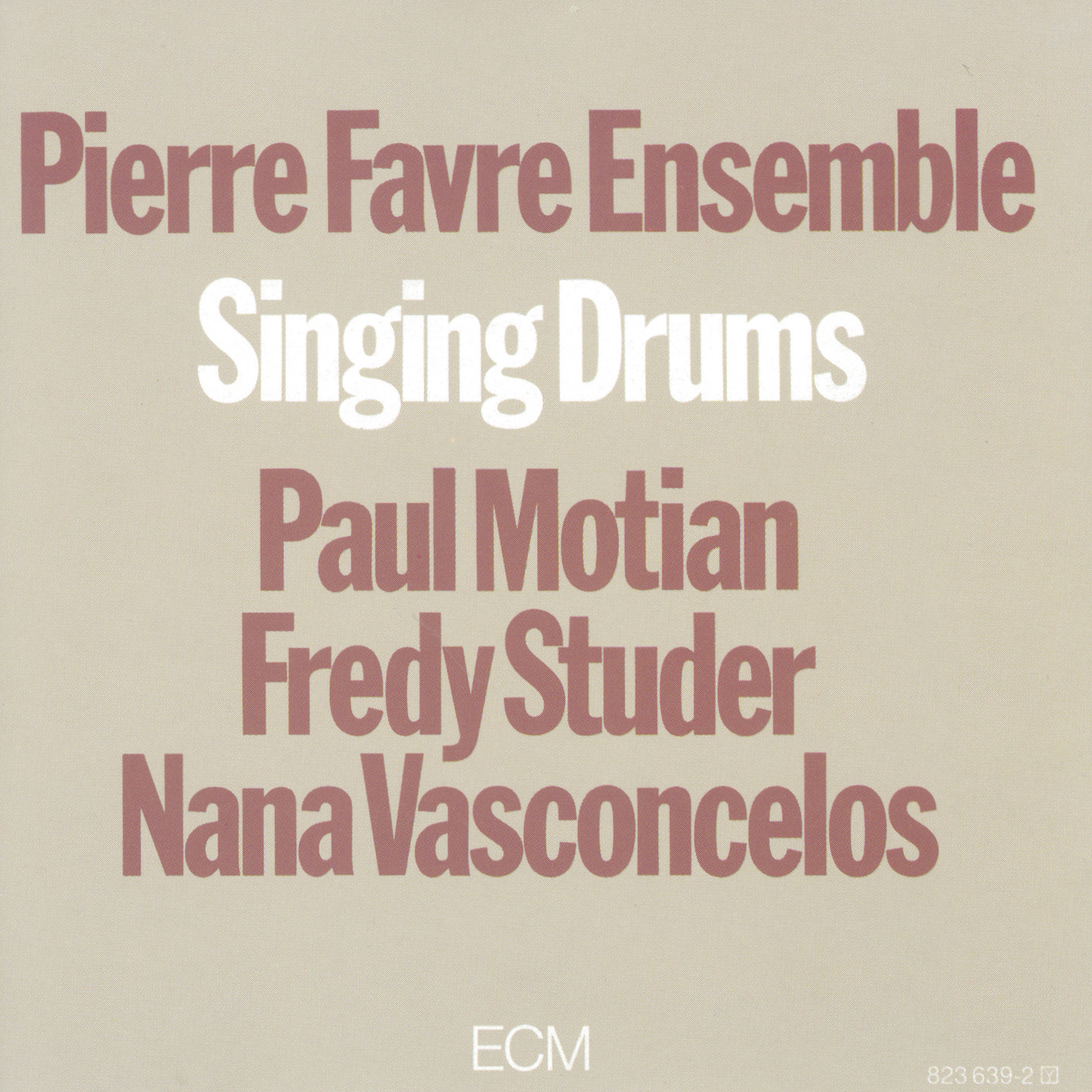
Pierre Favre Ensemble: Singing Drums (ECM 1274)

ECM 1274

Pierre Favre Ensemble
Singing Drums

Pierre Favre drums, gongs, crotales, cymbals
Paul Motian drums, gongs, crotales, calebasses, rodbrushes
Fredy Studer drums, gongs, cymbals
Nana Vasconcelos berimbau, voice, tympani, conga, water pot, shakers, bells
Recorded May 27 and 28, 1984, Mohren, Willisau
Engineer: Martin Wieland
Produced by Manfred Eicher

Singing Drums brings together some of ECM’s most formidable percussionists in this one-off incarnation of the Pierre Favre Ensemble. For this date, Favre welcomes Paul Motian, Fredy Studer, and Nana Vasconcelos into his fold. The results are, while brilliant, likely to be overlooked due to the special interest of its instrumental makeup. Let this not deter anyone, however, from experiencing its wonders. What I love most about this session is that each player’s style is so instantly recognizable. Between the twangy call of Vasconcelos’s berimbau, the crotales of Favre, the delicate cymbals of Studer, and Motian’s earthly patter, we can easily tease out every thread of conversation being woven before us.

One finds in these atmospheres broad intimations of times and places, a blurring of geographic and cultural signatures into a mosaic of worldly mindedness, a space where human and animal blur into one another, such that the hands of the player become the keen pounce of a lion in the bush and the leap of the gazelle who thwarts it. Drones and footsteps exchange glances amid the branches of the opening “Rain Forest,” while other tracks like “Metal Birds” work in more clipped gestures. Vasconcelos’s chanting is a vital thread here, and seeks only to enhance the pitch-bent drums and other sinuous energies around him.

This is a profound album of subtle creativity that gets only deeper with every listen. Anyone who knows these performers will not expect an all-out frenzy, but the careful and porous readings of “Edge Of The Wing” and “Prism,” not to mention the whispered accents of “Frog Song.” Theirs is a journey both of anthropology and dislocation, a masterful text written “Beyond The Blue,” which leaves us to ponder the cries of our ancestors, as countless as the stars above our heads.

<< Art Ensemble of Chicago: The Third Decade (ECM 1273)
>> Arvo Pärt: Tabula rasa (ECM 1275 NS)

Art Ensemble of Chicago: The Third Decade (ECM 1273)

Art Ensemble of Chicago
The Third Decade

Lester Bowie trumpet, fluegelhorn
Joseph Jarman reeds, synthesizer, percussion
Roscoe Mitchell reeds, percussion
Malachi Favors Maghostus bass, percussion
Famoudou Don Moye drums, percussion
Recorded June 1984 at Tonstudio Bauer, Ludwigsburg
Engineer: Martin Wieland
Produced by Manfred Eicher

Drawn from a wealth of sources and enhanced with the usual assortment of found sounds, The Third Decade is another solid outing from the Art Ensemble of Chicago that would be the group’s last on ECM for another seventeen years. One can always expect an eclectic experience on any AEC joint, and this one doesn’t disappoint.

From the snaking synthesizer lines and various nocturnal rustlings of Joseph Jarman’s “Prayer For Jimbo Kwesi,” which sound like the soundtrack to a home movie version of 2001: A Space Odyssey, to the freely improvised and maddening (traffic) jam of the title track, there’s bound to be something for everyone. The former, with its subtle horns and nascent bass, is especially fascinating and showcases the AEC’s ability to sustain itself through long, ponderous distances with unwavering interest. “Funky AECO” is just that, though always tempered by the percussive oddities that are the AEC’s trademark, and ever enlivened by inner fire. And speaking of fire, Lester Bowie positively dances on it here, carrying through his playing just the sort of uplift for which he will always be missed. Roscoe Mitchell counters with two mysterious constructions of his own, “Walking In The Moonlight” and “The Bell Piece,” each a link in a chain of good humor and transcendence. Bowie’s “Zero” is a more straight-laced affair and shows the AEC at its crowd-pleasing best.

As AEC efforts go, The Third Decade is relatively reserved and shows us a softer side of this powerful collective. By no means a detriment, it belongs with all the rest as a valuable creative archive.

<< John Abercrombie: Night (ECM 1272)
>> Pierre Favre Ensemble: Singing Drums (ECM 1274)

John Abercrombie: Night (ECM 1272)

John Abercrombie
Night

John Abercrombie guitar
Jan Hammer keyboards
Jack DeJohnette drums
Michael Brecker tenor saxophone
Recorded April 1984 at Power Station, New York
Engineer: Jan Erik Kongshaug
Produced by Manfred Eicher

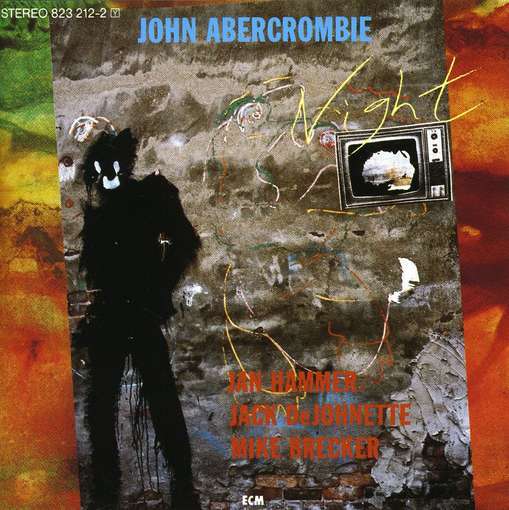
As its cover indicates, Night gives us a colorful, collage-like portrait of John Abercrombie, who jumps here into the urban deep end with smoky club atmospheres and tight jams. It’s a joy to see the guitarist working with Jan Hammer again, and the inclusion of Mike Brecker on tenor and Jack DeJohnette on drums make for a winning formula. Hammer adds a particular spike to this sonic punch, competently filling the session’s lack of bass while also fleshing out the production with an evocative sweep. Between the idiomatic blend of “Ethereggae” and the Timeless heat distortion of “3 East,” his billowing keys give Brecker more than enough room to show off his chops (he has hardly sounded better). This date isn’t all fun and games, however, for the rain-slicked streets of “Look Around” give us pause for reflection. Hammer reignites things in “Believe You Me,” which despite being the most straightforward track compositionally sports Brecker’s most uninhibited solo yet. The band saves the best for last with “Four On One,” which draws another ring of fire in an enthralling closer. DeJohnette gets his moment in the sun here as well.

Though something of an blip in the Abercrombie back catalogue, Night is far from benign. Aside from the effusive music, what really distinguishes this album is its sound. Another slam-dunk for engineer Jan Erik Kongshaug.

<< Pat Metheny: Rejoicing (ECM 1271)
>> Art Ensemble of Chicago: The Third Decade (ECM 1273)

Pat Metheny: Rejoicing (ECM 1271)

Pat Metheny
Rejoicing

Pat Metheny guitars
Charlie Haden bass
Billy Higgins drums
Recorded November 29 and 30, 1983 at Power Station, New York
Engineer: Jan Erik Kongshaug
Produced by Manfred Eicher

Those of you who, like me, hold Bright Size Life in high esteem as one of Pat Metheny’s best can take comfort in this, his second trio album for ECM, even if the presence of Ornette Coleman’s onetime rhythm section of bassist Charlie Haden and drummer Billy Higgins creates an entirely different result. As on the scratched cover, the names are distinct to a careful eye, but eventually comingle into a unified sound that bubbles with color and shades of intensity.

The session saunters into our hearts with an arresting version of Horace Silver’s “Lonely Woman.” Metheny’s acoustic leads a supremely attuned Haden, who plunks the ether like a giant rubber band as Higgins rustles an autumn’s worth of leaves with his brushes. It is through this play of light and shadow that we find solace in “Tears Inside,” a strangely upbeat affair for which Metheny breaks out the subtle sere of his electric. “Humpty Dumpty” is an even more visceral jaunt through storybook phrasings and fluid guitar licks. The short but sweet title track completes the Coleman half of the album and features some dexterous runs, matched step for step by Higgins’s cymbal work and Haden’s own nimble jaunts. Higgins has one of the most precise snares in the business, as evidenced in his solo. Haden stretches an unassuming flair in “Blues For Pat,” which also boasts Metheny’s most present solo on the album and more percolating beats from Higgins. “Story From A Stranger” reprises Metheny’s shimmering acoustic, which glistens with a backcountry charm, seeping like morning light into a log cabin of secrets. Against this perfect backdrop, Metheny’s soloing reaches some of its most revelatory ever recorded. Another Metheny original, “Waiting For An Answer,” makes for an enigmatic, arco-laden closer.

The album’s only misstep is “The Calling,” the synth guitar of which doesn’t quite jive with me (though flashes of brilliance do appear, as in the ascent at 7:20). And while I do appreciate the improvisatory spirit behind this track, I only wish it had been more properly amped, for at nearly 10 minutes it throws off the delicate balance of its surroundings. But don’t let this one personal caveat deter you from basking in the beauties of those surroundings.

Incidentally, one of engineer Jan Erik Kongshaug’s finer accomplishments.

<< Steve Tibbetts: Safe Journey (ECM 1270)
>> John Abercrombie: Night (ECM 1272)

Steve Tibbetts: Safe Journey (ECM 1270)

Steve Tibbetts
Safe Journey

Steve Tibbetts guitars, kalimba, tapes
Marc Anderson congas, steel drum, percussion
Bob Hughes bass
Tim Weinhold vase
Steve Cochrane tabla
Recorded 1983 in St. Paul, Minnesota
Engineer: Steve Tibbetts
Produced by Manfred Eicher

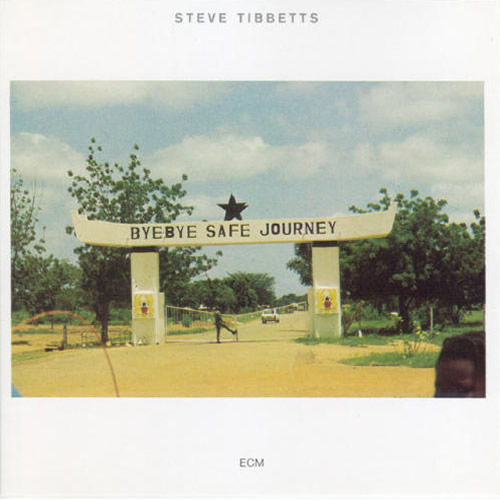
Guitarist Steve Tibbetts exploded our view when ECM introduced the world to the adroit textures of Northern Song. He did so again with “Test,” the doorway onto the enlightening path that winds through Safe Journey. Don’t let its initial stirrings fool you into slumber, for you are sure to be jolted by a guitar that seems to scrape the walls of its harmonic enclosure and expose the burnished paneling within. From humble genesis to almost frightening expanse: this is Tibbetts’s MO. With a minimal assortment of instruments in his coterie, he excavates eras’ worth of sediment. Note the stunning passage where his electric gets caught in echoing loops, while its second self solos over the remnants of what it once was. Such splitting of voices is another trademark, as are the contrasts of “Climbing.” In this quiet cave, Tibbetts sits cross-legged with a kalimba in hand, letting its plunking droplets of sound gild the surrounding stalagmites. Curiously, this track feels less like climbing and more like burrowing. Similarly, the delicacies of “Running” feel like a closing of eyelids, behind which the only feet to touch ground are those of an unfinished dream. A sparkling acoustic guitar, a touch of steel drum and sitar, and the patter of footsteps like rain through a children’s rhyme pull a shade of darkness that plunges us into “Night Again.” Here, the programmatic title holds true in the vastness of sound Tibbetts elicits from his strings as he weaves a lullaby against mounting starlit percussion, for neither does the night abide by arbitrary delineations of territory and bodily space. Eventually, the guitar cuts out, leaving the drone to “solo,” as it were, drifting like the Northern Lights into melodic aftereffects. “My Last Chance” is a swath of nostalgia filigreed by a promising future and opens us to the moral intensity of “Vision.” Tibbetts makes some of the most effective use of taped music one is likely to encounter in a band setting, and especially here. His electric cries like a voice from a cracked egg, breaking with the dawn into blinding intensity, seeming to hold its breath before every note is expectorated. “Any Minute” is another fragile design that wavers in ghostlike existence, never quite resolving the memories so fully fleshed out in “Mission.” Running on the gentle propulsion of a spiritual engine, “Burning Up” humbles itself before a smoldering backdrop, where only the trails of fleeting human figures “Going Somewhere” tell us where we might safely tread home. And it is in the tinkling of starlight that we finally come face to face with our destination, which has been ourselves all along.

With such distinct shades of ambience—all activated by an intuitive sense of ebb and flow—and a incredible group of musicians to give it life, this music glints anew every time. Tibbetts is the perennial traveler whose rucksack contains only the freedom of possibility.

Oh, to have been there, at a record shop when this album first came out. If what I feel now is any indication, I can only imagine the depth of its impact.

Wondrous to the nth degree.

<< Dave Holland Quintet: Jumpin’ In (ECM 1269)
>> Pat Metheny: Rejoicing (ECM 1271)