Wolfert Brederode: Ruins and Remains (ECM 2734)

Wolfert Brederode
Ruins and Remains

Wolfert Brederode piano
Matangi Quartet
Maria-Paula Majoor
 violin
Daniel Torrico Menacho violin
Karsten Kleijer viola
Arno van der Vuurst violoncello
Joost Lijbaart drums, percussion
Recorded August 2021 at Sendesaal, Bremen
Engineer: Stefano Amerio
Cover: Mayo Bucher
Produced by Manfred Eicher
Release date: September 23, 2022

For his fourth ECM album as leader, Wolfert Brederode returns with Ruins and Remains. This suite for piano, string quartet, and percussion, the result of a commission marking the 100th anniversary of the end of World War I, telescopes the seemingly insurmountable distance between horror and hope.

While such a backstory might seem a pivot for the Dutch pianist, thematic connections are drawable to his past work. From the association-rich wanderings of Currents to the patient grooves of Black Ice, he has consistently demonstrated an awareness of time as a physical substance. In Post Scriptum between them, he was already exploring suite-like structures around questions of the human condition.

The present record takes elements from all that came before and bonds them with something so intangible that only a microphone can capture and amplify it: history. To that end, he ticks our path with four signposts entitled “Ruins.” With their cold expanse and cautious navigations, they trace the movements of those who have fallen in places where hands cannot reach and only the heart may tread.

In “Swallow,” Brederode and his fellow musicians sift through the rubble for something salvageable: a ring, a photograph, perhaps a gold-capped tooth that once served as a runway for speech. The Matangi Quartet speaks in the language of the past, dreaming of better times when violence was something one only read about in storybooks. Meanwhile, percussionist Joost Lijbaart reveals glints of the future. Along the way, Brederode emotes very much in the present, holding close to lessons on the verge of fading. With these in mind, titles like “Cloudless” and “Dissolve” feel as much like descriptors of what we hear as what they evoke. The resonance of these passages tells stories in which we can have no part, each walking a bridge that must collapse. In this regard, “Retrouvailles” comes across as a false promise, a moment in time expanded to show the scars it would otherwise gloss over.

Although musical details rise into prominence, including the plucked piano strings of “Ka,” the rolling snare of “Nothing for Granted,” and the cello’s sagacious presence across the waves, a holistic mise-en-scène pervades. Like the blush of “Duhra,” it strikes a glow where mostly darkness has taken hold, a film without a screen.

The music’s openness to change is part of what makes it real. As death becomes written and rewritten, our souls adapt to its language. And as it heeds the horizon’s beckoning, we are given a choice: follow or turn away.

Dominic Miller: Vagabond (ECM 2704)

Dominic Miller
Vagabond

Dominic Miller guitar
Jacob Karlzon piano, keyboard
Nicolas Fiszman bass
Ziv Ravitz drums
Recorded April 2021 at Studio La Buissonne, Pernes-les-Fontaines
Engineer: Gérard de Haro
Mastering: Nicolas Baillard
Cover photo: Fotini Potamia
Produced by Manfred Eicher
Release date: April 21, 2023

For his third ECM outing, guitarist Dominic Miller brings quiet ferocity and lyrical precision to this quartet setting with pianist Jacob Karlzon, bassist Nicolas Fiszman, and drummer Ziv Ravitz, opening our ears to newer and even deeper terrains across a set of eight original itineraries.

In a statement for the album’s press release, he says, “Thanks to the amazing singers I’ve worked with over the years, I see myself more as an instrumental songwriter. And as they do, I see it my mission to surround myself with the best musicians who understand the narratives in the ‘songs.’ I’m happy to have assembled the right lineup here with Vagabond.” And in “All Change,” we hear that ethos played out. The rhythm section opens itself to Miller’s acoustic timekeeping while the piano smoothes the waters to ensure this vessel sails uninterrupted until it reaches its first port of call. Miller’s overlay brings fresh intimacy, capturing frames of a stop-motion memory.

Across the cinematic horizon of “Cruel But Fair,” an underlying breath of synthesizer kindles the hearth of Miller’s acoustic. A collective atmosphere reigns supreme, each musician contributing to a scene as it curls into shape around people, places, and things. Such associations collaborate in the music as much as those assembled in the studio to articulate them. Miller himself points to southern France, which he has called home in recent years, for inspiration. Whereas “Vaugines” refers to a small village he has frequented on his walks, “Clandestin” is a hidden bar where stories abound. The latter’s interplay reveals the most space between instruments, allowing for an unguarded swagger. To my ears, it feels anything but covert.

Such is the ability of Vagabond to open its borders to our psychological refugees. For example, while “Open Heart” is easily interpreted as an image of generosity, to me, it evokes the darkly inward period I faced when my father suffered a nearly fatal heart attack in December of 2023 (the main reason why I’ve posted so little since then). All the more fitting, then, that Miller should include an ode to his own father, “Mi Viejo,” an unaccompanied offering of intimate magnitude.

The delicacy of this music is also its strength. A case in point is “Altea,” the airy underpinnings of which give the trio plenty of fertilizer to work into the soil. What grows from it is lush yet variegated enough to let those precious rays of sunlight through. Lastly, “Lone Waltz” moves from stasis to momentum. Like a boat chasing the setting sun, it finds solace in the waves.

If we started with the notion of having to get somewhere, we end without quite knowing where that might be.

Heinz Holliger/Anton Kernjak: Éventail (ECM New Series 2694)

Heinz Holliger
Anton Kernjak
Éventail

Heinz Holliger oboe, oboe d’amore
Anton Kernjak piano
Alice Belugou harp
Recorded October 2021 at Radiostudio Zürich
Engineer: Andreas Werner
Cover: Fidel Sclavo
Co-production ECM Records / Radio SRF 2 Kultur
Release date: September 22, 2023

Dear dreamer, help me to take off
Into my pathless, pure delight
By always holding in your glove
My wing, a thin pretence of flight.

The vocalise is a form that, by modern definition, refers to a singing exercise focusing on melody over meaning. If it begs the need for words, it is only because we are accustomed to the notion that songs require them. In this instrumental program, oboist Heinz Holliger deconstructs the concept and reassembles it with apocryphal gems and other building materials from the 20th century. Pianist Anton Kernjak (last heard on Holliger’s Aschenmusik) leads as much as he follows in their co-search for lyrical forms.

It is Kernjak who introduces us to a forest of snow-covered trees in Maurice Ravel’s Pièce en forme de Habanera (1907). Holliger’s oboe is the wanderer who sings only when no one else is around, leaving behind a trail of crumbs not to be found but in the hopes they will bear fruit come spring. Thus, we are shown a way forward. The Sonate op. 166 (1921) of Camille Saint-Saëns, one of his last pieces, cuts across the grain of Romanticism with blades of light. From measured frolic to a march across time, it might just be his truer swan song.

A freshness as of twilight brushes
Against you as you flutter me,
And each imprisoned wing-beat pushes
Back the horizon tenderly.

From André Jolivet, who Holliger cites as the genuine successor to Edgar Varèse, we get the mysterious Controversia (1968). Originally dedicated to Heinz and Ursula Holliger, it replaces the latter with Alice Belugou on the harp. The relationship between the two instruments is one of tension without release. The oboe trembles, and the harp writhes, their dance a language unto itself. Belugou’s harmonics point toward points of starlight, while the double reed takes solace in tracing them for want of images. Holliger’s tone is unparalleled; his window racks but never shatters, offering a kaleidoscopic point of view.

It’s dizzying: shivers run through space
Like an enormous kiss, which, mad
At being born for no one’s face,
Can not discharge, nor yet subside.

The Vocalise-Étude (1935) of Olivier Messiaen offers yet another perspective. Holliger once played it in the composer’s presence while rehearsing for a performance of Des canyons aux étoiles he was to conduct. As the story goes, Messiaen’s enthusiasm led him to include it in the Concert à quatre, dedicated to Holliger, Yvonne Loriot, Catherine Cantin, Myung-Whun Chung, and Mstislav Rostropovich. As magical as it is brief, it breathes alongside the Morceau de lecture(1942), an etude for the oboe sight-reading exam at the Conservatoire National de Paris later expanded upon in the song cycle Harawi (“L’Amour de Piroutcha”).

Ravel’s Kaddisch (1914), from Deux mélodies hébraïques, sets the Jewish prayer for the dead. Although it wears a shawl to cover the eyes and mouth, it grasps delicately at light. Its companion is the Vocalise-Étude «Air» op. 105. Written in 1928 by Darius Milhaud, a student of Charles Koechlin, it is a veritable haiku.

Don’t you feel heaven is shy? It slips,
Blushing, a piece of laughter stifled,
Down by the corner of your lips
To hide in my concerted fold.

Syrinx (1913) by Claude Debussy takes on a new guise here. Originally a flute solo, it no longer feels “incidental” (as it was originally played off stage as an interval to a stage production) and dances on its own terms. Holliger chooses the oboe d’amore for this interpretation, as he also does for Koechlin’s Le repos de Tityre op. 216/10 (1948). If one is bone, the other is flesh. Following this dyad are further vignettes by Jolivet, Debussy, and Saint-Saëns, whose Le rossignol (1892)—quoted in the second movement of the late oboe sonata heard earlier—carves its own vessel.

This sceptre rules the banks of rose
And pools of evening’s golden mire,
This flying whiteness that you close
And land beside a bracelet’s fire.

Holliger and Kernjak save the best for last in the Sonate op. 23 (1936) of Robert Casadesus. Better known as a pianist, he remains lesser known as the fairly prolific torch bearer of Fauré and Ravel that he was. As Holliger recounts in the liner notes, he received this hidden treasure in autograph copy form from his teacher, Émile Cassagnaud. Though now in print, it is rarely performed. The piano writing alone is astounding. Airy in feel yet overflowing with imagery, it leans into jazz without ever losing its footing. From the cinematic middle movement to the rousing Allegro vivo that finishes, one cannot help but feel a new emotional horizon being drawn.

Incidentally, the album’s title comes from the poem “Another Fan” (Autre Éventail) by Stéphane Mallarmé, interspersed throughout this review. Like the spines that give the object its shape, these carefully chosen pieces allow the musicians to stretch their projection screens, each the first frame of a biography yet to be told.

Mike Gibbs/Gary Burton: In the Public Interest

Mike Gibbs/Gary Burton
In the Public Interest

Michael Gibbs composer, arranged, conducted, producer
Gary Burton vibraphone, producer
Randy Brecker trumpet, flugelhorn
Marvin Stamm trumpet, flugelhorn
Pat Stout trumpet, flugelhorn
Jeff Stout trumpet, flugelhorn
Michael Brecker tenor and soprano saxophones
Harvey Wainapel alto and soprano saxophones
Paul Moen tenor and soprano saxophones, flute
Bill Watrous trombone
Wayne Andre trombone
Paul Falise bass trombone
Dave Taylor bass trombone, tuba
George Ricci cello (1,2,3)
Alan Schulman cello (4,5,6,7)
Pat Rebillot electric piano, organ
Allan Zavod piano, electric piano
Mick Goodrick guitar
Steve Swallow bass
Warren Smith percussion
Harry Blazer drums (1,2,3)
Bob Moses drums (4,5,6,7) 
Recorded at Electric Lady Studios, NY, June 25/26, 1973
Engineer: Dave Palmer
Mixed at Tonstudio Bauer, Ludwigsburg, West Germany, August 20/21, 1973
Mixing engineers: Kurt Rapp and Martin Wieland
Recording supervisor: Manfred Eicher

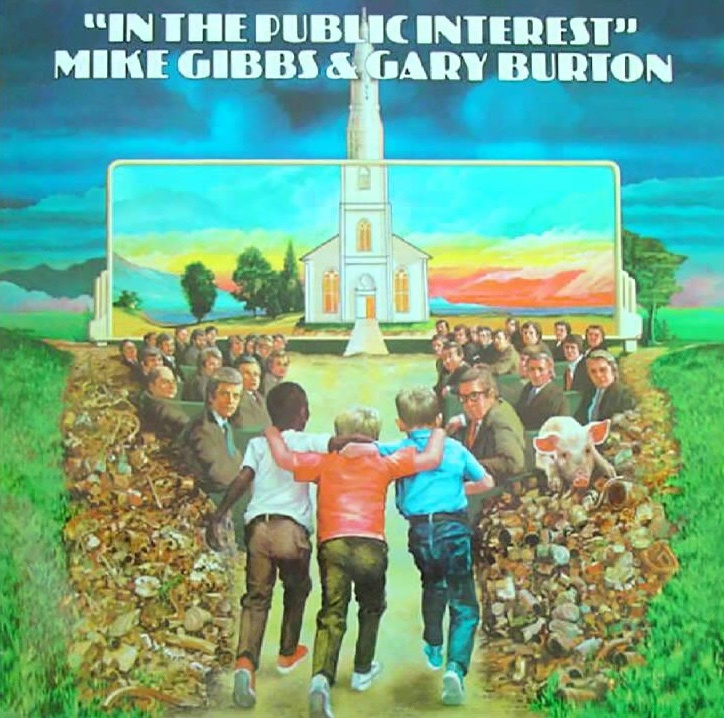
It has been well over a year since I’ve had enough time and energy to devote to this site. Now that I am back to posting regularly, in addition to catching up on ECM’s latest releases, I am resuming my quest to review every rarity I can find that may intrigue fans of the label. In that spirit, my readers sometimes do the finding for me, bringing things to my attention that I might otherwise have missed completely. Case in point is this out-of-print gem by way of Detrik, who dropped it in the comments, where it lingered for nine months before I gave it a spin. At last, I can offer my own.

Recorded in the summer of 1973 at Electric Lady Studios in New York and released a year later on Polydor, it bears the fingerprints of contemporaneous ECM productions. Manfred Eicher supervised the recording, which was mixed at Tonstudio Bauer by Kurt Rapp and Martin Wieland, the dream team behind Music From Two Basses. In this session, they render a rounded yet punchy sound.

Written, produced, and conducted by Mike Gibbs, In the Public Interest features a 21-piece band consisting of a robust brass section flanked by such heavyweights as saxophonist Mike Brecker, bassist Steve Swallow, guitarist Mick Goodrick, and drummer Bob Moses.

The A side begins appropriately with “The Start of Something Similar.” As the piano and vibes play in unison, dissonant brass gives rise to the theme before drifting into an atmospheric lull and back again. From this, one might expect a dreamier experience, but with “Four or Less,” it becomes obvious that reality abounds even when the musicians are at their most cerebral. Prominent now is the cello of George Ricci, who puts one rock into this stone soup for every two vegetables floating on top, Goodrick and pianist Allan Zavod stoking the fire until it all boils over in a free-for-all. Next is “Dance: Blue,” where groove is the name of the game. The horns evoke the colors of a 70s TV show (and all the associations that might come to mind with that image). Their carefree, youthful, seamless sound mellows as it goes, building a restrained strength in stretching out the theme.

After such a workout, it’s only fair that we are given a breather as we turn over to the B side, where “To Lady Mac: In Memory” awaits our ears.

A blistering flower of evocation, it features a soprano saxophone fluttering through heat waves of vibraphone on the way to “Family Joy, Oh Boy.” With weighty exuberance, this album highlight spotlights Burton in world-class form, navigating the maze laid out for him so adroitly by Swallow and Moses, who also share a savory dialogue. Lastly, the title tune, with its gentle carpet of vibraphone, electric piano, and cello, and “To Lady Mac: In Sympathy,” with its blushing skin, make for an easy offramp into contemplation.

In the Public Interest is an album of witty contrasts, thoughtful execution, confident melodies, and great charm. Listen to it here:

Benjamin Lackner: Last Decade (ECM 2736)

Benjamin Lackner
Last Decade

Benjamin Lackner piano
Mathias Eick trumpet
Jérôme Regard double bass
Manu Katché drums
Recorded September 2021 at Studios La Buissonne, Pernes-les-Fontaines
Engineer: Gérard de Haro
Mastering: Nicolas Baillard
Cover photo: Woong Chul An
Produced by Manfred Eicher
Release date: October 14, 2022

Benjamin Lackner makes a soft yet profound splash on Last Decade, his ECM debut. With Mathias Eick on trumpet, Jérôme Regard on bass, and Manu Katché on drums, the German-American pianist lays the groundwork for a quartet of wide imagination, forging a new relationship that is sure to grow over the next decade.

Lackner’s compositions are fertile ground for his bandmates. “Where Do We Go From Here” plants rows of seeds from the start, watering them in the same breath. Eick’s lyricism is given plenty of breathing room while the rhythm section snakes its way along like a shadow over rock and river. This mood (and mode) will be familiar to many ECM listeners, taking two steps inward for each outward.

But then, something happens as Katché’s groove in “Circular Confidence” opens up a much wider vista. Trading introspection for charity, it imbues Regard’s bassing with a lithe spirit as Lackner flips the landscape like the page of a book to reveal side quests galore. Foremost among them in Eick’s sojourn into distant cities and towns. Rather than bring us souvenirs, he returns with a travelogue. More tractions await in the enigmatically titled “Hung Up On That Ghost,” wherein Katché and Regard tessellate with unforced enchantment. Lackner and Eick give faith to form, the latter’s wordless vocals emblematic of a larger unity at play.

Although Lackner is more accustomed to solo and trio settings, Eick keeps in step as a natural ally. Lifting and lowering throughout “Camino Cielo,” he paints their relationship in streaks of gold and silver, his light as much a partner in the music as what is obscured by proxy. The title track is another collective journey marked by subtly daring harmonies and family memories. So, too, is the closing “My People.” Its staggered 11/4 time signature gives the listener plenty to meditate on.

Between them are three briefer excursions. Whereas “Remember This” is for the trio alone and finds Katché exchanging delicacies, “Open Minds Lost” offers the band’s fullest statement. All that remains is “Émile,” a freely improvised solo from Regard named after his son. Like the album as a whole, it pulls at the threads of life and weaves from them a tapestry of stories to be preserved for those who will outlive us.

Jakob Bro: Taking Turns (ECM 2543)

Jakob Bro
Taking Turns

Lee Konitz alto and soprano saxophones
Bill Frisell guitar
Jakob Bro guitar
Jason Moran piano
Thomas Morgan double bass
Andrew Cyrille drums
Recorded March 2014 at Avatar Studios, NY
Engineer: James A. Farber
Mixed August 2024
by Thomas Vang (engineer) and Jakob Bro
at The Village Recording Studio, Copenhagen
Cover design: Sascha Kleis
Album produced by Manfred Eicher
Release date: November 29, 2024

When I put this album into my computer, iTunes mistakenly named it “Exuding.” Then again, maybe the algorithm was trying to tell me something. As introspective as the music of Jakob Bro is often thought to be, it also chambers a creative fire that indeed exudes waves of inspiration. In this Copenhagen session, recorded in 2014 but given to the world a decade later, we encounter Bro in a mode of fearless exploration whereby coal is compressed into raw diamonds. Joining him are guitarist Bill Frisell, pianist Jason Moran, bassist Thomas Morgan, and drummer Andrew Cyrille.

At this point, except for Moran, Bro had shared a stage and/or studio with all the musicians gathered here. For example, his association with Lee Konitz goes back to 2008, when Paul Motian recommended that the two collaborate. And yet, as most under-the-skin jazz usually does, the all-original set glistens with the first-time-ness of its possibilities, especially given its delayed release. 

From the initial stirrings of “Black Is All Colors At Once,” it’s obvious that the notion of taking turns is subjective and at the whim of every moment. Its airy yet substantial sound takes an inch of history and gives a pound of cure, hiding its soul in places light cannot reach. If Konitz is a voice to be heard here, how much more so in his rare turn on soprano in “Haiti.” Alongside Cyrille’s cinematic cymbals and Bro and Frisell’s dialogism, there’s plenty of sun to go around.

“Milford Sound” is the band’s dreamiest calling card. The title, which references both Milford Graves and a fjord in New Zealand’s South Island, proves a revelatory beacon for Moran, who finds his stride band like a sole to its shoe. The unforced language of the guitars questions as much as it answers, Morgan and Cyrille trading periods and commas with perfect fluency all the while. Other reference points include New York’s Chinatown in “Pearl River” and memories of Argentina in “Mar Del Plata.”

The music also invites us to make our own associations. When listening to “Aarhus,” for example, I cannot help but remember my time in the city’s ARoS art museum. One note, and I am back strolling through its rainbow-colored rotunda, starting in the deepest reds and working toward indigo. Meanwhile, “Peninsula” suggests the liminal geographies that so often attract me, eschewing groove in favor of what speaks clearly enough through flow and circumstance.

These are travelers who have circled the world (and then some) whose paths have not only crossed here but become one for a while. How privileged that we should be invited to join them on this leg of the journey.

Valentin Silvestrov: Maidan (ECM New Series 2359)

Valentin Silvestrov
Maidan

Kjiv Chamber Choir
Mykola Hobdych 
conductor
Recorded 2016
St. Michael’s Cathedral, Kjiv
Engineer: Andrij Mokrystkij
Cover photo: private collection
Recording produced by Kjiv Choir Productions
Release date: September 30, 2022

At the core of German existentialist Martin Heidegger’s philosophy was a concept he called “thrownness” (Geworfenheit). Although he meant it to express the uncontrollable immanence of being born into a specific time and place, it has since taken on connotations of suffering and hardship, without which life would never be defined. On Maidan, Valentin Silvestrov’s third all-choral program for ECM New Series, we witness the composer thrown from his private spiritual light into secular shadow.

Sung once again by the Kjiv Chamber Choir under the conduction of Mykola Hobdych, Silvestrov’s writing takes on a political layer he never wished it to have. The title refers to the “Euromaidan,” or the “Revolution of Dignity,” as it is known in Ukraine, signaling the government’s refusal to associate itself with the European Union in 2014 and a precursor to Russia’s invasion on February 24, 2022. Witnessing these events unfold, Silvestrov, then 84, took solace in song. With the alarm bells of St. Michael’s Cathedral sounding a rare alarm in the background, he reclothed the naked body of nationalism with verses from Ukrainian poet Taras Shevchenko (1814-1861) and liturgical texts.

The album’s bulk is reserved for Maidan 2014, a “cycle of cycles,” which melts the words of the Ukrainian national anthem (penned by Pavlo Chubynsky) into five different molds. Its opening proclamation—“Ukraine’s freedom has not yet perished, nor has her glory…”—takes on more of its intended meaning than ever, crying in the wilderness against the onslaught of a regime surrounding itself in self-fulfilling icons.

In response to such inflations of power, much of what fleshes out the remaining spaces is scriptural in origin. “Give Rest, O Christ, to Thy Servants,” for example, speaks with the voice of the Savior on the cross, who forgave his enemies as he died by their hand. We feel surrounded by the spears of those who would deem him a blasphemer and usurper of authority. Individual singers and choir mirror this dynamic, balancing the alto-led vigil of “The Lord’s Prayer” with the Belarusian folk song-inspired “Lullaby.” These embody the same contradiction of “Lacrimosa,” which awaits a blessed hope in the thorns of a world without it. Like the soloist in “Holy God,” giving praise, honor, and glory to the one on high, they understand that no evil can ultimately overcome the power of faith. Even the wordless “Elegy” makes its deference palpable.

Few composers articulate silence with sound (and vice versa) like Silvestrov, as demonstrated by three collections from 2014 (Four Songs), 2015 (Triptych), and 2016 (Diptych). These settings of Shevchenko range from robust (“The Might Dnieper”) and reproachful (“Come to Your Senses”) to fable-like (“A Cherry Orchard by the House”) and altruistic (“To Little Mariana”), reaching their darkest resignations in “My Testament,” in which the narrator requests, “When I am dead, bury me / In my beloved Ukraine.” Thus, the music suggests that wickedness in high places is truer than we care to admit.

Since Silvestrov now sees the world as Maidan, releasing this music to a wider audience feels appropriate. No longer is it chained to the narrow vision of a particular historical moment but rather the delicate swan song of something dying in all of us lest we fail to have room for hope when the chance arises. “After all,” he says, “the louder the mortars and canons roar, the softer the music becomes.” Therefore, his goal is not to evoke the chaos of war; he is a shield for peace, standing his ground in its storm.

Tomasz Stanko Quartet: September Night (ECM 2650)

Tomasz Stanko Quartet
September Night

Tomasz Stanko trumpet
Marcin Wasilewski piano
Slawomir Kurkiewicz double bass
Michal Miskiewicz drums
Concert recording, September 9, 2004
at Muffathalle, Munich
Mixing: Manfred Eicher, Marcin Wasilewski, and Stefano Amerio (engineer)At Bavaria Musikstudios, Munich
Cover photo: Caterina Di Perri
Produced by Manfred Eicher
Release date: June 21, 2024

Recorded on September 9, 2004, at Munich’s Muffathalle, this surprise from the archives reveals as much about the late trumpeter Tomasz Stanko as it obscures. The live session finds him in the company of pianist Marcin Wasilewski, bassist Slawomir Kurkiewicz, and drummer Michal Miskiewicz, the trio with whom he shared stages from 1993 to 2017. “We were growing by his side, and he was watching us,” Wasilewski recalls about working with the man who was their mentor in every sense. “Every concert we played with him was important—the most important, almost as if it was the last one. That’s the approach he taught us: ‘When you play music, play it at a thousand percent!’” One hears that ethos revived throughout September Night, making it a vital document that deserves to wrap its arms around the shoulders of Suspended Night and Lontano, where it chronologically lands between.

I will never forget seeing Stanko with his New York Quartet in 2013. I still get whiffs of that octane now and then in the brain. But listening to “Hermento’s Mood,” which opens this all-original set, I am reminded of the ethereality he was uniquely capable of—a continuation of the song he held inside. Like “Elegant Piece” later in the show, it’s a flower that blooms only in moonlight.

Stanko’s ability to jump from exuberance to the depths of the soul never ceased to amaze. “Song For Sarah” is a prime example, just as comfortable grazing the bottom of the ocean in search of treasures long forgotten (of which this recording is one) as “Celina” is at home throwing its slow-motion strike across the proverbial plate. Even the freely improvised “Kaetano” cannot help but flirt with contradiction, shifting from urban meandering to a scenic train ride conducted by the rhythm section and exposited by Wasilewski.

Lest we forget the brilliance of Stanko’s backing band and the enmeshment of which they continue to be humble champions, we need only point to “Euforila” as a beacon of their craft. Opening with a lacy bass solo, it finds the band doing what it does best: knitting itself together while allowing plenty of open space between every instrument. As a determined body of water, they work around everything in their way without skipping a beat. Wasileswki is bright and joyful, while Stanko’s delicate punch of a solo is hot to the touch. Yet nothing can stop Miskiewicz from making the biggest waves below, crashing and roaring into the conclusion. Contrasting this is the closing “Theatrical,” which casts its ring into the fires of Mordor and walks away unscathed.

Incidentally, this concert was part of the “Unforeseen” symposium, co-curated by Munich’s Kulturreferat and the musicology department of the Ludwig Maximillian University, a week-long event that yielded two further ECM live albums: Evan Parker’s Boustrophedon and Roscoe Mitchell’s Composition/Improvisation Nos. 1, 2 & 3. If such companions feel radically different, it’s because freedom assumes a bespoke form here. Whereas Parker leaps skyward and Mitchell digs into the earth, Stanko is most comfortable riding that indefinable horizon between them.

Gianluigi Trovesi/Stefano Montanari: Stravaganze consonanti (ECM 2390)

Gianluigi Trovesi
Stefano Montanari
Stravaganze consonanti


Gianluigi Trovesi piccolo clarinet, alto clarinet, alto Saxophone
Stefano Montanari concertmaster
Stefano Rossi second violin
Claudio Andriani viola
Francesco Galligioni violoncello
Luca Bandini double bass
Emiliano Rodolfi oboe
Pryska Comploi second oboe
Alberto Guerra bassoon, dulciana
Riccardo Balbinutti percussion
Ivano Zanenghi archlute
Valeria Montanari harpsichord
Fulvio Maras percussion, electronics
Recorded January 2014 at Sala musicale giardino, Cremona
Engineer: Roberto Chinellato
Mixed September 2021 at Artesuono Studio, Udine
by Gianluigi Trovesi, Stefano Montanari, Guido Gorna, and Stefano Amerio (engineer)
Cover photo: Luciano Rossetti
An ECM Production
Release date: February 24, 2023

Italian reed virtuoso Gianluigi Trovesi and baroque violinist Stefano Montanari (doubling here as concertmaster) lead an ensemble of period instruments for a fresh take on the music of the 15th through 17th centuries. Meshing melodies from towering figures of the Renaissance and Baroque with equally visionary interpretations, the program manages to carve new initials into old pillars without marring their beauty. Some new compositions by Trovesi, plus a couple of improvisations with Fulvio Maras (percussion, electronics), complete the mix.

The album’s title, which translates as “consonant extravagances,” offers an accurate description of what is happening sonically, creatively, and even spiritually. “The Witches’ Dance” (from Henry Purcell’s opera Dido and Aeneas) leads off on a courtly foot. Purcell makes a handful of appearances throughout, most gorgeously as a motivic inspiration for Trovesi’s “For a While.” Like all of his pieces, it benefits from the robustness of Corrado Guarino’s arrangements, which take advantage of the period instrument ensemble under Montanari’s charge. The latter brings the crispness of strings to “Consonanze stravaganti” by Giovanni Maria Trabaci (an influence on Girolamo Frescobaldi), Guillaume Dufay’s Missa L’homme armé, and a sonata by Giovanni Battista Buonamente. Whether threading his alto through Andrea Falconieri’s “La suave melodia” or revealing his compositional wonders in “L’ometto disarmato” and the alto clarinet jaunt of “Bergheim,” Trovesi is a force of nature shapeshifting between song and cry on the turn of a dime. If the past is alive in his sound, then so is the future.

(This review originally appeared in the January 2024 edition of The New York City Jazz Record, a full PDF of which is available here.)