My latest translation is of Japanese author Sagisawa Megumu’s masterful short story collection, The Running Boy, out now from Cornell University Press. Click the image below for more information.



My latest translation is of Japanese author Sagisawa Megumu’s masterful short story collection, The Running Boy, out now from Cornell University Press. Click the image below for more information.
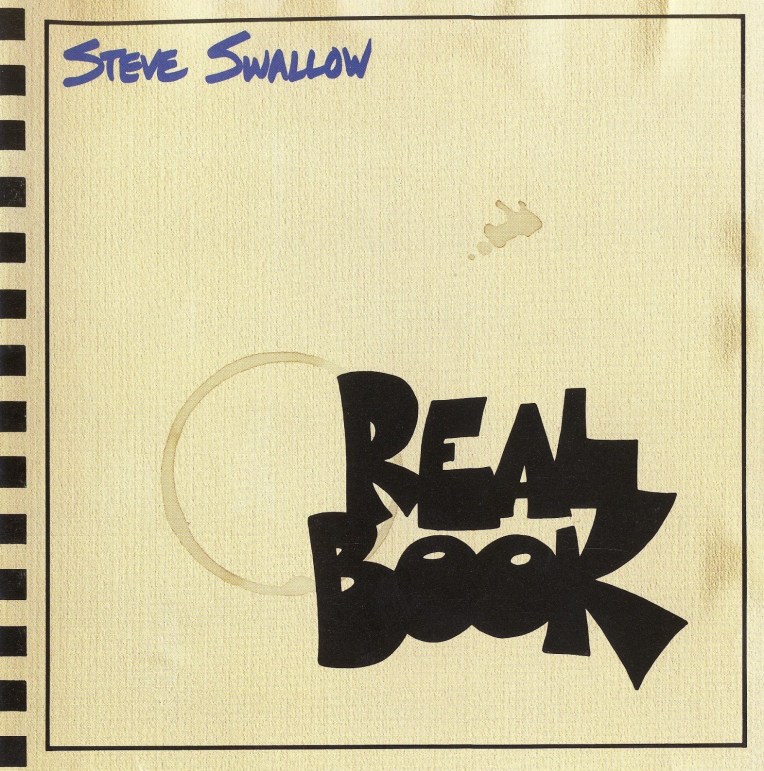
Steve Swallow
Real Book
Tom Harrell trumpet, flugelhorn
Joe Lovano tenor saxophone
Mulgrew Miller piano
Steve Swallow bass
Jack DeJohnette drums
Recorded and mixed December 1993 at Grog Kill Studio, Willow, New York
Engineer: Tom Mark
Mastered by Greg Calbi at Sterling Sound
General co-ordination: Ilene Mark
Produced by Steve Swallow
Release date: May 1, 1994
Even though Steve Swallow’s name is all over the original Real Book (the tome of jazz standards that came out of the Berklee scene in which he once served as teacher and clinician), none of the tunes featured on this album named after it appear on its pages. Either way, Swallow could hardly have asked for a more ironclad band to interpret them. Tom Harrell on trumpet and flugelhorn, Joe Lovano on tenor saxophone, Mulgrew Miller on piano, Swallow himself on bass, and Jack DeJohnette on drums make for a killer combo. Collectively, they play with every intention of unpacking heads, charts, and solos. Individually, they make good on that promise while interlocking their signatures as often as possible. At its highest octane, the quintet soars, as in the brightly lit “Thinking Out Loud” and the joyous “Let’s Eat.” Swallow and DeJohnette are a wondrous (if all-too-rarely seen) rhythm section, as evidenced in the charged opener “Bite Your Grandmother.” Additionally, Harrell and Lovano make a great pair, as complementary as they are distinctively individualistic. Like adroit lawyers, they know how to twist every phrase in their favor.
Lovano’s playing spans the gamut from bluesy (“Second Handy Motion”) to unchained (“Muddy In The Bank”), while Harrell shimmers in the relaxed strains of “Better Times” and the balladic “Wrong Together.” To the latter he adds just enough smoke to imply the fire that bursts into life in “Outfits.” This is the kind of tune that Swallow does best: exciting and forward-thinking. Harrell shifts into overdrive, inviting Lovano and Miller into the fast lane without hesitation, only to find that DeJohnette’s pace car has been ahead of them the whole time. On their way to the smoother destination of “Ponytail,” they take time to stop over in “Willow,” an intimate trio for Swallow, Miller, and DeJohnette that’s sure to rejuvenate.
If anything about this album nags me, it’s that I find it to be played a little too cleanly at times. Then again, with so much plush haystack to wade through, why waste time looking for a needle?
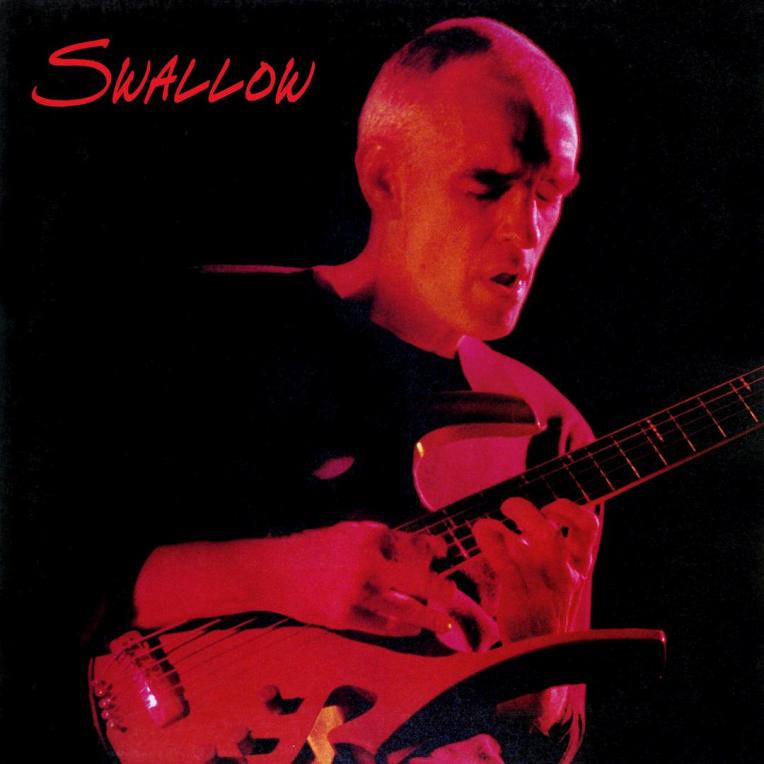
Steve Swallow
Swallow
Steve Swallow bass
Steve Kuhn piano
Carla Bley organ
Karen Mantler synthesizer, harmonica
Hiram Bullock guitar
Robby Ameen drums
Don Alias percussion
with
Gary Burton vibes
John Scofield guitar
Recorded and mixed September-November 1991 by Tom Mark and Steve Swallow, Grog Kill Studio, Willow, New York
Additional recording by Robin Coxe-Yeldham at Berklee Studio, Boston, MA
Mastered by Greg Calbi at Sterling Sound
Synthesizer programming: Harvey Jones
General co-ordination: Karen Mantler
Produced by Steve Swallow and Carla Bley
Release date: March 1, 1992
In this self-titled set, bassist and composer Steve Swallow proves his strengths in both capacities. Leading a septet that includes Steve Kuhn on piano, Carla Bley on organ, Karen Mantler on synthesizer and harmonica, Hiram Bullock on guitar, Robby Ameen on drums, and Don Alias on percussion, along with special guests Gary Burton on vibes and John Scofield on guitar, he adds yet another hue to his spectrum of colors. Swallow has always been a lively player, and here his ability to bring high-energy grooves into focus sings with vibrancy. That said, a recumbent “William And Mary” pans the camera to Bley’s organ, as do “Thirty Five” and the Scofield-centric romance of “Doin’ It Slow,” for a more touching mode of expression.
Swallow pulls out all the stops in “Belles.” Kuhn introduces the tune, and the album proper, as an experience in which to luxuriate. Swallow’s nylon-rich five-string bass sounds more guitar-like than ever in its navigations of a soothing improvisational climate. Ameen and Alias give us plenty of beat to bite on, while Mantler’s synthesizer draws a humid undercurrent. Those electronic strains carry over into “Soca Symphony,” as does a certain emotional uplift—a cloud on which Swallow will ride until he lays his head in the pillow of Burton’s vibes.
“Slender Thread,” another quiet seduction, strikes that balance of kitsch and sophistication Swallow walks so well. Mantler’s harmonica rings out across the night, while the bass swims its own waters. But it’s Swallow’s crafting of tunes like “Thrills And Spills” that brings a pulse to every note. In addition to being another moment in the sun for Ameen and Alias, it finds Scofield tearing a hole in the atmosphere with scalpel precision. Swallow matches him lick for lick. “Ballroom” is another swinging excursion with clever chord changes and geometric guitar work. Grooving somewhere between those two poles is “Playing With Water,” a bossa nova of intimately epic proportions. Like the fadeouts in some of what precedes, it could potentially go on forever and, either way, resonates in the heart long after silence puts a finger to its lips.
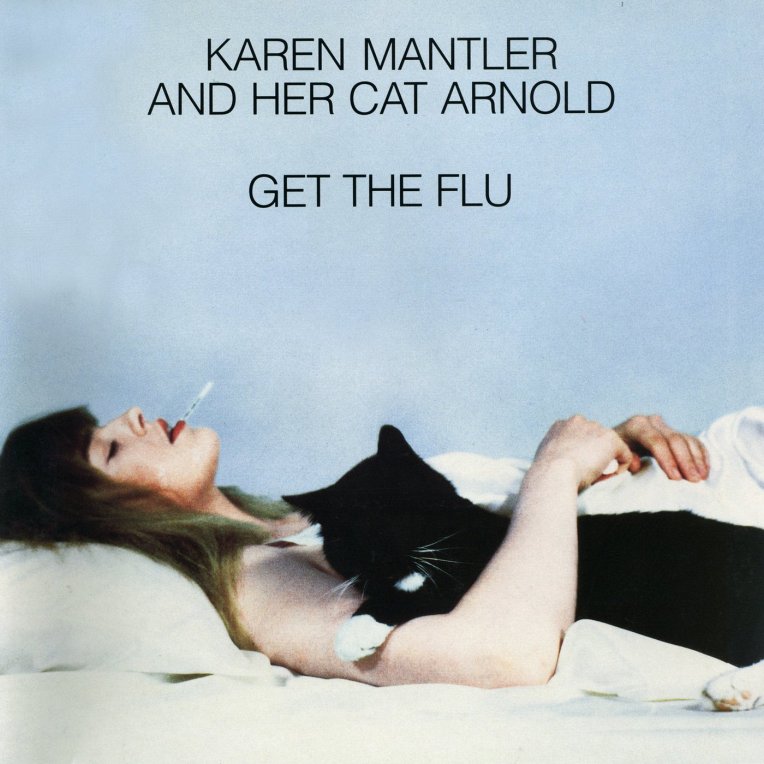
Karen Mantler And Her Cat Arnold
Get The Flu
Karen Mantler vocals, harmonica, organ, piano
Eric Mingus vocals
Steven Bernstein trumpet
Pablo Calogero baritone saxophone, flute
Marc Muller guitar
Steve Weisberg keyboards
Jonathan Sanborn bass
Ethan Winogrand drums
Michael Mantler trumpet (on “Mean To Me”)
Carla Bley C melody saxophone (on “Mean To Me”)
Steve Swallow flugelhorn (on “Mean To Me”)
Recorded and mixed Summer 1990 by Tom Mark and Steve Swallow, Grog Kill Studio, Willow, New York
Mastered by Greg Calbi at Sterling Sound, New York, NY
General co-ordination: Michael Mantler
Produced by Carla Bley and Steve Swallow
Release date: November 1, 1990
Nothing is as bad as the flu
Torture would be nice compared to this…
So begins the second album from Karen Mantler who, in her inimitable blend of melody and spoken word, goes on to tell us of her battle with a virus her doctor dubs “Shanghai A.” In relating our own experiences to her feverish delirium, evoked with filmic veracity by keyboardist Steve Weisberg and baritone saxophonist Pablo Calogero, we find ourselves connected to the strangely brilliant goings on. The band’s voices, as well as Arnold’s meow, emerge as a chorus, sending us off into the remainder.
Within that remainder, noteworthy vignettes abound. Foremost is “I Love Christmas,” which contains some of her cheekiest dialogue. From its opening line (“Everybody knows that Santa Claus is dead”), through its evocation of holiday blues (“Don’t you know it’s just a scam to make you spend your cash, and more suicides are committed then”) to Mantler’s banter with vocalist Eric Mingus (to whose derision she retorts, “But they make you eat moldy fruitcake”), this is a sly antidote to what is for some the loneliest time of year. The carnivalesque “My Organ” is another standout for expressing an in born love of music, and in it Mantler emotes via the titular instrument with the conviction of one who puts her money (what little of it she has) where her mouth is. Organ and harmonica play vital roles in “Au Lait,” stitched together by the rolling snare of Ethan Winogrand and guitar of Marc Muller. And then there’s the unsettling “Waiting,” an attractively woven tapestry of impatience and secrets.
If not already clear, the clouds hanging over these tunes are not quite as dark as they were the last time around, though the scenes played out in “Let’s Have A Baby” and “I’m Not Such A Bad Guy” remind us of past relationships. Whether exploring sickness as a metaphor for irreconcilable tensions in “Call A Doctor” or sending the everyman packing in “Good Luck,” Mantler is a constant voice of reason in an unreasonable world. Like the harmonica that sings so resolutely at her lips, her words cut through the noise to the cold reality of things. Neither is she immune to poking fun at herself, as in a new version of “Mean To Me,” in which her band derides very harmonica solo, when in spite of it all we know just how clairvoyant it can be.

Orchestra Jazz Siciliana
Plays The Music Of Carla Bley
Nico Riina, Massimo Greco, Pietro Pedone, Faro Riina, Giovanni Guttilla trumpets
Salvatore Pizzo, Salvatore Pizzurro trombones
Maurizio Persia bass trombone
Orazio Maugeri alto saxophone
Claudio Montalbano alto and soprano saxophones
Stefano D’Anna tenor saxophone
Alessandro Palacino tenor and soprano saxophones
Antonio Pedone baritone saxophone
Ignazio Garsia piano
Pino Greco guitar
Paolo Mappa drums
Sergio Cammalleri percussion
Guest artists:
Gary Valente trombone
Steve Swallow bass
Recorded direct to 2-track Digital Audio Tape at Brass Group Jazz Club and in concert at Teatro Metropolitan, Palermo, Sicily, May 11-16, 1989
Recording engineer: Lillo Sorrentino, assisted by Pino Passalacqua
Post-production by Steve Swallow and Carla Bley, November 1989, at Grog Kill Studio, Willow, New York
Engineer: Tom Mark
Mastered by Greg Calbi at Sterling Sound, New York, NY
General Co-ordination: Michael Mantler
Executive producer: Ignazio Garsia
Release date: October 1, 1990
Interpretations of a jazz composer as highly respected as Carla Bley can proceed one of (at least) two ways: either as springboard for idiosyncratic adlibbing and personal expression or as opportunity for an adoring homage. In the case of this recording by the Orchestra Jazz Siciliana under the direction of Bley herself, we get an instance of the latter. Each of these pieces has been re-orchestrated for big band by Jeff Friedman from their original versions and, with the exception of “Egyptian,” will be familiar to those who’ve kept an ear planted in her robust discography.
The sizable Italian ensemble, joined by special guests Gary Valente on trombone and Steve Swallow on bass, hits a line drive right off the bat with “440” by virtue of a faster pitch compared to its first appearance on record. Artisanal textures keep the melodic strengths of Bley’s writing front and center, while selective solos from altoist Orazio Maugeri and Valente serve to emphasize the smoothness of the undercurrent at hand. This gives way to the blues in “The Lone Arranger.” For this version, the banter is delivered (even by Bley herself) in Italian, making it a delightful standout. All of which feels like a grand prelude to the centerpiece: “Dreams So Real.” The present arrangement, compared to its siblings, is probably the most divergent from its source. With oodles of soul to reckon with, Valente’s trombone blasting across the airwaves with conviction, it evokes the title with gusto, and all of it framed by the beauty of guitarist Pino Greco.
The album’s remainder is taken from a May 1989 live recording at Teatro Metropolitan in Palermo. A tasteful reverb lifts the sound closer to the stratosphere, where some of the soloists like to spend their time. If Valente was the star of the first half (though one can hardly bat an eyelash at his solo in “Baby Baby”), this second half extols the wonders of tenor virtuoso Stefano D’Anna, whose backbone heightens the flexibility of such tunes as “Joyful Noise” and the outlying “Egyptian,” which lights Orientalism like a fuse and watches it explode with glee. In closing, we get hit with the cinematic flair of “Blunt Object.” The drums and percussion by Paolo Mappa and Sergio Cammalleri, respectively, along with Maugeri’s muscular turn at the plate, make this a solid home run.
The audience is into it, as should we be. Bravos all around.
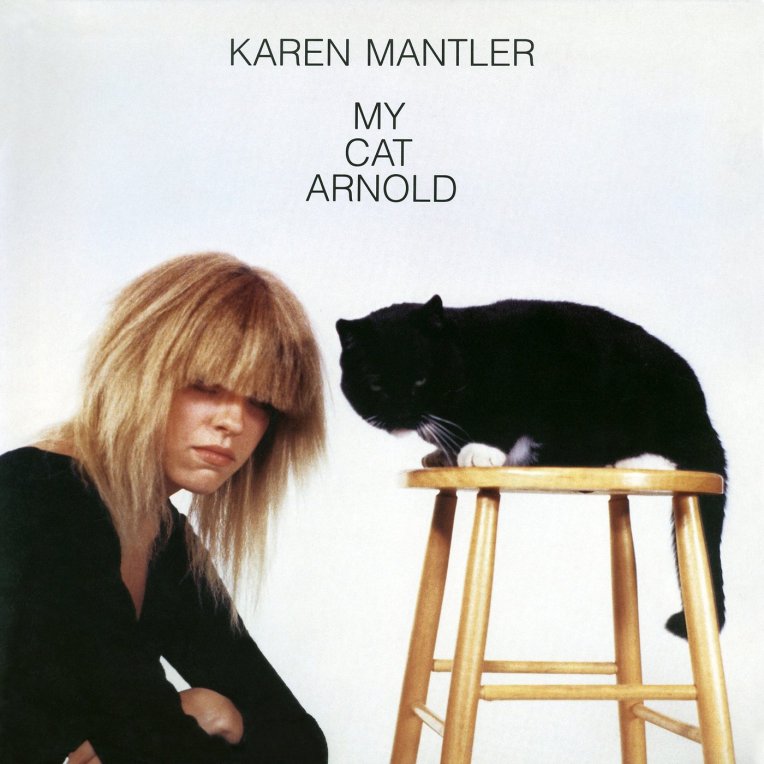
Karen Mantler
My Cat Arnold
Karen Mantler vocals, harmonica, organ, piano
Eric Mingus vocals
Jonathan Sanborn bass
Ethan Winogrand drums
Marc Muller guitar
Steve Weisberg synthesizers
Steven Bernstein trumpet
Pablo Calogero baritone saxophone
Recorded Spring 1988 by Angela Gomez and Steve Swallow
Mixed by Tom Mark, Grog Kill Studio, Willow, New York
Mastered by Greg Calbi, Sterling Sound, New York, NY
General co-ordination: Michael Mantler
Produced by Carla Bley and Steve Swallow
Release date: November 1, 1989
Karen Mantler, who takes after her father (Michael Mantler) in name and taste for the morose, as after her mother (Carla Bley) in musical spirit, has cobbled herself a pair of shoes that no one else could possibly fill. If Suzanne Vega did late-night cabaret, this might just scratch the surface of what you’ll find on this emblematic debut. Add in the talents of Charles Mingus’s son Eric on vocals and David Sanborn’s son Jonathan on bass, along with a bevy of nuanced musicians, and you get some dusty, forlorn songcraft that burrows into the skin and tattoos it from the underside.
As will become her usual, Mantler hangs out in the dimly lit corners of human experience and describes them as a means of emphasizing the unconditional purity of the relationship she shares with her titular cat Arnold. The most imposing door stands before us in the form of “I Wanna Be Good.” This one-act play of derision between partners spins a funky argument, replete with Greek chorus-like commentary from the band between verbal spars as the boyfriend (played by Mingus) tries to mold her into something she wishes not to be. Their relationship plays out further in “Breaking Up,” for which they swap self-defenses amid a congregation of bass, drums, organ, and the popping baritone saxophone of Pablo Calogero. “Fear Of Pain” takes an even more disturbing turn into domestic violence (Steve Weisberg’s synthesizer delineating a palpable tension throughout). Thankfully, Mingus isn’t always a target of fear, as when he takes on a comedic role in “My Stove,” acting the part of salesman trying to sell her on a variety of stoves (read: thinly veiled stand-ins for men) to the hapless Mantler, who longs for her old stove after it “moved to another town.”
Emotionally honest as these are, the album’s highlights deal with more mundane objects of concern. On “Vacation,” Mantler croons about her desire to get away from it all. Songs like this come across as destitute, because we know the events they describe will never happen. On the flip side, those about overtly sad things are presented as whimsical and airy. A fine example of the latter is “People Die,” which is so unadorned that nothing but emotion comes through. “It’s a fact,” she sings. “Once you’re born there’s no turning back.” These childlike rhymes blister with truth. With so little affect to get in their way, the wisdom of their banality glows.
The title track is an ode to her cat. Described as a “big furry pillow with claws,” he occupies her thoughts 24/7. Mantler’s obsession with Arnold makes the thought of losing him unbearable (and foreshadows the pall of her third album). “Best Of Friends” is a lovely song about her mother and is perhaps the only moment when genuine sunshine peaks through the clouds. Finally, “Green Beans” is a soulful song about—you guessed it—those vegetables so often pushed to the side of a child’s plate. Mingus gives a method performance as the man who hates green beans as much as the woman serving them, bringing us full circle to the reality of a broken world in which Arnold’s purr might be the only hope left.
Mantler’s one-of-a-kind psychoanalysis warms the cerebrum. Noteworthy also is her harmonica playing, which casts a varicolored light across each lyric. More than any other artist in the WATT family, she is an uncompromising outlier who understands that every generation has its story to tell, even if that story will never change.
Steve Swallow
Carla
Carla Bley organ
Steve Swallow bass
Hiram Bullock guitar
Larry Willis piano
Victor Lewis drums
Don Alias percussion
Ida Kavafian violin
Ik-Hwan Bae viola
Fred Sherry cello
Recorded and mixed Winter 1986/87 at Grog Kill Studio, Willow, New York
Mastered by Greg Calbi at Sterling Sound
General co-ordination: Michael Mantler
Produced by Steve Swallow and Carla Bley
Engineered and co-produced by Doug Epstein
Release date: October 1, 1987
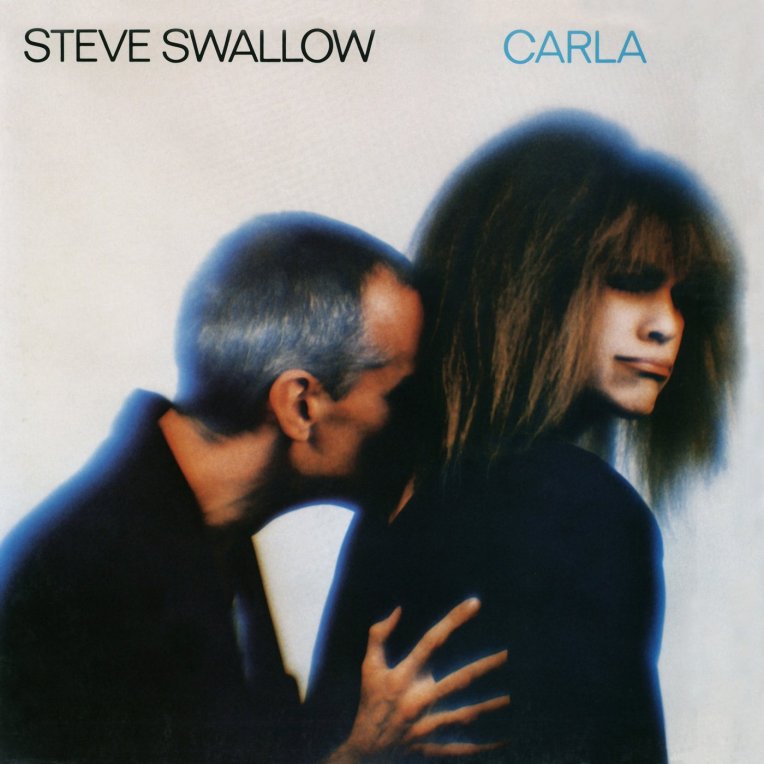
This timeless love letter from Steve Swallow to Carla Bley belongs on the shelf alongside Sextet, as both albums emerged from the same sessions. The core band of guitarist Hiram Bullock, pianist Larry Willis, drummer Victor Lewis, and percussionist Don Alias applies, but is augmented by DW-6000 and DW-8000 synthesizers, played by the lifelong lovers of the hour, and a bona fide string trio. Those extra forces enhance the underlying mood with such a high level of atmospheric integrity that the music they wrap themselves around is elevated to an emotional state far beyond nostalgia.
The quirky cover photograph makes more sense once the luxuriance of “Deep Trouble” unravels its melody like an unwanted cigarette. The tension between bliss and self-deprecation is real, and reminds us how falling in love is sometimes the greatest threat to everyday equilibrium. Bley’s fresh-out-of-the-oven organ—both here and in such tracks as “Fred And Ethel,” “Afterglow,” and “Last Night”—is as romantic as it is mysterious. Yet her spotlight is only as bright as Swallow’s compositions, which have the strength of a full moon. Whether coaxing a head-nodding rhythm from Alias and Lewis in “Count The Ways” or deferring to his partner’s sense of humor in “Hold It Against Me,” Swallow assures the listener of total comfort through slick key changes and unforced propulsions.
His ability to craft an environment is especially complex in “Crab Alley” and “Read My Lips.” With every shift of gear, he drives deeper into the chambers of his psyche, sticking a hand out of the window every now and then to take a Polaroid in his search for an authentic sense of self to lay down at his lover’s altar. And as Willis’s pianism propels the band into the stratosphere, we realize there’s still so much to discover within ourselves.
Carla is a crowning achievement for Swallow, through and through, and is about as enchanting as jazz gets. Something our hearts have heard before, because it hears us so well.

Steve Weisberg
I Can’t Stand Another Night Alone (In Bed With You)
Lew Soloff trumpet (solo on “Trapped”)
Baikida Carroll trumpet (solo on “Table”)
Gary Valente trombone
John Clark French horn
Wolfgang Puschnig alto saxophone, flute
Howard Johnson baritone saxophone, contrabass clarinet, tuba
Hiram Bullock guitar
Steve Weisberg piano, synthesizer, organ (on “Table” and “You Can’t”)
Steve Swallow bass
Victor Lewis drums (on “I Can’t Stand”)
Anton Fier drums (on “Table” and “Trapped”)
and
Norman David tenor saxophone
Neil Leonard clarinet
Eric Goldberg accordion
Karen Mantler organ (on “I Can’t Stand” and “Trapped”)
Mike Stanzilis bass (on “Trapped”)
Jack Cook drums (on “You Can’t”)
Ken Winokur percussion
Carol Capstein viola
Priscilla Chew cello
Frank Luther double bass
Recorded and mixed November/December 1985 by Tom Mark at Grog Kill Studio, Willow, New York
Produced by Carla Bley and Steve Swallow
Release date: November 1, 1986
In 1986, the WATT sublabel—a dedicated showcase for the musical projects of Carla Bley and Michael Mantler—gave birth to the sub-sublabel XtraWATT. To celebrate this momentous occasion, the inaugural release was handed off to Steve Weisberg. The onetime New York fixture, who continues to perform regularly with his orchestra (only now in Los Angeles, where he relocated permanently in 2003), is perhaps best known as a prodigious arranger who has worked with such diverse talents as Hal Willner, Marianne Faithfull, Howard Tate, and Suzy Williams, to name but a few.
The unmistakable trombone of Gary Valente opens the title track with a swanky, after-midnight atmosphere. Boiling with the tension of finding love in an urban sprawl, the music welcomes a large-scale ensemble, many members of which are on loan from the Carla Bley Big Band. Expertly blended strings and a bass line from Steve Swallow kick off an evocative groove through sunnier climates. The accordion of Eric Goldberg adds to the seaside palette and invites us on a journey to faraway places where dreams live on despite the dank reality outside our doors. Weisberg’s warped synthesizer reminds us that beauty always fades.
“Table For One” and “Trapped In True Love” are the album’s finest passages. Both feature legendary underground drummer Anton Fier, who bounces lithely beneath Swallow’s groundlines. The former tune features a clarion solo from trumpeter Baikida Carroll, while the latter boasts alluring horn textures and a carnivalesque undertone. Trumpeter Lew Soloff emits solar flares in his solo, and guitarist Hiram Bullock adds to the mounting tension, both in his comping and incendiary solo. Between these two encounters, we are treated to the interludes of “Walking Home Alone” and “Waking Up Alone,” each a haunt of cinematic proportions. All of which makes the final blast of fantasy that is “You Can’t Have Anything” an uplifting takeaway.
Having no idea what to expect from this recording, especially given the less-than-appealing title and cover art (a lesson I should already have learned during my jaunt through WATT), imagine my delight when I found this to be a lovingly composed, arranged, and performed album from start to finish. In Weisberg there beats a kindred heart to Carla Bley, whose influence is felt all over this curious little gem from one of jazz’s behind-the-scenes iconoclasts.
Carla Bley
Carla’s Christmas Carols
Carla Bley piano, celeste
Steve Swallow bass, chimes
Tobias Weidinger trumpet, flugelhorn (lead), glockenspiel
Axel Schlosser trumpet, flugelhorn (soloist), chimes
Christine Chapman horn
Adrian Mears trombone
Ed Partyka bass trombone, tuba
Recorded December 8/9, 2008 and mixed and mastered at La Buissonne Studio, Pernes Les Fontaines
Engineers: Gérard de Haro and Nicolas Baillard
“O Holy Night” and “Joy To The World” recorded live in Berlin on December 4 by Rundfunk Berlin-Brandenburg
Produced by Carla Bley and Steve Swallow
Release date: November 6, 2009
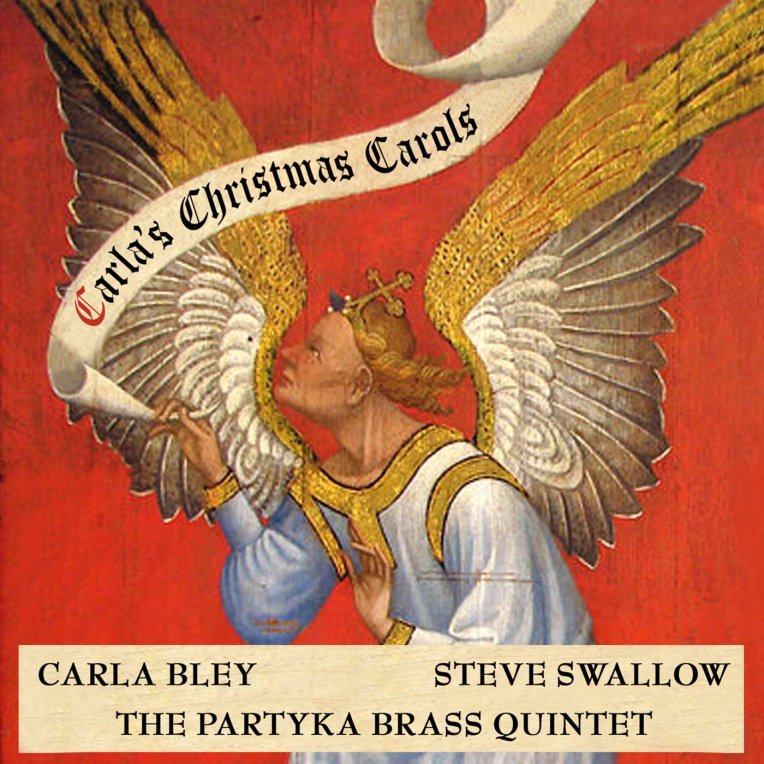
It seems altogether fitting, given Carla Bley’s religious jumping of ship, to come full circle in their biographical tendencies with this utterly reverent collection of well-known Christmas music. Joined by Steve Swallow and the Partyka Brass Quintet, Bley offers an album of original arrangements that speak to the heart of every song while drawing out something long-concealed by the artifice of commercialization.
The staples one would expect in such an assortment are all there. From the nostalgic uplift of “It Came Upon A Midnight Clear” and “Jingle Bells” to the sincere gratitude of “The Christmas Song,” there’s plenty of spice to mull your cider. More interesting, however, are the splashes of rum to spike your egg nog. These come in the form of Bley’s clever harmonization of “O Tannenbaum,” in the addition of celeste of “Away In A Manger,” and in the soulful trombone of Adrian Mears in “Ring Christmas Bells.” Like those pops of air from logs settling in a fireplace, such moments court our attention in unforeseen directions while abiding by the comforts of the familiar. Axel Schlosser in “God Rest Ye Merry Gentlemen” is another noteworthy soloist, by his flugelhorn lighting the set’s brightest candle.
Bley contributes two tunes of her own: the jauntier “Hell’s Bells” (replete with sarcastic allusion to “Santa Claus Is Coming To Town” and, of course, the sound of jingle bells) and the processional “Jesus Maria,” which Swallow reads prayerfully through the bass. Moreover, we get two bonuses—“O Holy Night” and “Joy To The World”—recorded live in Berlin during the tour from which the band broke to make this album. The end effect is of childhood unwrapped like a present beneath the tree.
And with that, we come to what is (as of this writing) our final stop on the WATT train. We’ve been through a lot together, in terms of space and time, traversing cultures and even galaxies as easily as opening our ears. But let us never downplay the unquantifiable amount of energy and sacrifice Carla Bley has given to the world of sound in order to refashion it in her own image.
 Between Sound and Space: ECM Records and Beyond