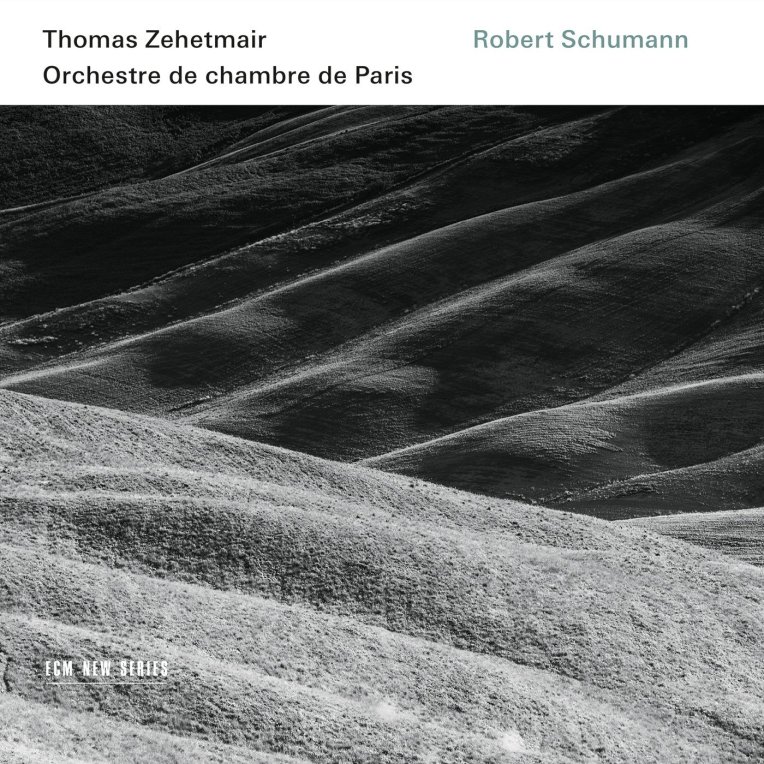
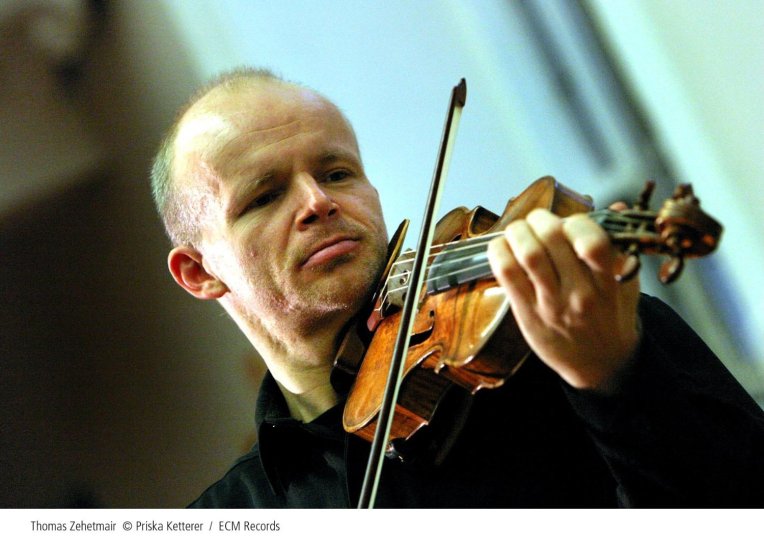
Thomas Zehetmair violin, direction Orchestre de chambre de Paris Recorded February 2014, Théâtre des Champs-Elysées, Paris
Tonmeister: Hannelore Gurtet
Recording supervision: Guido Gorna
Engineer: Frédéric Briant
An ECM Production
Release date: March 18, 2016
The music of Robert Schumann (1810-1856) has slowly coalesced on ECM’s New Series into a poetic genre all its own. In the capable hands of violinist Thomas Zehetmair, who rendered the labyrinthine depths of the German composer’s string quartets in equal parts crystal and shadow, and here conducting the Orchestre de chambre de Paris in an even more dynamic program, it has taken on new life.
For the Violin Concerto of 1853, Zehetmair plays from an Urtext edition to which he himself made important contributions, poring laboriously over the original manuscript to correct the piece’s many errors and elevate it to its deserved status in the pantheon of violin literature. The first movement is almost a concerto in and of itself, moving with the force of an ocean wave crashing on shore. The second movement is emblematic of its composer’s flair for merging strength and delicacy, and of the soloist’s ability to balance the two with artful resonance. As he and the orchestra leap into the final stretch with elasticity, we find ourselves nearly overwhelmed by invention. Few concertos feel as corporeal as this, seeming to pull on every tendon and sinew until it trembles with joy. Although originally thought unplayable by violinist Joseph Joachim (for whom it was written) and Clara Schumann, and never heard until 1937, this recording lends it a resplendent inevitability. Zehetmair’s direction is as vibrant as his playing, and in both one finds an abundance of insight.
The Symphony No. 1 (“Spring”), op. 38, of 1841 emerged only after many failed attempts, and in its present iteration abounds with Beethovenian exuberance, but always with that indefinable touch for which Schumann was so highly regarded. The programmatic flair of the first and fourth movements, in combination with the robust exposition between them, articulates a timeless pastoralism in concise terms. It’s an atmosphere rightly shared by the Phantasy for Violin and Orchestra, op. 131, of 1853. It brilliantly concludes the program, funneling every impulse that preceded it into a flourishing ecosystem of ideas. Ironically enough, in this rendering it feels more reflective of reality than the preceding two works, if only by virtue of its fiery exegesis. Zehetmair brings his all to the table, leaving not a single crumb to show for it.
The engineering is appropriately raw and clear—so clear, in fact, that a page turn is audible in the right channel in the first movement of the Violin Concerto—and allows us to feel immersed but never assaulted.
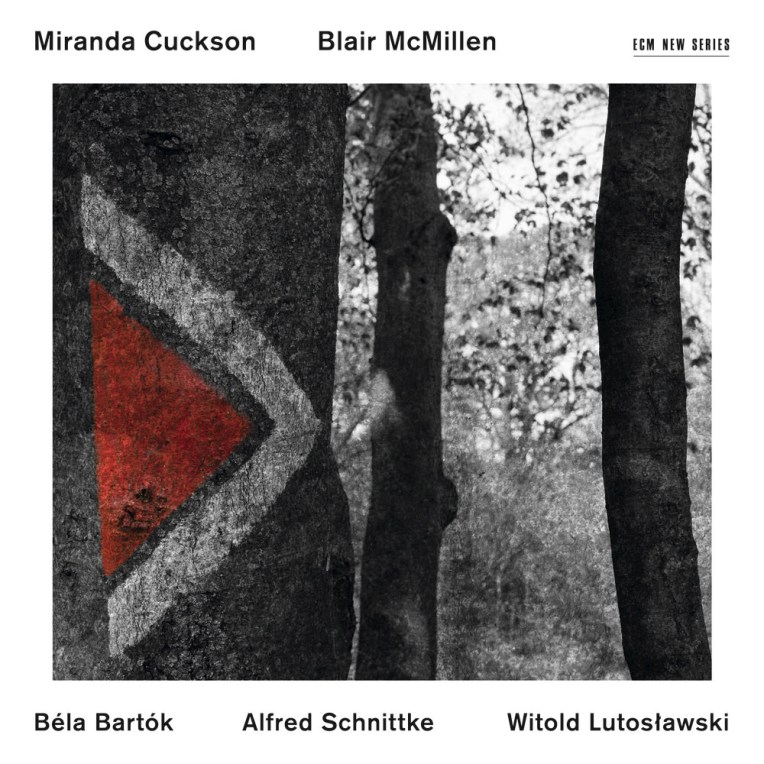
Miranda Cuckson violin Blair McMillen piano
Recorded January 2015, Auditorio Stelio Molo RSI, Lugano
Engineer: Markus Heiland
Produced by Manfred Eicher
Release date: April 15, 2016
Violinist Miranda Cuckson and pianist Blair McMillen make their ECM New Series debut in a program of three 20th-century Slavic masterworks. The two-part Sonata No. 2, Sz 76, of Béla Bartók (1881-1945) was composed in 1922, a time when Bartók was deeply into expressionism yet content in mapping two idiosyncratic detours for every step he took in someone else’s shoes. It opens with a profoundly simple statement, intoning the same note on the violin six times across the palimpsest of a piano key strike. Cuckson makes each iteration distinct before swimming against the delicate cascade that ensues.
Bartók’s folk influences are by turns clear and obscure, weaving with playful assurance throughout his compositional fabric, and the push and pull between the instruments has never sounded so continuous as in this rendition. The dancing Allegretto gives a range of insights into the composer’s distilling process, which by virtue of its underlying force makes an overlying confidence necessary to carry it across in performance. In that regard, Cuckson’s bow feels like two feet: separate yet guided by the same brain. McMillen’s artful exuberance likewise uproots colorations with systematic abandon. The piece ends as intimately as it began, forgetting every leap as a temporary severance from the gravity of mortality.
(Photo credit: Caterina di Perri)
The Sonata No. 2 “Quasi una sonata” of 1967/68 is a brilliant dip into the font of Alfred Schnittke (1934-1998), whose previous ECM appearances have been equally marvelous. The subtitle here means “like a sonata,” thus betraying the composer’s disdain for the constraint of something so pedantic. Its brazen chords, exaggerated silences, and whimsical details showcase the spaciousness of Markus Heiland’s engineering. Cuckson’s navigations of every angle are wonderous to behold, and McMillen’s presence feels at once responsive and directive. From the airy and mysterious to the grounded and profane, vignettes cohere by the unwavering creativity of both artists. The more insistent and programmatic the music becomes, the less one needs to cloak it in expectations. The default mode of this anti-sonata, then, isn’t pretty entertainment but on-the-ground activism. Ending as it does, violin alone and swooning, it has no qualms over dissolution.
From the pen of Witold Lutosławski (1913-1994) comes the Partita for Violin and Piano (1984), finishing the program with something conceptually between its two predecessors. Comprised of three through-composed pillars and garlanded by two ad-libbed sections between, it is a somewhat gloomier yet no-less-playful exposition of plurality. The first movement, marked “Allegro giusto,” is distinguished by its vertigo-inducing glissandi. Such meticulous imbalances work their way through everything that follows, finding only partial traction in the final Presto, as if resolution were the very antithesis of happiness. This leaves us with a wealth of impressions to choose from, any one of which might describe these pieces just as well, yet which falls short of touching fingers around motifs that have no use for category.
Muriel Cantoreggi viola Geneviève Strosser viola Jürg Dähler viola The Hilliard Ensemble David James countertenor Rogers Covey-Crump tenor Steven Harrold tenor Gordon Jones baritone
Recorded November 2010, Radio Studio DRS, Zürich
Engineer: Andreas Werner
Executive producer: Manfred Eicher
U.S. release date: November 6, 2015
To the eye, go, to the moist— hurricanes, hurricanes, from wherever, particle drift, the other, you know the one, we read it in the book, it was meaning. –Paul Celan, “Stretto”
Whether as composer, oboist, or conductor, Heinz Holliger never ceases to delight and surprise. His commitment to classical music has produced some of the most enduring documents on ECM’s New Series, including one of that imprint’s indisputable masterpieces, the Scardanelli-Zyklus. Here we have yet another turnaround, one that speaks with the open style in which Holliger has become so fluent. Featuring a host of accomplished interpreters—including the now-defunct Hilliard Ensemble—bringing to life a 21st-century cycle of works around the 14th-century French composer Guillaume de Machaut, the Machaut-Transkriptionen (2001-09) represent nearly a decade’s worth of thinking and rethinking through the past in a language of the future. Scored for an unusual combination of four voices and three violas, it weaves direct transcriptions of Machaut into Holliger’s idiosyncratic odes to the same.
This is one of those distinctively ECM projects, which, like Ricercar, unravels the avant-garde core of centuries-old music. The compact macramé, for example, that is Machaut’s hallmark is on full display in the program’s introductory Biaute qui toutes autre pere, wherein something more than ink and paper have convened to elicit vital sounds. If the feeling of this balladry is loving and sincere, even more so is Holliger’s enhancement of its rules in his own Ballade IV for three violins. More than ever before, Holliger has built his cathedral out of transparent stone, blacking out the windows, so that the sunlight might be its dominant form of expression. In this sense, Holliger is engaging with Machaut not as the target of an homage, but as the living force of an artist whose music breathes in the winds that shake his boughs. Use of untempered harmonics, transcribed note for note from the original, allows incidental commentary in this regard to seep through.
A second diptych, this time around Machaut’s Ballade XXVI: Donnez, Seigneur, transforms the gently sloping path of the original—in which countertenor David James at once renders the skin and the heart keeping it alive—into the wilder detours traced by the present recasting. And while the latter may seem more oblique in its structure, it also shares with its referent a clarity of expression. Both are neural mappings, very much alive in and beyond the confines of a single recorded performance. Even the wordless Hoquetus David of Machaut and Holliger’s responsory Triple Hoquet feel more like pieces of the same puzzle than distant cousins separated by time. Holliger gives us something of a granular synthesis of the former, an embodiment of Celan’s hurricane in the fullest sense.
A single voice retains the melody of Machaut’s Lay VII in a standalone arrangement, while guided improvisations flesh out its branches with unpredictable fruit. The Hilliards are best equipped to handle this flower without damaging a single petal. A beautiful piece that challenges not through its dissonances but through its consonances, as does its analogous In(ter)ventio a 3 und Plor- / Prol- / Or- atio for three violins, which from recitative beginnings morphs into a staggered prolation of time signatures, based on the Complainte of Machaut’s Remede de Fortune. That same piece lingers on in the final statement, in which it is combined with an “Epilogue” that unites voices and strings in quadrilateral fashion, distilled until only friction remains.
In a universe of countless musical systems, Holliger and his celestial body of work have always charted unprecedented orbits through the space-time continuum. Given the way in which he has refracted himself through Machaut, the sublimity of their intersection is clear, for both have stumbled on the fragility of human contact, tracing its origins just shy of rupture.
Anthony de Mare piano
All pieces were commissioned expressly for The Liaisons Project, Rachel Colbert and Anthony de Mare, Producers.
Producer for The Liaisons Project: Rachel Colbert
Recording producer and engineer: Judy Sherman
Additional engineer and editing assistant: Jeanne Velonis
Recorded 2010-2014 at the American Academy of Arts and Letters, New York, and Greenfield Recital Hall, Manhattan School of Music, New York.
Backing tracks for “Birds of Victorian England” engineered by Kevin Boutote
“Johanna In Space” backing track provided by Duncan Sheik
Mastering: Christoph Stickel and Steve Lake at MSM Studios, Munich
An ECM Production
Listen to that old piano roll play. When I hear that old piano roll play, I just gotta dance, And what I mean is dance with you.
In her exhaustive biography, Stephen Sondheim: A Life, Meryle Secrest shares the story of an adolescent Sondheim’s encounter with the 1945 film Hangover Square, and within it a piano concerto written by scorer Bernard Herrmann. The music’s bold mix of romanticism and Americana captured Sondheim’s imagination and was to become part of the origins of his intersections with the dramatic stage.
Sondheim has always composed at the keyboard, charting out his scores in great detail, to be orchestrated by (since 1970) esteemed collaborator Jonathan Tunick. Broadway has relied on this formula, which over the decades the duo funneled into surefire productions, but the project lovingly packaged in this three-disc collection from ECM takes Sondheimania to a new level through the intervention of rigorously trained note-smiths, each occupying a band along a spectrum of collaborations from a distance.
The roster of composers, who the behest of new music champion Anthony de Mare wrote new variations on the theme of Sondheim, reveals a depth and variety equaled by the songs they have re-imagined, as William Bolcom, Nico Mulhy, Steve Reich, David Rakowski, Eve Beglarian, Jason Robert Brown, Duncan Sheik, Eric Rockwell, Wynton Marsalis, Derek Bermel, Fred Hersch, Annie Gosfield, Jake Heggie, Kenjie Bunch, Ethan Iverson, Ricardo Lorenz, Paul Moravic, Frederic Rzewski, David Shire, John Musto, Mark-Anthony Turnage, Phil Kline, Bernadette Speach, Daniel Bernard Roumain, Andy Akiho, Ricky Ian Gordon, Nils Vigeland, Rodney Sharman, Gabriel Kahane, Thomas Newman, Jherek Bischoff, Mary Ellen Childs, Peter Golub, Tania Leon, and de Mare himself put a personal spin on the Sondheim songbook that is as true to life as it is to art.
Though Sondheim has historically been averse to being interviewed, in this collection we hear him speaking through the hearts of every composer who has felt his influential hand. In an album note, he himself describes these pieces not as “decorations” but “fantasias” of his songs. Indeed, Sondheim’s recognizable voice has been reworked with such fidelity—one original inspiring other originals to create new originals—that one need hardly peel away any layers of obfuscation to find him. Above all, however, it’s his scarcely rivaled gift for pastiche that resonates by virtue of de Mare’s encyclopedic flair.
According to Mark Eden Horowitz’s extensive liner text, the composers chose their songs based more on the lyrics and their stories than the melodies sung around them. And so, one can listen assured that de Mare’s consummate touch makes room on his metaphorical suitcase to display every sonic sticker of his travels. His dramatic, romping, emotional rollercoaster ride through A Funny Thing Happened on the Way to the Forum (1962), Anyone Can Whistle (1964), Company (1970), Follies (1971), A Little Night Music (1973), Pacific Overtures (1976), Sweeney Todd (1979), Merrily We Roll Along (1981), Sunday in the Park with George (1984), Into the Woods (1987), Assassins (1991), and Passion (1994) accordingly dwells as much on differences as similarities, bringing to fruition a “global” sound.
Not surprisingly, Sondheim’s masterpiece Sweeney Todd gets the most nods of the program, in addition to yielding a lion’s share of its highlights. One of those is Sheik’s “Johanna in Space.” This atmospheric gem opens with the chimes of a clock emulated on the piano and stretches itself over an electronic backdrop à la Tim Story. Todd’s ill-fated daughter is further subject of Brown’s “Birds of Victorian England,” which requires no small amount of heavy lifting from de Mare. As can be expected, Sweeney Todd engenders ample opportunity for over-the-top dynamics, epitomized in the spiraling density and fluent outcries of Bunch’s “The Demon Barber.” Other fine examples of the protagonist’s crushing pessimism abound, whether through the intimate knowledge of Newman’s “Not While I’m Around” or, in a satirical turn, Lorenz’s “The Worst [Empanadas] in London.” The latter requires a performer of de Mare’s chops to pull off the feel for rhythm and energy on which it subsists. De Mare welcomes the listener by shouting, “A customer!” as if in throwback to the speaking-singing pianist genre of which he was such a foundational proponent through his premiere of Rzewski’s De Profundis. It’s only natural, then, that Rzewski should have a piece included: the elegiac “I’m Still Here.” This and other selections from Follies, such as Wynton Marsalis’s Jelly Roll Morton-infused take on “That Old Piano Roll”, imply a bygone age with plenty of style to spare.
Company inspires a handful of homages as well, including Rakowski’s impressionistic “The Ladies Who Lunch,” through which Sondheim’s love for Ravel shines (as also in Bermel’s “Sorry/Grateful”); Rockwell’s tangible “You Could Drive a Person Crazy,” in which the composer “imagined a pianist trying desperately to catch the attention of rowdy patrons at a cabaret with as wide ranging a series of pastiches as possible”; and Roumain’s “Another Hundred People,” which invokes the troubled crooning of a Kurt Cobain or Thom Yorke.
A Little Night Music lifts its story from the Ingmar Bergman comedy Smiles of a Summer Night, and its comic touches are duly noticeable in Speach’s “In and Out of Love” (a personal album favorite), which shuffles the harmonies of “Send in the Clowns” (see also Iverson’s whimsical take on the same) into a balladic “Liaisons.”
Sunday in the Park gives us Muhly’s minimal yet expansive “Color and Light,” which embodies the pointillism that so fascinated the play’s subject, Georges Seurat. Muhly’s feel for the piano as a textural toolbox translates superbly. Reich’s more compact “Finishing the Hat” is scored for two pianos (de Mare multi-tracks himself) and links a brief yet persistent chain of chords. Sharman’s “Notes on ‘Beautiful,’” on the other hand, originally a duet between Seurat and his mother, no becomes a conversation between the living composer and his deceased mother. De Mare’s rendition of “Sunday in the Park – Passages (encore)” opens a lifeline to possibilities, and makes us feel connected to our own.
Shire’s “Love is in the Air” puts a delightful spin on the original opening number of A Funny Thing Happened on the Way to the Forum, underscoring de Mare’s abilities to evoke the past in a language of the future, while Bolcom’s “A Little Night Fughetta” references Anyone Can Whistle, pushing Bach through a jazzy filter of development. Pacific Overture is another of the less represented but no less effective source texts. Gosfield’s “A Bowler Hat” displays a meticulous feel for deconstruction, while Kline’s “Paraphrase (Someone in a Tree)” paints the first meeting between American and Japanese officials in 1853 with unexpected colors. Merrily We Roll Along gives us León’s “going…gone,” another remarkable highlight that, along with Akiho’s “Into the Woods” is perhaps the most technically demanding of the program. Hersch’s “No One is Alone” is another ode to Into the Woods, this one pentatonic and alliterative. And let me not neglect Beglarian, who pays tribute to Passion in her “Perpetual Happiness.” This striking piece is as real as the music gets on Liaisons, and builds its wings one feather at a time, until flight is achieved.
Doing justice to all of the composers and pieces represented here would be a futile, wordy exercise. Suffice it to say there isn’t a single sour note to be found, and as a whole the album demonstrates that, while Sondheim’s music may sometimes play hard to get, it will love you through and through if you let it, because that’s all it wants to do.
Márta and György Kurtág
In memoriam Haydée
Játékok – Games and Transcriptions for piano solo and four hands
Piano Recital
Cité de la musique, Paris
22 September 2012
Márta and György Kurtág piano
Filmed September 22, 2012 at Cité de la musique, Paris
Directed by Isabelle Foulard
An LGM Télévision production in association with Cité de la musique
Producer: Sabrina Iwanski
Executive producer: Pierre-Martin Juban
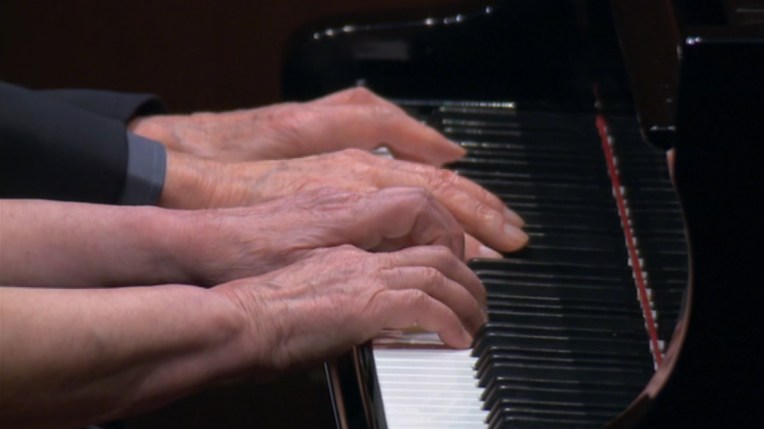
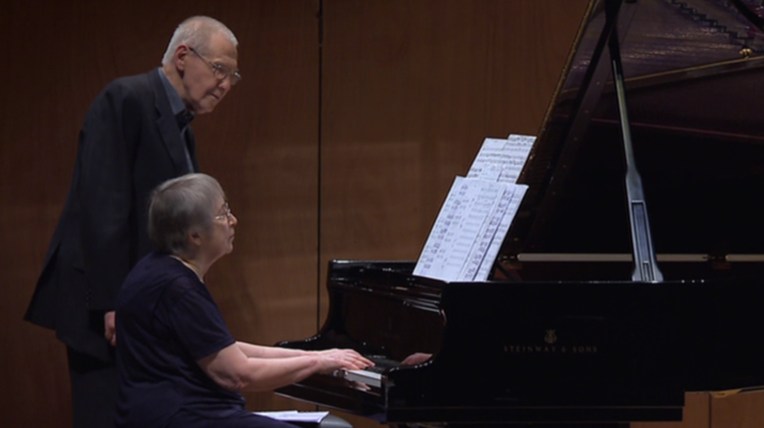
In September of 2012, Hungarian composer György Kurtág and his wife Márta gave a concert at Cité de la musique in Paris to honor the memory of a dear friend, musicologist Haydée Charbagi (1979-2008). Their program, as adventurous as it was delightful, combined piano transcriptions for two and four hands, exuding such intimacy that it’s a wonder the audience didn’t just melt away from all the love in the hall. For those not present, this DVD bears witness to the Kurtágs’ unbridled passion for each other and the music that passes between them. The program’s bulk is culled from György’s own Játékok (Games), an ever-growing miscellany of dedications to the living and dead alike. It’s also a tribute to classical roots on the whole, as indicated by the composer’s transcriptions of Bach chorales—each a towering trunk among his otherwise microscopic foliage.
There’s something dark yet wondrous about the first dissonances that creep from the stage. Saying hello with a farewell, György approaches the score as if it were a poem (such philosophies were, in fact, the subject of Charbagi’s thesis). And perhaps nothing so omnipresent as poetry could express either the compactness or vigor of each brushstroke. As observer, Márta stands like an appreciative statue before joining him at the keyboard. At times, she caresses him on the shoulder after he finishes a solo, an unspoken signal to connect the dots.
Those very points of light sparkle in pieces like Flowers we are…, which in conjunction with the pantheonic Baroque selections enables a poignant contradiction: namely, that Bach’s music eminently looks forward while György looks backward, leaving us in the middle like the binding of an open book. His own responsory is as much a reflection of the one to whom it is dedicated (Joannis Pilinszky) as the composer who vaulted the form.
With most at or under a minute, these concert selections are rife with inflection. There are moments of staggering beauty, especially in the Hommages, such as the Hommage à Christian Wolff, with its tip-toed notecraft, the resonant Hommage à Stravinsky – Bells, and the Hommage à Farkas Ferenc in its multiple incarnations, each more nuanced than the last and ideally suited to the composer’s greatest interpreter, Márta.
Campanule, as with so much of what transpires, expresses the pregnancy of emptiness, and the potential for healing amid broken motifs. This would seem to be the underlying message also of playful asides such as the fierce exchange of single notes that is Beatings – Quarelling and the kindred Furious Chorale. Another elliptical piece, Study to Pilinszky’s “Hölderlin,” gives musical interpretation of a poem written for Mr. Kurtág and reinforces the concert’s overarching theme, while the dramatic (Palmstroke) and the programmatic (Stubbunny and Tumble-bunny) trip over one another in search of continuity.
Director Isabelle Soulard focuses on these passages in close-cropped framings, allowing the tender lattice of Aus der Ferne, written for the 80th birthday of Alfred Schlee, and the confectionary first movement of Bach’s E-flat major Trio Sonata (BWV 525) to shine all the brighter among this crowd of lamentations. For if anything, György’s art is about remembrance—a point driven home by the three encores, all of which reiterate pieces featured in the main program: the Hommage à Stravinsky and two of the Bach arrangements. Were it not for programs and obsessive musical minds, we might not even notice the repetition, as life consists of nothing but.
The Gurdjieff Ensemble Emmanuel Hovhannisyan duduk, pku, zurna Armen Ayvazyan kamancha Avag Margaryan pogh, zurna Aram Nikoghosyan oud Davit Avagyan tar Mesrop Khalatyan dap, dhol Vladimir Papikyan santur, voice Meri Vardanyan kanon Norayr Gapoyan duduk, bass duduk Eduard Harutyunyan tmbuk, cymbal, kshots, burvar, bell Levon Eskenian director
Recorded February 2015, Auditorio Stelio Molo RSI, Lugano
Engineer: Markus Heiland
Produced by Manfred Eicher
U.S. release date: October 2, 2015
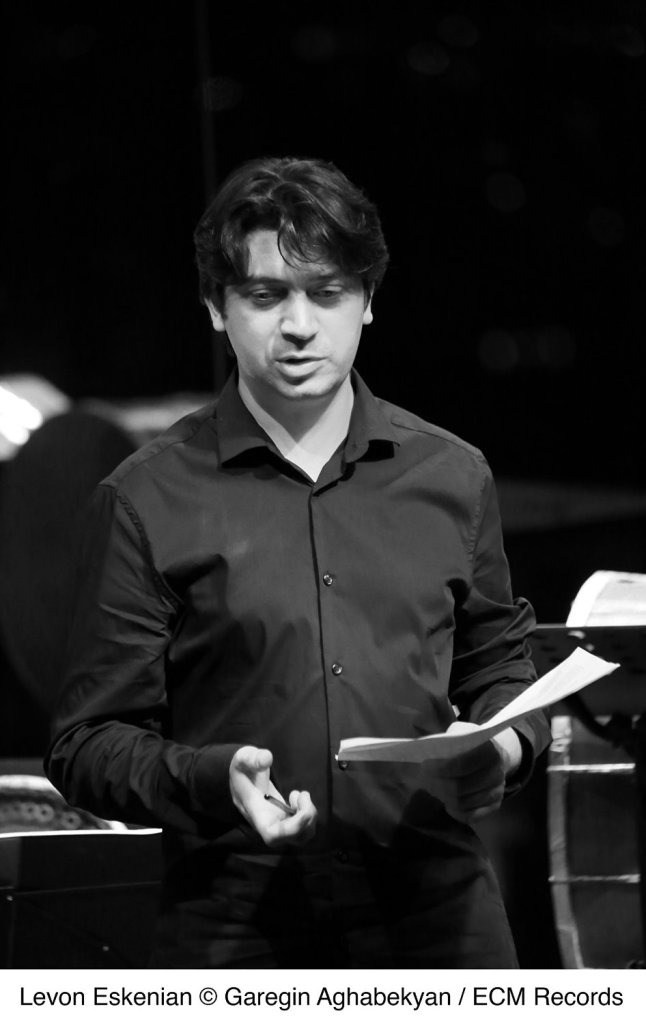
Since forming the Gurdjieff Folk Instruments Ensemble in 2008, musician and director Levon Eskenian has moved beyond delineations of the group’s namesake, even while staying truer than ever to the roots such an association implies. His ECM debut, Music of Georges I. Gurdjieff, drew from a well that had already been dug into the label’s landscape by Keith Jarrett and Vassilis Tsabropoulos/Anja Lechner, and deepened by Lechner’s subsequent duo with François Couturier. It was only natural, then, that Eskenian should turn his attention to that spiritual progenitor of Armenian classical music: Soghomon Soghomonian (1869-1935), a.k.a. Komitas.
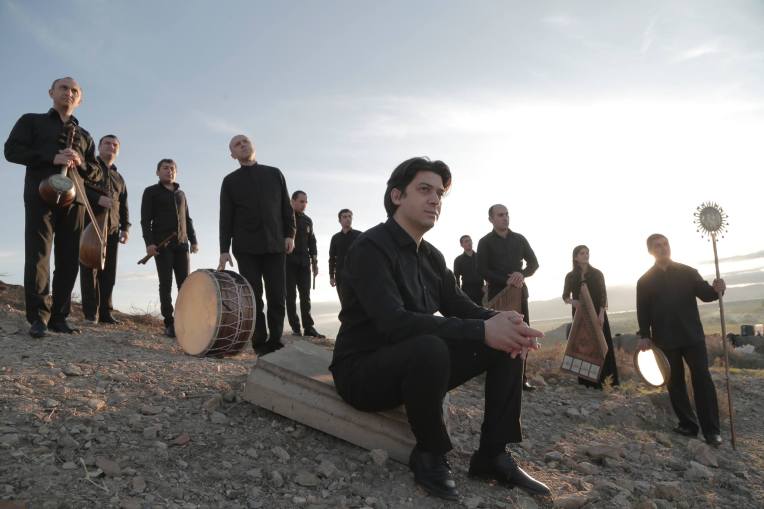
Having appeared on Kim Kashkashian’s Hayren and Savina Yannatou’s Songs of Thessaloniki, among others, the music of Komitas has been something of a leitmotif in the ECM catalog, where its expressions of folk sentiment feel right at home, and nowhere so fully as on this first disc dedicated to him alone. As with Gurdjieff, Eskenian and his ensemble have gone as far back to into this music’s past as is conceivable, arranging it for the very instruments whose sounds first inspired Komitas to put pen to paper. Eskenian has, in essence, “re-composed” them as physical environments around on which listeners can walk to absorb every detail.
(Photo credit: Andranik Sahakyan)
Eskenian, for his part, provides—in both the music and liner notes—a loving account of Komitas, whose approach to diverse interests imbued his writing with metaphysical levels of beauty. Even when composing for western instruments, he would often notate with traditional instruments in mind, and so Eskenian’s instinct is in keeping with the origin story at hand. Komitas and Gurdjieff share one degree of separation by way of the latter’s student, Thomas de Hartmann, but even more in terms of philosophy, lifestyle, and artistic engagement. I asked Eskenian whether these connections had anything to do with how he put this album together.
“Gurdjieff sent de Hartmann to Yerevan, where he immersed himself in, held concerts of, and gave lectures on the music of Komitas. Later on, de Hartmann would found the Komitas Society with the goal of collecting and printing the composer’s music. There are some pieces in which Gurdjieff and Komitas used the same folk tunes. Both of them were truth-seekers. Like Gurdjieff, Komitas would also talk about vibrations. He consulted ancient manuscripts and believed in the healing powers of music, the effects of modes and how each string of the knar [a traditional harp], for example, had on a different part of the body. He taught movements rooted in ancient ritual dances of pre-Christian temples, and often referred to himself as a teacher of dancing. In all cases, I consider the music of Komitas to be an essential key for a better understanding of the music of Gurdjieff and of the many other classical composers who have based their compositions on folk motifs.”
Eskenian’s gentle and respectful assertions of the significance of this music further explain why the album seemed to take form of its own volition. Eskenian elaborates on the genesis of the project, which began with a suggestion on the part of producer Manfred Eicher to center a follow-up to his Gurdjieff debut around Armenian folk and sacred music:
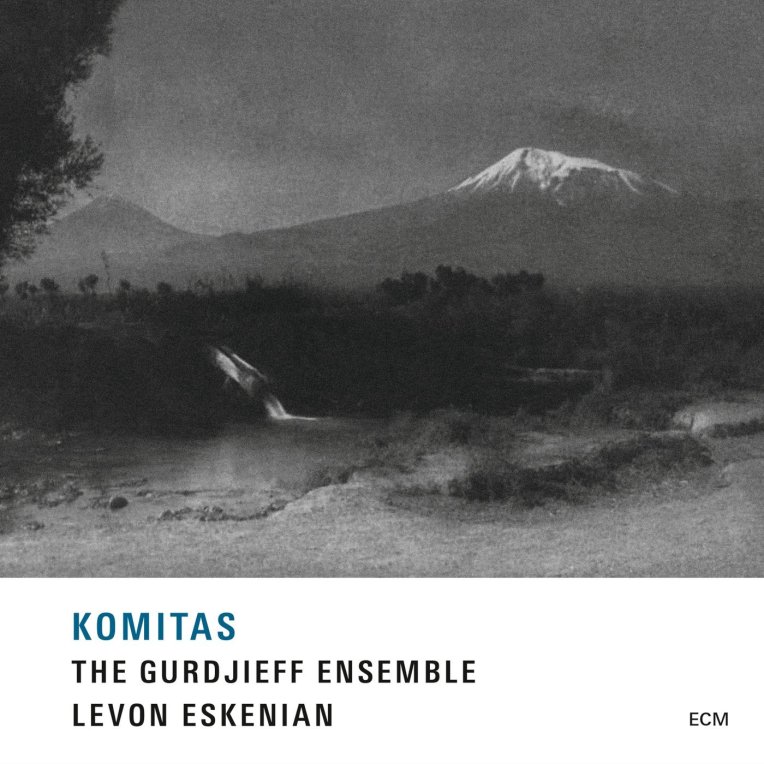
“For many years I’d thought about the Komitas dances, to have them performed on traditional Armenian and ancient instruments. I knew the pieces long before my encounter with the music of Gurdjieff and they had always served as a reference for me, but arranging the piano scores for authentic traditional Armenian instruments was in fact a bold labor which required additional research along anthropological, historical, and ethnomusicological lines in order to have a certain level of objectivity that wouldn’t ruin his work. Manfred left me free to decide the program. During the recording session he was actively involved in creating a comfortable atmosphere in which the musicians might better hear their inner sound, and with the assistance of engineer Markus Heiland recorded these instruments in their full timbrous colors. During the mixing session, Manfred paid strict attention to the sequence of pieces, and to the ‘silent’ pauses between them. The album cover was also of his choosing, a beautiful photo and one of the first of biblical Ararat Mountain ever taken at the beginning of the 20th century.”
In his own briefer liner note for the album, Armenian composer Tigran Mansurian—onetime director of the Komitas State Conservatory of Yerevan—expands on the cultural iconicity of Komitas, whose piano pieces he goes so far as to describe as “documentary works,” preserving as they do the spirit of his Armenian heritage. The “Yot Par” (Seven dances) represent one such set of piano pieces, recalibrated here to suit the spectral qualities of Eskenian’s peerless ensemble. These dances are centered around the capital of Yerevan, the contentious city of Shushi, the village of Karin, and the Turkish provincial capital of Mush. Whether the binary star of bowed kamancha and hammered santur in “Manushaki,” the duduk and tar in “Yerangui,” or the pogh flute and tmbuk drum duet that is “Het u Araj,” each dance flows in measured contrast to surrounding tunes and highlights a different instrumental color. That same pogh flute, in tandem with oud, embodies perhaps the deepest entanglement of ancient impulse and contemporary realization in “Karno Shoror,” which is about as close to experiencing history as this music gets. Even “Masho Shoror,” another piano work newly fashioned, is rife with textures that feel much older than we can articulate by any other means. The present rendition cross-hatches the double-reed zurna with the santur’s metallic lines. At just under 12 minutes, it is an album in and of itself, gathering as it does many influences in a single hearth of understanding.
“I often think about this piece,” says Eskenian, “which was a series of mystical pagan dances accompanying pilgrimage to St. Karapet Monastery in Mush. The monastery was one of the main pilgrimage sites for Armenians and served as their temple even before Christianity. After the Armenian genocide inflicted by the Ottoman empire, when most Armenians were killed, this marvelous monastery was destroyed much like ancient monuments in the Middle East have been in recent years. It was a great loss, to be sure, but I reflect on the fact that we have these sounds and traditions encoded into the piano music, now brought back to their inspirational sources. Through this process, we are reconstructing something of what has been lost. I am grateful to be able to share this with the world: a piece of the past reaching out to us from unrecoverable times.”
Many of the program’s standalone songs are likewise rooted in nature, by which traces of what came before our current generation continue to thrive, changed but also essential. In the plough songs of the northern Lori region, such as “Lorva Gutanerg,” we almost don’t need to know that Komitas gathered such melodies himself and separated them like chaff from the wheat so that posterity might be nourished by their bread. The medieval influences are clearest in these examples, as in the fortune-telling motivations of “Mani Asem, Tsaghik Asem” (Praises to the flower) and, more so, the strains of “Hov Arek” (Dear mountains, send me a breeze), a high point in the album’s topography that accentuates the talents of santur player Vladimir Papikyan, whose virtuosity unites sentiment and form. Moving through lullabies and other pieces for children, as well as love songs, the ensemble touches on Komitas’s religious affinities in songs like “Havun” (The fowl of the air), in which two duduks express Christ’s Resurrection in metaphor. On the subject of ascendant beings, the pogh solo “Havik” (A radiant bird) evokes its eponym with purposeful flight. Breathy and full of charcoal in its palette, it recalls the sensory world of a Japanese brush painting, trees barely visible as splashes of ink in the background.
Despite any mystical characterizations one might draw around Komitas, it’s clear from this recording that the heart of his music runs on a fundamental energy. It’s the same energy that allows us to listen and to love, to seek out those things which connect us beyond concerns of the flesh. So much so, that no matter what form it takes, the music of Komitas occupies an immediately relatable realm of understanding. In this vein, listeners can look forward to an album of his complete piano music as performed by Lusine Grigoryan, who has worked diligently to reproduce every effect as indicated in the original scores. Where Eskenian has taken those cues to heart by transferring them the very instruments that inspired them, Grigoryan has accepted the challenge of expanding the piano’s vocabulary to suit the ambitious needs of these timeless melodies. The reconstruction has just begun.
(Click here to read the rest of my interview with Levon Eskenian for RootsWorld online magazine, alongside another review of the album by Erik Keilholtz.)
Tigran Hamasyan piano, prepared piano Yerevan State Chamber Choir Harutyun Topikyan conductor
Recorded October 2014 at Argo Recording Studio, Yerevan
Engineer: Markus Heiland
Assistant engineer: Armen Paremuzyan
Mixed March 2015 at RSI Studio Lugano by Markus Heiland, Manfred Eicher, and Tigran Hamasyan
Produced by Manfred Eicher
U.S. release date: October 2, 2015
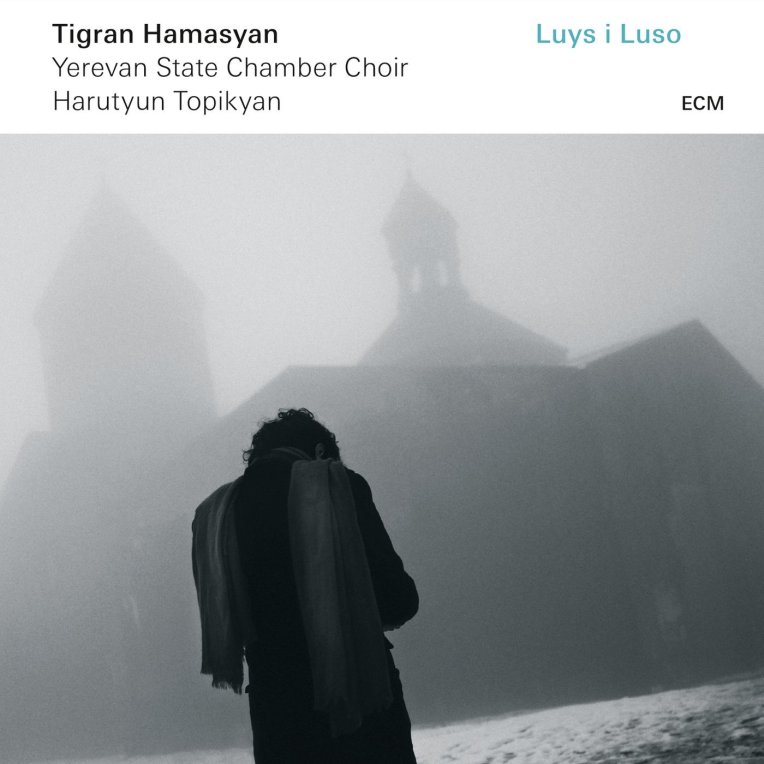
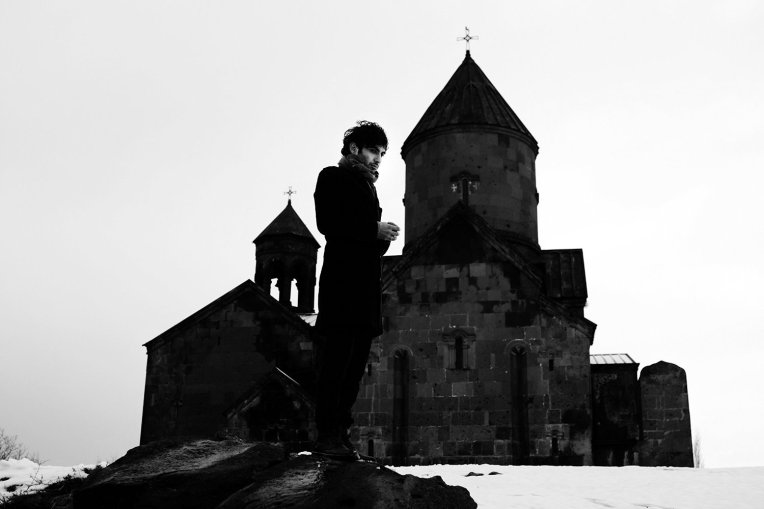
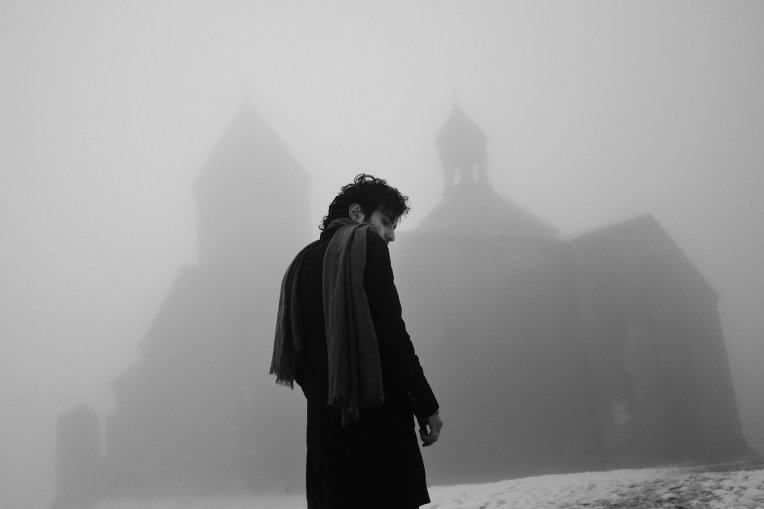
Luys i Luso realizes the dream of Tigran Hamasyan to build an entire album around the sacred music of Armenia. Now based in Los Angeles, the prodigious jazz pianist has held on to the melodies of his homeland with solemnity and patience for this project. The antiquity of much of the repertoire—hymns, sharakans (chants), and cantos, some of which date back to the fifth century—leaves room for improvisation, which evidence suggests has been a part of its living tradition for centuries. Hamasyan takes to this freedom like a wing to wind, using his polyphonic arrangements of monophonic melodies as runways for spontaneous flights. He has intentionally left the piano parts unwritten, so that by following only skeletal structures he is free to move about the score.
(Photo credit: Vahan Stepanyan)
The album’s title (Light from Light) is primarily descriptive, revealing the process of pulling out an interpretive glow from contemporary compositions, and from the older ones embers of bygone devotions. It also signals themes of variation in a program built around multiple incarnations of the core melodies. The preludinal “Ov Zarmanali” (Oh this Amazing and Great Mystery) by 12th-century catholicos and composer Grigor G. Pahlavuni, for example, illuminates the listener’s ears first through a solo piano treatment, like snow falling from the branches of a godly tree, and later in the album in a veritable river of voices. The Yerevan State Chamber Choir’s balance of raw technique and rhythmic precision indicates a vulnerability diminished by numbers. Hamasyan’s pianism takes on a regular role here, sounding its arpeggios with veracity. The modal changes speak to something deeper than beauty, to the heart within it darkened by neglect. Midway through the singers fade and leave the piano to move jazzily through their afterimages, only to return like objects of worship polished smooth over centuries of devotion. “Sirt im Sasani” (My Heart is Trembling!), a canticle by 13th-century canonical writer Mkhitar Ayrivanetsi (c. 1230-1297) also reveals its mercies through two iterations, the second of which is a piano variation of Trinitarian dimension, while the first professes faith through the distant mechanisms of exile. Bass soloist Seiran Avagyan renders a flower of textual identity shedding petals in favor of bodiless light.
(Photo credit: Vahan Stepanyan)
No such project would be complete without Komitas (1869-1935), because of whose efforts much of Armenia’s sacred music has been preserved. His “Hayrapetakan Maghterg” (Patriarchal Ode), a hymnal request to be heard and absolved, takes three forms. In two Hamasyan-only versions, the pianist attends to the words between notes. He is keenly aware of these spaces and gathers strength through their collective presence. Like the pages of a thumb-worn Bible, its gilding has faded through absorption, finding in its choral life a treasure of grace and, in soprano soloist Jenni Nazaryan, a dove clutching sprigs of gratitude. From Komitas’s Armenian Holy Mass we encounter two sections, “Surb Astvats” (Holy God) and “Orhnyal e Astvats” (Blessed is God), each based on melodies from the seventh century. Where the former is driven by forward-thinking improvisation, the latter looks backward by sampling tenor Armenak Shahmuradyan. This 1912 archival recording, made in Paris in the presence of Komitas, defines the palette from which the choir draws its colors over a century later.
Medieval theologian and hymnologist Mesrop Mashtots (c. 362-440) is represented in two chants and a canticle for Fasting Days. The first of these, “Ankanim araji Qo” (I Kneel Before You), is where the choir makes its album entrance—or should I say “in-trance,” for such is its state of being. Therein, singers descend to the bottoms of their linguistic wells, making dervish circles until the shadows are cleansed. Each is a powerful statement of redemption, of the will to drown in transgression so that one might be reborn into sobriety.
For the singly rendered, Hamasyan offers two cantos of the Resurrection, both chanted during Divine Liturgy. “Nor Tsaghik” (New Flower) by Nerses Shnorhali (c. 1102-1173) strikes difference through its use of prepared piano, at which Hamasyan uncovers hidden voices behind the voices, while “Havoun Havoun” (The Bird, the Bird was Awake) by Grigor Narekatsi (c. 951-1003) pairs soprano and piano in the name of faith. Nazaryan’s lone singing barely grazes the belly of the nearest cloud until the nourishment of Heaven comes raining forth, leaving us to drink in what we can.
Those who would write off this recording on the sole basis of its description—Do we really, they might say, need another jazz musician improvising over a vocal ensemble?—may be pleasantly surprised at the level of integration achieved on Luys i Luso. Like Misha Alperin, Hamasyan recognizes the dedication of knowledge required to mesh with equally disciplined singers. Whether broken or healed, each of his selections embodies the fragmentary nature of things as a path to wholeness. The sheer love pouring from that wholeness is proof of concept.
An unexpected masterpiece, and one of ECM’s most astonishing in years.
(To hear samples of Luys i Luso, please click here. Further information about the project is available here.)
Gidon Kremer violin Patricia Kopatchinskaja violin Kremerata Baltica Recorded December 2014 at Lithuanian National Radio and Television, Vilnius
Engineers: Vilius Keras and Aleksandra Suchova
Mixing and mastering at Emil Berliner Studios, Berlin by Rainer Maillard, Manfred Eicher, and Vilius Keras
Produced by Manfred Eicher
U.S. release date: November 6, 2015
“Despite the world’s obvious achievement, our planet is still torn by bloody contradictions. And no progress in artistic activity can withstand the destructive force that easily cancels the fragile process of construction. (…) I write for myself, without having any illusions that ‘beauty will save the world.’”
–Giya Kancheli
The words of a composer-in-exile who lives so deeply inside time that he creates outside of it. Kancheli speaks them not in the interest of putting forth a mission statement, but to assess the measure of his art against the metric of history, the last century of which has birthed some of its brightest galaxies and darkest nebulae. In the context of his personal astronomy, Kancheli seeks out vestiges of indifference in a world built on denial of the same. On this disc you will find no healing but the honesty of a mixed spirit. Surely, the music not only abides by such sentiments but also thrives on their shadows.
The 2010 title composition, first in a program of two, is scored for violin and chamber orchestra. Despite its perennial format, it reads neither like a concerto nor a tone poem, but rather a procession led by one who follows his own invisible nature. The feeling of inseparability is strong as these figures—nodes in a pathway of nerves—bond and separate. The bass drum rumble that opens their 23 prosaic minutes of communication signals the subterranean heart of it all, which by virtue of the shimmering strings that follow sews its raiment anew. As in the music of Valentin Silvestrov, the piano here adopts a commentary role. Its very involvement reveals an internal expanse rivaled in scope among his previous works perhaps only by Trauerfarbenes Land.
Violinist Gidon Kremer and his Kremerata Baltica handle every note with the admiration of a curator. Kancheli opines humbly about the musicians’ contributions and recognizes that the simplicity of his thematic moon shines by the light of many suns. In this recording, he dubs Kremer the “true author” of Chiaroscuro and he himself its “co-author.” The level of integration and respect achieved from both is something to behold with awe. Likewise, the distance and birdlike liquidity of Kremer’s high notes in the final phase.
At a slightly longer duration of 25 minutes, Twilight (2004) is scored for two violins and chamber orchestra. Kremer is joined by protégé Patricia Kopatchinskaja, last heard on ECM playing the music of Galina Ustvolskaya. Although it is Kancheli’s first piece for this instrumentation, and written at Kremer’s behest, it will feel familiar to the Kancheli initiate. Inspired by a row of poplar trees outside his Antwerp studio, whose significance became clear to him after a brush with death, it treats life as a gift twice given. The addition of a second leading voice emphasizes this metaphor and changes the landscape considerably, collapsing the former procession into a molecule of new rotations. Merest hints of Kancheli’s past thematic staples whisper through the overgrowth, speaking through the photosynthesis of the present. Interrelationships of soloists and orchestra are gnarled and rooted, each pouring out from the last in the manner of a divided cell. Melodies and atmospheric changes occur with such aching force that it is all one can do to keep the skeleton from trembling.
Twilight abounds in prismatic effects. Like an enhanced chamber music, it magnifies the immediacy of smaller forces with implications of unwritten futures. A direct emotional line takes shape from motif to motif until a naked mystery prevails. Kancheli is therefore correct in his self-assessment: This is not an album in which to seek sanctuary. That being said, one may discern a ray or two in the bleakness of its canvas, for to the interpreters’ authorship must be added the listener’s own.
As is always the case with the Kancheli experience, moments of apparent eruption are in fact the opposite. Nowhere truer than in this program, where the occasional outburst is, if anything, an “inburst,” pushing the focal point ever farther toward forgetting. Cavernous engineering thus allows the orchestra’s solitude to come spilling out in consumption of tension. We do well to see these dynamic affordances, like album’s title, as variations on a grander theme—in this case of mortality, and the parentheses that are its beginning and end.
Dino Saluzzi
Anja Lechner El Encuentro: A film for bandoneon and violoncello Directors: Norbert Wiedmer and Enrique Ros
Camera: Norbert Wiedmer and Peter Guyer
Editing: Katharina Bhend
Sound, sound editing, and sound mix: Balthasar Jucker
Production: PS Film, Biograph Film
Co-produced by SRF
Post-production: Recycled TV
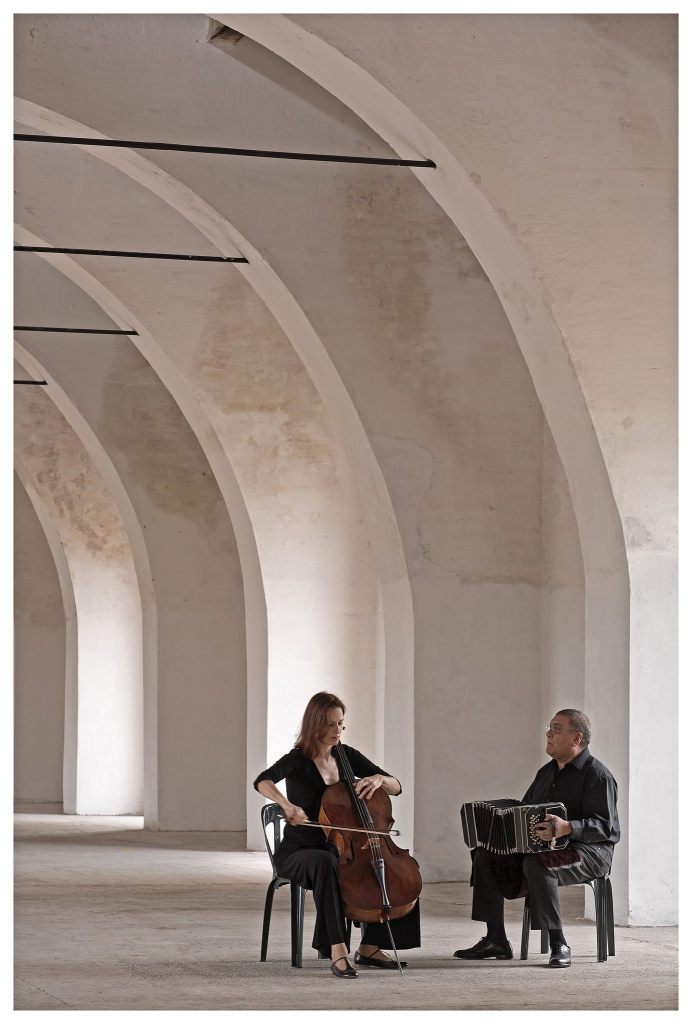
In Sounds and Silence, Norbert Wiedmer produced a rather fleeting portrait of ECM Records and its head Manfred Eicher, leaving viewers with, at best, vague sketches by trying to do too much in one go. But with El Encuentro, glimpses of which one might remember seeing in the former documentary, he has given us the film that should have been. Along with co-director Enrique Ros, Wiedmer touches more of the label’s ethos by following only two of its major artists than Sounds and Silence does in profiling many more besides. Despite being from opposite sides of the Atlantic, gentle giant of the bandoneón Dino Saluzzi and cellist Anja Lechner have bridged waters of their own making since 1998, when they first collaborated in the Kultrum project that featured the Rosamunde Quartett, of which the cellist was founder.
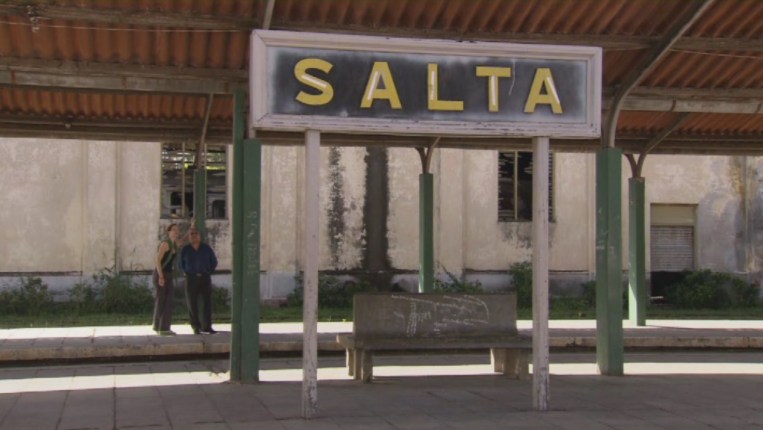
What makes El Enceuntro such an insightful window is the relative clarity of its narrative glass. At its core is a trip taken by Dino and Anja—so one feels compelled to call them after getting to know them so well by the end credits—to Salta, Argentina, where the bandoneonista absorbed the tango that would become central to his life. It’s an art form that would become increasingly important for Anja, who cites her own deep knowledge of, and respect, for the tango as a motivation for forging this intergenerational partnership with Dino. She recalls learning these rhythms for the first time in Argentina, where signatures rendered cut and dry through classical training now blossomed at her fingertips, reinvigorated.
Dino meanwhile looks back on memories of his father, who after working a long day at the factory would sing for their village. Dino took to his father’s love of song like a sunset to ocean and, as the film makes clear, has passed that spirit on to Anja in kind. Indeed, the cellist says that even though Dino is always more comfortable playing with his family, she feels she has become a part of it. Whether dancing with the locals or navigating a recording session with Dino and his brother Felix, she adapts with chameleonic precision—which is to say: unthinkingly.
But Dino’s story is as much about leaving home as finding it. He regales us with stories of putting his home country behind him to support his family, and of finding an unexpected brother in the late George Gruntz, who in 1982, as president of the Berlin Jazz Festival, traveled to Latin America in search of musicians and recruited Dino on the spot. No one in Gruntz’s band had ever seen or heard a bandoneón before, and this opportunity would prove career-defining.
The past, however, is never too far behind. As Dino admits, “I compose with memories and hopes,” and in so doing kneads the passage of time into desired shapes. In this respect, the film is as much a meeting of lives as of minds. Anja lets us in on her own past: playing with rock bands at age 12, among whom she learned to improvise in the heat of the moment; hearing Dino’s music for the first time in Munich, where she’d so dutifully immersed herself in classical music of the European masters, even while surrounding herself with the melodies and forms of other places. And for her that’s the key. You have to go to these places to experience the emotional core of their music. Location is vocation. It’s something that cannot be substituted or recreated.
None of this is meant to suggest that Lechner has abandoned her classical foundations. Far from it, as evidenced in her interactions with composer Tigran Mansurian in Armenia, the country dearest to her after Argentina.
The cameras are there again for conversations with Levon Eskenian, who explains to her the sacred music of Armenia, and how when playing folksongs on the duduk one must always convey a sense of improvisation. Anja thus characterizes life in Armenia as more immediate, whereas in Argentina people truly engage and look into you. Such is the balance of her traveling life.
On Dino’s own travels, no companion has been more constant than his trusted bandoneón. “I can’t conceive of life without the bandoneón,” he says. “The instrument has spoken with modesty since its conception. It doesn’t raise its voice, it only speaks with calmness, simplicity, and directness. All of the words are written here. All of the thoughts are here. All of the difficult equations are here. You only have to serve to bandoneón and understand that you’re letting the human experience pass through other channels.” But he also believes that bandoneonists should explore beyond the tango and create new forms of music. As if his recordings weren’t already ample proof of this advice in action, excerpts from concerts with drummer U.T. Gandhi and singer Alessandra Franco, and with the Metropole Orchestra in Amsterdam’s Musiekgebouw under the baton of Jules Buckley, show just how catalytic the instrument can be.
But it is in combination with the cello where channels of communication open their hearts to the vastest possibilities. Just as Anja says, “Music is a world in which all emotions exist,” so are emotions a world in which all music exists. And at their center, we can feel these two souls creating a third for the listener to inhabit at will.
(Photo credit: Juan Hitters)
Early on in the film, Dino wonders how people can connect at all to his melancholic music, even as he recognizes something that meets the listener halfway. “For me,” he goes on, “doubt is driving force. It’s like gasoline. You use gasoline to run a car. And for us to work, we need doubt. Because if doubt is a driving force, then it can’t become a paralyzing problem. On the contrary, it’s a generator of ideas and desires, of searches and answers to the great questions we have.” And if we must be the electricity that powers this generator, how fortunate we are to be swept up in its current.