Boris Yoffe: Song of Songs (ECM New Series 2174)

Song of Songs

Boris Yoffe
Song of Songs

Rosamunde Quartett
Andreas Reiner violin
Diane Pascal violin
Helmut Nicolai viola
Anja Lechner violoncello
The Hilliard Ensemble
David James countertenor
Rogers Covey-Crump tenor
Steven Harrold tenor
Gordon Jones baritone
Recorded November 2009 at Propstei St. Gerold
Engineer: Peter Laenger
Produced by Manfred Eicher

The limitations of words tend toward failure in expressing the breadth of any creative endeavor. Describing the music of Boris Yoffe is an exceptional case, for here words risk expressing too much. Yoffe himself has lived a life of cutting to the chase. He was born in St. Petersburg in 1968, where he composed and premiered his first works just shy of his 15th birthday. He emigrated to Tel Aviv, completing a degree in composition, and then to Karlsruhe, Germany to study with Wolfgang Rihm. Rihm was struck by Yoffe’s individuality from day one, and includes an affectionate note to that effect in the CD booklet: “His music has great beauty. Can it be misunderstood? Oh yes. But it doesn’t complain. Stays beautiful and giving. Unmisunderstandable. With time also hardened, pointed.”

Yoffe writes one string quartet a day (each just a page long), as if it were scriptural meditation. Of those culled for the present disc, he notes, “For me this recording is a handwritten collection of verse, in which the quartet poems are accompanied by the tenderly coloured miniatures of the sung pieces.” Yoffe’s scores are bereft of dynamics, tempi, and directions, and so the Rosamunde Quartett and Hilliard Ensemble are to be commended for tending to them with so much heart.

I sought him but I found him not introduces the program with ashen strings before the Hilliards’ voices, after a pause, break through the gloom with their palatial moonlight. So does their antiphon continue in meditative interaction with the Rosamundes, whose occasionally sharper gestures merely emphasize a fundamental contemplation. Both registers exist in mutual exclusion, bonded in a reality where contact and surface are one and the same, and the experience of language turns in on itself. My own vineyard I did not keep, by contrast, reflects a less syllogistic approach to text and melody. Brief chains of overlapping voices grow like a vine along brick: filigree to a hardened exterior.

Yoffe allows fragrance to waft through the lattice of his notecraft and opens its interstices to further interpretation. I sleep, but my heart waketh takes this philosophy furthest in a veritable calligraphy of air, born of flesh and thought yet writ large on the wind. Pizzicati in this quartet-only piece feel not plucked but pulled, as if by gravity into a watery hermitage. Death as transfiguration.

My head is filled with dew, my locks with drops of the night is a river run so long that it births a canyon. It is a particularly affecting vehicle for countertenor David James, in whose throat resides angelic hues. This is the most contemplative piece on the album. Its heartbeat folds into strings in My soul went forth when he spoke, for which the body’s connection to a life divine charts an altogether deeper anatomy, one of which veins and arteries are spun from the Word and through which the blood of deliverance dreams like a promise kissed into cognizance.

Yoffe’s elastic sense of proportion confirms the sentiments of Paul Griffiths, who in his liner text characterizes this recording as “a sampling of eternity.” The only possible end result is another beginning.

Lutosławski/Bartók: Musique funèbre (ECM New Series 2169)

Musique funèbre

Witold Lutosławski
Béla Bartók
Musique funèbre

Hungarian Radio Children´s Choir
Stuttgarter Kammerorchester
Dennis Russell Davies conductor
Recorded May 2004 and February 2010, Liederhalle, Stuttgart
Engineer: Peter Laenger
Executive producer: Manfred Eicher

Conductor Dennis Russell Davies leads the Stuttgart Chamber Orchestra in a program of music by, and dedicated to, Béla Bartók. The disc opens in the latter vein with Witold Lutosławski’s Musique funèbre, composed between 1954 and 1958 for the 10th anniversary of Bartók’s death. The title, often erroneously translated as “Funeral music,” is better rendered as “Music of mourning,” and connotes homage to one of Lutosławski’s greatest inspirations, if not the greatest, for he never dedicated a work to another composer. Although the piece’s overarching development resembles Bartók’s Music for Strings, Percussion and Celesta, the opening cellos closely prefigure the robust, overlapping memorial of Henryk Górecki’s Symphony No. 3, even if they do chart a vastly different geography, from collective to individual landing. That initial feeling of density and weight gives way to a dark airiness. Motives bend and sway—at moments pliant, at others sharply angled. Darting violins bring us closer to a sense of inner turmoil and bold reckoning. The Bartókian flavor is clear yet faged, and falls back where it began: in the solemn cellos. Ashes to ashes.

As Wolfgang Sandner observes in this album’s liner notes, for Bartók the music of Hungary’s peasants “was the source of a radical new musical system, not material for reverting to a nostalgic transfiguration of the original sounds.” In light of this, we might reckon his Romanian Folk Dances of 1917 not as an archival storehouse but, more like Estonian composer Veljo Tormis’s choral arrangements, as an experiment made fresh by extant impulses. While for me the reference recording by Midori and Robert McDonald (1992, Sony Classical) gets to the core of the music in ways I’ve not since heard, the Stuttgarters’ soaring performance of this 1937 arrangement for string orchestra by Arthur Willner articulates the orbits of its moons with surprising precision. A delicate piece of nevertheless sweeping proportions, it moves by a hand unseen. The solo violin stands out like a red rose among a field of black, its changes organic, even a touch mournful, in the present setting. As the mosaic evolves, it gives light to the translucent cells of its becoming. The flute-like strings in the enlivening finale give us reason to rejoice in the shadows.

So, too, does the Divertimento. Composed 1939 in dedication to Paul Sacher (who commissioned the work) and the Basler Kammerorchester, it achieves novel balance of spiritedness and restraint under Davies’s direction. Its unmistakable beginning lures with its insistent rhythm but would just as soon fragment into multiple galaxies of melodic thought. There is a smoothness of execution in the tutti passages and a paper-thin delicacy to the solo strings. While one might expect that energy to be sustained, it waxes and wanes in a most natural, thought-out-loud sort of way that lends especial insight into Bartók’s compositional process. The second movement proceeds slowly at first, but then, with the coming of dawn, stretches its gravity. The lower and higher strings forge an implicit harmony, an acknowledgment of the invisible forces connecting them both. The contrast between double basses and violins is one not of tone but of purpose: the lowers an unstable fundament, the uppers a firmament in turmoil. This chaos they share as if it were blood. The final movement returns the promise of that dance with wit. There are, of course, intensely lyrical and slow-moving parts, with the violin carving surface relief, but always returning with that whirlwind of fire.

In the wake of this dynamism, selections from Bartók’s 27 Two- and Three-Part Choruses (1935-41) come as something of a breather. They are not adaptations of folksongs, but were composed in such a style at the behest of Zoltán Kodály. With evocative titles like “Wandering,” “Bread-baking,” and “Jeering,” each is a vignette of imagined life. A snare drum pops its way through the choral textures, by turns martial and lyrical, adding colors of interest throughout. And while these pieces hardly hold a candle to his a capella choruses (the orchestral writing feels at points superfluous), they provide welcome contrast to the veils that precede it with gift of vision.

Kremerata Baltica: Hymns and Prayers (ECM New Series 2161)

Hymns and Prayers

Kremerata Baltica
Hymns and Prayers

Gidon Kremer violin
The Kremerata Baltica
Roman Kofman conductor
Khatia Buniatishvili piano
Andrei Pushkarev vibraphone
Marija Nemanytė violin
Maxim Rysanov viola
Giedrė Dirvanauskaitė violoncello
Sofia Altunashvili voice on tape
Recorded July 2008, Pfarrkirche St. Nikolaus, Lockenhaus
Engineer: Peter Laenger
Produced by Gidon Kremer and Manfred Eicher

A recent album released of solo piano music by Stevan Kovacs Tickmayer bears the title Gaps, Absences, which best describes the music of the composer, pianist, and essayist who, born 1963 in former Yugoslavia, has since 1991 called France his home. His life as an improviser has brought him in collaboration with Fred Frith, Chris Cutler, and many others of the avant garde, while on the classical side he has enjoyed fruitful collaboration with violinist Gidon Kremer and the Kremerata Baltica, having served as composer in residence at the renowned Lockenhaus chamber music festival, where this album was recorded in 2008, and more recently at the Kremerata Baltica’s own festival in Latvia. His Eight Hymns (1986/2004), written in memory of Russian filmmaker Andrei Tarkovsky, begins a tripartite program of monumental works for various ensembles. Scored for violin, strings, vibraphone, and piano, each of Tickmayer’s hymns bears a title of calm strength. His atmospheres are deceptively minimal, at times spectral and at others hovering as mist over a lake at dawn. The instruments interlock in alternating tides and continental shelves. The piano paints evening skies as single notes break off into satellites of a deeper gravitation. The violin is a thin yet utterly present voice, an omniscient myth-keeper whose experiences of assumption, redemption, and remembrance all answer to the same voice. The vibraphone is a pinwheel moved by breath of slumber. Strings move in the draw of a paintbrush from behind a veil of ash and harmonic light. All of this ends in a flower, as fragile as it is trembling, leaving us indeed with gaps and absences of profound resonance.

Such soul-nourishing music finds like spirit by way of Giya Kancheli, who wrote his 2007 Silent Prayer in honor of Mstislav Rostropovich (for his 80th birthday) and Gidon Kremer (for his 60th). The familiar Kancheli themes crystallize in the prerecorded singing of one Sofia Altunashvili. Her pure-toned voice, carried like a feather on exhale, rings authentically for its vulnerability. It’s an unusual voice, an untrained voice, a voice unafraid of a misshapen psalm. As in the Tickmayer pieces, the violin feels thin and unchained, and puts into relief the spaciousness of strings dragging hands across water from methodical vessels. Their occasional interjects feel like proclamations from above, chances to restring the universal lyre. Still, there is a feeling of oppression to this piece, as if the sky had become weighted with death, so that the lively center almost blinds. Even more cinematic in feel than the Tickmayer, Kancheli’s hymnal cast turns wine into water in a single tracking shot.

Equally affecting, if by relatively compressed dynamic force, is César Franck’s Piano Quintet in f minor (1878/79), which occupies program center. A dramatic and chromatically ecstatic work that met with criticism at the time of its premiere, it also makes expert use of its formidable combination of instruments. What appears short and sweet by name becomes epic in performance as Kremer and his colleagues muscle their way through the first movement with heartfelt aplomb, chipping away at the music’s calcified soul as they proceed. Each drift into the major is a barrel over the waterfall of reality. The most genuine passages are the quietest. On that note, the second movement turns an elegiac frame into a window on fertile land. The legato phrasings of the final Allegro, then, are a bittersweet harvest, tempered by the promise of winter’s freeze. In anticipation of that cold, the piano holds a fire in its belly, changing from blue to orange to white as echoes return with nourished grief. For indeed, mourning is the final message of even the brightest day. The tinge of mortality knows no limits of sun.

Garth Knox: Saltarello (ECM New Series 2157)

Saltarello

Garth Knox
Saltarello

Garth Knox fiddle, viola, viola d’amore
Agnès Vesterman violoncello
Sylvain Lemêtre percussion
Recorded December 2009, Auditorio Radiotelevisione svizzera, Lugano
Engineer: Stephan Schellmann
Produced by Manfred Eicher

Garth Knox describes Saltarello, his second nominal disc for ECM’s New Series following 2008’s D’Amore, as “a mobile structure of musical ‘snapshots’ taken from nearly one thousand years of music.” As the former violist of the Arditti Quartet, Knox gained in-depth knowledge of music by living composers, all the while strengthening his relationship to the viola d’amore and folk-grounded fiddling, and compresses that knowledge into a roaming program. Knox has also developed his voice as a composer, as demonstrated by his Fuga libre for viola solo, which juxtaposes fiery arpeggios with moonlit pizzicato diffusions, glissandi, and harmonic overlays. This cellular approach is writ large across the album’s full breadth, which for the most part traverses centuries-old lineages. Joining Knox on his time travels are cellist Agnès Vesterman and percussionist Sylvian Lemêtre.

On the deepest end of the spectrum we encounter works of medieval masters Hildegard von Bingen and Guillaume de Machaut. The former’s lilting poetry, liturgical and solemn to its ashen core, comes out all the more authentically in the intimate setting, while the latter’s Tels rit au ma[t]in qui au soir pleure adds percussion in Sephardic spirit. Three dances from the 14th century speak further to an ancient aesthetic uncluttered by the discontents of modernity, resonating instead through the viola d’amore’s singing body. Here, too, the percussion balances luminescence opposite Knox’s originary tone. A handful of traditionals takes us into less definable territory, where Appalachian folk song and Irish fiddling meet in Black Brittany in limber arrangement with cello, and a trio of Irish tunes under the title of Pipe, harp and fiddle turns temerity into joy through a prism of bells and drums.

A dip into the font of the Baroque gives up the ghosts of Henry Purcell and Antonio Vivaldi. Where one feels steeped in downright cinematic tragedy, the other crucibles a concerto originally written for viola d’amore and orchestra down to its lead and bass lines, so that the striking geometries of each movement, from dancing to slumbering to dancing again, mold a beautiful sculpture of exuberance.

Bolstering all of this is contemporary Finnish composer Kaija Saariaho’s Vent nocturne for viola and electronics, which was written especially for Knox. The first of its two movements bears the title “Sombres miroirs” (Dark Mirrors), the second “Soupirs de l’obscur” (Breaths of the Obscure). The piece includes the composer’s own breathing, as well as the amplified sound of the bow drawn across a string, in a mood that best recalls Sofia Gubaidulina’s String Quartet No. 4. It’s a windblown reverie, opened and not merely enhanced by the technological overlay. It is sometimes restless and draws from a relatively stark palette, even as glass harmonica-like drones bleed into frame as if they were time itself. Splitting the two movements even as it binds them is John Dowland’s Flow My Tears, a song last heard under ECM auspices with words on In Darkness Let Me Dwell. It is, like the album as a unit, a prayer that looks itself in the mirror and neither smiles nor frowns, but takes in the entire face, scars and all, as something greater than the sum of its features.

Meredith Monk: Songs of Ascension (ECM New Series 2154)

Songs of Ascension

Meredith Monk
Songs of Ascension

Meredith Monk & Vocal Ensemble
Ellen Fisher, Katie Geissinger, Ching Gonzalez, Meredith Monk, Bruce Rameker, Allison Sniffin voices
Bohdan Hilash woodwinds
John Hollenbeck percussion
Allison Sniffin violin
Todd Reynolds Quartet
Todd Reynolds violin
Courtney Orlando violin
Nadia Sirota viola
Ha-Yang Kim violoncello
The M6
Sasha Bogdanowitsch, Sidney Chen, Emily Eagan, Holly Nadal, Toby Newman, Peter Sciscioli voices
Montclair State University Singers
Heather J. Buchanan conductor
Recorded November 2009, Academy of Arts and Letters, New York
Engineers: James Farber and Paul Zinman
Assistants: Nelson Wong and Sean Mair
Editing engineer: Paul Zinman
Location Recording Service: SoundByte Productions Inc., New York
Mixed at Avatar Studios, New York by James Farber, Manfred Eicher, and Meredith Monk
Assistant: Akihiro Nishimura
Produced by Manfred Eicher

These pieces grew out of inspiration from poet Paul Celan, whose “Song of Ascents” suggested heavenly upward motion, and by extension a project to explore the sacrality of directions. Fortuitously, composer Meredith Monk was asked by artist Ann Hamilton to perform on site in Geyserville, California, where an eight-story tower with staircases in the shape of a double helix awaited Monk and her dedicated musicians. The beauty of the image, despite its live-giving implications, is that a helix has no up or down—or, rather, embodies both simultaneously—so that divinity comes to be expressed through suspension of the body.

As Monk’s subtlest assemblage, Songs of Ascension births a masterfully realized bioform. I use the adverb not lightly, because only mastery could stretch such a stable tightrope between being and non-being and walk between the two as easily as falling. To her vocal montage Monk adds string quartet, percussion, and woodwinds, for an amalgamated effect of such intimate proportions that the seemingly massive roster only serves to compress the music’s molecules into a galaxy of interpretation: it holds its shape by strength in numbers, an ethereal note inked in long before the earth dotted it on the then-blank score of outer space.

Indeed, one might trace an evolution of global life in the album’s embedded structures. Four seasonal “variations” and three so-called “clusters” are its spiritual campgrounds, from which sparks fling themselves into the night sky as the firewood settles. Songs are intoned and invoked, touched by percussion and overlapping strings, and moving in unison renderable only through total corporeal commitment. Gatherings and inner psalms blur into one another until the topography changes into air. Whether in the pointillism of “cloud code” or the ricocheting pings of “burn,” the topographic circles of “mapping” or the piercing meditation of “fathom,” a consistency of vision prevails. The instrumental passages are just as vocal, the vocal just as instrumental.

Songs of Ascension brings the atmosphere down to soil level. It speaks a continuity of earth and sky, the elemental composition of which draws notecraft from the farthest reaches of the universe, which happen to reside between our ears.

Thomas Zehetmair/Ruth Killius: Manto and Madrigals (ECM New Series 2150)

Manto and Madrigals

Manto and Madrigals

Thomas Zehetmair violin
Ruth Killius viola, voice
Recorded May 2009 at Radio Studio DRS, Zürich
Engineer: Andreas Werner
Produced by Manfred Eicher

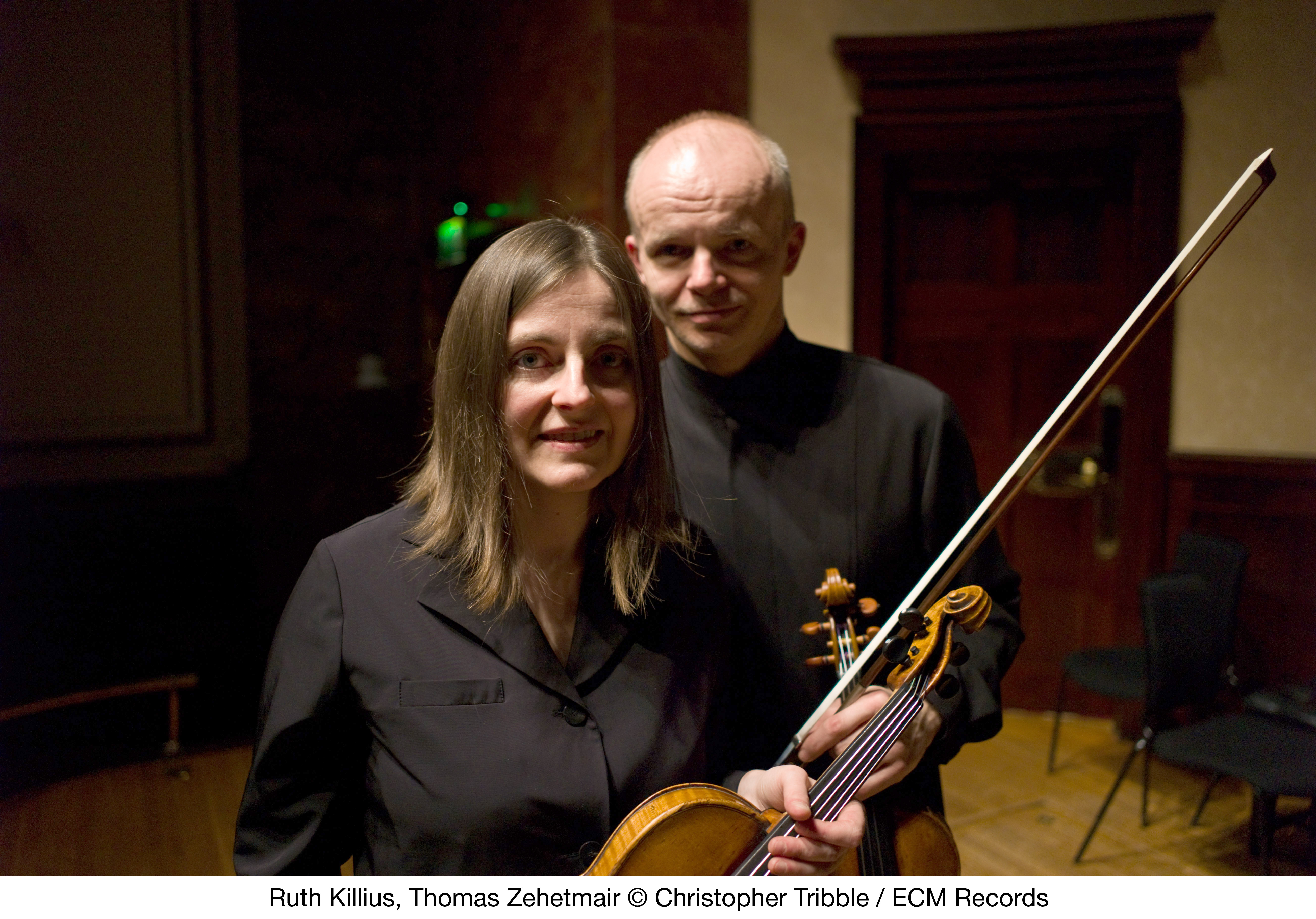
Violinist Thomas Zehetmair and his wife, violist Ruth Killius, break from their charter roles as one half of the widely acclaimed Zehetmair Quartet for a unique duo recital. In his album liner notes, Paul Griffiths says of the relationship between the two instruments, “What divides is also what binds,” and perhaps no summary could phrase it more accurately. The viola may often be mistaken as a mediator between the violin and the cello, a liminal instrument whose status in subordinate to either. In a setting like this, hearing music specifically written or arranged for the combination, it becomes an equal partner to the violin while retaining the edge of its voice: harmony through distinction.

Zehetmair and Killius

The program casts a long shadow from 2006, when Heinz Holliger composed his Drei Skizzen (Three Sketches) for the duo, back to the undateable Icelandic folk song Ó min flaskan friða (A love song to a bottle), given a fresh coat of paint in an arrangement by Rainer Kilius. The latter’s pulsing, stone-textured polyphony opens the album, flinted until it sparks. Holliger’s pieces, by not so large a contrast, chart the passage of fire into darkness. The glassy spindles of “Pirouettes harmoniques” are, like so many of the composer’s works, genuine agents of atmosphere, and culminate in a rich, if breath-held, conclusion. Moments of self-reference also abound. The swirling gestures of “Danse dense” recall his Duo for violin and cello, while the “Cantique à six voix” resurrects the more ethereal moments of his Scardanelli-Zyklus. This last movement requires the violist to sing, thus bringing out an antique spirit behind the meticulous abstractions. Holliger’s music follows that of 20th-century individualist Giacinto Scelsi, whose 1957 Manto gives up half of the album’s title. This piece, in which the musicians employ scordatura tuning (as they do in the Holliger), is also in three parts. It makes slow, archeological work of its motifs. Killius sings here, too, only in a trembling incantation, a ritual on the verge of dissolution. Bohuslav Martinů’s Three Madrigals of 1947 is yet another tripartite composition. Its lines are toned and strong, moving from sharp to supple in a single movement. From muted strings and flowering trills come the exuberant dialogues of the final Allegro, which unspools a tower of Baroque stairs into flourish.

The last of the threes comes by way of Nikos Skalkottas. A student of Arnold Schoenberg whose stark, individual qualities as a composer are nakedly audible in the 1938 Duo recorded here. The first movement opens with scraping bows and interlocking lines, all coming together with a certain thickness of description. This foils the central Andante’s blurry sheen and frames the final movement, which percolates through a network of forgotten folk fragments. Occupying a different band of the folk spectrum is Midhouse Air. This 1996 composition by Peter Maxwell Davies references folk music from the Orkney Islands and reaps a field of exuberant dreams.

Two outliers in the program nevertheless blend seamlessly into their surroundings. Béla Bartók’s Duo, composed in 1902, captures the spirit of a faraway dance with presence of mind. In this compact, Neo-Classical gem, the musicians play the same melody, only one of them inverted and backward. Johannes Nied’s Zugabe (2004), on the other hand, is a jagged yet cohesive piece. It bears further dedication to the duo, and from the performance it’s clear as to why. Like two pieces of clay scratched before kilning, they bond through the heat of creation, brushing the recital’s scope with a love and professionalism that perhaps only a married couple can bring to the studio.

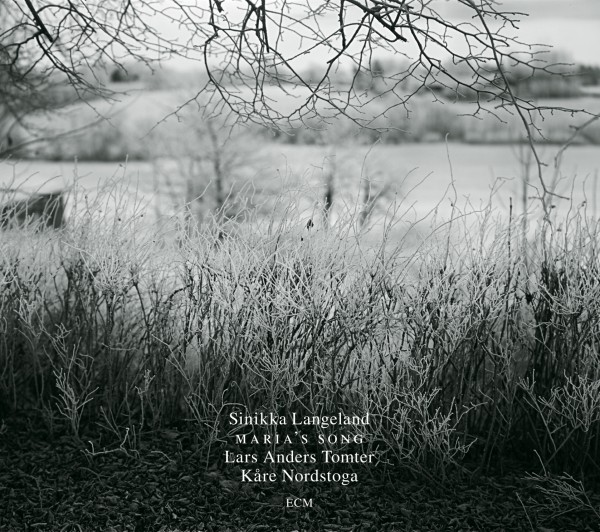
Sinikka Langeland: Maria’s Song (ECM 2127)

Maria's Song

Sinikka Langeland
Maria’s Song

Sinikka Langeland voice, kantele
Lars Anders Tomter viola
Kåre Nordstoga organ
Recorded February 2008, Nidaros Cathedral, Trondheim
Engineer: Ove Berg
Editing: Ove Berg, Jean Lewis (Suite, Chaconne)
An ECM Production

ECM may be nominally dedicated to contemporary music, but Johann Sebastian Bach has been a vital touchstone in its classical recordings. Whether acting as a foil to modern works in Thomas Demenga’s multi-album traversal of the Cello Suites or as the exclusive subject of fresh interpretations by Keith Jarrett and András Schiff at the keyboard, Bach has either existed as a point of reference or as a master being reckoned with anew toward the asymptote of definitive interpretation. Only Christoph Poppen has gone a step further, weaving Bach into the work of Anton Webern (as Webern himself had done) and exploring hidden chorales of the solo violin literature. That was, until Maria’s Song, which is by far, and may always be, ECM’s profoundest reckoning with Bach.

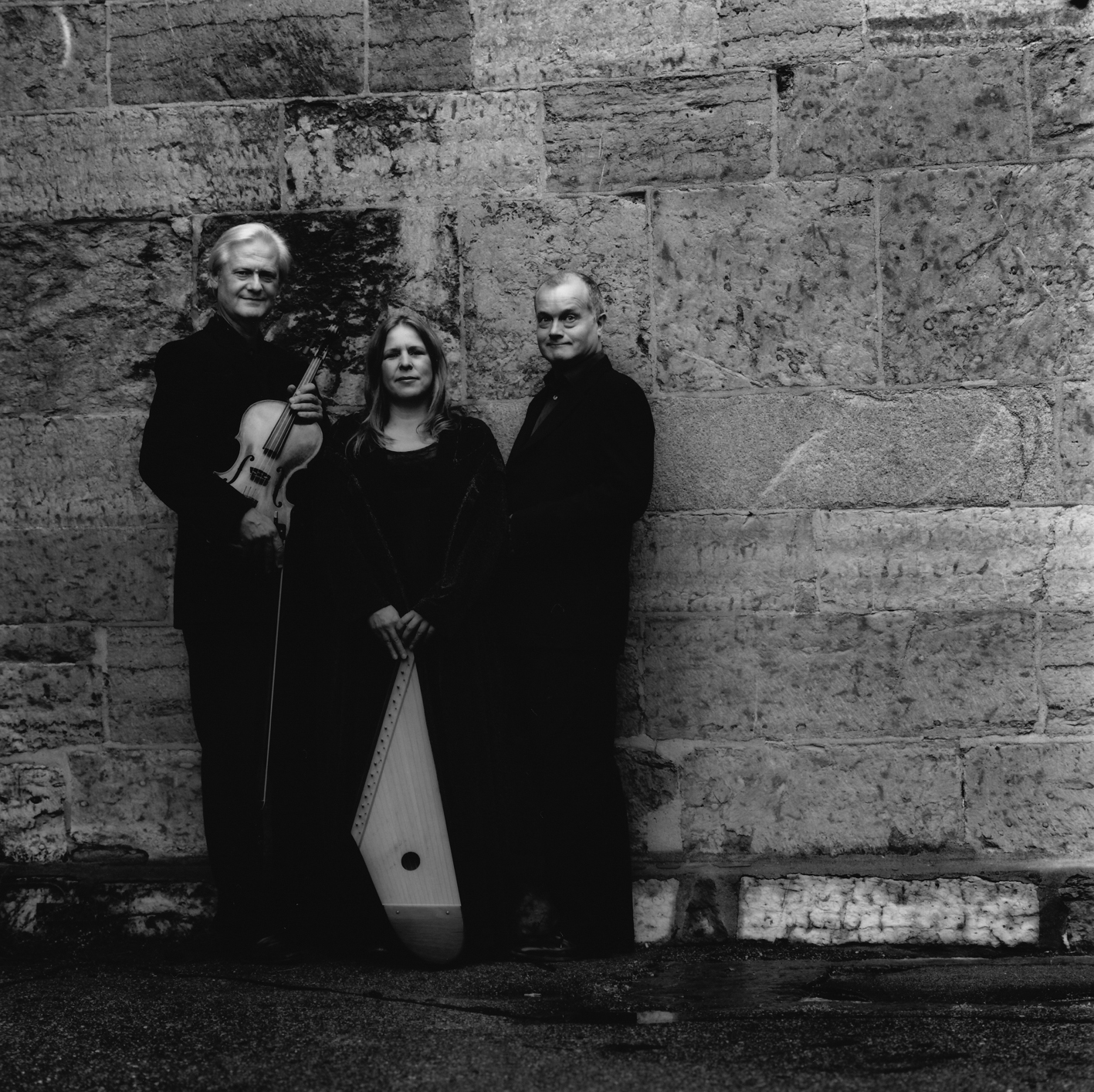
Previously for the label, Norwegian folk singer and kantele (15-string Finnish table harp) virtuoso Sinikka Langeland had recorded Starflowers and The Land That Is Not, both of which sought to explore the shared heart of folk and jazz around the heliocenter of Langeland’s full-throated voice. This time she is joined by Lars Anders Tomter, previously of Ketil Bjørnstad’s The Light, who plays a Gasparo da Salò viola made in 1590, apparently one of the world’s finest examples of the instrument. With them is Kåre Nordstoga, playing the 30-register Baroque organ of Trondheim’s Nidaros Cathedral. Nordstoga is the principal organist at Oslo Cathedral and a Bach specialist, having performed two complete traversals of the composer’s organ music over 30 Saturday recitals in 1992 and 2000.

Langeland Trio
(Photo credit: Morten Krovgold)

The program is a mixture of Marian texts from Luke set to folk melodies and medieval ballads, then threaded through the loom of Bach’s hymns (and the Concerto in d minor, BWV 596) at the organ. In addition, Tomter plays viola arrangements of the Solo Cello Suite No. 1 in G major, BWV 1007 (played an octave higher) and the Chaconne from the Solo Violin Partita No. 2 in d minor, BWV 1004 (transposed to g minor). A few things make this a remarkable project. First is Langeland’s immensity of knowledge, on which she draws to assemble a program of such originality that it feels as seamless as its pairings of word and melody. Second is her voice. Possessed of a luminescent, youthful energy, her intonation makes scripture feel like a sheaf of grain distilled into something digestible by the soul. Last is the utter respect with which the musicians perform, respect that emits a sacred light of its own. And no wonder, considering that the spirit of these texts was at one time forbidden in Norway, where the Reformation of 1537 disbanded monasteries and consigned church relics and artifacts, including depictions of Mary, to state storehouses. Worship of the Virgin thus became the stuff of hidden messages and codes, and in these songs Langeland has enacted their recovery.

“Lova lova Lina” is the first encoding of Mary and, like many of Langeland’s segues throughout the disc, is sung with only the cathedral’s resonant air as accompaniment. Along with the “Ave Maria,” it reappears transformed. At times, Langeland’s fingers find their way to the kantele, both as support for the voice and as a voice unto itself. A reprise of “Lova lova Lina” is especially potent for marrying the two. Narratively inflected singing throughout makes of the shuffled program something of a passion play, in which dialogues between Heaven and Earth come to define the natural order of things. One might expect the viola to brighten Bach’s solo cello writing, when in fact it casts a deeper, more spectral shadow. The feeling is distinctly cyclical, as emphasized by the vocal surroundings, and reaches open-gated confluence in the mighty Chaconne, over which the “Ave Maria” is dutifully papered. The organ, too, sings as it speaks, lifting Langeland in “Vom Himmel kam der Engel Schar,” BWV 607 and, on its own, ascending the spiral staircase of the “Fuga sopra il Magnificat,” BWV 733 at hub of it all. Even the Concerto transcription unleashes the Holy Spirit at an intersection of past and future. As Langeland recalls in her liner notes, “While we played our way through time, the Nidaros Cathedral reflected the spiritual currents of a thousand years. The large Russian icon stared at us as we began to record. The dawn light poured through the huge rose window as we finished the night’s recording.” To be sure, we can feel all of these things…and more.

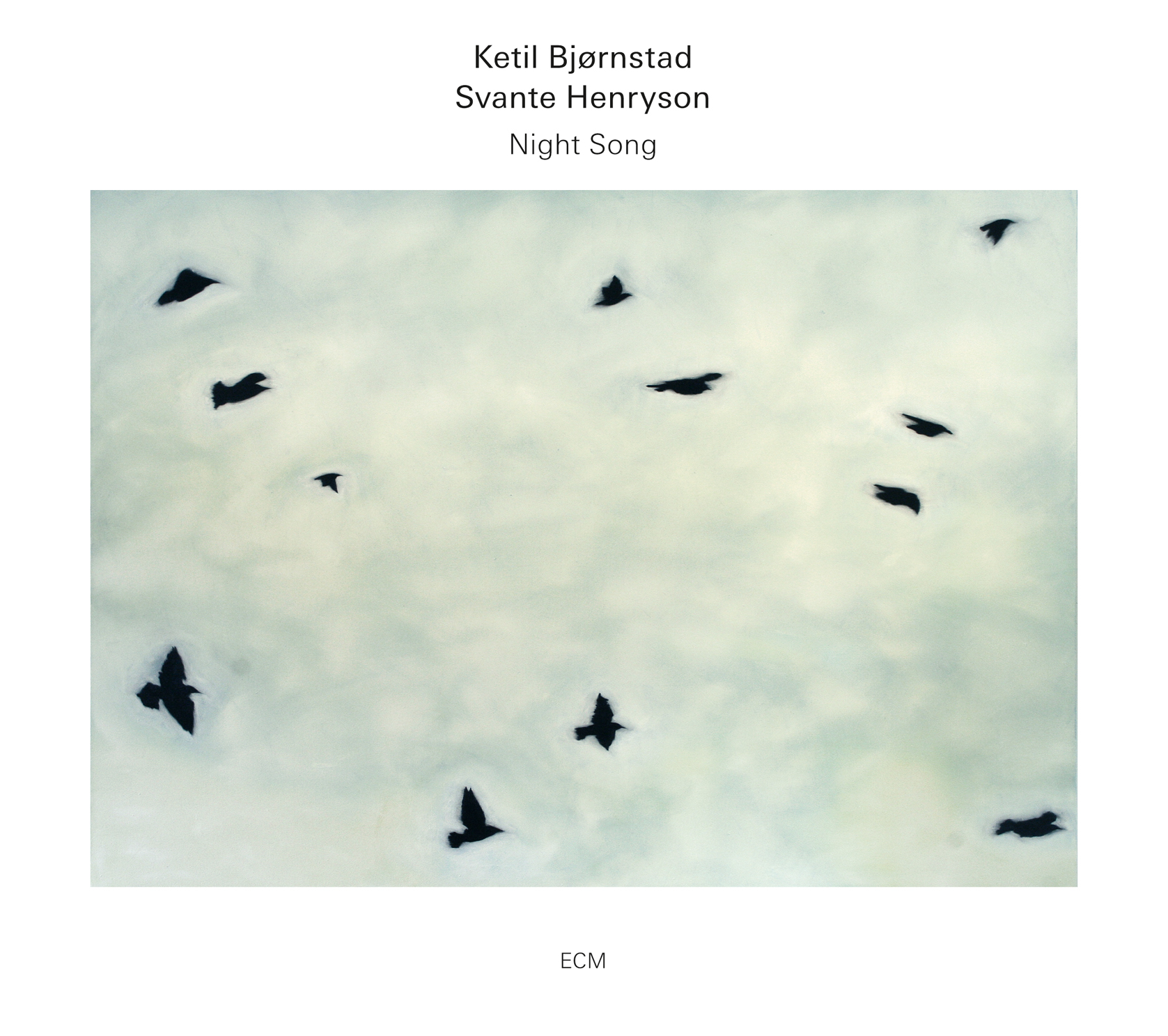
Ketil Bjørnstad/Svante Henryson: Night Song (ECM 2108)

Night Song

Night Song

Ketil Bjørnstad piano
Svante Henryson violoncello
Recorded January 2009 at Rainbow Studio, Oslo
Engineer: Jan Erik Kongshaug
Produced by Manfred Eicher

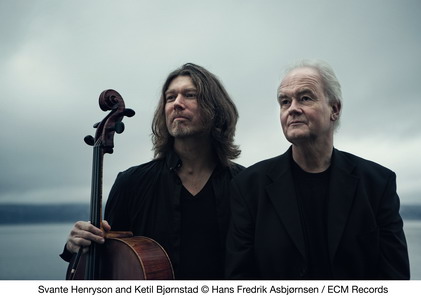
Pianist, composer, and author Ketil Bjørnstad has been long obsessed with Schubert, going so far as to sneak into his school gymnasium as a teenager to play him. “Schubert’s almost naïve openness, his existential sense of wonder and his emotional passion make him at the same time both concrete and mythical,” says Bjørnstad in his liner text. Hence Night Song, which pays tribute to, and engages in dialogue with, the Austrian great. For this project he is joined by Svante Henryson, a multi-instrumentalist and musical chameleon who plays cello alongside Bjørnstad. And by “alongside” I mean exactly that, for the two musicians recorded, at producer Manfred Eicher’s request, as closely as possible, so as to avoid the divisive tendencies of headphones and glass partitions. Bjørnstad: “It is always special for a musician when an ECM production evolves through a dialogue with Manfred Eicher from the very beginning. It can perhaps be compared to what an actor feels, when working with a film director.”

Ketil Svante

The nature of this piano-cello pairing is, however, rather distinct from Bjørnstad’s acclaimed collaborations with cellist David Darling, despite the identical instrumentation. Like Darling, Henryson is a gentle-minded musician, one who whispers more than he sings in the title track, which bookends the album with an “Evening Version” and “Morning Version.” There is, however, in his own music (Henryson pens four of the album’s 16 tracks), an altogether idiosyncratic grace. His arpeggios are of the same planar existence as our own, whereas Darling’s seem to float up from the very earth. Songs (for that is indeed what they are) like “Fall” and “Tar” inhale light and exhale pure, cinematic description—which is to say, by means of a music as visible as it is audible. Henryson’s pizzicati in “Reticence” and “Melting Ice” add further layers of breath, activated by a brooding play of shadows.

Due to the Schubert connection (crystallized in the thinner air of “Schubert Said”), one might think that Night Song would sound more romantic, but like much of Bjørnstad’s chamber music it emotes from a heart seemingly teleported from the late Renaissance. The transitions marked out by tracks like “Visitor” and “Share” from inward prayer to full-throated incantation tickle the senses. To better manifest these transitions, Bjørnstad substantially expands his coverage of the keyboard (note the low range of “Edge” and, by contrast, the glittering rays of “Sheen”). Wherever he may be on the spectrum, he always performs with forgiveness. Henryson, too, unravels coils of life force in the hopeful “Serene” and, in the album’s most songlike turn, “Chain.” His precision in the latter is astonishing for its balance of trepidation and peace.

Bjørnstad’s music begs image, movement, and reconsideration of time. In this sense, Night Song may just be his most intimate recording yet, a gem of expression clawed in silver and carefully polished until it is worthy of being slipped on the finger of a hidden muse.

(To hear samples of Night Song, click here.)