Egberto Gismonti: Saudações (ECM 2082/83)

Saudações

Egberto Gismonti
Saudações

Camerata Romeu
Zenaida Romeu conductor
Alexandre Gismonti guitar
Egberto Gismonti guitar
“Sertões Veredas”
Recorded August 2006, Teatro Amadeo Roldán, Havana
Engineer: Jerzy Belc
Assistant:  Argeo Roque Bernabeu
“Duetos De Violões”
Recorded April and May 2007, Mega Studio and Cecília Meireles Hall, Rio de Janeiro
Engineer: Márcio Gama
Assistant: Guthemberg Pereira
Executive producer: Manfred Eicher

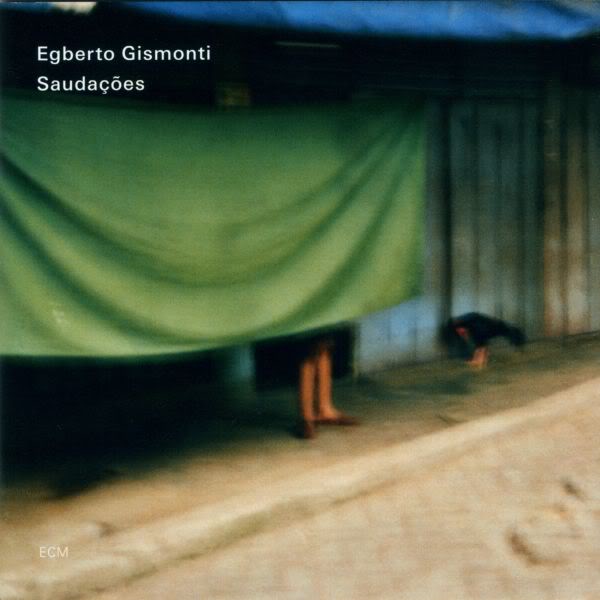
Saudações, of which the title means “salutations,” marks the welcome end of a 12-year ECM hiatus for Egberto Gismonti since 1997’s Meeting Point. Whereas on that record he explored his conservatory training in a set of lively orchestral compositions with Gismonti as piano soloist, the first of this two-disc follow-up consists of Sertões Veredas, a suite in seven parts for strings alone, while the second disc features guitar duets and solos with the composer’s son Alexandre.

Seasoned Gismonti listeners will know what to expect from the program’s latter half. In addition to renditions of classic tunes, including “Lundú,” “Dança Dos Escravos,” and “Zig Zag”—each a bouquet of nimble, sparkling exposition—the duo soars through a veritable résumé of Father Gismonti’s uniquely tender ferocity. From subdued (“Mestiço & Caboclo”) to slipstream (“Dois Violões”), the performances emit a veritable brocade of fire. Alexandre contributes two solos to the program: the gentle, cyclical “Palhaço” (by Egberto) and the original “Chora Antônio.” Alexandre’s animations make them both album must-hears. After a few jagged turns, notably in “Dança,” Egberto ends by his lonesome with the title track, an adroit little bee of a tune that settles in a flower of harmonics.

Gismonti & Son play with freedom of detail, all the while holding fast to an underlying pulse that distinguishes so much of Egberto’s writing. Concentrated as they are, any one of these pieces might expand to an album’s length without loss of potency. In a sense, this is the feeling behind the orchestral suite that begins the album. As always, Gismonti paints a world proper, a landscape of vivid memories, childhood impressions, and mature reflections—all tied together by a love for his homeland and its peoples. Subtitled as a “Tribute to Miscegenation” (Tributo à miscigenação) and played with vivaciousness by Cuba’s Camerata Romeu, it is a heartfelt tribute to—and preservation of—times and places clearly dear to him, all intermingling in a new continent.

The cornucopia of influences from which he has drawn is already apparent in the first movement, of which the spirit remains very much rooted in the composer’s guitaristic panache (even his pianism, heard elsewhere, turns the keyboard into an enormous, fretted instrument). More than the instrument’s mechanics, its immediate tactility carries over into the scores, which sound like magnified string quartets. Gismonti’s attention to the orchestra’s lower end is especially robust, the double basses providing pulse, melodic undertow, and soil for botanical riches above ground. The occasional cello line acts as a link between dynamic extremes, leaving the violins to pollinate, as they will. Each movement is a suite of its own, moving from high to low, slow to fast, loud to soft in a heartbeat. The most obvious references are to Stravinsky (Part IV), John Adams’s Shaker Loops (Part V), and even the romantic touch of a Mendelssohn (Part VI), leaving the final part, an ode to folk traditions and dances, to bask in the resolution of camaraderie.

Speaking of attention, Saudações is recorded with just the right balance of intimacy and mountainous space. Peak slope into a valley of riches, each more scintillating than the last. A treasure trove for Gismonti fans. Even more so for newcomers. Either way: leave your shoes at the perimeter and step into the circle as you are.

Stefano Scodanibbio: Reinventions (ECM New Series 2072)

Reinventions

Stefano Scodanibbio
Reinventions

Quartetto Prometeo
Giulio Rovighi violin
Aldo Campagnari violin
Massimo Piva viola
Francesco Dillon violoncello
Recorded January 2011, Teatro Giuseppe Verdi, Pollenza
Engineer: Gianluca Gentili
Executive producer: Manfred Eicher

Stefano Scodanibbio (1956-2012), best known for his collaborations with Terry Riley and as an improviser and extended technique innovator on the double bass, was also a prolific composer, writing more than 50 works for strings. His first album for ECM owes its existence to Irvine Arditti, lead violinist of the Arditti Quartet and a longtime friend, and actualizes a dream that occupied the composer’s final years to the point of obsession.

Stefano Scodanibbio
(Photo credit: Alfredo Tabocchini)

The “reinventions” of the album’s title refer to his string quartet reworking of Bach, Spanish guitar music, and Mexican songs in a long-form suite of seamless, expressive character. Although, on the surface, three iterations of the Contrapunctus from Bach’s Art of the Fugue seem little more than slight deviations of their source material, they actually brim with harmonic ornaments and slow tempi that allow the listener to better scrutinize their pathos through Scodanibbio’s idiosyncratic lens. Rather than simply “re-imagine” the works of his interest, Scodanibbio turns them slowly in the hands, studying them as might a diviner a crystal ball, until they sing of their own accord.

The Bach references are the massive vertebrae of the suite, each cushioned by the Spanish and Mexican disks between them. The former take the name of Quattro Pezzi Spagnoli, but breathe as one unit. The pizzicato ornaments of “Lágrima” begin a stroll through elegant gardens, which with every step elicits new aspects from each melody in turn. There is already so much life in this music that Scodanibbio’s filtering would feel intrusive, were it not for his sensitivity, so that by “Studio” we may feel every detail as a song unto itself.

The five Canzoniere Messicano, on the other hand, come across more urgently with the opening “Cuando sale la luna.” Their life force swirls in the night, disturbing the reflection of a waning moon and etching out a dance along the water. Even the evergreen “Bésame mucho” (the most beautiful song ever written, in the composer’s estimation) leaves ripples in the mirror of its timelessness. “Canzone popolare: La llorona” ends this portion as if thrown in a bottle out to sea, a beacon for ghosts whose love of life keeps them haunting the pitch.

The performances by Italy’s Quartetto Prometeo are quiet, assured, and strangely uplifting—as much a quality of the music as of their playing. The cyclicity of both underscores the depth of Scodanibbio’s craft: no mere homage but a profound exercise in empathy.

Ketil Bjørnstad: The Light (ECM 2056)

The Light

The Light

Randi Stene mezzo-sopran
Lars Anders Tomter viola
Ketil Bjørnstad piano
Recorded February/March 2007 at Rainbow Studio, Oslo
Engineer: Jan Erik Kongshaug
Mixed by Jan Erik Kongshaug, Ketil Bjørnstad, and Manfred Eicher
Produced by Manfred Eicher

“Longing itself is a pledge that what we long for exists.”
–Karen Blixen

Ketil Bjørnstad has left a nuanced yet indelible trail through ECM’s forest, leading to the beacon that is The Light. The more he creates, the less ornamental his music becomes, so that here we have distilled melodies and grander human themes that can breathe. Subtitled “Songs Of Love And Fear,” this album is essentially his second for the label as nominal leader, following 1993’s Water Stories. And while many subsequent collaborations, including his classic sessions among the “Sea” quartet (with David Darling, Terje Rypdal, and Jon Christensen), have rendered water his theme par excellence, now he treads the currents of an equally fundamental force of life.

As any Bjørnstad listener knows, the Norwegian pianist and composer has always had a flair for clear and evocative melodies, and fans will surely find their expectations well met in this album’s two song cycles. The strength of this record, then, lies in its personnel. Bringing new depth to the Bjørnstad aesthetic are singer Randi Stene’s and violinst Lars Anders Tomter, the second of whom adds a dash of reality to the dreamlike qualities of the piano-voice telos. Indeed, these songs would seem to reference the great lieder of European art music in spirit, albeit by means of a more translucent architecture.

Bjørnstad’s Fire Nordiske Sanger (Four Nordic Songs) represent three decades of writing, performing, and refinement. It is, perhaps, no coincidence that the Norwegian word for “four” should mimic the English “fire,” for that is indeed the type of inner glow brought to every verse. The personal feel of “Grensen” (The Border) sets the tone. Written for his wife’s 50th birthday in 2006, it is the most recent of the four songs and reads like a love letter. “Sommernatt Ved Fjorden” (By The Fjord), on the other hand, was written in 1978 and has since become, much to the composer’s surprise, a favorite on the Norwegian pop charts. Imagistic contrasts also abound, as between the rustically inflected “Natten” (The Night), in which the viola takes on a narrative role, and the cinematic “Sommersang” (Summer Song), which follows the emotions of its protagonist—the song was, in fact, written for Stene—with the precision of a tracking shot.

The album’s remainder and title piece sets eleven poems by John Donne (1572-1631). While the vagueness of Donne’s poetry has always been key to its appeal, here it is leveled by the music’s even keel, balancing absence with substance and stillness with life.

In songs like “A Valediction: Of Weeping,” “The Dream,” and “The Prohibition,” the words teeter between surrender and command, while in “Air And Angels,” “Love’s Alchemy,” and “Break Of Day,” love assaults the eyes like two transparencies of the same image bumped slightly askew. Nevertheless, the connective spirit of Bjørnstad and Tomter holds on to a vision of unity in the shadow of Stene’s voice, especially in their instrumental interlude, “Lamentoso.”

Moments of unity abound elsewhere. “The Flea” is both one of Donne’s most intriguing poems and receives here an equally vivid melodic treatment. “A Nocturnal Upon St. Lucy’s Day, Being The Shortest Day” is a morsel of comparable skill, weighted by the pall of a long winter, that finds its renunciations answered in “The Sun Rising,” in which rooted pianism evokes the grip of Donne’s passions. Finally, “A Hymn To God The Father” points to the poet’s devout core, where faith in heavenly blessing wraps his fears of death until they dissolve. This is where the album’s light truly shines through, exploring through prayer a love secluded from a world that would pick it clean if given the chance.

Alfred Zimmerlin: Euridice (ECM New Series 2045)

Euridice

Alfred Zimmerlin
Euridice

Carmina Quartett
Æquatuor

Aria Quartett
Euridice singt
Recorded October 2007
Kultur- & Kongresshaus Aarau
Streichquartette
Recorded August 2006
Radio Studio DRS, Zürich
Engineer: Stephan Schellmann
Produced by Manfred Eicher

One day, when this terrifying vision’s vanished,
let me sing ecstatic praise to angels saying yes!
Let my heart’s clear-struck keys ring and not one
fail because of a doubting, slack, or breaking string.
–Rainer Maria Rilke*

Continuing its mission to make internationally known the work of underrepresented composers, ECM documents on Euridice three chamber pieces by Swiss composer Alfred Zimmerlin. Born in 1955 and currently a professor of free improvisation at the University of Music in Basel, he is the recipient of numerous awards and a longtime member of the Werkstatt für improvisierte Musik (Workshop for Improvised Music), where his reputation as cellist precedes his reputation as composer. Thankfully, we have this pristine, artfully performed album to even the latter scale.

The program is bookended by two string quartets. The first is Zimmerlin’s second; the last is his first. The Second String Quartet, composed in 2003, comes into being by smooth, if ephemeral, brushwork and balances its draw with distinct pointillism. There is a strange push behind the music, a feeling of perpetual motion underlying the very barest outer ripples of a chaotic epicenter: a tsunami in a cupped hand’s worth of droplets. For this relationship, Zimmerlin looks to the “hermetic language” (hermetischen Sprache) of Rainer Maria Rilke’s “Duino Elegies.” Rilke, of course, was known to lament the limitations of orthography, and here Zimmerlin enables a sonic confrontation with those very limitations. As the composer notes, Rilke, too, breaks free from this constriction in the Ninth Elegy, which ends:

Look, I’m alive. On what? Neither childhood nor
the future grows less…More being than I’ll ever
need springs up in my heart.

Such effusion advances the strings along their own semantic path through space and time, finding eternity in a grain of sand. Each instrument is thus born of its own grammar: first violin as verb, second as declension, viola as punctuation, and cello as arbiter of marginalia. One feels the indefinite shape of their text as solidly as a printed page.

The First String Quartet, completed in 2002, at first feels imported from an opposite pole. Like a Terry Riley ritual spiked with a George Crumb infusion, it projects both shaman and possessing spirit. From a “dense state” (einem dichten Aggregatszustand), the quartet unfolds in an inherently even keel. The musicians hiss and muscle their way through this music, which somehow retains an edge of accessibility. It is enticing in its chaos, ordered not only by score but also by interpretation. There is an almost symphonic quality to the slower passages, fragmentary though they may be, suffused with local colorations and vocal paroxysms before settling in a flowerbed of pizzicati. That this quartet pays homage to the 18th-century Swiss folk song “Guggisberglied” and to Heinrich Ignaz Franz Biber’s Mystery Sonatas is of ultimately little consequence. Zimmerlin designates these not as thematic touchstones, but rather as echoes of a cultural memory, of which the string quartet is but one banal expression—one reason, perhaps, why he avoided the format for so long.

At the heart of the album is Euridice singt (2001-2003/04), a self-styled “scene” for soprano, oboe, cello, piano, and soundtrack (i.e., a prerecorded CD of electronics and vocals). Where the Second String Quartet sought inspiration in Rilke, Euridice is foremost a meditation on the opening of Ingeborg Bachmann’s poem, “Darkness Spoken”: Like Orpheus I play / death on the strings of life.** From this arises a refashioned Orphic myth, one in which Orpheus himself is bolstered by the generative power of his grief, brought on by his doomed Euridice. The latter’s death by snakebite (represented here by electronics) is where the piece begins in a text by avant-garde Swiss writer Raphael Urweider. The oboe (played by Matthias Arter) is Orpheus’s grief made manifest, while Euridice’s spirit lingers in the form of soprano Sylvia Nopper, who gifts her beloved a choir upon his return to the Overworld. Meanwhile, Euridice takes a certain reflective solace in her death. At first, she is ghostlike, nearly overtaken by the oboe: reeds above larynx. Euridice’s initial stirrings sound closer to Japanese Noh theatre than to song cycle as Orpheus’s rapping entourage emerges hauntingly. This is not, however, an infusion of contrasts, but a simultaneous reckoning of elements, so that none holds dominance. Although the oboe is a point of particular fascination in this milieu, it navigates the waters of a turgid anger on both sides of the crust, so that by the end it is spent, slave to its own fatigue. There is one passage, for instance, during which the oboe jackknives between clean and multi-phonic notes over an array of white noise, piano, and pizzicati. Even then, it walks the line between confusion and transcendence, of dreams and reality, in kind. Hence the droning conclusion, which culminates in an electronic fade to dark: the cycle will repeat until all colors become one.

There is an unforced feeling to Zimmerlin. He lets the sounds unfold of their own seeming accord and marks their passage as a jazz musician might transcribe a solo after the fact. In this respect, his experience as an improviser pays marked dividends. This leaves us with a compass that is at once full of direction and directionless, a relic from a past we may never recover, except through the affective, if ultimately illusory, experience of making music.

* All Rilke translations by A. Poulin, Jr.
** The translation of Bachmann is by Peter Filkins.

Erkki-Sven Tüür: Strata (ECM New Series 2040)

Strata

Erkki-Sven Tüür
Strata

Jörg Widmann clarinet
Carolin Widmann violin
Nordic Symphony Orchestra
Anu Tali conductor
Recorded May 2007 and June 2009, Estonia Concert Hall
Engineer: Maido Maadik
Assistant engineer: Jaan Tsadurjan
Executive producer: Manfred Eicher

The music of Estonian composer Erkki-Sven Tüür is much like his name. Its frame contains doubled elements, a cosmic chemical signature that embraces a hyphenated signifier in the middle, connection to some gravid space from which one can observe the unfolding of his distinctly personal character. Of that character we get plenty on this album, his fifth for the New Series, for which the usual roster of ECM performers is swapped for the phenomenally talented Nordic Symphony Orchestra and its principal founder and conductor, Anu Tali. Together they bring luminescence to two recent works with mellifluous authority.

The Symphony No. 6, the subtitle of which gives this album its name, is in fact dedicated to Tali and the NSO, who commissioned it. From the first bars, the reasons behind this inception become clear, for the musicians play this music as if they have known it all their lives. Composed in 2007, Tüür’s massive symphony is a master class in affect. It heralds a new direction for the maverick composer, who abandons his “architectonic” method (although echoes of Crystallisatio remain) in favor of self-styled “vectorial writing.” Where the former embodied an interlocking or amalgamation, the latter is more of an expansive or, in the composer’s terms, “genetic” development. One might say that architectonics constructed the body in which the cellular divisions of his vectorial composing could divide. Evolution over invention.

The nature of this newer method is obvious in the symphony’s opening and closing bars, stretching as it does a sudden awakening into a dream of perpetual motion that, like all such experiments, inevitably journeys toward stasis. The result of all this is an orchestra that moves amorphously but singly, even if particular instruments do leave trails in the water. In the latter vein, for instance, piano and harp share a brief yet memorable dialogue. On the whole, strings lurk in recession for some time before revealing their palette of light—all the more effective in music that seeks through a glass darkly.

What makes this feel like a symphony at all is perhaps its grandness of scope, which nevertheless retains an internal spirit, as indicated by the subtle (and not-so-subtle) percussive touches throughout. Tüür’s feel for color and space in this regard is so acute that it opens doors in the mind one never knew were closed. The smoothness of his transitions likewise enhances another symphonic staple: a feeling of luxuriance and orientation of detail that are remarkable for a 33-minute duration. Tüür’s narrative language is thus overlapping yet practical, a form of meta-speech that stretches a whisper to a sigh and allows the listener to draw any number of conclusions.

Noēsis, composed in 2005, grew out of a very different commission (by the Detroit Symphony Orchestra and the Philharmonia Orchestra London, at the behest of Neeme Järvi). Although billed as a concerto for clarinet, violin and orchestra, the soloists are scurrying forces, less leading and more integrative. Each section of the orchestra becomes the panel of a fan, unfolding one rib at a time to reveal a connected focal point. Clarinetist Jörg Widmann joins his sister, violinist Carolin Widmann, in this wonderfully evocative piece, which is equally illustrative of Tüür’s new approach. Unlike the symphony, it begins in a hush of ambience that smoothes into the clarinet’s refracted introduction. The violin, on the other hand, is possessed of a free, if trembling, quality. The orchestra, meanwhile, pitches slowly, a boat on waves of molasses. The ending is one of Tüür’s finest, a braid of violin and clarinet carried into afterlife by a soft gong hit, resonant and touched by the sun.

Tüür’s craft has always been deeply physiological, but with Strata he shows it to be also physiologically deep. Whereas his previous work seemed forged from raw material (cf. Ardor), now it issues a line of spider’s thread, pulled by an unseen hand from galaxy to galaxy. It is an expansion rather than a compression of time, the audio equivalent of quantum physics, the equation of which again finds articulate form in the name.

Bernd Alois Zimmermann: Canto di speranza (ECM New Series 2074)

Canto di speranza

Bernd Alois Zimmermann
Canto di speranza

Thomas Zehetmair violin
Thomas Demenga cello
Gerd Böckmann voice
Robert Hunger-Bühler voice
Andreas Schmidt bass
WDR Sinfonieorchester Köln
Heinz Holliger conductor
Recorded May 2005, Kölner Philharmonie
Engineers: Brigitte Angerhausen and Günther Wollersheim
Edited and mastered by Renate Reuter
Produced by Harry Vogt

In his 2003 monograph, Quotation and Cultural Meaning in Twentieth-Century Music, musicologist David Metzer describes West German composer Bernd Alois Zimmermann (1918-1970) as having “exposed the delusion behind the modernist renunciation of the past and offered a vision of time in which [past, present, and future] were interconnected.” Zimmermann, he goes on to say, “saw time as a broad sphere in which all periods were equally within reach.” Such philosophy was at the heart of a self-styled pluralistic approach to composition, taking comfort in a Joycean spirit of drift and adaptation.

One might say that ECM’s New Series imprint has followed suit, pulling lesser-heard composers like Zimmermann into an orbit equidistant from the massive planets he references. In line with this spirit, the label has brought together a meticulous team of interpreters—at the core of which Heinz Holliger conducts the WDR Sinfonieorchester Köln—to paint the portrait of a composer whose personal demons eventually won out: the final piece of this disc was, in fact, completed just five days before his suicide. Such biographical details, however, render the Violin Concerto that opens this disc all the more effective for its unabashedly serial touches. Completed in 1950 and cited as a model for the postwar concerto, it spans three richly contrasting movements, opening in a cacophony of details at once whimsical and shadowy.

The soloist’s relationship to the orchestra is very much in the Romantic mode, as emphasized by violinist Thomas Zehetmair’s gorgeous traversal of the second movement. As in the work of Erkki-Sven Tüür, the piano figures mysteriously, a distant echo of the violin’s central presence, a simulacrum of the internal. It finds entry points in the periphery and parasitizes the orchestral body therein. Despite some beauteous, even transcendent moments, this portion of the concerto is no fantasy, but rather an intense reality of its own making that transitions into the final movement, which dances circles around a joyful center: a rite of spring, if you will. Some magnificent brass writing spurs a solo violin passage into explosive yet contained finale.

Zimmermann’s sound walks the line between capriciousness and foreboding. Despite the composer’s fatalist (?) trajectory, the concerto exudes panache, presenting the soloist with no small technical task. His neoclassicism suggests Stravinsky and Bartók, but influences from Bach to jazz are equally discernible. His plurivocity is clearest in the cadenzas. The almost bacchanal exuberance and rhythmic color of the concerto is every bit as intense as the program’s relatively brooding title composition, which at the fingertips of cellist Thomas Demenga delineates an even thinner line between nostalgia and forgetting. Originally composed in 1952 and revised in 1957, the title of this “cantata” for cello and small orchestra means “Song of Hope,” although its distinctly internal dialogue would seem to shelter very little at first glance.

The sparse instrumentation yields a world of ideas, which Demenga handles with remarkable sensitivity. Tension is so smooth that it no longer feels like tension, but rather like the metaphorical harmony of lock and key: the yin of security and the yang of trespass. The chamber aesthetic, especially in Zimmermann’s pointillist writing for percussion, is solemn and melds beautifully with the cello’s forthright porosity. Demenga brings to these energies a feeling of such effortlessness that the music seems to unfold of its own need to be heard.

Yet, no solemnity can match that of the final piece on the program: Ich wandte mich und sah an alles Unrecht, das geschah unter der Sonne (“And turning then, I saw there great injustice is done under the heavens”). Designated as “an ecclesiastical action for two speakers, bass soloist, and orchestra,” this 1970 oratorio sets biblical verse and Dostoevsky’s “The Grand Inquisitor” parable from The Brothers Karamazov. Andreas Schmidt is the singer, a pathos-ridden reflection of actors Gerd Böckmann and Robert Hunger-Bühler, who provide the spoken voices.

Despite the large instrumental forces at his command, Zimmermann makes spare use of textural overlap, with brass and percussion adding particular and occasional resonance to the immediate voices. One can almost hear the theatrical gestures built into the score, the very comportment of which forms a language unto itself that is subtext to the piece’s articulated surface. Even with knowledge of German or a translation of the texts in hand, this is morose going. Sitting with it is a nevertheless dark fascination. Some moments recall the drama of Shostakovich’s The Execution of Stepan Razin, while others are their own brand of interlocking parable. It ends with a brass iteration of the Bach chorale “Est is genug” and an orchestral afterthought thereof, the latter an indication of a mind at play to the very end.

Concerning the level of musicianship required bringing this music to life, it is only appropriate that Holliger should hold the baton. This is clearly music after his own heart. Even the most dedicated listeners aren’t likely to pop Ich wandte mich… into their car stereo, but its rewards come earlier in the program, felt only as a retroactive lean toward infinity. In accordance to Zimmermann’s “sphericality of time,” the aftereffects are just as musical as the performances they follow, and sow their traces into our mental fields until, some time later, they sprout anew.

The Dowland Project: Night Sessions (ECM New Series 2018)

Night Sessions

The Dowland Project
Night Sessions

John Potter tenor
John Surman saxophones, bass clarinet, percussion
Stephen Stubbs lute, chitarrone, baroque guitar, vihuela
Maya Homburger violin
Miloš Valent violin, viola
Barry Guy double bass
Recorded September 2001 and January 2006, Propstei St. Gerold
Engineer: Markus Heiland
Produced by Manfred Eicher

The Dowland Project was the brainchild of former Hilliard Ensemble tenor John Potter, and had before this album’s release lulled listeners over the course of three traversals: In Darkness Let Me Dwell, Care-charming sleep, and Romaria. As the story goes, after shedding its light in the middle recording, the Project returned to the studio at producer Manfred Eicher’s unexpected behest. Thus the night sessions documented herein were born, in and of the moment.

With Potter are reedist John Surman, lutenist Stephen Stubbs, violinists Maya Homburger and Miloš Valent (by turns), and bassist Barry Guy. Together they forge a sigil of such intuitive, adaptive power that the texts treated here come alive in new and evocative ways. Of those texts, Potter selected a wide assortment, reading them aloud to the group before giving each a onetime go. Improvising around both familiar and adlibbed tunes, the musicians drew their individual lines with such openness that only a bold stripe of unrepeatable music making was left behind. Following that line as listeners after the fact is half the fun. Imagining what it might have been like to be a fly on the wall at Austria’s Monastery of Sankt Gerold, where the sounds were captured for posterity, is the other.

The songs span a range of eras and moods, but all with a twinge of heart that only a troubadour’s pen can elucidate. In that vein, the 12th-century “Can vei la lauzeta mover” by Bernart de Ventadorn yields some of the album’s richest musical textures. Although Potter is the focus, Guy (especially when in conversation with Homburger) proves to be another defining voice. Potter’s own is the horizon line between extremes, while Surman’s soprano saxophone is achingly present, a trail of firefly light running through the darkness.

Sources run the gamut from Portuguese pilgrim song (“Menino Jesus à Lappa”) to Byzantine chant (“Theoleptus 22”). Whether cracking like parchment in the Middle English lyric of “Man in the moon,” clanging like the blacksmith’s hammer in the anonymous 15th-century “Swart mekerd smethes,” or luxuriating in the delicate unabashed descriptiveness of “Whistling in the dark,” Potter navigates all of it with a conscious comfort and playfulness of spirit. Notables include the early 16th-century carol “Corpus Christi” and the 14th-century “Fumeux fume,” the latter by the recherché French composer Solage. Both pair Potter with Surman’s bass clarinet, while the second adds Guy’s upright. Also intriguing are “Mystery play,” in which Potter occupies a back corner of the studio, and “I sing of a maiden,” another Middle English lyric that is by far the most haunting on the album.

Instrumental pieces sprinkled throughout lend reflective prowess to the program’s flow. Two improvised “triages” make contrasts of dance and shadow, while the rest put the lute of Stubbs to full effect, whether in his own improvisations or in the works of Joan Ambrosio Dalza (fl. 1508) and Pierre Attaignant (1494-1551/52). His soloing provides anchorage for the more complex spider’s filament strung between. He also ends the album as tenderly as he begins, with Attaignant’s “Prelude”: an indication of things yet to come, of dreams yet to be dreamed.

It must be said that every musician of Night Sessions is as much a singer as Potter’s voice is an instrument. They’re all storytellers, finding order in chaos, plucking pearls from historical oysters, forgotten in oceans long unswum.

Gianluigi Trovesi: Vaghissimo Ritratto (ECM 1983)

Vaghissimo Ritratto

Gianluigi Trovesi
Vaghissimo Ritratto

Gianluigi Trovesi alto clarinet
Umberto Petrin piano
Fulvio Maras percussion, electronics
Recorded December 2005, Artesuono Recording Studio, Udine
Engineer: Stefano Amerio
Produced by Manfred Eicher

This album’s title, informs Steve Lake in his fascinating liner notes, comes from a madrigal by Giovanni Pierluigi da Palestrina, and connotes a beautiful, if hazy, portrait. From that concept, the trio of clarinetist Gianluigi Trovesi, pianist Umberto Petrin, and percussionist Fulvio Maras (who also provides subconscious electronics) unreels a bolt spanning premodern to modern textures, each deconstructed and rewoven along the way to the tune of each musician’s improvisational acumen. Vaghissimo Ritratto is thus a picture gallery that is as much spatial as temporal, painting with good-humored pigments over ECM’s vast canvas.

Trovesi has, of course, already left indelible marks on that same canvas, but perhaps none so distinctive as this. With Maras (heard also on the Trovesi Octet’s Fugace) and Petrin (of Trovesi’s Italian Instabile Orchestra) to assist him, the overall effect is a revelation. A good measure of the album’s “portraits” references Italian cellist and composer Alfredo Piatti. His themes resonate at regular intervals, each a cleansing exhalation before the next intake. In them, not only does Maras hint at a boundless inner world with his light applications, which haunt the edge of perception like dreams jumping off the cliff of waking; he also foils the record’s otherwise acoustic nature. Whether by means of an artful synthesizer or by the touch of hand on drum, he cuts a flash of poetry across every prosodic eye. Through it all, Trovesi stands like a prophet of the here and now. With a lyricism that is an intense as it is entirely his own, Trovesi hones a vibe as only he can elicit from even the simplest melodies.

As a unit, the trio sips from various glasses, moving photographically through stages of development. A taste of cabaret comingles with an operatic piquancy, while nostalgia binds the two in harmony. What might feel like the inside of a café at one moment could very well turn into a death scene the next. Such is the album’s theatrical edge, by which the trio adlibs its way through such tracks as “Serenata” with all the comfort of one reading from a score. And in “Mirage,” notable for the arresting, shawm-like quality that issues from Trovesi’s alto clarinet, we feel cargo moving across the sands while tintinnabulations, soft and hymnal, echo from the piano.

Two twentieth-century singer-songwriters, Luigi Tenco and Jacques Brel, are referenced in “Angela” and “Amsterdam,” respectively. In the hands of Trovesi and company, both of which move through changes with the greatest of ease, and with such grandeur as to make one yearn to have been there when first written. Maras and Petrin each contribute a tune in kind, delving through their rapport into jazzier turns.

If these are the vanity muscles, then the album’s blood supply comes from its host of Renaissance composers, including Claudio Monteverdi, Orlando di Lasso, Luca Marenzio, and Josquin Desprez. In the subsection, for instance, marked “Ricercar vaghezza,” the ritornello from Monteverdi’s opera “L’Orfeo” sounds downright futuristic, so pure is its antiquity, and receives the proper Trovesi treatment in the reedman’s “Grappoli orfici” (Orphic clusters), from which he unravels that Monteverdean thread and with it re-stitches the night sky to a toothsome smile of mountains along the horizon. Further delights await in Desprez’s classic “El grillo,” a song all the closer to my heart not only because it shares my last name, but because the spirited rendering it receives here removes that tongue-in-cheek wrapper and cracks open a little transcendence from within it.

By the time we reach our title destination, a vague and freely improvised foray that sparkles as it slumbers, we splinter along with the trio into a motif from Palestrina. Its message, though whispered, is clear enough: The circle is not a cycle, but the ripple of the first stone.