Arvo Pärt: Lamentate (ECM New Series 1930)

Lamentate

Arvo Pärt
Lamentate

The Hilliard Ensemble
Sarah Leonard soprano
David James counter-tenor
Rogers Covey-Crump tenor
Steven Harrold tenor
Gordon Jones baritone
Alexei Lubimov piano
SWR Stuttgart Radio Symphony Orchestra
Andrey Boreyko conductor
Lamentate recorded June 2004 at Stadthalle Sindelfingen
Engineers: Dietmar Wolf and Jürgen Buss
Da Pacem Domine recorded April 2005 at Propstei St. Gerold
Engineer: Peter Laenger
Produced by Manfred Eicher

Tempting as it may be, the typing of Estonian composer Arvo Pärt as a spiritual modernist hardly begins to assess the reach, import, and atmospheric integrity of his music. The more closely one listens to it, the more one hears between every heartbeat an alternating current, whereby shadows take solace in their own orientation of elements. Awareness of this dichotomy throws sanctity over the banal, and lends banality to the sacred, so that by the end of any Pärt listening experience one emerges changed yet profoundly the same—the self made clear under a magnifying glass polished by sound.

And so, while Lamentate may be said to represent a new direction for Pärt, whose music has hardly sounded this visceral since his formative dips into the avant-garde, it also feels like a reflection back to the womb, if only because the composer has so carefully woven into its basketry a conscious structural flaw. Said flaw is the essence of being human. It is what turns the visage of existence firmly away from the realm of fantasy toward the mirror of reality. This “lamento for the living” takes its inspiration from the enormous sculpture “Marsyas” by Anish Kapoor, at the time located in Turbine Hall of London’s Tate Modern, and anchors a piano soloist (here it is Alexei Lubimov at the keyboard) in an orchestral ocean. In the album’s liner notes, Pärt describes his first encounter with the sculpture: “My first impression was that I, as a living being, was standing before my own body and was dead—as in a time-warp perspective, at once in the future and the present.” Lamentate thus concerns itself with time—or, more precisely, with those who deal with time. The work was premiered at the sculptural site in London on February 7 and 8, 2003, and was recorded for ECM in 2004 at Germany’s Stadthalle Sindelfingen, near Stuttgart.

Before throwing us into these prophetic waters, the disc opens with the prayer for peace that is Da pacem Domine. Composed in 2004 on the basis of a ninth-century Gregorian antiphon and recorded here a year later at St. Gerold monastery near the Austrian mountains, it features the Hilliard Ensemble with soprano Sarah Leonard in a moving, timeless performance (the work reappears in updated form on In Principio). Like much of Pärt’s choral writing, its simplicity is its strength, requiring discipline from interpreters to bring out inner complexities. The antiphon is stretched to reveal a stratum unto itself, a melody to be born into and from. Its lines mark the binding of a book of experiences, the pages of which fade in one direction and become crisper in the other. All, however, bear equal wisdom of the divine hand that inscribed them.

With such pulchritude still warming the chest, Lamentate (2002) comes like a hit in the gut. Each of its ten movements is a monument—now fragile, now menacing—to some emotional shell. These surfaces act as palimpsests for the cellular activities that unspool from a brass incantation. A bass drum rumbles as would the hand of a god trapped beneath the earth’s surface pound for escape. In that frustration are flashes of a life confounded by lifelessness, declarations of dependence wrought in beat and bow. Over the piece’s own lifespan, the recording takes on a wavelength that cracks open intersections of space and time and spins from their yolks an entirely new cosmos. In this parallel universe, the winds are seemingly still yet utterly dynamic like nebulae as fetal kicks javelin fresh thought through a needle of questioning. The piano’s solitude provides the only answer it ever needed to breathe, for in the crafting of flesh lurks a question far beyond our articulation, and to which music nevertheless brings us steps closer. As relays of brass, piano, and percussion give way to whispering tides, echoes of earlier compositions (such as Psalom) make themselves known as a lilting oboe swims against the current. And even the nominal resolution treats alignment like a fantasy, leaving us by the end looking above for any sign of what it means to be below.

Marsyas
(Photo credit: Empics)

Dans les arbres: s/t (ECM 2058)

Dans les arbres

Dans les arbres

Xavier Charles clarinet, harmonica
Ivar Grydeland acoustic guitar, banjo, sruti box
Christian Wallumrød piano
Ingar Zach percussion, bass drum
Recorded July 2006 at Festiviteten, Eidsvoll, Norway
Engineer: Thomas Hukkelberg, Desibel
Produced by Dans les arbres

Dans les arbres (“In the trees”) is named for the collaboration of clarinetist Xavier Charles, guitarist Ivar Grydeland (who also plays prepared banjo and sruti box), pianist Christian Wallumrød, and percussionist Ingar Zach. Together they illuminate a microscopic diorama of improvisation, letting their inhibitions go in service of the moment. What comes of this is as unknowable as it is unscripted, a mystery that is yet naked before us, hiding nothing—only, we have forgotten its way of speaking.

Immediately striking about this all-acoustic quartet is its seemingly electronic blood flow, nonetheless letted by means unplugged. The feeling comes out in feather-light high tones, which caress the air like a hearing test administered by some distant deity. For much of the album’s duration, listeners are thus suspended at an intersection of thresholds: between motion and stillness, utterance and silence, melody and noise. Each of these is, of course, illusory at best, and this is the album’s greatest lesson.

With one exception—“Le Flegme” (Phlegm)—each movement of Dans les arbres describes a state of mind or being. Titles such as “La Somnolence” (Drowsiness) and “L’Engourdissement” (Numbness) are purely descriptive. They are not pretentious hints toward deeper intrigues, although one can hardly deny the music’s mysterious side effects. If anything, the sounds seem cryptic because of their warping of time. Hence, their pervading suspension. What we hear is what we hear.

The album’s initial stirrings paint a forest fire in its infancy, which sparks unnoticed and by the end reaches such force that it’s too far gone to quell. Nor would we ever think to, for by then the flames have already consumed us. Such dynamics come about through the expertise of the musicians, whose ability to listen to one another is mesmerizing, if only because often the instruments are unrecognizable in their extended play. An obvious piano motif might be overtaken by percussion or overblowing from the clarinet, and those in turn by less discernible soundings. In them is the whispering of the veins. Intimations of rhythm are occasional at best, giving way more often to stretches of aphasia and fitful dreams. As if to put a finer point on it, the self-obliterating prophecy that is “L’Assoupissement” (Slumber) echoes like a mournful gamelan for the inner sanctum.

What holds Dans les arbres together is the fact that every element remains crisply defined, each a key that doesn’t so much unlock as interlock. Whether by way of Wallumrød’s hymnody, Charles’s guttural language, Grydeland’s clicking gears, or Zach’s genetic incantations, the overall transmission comes through with messages intact. Throughout the album’s slow crawl toward the resonating chamber of the sun, where histories of inertia dwell in fantasies of their own design, the insistence of a struck gong or a splitting reed comes like a knock on the door, flowing from itself into itself in a cycle of renewal, residue, and retention.

The only comparison I can offer for reference is Nijiumu’s Era of Sad Wings, which may just be the most enchanting things ever committed to record. Whatever the analogue, this is an unusually beautiful creation from ECM, one well worth the risk of expanding your listening for its benefits.

Monika Mauch/Nigel North: Musical Banquet (ECM New Series 1938)

Musical Banquet

Musical Banquet

Monika Mauch soprano
Nigel North lute
Recorded May 2005, Propstei St. Gerold
Engineer: Peter Laenger
Produced by Manfred Eicher

Named for an anthology of lute songs compiled in 1610 by Robert Dowland (1586-1641), son of John (1563-1626), Musical Banquet offers up exactly that. Lutenist Nigel North joins soprano Monika Mauch in an expert dovetailing of musicality, detail, and, above all, emotive power. Performing such songs is no small task. The separation of lutenist from the voice that must once have issued from the same—the result of a long recital tradition—means that singer and accompanist must balance poetry and setting with poise. One hears both throughout this spaciously engineered recording, which is to say that Mauch and North bring the precise intonation of classical rigor in harmony with the raw affect of the words.

To that end, Mauch’s diction is so crisp and finely scored that, were one to snap it anywhere, it would break off in cleanest lines. Whether bound by the tenderness of “Passava Amor su arco desarmado” (Love walked by unarmed) or freed by the self-pity of “Far from triumphing court,” respectively the program’s opening and closing songs, Mauch navigates a veritable maze of lovelorn dimensions with gorgeous uplift. North’s cogent luting is equally alluring, a pleasure to behold in its adaptive variety. Between their covers flip beautiful pages—some tattered, others gilded—dripping with sentiment.

In addition to French and English songs, the repertoire includes more from Italy by Giulio Caccini (1551-1618), as well as a handful of anonymous examples from Spain. Each stream has its own quality. The French songs are like necklaces, beads held true by strings of regard. The English, especially those by Father Dowland (Robert avoided inclusion of his own), weave contradictory tapestries. The lyrics might at one moment invite with a flirtatious lilt (“Lady, if you so spite me”), while at the next steep the narrative voice in claustrophobia. In the latter vein, consider your ears fortunate should you ever encounter a more heartrending rendition of his timeless “In darkness let me dwell.”

As for the Italian, and especially the ever-popular “Amarilli mia bella” (My fair Amaryllis), they tend to favor brevity, exerting all the more inertia for it. The Spanish encompass Mauch’s depth of range, making full use of her dynamic control. Furthermore, they challenge North to maintain intrigue by switching one backdrop after another in a gallery of rhythms and styles. Such colors nuance every mystery behind the words. Throughout them all, a peppering of lute solos by John Dowland is the glue that binds. Each is a gorgeous, multifaceted thing, carved with the geometrical precision of a Celtic knot.

Not only is the music of this collection brimming with allure; it also comes to us by the art of two peerless early music interpreters. Mauch’s singing combines the innocence of an Emma Kirkby with the passion of an Arianna Savall into something uniquely her own. North, for his part, looks longingly in the mirror and draws messages from the past. All it requires is a cadence or snatch of melody, and our hand has already been taken, led through a landscape where bodies once danced before they were buried to nourish the trees that to this day grow in their place.

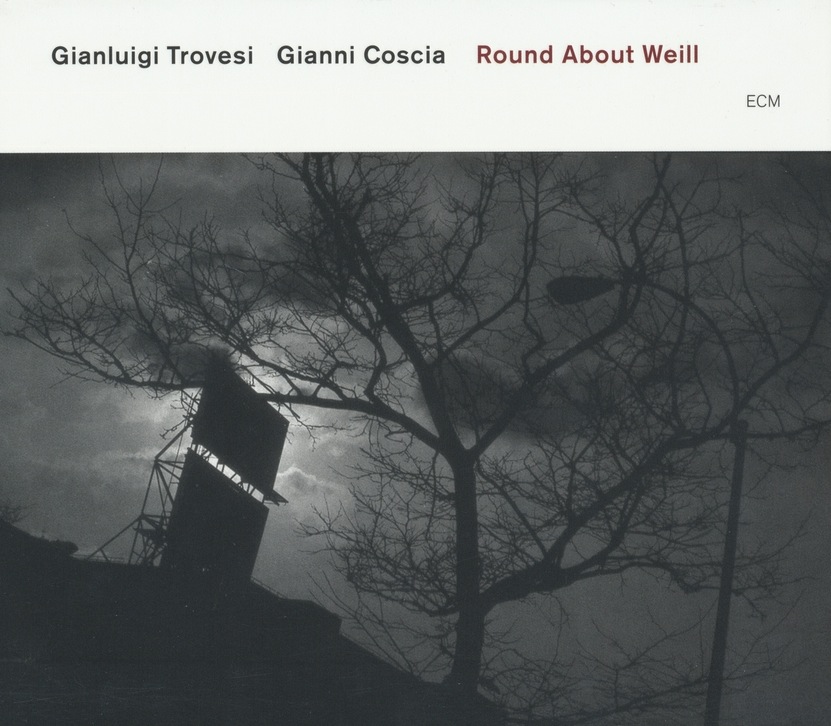
Gianluigi Trovesi/Gianni Coscia: Round About Weill (ECM 1907)

Round About Weill

Round About Weill

Gianluigi Trovesi piccolo and alto clarinets
Gianni Coscia accordion
Recorded July 2004, Radio Studio DRS, Zurich
Engineer: Markus Heiland
Produced by Manfred Eicher

Master clarinetist Gianluigi Trovesi and kindred accordionist Gianni Coscia pick up where they left off on Round about Offenbach, this time giving Kurt Weill (1900-1950) a treatment such as only they can realize. The two friends make Weill their own. Or, more precisely, they make their own Weill, stirring the pot until flavors become one delicious amalgamation. Their doing so is not without precedent. Weill himself found, and forged, art wherever he went, caring not for petty distinctions between the raw and the cooked. From Berlin to Broadway, to borrow from the title of Foster Hirsch’s biography, Weill left a vivid trail of reinvigoration. Yet Trovesi and Coscia do more than pick up the pieces left in his wake, adding as they do a slurry of original counterparts along the way. The latter, in fact, strut with as much panache as the one in whose name they were fashioned.

Turning to the duo’s contributions first, we find the playful romp—replete with harrumphing bellows and Trovesi’s nimble steps—of “Dov’è la città?” setting a tone of variation and complexity. Like so much of what follows, it is a constantly evolving organism, wearing and casting off styles like quick-change artists. Moods range from the profundity of a Górecki string quartet (“Improvvisamente”) and exploratory fugue of “Ein Taifun! … Tifone? No, pioggerella!” to the provocative slants of “Boxen” and the bifurcated title homage. Trovesi manages to navigate every maze-like turn Coscia mortars into being. As with seasoned actors, not a single gesture is out of place in their comportment, as each trades lines with the other in a match of wits so even that it would go on forever without the limits of human attention cutting away the edges.

That said, this is really Coscia’s album through and through. He activates the air as a film projector lights a screen, pulling the dead into life and the living into dreams. Whether riding the effortless wave of “Tango Ballade” (from The Beggar’s Opera) or flipping the coin of excitement and reverie that is “Alabama Song,” his elaborations sing like new. Yet the alpha and omega of the program, and of the duo’s performance thereof, is Weill’s The Rise and Fall of the City of Mahagonny. Like the fugitives with which the satirical opera concerns itself, the music herein is resourceful, self-confident, and always heading toward pandemonium. In these scenes, Trovesi and Coscia swap places with telepathic ease, mapping gypsy jazz motifs as comfortably as balladic impulses. Like the album’s penultimate interlude, which bonds “Cumparsita Maggiorata” (by tango pioneer Gerardo Matos Rodríguez) with the traditional “Tristezze di Fra’ Martino,” these instrumental thespians dip into nostalgia only sparingly, so that the dramaturgy at hand can spring forth as if for the first time.

John Holloway: Veracini Sonatas (ECM New Series 1889)

Veracini Sonatas

Veracini Sonatas

John Holloway violin
Jaap ter Linden cello
Lars Ulrik Mortensen cembalo
Recorded September 2003, Propstei St. Gerold
Engineer: Stephan Schellmann
Executive Producer: Manfred Eicher

Francesco Maria Veracini (1690-1768) is the subject of John Holloway’s fourth ECM traversal of Baroque violin repertoire. Joined now by cellist Jaap ter Linden and harpsichordist Lars Ulrik Mortensen, who together comprise a formidable continuo, Holloway mines the ore of yet another underrepresented violinist-composer, this one an iconoclast to the last: showman, itinerant solo artist, and experimenter. The variety of his contributions to the sonata canon of the time—in both its four- and five-movement incarnations—is expertly represented on this disc. Through them all runs a deep mineral vein of melodic and atmospheric sensitivity.

The Sonata No. 1 in g minor, composed in 1721, comes from the composer’s Opus 1. Its pentagonal structure flies effortlessly from Holloway’s bow, by which he elicits a tone so organic that one hardly notices the trills and mordents of his interpretive genius—some of the most artful to be found in the world of Baroque violining. Whether by the leaping Allegros or the darker, quasi-operatic turns, Holloway and friends mark the passage of this music with instruments as cartographic as they are sonorous.

One quickly notices an airiness to this music that, while charming, is never paltry. This is due equally to the writing and to the playing, both of which work in lively, scintillating congruence. And even though Holloway occupies the spotlight, the interactions between cello and harpsichord are so integral—the former weaving comets through the latter’s pinpointed stars—that to imagine the music without them is to imagine a sky without clouds. The result is a sense of open space, whereby each sonata lends grandeur to even the airiest movements—to wit: the Largo that begins the Sonata No. 5 in C Major. Taken from the Sonate a violino, o flauto solo, e basso, a collection that predates the Opus 1 by five years yet which was published only posthumously, it sketches canvas with bolder ground lines. This renders the exuberant movements all the more emphatic, enacting balance between the violin’s flight paths and the bass lines entrenched below. The concluding Allegro emotes with bravado in a blush of call and response.

The date of composition of the Sonata No. 1 in D Major, from Veracini’s “dissertation” on Corelli’s Opus 5, is uncertain. Considering its programmatic brilliance, youth dominates the possibilities. The dual voicing in particular invokes the antennae of a butterfly fresh from the cocoon. The contrast of this sonata’s shadows and lights presage the maturity of narrative voice achieved in the Sonata No. 6 in A Major, from Veracini’s Opus 2, the Sonate accademiche. Written in 1744, its sweep and drama are on par with Vivaldi’s The Four Seasons. The brief Siciliana that opens betrays nothing of the variety about to ensue. This one has it all: tearful beauty and folk-like revelry in equal measure. At its center is a memorable Andante, in which we are treated to a lute-registered harpsichord, while pizzicato cello and muted strings from the violin touch hands in a most delicate choreography before funneling into a spirited Allegro assai to superb closure.

Where some composers have left only breadcrumbs for future listeners to follow in the wake of paltry imitations, this benchmark recording offers loaves of sonic goodness that are as warm and nourishing as the days they were first baked. The mastery of their realization is matched only by the engineering, which captures details from a respectable distance. Yet another essential document of 18th-century repertoire from those who know its secrets best.

Leonidas Kavakos/Péter Nagy: Stravinsky/Bach (ECM New Series 1855)

Stravinsky:Bach

Stravinsky/Bach

Leonidas Kavakos violin
Péter Nagy piano
Recorded October 2002, Radio Studio DRS, Zurich
Engineer: Stephan Schellmann
Produced by Manfred Eicher

Igor Stravinsky (1882-1971) and Johann Sebastian Bach (1685-1750). Mirrors or two sides of the same coin? This electrifying album by Greek violinist Leonidas Kavakos and Hungarian pianist Péter Nagy answers the question: neither. Stravinsky was indebted to Bach, as so many who put pen to staves ever will be, and explored the Baroque master’s architectures to the very end—even working, the story goes, on Bach transcriptions on his death bed. Yet the Russian iconoclast accomplished a remarkable something that set him apart. Unlike so many before him, he did not shine his light through Bach’s prism but rather shined Bach’s through his own.

Stravinsky’s crucible in this regard was at its hottest in the Duo concertant (1931/32). One of two pieces written for violinist Samuel Dushkin (this for violin and piano, the other his 1931 Violin Concerto), it was not in a format the composer favored at the time but one he nonetheless reconciled through neoclassical rigor. Oscillating between the earthly and the mythological, the piece its composer called a “musical versification” finds unity in gradually joining the two. The first and last of its five movements—the Cantilène and the Dithyrambe—bear mysterious nomenclature. The one blossoms from a pianistic blush to an overpowering charge from the bow. The other drips with lachrymose quality, suspended high above Olympus casting threads to mortal hearts down below. Between them is another dyad, this of two “Epilogues” of friction and protraction in turn. And with them is the sprightly Gigue, one of Stravinsky’s finest moments, played here with integrity.

What sets Kavakos’s playing apart is his ability to be at once fluid and sharp, a quality that lends itself well to the above but also to the below, for in the Partita No. 1 in B minor that follows we hear exactly this contradiction at play. Although two centuries separate these works, Bach’s solo violin masterpiece feels remarkably present in this rendering. Kavakos gives the almighty Allemande a stately treatment, beginning with it a series of four movements and their faster “Doubles.” The first of the latter reveals barest tuning issues in Kavakos’s instrument, but these are quickly brushed away by the Corrente, which he plays with especial care, in the process exploiting the record’s engineering at full potential. The Sarabande likewise unfolds in its dance of blade and water toward the final Tempo di Borea and its Double, by which the music reaches a cavernous interior filled with stalagmites pontific.

The program returns to Stravinsky with the 1933 Suite Italienne for violin and piano. Based on his ballet Pulcinella, it proves the glistening counterpart to the Duo concertant, the spring to its thaw. The affirmation of its introductory motives barely hints at the fiery Tarantella which is the piece’s prime turn—a ball of yarn expertly unraveled. Kavakos’s hefty double stops nourish their flames on Nagy’s pointillist sparks. The folk-like Scherzino is another highlight and sets up the Minuet and Finale with authorial flourish.

From these concentrations we return once more to Bach, whose Sonata No. 1 in G minor reveals further affinity. From the cautious first half to the dawn-like awakening of the third movement and into the forward thinking of the final Presto, it develops itself like one long proclamation—slowed here and sped up there—until it glows.

Those thinking of buying this album for ECM’s treatment of the Bach will want to check out Holloway and Kremer’s versions first. In any event, the Sonatas and Partitas will always overshadow their interpreter. For the Stravinsky? Look no further.

Sylvie Courvoisier: Abaton (ECM 1838/39)

Abaton

Sylvie Courvoisier
Abaton

Sylvie Courvoisier piano
Mark Feldman violin
Erik Friedlander cello
Recorded September 2002 at Rainbow Studio, Oslo
Engineer: Jan Erik Kongshaug
Produced by Manfred Eicher

The ancient Greek title of Abaton denotes, abstractly, an “inaccessible place” and, practically, a space believed to have curative properties when used for ritual sleep by those deemed worthy of its seclusion. It also names the trio performing here under its auspices. Born in Switzerland, pianist Courvoisier has lived and worked in New York City since 1998. This is her only ECM appearance thus far, but with it she makes a far-reaching splash. Violinist Mark Feldman, who after a string of successful releases with the John Abercrombie Quartet explores his classical foundations through the pianist’s evocative writing, and cellist Erik Friedlander, another New Yorker whose penchant for edges finds him in comfortably eclectic tenure, accompany her. Together they have forged something so realistic that it can only be enchanting. Indeed, what began as a recording exclusively of Courvoisier’s compositions, four of which comprise the first disc, turned into a double album at the behest of producer Manfred Eicher, who encouraged the musicians to improvise another disc’s worth of material once the initial recording was complete.

SC

“Ianicum,” with which the album begins, is also its postmodern statement par excellence. Courvoisier daubs the canvas with barest ash, producing an audible equivalent of the album’s cover art, while Feldman and Friedlander draw a winter moon’s halo around her. From these introductions coalesces a mirror structure: strings on one side, keyboard on the other. Direct plucking of piano strings signals tectonic movements, a breaking of surface that flirts with indecipherability even as it speaks clear as day to our mental sanctums. Courvoisier’s internalism is echoed by pizzicati, prompting Friedlander to own the shadows of interpretive duty for a spell. Into this dynamic context wanders Feldman, who leaves a trail of breadcrumbs both familiar and newly inspired. The pianism of “Orodruin,” by contrast lights the cello’s fuses in an asymptotic dance between the macabre and material reality. Unisons somehow make it through, angelic and suspended in the glow of afterlife. The title composition is also for the trio. In it, linguistic affinities abound, dialecting over time as voices become protracted and distinct.

Courvoisier is absent for “Poco a poco,” making for a slicker, more chameleonic experience. The effect is celebratory at heart and delineates a realm where nostalgia for 20th-century chamber music blends motifs with assurance. Feldman and Friedlander are an intuitive pair in a tertiary drama.

Each of the 19 improvisations that follow is a vignette of eclectic power. Confronted with titles such as “Icaria” (of which there are three versions) and “Clio” (Greek muse of history), one can’t help but read mythological impulses behind these ad hoc constructions. Words and images fall short of their affective spectrum, dancing among the shadows across the wall of Plato’s allegorical cave. These figures haunt themselves, stepping into their own dreams as if through water.

As fascinating as the trio’s full-on interactivity can be (cf. “Archaos”), it is in the program’s solo portions where brilliance truly crystallizes. Feldman draws the most mournful bow through “Imke’s,” a candle flame in sound that holds on to wick like life itself and draws melody from oxygen. Friedlander is not far behind in “Turoine” and “Ava’s,” walking a tightrope between regret and resolve. Yet it is Courvoisier, tracing an arc from “The Scar of Lotte” through the organic preparations of “Brobdingnag” and lastly to “Narnia,” who houses the album’s spirit with most of its wing fibers intact. Her notes become indistinguishable from the snowflakes beyond the wardrobe, reminding us that quietude sits on the throne of this castle.

The relationship between these two halves—the predetermined and indeterminate—is hardly conversational. It instead forms a palindrome of intention, meeting in the silent middle between disc changes: the album’s very own abaton, waiting to make divided listeners whole again.

John Surman: The Spaces In Between (ECM 1956)

The Spaces In Between

John Surman
The Spaces In Between

John Surman soprano and baritone saxophones, bass clarinet
Chris Laurence double-bass
Rita Manning violin
Patrick Kiernan violin
Bill Hawkes viola
Nick Cooper cello
Recorded February 2006, Propstei St. Gerold
Engineer: Markus Heiland
Produced by Manfred Eicher

When reedman John Surman first collaborated with bassist Chris Laurence and an ad hoc string quartet on 2000’s Coruscating, the end result was a cause for beginnings. Unlikely surprising to the veteran Surman listener yet fresh as sun-dried sheets, the music of that debut opened a chapter in his compositional thinking now fleshed out to the depth of a novel on The Spaces In Between. Indeed, despite the wealth of fine performances all around, it’s the writing that makes this album such a notable entry in Surman’s expansive discography. The folk-infused melodies, and the means by which they are elucidated, shine through translucent curtains of improvisation, at which the bow-wielders now more forthrightly try their hands.

Balances abound. At the larger level, the album works in two halves, spit at the fulcrum of the title track. This playful sojourn for solo violin, brought to evocative fruition by quartet leader Rita Manning, upgrades the album’s wingspan from butterfly to bird, flitting from limb to limb in search of emerging buds. Before this, the set list steeps itself in winter, interlacing embraces and lettings go. Surman etch-a-sketches his own branches in “Moonlighter,” his methodical figurations seeming to describe a return from hard labor. In them is a sense of tragedy, with bass acting as narrator and strings as chorus. More nuanced balances follow. There is the diurnal contrast of bass clarinet (which under his fingers sings incarnate) and soprano saxophone. The latter doesn’t so much add to as emerge from the strings, drawing out warmth of heart from “Wayfarers All” and the crisper “Winter Wish.” As for those strings, they speak in pastoral dialects, their home a hearth among the ice.

Spring abounds on the other side of the album’s titular spaces, with “Now See!” setting tone in bucolic tracings. Only this and “Where Fortune Smiles” rely on the soprano’s inherent buoyancy to speak its own accord, favoring instead the baritone’s relatively challenging bounce. “Mimosa” (originally written for, but never included on, Thimar) elicits the jazziest inflections in this regard, that low reed moving jaggedly yet surely across the plains. This leaves only “Leaving The Harrow,” a song of drifting, of chemical reactions, of moving on.

Although its mise-en-scène is minimal, the emotional complexities of The Spaces In Between reach far and wide. Like the skies above, they welcome every change in weather, rain or shine, as if it were the first.

Gianluigi Trovesi All’opera: Profumo di Violetta (ECM 2068)

Profumo

Gianluigi Trovesi All’opera
Profumo di Violetta

Gianluigi Trovesi piccolo and alto clarinets, alto saxophone
Marco Remondini violoncello, electronics
Stefano Bertoli drums, percussion
Filarmonica Mousiké Orchestra winds and percussion
Savino Acquaviva conductor
Recorded September 2006, Teatro Serassi, Villa d’Almè, Bergamo
Engineer: Stefano Amerio
Assistant: Giulio Gallo
Edited and mixed by Gianluigi Trovesi, Manfred Eicher, Savino Acquaviva, Stefano Amerio
Produced by Manfred Eicher

The mind of multi-reedist Gianluigi Trovesi is a storehouse of refraction, the lens of a human kaleidoscope in whose turning we can see many zeitgeists, each gushing with its own color. For Profumo di Violetta, Trovesi dives headlong into a sea of operatic favorites, treading waters at once romantic and troubled. With sources ranging from Monteverdi’s L’Orfeo to Puccini’s Tosca, his meta-commentary manages to draw fresh catch from an overfished pond. Buoyed by a wind and percussion orchestra in the grand “banda” tradition of his native Italy, Trovesi taps his memories as a boy growing up around these ad hoc configurations and from them coaxes shoots of ingenious contrast.

It’s easy to appreciate the boldness of this project, which spreads the melodramatic jam of tragedy across hunks of improvisatory bread. In the latter vein, Trovesi is very much the Mad Hatter, altering familiar motifs as might a furniture restorer strip a bench to expose long-neglected grain. In the process, however, one comes to realize that his penchant for humor is not without its serious edge. Take, for instance, his rendition of the famous “Largo al factotum,” which turns a tongue-tying chain of Figaros into a field of dots connected by the fuzz of a heavily distorted electric guitar. A far cry from the tuxedo-and-evening-gown aria, it nevertheless boils over with intuition. Such brilliant grandiosity is part and parcel of the album’s sweep.

Bookended by a Prologue and Epilogue, Profumo unfolds across wild stretches of the imagination. The program proper is broken into six sub-suites, of which “Il Mito” (The myth) drops us into the path of Orpheus. Here Trovesi binds a Toccata and Ritornello of Monteverdi with his own compositional veining, so that the sonority of the old touchstones and the whimsy of the new may interlock in flight. In this regard, the butterfly kisses of “Musa” massage away the fatigue of interpretation, allowing Trovesi’s taunting clarinet in “Euridice” to work its way like sugar through the nervous system. His height of range on the instrument is piercing, tickling the clouds until they loose jazzier droplets.

From the underworld to the overdressed, Trovesi and his cohorts escort us to “Il Ballo,” for a dance that is as grand as it is brief. This leads further into “Il Gioco Delle Seduzioni” (The game of seduction), a triptych of early Baroque and contemporary transparencies. From the convivial to the parodic, Trovesi navigates its burrows with eyes closed and whiskers extended, playing with feet aflame while maintaining control of his dance at every bend.

“L’innamoramento” houses the two-part title piece. Trovesi’s homage to Verdi’s doomed La Traviata heroine belies its love through melodic time travel. Here the emotional overload of opera is compressed to diamond clarity. “Il Saltellar Gioioso” features album highlight “Salterellando.” Anchored by snare and cymbal, and threaded by Trovesi’s grungy altoism, it sets off a ripple effect that lingers long into the spiraling “La Gelosia” (Jealousy).

The performance ends with “Così, Tosca,” which for all its eclecticism breathes with consistency. Trovesi’s soulful pitch-bending traces every contour of an underlying drone with care. A subtle harrumph in the brass only serves to brighten the felicitous interweaving of breath and sonority that is his reverie, diving headlong into an incendiary finish that grovels with profound favor. Indeed, the album might just as well be called “Profondità di Violetta,” for all its depth of thought, arrangement, and execution.

Bravissimo.

(To hear samples of Profumo di Violetta, click here.)