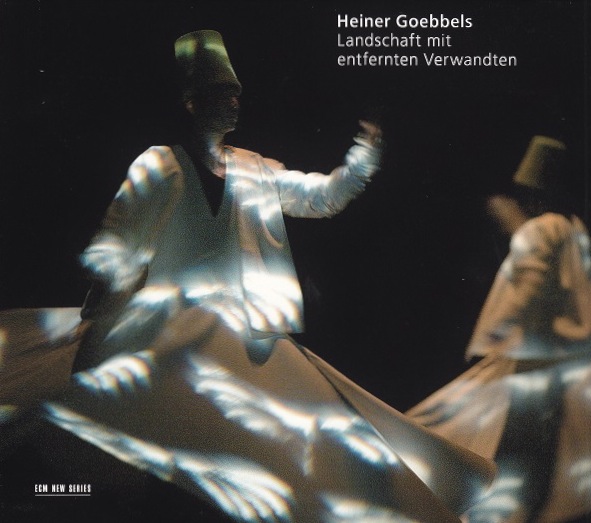
Heiner Goebbels: Landschaft mit entfernten Verwandten (ECM New Series 1811)

Landschaft mit entfernten Verwandten

Heiner Goebbels
Landschaft mit entfernten Verwandten

David Bennent voice
Georg Nigl baritone
Ensemble Modern
Deutscher Kammerchor
Franck Ollu conductor
Recorded live October 2004, Théâtre des Amandiers, Nanterre, Paris
Engineer: Max Federhofer, SWR
Mixed by Max Federhofer and Heiner Goebbels
Executive producer: Manfred Eicher

This recording chronicles the incidental music to Heiner Goebbels’s theatrical juggernaut, Landscape with Different Relatives, a much-lauded work that premiered in 2002. Billed as an opera for soloists, choir, and ensemble with texts by Gertrude Stein, Giordano Bruno, Arthur Chapman, Henri Michaux, T. S. Eliot, Leonardo da Vinci, and Nicolas Poussin, it includes mostly composed material with a mickey of improvisation slipped in. Both modes are taken up with gusto by the Ensemble Modern under the direction of Franck Ollu.

The composer’s polyglot approach to text reveals itself also in the music, which pins a wide-ranging geography of crumbling modernities. Like its librettic assemblage, the listener is eased into the work from the outside in. From above, one sees it divided into two parts. Seemingly disconnected in shape, the first contorts itself around all manner of war machinery while the second sees the body as machine and itemizes the internal workings of that most familiar technology. Closer inspection reveals a kinship between the two halves beyond the grasp of mere words. Both begin with the same introduction, for instance, adding only speech to the second iteration, as if the conscience of the opera’s former half were being revived.
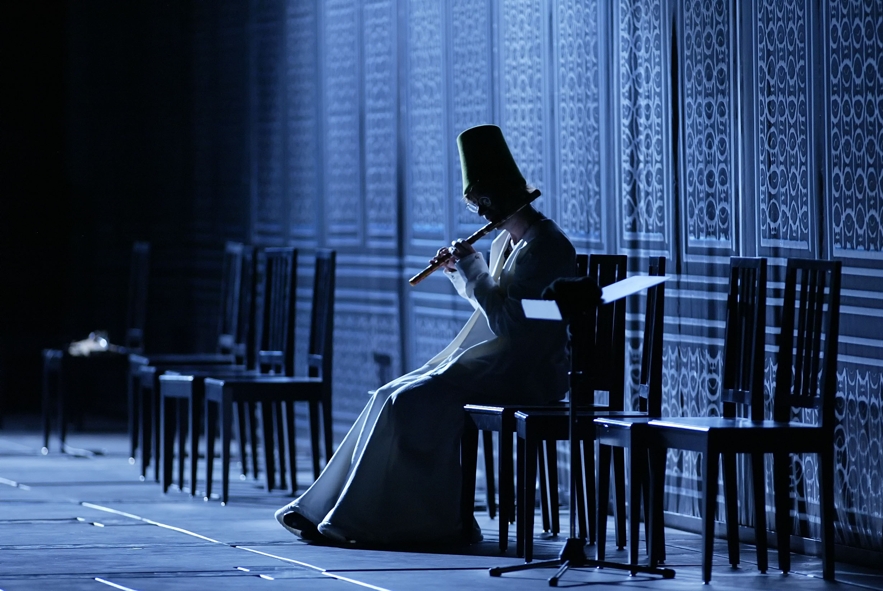
Landschaft
(Promo photo by Oper Frankfurt)

Part One thus inaugurates its concerns without voice. In a bed of organ, flute, and oboe, an electronic beep signals a message waiting to be heard before a wash of light shuttles the listener across narrow waterways into “The Sirens.” Here the vagaries of disgust are re-spun into catalysts, an interweaving of social stereotypes brought home by threats of destruction. Out of this swarm come multiple catharses. Dreamlike and fluid, they imagine procreation in lilting brass and, most notably, in the heavenward flute of “Tanz der Derwische,” one of three centerpieces. Drums and clarinet part the sky to reveal another, a parallel universe where the dead walk as if unscathed as gorgeous improvisations from the clarinetist interact with muted brass. “In the 19th Century” brings science under the lens of its own microscope and questions, as might Foucault, the dangers of expertise. “Triumphal March” is the second centerpiece. An obsessive mélange of lists and figures—and, by extension, of utility and servitude—it builds a monument to interrogation and crushes it to dust. “Schlachtenbeschreibung” is the final centerpiece. It’s title (Battle description) can be said to be the opera’s theme, layering as it does the grids of land and collateral damage that betray any ideological motivations lurking within terror. The playfulness of the instrumental arrangement here suggests a lost art and imbues baritone Georg Nigl with just the agitation he needs to carry off the words. Da Vinci’s pedantry, which guides artists in the depictions of battle scenes, lends a strangely categorical air, adding contrast to the fin de siècle politics that precede it. The ping-ponging of electronic and acoustic beats suggests confusion between the peace and antagonism of “Well Anyway,” which conflates revolution with sustenance, and celebrates the ability to shed tears. “Did It Really Happen?” further addresses the divide between historical revisionism and denial, and pulls the strings of the past clearly into the fray of the present, while “Kehna hi kya” haunts the center with its shrill plucked strings and local flourishes. The latter suggest a cultural archive, packaged and presented to the transient tourist. “Et c’est toujours” (And it is always…) addresses another gap, this between industry and flesh, between art and the earthen origins from which it is produced. It is the twist of a rind in the eye, a squinting of soul into eclipsed sun.

Part Two continues the opera’s marriage of modern and traditional instruments, consolidating many candles into a single flame. As emblematically in the feudalistic satire of “Just Like That,” it plays with minimalism (“Bild der Städte”), bricolage politics (“Krieg der Städte”), travel (“On the Road”), social awkwardness (“And We Said Good Bye”), communication (“On the Radio”), and even delves into a bit of Americana with “Out Where The West Begins,” replete with banjo and wagon procession. This blends into “Train Travelling,” about which the voiceover says, “The irregularity of its regularity is fascinating.” An overarching aesthetic of the opera if ever there was one.

Much of this second half delves deeper into notions of language and category, as in “Ich leugne nicht die Unterscheidung” (I do not deny the distinction), which understands the difference between destruction wrought by hand and by technological intervention, even as it washes both in the same descriptive waters. Such juxtapositions breed nostalgia through lenses of regret and distant complicities. Life takes its path abjectly. The deaths of animals loom as large as those of humans and round the jagged edges of the voices’ autobiographical disguises. Commanding and conquering can occur only where there are speech acts to back them up, and “Different Nations” gives a catalogue of call signs that lend vivid color to the connection between diplomacy and violence. Hence the ultimate arrival of the “Principes,” each a window into the soul that waters ambient soil. This final dronescape hosts only those voices that linger after all the others have expended their welcome. Welcome to their requiem.

Excerpt from the stage production, “Triumphal March”:

John Surman: Free and Equal (ECM 1802)

Free and Equal

John Surman
Free and Equal

John Surman soprano and baritone saxophone, bass clarinet
Jack DeJohnette drums, piano
London Brass
Recorded live June 2001 Queen Elizabeth Hall, London
Recording engineers: Steve Lowe and Ben Surman
Mixed January 2002 at Rainbow Studio, Oslo by Jan Erik Kongshaug, John Surman, and Manfred Eicher
Executive producer: Manfred Eicher

Free and Equal, John Surman’s furtherance of intermingling genres, is its own animal. Under its original title of That’s Right, it was the culmination of a 2000 festival commission and premiered in October that same year. The performance recorded for ECM comes from 2001, giving the work some time to incubate, as did subsequent mixing in Oslo’s Rainbow Studio under the direction of its composer, engineer, and producer.

Nods to classical and jazz modes are a clear and present danger throughout, for the purpose of their coexistence is not to mash them into some new hybrid but rather to flag their common goal: namely, to move listener and performer alike. Surman is joined by drummer Jack DeJohnette (also on piano) and classical stalwarts London Brass in an atmospheric tour de force that departs considerably from such previous experiments as Proverbs and Songs. The instrumentation alone would seem to imply a big band experiment à la Surman’s robust work with John Warren (see The Brass Project), but such is not the case. Neither should the DeJohnette connection, already well honed on Invisible Nature, foster misperceptions of what’s going on here. For as Surman paints the canvas with his soprano oils amid the swells of “Preamble,” it’s clear that freer considerations are at play. DeJohnette’s pianism, heard only occasionally on disc, proves descriptively apt in the follow-up “Groundwork,” which loops bass clarinet through trumpet in an evolving macramé of melody. Here, as elsewhere, Surman finds seemingly impossible paths for his improvisations through growing mazes of gold. Such balancing of the minimal and complex is no small task, and the establishment of that balance highlights their mutuality. It is in this spirit, perhaps, that DeJohnette doesn’t pick up his drumsticks until ten minutes into the album, working into “Sea Change” with the crash of surf in his cymbals, the heave of ocean waves in the brass choir at his back. His moments of abandon are thus kept within sight.

Soloists among the London players strengthen the marrow of this nine-part suite. The tuba soliloquy that opens “Back and Forth,” for one, gives an edible sense of textural contrast. Punctual and enlivening, it signals the first in a series of hardenings and dissolutions, from which trombone throws streams of light and draws Surman’s low reed into an invigorating trio with skins. Likewise, “Fire” traces the multifarious paths of its namesake through a modified trio of drums, trumpet, and bass clarinet. The latter continues its coppery speech in “Debased Line” with a nostalgia and restlessness of spirit that embodies Surman’s passion as a musician. “In the Shadow” evokes Paul McCandless in its sopranism, which floats over a relatively aggressive waltz in the background and sparks an ensemble-wide reaction in the title portion. Virtuosity is on full display as Surman looses his wilder side and fuels DeJohnette’s closing protraction. The drummer cracks many dams in the “Epilogue,” emptying into an open sea of well-earned applause.

Filled with exciting music that creates and maintains its own standard, Free and Equal represents an evolutionary leap in Surman’s compositional thinking. His uncanny ability to be at once joyful and mournful in a single arpeggio has elsewhere never been so explicit. It is music that begs for dancers or the flicker of a cinema screen—a vast, organic machine that runs on the promise of another listen.

George Gruntz: Percussion Profiles (JAPO 60025)

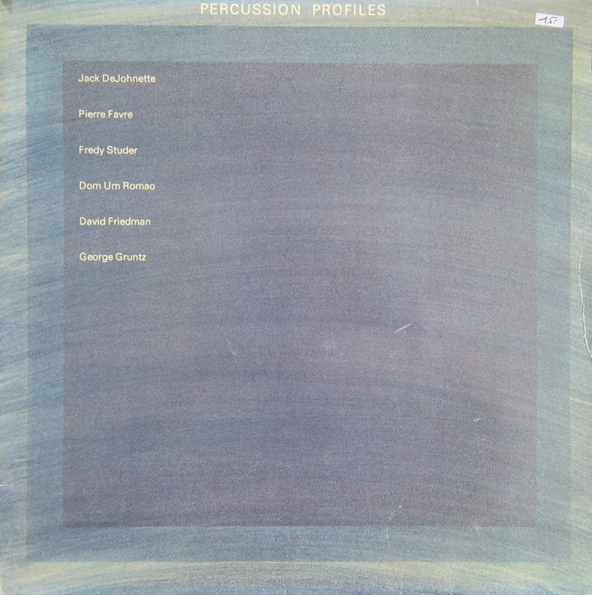
Percussion Profiles Front

George Gruntz
Percussion Profiles

Jack DeJohnette drums, cymbals, gongs
Pierre Favre drums, cymbals, gongs
Fredy Studer drums, cymbals, gongs
Dom Um Romão percussion, gongs
David Friedman flat gongplay, vibes, marimba, crotales
George Gruntz gongs, keyboards, synthesizer, crotales
Recorded September 20, 1977 at Wally Heider Studios, Los Angeles
Engineer: Biff Dawes
Mixing: Georg Scheuermann and Manfred Eicher
Producer: Robert Paiste

Late Swiss composer, multi-instrumentalist, and artistic director George Gruntz (1932-2013) left behind a long and fruitful trail, one that intersected with ECM twice: once for the label proper as Theatre and before that for JAPO in the form of Percussion Profiles. The eminently influential Gruntz assembles here a veritable Who’s Who of the rhythmic circuit at the time of its recording (1977): namely, Jack DeJohnette, Pierre Favre, Fredy Studer, Dom Um Romão, David Friedman, and Gruntz in the architect’s chair on synths and keyboards. The project speaks less to Gruntz’s big band experiments than it does to his classical roots. Dedicated to Paiste brothers Robert (who also produces) and Toomas, the piece is a bona fide percussion concerto that approaches its performers as equal elements in a larger chemistry.

The piece is divided into six Movements, each illuminating a facet of the whole. Movement 1 introduces the pleasant blending of registers—from twinkles to full-throated calls—that defines the album’s broad trajectory. Like the sun on a cloudy day, its light shines variedly: sometimes in floods, sometimes in winks and flashes, but always with a clear conscience. There is a sensitivity of expression here that tells the stories of chamber music in the language of the Serengeti. Movements 2 through 4 bring out a veritable bouquet of fragrances: briny ocean (laced with intimations of birdsong and splashes of electronic marginalia), undercurrents of metal and oil, and resonant drones share a path toward the masterful “Movement 5.” This last opens in a vocal flower, which cups in its petals a sparkling array of notions and potions. The histrionic ways of this piece make it a beguiling standout, akin to Marion Brown’s Afternoon Of A Georgia Faun. Here is where the visuality of his medium is most apparent. If this record is a house, this movement enacts a thorough cleaning of its basement. Rusted tools and unused others share conversations of things past. Stuck between the water-damaged photographs and listless rodents are fortuitous becomings, blips and dots and dashes, sputtering pipes and creaking infrastructure. These are the feelings within, the memories of which “Movement 6” is a snare-inflected shadow, a spacy ride through keyboard textures and xylophoned exeunt.

Those who admire the work of Edgard Varèse will find much to sink their teeth into in Percussion Profiles, which begs repeated, unaccompanied listening, if only for its level of detail. A memorable rung on the JAPO ladder, and worth the climb to get there.

Percussion Profiles Back

Alexander Knaifel: Svete Tikhiy (ECM New Series 1763)

Svete Tikhiy

Alexander Knaifel
Svete Tikhiy

Keller Quartett
András Keller
 violin
János Pilz violin
Zoltán Gál viola
Judit Szabó cello
Oleg Malov piano
Tatiana Melentieva soprano
Andrei Siegle sampler
In Air Clear and Unseen recorded October 2000 at Radio Studio DRS, Zürich
Engineer: Peter Laenger
Svete Tikhiy recorded1994/95 at Film Studio Lenfilm and 1997 at St. Petersburg Recording Studio
Engineers: Mikhail Shemarov, Victor Dinov, and Andrei Siegle
Produced by Manfred Eicher

Nature is not as you imagine her:
She’s not a mold, nor yet a soulless mask—
She is made up of soul and freedom
She is made up of love and speech…
–Fyodor Ivanovich Tyutchev (1803-1873)

For its first conspectus of St. Petersburg-based composer Alexander Knaifel, ECM presents  Svete Tikhiy (O Gladsome Light). Side by the side, the program’s two works—each a triptych—seem vastly different in scope. And perhaps they are on the surface. But they are also part of an ongoing braid of interest on the part of the composer in what is lifted from the score and held in the spirit of the performers to whom he entrusts interpretation: in essence, the reading of the word. For this recording, the word comes to us both lower- and uppercased.

The former flexes its waking hour throughout In Air Clear and Unseen (1994) for piano and string quartet, peeking from behind the Orthodox veil through which Knaifel’s music is often so diffused. Steeped in the poetry of Fyodor Tyutchev, each tableau reads through gestures of slowly measured time. “In Some Exhausted Reverie” begins in Silvestrov-like fashion: with a piano postlude. It touches the ether with a delicacy so organic it almost falls away by merely being gazed upon. Its stillness may be illusory, but the potential emotional connection it makes with the listener flows into the ribcage and finds room to conform.

If encouraged to compare, one could cite Pärt’s Alina as an analogous atmosphere, if only for its breathing room. Distinct here is the feeling of something titanic, as if an entire history were being grappled with in a single note. All of which makes the opposite point: that there is never just one note, for each is a combination of many more, and those of still others. The air is unseen, yes, but it can be felt. It is a field of touch. Hence the tactility of Knaifel’s performers, whose own lives are filtered through their contact with the music. Instructed as they are to intone that which is ultimately “unvoiced,” the instrumentalists embrace each living moment with their entire being, itself a resounding instrument of warmth and illumination.

The central section, “An Autumn Evening” (for string quartet), finds a more distant analogue to the music of Tavener, whose The Last Sleep of the Virgin is also of Byzantine cast (and, coincidentally enough, composed the same year as the accompanying work on this disc). The lucidities of both shimmer in slow motion. Unique to Knaifel’s aesthetic is the unity of the assembly: the quartet is one flesh, a portrait of humanity drawn through what he calls “chain breathing.” The combination becomes something of a filter through which death renews life. It is the dreamed-of ribbon still in hand upon waking. The final section marries these two impulses, pulling childhood memories like a hood against blasphemy and lighting many candles from a single, originary flame.

The title composition, Song of the Most Holy Theotokos, is composed for soprano Tatiana Melentieva and sequencer. The eponymous hymn, which appears only at the end of the piece, is among the oldest Christian hymns, a folding of light into Christ and both into the world. It is force of life, but also agency of solace. Here the self-reflexivity of the replenished soul is expressed in the electronic manipulations and multi-tracking of Melentieva’s voice. The result is a ponderous, overtly crafted chorus of the self, giving way to echoing caverns of implosion. These, in turn, impart life to the openness of God. From mantra-like quivers and resonant tongues to the rounded grace of the central unaffected voice, it turns lullabies into dust and dust into starlight. And as the final fragments blur skyward, worship becomes a shroud for the ears.

On the whole, Svete Tikhiy is also a master class in engineering. Were the content not afforded the spaciousness it deserves, its inner voices might never reach us. This is not to say that technology adds something not already there, only that it brings out inherent tendencies toward infinite expression. The echo becomes a primary signifier of its referent, but also something more: a reference in and of itself to yet another echo, ad infinitum.

<< Anders Jormin: Xieyi (ECM 1762)
>> Seim/Brække/Johansen: The Source and Different Cikadas (
ECM 1764)

Eberhard Weber: Endless Days (ECM 1748)

Endless Days

Eberhard Weber
Endless Days

Eberhard Weber bass
Paul McCandless oboe, english horn, bass clarinet, soprano saxophone
Rainer Brüninghaus piano, keyboards
Michael DiPasqua drums, percussion
Recorded April 2000 at Rainbow Studio, Oslo
Engineer: Jan Erik Kongshaug
Produced by Manfred Eicher

Electric bassist Eberhard Weber, one of the most recognizable depth-sounders of European improvisation, with Endless Days continues the journey charted so boldly across ECM’s fertile map. True to form, he breaks the jazz mold that searches him, instead making use of orchestral sweeps and precisely notated forms. Solos, per se, are few and far between. The only exceptions are “A Walk In The Garrigue” and “Solo For Bass,” the latter of which presages Weber’s sure-to-be-seminal Résumé. With liquid touch, he dances, turns on a molecule, and settles into warmth.

The instrumentation of Endless Days is as intimate as its sound is expansive. Multi-reedist Paul McCandless, keyboardist Rainer Brüninghaus, and percussionist Michael DiPasqua—all longtime allies—comprise a quartet of unveiled lyricism. The seesawing keys of “Concerto For Bass” fade in on a lush vista as only Weber can articulate. Skittering percussion hurtles us across a tessellation of water and land as an oboe cranes its neck, birdlike, in anticipation of a storm. A soft keyboard drone provides ample soil for Weber’s pliant germinations, which in characteristic fashion build majestic tidal waves from mere ripples in “French Diary.” Here DiPasqua and McCandless flank an itinerant piano to the rhythm of an internal clock before ending in a pinprick of light, adding a new star to the shadows of “Nuit Blanche.” This cinematic piece emotes through a sepia veneer of whisky and unrequited love, dripping like a tree after rain. “Concerto For Piano” brings the band up to full speed. Playful touching of the keys adds unexpected angles. The title track has the makings of a folk song unfolding in real time, fashioning from its cellular vocabulary set a full-bodied text. This program of otherwise new material ends with a throwback to Weber’s Little Movements, reworking from that 1980 album its opening composition, “The Last Stage Of A Long Journey.” Flowing arpeggios float the leaves of Brüninghaus’s pianism along an unbroken river and find their angelic alter ego in McCandless, whose soprano saxophone draws a thread from heart to ritual.

Eternally refreshing in Weber’s work is the comfort that titles are immaterial—so evocative is his sound-world that it tells us a different story every time, a story so familiar it seems to emanate from the listener. All that’s left to ask: What stories will it convey to you?

<< Thomas Larcher: Naunz (ECM 1747 NS)
>> Claudio Puntin/Gerður Gunnarsdóttir: Ýlir (
ECM 1749)

Thomas Larcher: Naunz (ECM New Series 1747)

Naunz

Thomas Larcher
Naunz

Thomas Larcher piano
Thomas Demenga cello
Erich Höbarth violin
Recorded November 1999, Europahaus Mayrhofen, Austria
Engineer: Stephan Schellmann
Executive producer: Manfred Eicher

Austrian pianist Thomas Larcher, previously known to ECM New Series aficionados as a tactful interpreter of contemporary music, with Naunz shows his colors as a composer of the same. That Larcher is a close associate of Heinz Holliger, another musician-composer of immense talent, should come as no surprise: both compose as if through a microscope. Yet while Holliger tends to languish in protracted gazes at what lies beneath his cover slides, Larcher is more interested in compressions and calms before storms—in the message of the medium. The laser-precise title piece, written 1989 for piano, evokes a particular brain chemistry and cellular dysfunction…yet also a fractured, spatial sort of harmony. Its thirteen-and-a-half-minute duration holds a broad technical spectrum on the tongue: metallurgical hammerings, bright pops, and bluesy accents trade places in carousel fashion. Every note drips like a love-sworn face, open-mouthed, a scabbard without a sword.

Thomas Demenga pushes these images deeper into the fire in Vier Seiten (1998), throwing himself into jaggedly brushed scenery. Larcher’s trust in Demenga is obvious, for even the most challenging passages flow effortlessly at the cellist’s virtuosic touch. Ley lines crack in a symphony of such intimate proportions that the piece stabilizes, settling into meditative fog curls, a muscle torn to infinity. Further bowings are put on hold for the duration of two more piano pieces. The fractured yet resonant Noodivihik (1992) works at an even more cellular level. With scientific attention, Larcher expounds its polyphony in monosyllables while moments of clarity rub up against those of murky discomfort. Not every piece, however, is so overtly disjointed, for in such a piece as Klavierstück 1986 (the collection’s earliest composition) there is overt color-bleeding, punctuated by moments of insistence that fade into bodiless reflections.

Larcher

The autobiographically inflected Kraken (1994-1997), a fascinating trio, revives Demenga and adds the violin of Erich Höbarth. In the latter’s playing is an Ysaÿe-like exuberance told yet in a language Larcher’s own, distinct for its obsessions. The entrance of piano after Höbarth’s pliant introduction lends a morose, titanic feeling of sunkenness. Violin lines evoke ghostly strangers from the wreckage, cleaving water and sky in kind. As a unit the trio forms a methodical braid, ponytail of a slumbering warrior. Larcher brings a percussive sound to his part, treading water in a marriage of staccato and legato impulses. The Holliger connection deepens as Demenga and Höbarth embark on a journey eerily reminiscent of his Duo for Violin and Cello before fragility and gnarled woodwork bring closure. Also bringing closure is the concluding Antennen-Requiem für H. (1999), an elusive piano piece that flirts with audibility by way of various extended techniques. Hands on the strings turn the instrument into a fast-forwarded film. It is a diegesis, an awakening, a genetic table setting loosed from its horizontal plane.

Larcher’s music is the equivalent of a postmortem. With a meticulousness that can only come out of self-discipline, he scours every body for clues of its demise. In so doing, he creates new life. Every helix begins a story.

<< Charlie Haden/Egberto Gismonti: In Montreal (ECM 1746)
>> Eberhard Weber: Endless Days (
ECM 1748)

Heino Eller: Neenia (ECM New Series 1745)

Neenia

Heino Eller
Neenia

Tallinn Chamber Orchestra
Tõnu Kaljuste conductor
Recorded August 1999, Estonia Concert Hall, Tallinn
Engineer: Teije van Geest
Produced by Manfred Eicher

The word “trauma” comes from the Greek, meaning “wound.” The derivation seems apt: a wound leaves one prone to infection from invisible forces, while from it exudes the very stuff that keeps us alive. According to classical Freudian psychoanalysis, a healthy Ego redirects traumatic influence, thereby protecting us from overstimulation. Otherwise, the trauma festers within. Either way, the subject is spared the pain of being consciously aware of the affliction in question. Music, however, inflects this view somewhat differently. In that of Estonian composer Heino Eller (1887-1970), a distinctly autobiographical impulse floods us neither with catharsis nor with a working-through. It is, rather, a fullness of life that sees death not as non-existence but as one of many equal facets.

Eller’s stamp on Estonian concert music cannot be overstated: his was the spark that set a revolution aflame. His influence pulses on in the work of his many students. Arvo Pärt, for one, fondly remembers his composition teacher as a noble human being who nurtured an open and personal approach, as the founder of Estonia’s professional music scene, and above all as a musician of “strict logic.” Yet Eller’s personal life was also indelibly marked by a strictly illogical act: the murder of his wife, Anna, at the hands of occupying Nazis. It was during this period that his Lüüriline Süit (Lyric Suite, 1945), originally composed for piano but heard here in an orchestral reworking, came to fruition. The heartrending physicality of its mortal undercurrents breathes with the ache of living—a sound as only the Tallinn Chamber Orchestra under Tõnu Kaljuste’s direction could elicit without need for the background sketched above. Each of its six movements is corporeally minded, a ballet of actors on a sociopolitical stage. In the final movement especially one notices the rhythmic sensibilities inherited by such progenitors as Erkki-Sven Tüür, only here they pick at a scab that will never heal. The depth of landscape is masterful, its contrasts of texture and time, of heaven and hell, indicative of all that follows.

The 1928 title composition is a memorial to friend Johannes Arro (1865-1928). A tone poem of majestic emotional depth, it undergoes constant color changes, each continuing the gloomy dramaturgy of the opening suite. The Five Pieces for String Orchestra (1953)—of which “Homeland Song,” says Pärt, is the Estonian equivalent of Sibelius’s Finlandia—unfolds in a more fragmentary, though no less organic, sense of architecture. Like that of Antonio Gaudi, straight lines are rare and there is a beginning at every end. Densities also vary: a solo violin draws a silver thread through the occasional needle, pocking the clouds with patches of sky. From lively dances to saturnine dips, the overall effect is stirring and reminds us that home is never far away, so long as one can find a song to share.

The concluding works of the program embrace the spectrum of Eller’s craft. The Sümfonietta (Sinfonietta, 1965-67), his last major composition, speaks in a language of catch and release. Every time it seems to tip, something swoops in to steady it. Agitations in the lower strings draw a screen as translucent as rice paper yet as impenetrable as an iron fortress as we are moved through a vast unraveling into the final dance, the spirit alive and forthcoming with its light. The promise of that light is realized in Eleegia (Elegy, 1931) for string orchestra and harp. Written in memory of another musical friend, Peeter Ramul (1881-1931), its lachrymose reflections turn into titanic hope, drifting through joyful memories to get there. All of which brings us full circle to the knowledge with which we began: namely, that something of our lives, whether given or taken away, persists beyond the measure of all the grief in the world.

The listener will be hard-pressed to locate a single abrasive maneuver in Eller’s compositions. Each is a coherent entity. There is feeling that the music will go on without ever resolving itself, but that in that lack of closure time becomes its own mirror. We may never understand the persistence of violence, but at least it may be temporarily diluted by the draw of a bow.

<< Trygve Seim: Different Rivers (ECM 1744)
>> Charlie Haden/Egberto Gismonti: In Montreal (
ECM 1746)

Iva Bittová: s/t (ECM 2275)

Iva Bittová

Iva Bittová

Iva Bittová voilin, voice, kalimba
Recorded February 2012, Auditorio Radiotelevisione svizzera, Lugano
Engineer: Stefano Amerio
Produced by Manfred Eicher

Characterizing the music of Iva Bittová as resistant to definition both describes it perfectly and does it a disservice. The former, because her minimal tools of violin and voice elicit a museum’s worth of colors, moods, and brushstrokes. The latter, because every listener will emerge from that museum with a unique image in mind that is anything but indefinable. Despite her many creative personalities—which encompass acting, performing, and composing—she has achieved notoriety by no small feats of expression. Still, don’t be mistaken: this is no “avant-garde” artist. She’s not upsetting paradigms, but deepening their self-awareness.

“The violin accompanies me all the time,” says Bittová of an instrument that has centered her musical life since the early 1980s. “It is a mirror reflecting my dreams and imagination.” Yet she is, above all, a singer. Whether through vocal folds, bow, or physical gesture, her voice strikes flint to stone and blows a tangle of weed until it glows. So potent is said voice that it inspired fellow Czech composer Vladimír Godár’s Mater (documented most recently in a 2007 release for ECM New Series), a multilayered cantata on women-centered texts of which Bittová is both sun and satellite.

Iva

This self-titled solo album finds Bittová in her element in a series of 12 numbered “Fragments,” and because fragments imply a whole, it makes sense to speak of the album as such. Like a work of masterful anamorphosis, its image emerges only by submitting oneself to its perspective. Twelve is, of course, a mystical number. It defines the modern clock, marks the end of childhood, numbers the Bibical apostles, and zodiacally divides the heavens. Here it is a riddle that harbors many more.

The album begins and ends with her voice slaloming through the delicate signposts of a kalimba. Here and throughout there is harmony and tension, starlight and soil. At one moment, her voice and bow may unify. At another, her feet go their separate ways, divorced from body and destination. Pizzicato gestures seem to pluck hairs from the scalp of the night, while arco gestures get lost in mazes even as Bittová draws them. Sometimes: her voice alone, spoken and then sung, so that incantation becomes chant becomes lullaby in one fluid swing. Sometimes: the violin alone, crossing every bridge without ever touching feet to plank. Sometimes: a river’s flow through black forest, hints of love and travel.

To be sure, ghosts of a Slovakian heritage breach the fabric of time that veils her, but the freshness of her storytelling makes it all feel uncharted. For while she does adapt the music of Joaquín Rodrigo in Fragment VI and sings texts by Gertrude Stein and, notably, Chris Cutler in others (III and VII, respectively), she renders these sources personal and organic through her crafting. Words like “gypsy,” “folk,” and “tradition,” then, might as well be gusts of air, so intangible are they in her sound-world. That being said, her art is certainly rooted in a worldly sense of time and plays with that notion as would a hummingbird flirt with a backyard feeder. Her sound is resilient to climatic damage, for it has already absorbed so much of the oxidation that gives it character, and her tone is never brittle, even at its thinnest. In fact, the album’s strongest moments are to be found in her unaccompanied singing. From gentle cuckoo to shaman’s possession, her voice cycles through many (after)lives and makes this world of social details begin to feel other-cultural.

Here is an artist whose sense of architecture is wholly translucent, whose persona is her crucible, and whose music is an embodied practice, a mimesis personified to the point of healing.

(To hear samples of Iva Bittová, click here. See this review as it originally appeared in RootsWorld magazine.)