Eleni Karaindrou: Trojan Women (ECM New Series 1810)

Trojan Women

Eleni Karaindrou
Trojan Women

Socratis Sinopoulos Constantinople lyra, laouto
Christos Tsiamoulis ney, suling, outi
Panos Dimitrakopoulos kanonaki
Andreas Katsiyiannis santouri
Maria Bildea harp
Andreas Papas bendir, daouli
Veronika Iliopoulou soprano
Eleni Karaindrou
Antonis Kontogeorgiou chorus director
Recorded July 2001 at Studio Polysound, Athens
Engineer: Yiorgos Karyotis
Produced by Manfred Eicher

No human heart is set so hard
that hearing the grave music of your dirge,
your keening, would not bring tears.

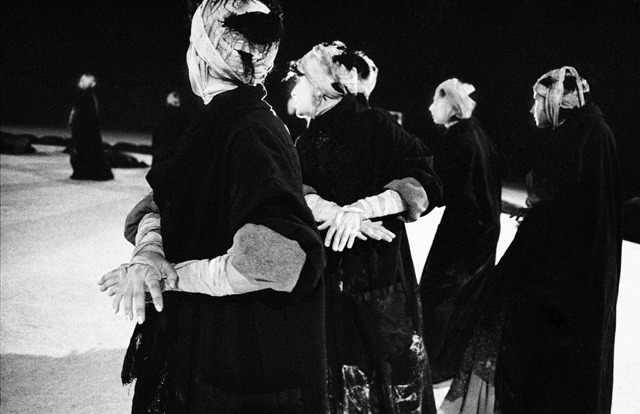
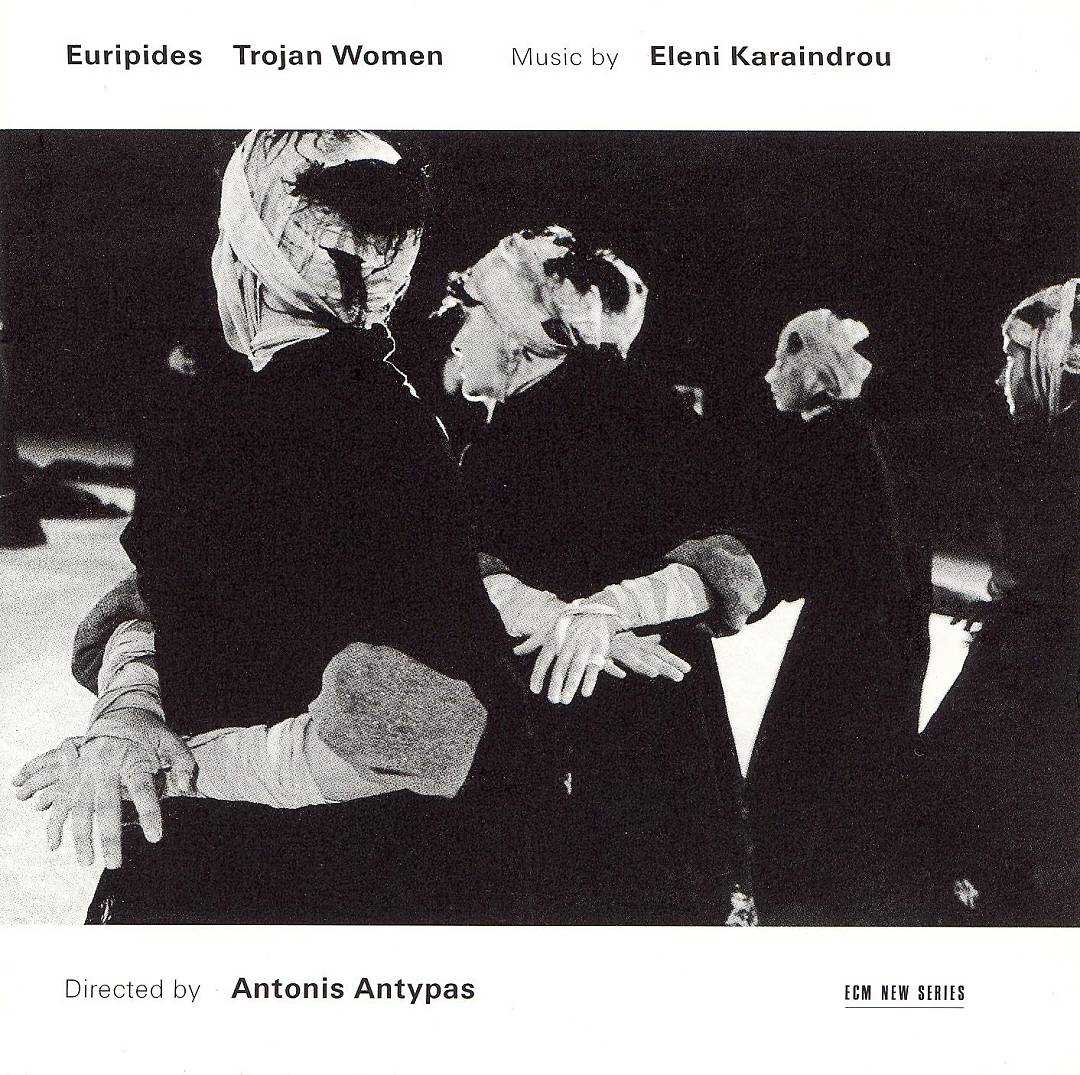
The distinct approach of Greek composer Eleni Karaindrou to film sound-tracking, through ECM’s rigorous documentation of her partnership with director Theo Angelopoulos, has imbued her music with a life of its own among international audiences. All the while, Karaindrou had been nurturing an equally prolific association at home with the theatre. Her Angelopoulos in that craft has been director Antonis Antypas, with whom she has collaborated on over 20 productions for the Aplo Theatro. This album documents her incidental music for a new staging of the Euripides tragedy Trojan Women, which received its premiere at the Ancient Theatre of Epidaurus on August 31 and September 1, 2001.

First performed in 415 B.C., the play was a vitriolic critique of the Athenians’ then-recent attack on the island of Melos, where countless violently perished and women were sold into bondage in the name of conquering Sparta (in this the Athenians did not succeed). It is perhaps no coincidence that the word melos also means song, for singing constitutes the very flesh of this album’s limestone skeleton. Karaindrou kneads into these politics the idea that less is more. With the barest use of folk instruments—such as the Constantinople lyra, ney, santouri, and bendir—she implies a battered panorama of immense emotional congruity. Producer Manfred Eicher has lent further sanctity through his arrangement and editing of the material into its present form.

A profoundly comported scenography of touching (which is to say, tangible) melodic beauty finds particular expression through the lyra’s grasshopper song. It is a mournful, unforgettable sound, dry as a reed in summer. The harp also figures notably in the music’s rolling waves, overcoming the barrenness evoked by titles like “Terra Deserta” with oceanic depth. Its vibrations are transformations of landscape itself, silenced by their own resonance.

Trojan Stage

Much of the material on Trojan Women will sound familiar to regular Karaindrou listeners. The themes, although nominally character-specific, are melodically uniform, changing their instrumental clothing from visage to visage, thereby sounding a fluidity of purpose and choice. Unusual, and perhaps a point of contrast to nevertheless persistent indications of barrenness, is the presence of choir and a soprano soloist who only occasionally poises her lips above the waterline to spout names of the deep. Of central importance in this regard are the three stasimons (choral odes), each a vertebra of both story and music, a refraction of the rest. In them voices grow bolder, reaching epiphany in “An Ode Of Tears” and “In Vain The Sacrifices,” the latter a ring to which the former’s gaping clasp holds true. These voices do more than the traditional Greek chorus. They burgeon at stage center, relegated not to the wings but to the head and body of a flightless bird. Without wings, they think themselves into freedom, casting their minds from horizon to horizon, faster than the sun. They do not create the stars but make them brighter.

As a matter of course, the pieces are generally short (only one surpasses four minutes). In their sublime chemical suspensions of tears, blood, and determination swims a pair of eyes—one directed at us, the other elsewhere. Consequently, there is a feeling of stepping out of time in order to better understand its circumscription. Vast harmonic networks slumber in the underlying empty spaces, never stirring except in the most funerary moments. Despite the mythic sheen, the music of Trojan Women finds deeper mystery in the earth’s living subjects, which in isolation reveal the mystery of creation, both divine and mortal, far more acutely: in order to attain permanence one must be open to the fallacies of agreement.

Alternate Trojan
Alternate cover

Karl Amadeus Hartmann: Funèbre (ECM New Series 1720)

Funèbre

Karl Amadeus Hartmann
Funèbre

Isabelle Faust violin
Paul Meyer clarinet
Petersen String Quartet
Münchener Kammerorchester
Christoph Poppen conductor
Recorded July and September 1999, Angelika-Kauffmann-Saal, Schwarzenburg
Engineer: Andreas Neubronner
Produced by Manfred Eicher

Funèbre stands out in the New Series both for its due attention to German composer Karl Amadeus Hartmann (1905-1963) and for welcoming conductor Christoph Poppen and the Munich Chamber Orchestra into the ECM fold. The latter have since gone on to record a number of pivotal records for the label, including the all-Scelsi program Natura Renovatur and the Bach/Webern crossover project Ricercar. Here they are joined by violinist Isabelle Faust, the Petersen String Quartet, and clarinetist Paul Meyer for a shuffling of dark, darker, and darkest. The two main courses—Concerto funebre and the Symphony No. 4—are among Hartmann’s best known and preface the world premiere recording of his Chamber Concerto for clarinet, string quartet, and orchestra.

Hartmann’s fiery personality and strikingly inter-idiomatic style made him an easy target under the Third Reich, during which time he withdrew his music from the public sphere altogether in solidarity with other persecuted composers who chose “internal exile” over excommunication (or worse). It was nevertheless heard abroad, where it took on a life of its own. After the war, his revitalization of the European soundscape through the famed Music Viva concert series further deflected attention away from his own work at home. This, coupled with his penchant for self-criticism, left the world with a minimal published output, a problem rectified only after his passing when all-but-forgotten scores were restored, printed, and performed.

Concerto funebre for solo violin and string orchestra is Hartmann’s only violin concerto. It is meant to navigate the iniquities he saw brewing in 1939, when he began writing it. Hartmann dedicates it to his son, only four at the time. In this spirit, he wrote in retrospect, “The chorales at the beginning and end are intended to offer a sign of hope against the desperate situation of thinking people.” The piece in four tableaux initially bore a different title: Musik der Trauer (Music of mourning)—which naturally recalls Hindemith’s Trauermusik for viola and string orchestra—before changing it upon revising the piece in 1959. It forges a unique alloy of violinist and orchestra, so that the former’s attitude is more traveler than soloist, strings the life-giving land from which it comes together. The end effect is such that high notes and low notes are not markers of altitude, but rather inversions of one another on a horizontal axis of expression. The violin is a full-throated being, a pendulum housed in wrought iron. Neither do typical rules of concerto form apply. The Allegro does not provide catharsis but rather embodies a deepening of grief. Only in the Adagio do we detect a morsel of affirmation. Nevertheless, the Allegro does provide a physical sensation of uplift, a cyclone of leaves in which Faust is the only one determined among them. It is also a stepping-stone for the achingly beautiful corridor of the final Chorale, which strengthens the elasticity of the body’s emotional skin and draws on its palimpsest a broken circle.

The Symphony No. 4 (1947/48) for string orchestra takes a 1938 concerto for strings and soprano as its palette and builds from it a new diorama. Two slower movements sandwich a compact inner core: a sonic flag bearing ugly repression and shaded resistance. The colors are wan at first, rhythmically tethered to a far-off caravan whose footprints have long since been dusted over. Lachrymose and weighted by unspoken fear, the figures that left them are but a flicker on the horizon. Hints of Mahler and Webern dot an otherwise bold, original score. That Hartmann deploys these references so organically is one thing. That he does so with such arresting melodic development is quite another. The free-floating sensations of the symphony’s bookends are especially instructive in this regard, while its heliocentric Allegro reaches downright thrilling peaks of agitation. The broad sweep of its closing Adagio is overwhelmingly dense, leaving us with a heavy bowl of fruit indeed to share with those who will listen.

Although the unusual Chamber Concerto was completed in 1935, it was first performed only posthumously, in 1969. In light of its gypsy flavors, that it bears dedication to Zoltán Kodály should come as no surprise. Two longer outer movements create yet another frame, this one housing six brief dance variations. Across these Hartmann splashes the piece’s most vivid colors. Gorgeous, rustic, and magnetic, the tunes practically leap of their own volition, turning midnight into dawn at Meyer’s fluid inflections. All of this builds to a haunting stretch of ocean, crisp and bright as the moon.

If this sounds like your cup of tea, you’ll not want to miss out on ECM’s worthy account of Sándor Veress, and vice versa. Both composers draw out likeminded freshness from the earthly cares of which they were both injured subjects.

From the ash comes the phoenix.

<< Mat Maneri: Trinity (ECM 1719)
>> Michael Mantler: Songs and One Symphony (
ECM 1721)

Alexander Knaifel: Amicta Sole (ECM New Series 1731)

Amicta Sole

Alexander Knaifel
Amicta Sole

Mstislav Rostropovich cello
Tatiana Melentieva soprano
Soloists of Boy Choir Glinka Choral College
State Hermitage Orchestra
Arkady Steinlukht conductor
Psalm 51 recorded September 2001 at Propstei St. Gerold
Engineer: Stephan Schellmannn
Amicta Sole recorded July 2000 at St. Catherine Lutheran Church, St. Petersburg
Engineer: Semion Shugal
Produced by Manfred Eicher

The text is intoned as if it sounds. These, the simple instructions that composer Alexander Knaifel offers in the score of his Psalm 51 for cello solo. Dedicated to Mstislav Rostropovich, who also performs it in the present recording, the piece is as skeletal as its source: a sounding of spirit made flesh by mortal touch. While listeners may never hear the words, they will feel them in Rostropovich’s bow, poised as it is on a fulcrum of silence. Says Knaifel, “it is the only one and unique experience in my life when not a note was composed—in the fullest and most exact meaning of this word.” By this he admits no fallacy of the creative process, but instead reveals the divinity behind its cause. The internal is renderable only as an idol to itself, so that every dynamic of the cellist’s articulation seems destined to tremble. A climb into higher registers opens a flame’s pathos into vision and leaves one suspended in Heaven’s basement.

Like the burnt offerings of which the psalm concerns itself in its final stanza, the music scatters easily in the wind. That it holds true to form at all is proof of its spiritual integrity. Although the performer is singular, the incantation is sometimes plural. From piercing bridge crawls and vulnerable downward steps to interlocking pizzicati, every motion signals a diacritical reality. Rostropovich achieves all of this through his decades-long path toward mastery. For while the notecraft is almost as bare as the paper it is written on, Knaifel infuses every nodule with a word. Were we to plot each on an axis of pitch and time, they would form a rainbow arc through the firmament from birth to death. Only at the end does light creep in, pulling ever higher into the cello’s very threshold of audibility.

The papery consistency of Psalm 51 provides absorption of the ink in Amicta Sole (Clothed with the Sun) for soloist (female) of soloists. As a follower of the former’s grace, this starkly glassine piece speaks in angel’s tongue and awakens to angel’s ways. It is also performed here by its dedicatee, the inimitable soprano Tatiana Melentieva, who etches with her voice a denser light against a slow waterfall of strings and choral textures. Now that the texts are consciously sung, there is great movement from above to below, from interior to interior’s interior.

Inspired by the “woman clothed with the sun” who appears in Revelations, Amicta Sole sequences the genealogies of Christ as a helix between new prayer and ancient origins. The instruments perform the same role as the cello in Psalm 51, sounding the texts as if singing them, while the voices sing the texts as if sounding them. Melentieva’s art is so rich that she could very well carry these forces without their cushion, for she seems to summon legions of air before her. Despite the above connotations, what we have here is the full spectrum of earthly care, the weight of human conditions pressed upon our ears with the almost there-ness of a molt feather. And although we are invited to bask in the caesural nature of what transpires, stretched into barest triad, we can never be a part of its cathedral, where vibration and darkness dwell. The feeling of renewal is such that no architecture can stand here for so long as a breath (hear this in the flute’s red thread of color). Only in the harp is the promise of good news made manifest, and with it the uniform face of which our own are imperfect copies.

That the pieces here are from the mid-nineties, shaded by a lingering fog of the Soviet era, is only fleetingly significant. In them is a stillness of heart that reflects on troubled pasts. By the same token, their worth lies not in their politics, bleeding as it does through the reddest of paper with its own hues intact. At once reifying and transcending the corporeal waver that is its mirror, they are but two jewels in an eternal crown. 

Have mercy on me, O God, according to Thy great mercy,
and according to the multitude of Thy tender mercies
blot out my iniquity.

<< György Kurtág: Signs, Games and Messages (ECM 1730 NS)
>> Robin Williamson: The Seed-at-zero (
ECM 1732)

Luciano Berio: Voci (ECM New Series 1735)

Luciano Berio
Voci

Kim Kashkashian viola
Vienna Radio Symphony Orchestra
Luciano Berio conductor
Robyn Schulkowsky percussion
Recorded November 1999, ORF Studio, Vienna; May 2000, Teldec Studio, Berlin
Engineers: Josef Schütz and Peter Laenger
Produced by Manfred Eicher

The interest of Italian composer Luciano Berio (1925-2003) in folk music runs as deep as the grooves in his scores—trenches, rather, through which performers have been backpacking their talents since the latter half of the 20th century. In them are remnants of decay and sound intermingling with fantastical re-creations. Much of said interest has flowed through those earthly scars outward into other lands. French, Italian, Armenian, Azerbaijani, and American sources were all fair game in the path of his net, reaching notable culmination in his Folk Songs of 1964. The range of this touchstone composition places unenviable demands on the singer, who must convey respective flourishes and qualities as if they were her own. The brilliance of the piece lies less in Berio’s settings, per se, than in his decoupling of songs from their provenance. This act of displacement lends their motives clarity and reliability (an idea that would surely have been fresh for one who had just relocated to America for a series of teaching appointments). We can therefore assume that the settings were no mere archival gesture (two of the Folk Songs are his own), but rather a vibrant shuffling of idioms. In that world we encounter a roving gallery of maidens, fishermen, even a nightingale, and in each there is a new message. It is something of a comfort to know that, in the midst of this politically charged period, Berio remained true to roots as he saw them, even when they were not his own. The folk song was thus for him a found object. Like his contemporary Italo Calvino (who would write two librettos for the composer), Berio was an interdisciplinary storyteller who meshed experimental and traditional impulses, and in the process saw fit to fit what he saw.

Voci (1984) continues the thread first spun in Folk Songs, but stares deeper into the looking glass. As the center of this exemplary recording from ECM’s New Series, it radiates with warmth and tactile force. Its focus is on the sights, sounds, and smells of Sicily, and in them finds a suitable color palette from which to sketch and paint. Its inaugural gesture of bells and viola is not unlike the solo introduction to Ravel’s Tzigane in its thorough physicality. The analogy stops there, however, for Voci is anything but a showpiece. It rings in the air like the street calls, lullabies, and folk tunes that inspired it, minimally dressed. Violist Kim Kashkashian and the Vienna RSO are ideal and formidable interpreters, bringing renewed variety to the piece’s inherent textures as compared to the reference recording by Aldo Bennici (for whom it was written) fronting the London Sinfonietta. Kashkashian carries full orchestral weight in her bow, keening her way through the piece’s epic travels with confidence. Fragmentary dances and incantations trade hands, carving circuitous paths around an elusive center. The colorful blend of percussion (courtesy of the great Robyn Schulkowsky), winds, and strings surrounding her form a pastiche of rusticity that brims with practically excessive totality. This is not the careful revelry of the attentive archivist, but rather the unrest of the enraptured interpreter, translating, transforming, and deconstructing.

In a fitting stroke of programming panache, producer Manfred Eicher includes five field recordings from the very regions that so entranced Berio. Of these, the lament is especially magnetic. Mournful though it is, it also undergirds a heavy weight of realization: the folk song is no fleeting thing. Rather, it continues to sing itself into existence even in the absence of voices, working its way into the very soil and thrumming among the dead. This makes Kashkashian’s performance all the more worthy of praise, for she does what many singers have done before her with a shaft of hair, rosin, and four strings.

After this dive into “agro-pastoral” authenticity, we return to land in Naturale (1985), which combines the composer’s own song recordings with viola and percussion. Although more than a mere Voci redux, its effects are nearly identical, drawn as they are from the same starting point. The intimacy factor is higher, the mirror more polished, the sun lower in the sky.

As Berio would have been the first to admit, the “cannibalization” process by which these strains made their way into his meticulous constructions remain free from romantic visions of preservation and speak to a process of linear progression in the continued search for new directions through the fusion of disparate paths. We can be thankful that some of those paths lead straight into our ears.

<< Charles Lloyd: The Water Is Wide (ECM 1734)
>> András Schiff: Leoš Janáček – A Recollection (
ECM 1736 NS)

Herbert Joos: Daybreak – The Dark Side Of Twilight (JAPO 60015/ECM 3615)

Daybreak Dark

Herbert Joos
Daybreak -­ The Dark Side Of Twilight

Herbert Joos fluegelhorn, trumpet, cornet
Thomas Schwarz oboe
Wolfgang Czelustra bass, trombone
Strings of Radio Symphony Orchestra Stuttgart
Recorded October 1976 and July 1988 at Tonstudio Bauer, Ludwigsburg
Engineer: Carlos Albrecht
Produced by Herbert Joos and Thomas Stöwsand

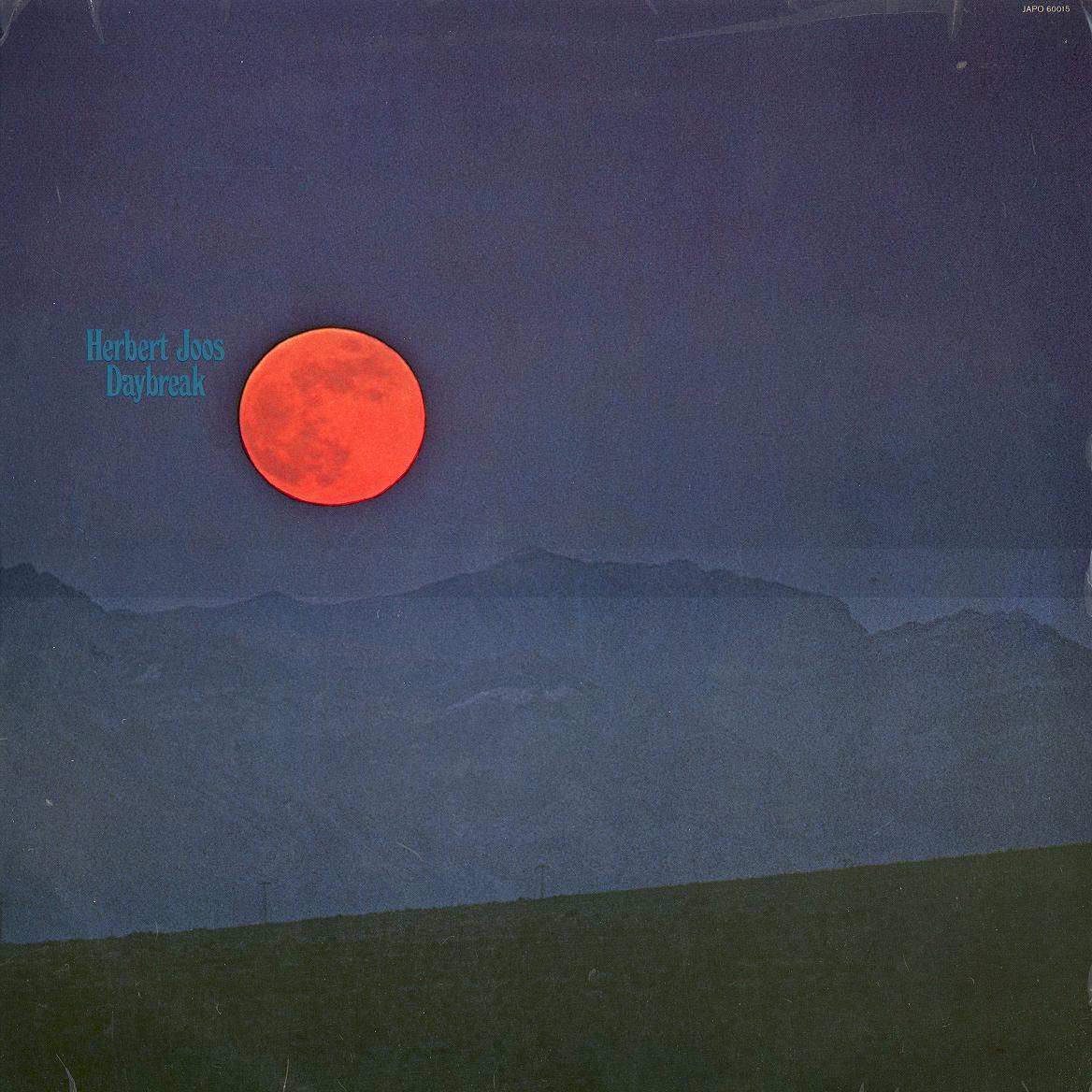
German trumpeter and fluegelhornist Herbert Joos’s flirtations with ECM have been few, contributing to the big brass sound of Eberhard Weber’s Orchestra and notably to Cracked Mirrors, a marvelous and, it would seem, overlooked date with guitarist Harry Pepl and drummer Jon Christensen. Yet it was with Daybreak, recorded in the fall of 1976 for sister label JAPO, that the knot of Joos first audibly untied itself alongside Thomas Schwarz (oboe), Wolfgang Czelustra (bass and trombone), and the strings of the Radio Symphony Orchestra Stuttgart.

The emphasis on classical textures will feel familiar to admirers of Keith Jarrett’s likeminded forays, especially In The Light and Bridge Of Light. That being said, the overall effect is shadowy, overhung, though equally honest. “Why?,” for example, answers its own question up front in the very asking. Although an obvious reference to Charles Ives’s The Unanswered Question, its progression spins closure from an interrogative oboe. The normally pastoral associations of the instrument are shed along with lingering symphonic details, such that when Joos’s breath cuts the air with its golden knife, the strings drip like lifeblood from its plane. None of which is meant to suggest that the music is in any way macabre. For what can there be but hope in the cyclical motif that churns during fadeout? “When Were You Born?” asks another question answered by its own sounding. The delicacies of Joos’s high-register playing render far more expansive maps in this instance, touching proboscis to firmament and sampling sunlight until nightfall. “Leicester Court 1440” features Joos in muted soliloquy. Riding a horse of compressed time, he enacts an agitated recession into the title piece. Joos has only his own echo for company before the inward journey is externalized by the dark arrival of strings. Hence, the “Black Trees” looming not far away. Yet despite the title, they actually let down the brightest of the album’s seeds with an approach that gives voice to nature and seeks universal truth in a bird’s nest. Joos’s lines bespeak haughty quest in “Fasten Your Seatbelt.” This playful frolic through arco fabric balances laughter and fearless arpeggios, while scuttling crabs and landlocked others communicate without need for sound. And when the seatbelt fails us, we are thrown into a life of slower motion, lit by “The Dark Side Of Twilight.” The latter appears only on the 1990 CD re-issue (ECM 3615) and, at 15 minutes, is the album’s most brooding texture. Relaying brass-synth and string chorale settings, it walks a broken circle with its head hung in thought, an outlier among the album’s modest population.

The music of Daybreak speaks to children in the language of adults. It photographs the illusion of age and melts it into a sea of numbers. Not every detail will be preserved in that translation, but in the process we come to understand that history and music are sometimes like water and oil. In this chamber of the past, futures hide in corners the light struggles to reach.

Daybreak
Original cover

Gianluigi Trovesi/Gianni Coscia: In cerca di cibo (ECM 1703)

In cerca di cibo

In cerca di cibo

Gianluigi Trovesi clarinets
Gianni Coscia accordion
Recorded February 1999 in Zürich
Engineer: Markus Heiland
Produced by Manfred Eicher

The virtuosic duo of multi-reedist Gianluigi Trovesi (performing here on clarinets) and accordionist Gianni Coscia makes its first ECM appearance with In cerca di cibo. Over the course of an affectionate hour, these two points of light join to create a binary star that shines in full spectrum. The album’s title means “In search of food,” thus indicating seeds sown and re-sown until they bear new fruit to nourish the ears. It also points to the music’s folk origins, glazed and fired to perfection.

The title piece in duplicate bookends the 15-track program with selections from Fiorenzo Carpi’ score to the 1971 TV mini-series Le avventure di Pinocchio. With the artistry of a wind-blowing cloud on an old map, it christens this sonic vessel and guides its sails as true as Trovesi’s psychoanalytic leaps. “Gepetto” is perhaps the most insightful in this regard. A far cry from Disney’s bumbling songster, it takes us instead into the soul of a man tortured by the fact that his only hope for a child’s love is to carve that love from the forest’s very flesh and bone. These sentiments are echoed in the heartrending “Fata Turchina” (Fairy) and “Lucignolo” (Candlewick). The duo further references the 1994 film Il Postino in its title theme by Luis Bacalov, here but a heart murmur, a flash of romance crocheted into warmth.

Even without a track list in hand, the cinematic contours of nearly every piece are apparent. Whether navigating Trovesi’s descriptive “Villanella” or the nimble fingerwork of “Minor Dance,” to say nothing of his wailing inscriptions in Coscia’s “Le giostra di Piazza Savona,” there is plenty of storyboarding at play. The co-composition “Celebre Mazurka alterata” further epitomizes the duo’s wide range of moods, abilities, and technical flourishes—a masterpiece that lends Ángel Villoldo’s classic tango “El Choclo” all the verve it needs to leave its meteoric trail across the sky. Also noteworthy is “Django (Donadona)” by pianist-composer John Lewis: not only for its superb music, but also for the narrative arc it takes on in the present rendition. From mourning to frivolity, Trovesi and Coscia are omniscient purveyors of their domain, such that when they close the album’s bright, tempestuous circle with the very shadows from which it was born, we know that the melodies will continue to dance into the distances of their hearts.

What we’re left with is a scene cinched by the drawstring of politics, war, and indecision, shaken free of its inhibitions and re-clothed in passion. It takes us as we are, provided we leave our preconceptions at the door. As Umberto Eco says in his liner notes, “there’s no need to wonder about in which temple we should place the music of Coscia and Trovesi. On a street corner, or in a concert hall, they would feel at home just the same.” It may just be that they feel best at home with you.

<< John Surman: Coruscating (ECM 1702)
>> Stockhausen/Andersen/Héral/Rypdal: Kartā (
ECM 1704)

Michael Galasso: High Lines (ECM 1713)

High Lines

Michael Galasso
High Lines

Michael Galasso violin
Terje Rypdal guitar
Frank Colón percussion
Marc Marder double-bass
Recorded November 2002 and April 2004 at Rainbow Studio, Oslo
Engineer: Jan Erik Konghaug
Produced by Manfred Eicher

The late violinist-composer Michael Galasso—whose solo album Scenes is a personal label favorite—returned to ECM more than two decades later with High Lines, a multifaceted set of music that draws on his love for theatre (as a longtime collaborator of dramatist Robert Wilson), film (having scored for Wong Kar-wai, Martin Provost, and many others), and dance. These activities brought him to many places around the world, among them Iran, where rhythms and melodies swirled their way into much of the writing realized here. From his soundtrack to Secret Ballot (dir. Babak Payami) to his extensive incidental work with Wilson, the program references many touchstones of Galasso’s varied career. Along with ECM stalwart Terje Rypdal on guitar (brought in at producer Manfred Eicher’s suggestion) and bassist Marc Marder with percussionist Frank Colón (brought in at Galasso’s), he opens himself to new interrelationships.

Because Scenes proved Galasso capable enough to row the waters in a boat of his own making, the presence of another distinctive voice in Rypdal bears mixed fruit. Whereas his atmospheric contributions in “Spheric” and “Fog and After” give sanctity and tactility to the surroundings, as an agent of melody his guitar feels like an afterthought in the context of tracks like “The Other” and “Swan Pond.” There’s not a single thing off about the playing itself: it’s pure Rypdal flame. It just doesn’t always have its eyes open. Then again, High Lines is more about the music than about the names behind it, and ultimately succeeds in this regard. Spread like ceremonial salt across a sumo stage, it prefaces a slow-motion ballet of powerful bodies in motion. Some of those gestures are cryptic, others hypnotic, and still others are intensely filmic. In the latter vein we have “Gothic Beach,” a brief passage pairing violin and ocean waves. Every footprint on those sands glows with life.

And really, the four strings conveying these things are the album’s heart and soul. A few pieces find Galasso multi-tracking on delicate fulcrums (“Iranian Dream” being a standout in this regard) and even experimenting with starry digital delays, as in “Boreal.” Lost travelers from Scenes (e.g., “Chaconne”) cross our paths, swaying and arpeggiating to the metronome of distant winds, while less familiar figures also sell their wares along the way. As one title would have it, this is an album of crossing colors, and in the final “Gorge Green” we have a churning stew of them. It is perhaps no coincidence, then, that Rypdal achieves strongest congruence of purpose here, tethering the journey at last to a foreseeable destination.

Yet lurking in the chemical composition of these sounds is an element that belongs to no instrument or music-maker. It is one that Galasso’s music activates of its own will, a wish made real in the asking.

<< Michelle Makarski: Elogio per un’ombra (ECM 1712 NS)
>> Thomas Zehetmair/Camerata Bern: Verklärte Nacht (
ECM 1714 NS)

Dino Saluzzi: El Encuentro (ECM 2155)

El Encuentro

Dino Saluzzi
El Encuentro

Dino Saluzzi bandoneon
Anja Lechner violoncello
Felix ‘Cuchara’ Saluzzi tenor saxophone
The Metropole Orchestra
Jules Buckley conductor
Live recording February 13, 2009 Muziekgebouw aan ’t IJ, Amsterdam
Music supervisor: Gert Jan van den Dolder
Recording engineer: Gert de Bruijn (Dutchview)
Assistant: Per van der Zande (Dutchview)
Mixing engineers: Gert de Bruijn and Ronald Trijber (Dutchview)
Concert production and executive producer for the NPS: Gustavo Pazos
A production of NPS Radio in collaboration with ECM Records

El Encuentro depicts Dino Saluzzi as a composer willing to go wherever the stream of consciousness takes him. In this, his first live album, the bandoneón maestro joins Anja Lechner (cello) and brother Felix (tenor saxophone) before the Metropole Orchestra, under the direction of Jules Buckley, for a varicolored quatralogy. Because the bandoneón is practically an orchestra unto itself, pairing it with strings feels like an implosive rather than explosive stroke of sonic fortuity. This introspective dynamic is heightened by the asymptotic relationship between the soloists, who are fully present in Plegaria Andina. This piece revisits thematic material from 1988’s Andina in a braid of wind, branches, and leaves: each strand a traveler from a different corner of the world. Even when silent, the soloists float like an oar-less vessel bobbing to the pulse of tide. The ruminations of this piece are thus deeply aquatic and equally representative of the clouds they reflect.

The relationship between bandoneón and cello is the album’s main anchor, and takes root in deepest reef in Vals de los días. Like the program as a whole, its moods and melodies are in constant flux, its themes as fleeting as the air in Saluzzi’s bellows, the touch of horsehair on Lechner’s strings. Assailed by dances and memories, their vessels keel and spread their melodic passengers far and wide. There is abundance to be felt here, plucked like ripe fruit from a branch, squished between the toes like wet sand, and dunked like the baptized body into holy river’s flow.

Despite its massive proportions, the title piece comports itself with the delicacy of a spider. It is the most brooding piece of the four—one which, despite its peaks and gorgeous finish, wallows in a pool of shadows. Its final jubilations pick at a lone thread of light, unravel the tapestry of the night, and weave a new one into the Miserere that follows. The strings, robust yet tentative in their dynamic recession, are servants to the bandoneón, the latter a messenger sent from above. Its lungs exhale only peace, leaving no doubt that Saluzzi’s is a spiritual art.

Despite the number of musicians gathered here, El Encuentro is one of Saluzzi’s most intimate realizations, compressing the sweep of an epic film into the eye of a spyglass. Because the title means “The Meeting,” it is tempting to read the album as one large cycle. Closer listening, however, reveals the self-awareness of the compositions therein. They are not cardinal points on a compass, but rather corners of a world that share a plane only in maps. Their yearning is more than physical; it is environmental. They meet only in dreams, drifting farther out to the sea with every heave. Were it not for the applause, we might blissfully remain so, never to feel the touch of shore beneath our soles.

(To hear samples of El Encuentro, click here.)

John Surman: Coruscating (ECM 1702)

Coruscating

John Surman
Coruscating

John Surman soprano and baritone saxophones, bass and contrabass clarinets
Chris Laurence double-bass
Rita Manning violin
Keith Pascoe violin
Bill Hawkes viola
Nick Cooper cello
Recorded January 1999 at CTS Studios, London
Engineer: Markus Heiland
Produced by Manfred Eicher

The title of John Surman’s Coruscating means sparkling. Yet with track names like “At Dusk,” “Moonless Midnight,” and “An Illusive Shadow,” we are squarely in a nocturnal realm. The multi-reedist, along with bassist Chris Laurence, puts his touch on this set of eight compositions, which over the album’s course blend into a seamless whole. At their center is an ad hoc string quartet, to which Surman and Laurence act as improvisatory satellites. The two aforementioned sections drop Surman’s oboe-like soprano into pre-written cuts of land, each a ripple in a lake that holds ebony sky in its cup.

Although it will not be surprising to any Surman fan, it is as baritonist—ever the rightful successor to Gerry Mulligan—that he comes closest to bringing the shine. Whether in the softly rolling sentiments of “Dark Corners” or the  muscular stirrings of “Stone Flower” (in memory of another baritone great, Harry Carney), his low reed dots the compass many times over through charcoal travels. “Winding Passages” is the most mature of these breeze-swept soliloquies and provides a solid platform for the composer’s bronzed hieroglyphs. Laurence shakes his most geometric ghosts out in “Crystal Walls,” while “For The Moment” mixes cello tracings into vibraphone, Surman’s restless gestures carrying us all the while into deeper pasture.

Those who weren’t quite feeling Proverbs and Songs might find Coruscating more accessible, if only because there is so much space for listeners to relax and, in spite of all the darkness, feel their way around. It is a dream of quotidian objects sleepwalking for want of a place to have purpose, only to discover that their wandering is that very thing.

<< Jan Garbarek/The Hilliard Ensemble: Mnemosyne (ECM 1700/01 NS)
>> Gianluigi Trovesi/Gianni Coscia: In cerca di cibo (
ECM 1703)