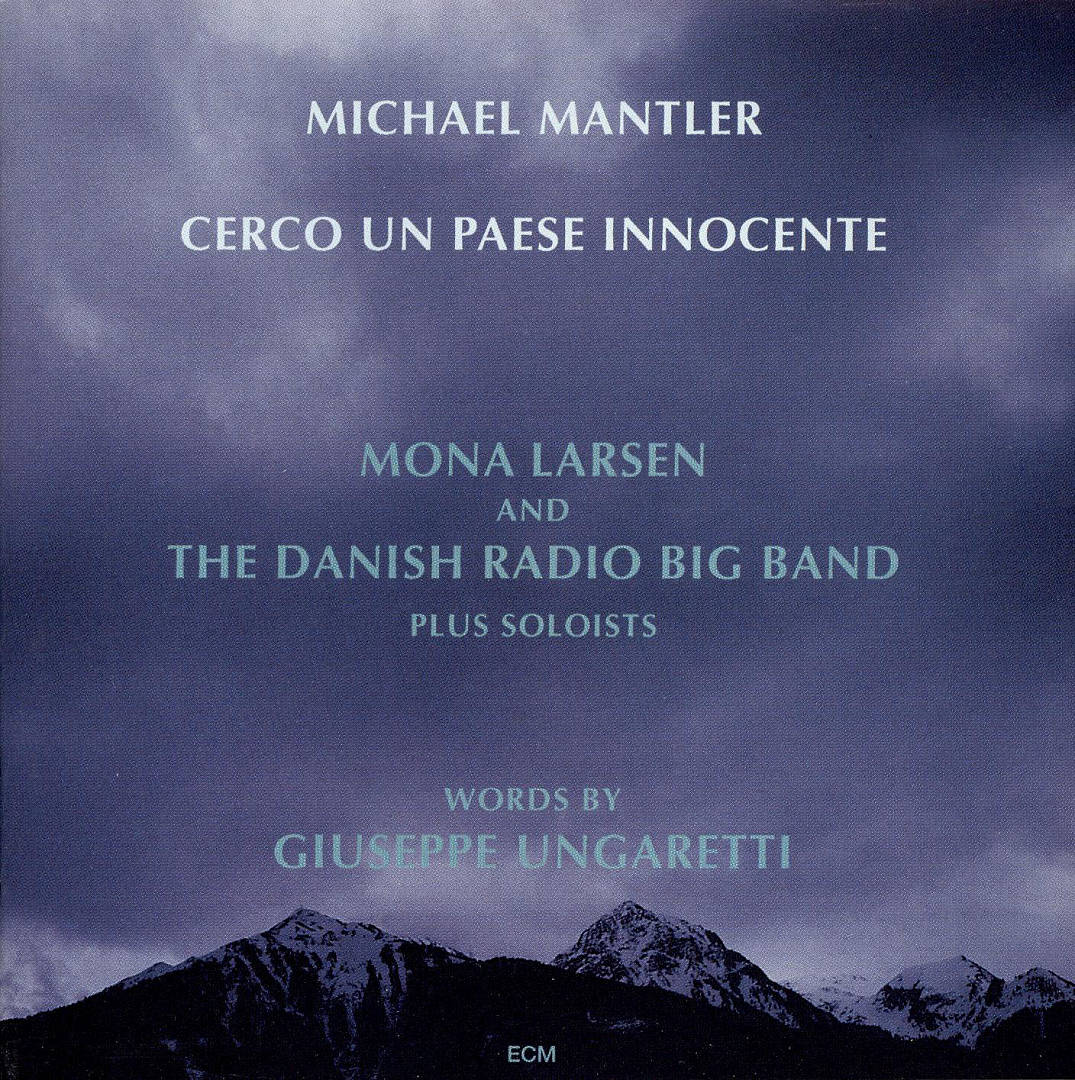
Michael Mantler: Cerco Un Paese Innocente (ECM 1556)

Michael Mantler
Cerco Un Paese Innocente

Mona Larsen voice
Michael Mantler trumpet
Bjarne Roupé guitar
Marianne Sørensen violin
Mette Winther viola
Gunnar Lychou viola
Helle Sørensen cello
Kim Kristensen piano
The Danish Radio Big Band
Ole Kock Hansen conductor
Recorded January 1994 at the Danish Radio, Studio 3, Copenhagen
Recording and mixing engineer: Lars Palsig
Produced by Michael Mantler

Beginning has us singing
and we sing to make an ending

Michael Mantler’s Cerco Un Paese Innocente (I search for an innocent land) pays tribute to the father of modern Italian poetry, Giuseppe Ungaretti. Subtitled “A Suite of Songs and Interludes for Voice, Untypical Big Band and Soloists,” this seamless construction feels anything but untypical in the comforting plush of its instrumentation and attention to soundscape. The present recording is also significant for bringing Copenhagen-born vocalist Mona Larsen back together with the Danish Radio Big Band, who debuted her as soloist in the seventies to wide renown. Larsen’s diction, in combination with her already broad palette, imparts life to dead limbs and electrical impulses to still hearts. Through it we know the touch of many landscapes, their peoples, their flora and fauna, reaching through our bodies toward the setting sun at our backs. This same sun warms the field’s worth of fragrance that wafts through the swell of orchestral goodness in the piece’s introduction. Yet the voice of “Girovago” (Vagrant) does not feel that touch, is forced to wander, forever a stranger, from land to land. A clarinet plays, stringing a trail of possible futures, all of which disappear into the first of five intermezzi, each an anointing of melodic oil that smacks of the perpetual. Curtains part to reveal the starlight of “Stasera” (This evening) and Larsen’s Francesca Gagnon-esque acrobatics. “Perché?” (Why?) ties an operatic ribbon around the index finger of Part 2. It is the tale of a dark heart lost in its desire to erase the scars of travel. “Sempre Notte” (Everlasting night) turns the dial further inward and walks through cascading gardens, from which hang sad and sorry tales of yesteryear like so much totora reed left to dry. The depths of “Lontano” (Distantly) evoke the poet’s blindness in a landscape of fiery hands. The music here seems to explore those sparkling pockets of air in which our dreams still breathe. Breathing, however, comes at a cost in Part 3, where the soaring orchestration of “Se Una Tua Mano” (With one hand) euphemizes the harm of curiosity trembling beneath its veneer. “Is surviving death living?” Larsen sings, prompting mental implosion through Ungaretti’s unwavering mortal concerns. The halting rhythms of “Vanità” (Vanity) further paint a world of startlement and shadows, its rubble soldered back together by the warmth of Mantler’s trumpet into “Quando Un Giorno” (When a day) and the invigorating “Le Ansie” (Fear). In these we encounter life as smoke, at once agonizing and brimming with potential. Gloom lives in these soils and nourishes the churning dramaturgy of Part 4, of which “È Senza Fiato” (Motionless) darkens like an arc of twilight, led by a shooting star of electric guitar into “Non Gridate Più” (Outcry no more). This sweeping transition rakes its fingers through silent grasses and hushes the mouths of the dead, in whom only the resolutions of “Tutto Ho Perduto” (I have lost all) continue to resound, their childhoods laid to rest by a final word.

One of your hands resists your fate,
but the other, you see, at once assures you
that you can only grasp
tatters of memory

<< Sándor Veress: Passacaglia Concertante, etc. (ECM 1555 NS)
>> Charles Lloyd: All My Relations (ECM 1557)
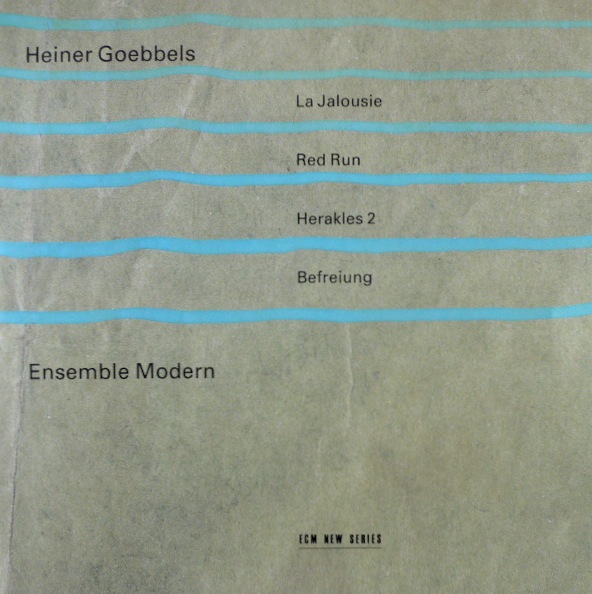
Heiner Goebbels: La Jalousie / Red Run / Herakles 2 / Befreiung (ECM New Series 1483)

Heiner Goebbels
La Jalousie / Red Run / Herakles 2 / Befreiung

Heiner Goebbels
Ensemble Modern

Christoph Anders narrator
Recorded May 1992 at Performance Studios, Frankfurt am Main
Recording engineers: Leslie Stuck and Andreas Neubronner
Mixed and edited at Rainbow Studio, Oslo
Engineer: Jan Erik Kongshaug
Produced by Manfred Eicher

Sometimes music is so theatrical that it needs no stage or actors to enlighten its listeners. If such music comprised a genre in and of itself, composer Heiner Goebbels would be one of its most idiosyncratic masters. Along with Michael Mantler, Goebbels represents a theatrical strand in the ECM universe that challenges the reviewer attempting to describe it, yet which is perfectly clear once it reaches the ears. My first encounter came through Surrogate Cities, a dazzling piece of music theatre that remains the yardstick by which I’ve measured all Goebbels experiences since. That being said, the more I hear, the more I recognize the futility of such comparison, for in his decidedly textual sound there is equal room for any and all sentiments to frolic, dance, and weep.

La Jalousie places four pieces of ranging character at the capable hands of Ensemble Modern, whose interpretations thrum with the utter embodiment that so distinguishes it from likeminded groups. The title composition for sixteen musicians, subtitled “noises from a novel,” already betrays Goebbels’s fascination with language as toolkit. His source is a work by Alain Robbe-Grillet (who famously wrote the script for Alain Resnais’s 1961 Last Year at Marienbad), in which the protagonist’s suppressed jealousy comes to vivid life on the page. Goebbels nurtures a description portion thereof and attempts to reconstruct it in acoustic terms. The genesis of this piece bursts forth from a rustling of conductor’s pages and unfolds from its compressed chaos a menagerie of guitar, piano, and winds. These are but clothing lines, however, for piles of freshly laundered samples: birds, frogs, and other secrets of the marshlands move in and out of the fray. A car door slams in retrospect, a voice seeming to relive this difficult dream in ominous reflection. The animals’ voices are an indigestion of the soul, stirring ever so disconsolately beneath this veneer of solitude. The clack-clock of footsteps pokes through the piano’s dampened commentary. An overblown oboe bears the imprint of Heinz Holliger’s Studie über Mehrklänge and leads us into a narrative passage underlined by crashing piano and synth shamisen (the synthesizer continues to bear witness to much of the goings on in varying gradations of convention). This brings us to an ending tinged by hope and submersion and a reprise of those restless pages.

In the wake of this palindrome, the nine songs for eleven instruments of Red Run come across rather comfortingly. This concert reduction of a ballet opens with a trio of drums, keyboard, and electric guitar in a deceptively simple pocket of jazz club anxiety. Improvisation abounds in this acute deconstruction of the popular. Tracing horns resolve themselves into a focal point of rumbling breath; a lilting violin arches its back from a bed of nails, drawing a sustained line from its dreams into the measured steps of its waking life: these handfuls and more share an edge, scattered like ashes in the wake of a trumpet’s derisive calls.

Herakles 2 (for five brass players, drums and sampler) takes a section of Heiner Müller’s play Zement as another structural prompt for music without words. The pedantic beginnings are just a front to a flipbook of superbly detailed constructions, each a building block in a crumbling tower of sound. The music trips over some quiet harrumphs from the tuba on the way toward Befreiung (Liberation). Goebbels composed this concertante scene for narrator and ensemblein celebration of the 200th anniversary of the French Revolution. Excerpting anti-liberal diatribes from Rainald Goetz’s anti-liberal play Krieg, he paints an insistent call to arms, where hugs turn into defense mechanisms against the blight of direct and noted perception. This is an unrelenting piece, ringing with the glass and bangles and spent energies of a zeitgeist now mute with self-realization. As Goebbels himself admits, with this piece he does not intend “to resolve for the audience the political tension contained in these texts but unleash it for individual confrontation.” And perhaps, in the end, individual confrontation is what the Goebbels experience is all about. Like a language stripped of its consonants, leaving only a sea of diacritical marks, his is a book without page numbers. Through it we face the emptiness of our texts, of our very bodies, and know that within emptiness beats a heart dying to create.

<< Meredith Monk: Facing North (ECM 1482 NS)
>> Hal Russell: Hal’s Bells (ECM 1484)

David Darling: Cello (ECM 1464)

1464 X

David Darling
Cello

David Darling acoustic cello, 8-string electric cello
Recorded November 1991 and January 1992 at Rainbow Studio, Oslo
Engineer: Jan Erik Kongshaug
Produced by Manfred Eicher

David Darling’s Cello is one of the most stunning albums ever to be released on ECM in any genre. Its fluid paths feel like home. Darling plows the improvisatory depths of his soul, given free rein in the studio to paint the negative spaces in between those clouds on the album’s cover, ever deeper, ever truer to the core of something alive. Most journeys might take you across some distance to get you to where you’re going, yet few will actually unpack where you are standing with such complex, unabashed glory that one need not take a single step to travel to the end of the universe and back. Cello is one such journey.

The opening “Darkwood I” carries us into a state of bliss unlike any other, finding its interest in the empty spaces of time that define our action and thought alike. “No Place Nowhere” swells with the blessing of life, finding in every shift of light a new window through which Darling casts the details of his destiny through shadow. One finds here a long and winding road into horizon, forever receding, that is the vanishing point in sound, the blessing and the curse of beauty, the sweeping gesture of aesthetic pleasure rolled humbly into a never-ending circle. The bird calls of “Fables” dance in the sky like time-lapsed aurora borealis, twisting our sense of time to the tune of something divine. “Dark-wood II” is a wilting flower, a lakeside flower dropping spores. “Lament” lowers us in swaddling into the slow-motion cradle of the wind, the mountain veil as a crook in a mother’s arm, singing our souls softly to sleep. “Two Or Three Things” evokes Jean-Luc Godard with its softly flowing landscape of water and wind, grass and foam, where swim the vagaries of our modern life against the tide of regression that is our calling into death. This breathtaking journey guides us into a place that is so deeply inside us that we must disappear to find it. “Indiana Indian,” forever my favorite track on the album, begins in a harmonic swirl before loosing a pizzicato chain of finely honed memories. A jazzy half-note swing brings us into the enthralling drama of “Totem.” Here, an ocean of double stops, a tidal wave of lilting lines, leaving an imprint of “Psalm” in the sands. Its protracted antiphony sheds its clothing to reveal “Choral.” This Möbius drop into solitude, where harmony offers the illusory promise of companionship in a world without bodies, whispers at the interstices of our alienation. “The Bell” has the makings of an Arvo Pärt choral work with its microtonal harmonies and tintinnabulations. “In November” rounds a cinematic edge, rolling over into a low and calming thunder and ending with the yellowing strains of “Darkwood III.”

On paper, these might seem little more than chromatic exercises, but in the vastness of Darling’s playing, combined with Eicher’s attention to space, they achieve a meditative state in which the simplest musical utterances become the most profound. Eicher’s touch can be ever felt in the sound and in the melodic elements he has provided, showing us that he is not only a fine producer, but also has a supremely sensitive ear for melody and, above all, time. For this improvised session, Eicher told Darling to go as deep as he could go, thus expressing the spirit of the label at heart, not to mention the spirit of what a musician can achieve when open to infinity.

<< John Surman: Adventure Playground (ECM 1463)
>> Charles Lloyd: Notes From Big Sur (ECM 1465)

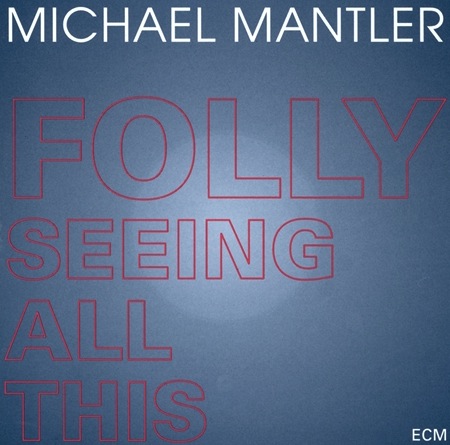
Michael Mantler: Folly Seeing All This (ECM 1485)

Michael Mantler
Folly Seeing All This

Alexander Balanescu violin
Clare Connors violin
Bill Hawkes viola
Jane Fenton cello
Michael Mantler trumpet
Rick Fenn guitar
Wolfgang Puschnig alto flute
Karen Mantler piano, voice
Dave Adams vibraphone, chimes
Jack Bruce voice
Recorded June 1992 at Angel Studios, London
Engineer: Ben T. Reese
Produced by Michael Mantler

Folly Seeing All This must have been something of a dream project for Michael Mantler. Working with the Balanescu Quartet opened up a vital portal in this phenomenal composer. The ensemble also includes guitarist Rick Fenn and a handful of talented chamber musicians. Alexander Balanescu’s unmistakable vibrato ushers us into the title piece’s shifting moods, which speak for themselves. Mantler’s trumpet pulls from this genesis a peak for every valley. Fenn draws thick sentiments with thin lines as a piano (played by Karen Mantler) rises from below the water’s surface to test the nets of time in hopes they might hold the revelations to come. Though nearly a half hour long, the music ends all too soon, imploding into a single white dwarf of energy.

News makes for an airy companion. It undulates with the tide of politics and is every bit as vocal as Mantler’s more operatic configurations. Some beautiful seashell rolls from Wolfgang Puschnig on alto flute make sense of the knotty background, where invisible talking heads are drowned by Fenn’s guitar, more insistent now in its cause. An insightful lead-in to What Is The Word. This meditation on the words of Samuel Beckett joins the voices of Karen Mantler and Jack Bruce to speak as if from within our collective ribcage, swinging from those branches of marrow and calcium with deftly slung words. Strings in the background cycle like an air raid siren in slow motion, lending finality to this brief, tender observation.

Mantler is that rare composer in whose music every instrument, every voice, rings with an equal truth. Folly Seeing All This is one of his most reflective albums to date and serves, along with Review, as an honest introduction to one of ECM’s greatest.

<< Hal Russell: Hal’s Bells (ECM 1484)
>> Stephan Micus: To The Evening Child (ECM 1486)

Terje Rypdal: Q.E.D. (ECM 1474)

Terje Rypdal
Q.E.D.

Terje Rypdal electric guitar
Borealis Ensemble
Christian Eggen conductor
Recorded August (Q.E.D.) and December (Largo) 1991 at Rainbow Studio, Oslo
Engineer: Jan Erik Kongshaug
Produced by Manfred Eicher

Quod erat demonstrandum (Latin: “which was to be demonstrated”) traditionally denotes the completion of a mathematical proof or philosophical argument. As Terje Rypdal’s opus 52, however, it seems to mark the start of one. The 36-minute work for electric guitar and chamber ensemble is, on the surface, a hard sell. Jazz purists may be perplexed by its chamber music abstractions, while the classical side of the fence may find it lacking in innovation. In the absence of expectation, however, one encounters an unpretentious and atmospheric work of sometimes startling beauty. The 1st movement sets a deceptive tone. Its abstract conglomeration of strings and winds flits through the trees like a Cheshire cat. The 2nd movement, however, introduces Rypdal’s electric, which sings amid a brassy swell of delirium into the 3rd movement. His labyrinthine keening works especially well here while the insistent strings build tension. The deep rumblings of the 4th, however, open like the gates of an alluring netherworld, where orientation is a bluff, grained like a hoarse voice in the echo chamber of time. This seems to be the center of all the activity we have endured—all the more so when we contrast it with the hulking 5th movement, which juxtaposes edges rounded and serrated, cacophonous and nearly silent, gilded by Rypdal’s reversed guitar and flung into a molten pit of scrapes and scrambles. To this, Rypdal appends his Largo, op. 55, a 17-minute stretch that further maps the subterranean concerns of Q.E.D.’s 4th movement. The composer’s ever-mournful song blasts its heat waves through the chest with the insistence of a dragon yet the gentility of a feather caressed against the cheek of one’s preconceptions.

A curious and multifaceted thing, Q.E.D. is filled with mysterious rewards for those patient enough to seek them out. By no means where one should start with Rypdal, but nevertheless a competent blip on ECM’s eclectic radar.

<< Heinz Holliger: Scardanelli-Zyklus (ECM 1472/73 NS)
>> Miroslav Vitous/Jan Garbarek: Atmos (ECM 1475)

The Dowland Project: Romaria (ECM New Series 1970)


The Dowland Project
Romaria

John Potter tenor
Miloš Valent violin, viola
John Surman soprano saxophone, bass clarinet, tenor and bass recorders
Stephen Stubbs baroque guitar, vihuela
Recorded January 2006 at Propstei St. Gerold
Engineer: Markus Heiland
Produced by Manfred Eicher

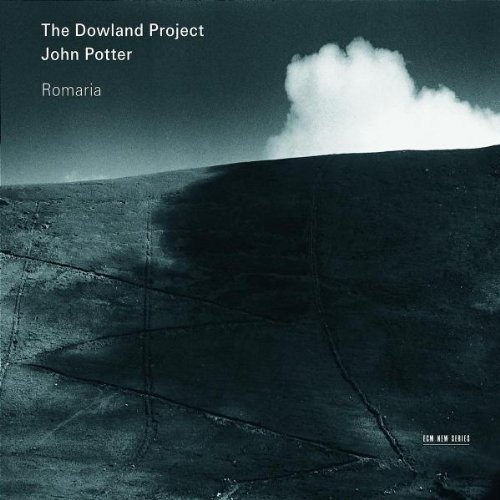
The atmosphere of Romaria, the Dowland Project’s third album for ECM, is exactly like its cover: monochromatic, with a splash of cloud over a stretch of scored earth. Stripping down its ethos to barest elements, the Project takes up plainchant, anonymous monody from the Carmina Burana manuscript, and Iberian folk songs, spinning from them a lush improvisatory world sprinkled with troubadour songs and motets from, among others, Orlando di Lasso and Josquin Desprez. The new addition of Slovak violinist Miloš Valent makes for a sustained and burrowing sound that blends uncannily with Stephen Stubb’s strings.

Got schepfer aller dingen starts us off with a brood, setting the tone for a somber yet somehow vigorous album. Where this vigor comes from is hard to say. Could it be in John Surman’s hopeful bass clarinet in Veris dulcis? Or perhaps in Stubb’s plucked accompaniment in Ora pro nobis? Yet further in John Potter’s aching vulnerability in Lá lume? Whatever the source, it’s clear that the versatility and depth of songcraft here is as delicate as a moth’s wing in a lantern’s flame.

Potter, it must be said, is the heartbeat of this album, drawing out from the instrumental surroundings a most thorough vocal line. The instruments seem to grow from his soil, particularly in Dulce solum, seeming to constitute the touch of breath through lips and mind. Similarly, Der oben swebt sways like the wind in the barley, carrying up in its wisps of recollection the promise of a lively day.

Much of the album is free-flowing and at times so organically realized (note, for example, In flagellis) that one wonders if the original melodies didn’t also arise in this unscripted fashion.The instrumental Saudade is another highlight that showcases the inspiring talents of Surman, whose soprano enlivens the darkest corners of Kyrie Jesus autem transiens and Ein iberisch Postambel to mesmerizing effect. Sometimes, the instruments recede just slightly, as in O beata infantia, allowing for Potter’s voice to carve its own tracks.

Listening to an album like this, one realizes the potency of the songs chosen, existing either in fragments or thicker sketches. Freedom is given to the performer, allowing new voices to come through. Each is but a drop in a larger body of water, necessary yet invisible in its surroundings.

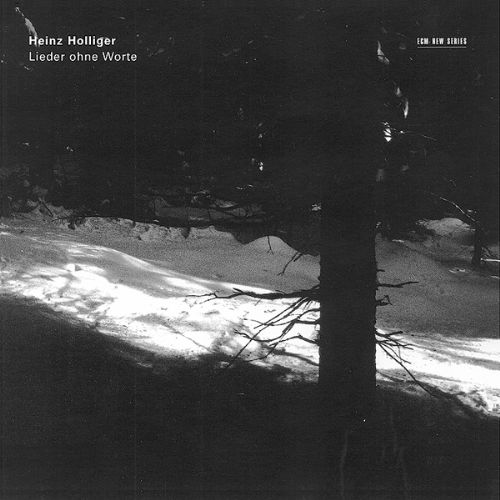
Heinz Holliger: Lieder ohne Worte (ECM New Series 1618)

Heinz Holliger
Lieder ohne Worte

Thomas Zehetmair violin
Thomas Larcher piano
Ursula Holliger harp
Recorded June 1996 at Radio DRS, Zürich
Engineer: Stephan Schellmann
Produced by Manfred Eicher

After an already healthy representation of the compositional prowess of Heinz Holliger, ECM decided to put out this disc pairing some of his earliest work from the sixties with that of decades later, thereby providing an engaging survey of a musical mind that turns like a kaleidoscope: holding tight to symmetries so that it might fragment their interiors in ever-novel, I would say linguistic, combinations. For indeed, language is what Holliger is all about. From the poetry that inspired him as a youth to the poetry that he creates as an adult, the Swiss composer revels in every portion of his mental reserve to fish out some of the most heartfelt music of the twentieth century.

The tactility of Holliger’s instrumental renderings always seem to have something of the human voice about them. Every cell is marked by the potentially vulnerable transfiguration of form, a breaking down or “clearing of the throat” by which the musical moment is rendered chalk-like in the face of its own palimpsestial illusions. The two sets of Lieder ohne Worte that embrace this disc turn the standard violin/piano duo inward, ever refracted toward a conversation comprised entirely of afterthoughts. Although generally light, it sometimes dips into urgent proposals to which the only desired answer can be a heavy silence. Both instruments become frames. The two Intermezzi recall Holliger’s 1982 Duo for violin and cello, linking adverbial phrases with descriptive trails. Songs without words, yes, but aren’t they always, for once they escape the lips they have already transcended the limitations of their shaping toward more distant reverberations.

In the Sequenzen über Johannes I, 23 for harp (played to perfection by wife Ursula), Holliger’s trademark fractures are filled by the plasma of fingertips, while the Präludium, Arioso und Passacaglia for the sameblush with savory dexterity. With the restrained ferocity of a classical guitarist, Ursula evokes an elastic space in which the life of any single note is determined by its distance from the body.

Two solo pieces fill in the eye sockets of this sonic skull. On the left is the winking Trema in a version for violin. Anyone used to the original for cello is sure to be caught up in the stark new textures. Where the cello draws that trembling forth from deep within its bowels, here it issues from the nostrils of a head animated by vehement denial. Yet in that denial is an unspoken (and unspeakable) commitment to self-reformation, to the idea that within the brain there is enough room to squeeze in all life experience into a single synapsial firing. The expediency of the lie is betrayed by its brevity. On the right are the three drowsy piano miniatures that make up Elis. In these vibrant fits there are only dreams. Rather than try to smooth them into a unified narrative, Holliger allows their worth to come clambering into our attention at whatever pace it chooses. A few extended techniques, like the hitting of a dampened string, emit flashes of color in an otherwise monochromatic field.

Holliger is notable for being a composer duly aware of the importance of space: between notes, between pieces, between selves. The stillness thereof is so heavy that, rather than falling like a stone, every note floats like a particle of windblown pollen. And in the hands of such astute performers, we begin to feel windblown ourselves.

<< Joe Maneri Quartet: In Full Cry (ECM 1617)
>> György Kurtág: Játékok (ECM 1619 NS
)

Alexei Lubimov: Messe Noire (ECM New Series 1679)

Alexei Lubimov
Messe Noire

Alexei Lubimov piano
Recorded May 1998 and December 2000 at Radio Studio DRS, Zürich
Engineer: Peter Laenger
Produced by Manfred Eicher

Messe Noire was the second ECM recital debut for Russian pianist Alexei Lubimov, following his enigmatic debut, Der Bote. It remains one of his freshest and most luminous programs, forging from the composers of his homeland what Reinhard Schulz describes in his liner notes as “a cosmos in which free spirits gather together.” The image is apt, for in the “Hymn” of Igor Stravinsky’s Serenade in A (1925), which opens the disc, we do indeed encounter a galactic ocean of impressions. From the gentle reverie of lost love to the grumbling belly of despair, it encapsulates Stravinsky’s penchant for emotional directness, as in the processual Romanza that follows and all the way through to the frayed Finale. The Sonata No. 2 op. 61 (1943) of Dmitri Shostakovich rather chooses ebullience as its quill, and marks with it a playful inter-relationship between the left and right hands in a volleying of motifs. An off-kilter Largo leads us to a plaintive Moderato, which provides one of the more sustained, gloomier contractions on the album.

Sergey Prokofiev’s Sonata No. 7 op. 83 (1942) introduces characteristic buoyancy before quickly fading into a quieter spell, inhabiting the after-effect with the oral passion of a missionary. This ebb and flow of pensive dips is the sonata’s overall modus operandi, epitomized most movingly in the Andante. This dynamism is only strengthened by Lubimov’s mature sense of syncopation. The boisterous reverie that is the final Precipitato brings that same play of weight and lightness to bear on more wistful statements. After this rousing feast, we are treated to desert in the form of Alexander Scriabin’s Sonata No. 9 op. 68 (1913). Marking time with seemingly reserved energy, its gorgeous contours actually build toward an arresting resolution.

What connects these four towering works is precisely what separates them. Over a spread of personal and social politics three decades in the making, they remain unscathed (if somewhat neglected), breathing with vibrant life at Lubimov’s fingertips.

<< Maneri/Phillips/Maneri: Tales of Rohnlief (ECM 1678)
>> Tomasz Stanko: From The Green Hill (ECM 1680
)

Michelle Makarski: To Be Sung on the Water (ECM New Series 1871)


Michelle Makarski
To Be Sung on the Water

Michelle Makarski violin
Ronald Copes viola
Recorded March 2004, Radio Studio DRS, Zürich
Engineer: Stephan Schellmann
Produced by Manfred Eicher

Like the blade of light on the album’s cover, Michelle Makarski draws luminescence through the darkness with her bow. For her third ECM recital disc, the violinist further hones both her craft and her sense of programming, constructing a Jacob’s ladder of Giuseppe Tartini and American composer Donald Crockett, the latter of whom offers two works in Makarski’s honor. Of these is the album’s 1988 title work, for which she is joined by violist Ronald Copes. Its lush double stops create a virtual quartet. From these arise steady pulses, slowly lobbed between the two instruments. Even as the narrative fragments midway through, the other always picks up the action in one, as if looking in a mirror that shows the distant past. Open strings prevail in this meeting of voice and translucent surface, a conversation between opacity of the instrument and transparency of the voice.

Hugging this piece are two sonatas by Tartini. The Sonata IX in A Major achieves an intimacy on par with Bach’s solo works. Yet where Bach inscribes the waking world with his solitary thoughts, Tartini crams that same world into the depths of his dreams in order to salvage what might otherwise remain unseen. The inaugural Largo sways with the same flexibility, as might a dream in which the parameters of one’s immediate reality are just as indecipherable as those beyond it. This renders the Allegro that follows a negation of self. Hence the echoes in the third movement, softer in the anchored line of the double stop, weaving its way like a caduceus into the frantic trills of the final proclamation. With its ponderous dissonances and looming double stops, the first strains of the Sonata II in d minor sound closest to Crockett. And while the middle movement is far more exuberant, filled with dancing diversions, the final Allegro marks a sinuous organism, its lines curling like fingers beckoning from behind a curtain.

All of this makes of Crockett’s mickey finn (1996) an urgent crawl to a bygone era, a literary and geographic aside wrenched from the ether with reluctant precision. Crockett’s tantalizing grasp of language makes for a delectable passage into Tartini’s  Sonata XIII in b minor. Makarski articulates the ground lines most strongly here, drawing them out to allow their resonance to overtake the lead. This is clearest in the stunning Andante, which finds its second self reinvigorated in the arousing Giga.

These works by Tartini, despite their bare construction, ask of the musician a certain depth of expression that Makarski handles with intuitive linearity. The music of Crockett similarly draws out the violin’s potential as songstress, shedding the husk of programmatic arbitrariness in favor of direct communication. Both write music without masks, and both are given the ideal mouthpiece in a violinist whose touch is supreme.