Gianluigi Trovesi piccolo and alto clarinets Gianni Coscia accordion
Recorded January 21-23 and March 2-4, 2009, Centro Civico Musicale Sant’Anna, Perugia
Engineer: Francesco Ciarfuglia
Produced by Manfred Eicher
In search of Brother Jacques, Mr. Offenbach, the great iconoclast, composer of operettas and wound-bringer to discerning classical minds. Our guides, multi-reedist Gianluigi Trovesi and accordionist Gianni Coscia. The itinerary destroys borders, forges new ones in their wake, and takes every path with more than a grain of salt. The melodies take on an ember glow, gesticulating in the manner of an oil painter’s brush and leaving behind a portrait that is offering and caricature in one. We stumble and marvel at what impedes our feet, knowing that we can only sit this one out and accept the frivolity of its passage. It is the pageant, and we the hapless spectators, ears sharpened to the whim of interpretation.
Scholar Heather Hadlock writes of Offenbach’s Les Contes d’Hoffmann as a “death-utterance,” so concerned is his only (and unfinished) opera with death and its many reflections, to say nothing of its emergence from the pen of a dying man himself. In the course of the work, Offenbach “reviews his own compositional past, drawing its various elements into a musico-dramatic kaleidoscope.” And so, Hadlock concludes, we might better see it as “undead,” for the narrator lives and speaks on even after his symbolic passing. Doubtless, the listener will find in Trovesi and Coscia’s striking reinventions a death-defying vivaciousness on par with their sources. Breath and bellows jump from their digital oven like myriad gingerbread men, running nakedly and wittily through Hoffmann with all the requisite stagecraft such activity would require to convince us of its aliveness. Fitting, too, is the “Epilogue” drawn from the same, which ends the album on a funereal pitch.
Most of what precedes it, however, seats us at a banquet table of delights. The four opéras bouffes—operettas rich in parody and farce named for the Théâtre des Bouffes-Parisiens at which Offenbach premiered them, if not the other way around—sampled here come out of a particularly fruitful tenure, during which time the composer produced some of his most popular work. Of La belle Hélène (1864), La vie parisienne (1866), La Grande-Duchesse de Gérolstein (1867), La Périchole (1868), he quipped most characteristically, “I am certainly the Father, but together they are the Son and the Wholly Spirited.” Trovesi and Coscia are more than happy to toss these ingredients almost cartoonishly in their kitchen. With herbs and stalks a-flying, they include whatever comes to mind in the largest pot they can find, only to ladle the resulting concoction with butler-like care into our bowls. It’s all we can do as their guests to not dip our spoons in unison, and join in the after-dinner dancing into which the sheer joy of these flavors bids us welcome.
To be sure, these provide a rich and complementary tasting experience. The truffle of Trovesi’s alto clarinet blends into Coscia’s creamy leeks, each enhancing the other to infinite effect. La vie parisienne provides some of the album’s maddest brilliance, ambulating like feet on a mission to stir up gossip in the village square. From Mozartian prances to fervent declarations, the remainder flies. Yet it is in the improvisatory hands of our fantastic duo where lie the deepest treasures. Among them are the vivid gems of “Tangoffenbach” and “Dedicated to Hélène and her little birds,” each an aperitif of smoothest finish. These are monologues that sing and move, bringing shadow to can-can, and lipstick to statues.
This is a diarist’s playbook, a sincere exploration of passion and obsession that not only pays tribute to but also transcends its namesake, all the while caging the spark of creativity in action. What’s left is an affirmation…and a smile.
Terje Rypdal electric guitar Palle Mikkelborg trumpet Terje Tønnesen violin David Darling cello Christian Eggen piano, keyboards Paolo Vinaccia drums, percussion Jon Christensen drums
Recorded February 1996 at Rainbow Studio, Oslo
Engineer: Jan Erik Kongshaug
Produced by Manfred Eicher
If Terje Rypdal’s instrument is his axe, then he has ground it to an edge like no other, and perhaps few places so finely as on Skywards. The result of a Lillehammer Festival commission, his jeweled exposition is an aural thank you note to the unquantifiable contributions that ECM has made, via producer Manfred Eicher, to the Scandinavian soundscape. One could hardly script a more fitting lineup for such a task. Joining the Norwegian renaissance man are trumpeter Palle Mikkelborg, cellist David Darling, drummers Paolo Vinaccia and Jon Christensen, violinist Terje Tønnesen (heard recently on If Mountains Could Sing, and Christian Eggen on keyboards (familiar to Rypdal followers as conductor for Undisonus and Q.E.D.). Of these, it is Mikkelborg who leads the way most economically, as in the central “Out Of This World,” transplanted from the Lillehammer stage and redressed here in Oslo’s Rainbow Stuio. The sincerity of his gambit bleeds into Rypdal’s own blazing chess moves against a backcloth of shifting voices. The guitarist writhes as if singing, even as Eggen exposes ancient shadows whose dance has remained unchanged since its inception. Before kissing this quasar, however, we are treated to the earth-friendly title piece. Its anthemic strains carry the torch of “The Return Of Per Ulv,” of which it is a shining reflection, and unwraps also the album’s hallmarks: drums like speech, synths like water, and glorious leads. “Into The Wilderness” bears the frostbite of the Norwegian film, Kjærlighetens kjøtere (Zero Kelvin), for which he composed it. Yet it brings warm thoughts, wrapped in savannah dreams, the creaking of bones, and subterranean currents. In this cinematic enclave we encounter a host of idioms, all tied by a quiet splendor that burgeons even as it fades. David Lynch-like atmospheres mix freely with turpentine and darkening reality, where the sunlight now becomes a ghost wished for to be gone. “The Pleasure Is Mine, I’m Sure” is another cinematic bow to the legions of our shared past. In its wake treads the ostinato of “It’s Not Over Until The Fat Lady Sings!” skirted by drums and overlaid by Rypdal’s collected, fierce lyricism. The set ends with “Shining” and “Remember To Remember,” each a reworking of an earlier motive, mineral from the soil, trembling with romantic charge.
A perfect marriage of concept, cover, and content, Skywards guides the way with light while leaving footprints of shadow. A fantastically beautiful record.
<< Wheeler/Konitz/Holland/Frisell: Angel Song (ECM 1607) >> Bley/Parker/Phillips: Sankt Gerold (ECM 1609)
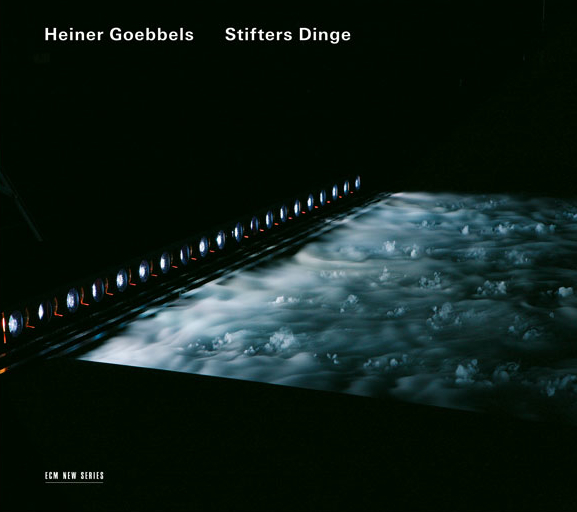
Heiner Goebbels Stifters Dinge Heiner Goebbels conception, direction
Recorded October 20/21, 2007 by Willi Bopp, Grand Théâtre de la Ville de Luxembourg
Edited and mixed July 2010 by Max Federhofer (SWR) and Heiner Goebbels
Executive producer: Manfred Eicher
“Language cannot represent thought, instantly, in its totality; it is bound to arrange it, part by part, in a linear order.”
–Michel Foucault
How can the pen be mightier than the sword when the page is the most hurtful weapon? It is not that the flesh receives the pen, but that the eyes swallow words into the soul, their blades wreaking havoc in a place where dying utterances thrash, unnoticed, for want of lips and tongue. There is something to be felt here, pondered like sun and moon in the same sky, only to slip from grasp, tether to a dream. In that state of half-sleep we are hyper-aware of sounds that make us. We turn them inside out and hold them to our ears, each a vacated conch shell. Were we able to peer into the shadows of those porcelain folds, we might encounter composer Heiner Goebbels tinkering in the deepest crevice, his fingernails clicking like camera shutters at the dawn of time.
Such is the veil that stands between us and Stifters Dinge (Stifter’s Things), the 2007 installation piece that would be enigma were it not for the clarity of its presence. It is many things. It is everything. It is the power of speech turned on its head and spun until it is a single color. The voice of Claude Lévi-Strauss excavates the work’s ethos, at once underscoring and disavowing our need for discovery, the rarity of adventure in a global network mapped and catalogued to every conceivable end. It is also a regression into a past where the truest blanks in our physiological scripts remain. These blanks play host to other notable figures. William S. Burroughs levels his critique of inner fire into social ice. Malcolm X speaks of division, fragmentation of power, splitting of the master’s tools. Goebbels weaves in field recordings from Papua New Guinea, Greece, and Colombia, archives of travel and lost communities, shades of Bach and monoliths. Bobbing along these waves is the constant ghost of one Adalbert Stifter, the eponymous 19th-century Austrian writer who, like Henry David Thoreau, heard nature as the musical amalgam of machine and biome that it is.
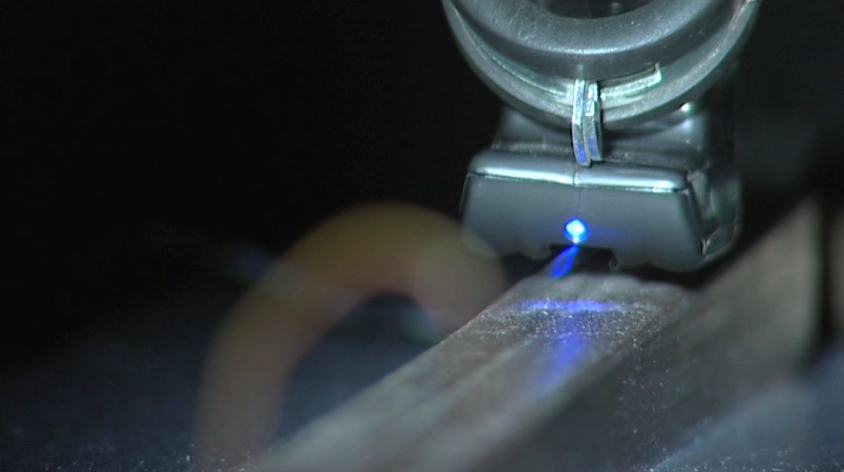
The piece is, above all, an experience—Goebbels calls it a “performative installation”—that abets the evolutionary processes it unravels and reties into permeable sculpture. The gentle logic of it all is indeed linguistic. We feel ourselves caught up in its locks and thorns. But the human is hidden, falling into ruin among the crust and residue of progress. It is an irrigation system that draws forth the atmospheres of solids. Drones of screen and sand, of distortion and touch: these are its faces.
The piano looms large, both literally onstage and figuratively as the consummation of the gallantry it burns to ash. As a mouthpiece of elitist spirit, its heft trembles under contact. As a technological pest, it is so impervious that only practice, mastery, and ultimately submission are its effects. It is an artificial ecosystem that somehow becomes parthenogenetic. As the soundtrack to smoke, it enfolds us, settles in with our bacteria. Stifters Dinge, then, is an astonishing concept that fully alerts us to the astonishment of concept.
“Language refuses but one thing,
to make as little noise as silence.”
–Francis Ponge
“Is there such a thing as three-dimensional music?” asks Wolfgang Sandner. In ECM’s audio version of Stifters we have one answer.
The fog (1) flaunts a wave of mystery, given traction by the distant bass beat of a techno house, pulsing like our zeitgeist through avenues of youthful expression, bodily movement, and philosophical naïveté. The salt (2) chips away at our ear canals and offsets the arterial spice trade with the attention of rot hidden in every city’s foundation. The water (3) speaks in drips, opening us to the metronome’s deception. In every deposit we startle a different facet of the same visage. The wind (4) carries sailors’ incantations: sinewy, mineral. A recurring clutch, an audio checkmark spinning us on our axes of interpretation. A prayer for the nameless, for the bodiless, for the motionless. The trees (5) whisper through punctured tires and forest tales. Piano chords rest on the fulcrums of frozen pasture. Anxieties fade, crystalline, into the aching heart of the beast. The thing (6) abrades its hide with strings, in each a keystone of intent that opens its mouth and sings nothing. The rain (7) does not pour but weeps, finding its way through crags, abandoned houses, and blackened farms. It soaks the earth, churning, sneezing diagrams into every root. It is the thunder (8) that falls, unleashing torrents of political rhetoric. The sound (9) emotes from a muffled source, its life written in a phonograph’s needle and spoken through a black-and-white broadcast. The piano kicks like a sleeping dog. And while the storm (10) hails morose arpeggios, it also closes itself to the possibility of air and cracks instead along fault lines that far outdate the means of their articulation. A foot drags through leaves and curls around the coast (11). A blink extends, every lash a piece of driftwood pillared between heaven and earth. A pressure gauge, valve and open throat, thump of a Tell-Tale Heart and tick of an Ingmar Bergman clock. In the exhibition of objects (12), we find that many such curios have fallen through the cracks and gathered at the bottom of this tub, washed down a drain of silence.
“So we have destiny to thank for permitting us to be what we will become to each other.”
–The Brothers Quay, The Piano Tuner of Earthquakes
In light of these evocative possibilities, of which I have sketched hardly the crescent of a thumbnail, I search for concrete language with which to describe that which is coated like so many dusty attics. For this, I go to the source. Mr. Goebbels answers the following questions I posed via e-mail:
1. There is a sense of “opening” in your music that, like a painting, offers a window into its own world. In your mind, where does this opening lead?
To the listener’s imagination.
2. Often in your work, and especially in Stifters Dinge, I feel a sense of unsettling, of things coming apart. And yet, there is still unity. The music, the theatre—it all holds together. How do you balance these two seemingly contradictory aspects? Or are they part of the same sound, image, and word?
I think it’s a sometimes-unconscious contrapuntal (counterpoint) strategy, in the best possible 18th-century sense.
3. How did you approach the CD version versus the museum version? What special characteristics of the CD as a visual and sonic package influence the physical experience of Stifters Dinge?
The CD recording offers a very direct and detailed “view” of the machines and instruments; you can hear things which you will not be able to perceive in the live performance because of visual distraction or spatial distance.
4. Was there anything about Stifters Dinge that surprised you when you experienced the final result?
Yes, everything. I didn’t start this project with a vision. Just with a question: Are the performative installation and music possible without any performer? The answer is the result.
5. On that note, is there a “final” result, or does it always shift and evolve? Does it still surprise you?
What still surprises me is the range of experiences from audiences. These are the actual “center” of the piece.
6. Which elements from your previous work are present in Stifters Dinge? Which elements are new?
There is a strong continuity in all my work regarding the use of acousmatic voices, the use of documentary recordings. What’s new is the heavy, overall machine-like construction.
7. I am so grateful not only to you for creating such visceral and reactive art, but also to Manfred Eicher for believing in it so strongly. Because of him, I have discovered it. Can you briefly discuss how you first met Mr. Eicher and how he has influenced your activities and way of thinking?
I met him for the first time in the late seventies/early eighties in concerts. Since The Man In The Elevator (1987) we’ve had a sort of exclusive partnership based on friendship, with inspiring talks on all art forms, literature, music, film, etc. And during these exchanges he was the one who drew my attention to Francis Ponge’s “The Pine Wood Notebook” (in Ou bien le débarquement désastreux) or to Samuel Beckett’s “Worstward Ho” (in I went to the house but did not enter).
For further answers, I turn to filmmaker Marc Perroud, whose documentary The experience of things, Heiner Goebbels charts the development and realization of Stifters from the turnstiles of the brain to the stages of reality. As Goebbels informs the camera, he sought to eschew the use of actors, to build a “free area” of intensity for the public. For him, composition and stagecraft go hand in hand. “I’m not a visionary or someone who has a clear idea of what he wants to do,” he goes on to say. “I always react strongly to what I see.” The lack of prepared material allowed for merging between technical and artistic processes. The situation created the music.
As one interested in the infinity of theatre, Goebbels sees the art form not as a means of “narrowing vision” but as an “open channel” for fresh experiences. Placing action behind details is his fascination. Communication thrives here in song, in text, in stasis, cracked to reveal the sound that is its blood: “We understand things better when they are placed at a distance and are more aware of their structure when we focus on abstraction.” Stifters ritualizes nature. Land and water become one. Things are not only objects, but are the unfamiliar, a space of curiosity to which Goebbels holds a magnifying glass. The machines speak, he listens.
For a more user-friendly synopsis of Stifters Dinge, visit ECM’s background page.
To watch a trailer of Marc Perroud’s documentary and find ordering information, click here.
Ketil Bjørnstad piano David Darling cello
Recorded June 1996 at Rainbow Studio, Oslo
Engineer: Jan Erik Kongshaug
Produced by Manfred Eicher
If ever there was a seed beating like a shaded heart in The Sea, it was the twined musical filaments of Ketil Bjørnstad and David Darling. The Norwegian pianist and American cellist spoke on that session like siblings, at points giving us a foretaste of the droning flavors we encounter at the edge of The River. The size and scope of the water have changed in name only, for here is the former’s other half, spreading its finger paint across twelve parallel sections. If we note anything different this time around, it’s that the horizon feels so close that we could just close our eyes and reach out and there would be the sun.
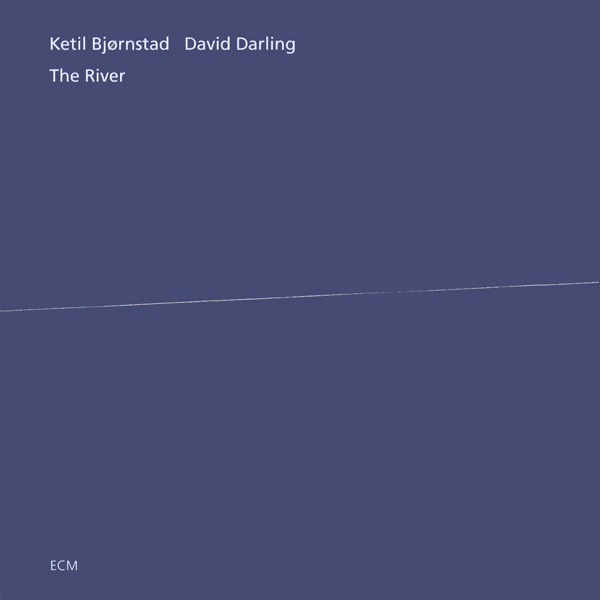
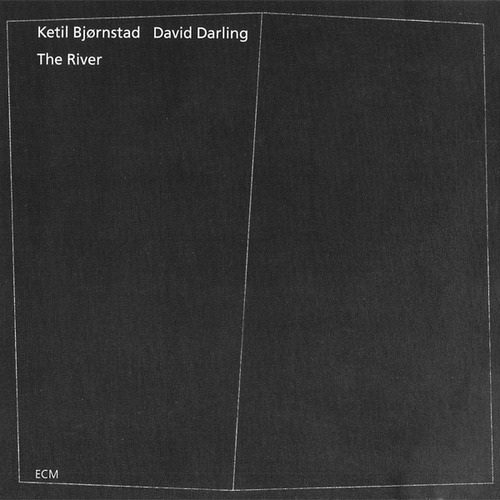
Bjørnstad’s love of aquatic themes stretches an ideal surface tension across which Darling may unfurl his sails. The delicate ostinato of one becomes the leviathan drone of the other, drawing threads through opaque expanse (just as Swiss-born artist Mayo Bucher has placed a white edge through this and select other ECM cover paintings). As cello keens and trembles through a pianistic hall of mirrors, it ladles shadow from the wells of solitude in which we all take shape before birth and to which we also return, lowered in buckets of light. So is The River as much about earth as it is about water, impossible to separate from the glitter of mineral deposits that marks its flow. Darling may paint the air as a salmon through the current, but he is also keenly aware of the sediment kicked up by his journey, of the molecular oneness that binds. Lost to the gazes of two figures crouched at the banks, lowering offering memories to an open fan of moonlight, he swims on.
These are pieces of subtle virtuosity, timbre, and emotional integrity, utterly devoid of self-interest. Their flowering symmetry is a living palindrome of surrender that shuns the pleasures of its philosophies in favor of feeling for its own sake. Though overwhelming at times, there is never a possibility of drowning when water is your air. In this reverie there can be no reveries, for the world is already a dream.
Alternate cover
<< Arvo Pärt: Litany (ECM 1592 NS)
>> Peter Erskine Trio: As It Is (ECM 1594)
Egberto Gismonti piano Gintaras Rinkevicius conductor Lithuanian State Symphony Orchestra
Recorded June 1995, Vilnius
Engineer: Markus Heiland
Produced by Manfred Eicher
If any title could sum up the ECM aesthetic in two words, it is Meeting Point. This disc features the Lithuanian State Symphony Orchestra, under the direction of Gintaras Rinkevicius, playing the music of Egberto Gismonti, who also acts as soloist. Having studied under Jean Barraqué and Nadia Boulanger in Paris, the multitalented Brazilian musician and composer puts his conservatory training into effect on this program of seven pieces. Of these, the diptych “Strawa no Sertão” is the shortest, making for a rollicking introduction that bustles like a market square, threading between fruit stands and children’s laughter. The nocturnal dances of “Música para Cordas” provide much-needed contrast to its surroundings, setting up a lively arrangement of “Frevo” (first heard on Sanfona). Gismonti now appears at the keyboard, adding urgency to this orchestral milieu. Interjections from horns burst onto the page like punctuation marks, while the flutes draw erasable underlines. The piano’s function as percussion instrument is further emphasized in the romping “A Pedrinha Cai.” It runs through that same market with stall prize clutched in hand, ending with that first sweet bite. Yet the most personal voice emerges in “Eterna,” for which a romantic solo violin blows like a summer breeze and breaks the orchestra down into the intimacy of a string quartet. Thus prepared for the roiling sea of a re-imagined “Música de Sobrevivencia,” we puzzle our way through brine and wisps of cloud, each blind to the other except through Gismonti’s overwhelming desire to communicate.
Though I wouldn’t recommend Meeting Point as your first Gismonti experience, one should never bypass the lungs on the way to the heart, for here is a breath of ineluctable brilliance, teaching, and careful thought.
<< Jan Garbarek: Visible World (ECM 1585)
>> Michelle Makarski: Caoine (ECM 1587 NS)
Terje Rypdal guitar Ronni Le Tekro guitar Riga Festival Orchestra
Normunds Šnē conductor
Recorded June 1998, Riga, and August 1998, Nyhagen
Engineers: Audun Strype and Dag Stokke
Produced by Manfred Eicher
Ever the slippery idiomatic eel, Terje Rypdal holds his own as composer in two massive works, the Double Concerto for two electric guitars and symphony orchestra and the 5th Symphony, totaling eight movements of classical brilliance. While the influences are as maverick as he, the overall consistency of texture is refreshing and clean. Rypdal and fellow guitarist Ronni Le Tekro build on a mutual appreciation as soloists for the opus 58 Concerto. Erkki-Sven Tüür fans will find much to admire here in the adroit incorporation of percussion and brass against a Baroque-flavored counterpoint in the leading motives of the first movement. After these pyrotechnic swoops, the meditations of the second movement are a welcome reprieve. Yet the torch still burns all the way to the fourth, braving a storm of Glenn Branca proportion toward cinematic resolution.
If the concerto is about closure, then Rypdal’s opus 50 is about openness. The 5th Symphony reveals a detailed aesthetic that builds with molecules of descriptive energy, as what at one moment may evoke the sway of windblown trees may trade places the next with a waterfall’s shimmering veil. From this cascade emerges a faunal English horn, poking its head through the foliage like a curious deer whose need for caution pales in the light of the comfort that surrounds it. From a dissonant rumbling from below, a wayfaring piano anoints us with slumber, pulling threads of pathos to harp-gilded crests and falls. A thorough and pervasive atmosphere wins out, hurling us into oblivion.
Rypdal swings from innocence to fortitude at the flick of a pick (or pen, as the case might be). Like the oceans of Solaris, his music is ethereal even as it feeds on our darkest fears.
Terje Rypdal electric guitars Bjørn Kjellemyr basses Audun Kleive drums Terje Tønnesen violin Lars Anders Tomter viola Øystein Birkeland cello Christian Eggen conductor
Recorded January and June 1994 at Rainbow Studio, Oslo
Engineer: Jan Erik Kongshaug
Produced by Manfred Eicher
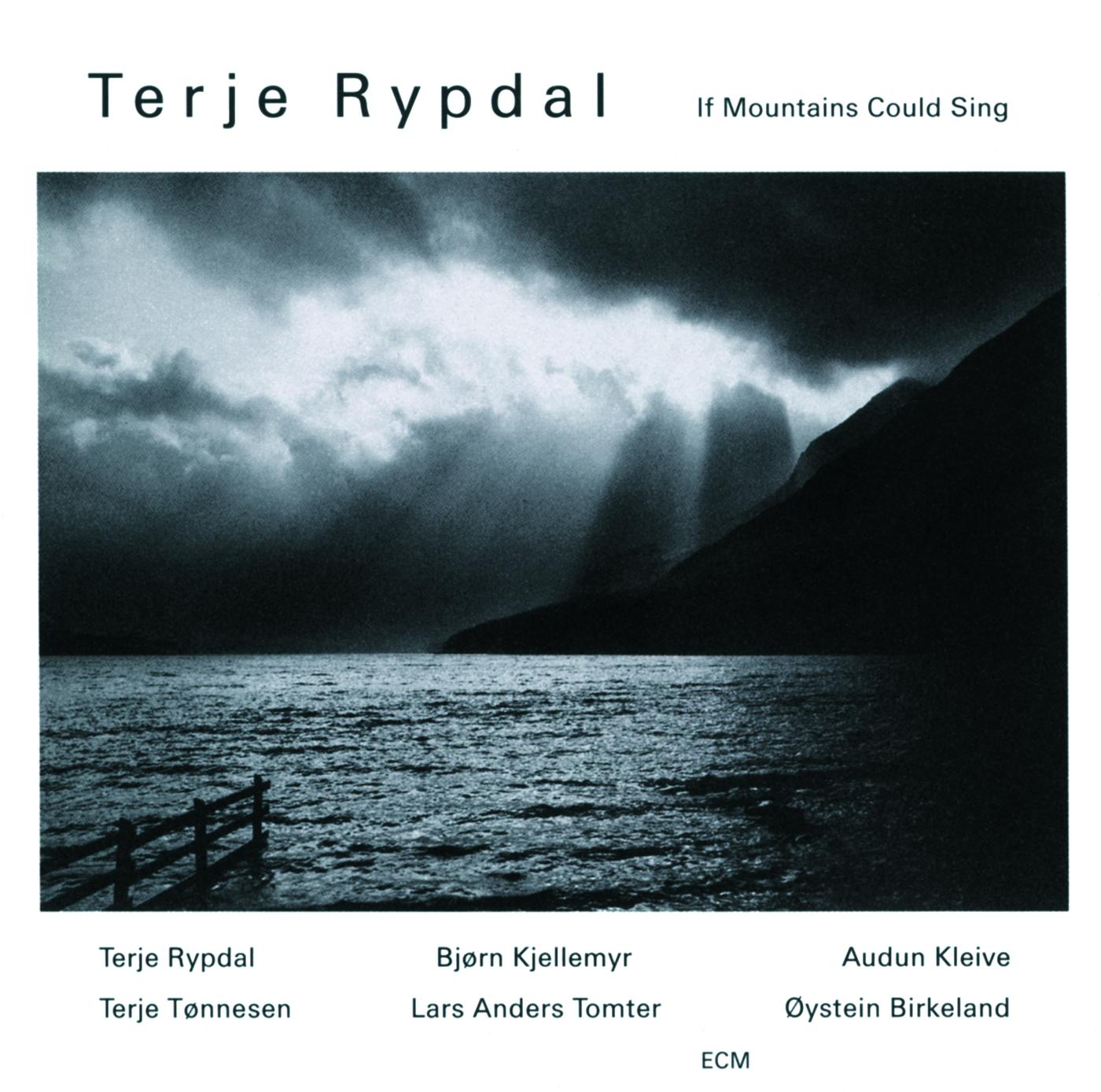
I start this review where I might end it, by marking If Mountains Could Sing as one of Terje Rypdal’s finest achievements. Marrying the Norwegian guitarist’s penchant for magnesium fire with his comparable passion for classical textures, this record gives us the clearest intersection of his split idiomatic personality since Descendre. “The Return Of Per Ulv” kicks off a journey that is modest in length—just shy of 48 minutes—yet anything but in scope and palette. Despite the odd title (“Per Ulv” being the Norwegian moniker for Wile E. Coyote), the smoothness of its melodic line, downright edible phrasing, and fluid bass playing (courtesy of Bjørn Kjellemyr) at once evoke snow and thaw, a landscape of discovery stretching beneath steel gray skies. If ECM were to make a single Best Of album for the label as a whole, omitting this one would be tantamount to crime. Running a close second is “Dancing Without Reindeers,” which after a pizzicato burst walks the violin off the plank into an ocean schooled by drummer Audun Kleive, who chronological ECM followers would have last heard with Jon Balke on Further. Kleive, in fact, shows incredible dynamic sensitivity throughout, supplying whispers of cymbal and snare in “It’s In The Air” and “Foran Peisen” as Rypdal awakens like some giant dragon from hibernation, splashing through the puddles of “But On The Other Hand” after a cosmic storm, and anchoring “Private Eye” with depth of experience. As for the composer behind all this, he breeds lifetimes of haze against tidal strings in the arresting title track and conjures up the object of Per Ulv’s ever-unrequited chase in “One For The Roadrunner” to gut-wrenching effect. The rhythm section gets its last gasp in “Genie” before he signs this love letter on a note of “Lonesome Guitar.”
Here we have a pinpoint of dawn stretched into a canvas large enough to fit any and all listeners. We can walk and admire, lounge or run as we please through its many moods, always knowing that the music is here for us and us alone. Open this door and don’t listen back.
<< Surman/Krog/Rypdal/Storaas: Nordic Quartet (ECM 1553)
>> Sándor Veress: Passacaglia Concertante, etc. (ECM 1555 NS)
Miklós Perényi violoncello
Recorded November 2009, Auditorio Radiotelevisione svizzera, Lugano
Engineer: Stephan Schellmann
Executive producer: Manfred Eicher
I first encountered Benjamin Britten’s opus 87, the 1971 Third Suite for solo cello, as played by Steven Isserlis, and in the towering company, no less, of John Tavener’s The Protecting Veil. Whereas there it came across as an unexpected, if enchanting, epilogue to the Virgin Classics release in question, here it opens an unquestionably cohesive program at the horsehairs of Hungarian cellist Miklós Perényi. Heard previously on ECM for a survey with András Schiff of Beethoven’s music for cello and piano, here he offers a distillation, a community of symbols rich in affect and unity. As Paul Griffiths notes, Perényi “is playing the cello to present music by Britten, Bach and Ligeti, and at the same time playing music by Britten, Back and Ligeti to present the cello.” Such is the circle of life—a circle that smiles and winks as much as it keens and weeps—that guides his craft and abets full disclosure of Britten’s abounding curiosity in the first of many shorter movements, its pizzicato mantra whispering beneath gravid suspensions from the bow. But there the solemnity ends, as the cello leaps from its pitted stasis and drapes itself like a ribbon from a branch swaying in the wind of the third movement. The fourth gives the most obvious shades of Bach, dancing through a jagged fifth and eighth, and swirling into the distended groans of the ninth.
In light—or is it dark?—of this flowing palindrome, the D-major Sixth Suite of J. S. Bach unfolds in an architecture as naked as Perenyi’s instrument. If its Prélude were any more immaculate in its affirmations, then its balance would crumble. The final note, here drawn without vibrato in pure and throated song, leaves us poised heavenward for the Allemande’s seesawing descent. A will to live pervades, seeming to clutch at earthly things as might a pauper’s hands to trinkets and baubles. The Sarabande is a thing of beauty (one that puts me in mind of Ingmar Bergman’s film of the same name) and passes us through the mimetic Gavottes before double stops galore surround us in the final Gigue.
György Ligeti’s Sonata (1948/53) expresses, like much of his chamber music, a world of ideas in relatively microscopic terms. Although a touch of humor nuances the title (this “Sonata” only has two movements), the goings on feel like darkness upon darkness. Alternating between lute-like strums and mournful bowings, the first half lends brightness to the second, which at its fulcrum returns to the fingers, spinning lyric from prisms and breath.
Perényi is that rare cellist who plays Bach as if for the first time while approaching less performed works like Britten’s as if they’ve always been here. It is the solitary pursuit of melody and time through an instrument corporeal, of which the cello is infant, elder, and every age between.
David Darling cello
Recorded July 1993 at Rainbow Studio, Oslo
Engineer: Jan Erik Kongshaug
Produced by Manfred Eicher
In the middle of the journey of our life I came to myself in a dark wood For the straight way was lost. –Dante Alighieri
Cellist David Darling continues where he left off on Cello, furthering the rings and grains of “Darkwood,” a multitracked suite drawn in otherwise acoustic measures, of which the latter four parts appear here. While such name might evoke visions of shadow and deepest night, each part starts its titled sections with anything but. Darkwood IV opens its eyes to the “Dawn” while V passes through “Light,” which marks the “Beginning” VI and illuminates downward to “The Picture” in Darkwood VII. The latter is one of the most heart-tugging pieces Darling has ever recorded, weaving tender threads of thought whose philosophies are drawn from the wayside where others have left their faith. Stained tones cradle us in cloud and wind, leveling stepwise motions into molasses tide, proceeding ever deeper into a monochromatic ceiling, at the center of which a light drives away the spirits of insects whose flights are captured “In Motion.” In the starlit expanse of these dreams, we step on floes of ice, each an eye closed by lids of water as it sinks.
Such are the stories, rising from within rather than falling from without. Plunged into the heavy pizzicato of “Earth,” Darling sparks kindling by torchlight, casting bones into a hearth of sky. In its smoke we find the fantasy of a folksong trembling in wake of sunset. Primal cry in slow motion, harmonic ostinato and trembling alto line—these connect one spirit to another and arch their heads, slingshots at the ready. Only instead of a sudden unleashing we get the meditative crawl of fadeout. “Searching” is the cello equivalent of Paul Giger’s “Birth Of The Bull,” which pries open its mortality to find that in death there is life, and in “Medieval Dance” we feel hands touching and releasing, bodies whirling in smoky midnight, following harvest and offering. This leaves only “Returning,” and the eclipse of “New Morning,” where hints of infinity plough and turn like the soil from which they were born, lustful for nothing but absence.
Ultimately, such (di)visions become as arbitrary as the names ascribed to them, etched as they are in perpetual cosmic change. They skip across the chasm of time, closing their parched lips around morsels of memory along the way. Darling bows his cello as if with a comet’s tail and leaves us similarly alone beneath a stretch of sky, harps at Poseidon’s call, hoping for that next chance encounter between perception and transience.
<< Eberhard Weber: Pendulum (ECM 1518)
>> Demenga/Demenga: 12 Hommages A Paul Sacher (ECM 1520/21 NS)