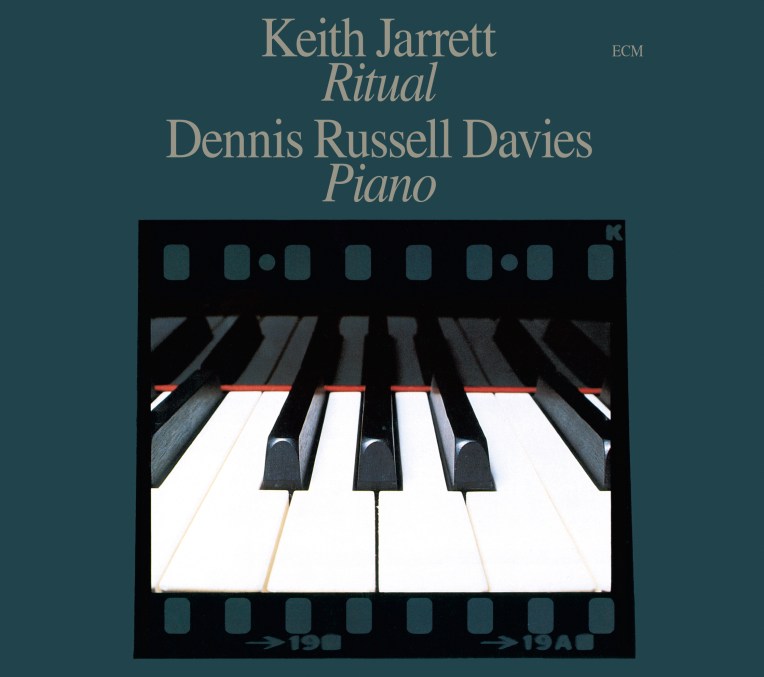
Keith Jarrett: Ritual (ECM 1112)

1112 X

Keith Jarrett
Ritual

Dennis Russell Davies piano
Recorded June 1977 at Tonstudio Bauer, Ludwigsburg
Engineer: Martin Wieland
Produced by Manfred Eicher

Ritual is something of an anomaly in the Keith Jarrett archive. It’s a solo album, as many of his best are, only this time it is pianist, conductor, and frequent collaborator Dennis Russell Davies at the keys playing a work penned entirely by Jarrett. The hallmarks of a Jarrett piano recital are all there—the rolling ostinatos, dense arpeggios, and profound doublings—yet are valenced differently under the rubric of “composition.” In this context, we get a sense of “once removed-ness” that might not present itself under improvisational circumstances. The piece’s modest 32 minutes are divided into two immodest parts. From the opening groundswell we get not only dense pockets of energy, but also nodes of emptiness. Put another way: the music’s glorious peaks share the same space as the shadowy valleys at their feet, thereby encompassing a harmonious middle ground. Like a geyser, its eruptions are predictable yet manage to enthrall every time. Despite its claustrophobic beginnings, Part 1 ends in bright solitude, like a room in which the curtain has been slowly opened to welcome the morning sun. Heavier chording marks Part 2, which resolves in a hopeful melancholy, but not before gelling the emotional plasticity of its precursor. This brings us full circle, ending on a solemn intonation of a single note.

Ritual is far more “regulated” than typical Jarrett fare, spun as it is from the surrogacy of another performer rather than through the alchemy of spontaneous creation (though there is, of course, some of each in the other). The results are captivating in their own way, stoked by every depressed key and lifted pedal. Its shapes are drawn not by what is, but what has been and will be. The present is invisible and lives on only as formless possibility, caught like a blown kiss in the cup of one’s hand.

<< Gary Burton: Times Square (ECM 1111)
>> Tom van der Geld and Children At Play: Patience (ECM 1113)
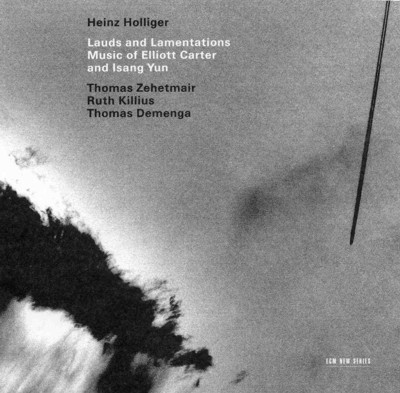
Lauds and Lamentations – Music of Elliott Carter and Isang Yun (ECM New Series 1848/49)

Lauds and Lamentations
Music of Elliott Carter and Isang Yun

Heinz Holliger oboe, English horn
Thomas Zehetmair violin
Ruth Killius viola
Thomas Demenga cello
Recorded September 2001 and February 2002 at Radio Studio DRS, Zürich
Engineer: Stephan Schellmann
Produced by Manfred Eicher

Elliott Carter is the Benjamin Button of contemporary music: the more he ages, the more youthful he seems to become. At the time of this writing, he’s still going strong at 102. That being said, his is not an endeavor to overcompensate for a fading mortality, but rather a deeper exploration into a key aesthetic of his entire output: possibility. What that possibility looks like depends entirely on the whim of the moment, the colors of scoring and performance that mark his oeuvre at all stages.

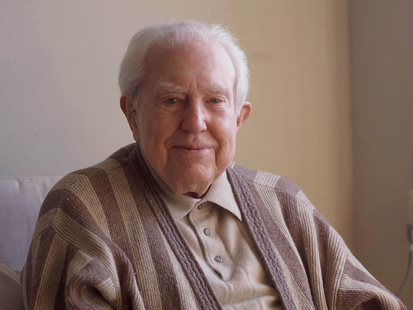
Elliott Carter (photo courtesy of The Arts Fuse)

The Oboe Quartet of 2001 is a quintessential example of Carter’s tightly wound exuberance. While distinctly “modern,” there is something downright fun about the piece. It is playful, inventive, and positively bursting with life. And who better than Heinz Holliger to act as its heliocenter? Here is a musician who not only plays the oboe as if it were a part of him, but who also brings a singular admiration for Carter to light in every measure. The quartet is a peanut gallery of moods, some meditative and others jarring, each more fascinating than the last. The final passages show especial and intensive concentration. After this 17-minute chunk of gravid whimsy, the 4 Lauds (1999/1984/2000/1999) for solo violin pat the cheeks of our comatose inner children into wakefulness. Each has its center—be it a note, an atmosphere, a statement, or a phrase—from which emanates a fresh start. A 6 Letter Letter (1996) for English horn in F scales a modest cliff, reaching at last with its final hand-crawl the horizontal plane it seeks. The tongue-in-cheek Figment (1994) for cello alone unfolds like a beautiful lie, for which its companion, Figment II: Remembering Mr. Ives (2001), provides gorgeous contrast with its lower microtonal vowels and high-pitched consonants.

Isang Yun (photo courtesy of Boosey & Hawkes)

The pairing of Carter with Korean dissident Isang Yun (1917-1995) is more than circumstantial. Theirs is an inexplicable sort of affinity. Where the former elicits winsome optimism, the latter drowns us in ceremony. Piri (1971) for solo oboe solo is a discipline in and of itself. Spurred by Holliger’s focused tone, it spins themes from the thinnest of fibers. This deeply internal sense of space and accumulation is expanded in Yun’s own Oboe Quartet of 1994, which skitters sideways like a crab on sand. Over three densely packed movements it starts in collective naivety before falling to its knees amid the slowed air raid sirens at its center. A potentially lucid finale is hinted at through a memorable trill shared between oboe and violin, only to crack under the pressure of earthbound agitations.

For the two oboe quartets featured on Lauds, we must thank Heinz Holliger, who asked both composers to write pieces for this neglected configuration, as yet “unchallenged” since Mozart. Both receive their world premiere recordings here and glisten with the golden seal of any benchmark achievement. The musicians on Lauds are all ideally suited to the material and its “linguistic” stumbling blocks. Thomases Zehetmair and Demenga (both ECM mainstays) and Ruth Killius (violist of the Zehetmair Quartett) round out the limitless talents of Holliger in a program that is sure to yield many new discoveries for years to come.

Arvo Pärt: Orient & Occident (ECM New Series 1795)

Arvo Pärt
Orient & Occident

Swedish Radio Symphony Orchestra
Swedish Radio Choir
Helena Olsson soprano
Tõnu Kaljuste conductor
Recorded May 28 – June 1 2001, Berwaldhallen, Swedish Radio, Stockholm
Engineers: Jan B. Larsson, Anders Hägglöf, and Rune Sundvall
Produced by Manfred Eicher

The name of Arvo Pärt has become something of an institution in the consumer culture of classical music. The “New Spiritualism” heralded by such seminal recordings as his Tabula rasa and Te Deum crystallized a sentiment that listeners were craving in the ruins of a postmodern malaise. Yet with this music came a host of expectations: it was supposed to heal us, guide us to an inner light, and provide an inexpensive and convenient means of achieving (temporary) peace. It was something to rely upon, a sonic friend that would never leave us. In believing this, however, we began to lose sight of our own powers and the tremendous dependence we were placing upon recorded media to wrestle with moral dilemmas in our stead. Beautiful and, yes, spiritual though these media are, they can never be a substitute for the enlightenment we read into them.

The frame of Orient & Occident captures the dark side of Pärt’s compositional moon. Stand too close to it, and its darkness overwhelms; too far and it becomes a mere block of shadow. Wallfahrtslied (Pilgrim’s Song), a German setting of Psalm 121, positions us at a median distance and allows us to appreciate the best of both worlds. Composed in 1984 in memory of the composer’s close friend, Estonian director Grigori Kromanov, and since revised for men’s choir and strings, it is a harrowing slice of emotion. The music seems to grit its teeth in a slow, seething discontinuation as voices lay themselves at the orchestral altar. Strings try to remain passive, yet cannot help but break free from their subordinate position with cries of supplication. Before long, they stretch themselves into the thinnest of layers, through which one may see the translucence of the “self” and the “other” and acknowledge that the same light passes through and gives both substance.

The seven-minute title composition, penned in 2000, is for strings only and continues the path that Pärt first began laying with Psalom and Trisagion. It is a grand statement, to be sure, but works its effect through tiny sonic miracles and primes us for the sojourn that awaits us in Como cierva sedienta (1998), a Spanish setting of Psalms 42-43 for women’s choir and orchestra. Exquisite winds recall 1989’s Miserere and rock like a cradle for soprano soloist Helena Olsson’s spiraling invocations. This is music firmly entrenched in its surroundings, while also content to break free from its compulsory resolutions. Strictly choral passages add pastoral unrest. Words tumble out of their own volition, filled with outbursts and infectious proclamations. Like the soul in this final Psalm, downcast even in the light of salvation, I realize that I fall into traps only of my own making. Every time I pull myself out of one, I am reminded that sounds like these are more than incidental to that struggle. Rather, they embody it to the fullest, a collective reminder of the physicality of living experience and the lessons it provides.

The title of Pärt’s eighth ECM album makes me think of colonialism and its feeble justifications for subversion. That being said, I don’t think this is what the music is about. It deals instead with the gap that links these two words and the sacrifices that fill it with song. It is the blood flowing through that emptiness, and we the plunger pulling back to suction out the contagion of enslavement that prevents us all from staring into the face of love.

<< Frode Haltli: Looking on Darkness (ECM 1794 NS)
>> John Surman/Jack DeJohnette: Invisible Nature (
ECM 1796)

Juliane Banse/András Schiff: Songs of Debussy and Mozart (ECM New Series 1772)

Juliane Banse
András Schiff
Songs of Debussy and Mozart

Juliane Banse soprano
András Schiff piano
Recorded January 2001, Reitstadel, Neumarket
Engineer: Stephan Schellmann
Produced by Manfred Eicher

Sometimes one can set aside the reputations of composers and simply enjoy their music. This recital of songs by Mozart and Debussy, performed by an equally unlikely pair in pianist András Schiff and soprano Juliane Banse, however, simply overflows with its creators’ indelible marks. With a hefty dose of poetry, from French symbolists to Goethe, at hand, we’re the lucky ones who get to connect the dots in a constellation of unusual proportions.

Schiff’s well-spaced articulations and Banse’s meticulous control of tone make for a most fitting vehicle for the evocative Beau soir (Beautiful evening) of Debussy that introduces the program. Clair de lune (Moonlight) very much recalls the songcraft of Poulenc and enchants with its opening line from Verlaine: “Your soul is a chosen landscape…” Such cerebral storytelling continues through Pierrot to the equivocal Apparition. Dissonances in En sourdine (Muted) and the almost Carmen-like pastiche of Fantoches (Marionettes) add bolder hues. Verlaine’s careful words reappear in C’est l’extase langoureuse (It is languorous ecstasy), in which Banse pines:

This soul which mourns
In the subdued lamentation,
It is ours, is it not?
Mine, say, and yours,
Breathing a humble anthem
In the warm evening, very softly?*

These songs are not without their programmatic gildings, as in the cascading pianism of Il pleure dans mon cœur (Tears fall in my heart) and the thrilling chording of Chevaux de bois (Merry-go-round). Many adjectives come to mind when trying to describe these miniatures, but the one that resounds most for me throughout this recording is: clear. Like fresh light poured upon the morning fields, they nourish like no other stimulant.

Where Debussy works in more horizontal, sinuous gestures, Mozart brings potent verticality. Though a few of his Lieder, such as Warnung (Warning), bristle with the stately charm we popularly associate with the Salzburgian wunderkind, we cannot help but be delighted by the playful strains of Der Zauberer (The sorcerer), which likens the flames of passion to the dark magic of an eager pursuer. The little fable of Das Veilchen (The violet) gives voice to the desires of its titular flower, who spots a frolicking shepherdess. The violet dreams of being plucked and pressed to her bosom, only to be trodden as she skips ignorantly past. Its last sentiments:

“If I must die, at least I die
Through her, through her,
Here, at her feet!”

The recital closes with Abendempfindung (Thoughts at eventide), in which Joachim Heinrich Campe bids his loved ones not to fall too deeply into grief upon his death, promising to be there with open hands to carry them into heaven:

Bestow a tear on me and be
Not ashamed to weep for me,
For this tear shall be the finest
Pearl within my diadem.**

These songs are simply fascinating, and all the more so for being programmed together. Within them are many discoveries to be had. Banse and Schiff are so exacting that one almost imagines the music as having been written for them. An altogether captivating album that is as capricious as it is austere.

* Translation by Winifred Radford.
** Translation by Lindsay Craig.

<< Alexei Lubimov: Der Bote – Elegies for Piano (ECM 1771 NS)
>> Giya Kancheli: Diplipito (ECM 1773 NS)

Zehetmair Quartett: Schumann (ECM New Series 1793)

Zehetmair Quartett
Robert Schumann

Zehetmair Quartett
Thomas Zehetmair violin
Matthias Metzger violin
Ruth Killius viola
Françoise Groben cello
Recorded August 2001, Radio Studio DRS, Zürich
Engineer: Stephan Schellmann
Producer: Manfred Eicher

Composed during the summer of 1842, Robert Schumann’s three string quartets bear dedication to Felix Mendelssohn and are his only chamber works without piano. A few years before their appearance, while sitting in on a series of quartet rehearsals led by Mendelssohn’s friend and concertmaster, Ferdinand David, Schumann was first struck by the greatness that Ludwig van Beethoven had brought to the form. Determined to match that greatness, he found himself obsessed by “quartettish thoughts” and ready to tackle the form at which he had long desired to try his hand. He set out on the daunting task of writing his first quartet. Sadly, this piece did not survive, but we do have the subsequent threesome that is his Opus 41, of which two have been recorded for this instant reference recording.

Schumann struggled with inner demons all his life in a constant balancing act between his burgeoning romanticism and intellectual acumen. It was only in Beethoven’s titanic and immovable reputation, says Martin Meyer in his liners, that Schumann turned to both internal and external sources for inspiration. Where Beethoven’s “absolute” approach seems to cast the greater shadow, this is as much due to the inordinate amount of light shed upon it as to any inherent superiority. Schumann’s programmatic idiosyncrasies provide as much fascination, and these the Zehetmair Quartet brings out at every turn.

The fluidity of the String Quartet No. 1 in A minor is surpassed only by that of the performance itself. The Mendelssohn-influenced Scherzo brings the gelatinous bones of the Introduction to vibrant life with palpable connective tissue. The results are playful yet graceful, honed in rustic elegance in spite of their aristocratic borrowings. After a speculative Adagio, we arrive at the scraping violin and resplendent tutti passages of the Presto. Such alluring energy leaves us in need of the Andante that opens the String Quartet No. 3 in A major. A beautiful legato theme, eerily similar to the central oboe/flute passage in Tchaikovsky’s “Waltz of the Flowers,” emerges in the violins. Zehetmair moves like a breeze across water, while the others capture every wave of sound with unbending accuracy. Muted strings in the second movement build to a rousing density that is easily the disc’s highlight. Pizzicato strings enchant in the third, while the masterful Finale inspires with its urgency.

With the string quartets Schumann tightened his grasp of modality in a careful exchange of sentiment. There is what Meyer calls a “clouded lyricism” throughout these ternary works that is enhanced all the more by the enlivening performances on this recording. And while the fact that it won the Gramophone Award for Album of the Year is no small consolation prize, it seems but an afterthought when reeling from the music that earned it.

<< Anouar Brahem: Le pas du chat noir (ECM 1792)
>> Frode Haltli: Looking on Darkness (
ECM 1794 NS)

Gideon Lewensohn: Odradek (ECM New Series 1781)

Gideon Lewensohn
Odradek

Auryn Quartet
Matthias Lingenfelder violin
Jens Oppermann violin
Stewart Eaton viola
Andreas Arndt cello
Alexander Lonquich piano
Gideon Lewensohn piano
Recorded February 2001 at Radio DRS, Zürich
Engineer: Stephan Schellmann
Produced by Manfred Eicher

Israeli composer Gideon Lewensohn splashes onto ECM New Series with Odradek, a program of intriguing, sometimes perplexing, but always gripping music. The Piano Quintet is exemplary of Lewensohn’s odic approach, paying homage to his own brother Micah, as well as to György Kurtág, the Hilliard Ensemble, George Rochberg, and Dmitri Shostakovich. And while more than a smidgeon of each movement’s namesake is palpable, even more so is the freshness of a unique voice in contemporary music. These are not the seemingly perfect circles of ripples in a pond, but rather the jagged and frothy edges of an immeasurable shoreline. The first movement is a cycle in reverse. Violins pull like hands from a gooey mass clutching the prize they so desperately sought, only to realize that its virtues have all but been destroyed in the process of discovery. The second movement skitters like glass, shifting through high harmonics and mysterious refractions. In the third movement the cello at last groans from the underworld. With the circling birds of high violins now gone, it is free to peek its head above the surface and divine its own shadow. The fifth movement is the most violent, its controlled chaos spiraling ever downward into magma. These honorary fragments continue in the title quartet with further nods to Giya Kancheli, Witold Lutosławski, and Gustav Mahler, among others. Other descriptors are more subjective, charting moments of paranoia, drunkenness, and distortions of time. Still others bear whimsical subtitles like “Sarabandoned” and “Epiloque.” Each is a drip through a semantic IV in which the sublime and the violent are equal medicine. Bookending the Quartet are two iterations of the Postlude for piano. With every protracted fall into joy, moments of dynamic increase seem more like extensions of a default quietude rather than ruptures of it.

To be sure, Odradek is an uneasy place to be, but one that offers up its own fascinations with contemplation. The music responds just as well to abandonment as it does to undivided attention and maps its footsteps on the bodies of each high-caliber performer. Instruments are re-clothed and compressed into seeds before being scattered across a barren field that only now flourishes to make up for lost time. We are the reapers here, our scythes raking together every husk of this brilliant crop.

<< Keith Jarrett Trio: Inside Out (ECM 1780)
>> Thomas Demenga: Hosokawa/Bach/Yun (
ECM 1782/83 NS)

Helmut Lachenmann: Schwankungen am Rand (ECM New Series 1789)

Helmut Lachenmann
Schwankungen am Rand

Ensemble Modern
Peter Eötvös conductor
Recorded November 1998 at Alte Oper, Frankfurt (Schwankungen am Rand); November 1994 at Radiostudio Hessicher Rundfunk, Frankfurt
Engineers: Rüdiger Orth and Wolfgang Packeiser (Schwankungen am Rand); Udo Wüstendörfer
Produced by Manfred Eicher

“Enigmatic” doesn’t even begin to describe the music of Helmut Lachenmann, a composer who had for decades been charting a most distinct path in the world of sound unknown to most listeners outside of Europe until this, his first New Series release. Like the work of mentor Luigi Nono, Lachenmann’s sonic project seems bent on sidestepping tradition, all the while plumbing its very depths for inspiration and raw material. His polemics are genuinely concerned with their origins, of which the compositions surveyed here constitute a solid mythos.

Despite its porous structure, Lachenmann’s music is not something one enters into lightly. Take, for instance, the disc’s eponymous work of 1974/75. Translating as “Teetering on the Brink,” the title is as much a state of mind as it is a descriptor. The music seethes like an unprocessed emotion threatening to overtake the wounds that bore it. Whereas its featured percussion instruments produce viable utterances no matter how they are struck or manipulated, we almost never hear any stringed instrument played in the manner for which it was intended—only the tuning of violin pegs, but no bows to “justify” their adjustment. Snatches of electric guitar, sine wave-like whines, and underbelly rumblings constitute a turgid and unnavigable topography. A disembodied voice gives a Kabuki musician’s “Hup!” As if to intensify the analogy, wood claps, crunchy yet delicate, move across the stage as if kneeling, labored like the beaten metal thunder sheets that tremble above them. There is never any storm, only the pronouncements of Mouvement (- vor der Erstarrung) für Ensemble (Movement before Paralysis), composed between 1982 and 1984. With pathos restored, we can grasp strings again like vines in a broadening jungle. After a winding bell, woodwinds spin breath into more discernible vocabularies, a colony of semantic mice scampering through the orchestra room after being locked up for the night. The disc ends with the newest work, 1992’s …zwei Gefühle… (…Two Feelings…) for speaker and ensemble. Based on texts by Leonardo da Vinci, it was later dropped into the complex folds of the composer’s opera, Das Mädchen mit den Schwefelhölzern. Further protractions and creaking floorboards abound in this weathered vessel, raising its voices only rarely for benefit of our attention. Comprehensibility is wrought by the purity of the utterance, scripted in a clear and present language. These constant dictations lend the instruments a blatantly subjective quality that never wavers.

In his liner essay, Jürg Stenzl paints a portrait of Lachenmann as one who “himself views the composer as a person who obeys tradition by prolonging it rather than clinging to a misconception that rigidly equates ‘tradition’ with its misguidedly idyllic aspect.” In other words, what seems haphazardly thrown together here can only be meticulously ordered, tied up in crisp packages and offered to us like an array of sweets upon a well-worn tray. His is a world in which the parameters of understanding are a Möbius strip that we fear to tread upon and yet from which we cannot look away. And so, we sketch it on paper, that we might memorialize its effect without ever having fallen into its permanence. In this way, every line comes to have its hallowed place.

<< Tomasz Stanko Quartet: Soul of Things (ECM 1788)
>> Valentin Silvestrov: Metamusik / Postludium (
ECM 1790 NS)

John Holloway: Unam Ceylum (ECM New Series 1791)

Heinrich Ignaz Franz Biber
Unam Ceylum

John Holloway violin
Aloysia Assenbaum organ
Lars Ulrik Mortensen harpsichord
Recorded May 2001, Propstei St. Gerold
Engineer: Stephan Schellmann
Produced by Manfred Eicher

Much of what the classical listener hears in recent recordings of Baroque music is cluttered with ornamentation, overbearing virtuosity, and fresh takes on the tried and true. In short, a little too much fuel where already there is fire. Such innovations aren’t necessarily a detriment to the industry, as they can (and do) inspire new generations of listeners who may not have a taste for what they consider to be “staler” interpretations. Still, there is something to be said for the straightforward and the cerebral. Thankfully, the ECM albums of violinist John Holloway are here to provide a happy compromise between the two camps, playing with humility music that is already a raging conflagration amid a growing pile of neglected aural kindling.

Though I am compelled to praise the works of Heinrich Ignaz Franz Biber (1644-1704) for their sagacity, inventive scordatura tunings, and an indomitable spirit that seems to leap from every phrase, I am all the more boldly struck by their descriptive qualities. The sonatas on Unam Ceylum are taken from a 1681 anthology and include at least one (No. 84) never before committed to disc. In the company of Holloway and his esteemed colleagues, the composer’s descriptivism is given full reign. Building off the somewhat controversial success of its earlier Schmelzer recording, the trio sets the violin afloat upon an innovative continuo of harpsichord and organ.

Biber has a way of painting full-fledged dramas in but a single stroke of the bow, and indeed these sonatas would seem to thrive on stage, each a different scene in an overarching play. Some depict dancing and courtly romance, while others ooze with nostalgia for bygone days. The Sonata III in F majorprovides our opening act, evoking everything from birdcalls to tempests. The four-handed (and two-footed) continuo adds intrigue to an already fleshy plot. Mortensen follows wherever he is led. Assenbaum adds a touch of vaulted beauty. The latter shares a particularly enraptured passage with Holloway, who then transposes the bass line over a harpsichordic run before ending on a fast, unresolved note at the very peak of emotion. The somber drawl of Sonata IV in D major makes for an undulating segue into Act II, brought to jovial light in the unpublished Sonata No. 81 in A major. Its playful, teasing tone delivers what it promises in dense ascents, diffused by a scattered finish. The Sonata VI in C minortwists itself into a tantalizing climax from modest beginnings. After a positively lovely organ introduction, its rubato journey pulls us through edgier continents, all too soon alighting on forlorn shores. The G-major Sonata VII is a mixture of sadness and frivolity leading us into to the Sonata No. 84. It is here where finality comes to light, allowing Holloway the last word in ecstatic tangents. Yet again we are left hanging in delightful anticipation. This lends the music further commensurability and allows us to return to it eager for new details to emerge, which they inevitably do.

Though I began by downplaying virtuosity a bit, I cannot help but give a heavy nod to these musicians for theirs and the clarity it produces. Through the force of his vision, Holloway plays with this clarity to dazzling effect, never straying far from the printed score. He has completed his survey of the 1681 Sonatas with a follow-up album that also includes Muffat and which deserves a seat alongside this phenomenal start. Played as pristinely as it is recorded, this is a set to be savored.

<< Valentin Silvestrov: Metamusik / Postludium (ECM 1790 NS)
>> Anouar Brahem: Le pas du chat noir (
ECM 1792)

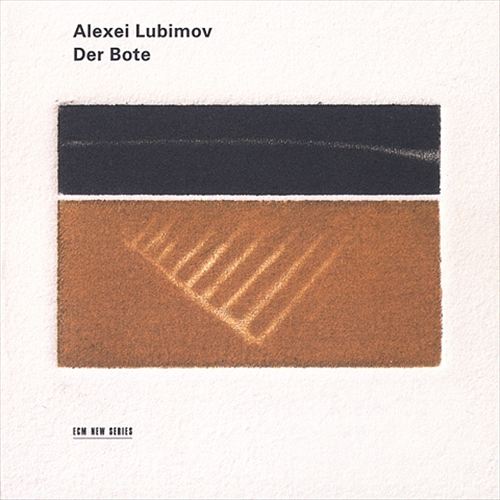
Alexei Lubimov: Der Bote – Elegies for Piano (ECM New Series 1771)

Alexei Lubimov
Der Bote – Elegies for Piano

Alexei Lubimov piano
Recorded December 2000, Radio DRS, Zürich
Engineer: Peter Laenger
Produced by Manfred Eicher

The title of Alexei Lubimov’s second recital for ECM translates as “The Messenger,” and perhaps no more fitting sobriquet could apply to the Russian pianist in this collection of ten elegies spanning three centuries. In opening with Carl Philipp Emanuel Bach’s Fantasie für Klavier fis-Moll, Lubimov provides something of a meta-statement encompassing all that follows. After a dream-like introduction, both musician and composer throw the listener for a loop with a burst of virtuosic splendor before returning to slumber. The music is rooted at the outer cusp of the Baroque while also far ahead of its time in scope and romantic flair, and pairs surprisingly well with John Cage’s In a landscape. The latter receives a uniquely spirited treatment here. Comparing this to Herbert Henck’s ECM recording of Cage’s early piano music, on which a slower read adds four minutes to its duration, one hears it rather differently. Lubimov’s playful undulations recast the piece’s depth of immediacy in quickly flitting shadows. Either way, it is achingly beautiful, a singular composition from a composer whose melodic humility remains unparalleled.

The fumbling dance of Tigran Mansurian’s Nostalgia hints at revelry but succumbs to meditation, while the Abschied of Franz Liszt provides our steadiest elegiac thread so far that moves with the sway of windblown branches. Mikhail Glinka blots our vision with nostalgic hues in his Nocturne f-Moll “La separation, a faded photograph lost in the pages of a dusty book, in which one may pore over Frédéric Chopin’s Prélude cis-Moll op. 45. It is a tale of sorrow, fading in on the stagnant lake of an abandoned estate, long overgrown with neglect. Beam by beam the mansion crumbles, until fireflies take the place of the footsteps that once dotted its halls: a thousand years of history condensed into six minutes. The abstractions of Valentin Silvestrov’s Elegie are like the ghosts left behind, fractured through the passage of time and made visible by the glow of introspection. In the Elégie of Claude Debussy, we are distracted by a passing mysticism, swept by the wind into the light of daybreak far from our own. Alone and without recourse, we seek shelter in Béla Bartók’s Vier Klagelieder op. 9a, Nr. 1, finding in its sweeping gestures and impressionist fades the key to Silvestrov’s title work that finishes. A gorgeous deconstruction of Mozart in a kind of haunted chamber, it is a touch upon the shoulder from the afterlife. By its last note, one wonders whether it ever really existed.

Lubimov is a pianist who understands music’s humble beginnings. He cradles every note like a wounded bird, nurturing it with grace until it is well enough to fly on its own. Equally intelligent programming makes this a disc to remember, if not forget like the memory of a past too beautiful to reproduce with any claim to faith. But this he does, and with a quiet passion that welcomes us with open arms.

<< John Abercrombie: Cat ‘n’ Mouse (ECM 1770)
>> Juliane Banse/András Schiff: Songs of Debussy and Mozart (
ECM 1772 NS)