Ensemble Belcanto: Come un’ombra di luna (ECM New Series 1739)

Come un’ombra di luna

Ensemble Belcanto
Dietburg Spohr mezzosoprano, director
Birgitta Zehetner mezzosoprano
Andrea Baader soprano
Rita Huber soprano
Dzuna Kalnina alto
Rica Rauch alto
Recorded January 2000 at Festeburgkirche, Frankfurt am Main
Engineer: Markus Heiland
Produced by Manfred Eicher

I have at home a blue piano
and yet know no note.
–Else Lasker-Schüler

My first encounter with Ensemble Belcanto was on an extraordinary recording of Klaus Hinrich Stahmer’s Hommage à Daidalos on the ProViva label, which combined Belcanto’s rich voices with the sound sculptures of Elmar Daucher (whose resonating stones also found their way into ECM via Stephan Micus’s The Music Of Stones). The ensemble was formed in 1986 by mezzo-soprano Dietburg Spohr as a springboard for new music activity and has since honed its skills in a variety of percussion instruments. The ensemble’s depth of performance is clearly seen in Haim Alexander’s Mein Blaues Klavier (1989-90), a setting of four poems by Else Lasker-Schüler. Although the piece inhabits a tight chromatic range that steps just beyond one octave, the singers manage to expand its borders through a wealth of gingerly applied drums, gongs, triangles, and other accentuating paraphernalia. The ritualistic arrangements lend the voices a flavor of incantation, each word seeming to bring about a discernible change in the music’s countenance. Mein Blaues Klavier is severely analytical without being clinical, especially in its final section, in which repetitive clangs probe deeper into self-inflicted wounds.

This is followed by two a cappella settings. The first, Konrad Boehmer’s Un Monde Abandonné Des Facteurs (1996), is a wavering slog through its text. The composer’s Darmstadt School roots are on full display, voices bristling with his teacher Stockhausen’s same penchant for the instability of the utterance. The 1997 title composition comes from Fabrizio Casti. His is a haunting weave of darkness and light that burns like the calls of sirens in one’s head.

We close with Wolfgang Rihm’s Séraphin – Stimmen (1996), a magnificent cartographical exploration of wordless territories. It is the most minimal piece on the album, and all the deeper for it. Rihm’s use of percussion is most adept, and seems to be directly influenced by Noh theatre, where a single wood clap can accentuate an emphatic syllable, and where the beat of a drum can synchronize an action or gesture, infusing it with intense programmatic effect. Also like Noh, the piece makes the most of silence and its implied sense of movement. And in fact, the entire album has the feeling of something staged, inhaling and exhaling through its dramaturgy.

While every voice here is superb, Spohr’s stands out for its technical breadth and for possessing one of the most engaging vibratos I have ever heard. The ensemble as a whole shapes every syllable with strict attention, elongating certain syllables and severely shortening others. Such textual detail is always such a pleasure to hear, for rather than trying to fit a text into a predetermined musical structure, Spohr and her companions adapt their sound to emergent vocal surroundings. Again, this speaks to an explicit root in drama, for ultimately these pieces are like plays of the mind, populated by characters of one’s own making.

<< Michael Mantler: Hide and Seek (ECM 1738)
>> Bobo Stenson Trio: Serenity (
ECM 1740/41)

Bach: Goldberg Variations – Schiff (ECM New Series 1825)


Johann Sebastian Bach
Goldberg Variations

András Schiff piano
Concert recording, October 30, 2001 at the Stadtcasino, Basel
Engineer: Stephan Schellmann
Produced by Manfred Eicher

“This is one of those few journeys that can be repeated again and again.”
–András Schiff on the Goldberg Variations

Bach, says Schiff, “was a composer with encyclopedic ambitions.” As such, one might say that the Klavierübung—of which the Goldberg Variations are the crowning jewel—was as much an attempt to fill in a musical gap, if not to elevate a preexisting one, in a form so concise that no one could claim its place. In their profoundly moving dance between the Apollonian and Dionysian, the Variations fold and refold themselves like a constantly shifting origami figure reusing the same sheet of paper. Likewise, the collection begins and ends with an all-encompassing Aria, so that by the end one spreads that sheet out to reveal a tightly knit symmetrical pattern of inimitable proportions.

As with any pianistic interpretation of Bach, debates over medium abound. Whatever your instrumental preference, however, I put forward that Schiff’s clarity transcends any and all technical concerns. And let us not forget that the success of any recording lies as much in the hands of its engineers, instrument makers, and tuners. The clarity of this particular ECM recording, and its marriage with Schiff’s performance, is particularly refreshing, for it gives each variation such a firm position in the greater scheme of its placement that we cannot help but become utterly invested in its brief traversal. Schiff’s surgical precision lends itself particularly well to the faster variations—Nos. 1, 5, 8 (a personal favorite), and 21—as it gives them just enough added vigor to make them spring from their cages. For the slower variations—particularly Nos. 9 and 15—this approach means a validation of brevity, emboldening as it does the delicate lines they walk between speech and song. As for the more heavily syncopated numbers, such as 4, 7, 12, and 16, this feeling descends into one of rootedness. For me, Variation No. 14 is the prize and Schiff handles its demanding trills and hand-crossings with the utmost fluency, providing us with more than enough energy to work our way to the Aria’s reprise.

Listening to Schiff play Bach is always an uplifting experience, and nowhere more so than here. The palpable bond between him and the music speaks of a mutual love. The recording scintillates throughout, but is a live one, so everything from piano dampers to the occasional cough comes through. It is worth having in physical form for Schiff’s whimsical “guided tour” of the Variations included in the booklet. While this has the makings of a benchmark recording, I recommend that you also check out Keith Jarrett’s ECM recording of the same on harpsichord. The two make a lovely pair.

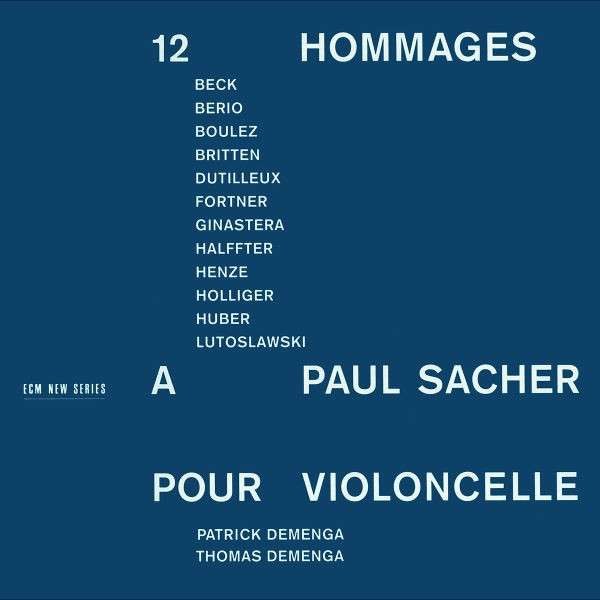
12 Hommages A Paul Sacher (ECM New Series 1520/21)

12 Hommages A Paul Sacher

Thomas Demenga
Patrick Demenga
Jürg Wyttenbach Conductor
Recorded June 1993, Kirche Blumenstein, CH
Engineer: Teije van Geest
Produced by Manfred Eicher

Before first encountering this recording, Paul Sacher was an unfamiliar name to me. Now that the album has been with me for fifteen years, it is a name I cannot forget. Sacher (1906-1999) was a Swiss conductor and patron of the arts who championed all of the composers represented in this 2-CD tribute. His wealth and musical acuity led him to commission some of the most defining works of the twentieth century. Without him we wouldn’t have, for example, Bartók’s Music for Strings, Percussion, and Celesta or Stravinsky’s Concerto in D. For this project, realized in commemoration of his 70th birthday, a choice group of composers were commissioned to write pieces for cello around the so-called “Sacher hexachord,” a tone row derived from Sacher’s name: Eb=Es A C B=H E D=Re. The concept is similar to that of the B-A-C-H motif (Bb=B, A, C, H=B natural), which has been incorporated into works by, among many others, Liszt, Busoni, Pärt, Webern, and Bach himself (see ECM’s Ricercar for a creative juxtaposition of the latter two). The project was originally spearheaded by Mstislav Rostropovich, but has been recorded here with requisite flair by Thomas and Patrick Demenga.

At the heart of this project is Benjamin Britten’s Tema, the most straightforward iteration of the Sacher theme. Originally, the other composers were asked to simply write variations thereof, but their ideas soon developed into full-fledged pieces in their own right. Alberto Ginastera’s Puneña No. 2, Op.45 immediately draws us in with its keening melody, crying out like a hawk losing sight of its prey. The majestic bird tears at the sky as it would the earth, eliciting a flurry of virtuosic leaps and plucked asides. Each whispered harmonic lifts the bird with the silent power of a thermal. But then the prey is spotted, and falls as if pierced by an arrow from its hunter’s very gaze. Agitated pizzicati scamper like the rodent’s ghost into a dense thicket of trees as the hawk raises calls of revelry and tears its meal limb from limb. To my ears, this is one of the most technically demanding pieces on the album, sometimes requiring the cellist to pluck with the left hand while bowing with the right. Wolfgang Fortner’s Zum Spielen für den 70. Geburtstag – Thema und Variationen für Violincello solo is a more somber affair, its flashes of consonance piercing the surrounding dissonant fabric with divine light. The Capriccio by Hans Werner Henze is among the more cryptic pieces. Its complex narrative and subtle details beg repeated listening. This is followed by a string of vignettes. Of these, Henri Dutilleux’s 3 Strophes sur le nom de Sacher and Witold Lutosławski’s Sacher-Variationen are remarkable. Both give us a “conversational” portrait, perhaps reflective of the relationship either composer may have had with the man behind the music, for like a conversation among friends these pieces are fraught with conflict and agreement in equal measure. They are also very “alphabetic” and are perhaps the most committed to the their morphological assignment. Cristóbal Halffter seems to take a similar tack in his Variationen über das Thema eSACHERe, while Conrad Beck and Luciano Berio opt for a more concise approach that favors melodic dissection over prosody. By far the longest piece is Klaus Huber’s Transpositio ad infinitum – Für ein virtuoses Solocello, another compelling delineation of attenuate character and detail. Following this, Heinz Holliger yet again flexes his brilliant compositional muscle with the Chaconne für Violoncello solo. This rather enumerative piece makes apt use of the acoustics of the recording space and exploits the incidental sounds of the strings against the fingerboard as a sort of parallel dialogue. And just when we begin to suspect all possibilities have been exhausted, Pierre Boulez, ever the nonconformist, throws us for a loop with his Messagesquisse for seven cellos, which seems to blend all that came before until smooth.

Even though all of this music inhabits the same landscape, each piece digs up its own relic and turns it into music. The album is passionately performed, and recorded in clear and present sound. It is a unique testament to a unique individual, one that unlocks Sacher in a way those of us who will never know him cannot ever experience otherwise. Essentially, it is the Sacherian equivalent of A Hilliard Songbook, for just as the latter would not exist without the Hilliard Ensemble, so too is this album a timeless memorial to a figure whose absence might have effectively erased an entire generation of masterworks.

<< David Darling: Dark Wood (ECM 1519)
>> Charles Lloyd: The Call (ECM 1522)

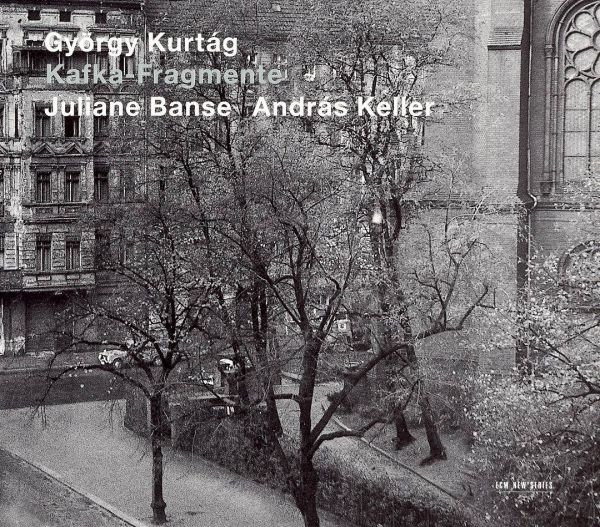
György Kurtág: Kafka-Fragmente (ECM New Series 1965)


György Kurtág
Kafka-Fragmente

Juliane Banse soprano
András Keller violin
Recorded September 2005, Reitstadl, Neumarkt
Engineer: Peter Laenger
Produced by Manfred Eicher

The true path goes by way of a rope that is suspended not high up, but rather just above the ground. Its purpose seems to be more to make one stumble than to be walked on.
–Franz Kafka

The Kafka-Fragmente (1985-87) of György Kurtág make up the composer’s longest song cycle to date. Written for soprano and violin, its forty short pieces fall just shy of an hour. While Kurtág frames the text, consisting of fragments from Franz Kafka’s diaries and letters, and its ordering as being secondary to the music, I believe a closer look at the words can only enrich one’s experience of these finely composed vignettes. In the same way that Kurtág has pulled Kafka out of context and reworked him, so too has he pulled melodic material from the words themselves and fashioned it into a demanding exercise in instrumental and vocal economy. The scoring may be sparse; the results are anything but. Kurtág’s miniaturist approach ensures that every word gets its unadulterated moment, while the intimate arrangements pay due attention to the space into which those words are deployed.

Some of these pieces are relentlessly dramatic—“Ruhelos” (Restless), “Stolz” (Pride), “Nichts dergleichen” (Nothing of the kind) come to mind—and others meditative—“Berceuse I,” “Träumend hing die Blume” (The flower hung dreamily), “Ziel, Weg, Zögern” (Destination, path, hesitation)—but all are linked by dialogue. Still others are playfully programmatic and concise, such as “Es zupfte mich jemand am Kleid” (Someone tugged at my clothes) and “Eine lange Geschichte” (A long story). The one fragment that is Part II, which I have quoted above, is a haunting piece and seems to act as the center toward which the others gravitate.

As part of a lifetime’s worth of personal musings and correspondences, Kafka’s jottings are, of course, rather candid, and indeed give us a “fragmentary” vision of the great writer. None is perhaps so self-deprecating as his letter to Milena Jesenká. “I am dirty,” he writes, “endlessly dirty, that is why I make such a fuss about cleanliness. None sing as purely as those in deepest hell; it is their singing that we take for the singing of angels.” Whatever darkness this piece may imply on the printed page is immediately transformed into a serenade, evoking the final image with voracious dedication. We find another lyrical moment in the mysterious “Verstecke” (Hiding-places), in which Kafka muses: “There are countless hiding-places, but only one salvation; but then again, there are as many paths to salvation as there are hiding-places,” and for which the accompaniment is suitably cryptic, scampering toward any available cranny in which it might conceal itself. Another highlight is “Szene in der Elektrischen” (Scene on a tram), a whimsical anecdote about street musicians and the delicate line they walk between musical appreciation and intrusion into personal space. Because the story tells of two violinists, the violinist must switch between two differently tuned instruments on either side of the soprano, who strings the narrative along with her own bowed articulations. The final fragment, “Es blendete uns die Mondnacht…” (The moonlit night dazzled us…), is a brooding and mystical evocation of animal spirits and the limits of human understanding.

Soprano Juliane Banse displays a superb command of voice as she squeals, chirps, and whispers her way through Kurtág’s personal selections, and violinist András Keller negotiates the minutiae therein with finesse and panache, while also managing to maintain the touch-and-go relationship with the texts at hand. In spite of the bright performances and ingenuity throughout, this isn’t necessarily music to have on the in the background while surfing the internet or throwing a dinner party (and to anyone using Kurtág to enhance a soiree, I humbly request that you invite me), but rather demands our attention as “readers.” Kurtág was in the studio throughout the entire recording process, and his presence is palpable. It is only appropriate, then, that we be just as present in the listening.

Jean-Luc Godard: Nouvelle Vague (ECM New Series 1600/01)

Jean-Luc Godard
Nouvelle Vague

Featuring the music and voices of:
Dino Saluzzi
David Darling
Patti Smith
Jean Schwartz
Werner Pirchner
Paul Hindemith
Heinz Holliger
Paul Giger
Arnold Schoenberg
Gabriella Ferri
Alain Delon
Domiziana Giordano
Roland Amstutz
Laurence Cote
Jacques Dacqmine
Christophe Odent
Laurence Guerre
Joseph Lisbona

But I wanted this to be a narrative. I still do. Nothing from outside to distract memory. I barely hear, from time to time, the earth softly creaking, one ripple beneath the surface. I am content with the shade of a single poplar, tall behind me in its mourning.

In every Godard film, there are moments in which chaos reigns. Ambient sounds replace human voices. Animals, especially dogs and crows, always seem to have something to add. The mechanical world becomes part of the conversation. These intersections of sound and darkness, of silence and light, underscore our social inequities and nothing more. They pass without judgment, suddenly swallowed whole by accidents and unarticulated pain. Yet it is in precisely these gnarled irregularities that the larger construction of life, and this film depicting it, is betrayed. There is no order beyond choice, no means for permanence in a world so finitely recreated. The film gives illusory clout to its own staying power and falls flat against the screen long before its depth can be realized.

As a soundtrack, Nouvelle Vague is a rich experience, made all the more so if one has seen the film and has its images in mind. An earlier companion piece to the vastly significant Histoire(s) du cinema, this is the complete aural map of Godard’s multi-sensory essay. Like the soundtrack to Histoire(s), it brings to light not only the film’s interior but also its exterior nuances, probing its topography, if you will, with a practiced hand. This is strictly a descriptive engagement. As spoken voices fade in and out of a painterly mélange of musical selections, ECM and otherwise, our ears (and our eyes) spin the one continual thread holding it all together. The musics of Dino Saluzzi and David Darling figure most heavily in Nouvelle Vague and inform much of its dialectic edge. They are placed among, and in place of, dialogue, adding to a mounting intellectual cacophony. Darling’s cello merges with a beeping car horn and screeching tires, Hindemith graces the inside of every mask donned by the film’s characters, and voices cry out like solo instruments against a larger orchestral palette. Godard’s familiar splashing water also makes its requisite cameo. Yet it is Saluzzi’s bandoneón that provides some of the more understatedly dramatic moments. Its tearful, bellowed cry is as recognizable as the rhythms of the filmmaker using it, and ends the text on a stark note as a car speeds away in a swirl of filmic dust.

With this release, ECM redefined what a soundtrack can be: something that literally “tracks sound,” marking every stage of a narrative with its most fleeting aspects. Diegetic distinctions are arbitrary in Godard’s world. Sound is image is sound. Our own mental pictures are no less substantial than those captured on film, for captured is precisely what they are. Nouvelle Vague invites us to let the visual world unfurl—not through the sound, but as the sound itself.

<< Eduard Brunner: Dal niente (ECM 1599 NS)
>> Ralph Towner/Gary Peacock: A Closer View (ECM 1602)

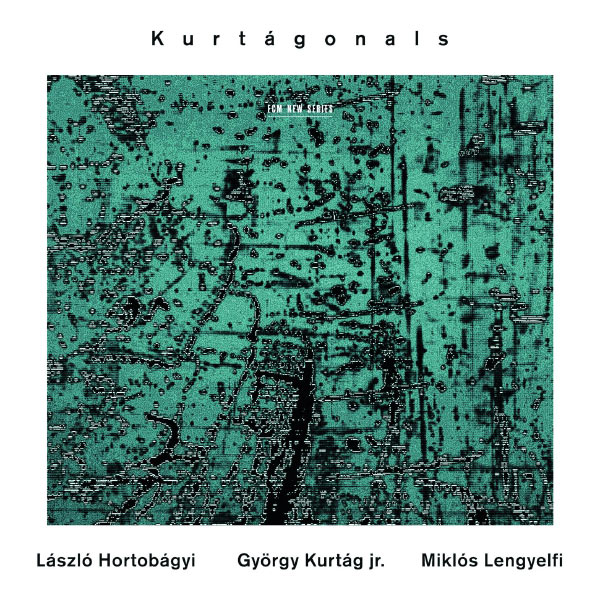
Kurtágonals (ECM New Series 2097)


Kurtágonals

László Hortobágyi synthesizers, computers
György Kurtág Jr. synthesizers
Miklós Lengyelfi bass, effects
Recorded August 2008 at the Guo Manor, Budapest
Produced by Hortogonals

In the landscape of electronic music among European art circles, the name of Pierre Schaeffer (1910-1995) is a monumental landmark. A pioneer in musique concrète and its ancillary technologies, Schaeffer introduced a remarkable line-up of composers to new and exciting possibilities in audible media, not least among them Luc Ferarri, Iannis Xenakis, Jean Barraqué, Karlheinz Stockhausen, and Pierre Boulez. Boulez is particularly important in the context of this album, for he would go on to found the Institut de Recherche et Coordination Acoustique/Musique, or IRCAM, where György Kurtág Jr. later studied. Boulez’s rocky association with Henry led to a schism between the former’s insistence on the integrity of electro-acoustic configurations over the latter’s “computer music.” I find this conflict to be a moot one, however, when considering that instrumental music immediately becomes “electronic” the moment it is recorded, and that electronic music becomes “acoustic” when played through speakers in any given environment. Also, much of Schaeffer’s pioneering work, such as his entrancing Symphonie pour un homme seul (1951), was fundamentally rooted in the acoustical properties of live instruments and the human voice. Whatever the argument may boil down to, this fiercely original album happily marries the two camps into a bustling commune of shared ideas. Kurtág is joined here by two fellow Hungarians: composer László Hortobágyi, who works much of his compatriot’s thematic material into the album’s infrastructure, and Miklós Lengyelfi, a musician of many stripes whose rock roots bring an edgier sensibility to the underlying aesthetic. The three are known collectively as Hortogonals, and through their triangular approach they create music that is undeniably spherical.

Intraga sets the tone for the album as a whole, its varied sounds barely discernible from the surrounding haze: a bass sings at our feet, a toy piano croaks into our ears, and a wordless voice flickers at the threshold of audibility. Kurtagamelan is appropriately riddled with its titular chimes. Their echoes are electronically transformed, seeming to inject a visible murmur into every struck note. A passing swarm of insects retreats into the background. And beneath it all, a muffled drum. The bass continues its subterranean journey, marking its passage through the earth with pitfalls and sinkholes. A brief chorus of voices swells, the wind blows. Interrogation is overlaid with a cicada-like drone and a distant wash of strings, contrasting effectively with the lovely rhythmic threads of Lux-abbysum, which put me in mind of Tomas Jirku’s early click-hop experiments on the Substractif label, though the “live” touches of triangle and other percussive samples add more variation to the music’s topography. Dronezone showcases some of Hortobágyi’s interest in North Indian music, and Kurtaganja a bit of Lengyelfi’s in the electric guitar. This and Twin PeaX form a whimsical pair, respectively characterized by less veiled beats and freer sampling. Necroga closes where the album began, its steady bass strummed like a large cosmic string boring into the center of our spines.

Although the music of Hortogonals is rich in implied silence, here it moves in a continuous stream of sound. The lack of gaps between tracks renders the titles almost arbitrary, even if they do provide the occasional clue into the goings on. The music is dark, but far from ominous, and when it is ominous it is never dark. The experienced electronic listener may not encounter much in the way of innovation in the album’s sound or construction, but will nevertheless find it bears a unique compositional stamp and that sort of haggard beauty only the collaborative object possesses.

Bach: Das Wohltemperierte Klavier, Buch I – Fellner (ECM New Series 1853/54)

Johann Sebastian Bach
Das Wohltemperierte Klavier, Buch I

Till Fellner piano
Recorded September 2002, Jugendstiltheater, Vienna
Engineer: Markus Heiland
Produced by Manfred Eicher

One need only hear Till Fellner’s opening bars of the C major Prelude to know we’ve been taken in by a most heartfelt performance of The Well-Tempered Clavier. The Viennese pianist’s unparalleled grace and fluidity, aided by a rather “submerged” recording, serve to enlarge the visual field of the music at hand. And by the time we get to the C minor Prelude, we know there is no escape from this miraculous cage. Fellner always manages to keep himself at a distance, as if the music were coming from a dream he never wishes to abandon.

These pieces are like bits of life in concentrated form, each prelude a genetic signature and every fugue the trait it enables in the growing organism. Fellner bows to every movement and allows the dynamics to unfold from within. The faster sections in particular show a marked infusion of drama, each building through a slow fade-in to a more pronounced finish. Prime examples of this include the C-sharp major, G major, and B major Preludes, and the E minor Fugue. Fellner also makes the most of striking juxtapositions. The sprightly D major Prelude, for example, is all the more enlivening for being paired with the C-sharp minor Fugue’s beautiful lag. Yet never has a Bach interpreter so evocatively captured my interest in the slower movements, and no more so than in Prelude and Fugue in B minor. The A major Fugue and F minor Prelude go straight to the gut, and the F-sharp major Prelude practically weeps from the keyboard. Some of the album’s most emotional moments are to be found in the celestial G minor Prelude, with an opening trill that practically sings. And so, it is rather fitting that Book I should end on the somber B minor Fugue, seeming to regret its impending end while also fully resigning itself to the sentiment it has left behind.

Fellner has achieved something truly magical in this recording. Not only has be managed to “reopen” The Well-Tempered Clavier with his warmth, but he has done so by stretching it into a vaster tapestry, thereby allowing us to visualize every shadowy figure that passes through it. We distinguish mere snatches of form—an eye, a pair of parted lips, perhaps an extending hand—so that every nuance brings us closer to understanding the corporeal totality of the music. Fellner’s superb handling turns even the most staid movements into fresh listening experiences, while his airy separation and delicately applied arpeggios turn every polyphonic moment into its own soundscape. The album’s softness is, I think, as much a part of Fellner’s aesthetic as it is of ECM’s. Yet for all that Fellner brings to this project, the music comes through with renewed vigor, and that is the sign of a singular musician indeed.

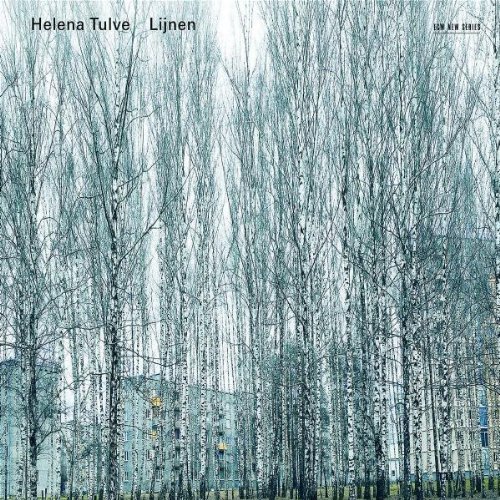
Helena Tulve: Lijnen (ECM New Series 1955)

Helena Tulve
Lijnen

NYYD Ensemble
Olari Elts
Arianna Savall voice
Stockholm Saxophone Quartet
Sven Westerberg soprano saxophone
Jörgen Pettersson alto saxophone
Leif Karlborg tenor saxophone
Per Hedlund baritone saxophone
Emmanuelle Ophèle-Gaubert flute
Mihkel Peäske flute
Silesian String Quartet
Szymon Krzeszowiec violin
Arkadiusz Kubica violin
Lukasz Syrnicki viola
Piotr Janosik violoncello
Recorded between November 1997 and June 2006

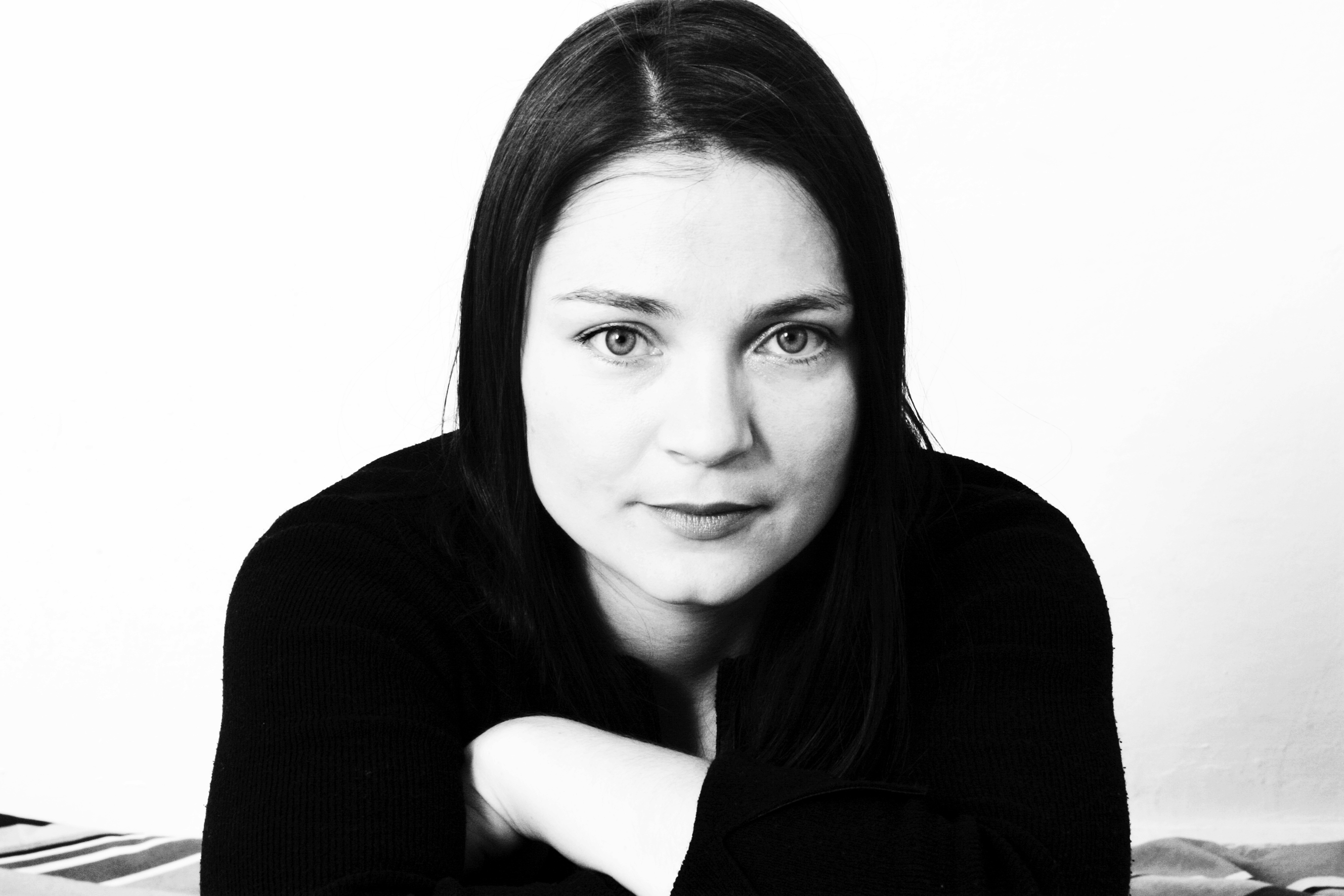
Helena Tulve, part of a new generation of young Estonian composers, has the honorable distinction of being the only pupil of Erkki Sven-Tüür. Like her mentor, Tulve breaks down her music into bite-sized morsels, so that even her large-scale works feel like congregations of chamber ensembles. In this representative selection, we get a taste of the latter. Encountering these works for the first time, I hear them as a single story:

In à travers (1998), the ensemble opens with distant calls. A pack of animals wanders, guided by communication alone. These calls come closer as they are taken up by woodwinds. Rather than antagonize one another, they join forces, comingling in search of a new language through which they may repopulate their frozen world. An oboe soloist raises its cry, occasionally overblowing as if to wrench out as much emotion from its solitude as it can: the firstborn of the newly formed colony, flexing its hybrid voice as the pack falls into silence to hear what it has wrought. A viola bravely joins in. Lijnen (2003) continues this conversation, and introduces the lone soprano, who approaches with trepidation. She wanders the landscape like an anthropologist on her first solo field assignment. Her mind desires all the fame this study is sure to bring her, even as her heart yearns to be accepted into the fold, that she might shun the world’s obligations in favor of danger. She scours the terrain with her instruments, her notepads, and her books: all the material culture she has brought from a faraway land. The animals respond with confusion, putting up a dense resistance, not so easily thwarted by her sensitive approach. Her song is half lament and half appeal. Öö (1997) gives us a peek into the anthropologist’s dream. Only in slumber can she approximate this animal language in private. Abysses (2003) awakens her with warning cries. In her half-sleep they seem to come from beyond the forest, but as she grows more aware of the gravity of the situation, she reacts. In the opening haze of cendres (2001), she immediately abandons her tent and hides in the trees, peering out into the valley below. She watches the slow, careful dance that signals the battle to come. There is so much tension in the air that every hair on her body stands on end, and for that instant an invisible thread instinctively connects her to the very subjects of her study. There is a swipe of claws, a bid for distance, but this sets all eyes aflame as reinforcements emerge from thickets and underground hovels, with more yet hidden in reserve. Brief spats of chaos erupt. Eventually, these conflicts subside. The territory has been successfully defended. In the final piece, nec ros, nec pluvia… (2004), the anthropologist weeps because her favorite has been brutally killed. She stumbles down into the valley and weeps over the fallen body. The more she holds it, the more she smells like blood. The rest of the pack surrounds her and kneels to the ground. Once they have licked her clean, they watch her until she has shed her last tear. They no longer fear her, for she no longer fears them.

Lijnen is among the more exciting recordings to grace ECM’s New Series in the past few years. The beginnings and endings of these pieces are open links, flowing into one another in an ongoing chain. This allows us to approach them any way we wish and makes for an utterly genuine listening experience. Tulve is not interested in resolution, but in leaving us with more questions than we started with. In this way, the music stays with us, even if we don’t stay with it. Let’s hope partnership with the label continues.

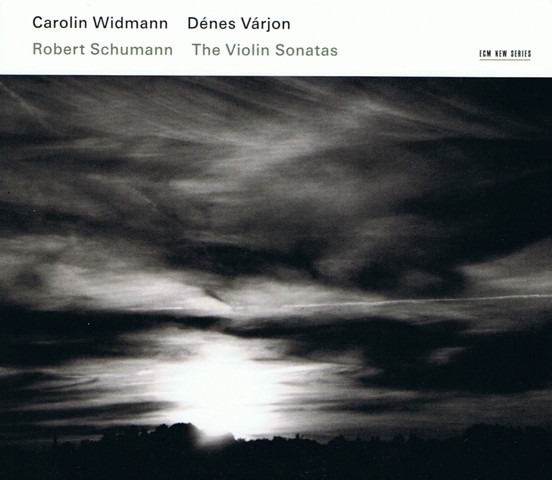
Schumann: The Violin Sonatas (ECM New Series 2047)


Robert Schumann
The Violin Sonatas

Carolin Widmann violin
Dénes Várjon piano
Recorded August 2007 at Auditorio Radio Svizzera, Lugano
Engineer: Markus Heiland
Produced by Manfred Eicher

“Maybe Schumann, as opposed to so many other composers, really is the one whose black dots on white paper represent the least that is actually to be said.”
–Carolin Widmann

Musicologists and historians alike often paint Robert Schumann as a tragic figure. The mental degeneration of this prominent composer has become a prototypical example of the genius in decline and of the ineffability of humanity’s most creative energies. Admittedly, I have been guilty of this characterization myself. But when we hear a recording like this, all that myth-making goes straight out the window. These sonatas are among Schumann’s final works, the first two having been written in 1851 and the third in 1853, and are no less engaging for it.

Sonate Nr. 1 für Pianoforte und Violine in a-Moll, op.105
This is an absolutely glorious sonata. The piano parts are alive with ideas and seem to come in waves. The second movement is one of Schumann’s most questioning, cautiously approaching the knowledge it seeks before growing into confidence. The third movement catches us almost unawares with its colorful changes in rhythm and atmosphere. This is the most eclectic portion of the sonata, a beautifully synchronized braid of instrumental forces. After the dainty, lively introduction, suspicions loom threateningly over the finale’s exuberant communion until they crumble into piles of declamatory dust. Only then do we realize the goal no longer means anything, now that it’s unobstructed.

Sonate Nr. 3 für Violine und Pianoforte in a-Moll, WoO 2
Schumann’s third sonata was withheld by his wife Clara for years before it was ever heard. Its central position in the album’s program isn’t an apology, but a gesture perhaps meant to ensure that it be taken seriously. The opening piano thumps like a nervous heartbeat. Its balance is so fine that one false move could easily upset it, but the virtuosity of our duo keeps it perfectly intact, so that we may admire it from every angle and with every assurance of safety. The second movement evolves in retrograde motion to an arousing end, after which the piano’s bass note lingers beyond the violin’s curtailed exultation. The third movement climbs determinedly, aware of its own lightness, its many open paths. The cascading pianism here renders the music into a raging river. Like a salmon swimming upstream, the violin must struggle with all its might to get to where it’s going. Because its life is determined by that very struggle, it relies solely on the challenge of the current.

Sonate Nr. 2 für Violine und Pianoforte in d-Moll, op. 121
Also known as the “Grand Sonata,” Schumann’s second shows off its complex unity at every turn. The opening movement is an epic journey, finding its resolution no fewer than three times before bowing out, while the sonata’s remainder combs through the populous landscape of human interaction. The lesson: in agreement there is no unity, but only the semblance of disparate voices blending into one, whereas true unity is achieved in keeping those voices separate, sharing the awareness of an internal bond that can never be made externally aware.

Widmann and Várjon both see much in the way of modern sensibilities in these sonatas, bringing their progressive approach to every nuance therein. Their dynamic control is so effortlessly realized, they never manage to lose the energetic thread that binds them, even in the quietest moments. Widmann intentionally plays on open strings whenever possible, allowing the rich sonority of her instrument to ring through with an almost harsh beauty, while Várjon take full advantage of the studio’s acoustics to further flesh out the piano’s inherent resonance. If these sonatas are pieces of a larger puzzle, then these two fabulous musicians have foregone the corner pieces and worked their way from the center to the margins.