Heinz Holliger: Scardanelli-Zyklus (ECM New Series 1472/73)

Heinz Holliger
Scardanelli-Zyklus

Aurèle Nicolet flute
London Voices
Ensemble Modern
Terry Edwards
Heinz Holliger
Recorded September 1991, Inselhalle Lindau, Germany
Engineers: Andreas Neubronner, Markus Heiland
Produced by Manfred Eicher

The rivers are, like plains, the shapes of wildness
Are scattered also, more revealed the mildness
Of life continues, and our cities’ traces
Appear most clearly in unmeasured spaces.
–F. Hölderlin

Scardanelli-Zyklus (Scardanelli Cycle) is Heinz Holliger’s crowning compositional achievement. It is so lovingly crafted that I cannot help but bask in its atmospheres anew with each listen. This was my inaugural Holliger encounter—as either musician or composer—and will always hold a special place in my life for that among other reasons. I first heard Scardanelli-Zyklus when I was sixteen (as many years as it took to compose), and the experience was nothing short of a revelation. To compare it to anything else would be an injustice.

The cycle is a composite work and is comprised of:

The Seasons, three sets of four songs for a cappella choir
Exercises for Scardanelli for small orchestra
comments, mirrors, responses, marginalia to The Seasons
(t)air(e) for solo flute
Excerpts from:
Tower Music for solo flute, small orchestra and tape
Ostinato Funebre for small orchestra

These are squared and shuffled like a deck of cards. Holliger sets vocal passages to the words of famed German poet Friedrich Hölderlin (1770-1843), and for this has selected poetry from the latter years of Hölderlin’s life, a period of mental instability and obsessive writing and revision. Much in contrast to the free verse at his peak, Hölderlin eventually took to penning rhymed quatrains on rather innocuous subjects, many of which he signed with the nom de plume “Scardanelli” and which he dated with absurd imprecision, sometimes years into the future. In many ways, this is exactly what the music feels like: caught in time against the blatancy of its own transcription.

The Seasons are the glue that holds Scardanelli-Zyklus together. Each is divided into three sections and sprinkled liberally throughout. While Hölderlin tends to opt for traditional seasonal imagery, he occasionally surfaces with rather insightful readings of nature. In Scardanelli’s world, Spring is less about new life than the reinvention of its vocabulary. Peaks graze the sky in order to emphasize the darkness between them, looming over the explicit deference to perfection and valorization of the lowly-wise agrarian. Summer is fittingly presaged by Holliger’s Summer Canon IV, in which precision is no longer mathematical, but emotive. Here, the season is about life, the body in all its fragile stages. It is a landscape of rippling water rife with intimations of unity. Holliger makes sure to leave its surface tension unbroken. Sunlight is reduced to a whisper, no longer a blinding presence. We see the wonders of production and learn to appreciate the harvest all over again. These are hymns of heat waves, hair-thin rays of light woven into audible dimensions. Summer is uneasy, unpredictable, more causal than caustic. Glittering streams feed the valley, made known more by light than sound. Autumn is the brittle leaf transformed into a promissory spirit underfoot. We are treated to a stunning confluence of voices and instruments in Holliger’s arrangements thereof. Each word is given equal weight, gilded by an underlying drone. It is supremely unsettling and undeniably gorgeous. A glass harmonica ushers in Winter, lending an icy repose to deadening voices. Some tremolo is introduced, as if of a thrashing possibility yearning for the distant thaw. It is one incarnation of Winter that ends the cycle, growling and scraping the bottom of each singer’s vocal range.

The more instrumentally focused works are cue cards signaling new turns in the cycle’s narrative flow: Fragments is a flute-driven explication of the incomplete; Bell-Alphabet features Japanese bells cradling flute and orchestra on a tonal journey through speech unspoken; Paddlewheel revolves until it is the rasping of strings and air; Ice Flowers burgeons slowly into a frosty cornucopia of sound; Ostinato Funebre is a sketched crease in time overlaid with a warped deconstruction of a Mozart motif; The Distant Sound is a stunning instrumental reworking of an earlier Winter section; (t)air(e) is to the solo flute what Holliger’s Studie über Mehrklänge is to the oboe, and then some (taire = keep secret, not to talk; air = air, song, aria, breath; te = you)…a masterful exposition piece for the non-exhibitionist; Ad Marginem, based on a Paul Klee painting of the same name, utilizes taped frequencies thinner than a molecule’s breath to elicit an inescapable effect.

For all of its complexity and ambition, Scardanelli-Zyklus is a refreshingly straightforward work. Voices sing with little trickery (the most adventurous of which merely requires singers to follow the beat of their own pulses) and instruments faithfully follow the mechanics of their titular signposts. This music carries itself neither programmatically nor incidentally. Scardanelli-Zyklus is not only Holliger’s magnum opus, but is also undoubtedly one of the most compelling masterpieces of twentieth-century music. What a joy to have this recording to preserve its existence.

<< Kancheli/Schnittke: Vom Winde beweint (ECM 1471 NS)
>> Terje Rypdal: Q.E.D. (ECM 1474)
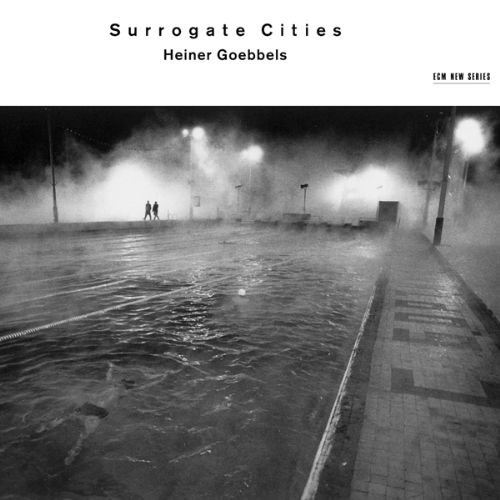
Heiner Goebbels: Surrogate Cities (ECM New Series 1688/89)


Heiner Goebbels
Surrogate Cities

Junge Deutsche Philharmonie
Peter Rundel conductor
Jocelyn B. Smith vocals
David Moss vocals
Recorded 1996, Bayerische Rundfunk, Munich / 1999, Frankfurt
Engineer: Peter Jütte
Produced by Heiner Goebbels & Manfred Eicher

As a longtime fan of David Moss, I needed only to learn of his involvement in Surrogate Cities before rushing out to buy the CD. Sadly, at the time I had no idea who Heiner Goebbels was. I couldn’t have asked for a more comprehensive introduction. The reader will forgive my penchant for abstract analogies when I say that Surrogate Cities is like pricking a piece of paper with a pin and shining a metropolitan nightscape through it so that one may connect those rays of light with brittle chalk. Practically speaking, the project is meant to be an ode to the city of Frankfurt in celebration of its 1200th year. As such, it is an amalgam of atmospheres, moods, and sensual provocations. This project unfolds like a massive suite with instruments drawn from architecture and flesh alike. Each section reads like a novella in the grander scheme of its binding.

Suite for Sampler and Orchestra
Preluded by snippets of cantorial singing, computer-controlled voices seek dominance over the imperialistic power of the orchestra in a kaleidoscopic and utterly focused vision of the urban sprawl. Rather than penetrating the city, Goebbels turns it inside out for our inspection. The samples are not so much quotations as they are memories shaken loose from long-neglected nooks and crannies. The digital flick of “Menuett/L’ingénieur” is haunting in its subtlety, appropriated like so much data flowing through the airwaves. The conclusion, “Air/Compression,” is a chamber piece for the overlooked sounds of our post-industrial comfort. Admirers of John Zorn’s Kristallnacht will find themselves on familiar ground here, as the archival instinct is similarly apparent.

The Horatian – Three Songs
Based on words by Heiner Müller, this song cycle relates a conflict between Rome and neighboring Alba. A lot is cast to determine who will fight as representative of each city. A Horatian is chosen for Rome, a Curiation for Alba. During the course of the ensuing battle, the Horatian strikes down the Curiation and does not spare his life. His sister, who is betrothed to the Curiation, weeps upon his return. He rewards her grief by slaying her. Thus is the victor’s valiant heart tainted with murder. According to Müller, Goebbels “proposes a new form of reading, a different, no longer touristic approach to the landscape of a text.” In this sense, The Horatian is far from the bombastic cantata it could have been. Rather, it heaves with the weight of its own moral conundrum. Joselyn B. Smith is superb as the voice of bipartisanship, weaving in and out of its allegiances with the acuity of a practiced raconteuse. She emotes with a confident Broadway twang that is gorgeously appealing against Goebbels’s orchestral backdrop.

D & C sounds like someone knocking at the outside of a building with no entrance; a book one has been dying to read, but which opens to reveal rain-soaked pages. It is a film noir standing on its head, loose change and candy wrappers falling out of its pockets. The music circles until it loses hope and collapses onto the wet asphalt.

Surrogate, with words by Hugo Hamilton, is the moment I was waiting for during my first listen. Over a lush carpet of piano, Moss runs into the night along with the nameless character of Hamilton’s text. His indulgent enunciation of “surrogate” is priceless, prelude to a tranquil, breathy fade.

In the Country of Last Things
The words here are by Paul Auster. Bleak and morose, they paint a fatalistic picture of urban living. Moss provides the narration here as Smith wails plaintively in the background: “A house is there one day, and the next day it is gone. A street you walked down yesterday is no longer there today…” The city has become the ephemeral soldier, running AWOL from the army of its own becoming. All convictions remain unrequited, leaving the barest puffs of cigarette smoke as the only indications that they ever breathed.

Smith and Moss are the clear winners here. Not to be outdone, however, is the superb orchestra. The presentation is sharp, the sound so crisp you want to teethe on it, and the arrangements fantastically varied. Probably not the best album to play in your greenhouse, but for our psychological biota it does the trick.

<< Veljo Tormis: Litany To Thunder (ECM 1687 NS)
>> Gudmundson/Möller/Willemark: Frifot (ECM 1690
)

Shostakovich/Chihara/Bouchard (ECM New Series 1425)


Shostakovich/Chihara/Bouchard

Kim Kashkashian viola
Robyn Schulkowsky percussion
Robert Levin piano
Recorded June and October 1990
Engineer: Jan Erik Kongshaug
Produced by Manfred Eicher

Kim Kashkashian’s third disc for ECM is a curiously mixed bag. Although the liner notes give some delightful anecdotes and insider’s information, I am torn over how much said information enriches my experience of the whole. For example, Kashkashian points to the percussiveness of Shotakovich’s piano writing in his Sonata for Viola and Piano op. 147 as justification for the two companion pieces scored for “actual” percussion and viola. To be sure, this is a fascinating connection, though one that perhaps only the performers can intuit with such immediacy. Either way, the knowledge does guide my listening in new directions and pushes me to burrow into the music wholeheartedly.

We begin with Pourtinade by Linda Bouchard, consisting of nine sections that may be rearranged at will and which are otherwise meticulously notated. Each chapter breeds freshness in this indeterminate order and points to a hidden vitality behind the deceptively ineffectual surface. This is a piece that finds precision in its looseness. Deftly realized, Schulkowsky’s percussion work is porous and minutely detailed like a spiked pincushion through which Kashkashian threads her song.

Next we have Paul Seiko Chihara’s Redwood. Chihara, a film composer who has collaborated with such greats as Louis Malle, was inspired by Japanese ukiyo-e woodblock prints for this piece largely built around melodic phrases volleying between viola and tuned drums. I doubt that one would ever guess its source from the music alone, and I can’t say for sure whether this really informs the way I listen to it. Nonetheless, the programmatic music has its heart set on something beautiful.

Last but not least is Dmitri Shostakovich’s Sonata for Viola and Piano op. 147. This being his final work, it unfolds like the imminence of death and the timid promise of afterlife. The central Allegretto is filled with concentrated ardor, held back every time it threatens to transcend its cage, and the final 15-minute Adagio is as visceral a swan song as one could expect from such a towering figure in modern music. While this sonata does sound haggard, conserving its energy for selective crescendos, there is a glint of affirmation for every cloud of resignation, so that by the end there is only neutral space.

Even after repeated listenings, I am still not sure how successful this program is as a whole. While the Bouchard and Chihara pieces have their own merits, knowing that Shostakovich is waiting around the corner throws a much different shadow on already obfuscated atmospheres. It’s not that the conceptual approach of the percussion pieces is out of place with the op. 147, but simply that they feel like different languages in want of an intermediary (and, to Kashkashian’s credit, she tries her best to fulfill that role). They rather put me in mind of the stark stop-motion artistry of the Brothers Quay, and would perhaps be better suited to such imagery, crying as they are for visual accompaniment. Nevertheless, all three musicians’ rich talents scintillate at every moment, breathing vibrancy into still notes on a page with oracular fervor.

Knowing the context of a piece biases our interpretation of it. This can be a hindrance, or it can lead to an enlightened understanding. In this case, I find it to be both—hence my complicated reactions to this release. Sometimes the most memorable musical experiences are also the most unexpected. Albums such as this remind us that music is its own reward.

<< Gavin Bryars: After the Requiem (ECM 1424 NS)
>> Paul Giger: Alpstein (ECM 1426)

Elliott Carter/Paul Griffiths: What Next? (ECM New Series 1817)


Elliott Carter
What Next?

Valdine Anderson soprano
Dean Elzinga baritone
Sarah Leonard soprano
William Joyner tenor
Hilary Summers contralto
Emanuel Hoogeveen boy alto
Netherlands Radio Chamber Orchestra
Peter Eötvös conductor
Recorded September 9, 2000, Concertgebouw, Amsterdam (What Next?)
Recording Engineer: Ron Ford
September 2001, MCO Studio 5, Hilversum (Asko Concerto)
Recording Engineer: Frans Meyer
Co-production of ECM Records/VARA Radio

“Wherever we go, words have been there first.”

Imagine you are driving along a busy metropolitan street. On the passenger seat is your latest score. Having made some hasty but crucial changes just in time for the premier performance, you floor the gas pedal in a paroxysm of anticipation. Your hands itch for the baton. As fate would have it, however, your life compresses into a single dot of light. When you come to, you awaken to the reality of a near-fatal crash. Score pages rain around you, many burnt to mere fragments of their former selves. You scramble to gather them into something coherent, stitching them together with nothing but your own determination. Dash a little Sartre on this scene, stage it, then pull the existential rug out from under it, and you begin to approximate the feeling of What Next?, a one-act opera (Elliott Carter’s first and only after decades of false starts) inspired by the brilliant 1971 Jacques Tati film Trafic.

The proceedings ignite in a metallic whirlwind of sound: the traffic accident as afterthought, recreated in fragments of trauma’s own trauma. Voices enter as if hewn in shards of glass, dying in reverse to their original shape. “Starts are always an embarrassment to us / for we are creatures of eternity / and each new beginning is only a new illusion.” So says Zen, one of six survivors working their way through the wreckage. Rounding out the sextet are Mama, her son (indecisively named “Harry or Larry”), his wife-to-be Rose, and the mysterious swath of a character known as Kid. As Mama’s former husband, Zen knows a thing or two about life’s little tragedies and makes no qualms about showing it. His tongue-in-cheek self-awareness is taken up by Rose, the natural born performer, who begins her aria as if addressing the metaphysical orchestra: “Più andante, maestro.” And while the adults monopolize most of the fun working through to their ends, I find Kid to be more consistently intriguing. His language cuts through the haze of parental distanciation, holding fast to gut reactions in the face of studied response. Hearing him, I cannot help but think of the frog in Janáček’s The Cunning Little Vixen: direct and ever the voice of playful reason (it is perhaps no coincidence that Kid, too, has the final word). Mama tries to console him, shielding him from the painful reality that drapes their muddling philosophy like a wet blanket. “Think of this as a game,” she insists, for indeed their predicament is nothing but. The opera’s occasional lyrical moments—such as the ravaging solo “Stella cannot explain”—are all the more heightened for the jumble of their periphery. Conversely, certain moments are parodically hilarious, as when Rose and Harry or Larry claim to have heard something, to which Zen quips, “Unless the sound of one hand,” followed by a blatant percussive clap. Despite a penchant for self-indulgent rhetoric, Zen does break out now and then with solemn wisdom. “Whose eyes can we use to see what we are?” he interjects as the survivors grope for a plan of action. Ironic, to be sure, for action is one thing this opera clearly lacks. Toward the end, the potential wedded bliss of Rose and Harry or Larry crumbles before our very eyes, even as we question the soundness of its foundations; the significance of the accident dissolves as everyone retreats into their own anger; and personal foibles reign supreme over the threat of the almighty superstructure. Contrary to what the unfinished ending might imply, there is nothing elliptical about What Next?, having by now forgotten its own beginnings.

What Next? is nothing without its text, penned from the steady hand of Paul Griffiths, whose reprinted diary in the liner notes allows us a rare glimpse into the dramaturgy therein. Librettists are the drummers of the operatic world: their rhythm-keeping is taken for granted. Yet one can hardly ignore the words here, as they are the bones and the flesh of the opera, while the orchestra wafts like afterthoughts in response to each precious cell of exposition. Put simply: the words are affect, the music is effect. Griffiths works both in a linguistic see-saw of pathos and obscurity, placing us squarely at the fulcrum throughout.

Composed at the cusp of his ninetieth year, Carter’s opera explodes with the vitality of one in his ninth. The textures are akin to a family reunion, disjointed and confusing while also making a bizarre sort of sense through some hidden genetic continuity. Solo voices are often bolstered by wordless syllables from supporting characters in a scat-like dribble, so that no one is ever alone, bound by the cruel aftermath in which the cast finds (or loses?) itself.

The Asko Concerto provides a constellatory coda. This instrumental runaround of fiery spirit partners well with What Next? It doesn’t so much pick up where the latter left off as it picks us up where we have been dropped in the wake of Kid’s half-utterance. In a way, it feels like a programmatic speculation of the action that could have been, breathing like an asthmatic in recovery.

Carter’s music is tirelessly multi-dimensional and demands an open and patient ear. I cannot help but think that these two pieces were dashed out in a frenzy of creative impulses, even if both strive for practiced cohesion in the face of their own instability. Regardless of whether or not this disc can be called “enjoyable,” it never fails to fascinate, frustrate, and stimulate with its surprises and unflinching attitudes toward mortality.

Tigran Mansurian: Ars Poetica (ECM New Series 1895)


Tigran Mansurian
Ars Poetica

Armenian Chamber Choir
Robert Mlkeyan conductor
Recorded June 6, 2003, Saghmosavank monastery, Armenia
Engineer: Garen Proyan
Produced by ECM

Ars Poetica is a choral “concerto” based on the poetry of Armenian writer Yegishe Charents (1897-1937). The language is rustic, bumpy, and delectable. The works of Charents, who suffered at the hands of the Stalinist regime and would die in a Yerevan prison for his politically “subversive” writings, were liberated with Stalin’s death in 1953. Likewise, his words seem to wrestle out of their national confines and onto the world stage through Tigran Mansurian’s faithful settings.

“Night” begins with breath; words are only implied, shaped by lips and lungs like rustling leaves. As the choir swells, a deeply affecting baritone solo intones: “But all was pale and dull around me, / No words were there, and there was no sun…” In this first of the Three Night Songs, we are ushered into a place where stillness is aflame. The Three Portraits of Women that follow turn our attention from the ethereal to the corporeal. Mansurian dresses these poems with darkness left over from the waning night. Lines such as “What Spirit was it that brushed / Your countenance in radiant strokes?” feel torn with pain, as if accepting the beauty of one’s love might lead to self-destruction in surrender. Archetypes of angels and maidens wander labyrinthine depths of their own making, impervious to the talons of words seeking purchase on their shoulders. Three Autumn Songs give us our first taste of sunlight trickling through the breaking clouds. Even so, melancholy is never far away, holding us in a lukewarm embrace as voices kneel before the awesome power of all that withers. And Silence Descends brings indefinite closure with a long untitled verse. Intermittent climaxes fall like sudden showers as a single soprano voice cuts through the din with a painful resignation. Language takes on yet another guise in the form of death, creeping along the streets and through back alleys, threatening to erase the text that is one’s existence from its sallow pages.

Mansurian’s compositional style is linguistically informed; not only because he is working with poetry that is already so very musical, but also because the Armenian language is such a vital part of Mansurian’s worldview and expressive deployment. Ars Poetica is a naked and vital work. It screams as its cries, whispering secrets and intimate thoughts as it careens through the cosmos with the quiet restraint of a meteor. Ultimately, it transcends language, bringing with it the promise of internal meanings through which orthography is wrung of its juices and fed to us drop by drop.

The Hilliard Ensemble: Perotin (ECM New Series 1385)

Perotin

David James countertenor
John Potter tenor
Rogers Covey-Crump tenor
Mark Padmore tenor
Charles Daniels tenor
Gordon Jones baritone
Paul Hillier baritone, director
Recorded September 1988, Boxgrove Priory, Sussex, England
Engineer: Peter Laenger
Produced by Manfred Eicher

There is a moment in the opening Viderunt omnes when, to signal the final section, its voices modulate to a higher space. This shift from gravid baritone- to tenor-driven majesty is for me one of the most sublime moments in all of music. Such transformative moments are what make many of the Hilliard Ensemble’s endeavors so enduring. In medieval music in particular, the enigmatic Hilliards have found a groove of sorts from which they seem reluctant to part. As Paul Hillier notes, these sounds represent a major development in the polyphonous “organum” typical of the ars antiqua style, breaking from the staid (though certainly no less “organic”) Gregorian mode. This fine disc metes out a hefty dose of the works of Magister Perotinus (fl. c. 1200), along with some worthy anonymous pieces to thicken the brew. Listening to this music, I cannot help but try to imagine the time and place of its conception. I can almost taste the air, feel the cold stone of gothic architecture on my fingertips and the swept floor beneath my sandaled feet. The voices glitter like facets of the same dusty light that once pierced arched windows and landed softly on solid pews.

This is music we approach impressionistically, seeing it first as a worldly sound before distinguishing local colors. The interpretations are restrained yet full of overwhelming power. The Alleluia posui adiutorium is a stunning example of Perotin’s craft. On the surface transcendent, the piece is also laden with paratextual significance. The pedal tones here are airy yet substantial and the brief lapses into chant are like translucent beads on a deftly interwoven chain. Dum sigillum, sung here by tenors John Potter and Rogers Covey-Crump, sounds like four voices compressed into two. They flit and fall, taking one step back for every two taken forward. The Alleluia nativitas is, like its companion piece, a finely wrought macramé. David James’s glorious voice has its day in Beata viscera, a Communion prayer (and Perotin’s only extant monophonic work) rising like censer smoke in a solitary alcove. Sederunt principes closes the disc on a fittingly supplicatory note.

On April 23, 2004 I had the fortunate experience of seeing the Hilliard Ensemble live at Wesleyan University, where they opened with the Viderunt in an otherwise eclectic program. The experience was very much like putting on this disc: the audience had almost no time to prepare for the sudden immersion that ensued the moment they took the stage. This is precisely what the home listener can expect. As always the Hilliards offer an impeccable performance that speaks of a deep and heartfelt commitment to every project they undertake, and it is this same commitment that I feel obligated to bring to the table every time I sit down to partake of this finest of recordings.

<< Stephan Micus: The Music Of Stones (ECM 1384)
>> Paul Giger: Chartres (ECM 1386 NS)

Heinz Holliger: Schneewittchen (ECM New Series 1715/16)

Heinz Holliger
Schneewittchen

Juliane Banse soprano
Cornelia Kallisch contralto
Steve Davislim tenor
Oliver Widmer baritone
Werner Gröschel bass
Orchester der Oper Zürich
Heinz Holliger conductor
Recorded January 1999, Radio Studio DRS, Zürich
Engineer: Charles Suter
Produced by Manfred Eicher

As a self-proclaimed “musician whose medium begins where words end,” Heinz Holliger may seem an unlikely candidate to attempt a full-length opera. Yet looking at his source text, the idiosyncratic and delightfully schizoid Schneewittchen (Snow White) by Swiss writer Robert Walser (1878-1956), one senses a kindred spirit in the latter’s semantic approach. In light of this, Holliger’s adaptation is perhaps best described as a “subtextual” opera. As such, it begins in harmonic suspension before dropping into a confused milieu of verbal emotions. For Holliger, the job of the music here is to mask the characters on stage, thereby providing them with extension cords to fasten to their utterances.

The Prologue opens with an evocative and programmatic arrangement of wind gusts and tinkling icicles giving way to an eerie congregation of glassy voices and drones. Reminiscent of quieter moments in his equally ambitious Scardanelli-Zyklus, Holliger’s sound palette immediately draws us into an evocatively unstable environment. This plaintive mood is quickly undermined, however, by the appearance of words. “Child, are you ill?” the Queen asks, as if the tremulous unease of the preceding sounds were the inner turmoil in Snow White’s powdery gut. Thus begins a brief exchange between mother and daughter on the nature of disease and sin. A Huntsman, lackey to the Queen, appears. He is an easy target for Snow White’s pessimism: surely, the Queen has enchanted him, she wonders. Although the seduction is questionable, he admits to taking part in her assassination. In his compassion, however, he has killed a deer in lieu of her undamaged body, sucking its blood with reckless abandon. Fed up with this foolish talk, the Queen proclaims her maternal love, even as the Prince indulges Snow White’s fantasies of deception. He escorts Snow White to the castle that she might have the mental room to work through her grief.

The Prince’s proclamations to Show White in Scene II seem to echo the opera’s own methodology: “How merry is your word alone. Enraptured by its wealth, my ear hangs in a hammock, as it were, of hearkening, dreams of violins, of lispings, nightingales’ sweet sobs, love twitterings.” What follows is a profound, if tongue-in-cheek, parry-and-thrust discussion of sensuality and silence. The music ruptures as the Prince perversely describes the Queen’s sinful coupling with the Huntsman, made all the more ominous by keening voices in the background. Snow White proclaims, “Oh, I want nothing more, you see, than to be dead and smiling,” and sends the Prince on his way for lack of resolve.

Scene III finds Snow White and the Queen in a metatextual argument: the Queen touts her wicked past as laid out in fairy tales, while Snow White seeks to problematize her mother’s ill deeds for the sake of empowerment. In Scene IV the Prince returns, only to profess his love for the Queen over her daughter. The Huntsman joins in the fray, whereupon he is ordered by the Queen to reenact Snow White’s death. Before long the scene devolves into laughter, exposing the farce within. The opera’s resolution reflects the dangers of relying upon narrative to dictate the flow of one’s life. The ambiguity of Snow White’s past remains paramount, even if recast in the familiar mold of resolution, cracked as it is at the edges, like the metallic sheet of strings that brings the opera to a close.

Whereas Holliger is normally used to composing from the inside out, in writing this opera he felt required to do the opposite: that is, to open himself to spirited ideas flickering beyond the immediacy of his own embodied self. Schneewittchen represents a rare fusion of what Roman Brotbeck calls “mono-perspectival” and “poly-perspectival” opera. By this he means to say that both Holliger and Walser shine through the weave of the opera as a whole, while at the same time the authors’ voices and collective presence are destroyed, torn into self-sufficient shreds of identity untraceable to their hosts. Holliger’s aural façades serve to heighten this sense of disguise. The Walser text is mediated through, to borrow again from Brotbeck, “negative translations”: the opera is vocally driven while also dependent on the hints of implosion wrought into its language. The instrumentation reacts to these voices in kind. It bobs and sinks across a floe-laden ocean, multiplying like cell cultures in time-lapse film. Needless to say, the musicianship is as meticulous as the opera it brings to life and matched by weighty yet effervescent singing.

Unlike some operas, I find it difficult to listen to Schneewittchen without the libretto in front of me. It is so closely bound to its text that the two feel one and the same. Holliger has produced a rare achievement. Not unlike Walser in his postcriptorial treatment of a canonic tale, he has laid his source to rest in order to air it from the rafters of his own distinctive vocabulary.

<< Thomas Zehetmair/Camerata Bern: Verklärte Nacht (ECM 1714 NS)
>> Anour Brahem Trio: Astrakan Café (
ECM 1718)

Christoph Poppen: Morimur (ECM New Series 1765)

Version 1.0.0

Morimur

Christoph Poppen baroque violin
The Hilliard Ensemble
Monika Mauch soprano
David James countertenor
John Potter tenor
Gordon Jones baritone
Recorded September 2000, Monastery of St. Gerold, Austria
Engineer: Peter Laenger
Produced by Manfred Eicher

Drawing on the research of musicologist Helga Thoene of the University of Düsseldorf, Christoph Poppen and the Hilliard Ensemble take great care in juxtaposing the monumental “Ciaccona” from J. S. Bach’s Partita in D Minor BMV 1004 alongside (and against) various Bach chorales, through which cryptic synchronicities are brought audibly to light. These “chorale quotations”—believed by Thoene to comprise a “tombeau” (i.e., epitaph) for Bach’s deceased wife Maria Barbara in the larger context of Christ’s death and resurrection—are transformed here into an entirely new experience that traces the intangible borders between life and death. And indeed, the title of the album, Morimur, connotes “death as a passage to life” and reflects the numerology therein as an equation for transubstantiation. Chorale passages are interspersed between movements of the refracted Partita, thus allowing us insight not only into the hidden connections of violin and voice (insofar as the Ciaccona is concerned), but also into the nearly tangible sinews that hold together the Partita as a whole. Poppen’s violining digs ever deeper into its source, as if overwriting the original manuscript with heavier ink.

This is a very challenging album to encapsulate in one review, for it is a listening experience like no other. With each new turn it offers hitherto unexplored avenues of creation. As a mere listener, it may be easy for me to dismiss the intense scholarship that has gone into this recording and simply enjoy it for the contemplative music it contains. After all, much of what lies hidden between the Ciaccona and its companion chorales is perhaps more obvious to the trained eye on paper than it is to the casual, if not enraptured, ear on disc. At the same time, I cannot help but think that the connections drawn out through its attendant scholarship are vastly important for the sole reason that this program would not exist in its present form without them. That being said, I feel that Bach’s ciphers stimulate the heart without the need for a direct correlation in numbers. In other words, we don’t necessarily require those connections to be spelled out for us as a guidebook to what remains fundamentally communicative.

Music never ceases to amaze and entice with its potential for infinite variation. The intersections drawn in Morimur are omnipresent and need not always be so contrived. Bach’s music, especially as it is rendered here, reminds us that sometimes those transparent bridges between our intellect and the environments around us are also the most fleeting and unexpected. Contrary to what we might expect from a project so described, this is not about solving some age-old code left for only the most astute of posterities. It is, rather, about uncovering those mysteries that never go away and make us who we are: mysteries of faith, of love and absolution, of desire, and of death. Therefore, I see this album not so much as a reflection of Bach’s often-touted genius, but of his humility.

<< Seim/Brække/Johansen: The Source and Different Cikadas (ECM 1764)
>> Susanne Abbuehl: April (
ECM 1766)

John Adams: Harmonium (ECM New Series 1277)

John Adams
Harmonium

San Francisco Symphony Orchestra and Chorus
Edo de Waart conductor
Vance George chorus director
Recorded January 1984, Davies Symphony Hall, San Francisco
Engineer: John Newton
An ECM Production

Music emerges from a dark tunnel, a smooth and liquid train with a large chorus as passengers. The accelerated evolution of Harmonium is brought forth in what Adams calls a “preverbal creation scene,” an inescapable feeling of solitary light tinted with the weight of retrospection as the voices intercede. Harmonium seems to revel in self-awareness, building as it does through a series of dynamic swings from the threshold of audibility to ringing pronouncements of verse. It is a convoluted world where density and transparency coexist in equal measure.

At times this piece sounds like Adams’s popular Shaker Loops with words, at others like a Philip Glass tribute with characteristic pulses of flute and strings, at still others like a ritual of its own kind. It is a pastiche of poetry (John Donne and Emily Dickinson provide the texts), a bridge of intentions, a house with only two windows.

The recording quality here may polarize listeners somewhat. While on the one hand it captures the overall mood of the piece in a rather heterogeneous mix, on the other it loses detail in the quieter moments. I would imagine, however, that engineering choices in this case were dictated by Adams’s vision for the piece as a whole. It is meant to be a single “fabric of sound,” thereby necessitating a more distanced recording. It is like a lake: deceptively uniform from a distance, but promising new life and environments if only we can plunge into its depths. Yet somehow we are unable to take that plunge. The recording engineer, like the listener, is an observer here rather than an intruder. We do not approach this music; it approaches us, and it can only come so far before receding into its womb.

<< Keith Jarrett: Trio Changes (ECM 1276)
>> Pat Metheny Group: First Circle (ECM 1278)